← Series 7 Whisperer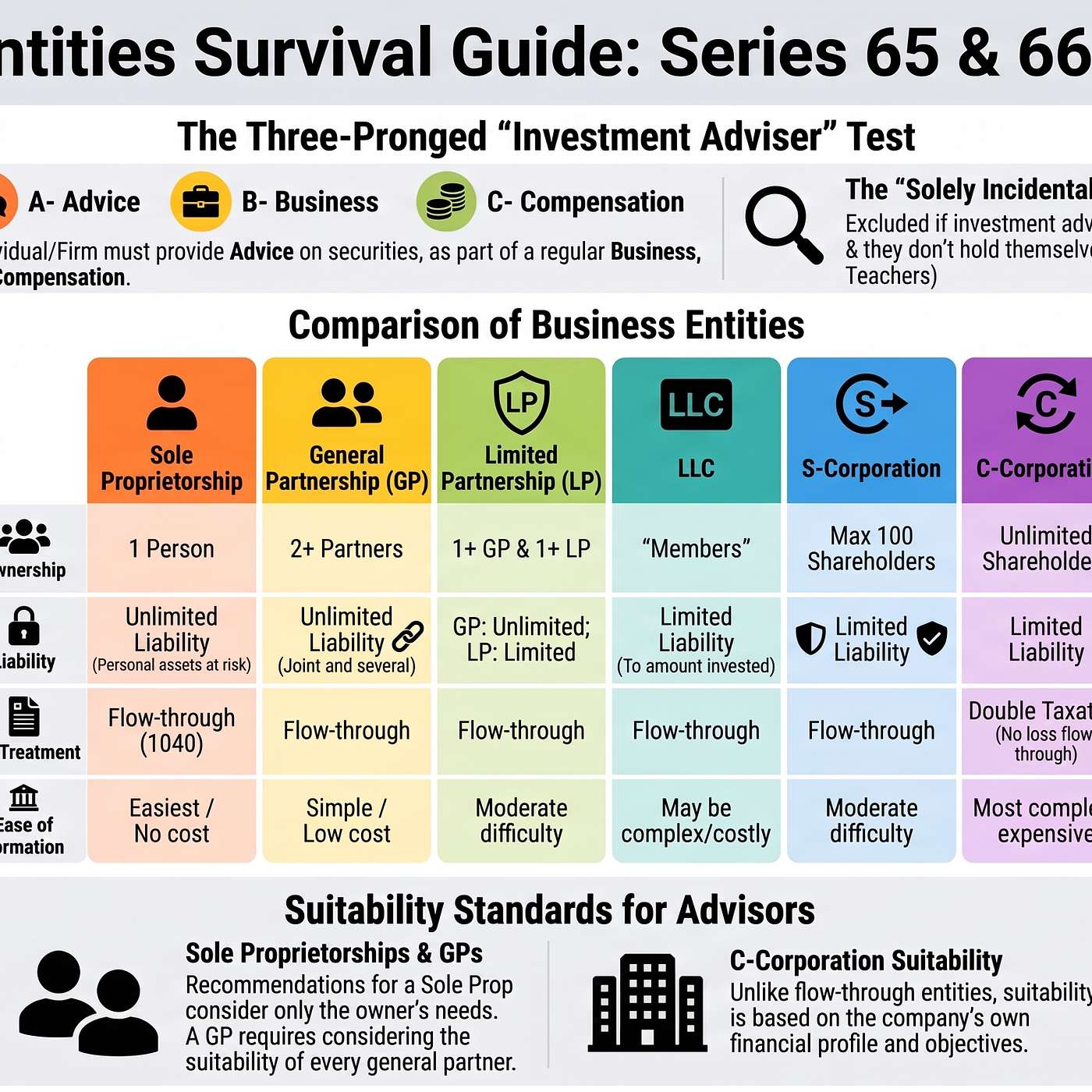
Loading summary
Transcript296 lines
- [00:01]
A
Hey, this is Ken Finnan, also known as a Series 7 whisperer. And my job is to get you passed the SIE exam. The series 7 exam, series 65, all the FINRA and NASA exams. So going forward, I'm going to be going a mix of like short little videos, long ones, maybe some podcasts about like interviewing some people who took the tests. But a lot of these are going to be where I use a external source to create a script and then I have somebody else read it because I stumble and mutter a lot and, and I think these are working really well. So let's get into it and we're going to have some fun here. And before we get into it, let's talk about one thing I do live Q and as every Tuesday night for the FINRA exams and every Thursday night for the NASA exams, 8pm Eastern on YouTube. Come have fun, ask questions about whatever you want, celebrate the wins, commiserate with the losses. But meet me every Tuesday night for FINRA stuff, every Thursday night for NASA stuff. Live on the two of you and we can get this done. Baby. Let's go.
- [00:58]
B
Imagine this. You spend like 10 years building a highly successful, incredibly profitable local business. You know, you have a dozen employees, a great reputation, and a pretty comfortable life, right?
- [01:11]
C
The classic American dream.
- [01:12]
B
Exactly. You've paid off your family home, you built up a healthy retirement fund, and you even saved enough for your kids college tuition. But then on a random Tuesday, your business partner accidentally backs a company delivery truck into a luxury car.
- [01:27]
C
Oh man. Injuring the driver, I'm guessing.
- [01:30]
B
Yeah, injuring the driver. And just like that, because of a choice you made on a single piece of paper a decade ago, you lose the business, you lose your retirement savings, and the bank actually forecloses on your family home to pay the legal settlement.
- [01:44]
C
I know that sounds like a worst case scenario that's just designed to scare people, but I mean, that exact chain of events is a terrifying everyday reality for thousands of entrepreneurs.
- [01:53]
B
It really is.
- [01:54]
C
People just choose the wrong legal structure. The legal foundation you build on completely determines whether a disaster stays inside the business or, you know, bleeds out into your personal life.
- [02:03]
B
Which is exactly why we are dedicating this deep dive to mapping out the genetic code of business entities. If you're listening to this, you are likely sitting in one of two seats, right? You're either deep in the trenches, studying for your Series 65 or Series 66 exams, staring down incredibly dense questions about like direct participation programs and corporate tax
- [02:25]
C
structures, or you're a new entrepreneur standing at the Starting line, Right?
- [02:29]
B
Yeah.
- [02:29]
C
Trying to figure out how to legally form your grand vision without stepping on a hidden legal landmine.
- [02:35]
B
Exactly. So we're going to treat our time today as a mentorship session. We have a massive stack of source materials in front of us. Legal analyses, IRS tax codes, securities law breakdowns.
- [02:45]
C
Oh, yeah. It's a very tall stack.
- [02:47]
B
It is. And our mission is to take all of that complex legal theory and forge it into the ultimate practical cheat sheet for you. We're going to completely demystify this.
- [02:56]
C
Sounds good. Where do we start?
- [02:57]
B
We'll start with the most bare bones forms of business, work our way through the middle ground of partnerships and LLCs, and finally, you know, analyze the complex corporate behemoths.
- [03:06]
C
But before we get into the weeds of tax codes and liability shields, we should probably establish a mental model.
- [03:13]
B
I agree. So think of business entities like vehicles. A simple sole proprietorship is a bicycle. It's incredibly easy to ride. It costs almost nothing to maintain, and you can just jump on it and go anywhere.
- [03:26]
C
But it offers absolutely zero protection.
- [03:28]
B
Right. If you get into a crash on a bike, you take the full physical impact.
- [03:32]
C
And building on that analogy, at the opposite end of the spectrum, you have the C Corporation, which is essentially an armored bank truck.
- [03:39]
B
An armored truck. I like that.
- [03:40]
C
Yeah. I mean, it protects the occupants perfectly and it can transport massive amounts of capital.
- [03:45]
B
Yeah.
- [03:46]
C
And this is a big. But it's incredibly expensive to build, it's slow to maneuver, and it burns a massive amount of fuel.
- [03:52]
B
Fuel being complex taxes in this case.
- [03:54]
C
Exactly. Plus it requires specialized licenses and mechanics just to keep it on the road.
- [04:00]
B
Okay, let's unpack this by starting with the bicycle. The path of least resistance, the sole proprietorship. If I just decide tomorrow to, I don't know, start selling custom woodworking out of my garage, or I start freelance writing on the weekends. And I don't file any specific organizational documents with my state. Like, I haven't hired a lawyer, I haven't drafted an operating agreement. I am automatically a sole proprietor, Right.
- [04:25]
C
By default. Yes. Yeah, you are. The barrier to entry is effectively zero.
- [04:30]
B
Yeah. Okay.
- [04:32]
C
Now, you might still need to comply with local regulations. For example, if you're a plumber, the city will obviously require a plumbing permit or a hairstylist needs a state cosmetology license.
- [04:41]
B
Right. The basic functional licenses to do the job safely.
- [04:45]
A
Right.
- [04:46]
C
But from a corporate structuring standpoint, there's no charter, there's no board of directors, and crucially, there is no formal legal separation between you and the work you do.
- [04:56]
B
And reading through the sources, the tax side of the bicycle is just as simple. They use this phrase, constantly flow through taxation.
- [05:03]
C
Yes, that's a huge concept for the exam.
- [05:05]
B
So my understanding is that the business itself doesn't actually exist. To the IRS, it's like a ghost. So if the business makes $50,000, that profit just flows straight onto my personal tax return.
- [05:14]
C
That captures the mechanics perfectly. The IRS doesn't expect, say, Harry's Hot Dogs to send in a corporate tax payment, Right? Instead, the sole proprietor simply attaches a document, it's called Schedule C, to their standard personal form 1040.
- [05:31]
B
So it's just an extra piece of paper on your normal taxes.
- [05:34]
C
Exactly. The Schedule C is essentially a basic profit and loss statement. You know, here's what the business made in revenue. Here are the expenses, and the net number at the bottom simply gets added to your other personal income for the year.
- [05:47]
B
It makes tax preparation incredibly straightforward.
- [05:50]
C
It really does.
- [05:51]
B
Takes an afternoon, so it's virtually free to set up. And the tax is super easy. It sounds ideal, but here's where it gets really interesting and honestly, terrifying. The liability.
- [06:01]
C
Oh, yeah, this is the catch.
- [06:02]
B
The source materials. Pound the table on this concept of unlimited liability. I want to go back to that Harry's Hot Dogs example from the text. Let's say Harry is running his cart. He's a sole proprietor. A supplier delivers a bad batch of meat. Harry doesn't realize it, and he accidentally sells tainted hot dogs. 20 people end up hospitalized with severe food poisoning, which is a nightmare, a total nightmare. And suddenly, Harry is facing a multimillion dollar class action lawsuit.
- [06:32]
C
Right? And in that courtroom, the law does not recognize Harry's Hot Dogs as an independent entity capable of taking the blame.
- [06:40]
B
Because it's a ghost.
- [06:41]
C
Because it's a ghost. The plaintiffs are suing Harry, the human being, if the damages exceed whatever basic liability insurance Harry might have. And I'll tell you, small businesses are notoriously underinsured, right?
- [06:54]
B
They never have enough coverage.
- [06:55]
C
The courts will start looking at Harry's personal life.
- [06:57]
B
So they aren't just taking the hot dog cart in the cash register. They're coming for his personal checking account.
- [07:02]
C
They're coming for his checking account, his personal vehicles, his investment portfolios, and depending on state homestead laws, potentially his family home.
- [07:11]
B
That is wild.
- [07:13]
C
The liability is unlimited because the owner and the business are one and the same. You carry the entire weight of any disaster on your own shoulders.
- [07:20]
B
I read another devastating example about a sole proprietor lawn care service. A guy is cutting grass. His riding mower kicks up a heavy stone and it shatters a massive custom built floor to ceiling glass window on a wealthy client's mansion.
- [07:35]
C
Ouch.
- [07:36]
B
Yeah. Causing a million dollars in structural damage. The liability vastly outstrips the value of a few lawnmowers. But let me push back here.
- [07:45]
C
Sure, go ahead.
- [07:46]
B
If the risk is literally losing your house over a rogue lawnmower rock, why does anyone stay as sole proprietor? Is it purely to save the few hundred dollars it costs to file an llc? Or is there some hidden strategic advantage?
- [07:59]
C
Honestly, it almost never comes from a place of strategy.
- [08:02]
B
Really?
- [08:03]
C
Yeah. It stems from a profound underestimation of risk. A freelance graphic designer sitting at a laptop thinks, well, I'm just making logos, I can't physically injure anyone.
- [08:10]
B
Right. No lawnmowers involved.
- [08:12]
C
Exactly. But what if they accidentally use a copyrighted image for a massive corporate client's ad campaign and trigger a a devastating intellectual property lawsuit?
- [08:22]
B
Oh, wow. Hadn't thought of that.
- [08:24]
C
The assumption of safety is the biggest danger. Furthermore, sole proprietorships lack what we call continuity of life.
- [08:31]
B
Meaning if the owner dies, the business legally dies with them instantly.
- [08:37]
C
The assets might become part of the owner's estate, but the business entity ceases to exist. You can't easily hand a sole proprietorship down to your children or. Or sell it as a neat packaged entity to an investor.
- [08:49]
B
So it's really a structure fundamentally designed for single operator, ultra low risk endeavors. Where the owner never intends to scale.
- [08:57]
C
Exactly.
- [08:58]
B
Okay, so if you want to bring in a partner, or if your risk profile increases even slightly, you have to upgrade your vehicle. So let's look at what happens when you add a second rider to the bicycle. We're moving into the realm of general partnerships.
- [09:09]
A
Right.
- [09:10]
C
So when two or more people decide to go into business together without filing formal limited liability paperwork, they form a general partnership or gp.
- [09:18]
B
Looking at the mechanics, a GP seems to function almost exactly like a sole proprietorship. Just multiplied by the number of people involved. The taxes are still flow through. Right. The partnership doesn't pay a corporate tax rate.
- [09:30]
C
That's true, but the tax mechanics require a slight upgrade here. While the GP itself doesn't pay tax, it is required to file an informational return with the IRS known as Form 1065.
- [09:43]
B
Wait, if the partnership isn't paying any taxes, what is the point of an informational return? Is it just a memo to the IRS saying, hey, we exist?
- [09:50]
C
Not exactly. It basically acts as a treasure map for the IRS. The Form 1065 shows the total profit or loss of the partnership but more importantly, the partnership generates a document called a schedule K1 for each individual partner.
- [10:04]
B
Okay, the K1. I've seen that mentioned a lot.
- [10:06]
C
Yeah. The K1 dictates exactly what percentage of the profit or loss belongs to that specific partner. The IRS uses that informational return to cross reference the partner's personal 1040s, ensuring that 100% of the business's income has been accounted for and taxed at the individual level.
- [10:22]
B
Ah, so it's a tracking mechanism to make sure nobody's hiding profits.
- [10:26]
C
Exactly.
- [10:27]
B
Okay, but let's talk about the liability, because this is where the general partnership goes from being a tandem bicycle to a terrifying tightrope walk. You have unlimited liability, just like the sole proprietor. But now you have joint and equal management.
- [10:42]
C
Yes. Unless you have a heavily customized partnership agreement that states otherwise. Every partner in a GP has an equal vote.
- [10:50]
B
Okay.
- [10:51]
C
And crucially, every partner has the agency to bind the entire partnership to a legal contract or an obligation.
- [10:58]
B
Okay, so going back to our intro scenario, if I'm in a general partnership and my business partner makes a terrible decision while I am on a two week vacation in Hawaii. So they sign a disastrous crippling lease agreement, or worse, they get drunk and crash the company delivery truck into a pedestrian.
- [11:14]
C
Under the doctrine of joint and several liability, you are completely personally liable for their actions.
- [11:19]
B
Even though I was in Hawaii?
- [11:20]
C
Even though you were in Hawaii. The injured party won't just sue the partner who was driving the truck. They will sue the partnership. And they'll come after your personal assets, your house, your savings to satisfy the debt.
- [11:32]
B
I could lose everything because of a mistake my partner made while I was out of the state. That requires an unfathomable level of trust.
- [11:38]
C
It really does. And similar to the sole proprietorship, the general partnership is incredibly fragile. Technically, unless an agreement overrides this, a general partnership dissolves upon the death, bankruptcy or withdrawal of any single partner. It just lacks stability.
- [11:56]
B
Which perfectly sets up the next entity on our journey. Because if general partnerships are that risky, investors would never fund them. No one with money is going to risk their entire net worth on someone else's management skills.
- [12:08]
C
No, absolutely not.
- [12:09]
B
And that gives birth to an entity that is massive, massively tested on the series 65 and 66 exams. The limited partnership, or LP.
- [12:16]
C
The limited partnership is a masterclass in risk allocation. To form an lp, you must have two distinct classes of owners. You need at least one general partner and at least one limited partner. And the law treats them entirely differently.
- [12:30]
B
So the general partner is the driver of the Bus. They manage the day to day operations, they hire the staff, they sign the contracts. And because they hold the steering wheel, they also hold that terrifying unlimited liability we just talked about.
- [12:43]
C
They shoulder all the legal risk because of that. In modern business, the general partner of a large LP is almost never a human being.
- [12:51]
B
Oh really?
- [12:52]
C
Yeah. It is usually a specifically formed corporation or llc. That way the corporation acts as the general partner, taking on the unlimited liability that essentially traps the risk inside that corporate shell, shielding the human managers behind it.
- [13:07]
B
That's a brilliant legal workaround. But the real stars of the exam questions are the limited partners. These are the passengers on the bus. They provide the fuel, the capital, and their liability is strictly capped.
- [13:18]
C
Right. As a limited partner, the absolute most you can lose is the money you invested. If you put $50,000 into a real estate LP and the building burns down while uninsured and the partnership goes bankrupt, you lose your 50,000, which hurts. But the creditors cannot come after your personal house or your checking account. Your personal assets are sealed off.
- [13:40]
B
Okay, but this brings us to a concept that always trips people up. Direct participation programs or DPPs.
- [13:46]
C
Yes, DPPs.
- [13:47]
B
The sources highlight that LPs are frequently structured as DPPs. I understand why an investor wants to participate in the profits, but the material specifically emphasize that DPPs allow investors to participate directly in the losses. Why on earth would an investor actively seek out a loss?
- [14:05]
C
I know it feels completely counterintuitive until you understand the high net worth tax strategy behind it. Let's look at real estate as the classic example. An LP buys a massive apartment complex because of flow through taxation. The LP doesn't pay taxes. Everything flows to the partners. Now the apartment building is generating rental income, but the IRS allows the partnership to claim depreciation. Depreciation meaning a massive paper deduction representing the wear and tear on the building over time.
- [14:33]
B
So the building is actually making cash, but on paper for tax purposes. The massive depreciation makes it look like the business lost money.
- [14:42]
C
Precisely. That paper loss flows through the k1 directly to the limited partner. The limited partner can then take that loss and use it to offset other passive income they might have earned that year.
- [14:52]
B
Oh wow.
- [14:53]
C
They're essentially buying a tax shield. They get the cash flow from the rent, they get the long term appreciation of the property. But in the short term, the structured losses actively lower their overall personal tax burden.
- [15:04]
B
That is tax engineering at its finest. But let's look at the relationship dynamic here. The limited partners hand over their money, but the general partner has total control. What stops the general partner from taking the investor's money, paying themselves a massive salary and just playing golf all day.
- [15:22]
C
Well, the law anticipated this power imbalance. Which is why the general partner is bound by a strict two pronged fiduciary duty to the limited partners. And this is not a suggestion. It is a legally enforceable obligation.
- [15:36]
B
Let's unpack the two prongs. The first one is the duty of loyalty. My understanding is that this prevents self dealing. If the LP is formed specifically to acquire commercial real estate in downtown Chicago, the general partner can't secretly go and buy the most lucrative high rise in Chicago for their own personal portfolio.
- [15:53]
C
Exactly. They must present the opportunity to the partnership. First, they cannot compete against the very people they're managing money for.
- [16:00]
B
And the second prong?
- [16:02]
C
The duty of good faith. The general partner must act with prudence, care, and always in the best economic interest of the limited partners. If they violate either of these prongs through gross negligence, fraud or self dealing, the limited partners have the legal right to organize and sue the general partner.
- [16:21]
B
Wait, hold on. Let me put on my series 66 student hat and challenge this. We just established that limited partners are passive passengers. The rule is that if they try to interfere with management, they lose their liability shield and become treated as general partners, risking your personal assets. Right, but now you're telling me they have the power to organize, hire lawyers and literally sue the manager? Where exactly is the line between managing the business and protecting the investment?
- [16:48]
C
It's one of the most vital distinctions in partnership law. And it operates under a concept known as partnership democracy. The line is drawn between daily operational control and existential oversight.
- [16:59]
B
Okay, existential oversight.
- [17:00]
A
Right.
- [17:01]
C
A limited partner cannot hire or fire a recessionist. They cannot negotiate a contract with a vendor. They cannot tell the GP what color to paint the apartment building. If they do those things, they pierce their own shield.
- [17:14]
B
They have to sit on their hands for the day to day.
- [17:16]
C
Operationally, yes. But partnership democracy guarantees them a vote on fundamental structural changes. They have the right to inspect the financial books. They can vote to admit a new general partner. They can vote to dissolve the partnership entirely.
- [17:30]
B
Okay, I see.
- [17:31]
C
And yes, suing the GP for a breach of fiduciary duty is considered a fundamental investor protection, not a daily management task.
- [17:39]
B
That distinction is absolute gold for the exams. Now, staying on the topic of risk and money, let's look at debt. The sources make a big deal out of recourse versus non recourse notes and how they affect a limited partner's basis. Explain the mechanics of this debt Your
- [17:55]
C
basis is essentially the total amount of capital you have at risk in the investment. And that determines how much of those tax losses you are legally allowed to claim. Let's say a limited partnership needs a massive bank loan to buy a property. The bank might look at the GP and say, we need more security. We need the limited partners to personally guarantee a portion of this debt.
- [18:15]
B
If the investor signs that guarantee, that is a recourse note, meaning the bank has legal recourse to bypass the LP shield and come after the investor's personal assets if the loan defaults.
- [18:27]
C
Correct. When you sign a recourse note, you are dramatically increasing your risk. But because you took on that personal risk, the IRS rewards you by increasing your basis. Your maximum liability is now your initial cash investment plus the amount of the recourse note.
- [18:42]
B
And if it's a non recourse note?
- [18:44]
C
A non recourse note means the lender relies solely on the collateral of the building itself. If the partnership defaults, the bank forecloses and takes the building. But they cannot legally pursue the limited partner's personal assets.
- [18:56]
B
So the investor is safe.
- [18:58]
C
Yeah. And because the investor didn't take on personal risk for that debt, a non recourse note generally does not increase their basis. With some highly specific exceptions for real estate that we don't need to get bogged down in right now.
- [19:11]
B
So it's a trade off between maximizing tax deductions and minimizing personal exposure.
- [19:16]
C
Got it. Now what happens when the ride is over? When the LP is dissolved and liquidated? There is a very strict hierarchy of of who gets paid out of whatever cash is left. Walk me through the absolute priority rule.
- [19:30]
B
It is a rigid, unforgiving waterfall. Priority number one goes to the secured creditors. These are the banks holding mortgages or loans backed by physical collateral. They get made whole first.
- [19:41]
C
Okay, that makes sense.
- [19:42]
B
Priority number two goes to the unsecured creditors. Think of utility companies, vendors, or lenders who issue debt without collateral.
- [19:50]
C
So all the outside debts must be completely satisfied before any owner sees a single penny.
- [19:55]
B
Absolutely. Priority number three goes to the limited partners. They get their share of the remaining assets, representing their initial investment and any retained profits.
- [20:03]
C
And the general partner, finally, at the
- [20:05]
B
very bottom of the barrel, priority number four is the general partner. They assume the most risk, they had the most control, and they are the absolute last to get paid in a liquidation. Which is an elegant kind of financial justice. So we've explored the bicycle of a sole prop, the tandem bike of a G key, and the bust of the limited partnership. But let's say you're an entrepreneur who wants the best of both worlds.
- [20:27]
C
Okay?
- [20:28]
B
You want to personally drive the car, but you absolutely demand airbags. You want limited liability, but you refuse to sit passively on the sidelines. This brings us to the legal innovations of the late 20th century. The modern shields. The LLC and the S Corporation.
- [20:45]
C
These two entities completely transformed the landscape of small business before them. If you wanted liability protection, you had to navigate the crushing double taxation of
- [20:55]
B
a C corporation, which we'll get into shortly.
- [20:57]
C
Right, but the LLC and the S Corp offered the holy grail. The protective armor of a corporation combined with the favorable flow through taxation of a partnership.
- [21:07]
B
Let's start with the limited liability company, the llc. First, vocabulary matters on these exams. The owners of an LLC are not called partners or shareholders, they're called members.
- [21:18]
C
That's right. LLC owners are members and their liability is limited to their capital contribution. But where the LLC truly shines is its flexibility. We actually call them tax chameleons.
- [21:29]
B
Tax chameleons?
- [21:30]
C
Yeah, because the IRS actually allows an LLC to choose its own tax treatment using a form called Form 8832.
- [21:37]
B
So they get to pick how they are perceived by the government.
- [21:40]
C
Exactly. For default, a single member LLC is taxed like a sole proprietorship. And a multi member LLC is taxed like a partnership. But if it benefits their specific financial situation, the members can literally check a box on that form and elect to be taxed as an S Corp or even a C Corp.
- [21:57]
B
But the real nuance with LLCs, especially for the series 65 and 66 exams, comes down to management and securities law. We just spent a lot of time drilling in the fact that limited partners must stay completely passive. Is that true for LLC members?
- [22:10]
C
No. And this is the major evolution in an llc. Members can be deeply involved in the daily management of the business. Negotiating contracts, hiring staff, running operations without ever risking their limited liability shield. Oh, this is called a member managed llc. Alternatively, if they want to act like passive investors, they can appoint outside executives to run it, which is a manager managed llc.
- [22:32]
B
Okay, here is a massive conceptual hurdle based on the legal brief we reviewed from Brownstein, Hyatt, Farber, Schreck. If I am a passive investor in a Manager Managed LLC, I just write $100,000 check and wait for returns. The SEC might view my membership interest not as a business asset, but as a security subject to federal anti fraud rules, prospectus requirements and heavy regulation, just like a share of Apple stock. But if I work in that same LLC every day, it's not a security. How can the exact same legal entity morph its fundamental nature based on my behavior?
- [23:07]
C
It is a brilliant question and it cuts right to the core of federal securities law. To understand why, we have to travel back to 1946 to a Supreme Court case involving Florida citrus groves.
- [23:18]
B
Ah, the famous Howey test.
- [23:20]
A
Exactly.
- [23:21]
C
The case was SEC vwj, Howey company. The howdy test is the bedrock of identifying a security. The Howey Company was selling tracts of orange groves to out of state investors.
- [23:30]
B
And these investors knew nothing about farming.
- [23:34]
C
Nothing. How? He offered a service contract where Howie's team would farm the land, pick the oranges, sell them, and just send the profits to the investor. The Supreme Court ruled this wasn't just real estate. It was an investment contract, which is
- [23:47]
B
a security because the investor was totally passive.
- [23:51]
C
Precisely. The court established the Howey test. An investment contract exists if there is an investment of money in a common enterprise with the expectation of profits to be derived solely from the efforts of others.
- [24:04]
B
Solely the efforts of others. That is the hinge point.
- [24:07]
C
Right. So if you buy into an LLC and the operating agreement gives you no voting rights, no ability to fire the manager, and you have zero sophisticated knowledge of the underlying business, you're relying solely on the efforts of others. The SEC looks at that and says, that is a security.
- [24:23]
B
And the issuer has to comply with heavy federal regulations to protect you.
- [24:27]
C
Exactly.
- [24:28]
B
But if I am an active member,
- [24:29]
C
managing founder, then your profits are derived from your own efforts. You have control over your destiny. The courts view that as a joint business endeavor, not a passive security. The law focuses on the economic reality of the relationship, not just the letters LLC on the door.
- [24:45]
B
That is fascinating. The regulatory burden shifts based on who is holding the steering wheel. Now, before we move to S. Cor, we have to talk about a critical concept that I know listeners need. Piercing the corporate veil.
- [24:59]
C
Oh, yes, very important.
- [25:01]
B
We've talked about this liability shield like it's made of indestructible steel, but it's actually made of glass. Right?
- [25:08]
C
That is a phenomenal analogy. The LLC shield is made of glass. It protects you from the outside elements. But if you abuse the structure, a judge will shatter that glass and allow creditors to reach right through to your personal assets.
- [25:21]
B
How does an owner accidentally shatter their own shield?
- [25:24]
C
The most common way is commingling funds. If you use the LLC's business bank account to pay your personal home mortgage or buy groceries or pay for your kids braces, you are treating the business as an extension of yourself.
- [25:36]
B
You're Blurring the lines.
- [25:38]
C
Right? And a judge will say, since you didn't respect the legal separation of the business, neither will the court. The veil is pierced.
- [25:46]
B
Is there any other way?
- [25:48]
C
Another way is severe undercapitalization. Starting a highly risky business with almost zero money in the bank account. Clearly intending to use the LLC purely to defraud creditors, you must treat the entity with respect for the shield to hold.
- [26:03]
B
That is incredibly practical advice for a new entrepreneur. Okay, let's look at the other modern shield, the S Corporation. Let's get the vocabulary straight first. Owners of an S Corp are not members, they are shareholders. And the tax treatment.
- [26:18]
C
I know you found a great mnemonic for this from the series 66 subreddit sources.
- [26:21]
B
I did. And it sticks in your brain perfectly. S is for Snake slithering through to personal taxes. S Corp, just like LLCs and partnerships utilize flow through taxation, it perfectly describes the mechanics.
- [26:34]
C
An S Corp files a corporate tax return, but it does not pay a corporate level federal income tax. The profits and losses slither right through the corporate entity and land on the shareholders personal tax returns.
- [26:45]
B
So if an LLC offers flow through taxation and limited liability and an S Corp offers flow through taxation and limited liability, why do we need both? The sources indicate that S Corp have an incredibly rigid strict set of limitations that LLC is completely avoid. Why would anyone choose the S Corp?
- [27:04]
C
Well, the choice often comes down to complex nuances in self employment taxes. Which is honestly a bit deep for today. But you are right to focus on the limitations. The S Corp rules are incredibly strict and you have to understand the legislative intent behind why Congress created these rules.
- [27:20]
B
Let's break them down. Limitation number one. An S Corp can have a maximum of 100 shareholders. Why the hard cap?
- [27:28]
C
Congress designed the S Corp specifically for small closely held mom and pop businesses. They didn't want massive publicly traded companies with millions of shareholders utilizing flow through taxation. Because tracking that much dispersed tax revenue on millions of personal returns would be an administrative nightmare for the irs.
- [27:45]
B
That makes total sense. Limitation number two. All shareholders must be US citizens or permanent residents. No non resident aliens allowed. Why does the IRS care about the nationality of the shareholder?
- [27:57]
C
Think about the flow through mechanics. The S Corp doesn't pay taxes, the human does. If a non resident alien who is not subject to U.S. personal income tax owns shares of an S Corp, that profit flows through the company and straight out of the country.
- [28:11]
B
Oh, so it would escape the US tax system entirely.
- [28:14]
C
Exactly. The citizenship rule ensures the IRS gets its cut.
- [28:18]
B
That is a brilliant explanation. Limitation three, Shareholders can only be human beings or certain very specific trusts. You cannot have a partnership or another corporation own shares in an S Corp. And finally, limitation 4. An S Corp is only allowed to issue one class of stock, right?
- [28:34]
C
And this is about preventing complex tax avoidance. If you had multiple classes of stock, say voting and non voting or preferred dividend tiers, wealthy founders could use complex accounting loopholes to funnel profits disproportionately to specific family members in lower tax brackets. One class of stock ensures everyone gets the exact same economic rights per share, keeping the tax flow predictable and fair.
- [28:58]
B
Let's apply these rules to the real world. If I am opening a local chain of boutique coffee shops with three trusted partners, an S Corp is fantastic. But what if I am in a garage in Silicon Valley building the next massive artificial intelligence software and I want to raise $50 million from venture capitalists?
- [29:15]
C
An S Corp would be a fatal structural error for a venture backed tech startup.
- [29:19]
B
Why is that?
- [29:20]
C
First, venture capital funds are usually structured as partnerships or LLCs themselves. Because of the S Corp rules, the VC legally cannot own your stock.
- [29:29]
B
Oh, because only humans can be shareholders?
- [29:31]
C
Exactly. Second, VCs absolutely demand preferred stock shares that guarantee they get their money back before the founders if the company is sold. Since an S Corp can only issue one single class of stock, you cannot offer preferred shares. Wow.
- [29:46]
A
Okay.
- [29:47]
C
And finally, if your startup succeeds, you will eventually want to grant equity to hundreds of employees and eventually go public. The 100 shareholder limit makes a massive IPO impossible.
- [29:58]
B
Which means if you want to scale to the moon, you have to abandon the bicycle, the tandem and the modern shields. You have to climb into the armored bank truck. This brings us to the corporate behemoth, the C corporation and the 21% strategy.
- [30:11]
C
When you look at the titans of the global economy, Apple, Microsoft, Ford, Amazon, you are looking at C corporations.
- [30:19]
B
The structural limitations of the S Corp are completely stripped away here. In a C Corp you can have unlimited shareholders. You can sell stock to anyone, anywhere in the world. You can slice and dice the equity into a dozen different classes of stock. Series A preferred convertible notes common founder shares. This is the ultimate playground for raising capital.
- [30:36]
C
And the management structure is highly formalized to handle that massive scale. The ownership and the management are legally severed. You have the stockholders who own the company, but are entirely passive. They vote to elect a board of directors.
- [30:50]
B
And the board is the strategy team.
- [30:51]
C
Right. The board oversees the grand strategy and the major financial decisions. The board then hires the officers, the CEO, the cfo, who execute the day to day operations. Furthermore, unlike partnerships, A C Corporation possesses perpetual life. It exists completely independent of its founders and will outlive them.
- [31:12]
B
But. And this is a massive but, we have to confront the monster hiding in the C Corp structure. The reason small business owners run away from C Corp screaming double taxation. Let's deconstruct exactly how painful this mechanism
- [31:24]
C
is is the defining drawback of the entity. Because the C Corp is a completely separate legal person in the eyes of the law, it must pay its own taxes on its own income. Currently, the federal corporate tax rate is a flat 21% on all profits.
- [31:38]
B
Okay, 21% doesn't sound apocalyptic. A successful S Corp owner might be paying 37% in the top personal bracket.
- [31:45]
C
The 21% is fine until you want to take that money out of the corporate vault to buy a house or pay for your kid's education. When the C Corp distributes those after tax profits to the shareholders in the form of a dividend, the IRS steps in and taxes that exact same money again on the shareholder's personal tax return.
- [32:03]
B
So let's trace a dollar. The Corporation earns a dollar of profit. The IRS takes 21 cents at the corporate level. The corporation takes the remaining 79 cents and hands it to you, the founder. And then the IRS taxes that 79 cents on your personal return.
- [32:17]
C
Exactly. Depending on your overall wealth, you might pay a 15% or 20% capital gains rate on that qualified dividend, plus an additional 3.8% net investment income tax.
- [32:27]
B
Ouch.
- [32:28]
C
Yeah. When you blend the 21% corporate bite with the personal dividend taxes, the effective federal tax rate on distributed earnings easily approaches 36% to 40%.
- [32:38]
B
Meanwhile, the S Corp owner just passes the dollar through once, pays their personal rate, and puts the rest in their pocket. For a small business owner whose primary goal is pulling all the cash out every year to live a wealthy lifestyle, the C Corp is a wealth destroying machine.
- [32:56]
C
It is entirely inefficient for a lifestyle business. The REIS tax and wealth source provides a stark mathematical comparison.
- [33:03]
B
Let's hear it.
- [33:03]
C
Assume a business generates $400,000 in pure profit and the owner wants to drain every penny of it for personal use. In a C Corp structure dealing with the double tax, the total combined taxes will be roughly $159,000.
- [33:18]
B
And the s Corp.
- [33:19]
C
In an S Corp structure, flowing it all through to a high earner, the total taxes are about 148,000. The S Corp leaves you with over $10,000 more in your pocket every single year.
- [33:30]
B
So looking at that math, why would anyone willingly choose A C Corp. Unless they're literally forced to by a venture capitalist. The Reis tax article pivots here and reveals a counterintuitive strategy where the C Corp actually crushes pass through entities. Let's look at the benefits.
- [33:48]
C
Right.
- [33:48]
B
We know benefit number one is VC funding. But benefit number two is where the math gets incredibly strategic. Profit retention.
- [33:56]
C
This strategy requires a total mindset shift. It is for founders who are in aggressive high growth mode. Let's go back to that $400,000 in profit. What if the founder doesn't want to buy a new sports car?
- [34:08]
B
What if they want to grow?
- [34:10]
C
Right. What if their goal is to use that money to buy cutting edge manufacturing equipment, hire five new engineers or acquire a smaller competitor? They want to retain the earnings inside the business to fuel growth.
- [34:21]
B
Let's run the retention numbers for an S Corp first.
- [34:24]
C
Remember the flow through mechanics of the S Corp. Whether you take the cash out of the business checking account or leave it sitting there to buy a factory next year, the IRS doesn't care. You personally owe taxes on that 400 grand this year.
- [34:35]
B
Which means money has to come out to pay the irs.
- [34:38]
C
Exactly. If you're in the highest brackets, you might owe 148,000 out of pocket. That leaves the business with only $252,000 of cash to actually reinvest.
- [34:49]
B
But in the C Corp.
- [34:50]
C
In the C Corp the business pays its flat 21% corporate rate on the profit. That's $84,000. Because the founder chose not to distribute the money as a dividend. The second layer of the double tax is never triggered. The business retains $316,000 in pure cash to reinvest.
- [35:10]
B
So the C Corp gets to keep 316,000 to buy equipment, while the S Corp only keeps 252,000. That is a massive difference in working capital.
- [35:20]
C
And that difference creates a compounding snowball effect. Over a five year period, assuming the business consistently retains 400 grand annually, the C Corp will accumulate $1.58 million in retained cash. Yeah. The S Corp owner, bleeding out high personal taxes every year to cover the flow through burden will only accumulate 950,000. By simply choosing the C Corp, you give your business a half million dollar head start on growth over five years.
- [35:50]
B
I want to use an analogy here. This sounds like building a massive financial dam.
- [35:54]
C
A dam. Okay.
- [35:55]
B
The C Corp structure is the concrete wall. It holds all the water. The profits inside the corporate reservoir, beautifully protected by that incredibly low 21% tax rate. You can use that deep water to generate internal Power and build a bigger dam.
- [36:11]
C
I follow you.
- [36:12]
B
But the second you decide to open the spillway and funnel that water out to pay the founders, you get hammered by the double taxation.
- [36:18]
C
Rapids, that is exactly how it works. You're deferring the pain of the personal tax, using the government's money to grow your business, but you aren't eliminating the tax entirely. Eventually, when you want to enjoy the wealth, you have to open the spillway.
- [36:30]
B
Unless, and this is benefit number three, the absolute holy grail for tech founders. Unless you sell the entire dam completely tax free using section 1202.
- [36:39]
C
Oh, section 1202 of the Internal Revenue Code, also known as the qualified small business stock or QSBS exclusion. It is, without exaggeration, the most powerful wealth creation tax incentive in the entire federal code. And it is exclusively available to C corporations.
- [36:58]
B
I read the breakdown in the source and it almost sounds illegal. How can a founder legally pay 0% in capital gains taxes on a multi million dollar exit? What is the legislative intent behind this?
- [37:10]
C
Congress wanted to spur massive investment into high risk early stage startups, knowing they drive job creation and innovation. So they created an ultimate reward. But you have to thread a very specific five part needle to qualify.
- [37:23]
B
Okay, let's go through the needle. What's step one?
- [37:25]
C
First, the stock must be issued by a domestic C corporation. Second, it has to be a qualified active business.
- [37:31]
B
Meaning what?
- [37:32]
C
Meaning the business has to actually make something or develop technology. Most professional services like law firms, accounting practices, financial consulting or boutique hotels are specifically excluded. They want to reward innovation, not standard service models.
- [37:46]
B
That makes sense. What's the third part?
- [37:48]
C
Third, the corporation must have had less than $50 million in gross assets at the exact moment your stock was issued.
- [37:55]
B
So you have to get in early. It targets true startups.
- [37:58]
C
Right. Fourth, you must acquire the stock directly from the company at its original issuance. You cannot buy it from another investor on a secondary market.
- [38:06]
B
Got it. And the fif.
- [38:07]
C
And finally, the most critical test. You must hold that stock for a minimum of five years.
- [38:13]
B
Okay. If a founder hits all five of those markers and they sell the company, what is the actual prize?
- [38:19]
C
If you hit the markers, you can exclude up to 100% of your capital gains from federal taxes. The exclusion is capped at the greater of $10 million or 10 times your basis in the stock.
- [38:29]
B
That is absurd.
- [38:30]
C
I know. And for Stock acquired after July 4, 2025, under new legislative rules mentioned in the resource, that cap actually increases to $15 million, though it introduces a tiered vesting schedule, 50% exclusion if sold at three years, 75% at four years, and the full 100% at five years.
- [38:49]
B
Let's visualize this. You start a software company as A C Corp. Five years later, you sell your founder shares for $10 million. Normally, you'd owe roughly 23.8% in federal capital gains and net investment taxes. That is a tax bill of almost $2.4 million.
- [39:06]
C
Yep.
- [39:06]
B
Under section 1202, you wipe that entire federal tax bill to zero. You keep all $10 million.
- [39:13]
C
It is a staggering reward. I will add one caveat from the text. Though certain states, notably California, do not conform to section 1202, they will still charge you state income tax on that $10 million gain. But avoiding the federal hit is life changing.
- [39:27]
B
There's one more quick C Corp benefit. Fringe benefits. The sources note C Corp can fully deduct health and life insurance premiums for their employees. But for S Corp, if an owner holds more than 2% of the company, the IRS forces them to add those health premiums to their taxable W2 income.
- [39:42]
C
Right? It's a small detail, but it means the C Corp lets you build a cleaner, tax free benefits package for yourself.
- [39:48]
B
But we also have to warn our listeners about the trap. The IRS is not stupid. They are fully aware of our financial damn analogy. They know founders try to hold cash in a C Corp just to shelter it at the 21% rate, avoiding personal dividends. To combat this abuse, they created the accumulated earnings tax or aet.
- [40:08]
C
Oh yeah, the aet.
- [40:10]
B
How does the IRS spring this trap?
- [40:12]
C
If your C Corp retains earnings beyond what the IRS considers the reasonable needs of the business, which they generally defined as anything over $250,000 for regular businesses or 150,000 for service corporations. The IRS can hit you with an aggressive 20% penalty tax on all of those accumulated funds.
- [40:30]
B
So they forcibly open this bill way. How do you defend against that documentation?
- [40:34]
C
If you are going to retain massive amounts of cash, you must have heavily documented business reasons. You need formal board minutes showing a planned acquisition of a competitor, or architectural blueprints for a new factory, or a documented mathematical need for a massive working capital reserve. You cannot just leave $5 million sitting in a corporate brokerage account to avoid personal taxes.
- [40:56]
B
That is a staggering amount of nuance. Great. As we approach the end of our time, I want to step back into the shoes of the mentor guiding a series 65 or 66 student. Because the exams aren't just going to ask you to define an S Corp. They are going to test your ability to evaluate these entities in real world scenarios, how should a test taker mentally approach analyzing an entity?
- [41:17]
C
This is a critical conceptual shift. When you are analyzing a business entity for an exam question, you have to understand the exact shape of the liability shield. And you have to trace the flow of the taxation. You have to identify who is actually absorbing the economic reality of the business's actions.
- [41:34]
B
Let's run a rapid fire review. If you are looking at a sole proprietorship on the exam, you look directly
- [41:39]
C
at the single human owner. There is no shield and the taxes flow through the business. Is the person. The owner's personal net worth is fully exposed.
- [41:48]
B
What about a general partnership?
- [41:50]
C
You must evaluate the exposure of each and every general partner. Because of joint and several unlimited liability. A catastrophic event could cost every single partner their personal home. The risk profile is intensely high for everyone involved. And the limited partnership, you focus primarily on the general partner because they are the entity bearing the unlimited legal risk. However, you must also understand that the economic gains, and crucially those passed through paper losses, directly impact the personal tax returns of the passive limited partners.
- [42:23]
B
Okay, now the modern shields the LLC and the s Corporation.
- [42:26]
C
For LLCs and S Corp, they possess the corporate shield protecting personal assets from lawsuits. But because they feature flow through taxation, the economic reality of the business flows directly onto the personal tax returns of the members or shareholders.
- [42:40]
B
So if I'm analyzing an S Corp's financial health, I can't just look at the corporate bank account. I have to look through the company like it's a pane of glass and understand that the profits and losses are ultimately impacting the human standing behind that glass.
- [42:53]
C
That is exactly right. The glass stops the bullets of a lawsuit, but the tax reality flows right through it. You must look through the glass.
- [43:01]
B
But the C Corporation is fundamentally different.
- [43:04]
C
Entirely different. A C Corporation is a fully separate, opaque, taxable entity. It is a brick wall, not a pane of glass. It absorbs its own legal losses. It pays its own taxes at the 21% rate. When you analyze a C Corp, you look at the corporate balance sheet and the corporate tax strategy. You do not look through the wall to the shareholders because the shareholders personal tax returns are completely insulated from the corporation's internal operations until a dividend is actually declared.
- [43:33]
B
That perfectly synthesizes the mechanics. We have gone on an incredible journey today. Moving from the exposed bicycle of a sole proprietorship, navigating the tightropes of partnerships, discovering the glass shields of LLC and S Corp. And finally breaching the vault of the armored C Corporation.
- [43:51]
C
The ultimate takeaway for any student or entrepreneur is that Entity choice is a complex sliding scale. You're constantly negotiating trade offs between administrative burden, tax efficiency, liability protection and the ability to attract venture capital. There is no universally perfect choice, but
- [44:09]
B
there are definite sweet spots for the vast majority of profitable closely held businesses where the owners want to take the cash home. The consulting firms, the local tradespeople, the agencies, the S Corp or the LLC provides the perfect balance. They give you the armor to protect your house with the flow through tax efficiency to protect your wallet.
- [44:26]
C
Agreed entirely. And the C Corp should not be feared. It should be wielded as a highly specific strategic weapon. If you are building a startup that requires venture capital, or if you plan to retain massive profits for aggressive compounding, or if you were aiming for that glorious section 1202 tax free exit, the C Corp is the only vehicle engineered for that specific journey.
- [44:49]
B
Which brings us to a final, slightly provocative thought to leave you with everything we have explored today. These rigid, distinct choices made on paper at the inception of a business is based on legal frameworks and tax codes developed over the last century. We are operating under the assumption that a business is a static physical entity.
- [45:07]
C
But the modern economy is anything but static.
- [45:09]
B
Exactly. Look at the explosion of the gig economy where millions of people are accidental sole proprietors. Or look at the rise of decentralized Autonomous organizations or DAOs built on blockchain technology. You have thousands of anonymous individuals pooling capital and voting on global projects without ever signing a paper partnership agreement or filing an LLC charter. In Delaware, we are seeing algorithmic micro businesses spin up, execute a complex trade or service, and dissolve entirely in a matter of days.
- [45:40]
C
The pace of technological innovation is severely outpacing corporate law.
- [45:44]
B
So the question I want you to mull over as you study or as you build your own company is this as business outpaces traditional legal frameworks, will these rigid definitions of member, partner and shareholder survive the next decade? Or will we eventually need an entirely new, fluid business entity? An entity that shifts its tax and liability structure algorithmically, day by day, based on its real time operations? Balancing the needs of a bicycle in the morning with the armor of a bank truck in the afternoon. It is something to keep in the back of your mind as you navigate this space.
- [46:14]
C
A fascinating concept. The legal frameworks we rely on are definitely going to need a massive software update in the near future.
- [46:22]
B
They absolutely will. Thank you for joining us on this deep dive. Keep studying, keep building, and we'll catch you next time.