
Podcast
Series 7 Whisperer
Hosted by capadvantage · EN
The Series 7 Whisperer is the voice in your head you wish you had while studying. Hosted by a retired NYSE trader and FINRA principal with 37 years on the Street, this podcast cuts through the noise to deliver the raw, real, and testable truths behind the Series 7 exam. No fluff. No filler. Just the stuff that gets you paid. Whether you’re cramming before test day or grinding through options, suitability, and regs, this is your shortcut to passing with swagger.
32episodes
Episodes
Newest firstAll episodes

Series 65 Exam: Cybersecurity Beats ( Series 66 Exam )
2d ago00:05:07Summary readySend us Fan Mailhe five core functions of the NASAA cybersecurity framework, summarized by the acronym I-P-D-R-R. This educational mnemonic guides financial professionals through the essential stages of risk management, beginning with the identification of digital assets and potential vulnerabilities. The framework then moves into protection through preventative safeguards like encryption and detection via continuous system monitoring to spot active threats. When a security breach occurs, the protocol dictates an immediate response to contain damage, followed by a recovery phase to restore business operations from backups. By breaking down complex regulatory requirements into memorable exam triggers, the source helps candidates prepare for the Series 63, 65, and 66 exams. Overall, the material emphasizes a proactive and structured approach to maintaining data integrity and organizational resilience against cyberattacks.Support the show📚 About the PodcastReal-world finance explained the way exams and real life actually test it. Ideal for the SIE, Series 7, Series 65/66, and anyone who wants to actually understand money—not just memorize buzzwords.⚠️ DisclosureThis podcast is for educational purposes only and is not a recommendation to buy or sell any security. Opinions expressed are solely those of the host.🚀 Go DeeperLive classes, tutoring, practice questions, and bonus content:👉 Website / Classes: https://series7exam.org 👉 YouTube: https://youtube.com/@Series7exam 👉 Substack:https://substack.com/@series7whisperer?New episodes weekly — subscribe so you don’t miss one.
Summary
Series 7 Exam prep: Variable Annuities
2w ago01:08:24Summary readySend us Fan Mail outlines the fundamental structure and regulatory components of variable life insurance and annuity contracts as covered in the Series 7 exam. It examines the unique insurance features, such as death benefits and living riders, alongside the mechanics of separate accounts and their investment performance. The text details the valuation process, explaining how accumulation and annuitization units determine the financial worth of a policy. Additionally, it highlights the purchasing requirements, fee structures, and various payout elections available to investors during the annuitization phase. Finally, the material addresses the critical tax implications associated with these products during both the growth period and the eventual surrender of the contract.Support the show📚 About the PodcastReal-world finance explained the way exams and real life actually test it. Ideal for the SIE, Series 7, Series 65/66, and anyone who wants to actually understand money—not just memorize buzzwords.⚠️ DisclosureThis podcast is for educational purposes only and is not a recommendation to buy or sell any security. Opinions expressed are solely those of the host.🚀 Go DeeperLive classes, tutoring, practice questions, and bonus content:👉 Website / Classes: https://series7exam.org 👉 YouTube: https://youtube.com/@Series7exam 👉 Substack:https://substack.com/@series7whisperer?New episodes weekly — subscribe so you don’t miss one.
Summary
Series 7 Exam prep : Mutual Funds, Closed End Funds and ETFs ( SIE Exam also )
2w ago01:03:05Summary readySend us Fan Maildetails the core concepts surrounding packaged investment products as outlined in the Series 7 exam curriculum. It explores the foundational structures of investment companies, specifically contrasting the operational mechanics of open-end and closed-end funds. The text enumerates various fund objectives, such as growth and income, while explaining technical aspects like net asset value (NAV) and diverse fee structures. Furthermore, it covers essential sales practices and redemption procedures that govern how these assets are bought and sold by investors. The source also emphasizes the tax implications and rules regarding the reinvestment of distributions within a portfolio. Ultimately, these guidelines provide a comprehensive framework for understanding how mutual funds and ETFs function within the financial markets.Support the show📚 About the PodcastReal-world finance explained the way exams and real life actually test it. Ideal for the SIE, Series 7, Series 65/66, and anyone who wants to actually understand money—not just memorize buzzwords.⚠️ DisclosureThis podcast is for educational purposes only and is not a recommendation to buy or sell any security. Opinions expressed are solely those of the host.🚀 Go DeeperLive classes, tutoring, practice questions, and bonus content:👉 Website / Classes: https://series7exam.org 👉 YouTube: https://youtube.com/@Series7exam 👉 Substack:https://substack.com/@series7whisperer?New episodes weekly — subscribe so you don’t miss one.
Summary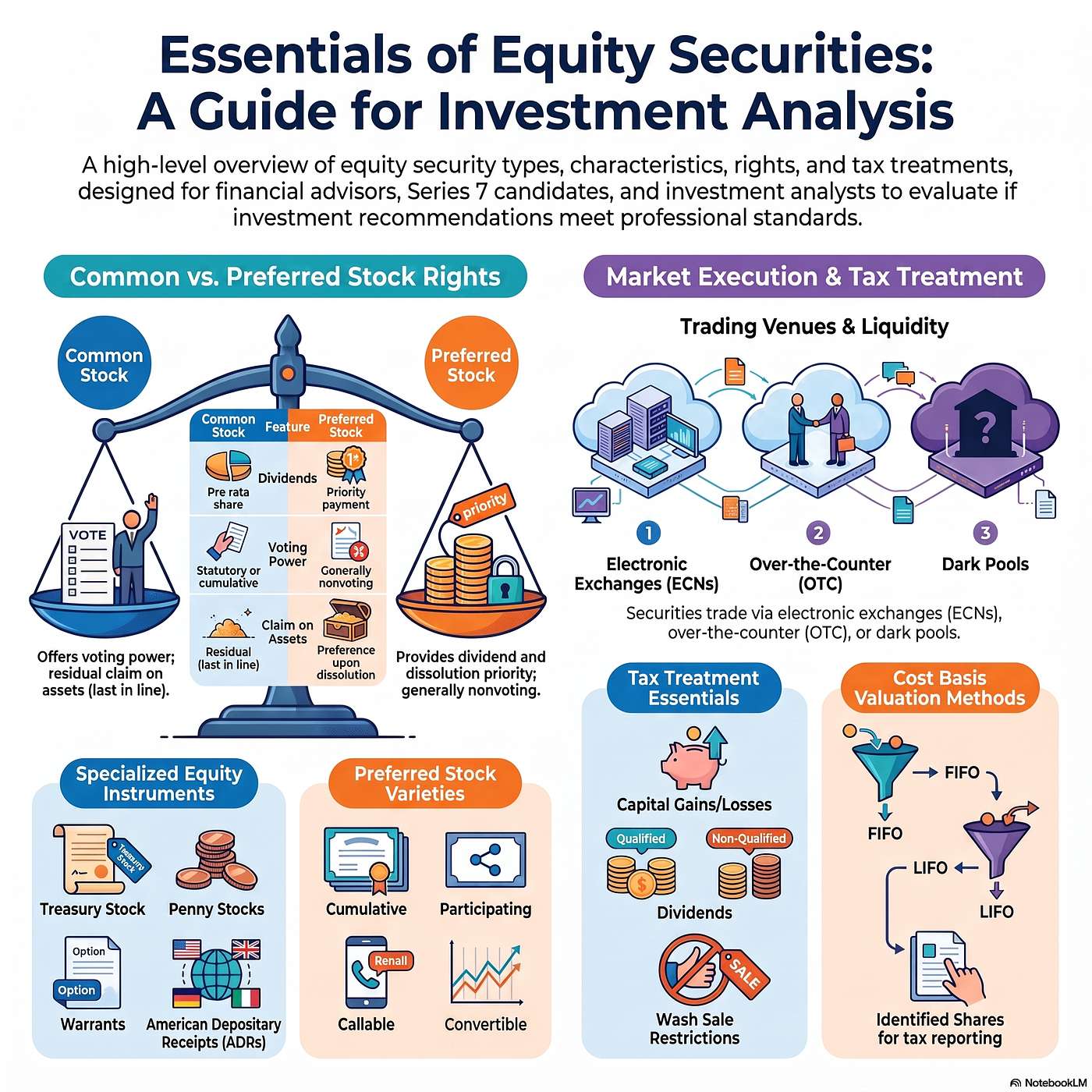
Series 7 Exam Prep: All About Equities
4w ago01:08:55Summary readySend us Fan MailThis comprehensive guide outlines the essential knowledge required for evaluating equity securities and ensuring investment choices align with regulatory standards. It details the fundamental characteristics of common and preferred stocks, covering specific investor rights such as voting power, dividend claims, and liquidation preferences. The text further explores various market instruments, including warrants, rights, and foreign securities like American Depositary Receipts. Additionally, it examines the operational landscape of trading, ranging from traditional electronic exchanges to private dark pools. Finally, the source provides an extensive overview of taxation and accounting, focusing on cost basis calculations and the fiscal impact of capital gains or losses. Together, these elements serve as a rigorous framework for professionals to navigate the complexities of equity investment analysis.Support the show📚 About the PodcastReal-world finance explained the way exams and real life actually test it. Ideal for the SIE, Series 7, Series 65/66, and anyone who wants to actually understand money—not just memorize buzzwords.⚠️ DisclosureThis podcast is for educational purposes only and is not a recommendation to buy or sell any security. Opinions expressed are solely those of the host.🚀 Go DeeperLive classes, tutoring, practice questions, and bonus content:👉 Website / Classes: https://series7exam.org 👉 YouTube: https://youtube.com/@Series7exam 👉 Substack:https://substack.com/@series7whisperer?New episodes weekly — subscribe so you don’t miss one.
Summary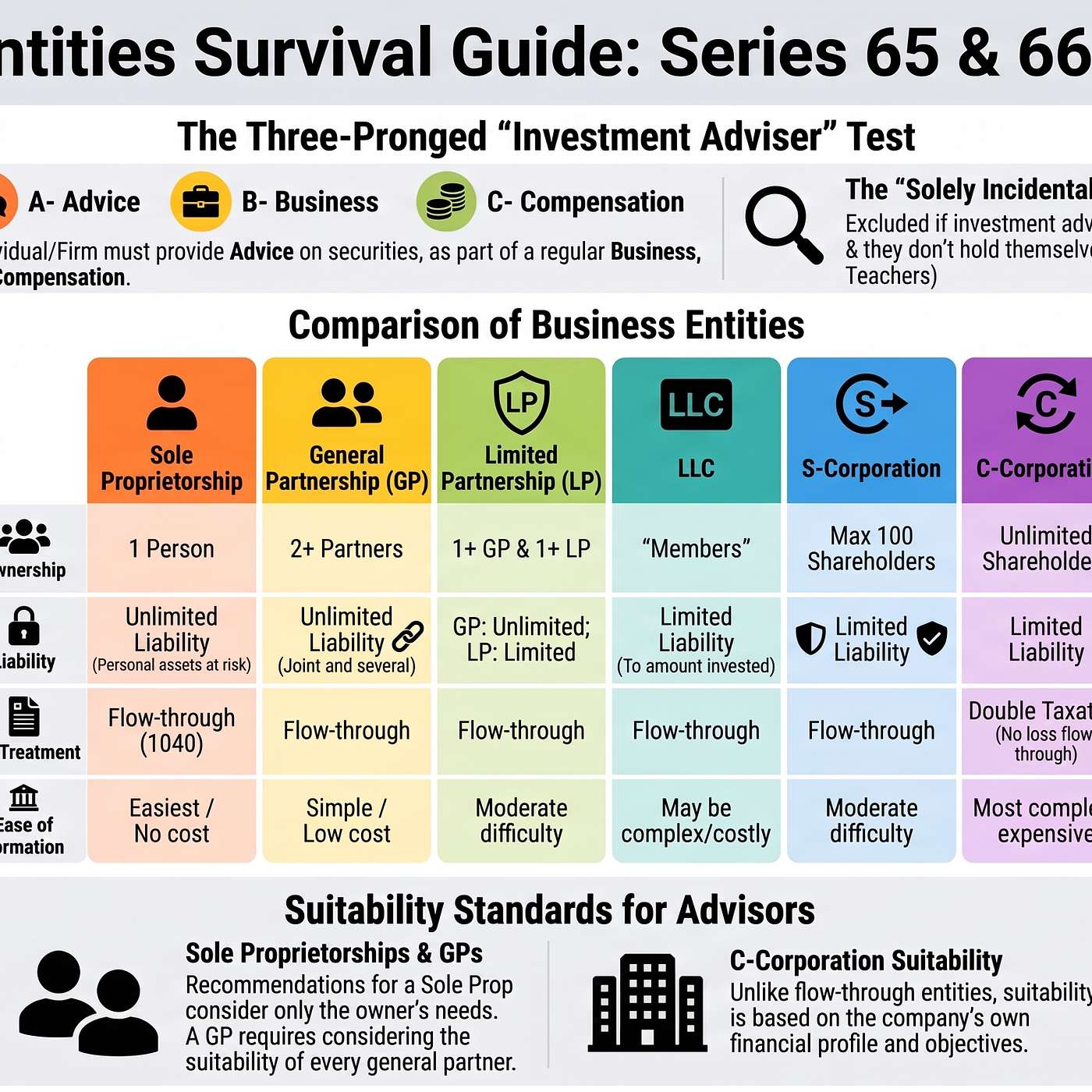
Series 65 Exam ( Types of Corporations ) Series 66 Exam also
Jul 1500:46:28Summary readySend us Fan Maila comprehensive comparison of legal business structures, detailing the unique characteristics of entities like C corporations, S corporations, LLCs, and partnerships. They explain critical distinctions regarding owner liability, specifically contrasting the limited protection of shareholders and members with the unlimited personal risk faced by sole proprietors and general partners. The materials also highlight taxation frameworks, differentiating between double taxation at the corporate level and pass-through (flow-through) treatment, where profits and losses are reported on individual returns. Beyond legal definitions, the texts provide suitability guidance for financial professionals to help them recommend the appropriate structure based on a client's ability to raise capital or their need for operational simplicity. Furthermore, the documentation addresses the regulatory requirements for investment advisers, clarifying when professional advice on these entities necessitates official registration with state or federal authorities. Overall, the collection serves as both a technical reference for organizational formation and a study guide for navigating complex business and investment regulations.Support the show📚 About the PodcastReal-world finance explained the way exams and real life actually test it. Ideal for the SIE, Series 7, Series 65/66, and anyone who wants to actually understand money—not just memorize buzzwords.⚠️ DisclosureThis podcast is for educational purposes only and is not a recommendation to buy or sell any security. Opinions expressed are solely those of the host.🚀 Go DeeperLive classes, tutoring, practice questions, and bonus content:👉 Website / Classes: https://series7exam.org 👉 YouTube: https://youtube.com/@Series7exam 👉 Substack:https://substack.com/@series7whisperer?New episodes weekly — subscribe so you don’t miss one.
Summary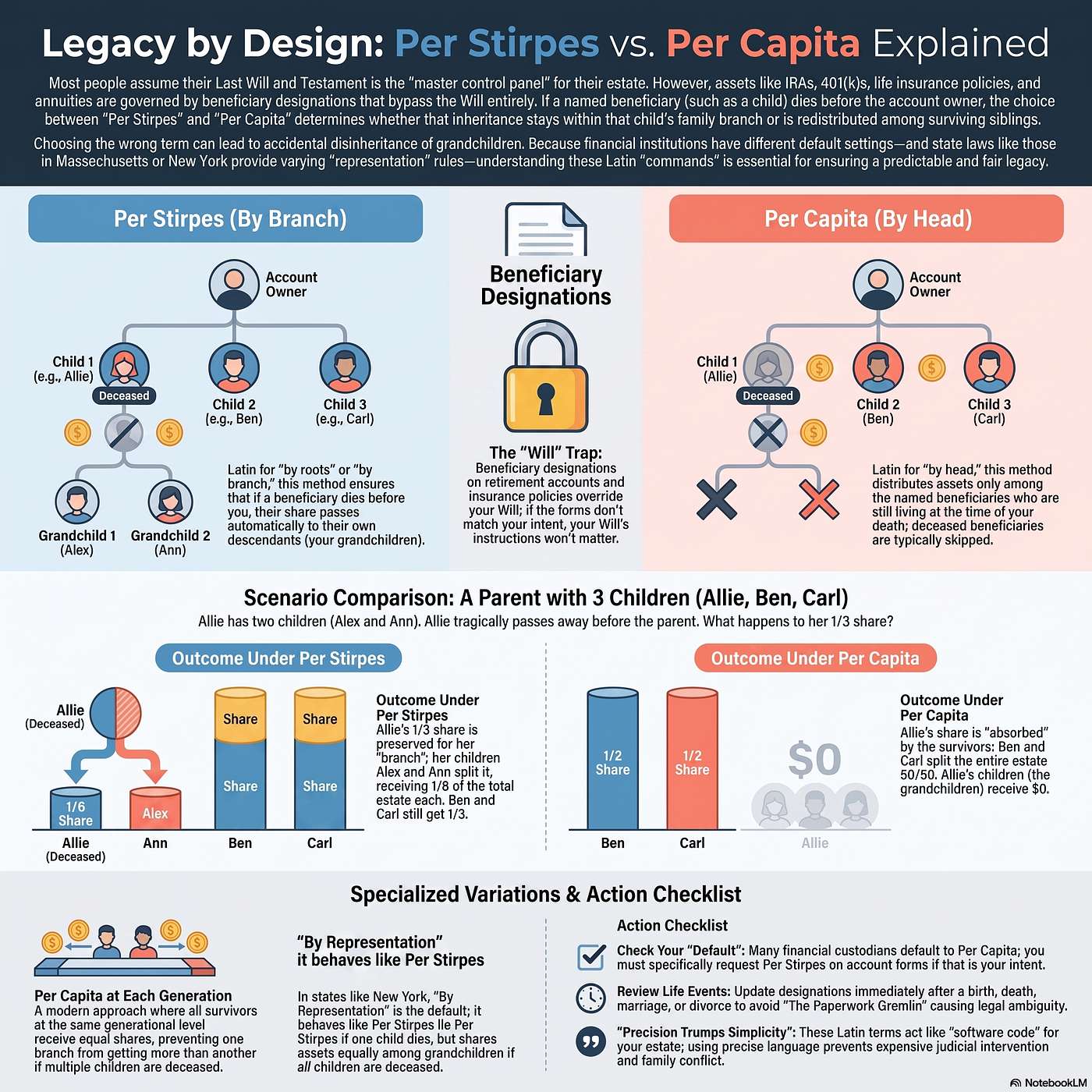
Series 65 Exam: Per Stirpes vs Per Capita ( Series 66 Exam also )
Jul 1300:41:21Summary readySend us Fan MailThe difference between these two distribution methods comes down to how the "class" of beneficiaries is defined, which radically changes who is included in the final headcount (since per capita translates to "by head").Here is the breakdown of how each designation works:"To My Children, Per Capita"Who is included: The beneficiary class is strictly confined to your immediate, first-generation children.How it works: The estate is divided equally only among your children who outlive you.If a child predeceases you: Their share is permanently lost to their family branch and is instead reabsorbed and divided among your remaining surviving children. The grandchildren belonging to the deceased child's branch receive absolutely nothing (0%).Why it's used: This approach is often chosen by individuals who want to keep assets concentrated strictly within their immediate living generation—for instance, to prevent minor grandchildren from inheriting complex assets that could trigger court-appointed guardianships."To My Descendants, Per Capita"Who is included: The designated class expands exponentially to encompass all living direct linear descendants across all generations. This includes surviving children, grandchildren, great-grandchildren, and so on.How it works: The estate is divided into equal shares based on a total headcount of all surviving descendants, regardless of their generation.If a child predeceases you: The deceased child's share is added to the total pool, which is then split equally among all living heads. Consequently, grandchildren will inherit equal shares right alongside their living parents, aunts, and uncles.Why it's dangerous: This method often results in a massive dilution of individual shares. It can also create significant family friction, as your living children will see their portions drastically reduced by the sheer number of grandchildren and great-grandchildren counted in the distribution.A Practical Example To illustrate the difference, imagine you have an estate to pass on. You have three children, and between them, they have given you seven grandchildren. Tragically, one of your children passes away before you do.Under "To My Children, Per Capita": Your two surviving children would split the entire estate (50% each). All seven grandchildren would receive $0.Under "To My Descendants, Per Capita": The headcount would include your two surviving children and all seven grandchildren (totaling 8 living heads). The estate would be divided into eight equal pieces, meaning each child and grandchild would receive a 12.5% shareSupport the show📚 About the PodcastReal-world finance explained the way exams and real life actually test it. Ideal for the SIE, Series 7, Series 65/66, and anyone who wants to actually understand money—not just memorize buzzwords.⚠️ DisclosureThis podcast is for educational purposes only and is not a recommendation to buy or sell any security. Opinions expressed are solely those of the host.🚀 Go DeeperLive classes, tutoring, practice questions, and bonus content:👉 Website / Classes: https://series7exam.org 👉 YouTube: https://youtube.com/@Series7exam 👉 Substack:https://substack.com/@series7whisperer?New episodes weekly — subscribe so you don’t miss one.
Summary
Series 79 Function 1.2 part 2 Essential Financial Ratios and Valuation Metrics for Corporate Transactions
Jul 1000:56:40Summary readySend us Fan Maila comprehensive outline of key financial metrics and ratios utilized in corporate advisory services, including mergers and acquisitions (M&As), restructurings, and equity or debt transactions. It categorizes these critical data points into five main areas:Liquidity: Metrics that measure a company's cash flow and working capital, such as the current ratio, quick ratio (acid test), debt-to-capital, and the cash collection cycle.Profitability: Indicators of a company's ability to generate earnings, including EBITDA, earnings per share (EPS), return on equity (ROE), return on assets (ROA), and various profit margins (gross, operating, and net).Leverage: Ratios that evaluate a company's debt levels relative to its earnings, such as the interest coverage ratio and debt-to-EBITDA.Valuation: Tools used to determine the value of a business or asset, including Enterprise Value (EV), Price-to-Earnings (P/E) multiples, Discounted Cash Flow (DCF), Weighted Average Cost of Capital (WACC), and the Dividend Discount Model (DDM).Asset Turnover: Methods that evaluate how efficiently a company manages its assets, specifically noting inventory valuation methods like LIFO and FIFO.Support the show📚 About the PodcastReal-world finance explained the way exams and real life actually test it. Ideal for the SIE, Series 7, Series 65/66, and anyone who wants to actually understand money—not just memorize buzzwords.⚠️ DisclosureThis podcast is for educational purposes only and is not a recommendation to buy or sell any security. Opinions expressed are solely those of the host.🚀 Go DeeperLive classes, tutoring, practice questions, and bonus content:👉 Website / Classes: https://series7exam.org 👉 YouTube: https://youtube.com/@Series7exam 👉 Substack:https://substack.com/@series7whisperer?New episodes weekly — subscribe so you don’t miss one.
Summary
Series 79 Function 1.1 Analysis and Evaluation of Data
Jul 800:47:15Summary readySend us Fan Mail Function 1.2: Analysis and Evaluation of Data covers several essential topics that would make a great foundation for your podcast:Financial Analysis & Modeling: Analyzing individual companies, comparable companies, and specific industry sectors, as well as building spreadsheets and financial models using basic accounting and statistical concepts.The Balance Sheet: Breaking down assets (such as cash, marketable securities, inventory, PP&E, and goodwill), liabilities (like short-term debt, accounts payable, and long-term debt), and stockholders' equity/net worth (including preferred/common stock and retained earnings).The Income Statement: Understanding the flow from revenue/sales down to net income, including COGS (fixed and variable costs), SG&A expenses, depreciation/amortization, operating income, and taxes.The Cash Flow Statement: Exploring the three main pillars: operating cash flow, investing cash flow, and financing cash flow.Support the show📚 About the PodcastReal-world finance explained the way exams and real life actually test it. Ideal for the SIE, Series 7, Series 65/66, and anyone who wants to actually understand money—not just memorize buzzwords.⚠️ DisclosureThis podcast is for educational purposes only and is not a recommendation to buy or sell any security. Opinions expressed are solely those of the host.🚀 Go DeeperLive classes, tutoring, practice questions, and bonus content:👉 Website / Classes: https://series7exam.org 👉 YouTube: https://youtube.com/@Series7exam 👉 Substack:https://substack.com/@series7whisperer?New episodes weekly — subscribe so you don’t miss one.
Summary
Series 79 Function 1.1 Collection of Data
Jul 600:47:13Summary readySend us Fan Mailto help you prepare for the Series 79 exam, here is a breakdown of the core concepts from the provided bullet points, organized into key areas of investment banking responsibilities:1. Data Collection and Valuation Analysis A major part of the role involves gathering and analyzing data to value companies and understand the market:Information Gathering: You must collect financial, performance, and transaction data from a variety of sources, including commercial databases, regulatory filings, company websites, and media.Market and Company Analysis: This data is used to analyze market trends, specific industry sectors, and individual companies.Valuation Methods: You will need to analyze the capital structure and valuation metrics of comparable companies to perform relative valuation analysis, which determines a company's position and value compared to its industry peers.Precedent Transactions: You must track recent mergers and acquisitions (M&A) as well as securities offerings executed by both your firm and competitors to understand historical deal multiples and structures.2. Regulatory FilingsSecurities Exchange Act of 1934: You must be familiar with the information contained in the schedules, reports, statements, and forms filed under this Act (which typically includes ongoing periodic disclosures like 10-Ks, 10-Qs, and 8-Ks).3. Permissible Communications and Internal Coordination The framework strictly outlines who investment bankers can communicate with and for what purpose, noting that these communications must be permissible and often require coordination with legal and compliance teams:Clients: Communicating to gather and verify the necessary information for financial statements and modeling.Industry Specialists (IB and Capital Markets): Collaborating to identify business opportunities, collect industry data, and determine the best marketing strategies for a company.Research Department: Connecting to gain broader perspectives on the market and specific industry sectors.Syndicate Desk: Gathering real-time market intelligence, including information on current deals, market demand, security pricing, deal structures, and covenants.Other Internal Departments: Coordinating to review data intended for marketing materials and securing the necessary approvals before distributioSupport the show📚 About the PodcastReal-world finance explained the way exams and real life actually test it. Ideal for the SIE, Series 7, Series 65/66, and anyone who wants to actually understand money—not just memorize buzzwords.⚠️ DisclosureThis podcast is for educational purposes only and is not a recommendation to buy or sell any security. Opinions expressed are solely those of the host.🚀 Go DeeperLive classes, tutoring, practice questions, and bonus content:👉 Website / Classes: https://series7exam.org 👉 YouTube: https://youtube.com/@Series7exam 👉 Substack:https://substack.com/@series7whisperer?New episodes weekly — subscribe so you don’t miss one.
Summary
Series 63 Exam Cheat Sheet: Registration and Regulations ( Series 65 and Series 66 Exam )
Jul 100:56:08Summary readySend us Fan Mailcomprehensive guide for individuals preparing for the Series 63, 65, and 66 exams. The content details the specific registration requirements and legal definitions for broker-dealers, investment advisors, and their representatives. It highlights critical distinctions, such as how broker-dealers focus on transaction execution while investment advisors provide compensated advice. The source also clarifies complex regulatory jurisdictional rules, explaining when firms must register with the SEC versus individual states. Finally, the material provides practical test-taking strategies, including a "cheat sheet" to help students identify which entities are exempt from certain legal classifications.Support the show📚 About the PodcastReal-world finance explained the way exams and real life actually test it. Ideal for the SIE, Series 7, Series 65/66, and anyone who wants to actually understand money—not just memorize buzzwords.⚠️ DisclosureThis podcast is for educational purposes only and is not a recommendation to buy or sell any security. Opinions expressed are solely those of the host.🚀 Go DeeperLive classes, tutoring, practice questions, and bonus content:👉 Website / Classes: https://series7exam.org 👉 YouTube: https://youtube.com/@Series7exam 👉 Substack:https://substack.com/@series7whisperer?New episodes weekly — subscribe so you don’t miss one.
Summary