Loading summary
Transcript414 lines
- [00:01]
A
Hey, this is Ken Finnan, also known as a Series 7 whisperer. And my job is to get you passed the SIE exam, the Series 7 exam, Series 65, all the FINRA and NASA exams. So going forward, I'm going to be going a mix of, like, short little videos, long ones, maybe some podcasts about, like, interviewing some people who took the tests. But a lot of these are going to be where I use a external source to create a script and then I have somebody else read it because I stumble and mutter a lot and. And I think these are working really well. So let's get into it, and we're going to have some fun here. And before we get into it, let's talk about one thing I do live Q and as every Tuesday night for the FINRA exams and every Thursday night for the NASA exams, 8pm Eastern on YouTube. Come have fun, ask questions about whatever you want, celebrate the wins, commiserate with the losses. But meet me every Tuesday night for FINRA stuff, every Thursday night for NASA stuff. Live on the two of you and we can get this done. Baby, let's go.
- [00:58]
B
You know, usually when we talk about buying something, there is this underlying expectation of absolute simplicity.
- [01:05]
C
Right? Like a basic transaction.
- [01:07]
B
Exactly. Think about going to the grocery store. You walk in, you pick up an apple, you pay your dollar at the register, the receipt prints, and you own that apple.
- [01:15]
C
Yeah. It is a purely binary transaction.
- [01:18]
B
Right. It's yours. You can eat it right there. You can, I don't know, throw it in the compost, bake it into a pie. The transfer of ownership is immed, and your rights over that object are basically absolute.
- [01:29]
C
The physical asset is literally in your hand, and the legal implications end the exact moment you walk out those automatic sliding doors.
- [01:38]
B
Clean, comforting, and just while, simple. But then you step into the world of the stock market, and suddenly that simple grocery store transaction just entirely vanishes.
- [01:47]
C
No, it goes completely out the window.
- [01:48]
B
Yeah. You open your brokerage app, you see a ticker symbol, you hit the bright green buy button, maybe a little digital confetti drops on your screen, and you think to yourself, awesome, I own a piece of this company.
- [02:00]
C
Which is true in theory, but.
- [02:01]
B
Right, but the reality of what you actually just bought, the specific legal rights attached to it, where that trade even happened in the digital ether, and how the taxman is going to view it down the road is, honestly, it's a labyrinth.
- [02:15]
C
It is the absolute definition of structural and diagnostic muddy waters. I mean, when you buy a share of stock, you aren't just buying a digital asset. You are entering into a highly complex, multi layered legal and financial contract.
- [02:30]
B
And the terms of that contract can vary wildly depending on what specific type of equity you just purchased. Right?
- [02:36]
C
Absolutely.
- [02:36]
B
So welcome to the duck dive. Today we are focusing entirely on you, the listener. Maybe you are staring down the barrel of the Series 7 exam and need to master these concepts, or maybe you are just trying to build a rock solid, impenetrable foundation in equity securities and investment analysis for your own portfolio.
- [02:53]
C
Which is a huge task, by the way.
- [02:54]
B
It is. Our mission today is all about demystifying the incredibly complex plan plumbing of the stock market. We are taking the dense, sometimes overwhelming material of equity securities and translating it into usable, tangible aha moments.
- [03:08]
C
Because, you know, memorizing a textbook or a study guide is one thing, but truly understanding the mechanics is another entirely.
- [03:15]
B
Yeah, totally different ball game.
- [03:16]
C
The key to mastering this material, especially for the Series 7, is recognizing that every single rule we will discuss today was created to to solve a specific problem in the market.
- [03:27]
B
Right. There are no arbitrary regulations.
- [03:29]
C
Exactly. If we can uncover the why behind these market structures, what becomes much easier to remember and honestly, much more intuitive to apply when you're taking the test?
- [03:41]
B
Okay, let's unpack this from the ground up. The stock market isn't just about lines going up and down on a chart. It's about corporate governance, ownership claims, and a surprising amount of defensive rules.
- [03:52]
C
A lot of defense.
- [03:53]
B
So to get through it all, we're going to take a journey. We will start with the actual birth of a sheriff stock. Figure out what voting power it gives you, and look at how to protect your slice of the pie.
- [04:03]
C
And then we'll move over to the VIP section, right?
- [04:06]
B
Yes, the VIP section to understand preferred stock. Then we take a detour into the slightly wilder side of the market with derivatives and foreign securities. Look at the hidden plumbing of modern trading venues. And finally, because we cannot escape him, we will face the irs.
- [04:23]
C
Always got to face the tax ban.
- [04:25]
B
Always. We'll break down the highly testable mechanics of cost basis and tax loss.
- [04:29]
C
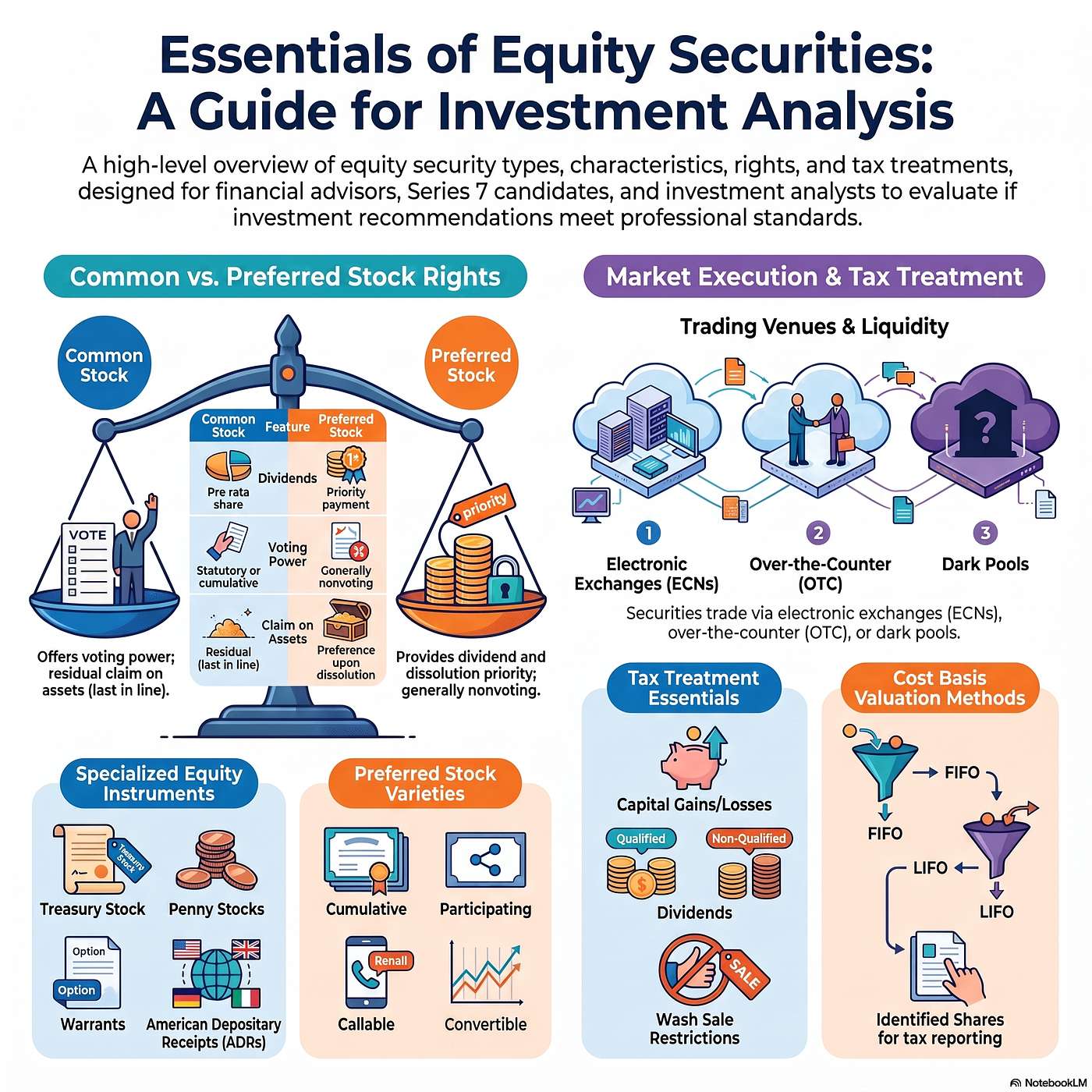
Harvesting it is a comprehensive roadmap, for sure. And the most logical place to begin is at the absolute foundation. Before anyone can trade a stock on an app or an exchange, we need to establish what a stock actually is, structurally speaking.
- [04:45]
B
Right. The genesis of a share. Because a company doesn't just, you know, infinitely print shares on a whim whenever it feels like raising cash.
- [04:52]
C
No, absolutely not. There are distinct legally bound phases of a stock's existence.
- [04:56]
B
And I usually see this breaking down into Authorized stock, issued stock, outstanding stock, and treasury stock. So to make this concrete, let's use the analogy of a massive concert venue.
- [05:05]
C
Oh, I like that. A physical space is a great way to visualize corporate capitalization.
- [05:10]
B
Okay, so think of a brand new massive stadium. Before a single ticket is ever sold to a fan, the the city fire marshal comes in, inspects the exits in the square footage and says, okay, the absolute maximum legal capacity for this building is 50,000 people. Right. That maximum limit legally allowed to exist is your authorized shares. It is the absolute ceiling. It's the total number of shares a corporate charter legally permits the company to issue.
- [05:39]
C
And the company cannot exceed that number without going through a massive legal hurdle.
- [05:43]
B
Right. They can't just print more.
- [05:45]
C
Exactly. They would have to formally amend their corporate charter, which usually requires a formal shareholder vote and a ton of regulatory filings. It's a hard cap.
- [05:53]
B
Okay, got it.
- [05:54]
C
Now, just because the venue can safely hold 50,000 people doesn't mean the concert promoter wants to sell 50,000 tickets right away.
- [06:00]
B
Sure, maybe they want to hold some back for a future event.
- [06:03]
C
Or they just don't think they can fill the whole stadium yet. So they only print and sell, let's say, 40,000 tickets. Those 40,000 tickets that are actually created and distributed out into the world, those represent the issued shares.
- [06:15]
B
So authorized is the legal ceiling. Issued is what management has actually decided to put out there into the wild. Yeah, but then we have the tickets that are currently sitting in the pockets of the fans who are actually walking through the turnstiles into the stadium today.
- [06:30]
C
Right, the active attendees.
- [06:31]
B
Those are your outstanding shares. Those are the shares currently actively held by the public. And that includes institutional investors, retail day traders, and company insiders.
- [06:41]
C
And this is where we have to explicitly contrast authorized and issued shares with the fourth category, which is heavily tested and conceptually vital for the Series 7.
- [06:52]
B
Treasury stock.
- [06:53]
C
Yes, treasury stock.
- [06:54]
B
So sticking with our stadium analogy, let's say the venue management looks out front and realizes, hey, we printed and sold 40,000 tickets, but there are scalpers out there dumping them for incredibly cheap, which
- [07:06]
C
is driving down the perceived value of the band.
- [07:09]
B
Right. Or maybe the band just has a ton of extra cash sitting around. So the venue management walks out front and buys back 5,000 of their own tickets directly from the scalpers.
- [07:19]
C
Okay, so they bought them back.
- [07:21]
B
Yeah, they take those 5,000 tickets, put them in a safe in the back office, and just hold on to them.
- [07:26]
C
The critical thing to understand about those specific tickets locked in the safe, that treasury stock, is that they effectively Become dormant.
- [07:34]
B
Dormant how?
- [07:35]
C
Well, treasury stock is previously issued stock that the company has repurchased on the open market. And because the company itself holds it, that stock loses its fundamental shareholder privileges.
- [07:47]
B
Oh, I see.
- [07:48]
C
A ticket locked in the safe doesn't get a vote on what song the band plays for the encore. And it certainly doesn't get a free drink at the bar, which, in financial terms, means it receives absolutely no dividends.
- [08:00]
B
So, to summarize the math on that, because this is an equation people really need to know. For the exam, issued shares minus treasury stock equals outstanding shares.
- [08:09]
C
It is a foundational formula. Issued minus treasury equals outstanding. And outstanding shares are the only ones that have voting rights and the only ones that receive dividends.
- [08:19]
B
So why would a company even do that? Buy back its own stock?
- [08:24]
C
Companies buy back their own stock for various reasons. Maybe to inflate their earnings per share by reducing the number of outstanding shares, you know.
- [08:31]
B
Oh, right. Making the math look better.
- [08:33]
C
Exactly. Or to have stock on hand to give to employees as compensation. Or even to defend against a hostile takeover by consolidating ownership.
- [08:42]
B
Okay, so if I hold an outstanding share, I am holding an active ticket in the stadium. I get to vote on the encore. Let's dig into that voting power.
- [08:50]
C
Let's do it.
- [08:51]
B
Because holding common stock comes with a voice. You get to vote on electing the board of directors, approving stock splits, signing off on major mergers. But how exactly does that voting work? Looking at the mechanics, there seem to be two competing systems. Statutory voting and cumulative voting.
- [09:08]
C
This is a classic battleground of corporate governance. Let's start with the older standard method, which is statutory voting. This is traditional and straightforward. You get one vote per share per open board seat.
- [09:20]
B
All right, let's run a hypothetical for the listener. I am a retail Investor. I have 100 shares of a company, and there are currently three open seats on the board of directors. Seat A, seat B, and seat C.
- [09:33]
C
Under statutory voting, you cast 100 votes for a candidate for seat A, 100 votes for a candidate for seat B, and 100 votes for a candidate for seat C. Okay, the key is you cannot combine them. You can't put 300 votes on one person.
- [09:50]
B
That sounds perfectly fair on the surface, but Wait. Let's say there is an activist hedge fund manager who wants to gut the company, and they own 1,000 shares.
- [09:58]
C
Well, that hedge fund cast 1,000 votes for their guy in Seat A, 1,000 for Seat B and 1,000 for Seat C. Which means? Which means, mathematically, they will outvote you and your little 100 shares on every single seat. Statutory voting strongly and unapologetically favors the large majority shareholders. If you own 51% of the statutory voting stock, you essentially control 100% of the board of directors. You dictate the entire future of the company.
- [10:28]
B
So the little guy, the retail investor trying to get just one environmentally conscious director or, I don't know, one pro dividend director on the board, just gets completely steamrolled. Their vote is basically ceremonial.
- [10:39]
C
It really is. And that perceived inequity, the silencing of the minority owner, is exactly why cumulative voting was invented.
- [10:47]
B
Okay, so how does that fix the math?
- [10:49]
C
It is designed specifically as a protection mechanism for minority shareholders. Under cumulative voting, we change the math entirely. You take your number of shares, multiply by the number of open seats, and you get a single massive pool of votes that you can allocate however you see fit.
- [11:04]
B
Ah, okay, let's rerun my hypothetical. I have my 100 shares and there are three open seats. Under cumulative voting, 100 shares times three seats equals 300. I now have a war chest of 300 votes.
- [11:16]
C
And you are not forced to split them up. If there is one specific candidate you really believe in, you can take all 300 of your votes and dump them entirely onto that one single candidate.
- [11:27]
B
So even if the big hedge Fund spreads their 3,000 votes across all three of their Corporate Raider candidates, putting 1,000 on each, my concentrated block of 300 votes, combined with maybe other retail investors doing the same thing, gives us a very real mathematical fighting chance to secure at least one seat on the board.
- [11:47]
C
Exactly. You pooled your power.
- [11:49]
B
That makes so much sense.
- [11:51]
C
If we look at the bigger picture, cumulative voting ensures proportional representation rather than a winner takes all scenario. When you are analyzing a corporate charter or facing an exam question, the shorthand to remember is statutory favors the whale, cumulative protects the minnow.
- [12:06]
B
I love the mechanics of that. It's so clean. But I have to push back a bit on the reality of it.
- [12:11]
C
Okay, go ahead.
- [12:11]
B
What does this actually mean for the little guy today? I mean, does a retail investor with 20 shares of a massive trillion dollar tech company actually have any real say? Even with cumulative voting, these companies have billions of outstanding shares.
- [12:28]
C
It is a very pragmatic question and the reality is often quite cynical. The retail vote is massively diluted by Institutional Holdings, Vanguard, BlackRock, State Street. They hold the real voting power, right? And corporate founders know this. In fact, many modern founders are terrified of exactly what we just discussed. An activist hedge fund buying up enough shares to vote them out of their own company. This fear has led to the explosion of non voting stock.
- [12:55]
B
Non voting stock. So it's like I'm allowed into the stadium. I paid for my ticket, I get to watch the show, I get the free drinks that they hand them out, but my mouth is literally taped shut. I have zero say in the encore.
- [13:04]
C
It is a stark way to frame it, but economically, yes. Companies issue non voting or limited voting shares when they have a desperate need to raise capital. They want the public's money to fund their massive growth. But the founders absolutely refuse to surrender control of the company's direction.
- [13:22]
B
So they create like a tiered system.
- [13:23]
C
Yes, a dual class structure. They issue class A shares which have maybe 10 votes per share and keep those for the founders and insiders. Then they issue class B shares which have one vote or sometimes zero votes per share and sell those to the general public. You still get the economic benefits of ownership, like stock appreciation and dividends, but you formally forfeit governance.
- [13:46]
B
So your voice in the company is situational at best. But what about protecting your actual slice of the financial pie?
- [13:53]
C
What do you mean?
- [13:54]
B
Let's say I find a great startup, I buy in early, and I own 10% of the outstanding shares. I am thrilled. But a year later, the board decides to print and sell a massive amount of new shares to the public to build a new factory. By flooding the market with new shares, My 10% slice of the pie suddenly shrinks to a 5% slice. I didn't sell anything, but my ownership was just cut in half. My voting power is halved. My claim on future dividends is halved. I would be furious.
- [14:22]
C
You are describing dilution, and it is a massive threat to a shareholder's equity. And that brings us to the defensive mechanisms designed to prevent exactly that scenario, starting with preemptive rights.
- [14:34]
B
How do preemptive rights stop that dilution? Because that sounds like a lifesaver.
- [14:39]
C
It is. A preemptive right is a privilege often baked right into the corporate charter granted to existing common stockholders. Let's use your example. The company has 1 million shares outstanding, and you own 100,000 of them. You own exactly 10%.
- [14:53]
B
Okay, nice round numbers.
- [14:54]
C
Now, the company wants to raise more money by issuing another 1 million brand new shares to the public, which would
- [14:59]
B
double the total pool and have my stake.
- [15:01]
C
Right. But if the company has preemptive rights, the law dictates they cannot just dump those new shares onto the public market. They must offer those new shares to you, the existing shareholder, first.
- [15:14]
B
Oh, first dibs.
- [15:15]
C
Exactly. They have to give you a window of time to buy enough of the new issue to maintain your proportionate 10% ownership before anyone else is allowed to touch them.
- [15:25]
B
So they essentially knock on my door and say, hey, we are doubling the shares. Because you own 10% currently, you have the right to buy 10% of this new batch. Do you want them?
- [15:35]
C
Yes. It's an anti dilution mechanism. It allows the shareholder to play defense and maintain their fractional ownership of the corporation.
- [15:42]
B
What if I don't have the cash to buy them?
- [15:44]
C
No, you don't have to buy them. You can let the rights expire, or in many cases, you can actually sell the rights themselves on the open market to someone else. Because those rights have intrinsic value.
- [15:53]
A
Right.
- [15:54]
C
But the company is legally obligated to give you the option to protect your stake.
- [16:00]
B
That makes perfect sense for protecting my percentage. Now, let's talk about some other corporate actions that changed the math. In my brokerage account. Things like stock splits and spinoffs.
- [16:10]
C
Oh, these are heavily tested.
- [16:11]
B
I bet. Let's invent a hypothetical company. I'm going to call it Megacorp. Megacorp is a conglomerate. They make enterprise software, but they also have a weird, highly experimental cloud computing hardware division.
- [16:24]
C
Okay. Megacorp it is.
- [16:25]
B
Now, let's say Megacorp stock is doing incredibly well. It is trading at $100 a share. The board looks at that and decides to execute a 2 for 1 stock split. What physically happens to my shares?
- [16:39]
C
Well, a stock split is fundamentally a cosmetic change. It does not change the underlying fundamental value of the company, and it does not change your proportionate ownership.
- [16:47]
B
It just changes the look of it.
- [16:49]
C
Exactly. In a standard 2 for 1 split, Megacorp takes every single existing share and divides it into two. So if you went to bed holding 100 shares at $100 each, a total portfolio value of $10,000. You wake up the next morning and your account shows you now own 200 shares.
- [17:06]
B
It feels like magic.
- [17:08]
C
I have double the shares, you have double the quantity. But the market immediately adjusts the price of the stock proportionally. Those 200 shares will now open for trading at $50 each. Your total value is still exactly $10,000.
- [17:23]
B
So if I have a crisp $100 bill in my wallet and I go to the bank and ask the teller to break it into two $50 bills. I have twice as many pieces of paper, my wallet feels a bit thicker, but my actual purchasing power hasn't changed by a single cent.
- [17:38]
C
That is the perfect analogy.
- [17:40]
B
So why do companies even do it?
- [17:41]
C
Primarily for market psychology and liquidity. If A stock runs up to $1,000 a shareholder. A lot of smaller retail investors might feel priced out. They think, I can't afford a whole share.
- [17:52]
B
Yeah, that happens a lot.
- [17:53]
A
Right?
- [17:53]
C
By splitting it 10 for one, the price drops to $100 a share. It suddenly feels much more accessible, which encourages more retail buying and increases the trading volume and liquidity of the stock.
- [18:05]
B
And what about a stock dividend? Is that the same thing?
- [18:07]
C
A stock dividend works on the exact same mathematical principle. Instead of a ratio like two for one, they give you a percentage, like a 10% stock dividend. You get 10% more shares, but the price per share drops proportionally. On the market, your total wealth remains completely unchanged.
- [18:24]
B
Okay, so splits and stock dividends are just making change with the $100 bill. But what if Mega Corp's board decides. You know what? This experimental cloud hardware division is bleeding cash and distracting investors from our highly profitable core software business. We need to get rid of it.
- [18:41]
C
A very common corporate realization.
- [18:43]
B
Right, but instead of selling it to a private equity firm, they execute a spinoff.
- [18:48]
C
A spinoff is a much more structural corporate action. Megacorp takes that entire cloud hardware division legally severs it from the parent company, and incorporates it as an entirely new independent publicly traded company. Let's call it Megacloud.
- [19:02]
B
Okay, but I bought shares of Megacorp. What happens to me?
- [19:05]
C
Because you owned a piece of Megacorp and Megacorp wholly owned that cloud hardware division, you inherently owned a piece of that division.
- [19:12]
B
Oh, so I'm already an owner.
- [19:13]
C
Exactly. When it spins off, the parent company distributes shares of the newly formed company, Megacloud, directly to its existing shareholders as a special dividend. So without logging in or hitting buy, you check your brokerage account one morning and you suddenly hold your original shares of Megacorp and brand new shares of Mega Cloud. You acquired new stock through a corporate transfer.
- [19:35]
B
That's wild. It's like investing in a massive successful restaurant. And one day the owners decide the pastry chef is so good, they're going open a separate bakery next door. Because I own part of the restaurant, they just hand me the keys to a percentage of the new bakery.
- [19:50]
C
That's a great way to think about it. And just like the restaurant, the value of the parent company will adjust. The market capitalization of Megacorp will drop by roughly the exact value of the spun off asset, megacloud.
- [20:03]
B
So I don't suddenly have free money?
- [20:05]
C
No. On day one, your total wealth across the two companies is the same as it was the day before. It has just been bifurcated into two distinct equity vehicles that will now trade and grow independently.
- [20:16]
B
Alright, we've talked about growing, splitting and spinning off. But we have to face the dark side of capitalism. What if megacorp completely fails?
- [20:25]
C
The dreaded bankruptcy.
- [20:27]
B
Yeah, they mismanaged the software, the cloud division tanked and they file for Chapter 7 bankruptcy. The doors are padlocked, the lawyers are circling, and they are liquidating every desk, server and patent to raise cash. Corporate dissolution. What are my rights in that scenario? As a common stockholder.
- [20:46]
C
This scenario is exactly why we always say common stock carries the highest inherent risk. Yeah. When a corporation dissolves and liquidates its assets, it doesn't just hand the cash back to the investors In a free for all.
- [20:57]
B
Right.
- [20:57]
C
There is a strict legally mandated hierarchy of who gets paid out of the remaining cash pool. This is known as the priority of claims or the absolute priority rule.
- [21:07]
B
Let me guess, the IRS doesn't wait at the back of the line.
- [21:10]
C
Never. Unpaid taxes along with unpaid wages to employees sit right at the very top of the liquidation hierarchy. They get paid first.
- [21:17]
B
Makes sense.
- [21:18]
C
Once they are satisfied, we move to the debt holders. Specifically the secured bondholders. The banks that loaned money backed by hard collateral like the corporate real estate or the factory equipment. If they sell the factory, the bank gets that money. Then come the unsecured bondholders, the suppliers who haven't been paid, the general creditors.
- [21:39]
B
Wow, the line is getting incredibly long. When do the stockholders get a check?
- [21:44]
C
Only after every single dollar of debt is completely wiped out. If there's anything left over, and in bankruptcy, there rarely is. We finally move to the equity side of the ledger.
- [21:54]
B
Okay.
- [21:54]
C
Finally, the preferred stockholders are first in line for the equity payout.
- [21:58]
B
And the common stockholder, the person holding the basic voting shares.
- [22:02]
C
The common stockholder is at the absolute rock bottom of the capital structure. You hold what is legally defined as a residual claim on corporate assets. You only have a claim to the residue, the leftovers.
- [22:13]
B
So if the corporate ship is sinking, the taxman, the employees and the banks get the first lifeboats. The unsecured bondholders get the next lifeboats. The preferred stockholders get the last couple of slightly leaky lifeboats. And the common stockholder basically gets handed a piece of driftwood. If they're incredibly lucky.
- [22:32]
C
If they're exceptionally lucky. In the vast majority of total corporate liquidations, the common equity is completely and utterly wiped out. The lifeboats are gone before the crew even gets down to the common deck.
- [22:44]
B
Ouch.
- [22:45]
C
This residual claim is the ultimate trade off of the stock market. Common stock offers the Absolute highest potential for growth if the company succeeds. Your upside is technically infinite, but you bear the absolute maximum risk of total loss if the company fails.
- [23:01]
B
Speaking of getting the lifeboats before the commoners, let's talk about the people who get VIP treatment in that line. We are shifting gears to decode preferred stock.
- [23:10]
C
Preferred stock is a fascinating instrument. It is often described as a hybrid security because it sits right on the boundary between common equity and debt in the corporate capital structure.
- [23:19]
B
Okay, contrast this for me. I'm an investor looking at a company's stock page, trying to choose between buying their common stock and their preferred stock. What are the fundamental structural differences?
- [23:32]
C
Well, as we just established, common stock is high risk, high reward. It usually has voting rights. Its dividends are entirely dependent on how much profit the company makes that quarter. And it has incredible upside appreciation potential if the company invents a new product or corners a market.
- [23:48]
B
Right. The infinite upside preferred stock, on the
- [23:51]
C
other hand, trades all of that dynamism for income stability. First off, it generally lacks voting power. You trade your voice in the company for financial security.
- [24:00]
B
So I give up my cumulative voting rights. I can't try to get my guy on the board. I'm totally passive.
- [24:05]
C
Correct. But in exchange for that silence, preferred stock gives you two major advantages. First, it is issued with a par value. Think a par value as the face value printed on the stock certificate. Almost always $100. The stock then pays a fixed stated dividend, which is expressed as a percentage of that par value. So a 5% preferred stock will pay you exactly $5 a year, every year, regardless of whether the company makes a million dollars or a billion dollars in profit.
- [24:35]
B
Predictable income. I like that.
- [24:37]
C
And second, it has a strict preference for dividend payments.
- [24:40]
B
Ah. Meaning the board of directors has to pay the preferred stockholders their fixed $5 dividend before they are legally allowed to distribute a single penny of dividends to the common stockholders.
- [24:51]
C
Exactly. Hence the name preferred. They cut the line. And as we just noted in our sinking ship analogy, they also have preference over common stock during a corporate liquidation.
- [25:00]
B
But there isn't just one monolithic type of preferred stock, is there? Looking at the structural variations, there's a whole menu of flavors. Cumulative, non cumulative, participating, callable, adjustable rate, convertible. Let's focus on the heavy hitters that always trip people up on the Series 7. Let's look at cumulative versus convertible preferred stock.
- [25:20]
C
Let's start with cumulative because it represents the ultimate defense of your income stream. Imagine the company hits a severe macroeconomic rough patch. A recession hits sales Plummet and cash becomes incredibly tight.
- [25:33]
B
A bad year, right?
- [25:34]
C
The board of directors holds an emergency meeting and votes to suspend all dividend payments for the entire year to conserve cash and keep the lights on.
- [25:42]
B
So the common stockholders get zero.
- [25:45]
C
Right. But what about the preferred stockholders who are relying on that fixed $5? If they own non cumulative preferred stock, they also get zero. And that money vanishes into thin air. The year is over. The dividend is skipped. Better luck next year.
- [26:00]
B
Ouch.
- [26:01]
C
But if they own cumulative preferred stock, that missed dividend does not vanish. It goes into a specialized accounting bucket called dividends in arrears.
- [26:10]
B
So it stacks up. It becomes an IOU.
- [26:12]
C
Exactly. If the recession lasts three years and the company misses three years of dividends, all three of those $5 payments stack up in arrears. You are owed $15 per share.
- [26:22]
B
Oh, wow.
- [26:22]
C
And here is the ironclad defense mechanism. When the economy finally recovers, the company is flush with cash again, and the board wants to reward the common stockholders by declaring a massive dividend. They can't.
- [26:35]
B
They are legally blocked.
- [26:36]
C
They are blocked until they have reached into that arrears bucket and paid off every single cent of the accumulated IOUs to the cumulative preferred stockholders first, plus the current year's dividend.
- [26:47]
B
Wow. So cumulative preferred stock is basically an unbreakable fortress for your yield. The company can delay paying you to survive a crisis, but they can't avoid paying you entirely unless they're willing to permanently starve their common shareholders of any cash return.
- [27:03]
C
That is the exact mechanism. It vigorously protects your income. Now contrast that fortress with convertible preferred stock, which serves a completely different strategic purpose.
- [27:12]
B
Okay, how does convertible work?
- [27:14]
C
Convertible preferred is less about ironclad income defense during a recession and more about providing a bridge to massive growth during a boom.
- [27:22]
B
I see two competing options on my screen. Cumulative and convertible. Why would I choose convertible?
- [27:27]
C
Convertible preferred stock gives you, the holder, the contractual right, completely at your own discretion, to exchange your preferred shares for a predetermined fixed number of common shares.
- [27:39]
B
Here's where it gets really interesting. Convertible preferred is like having your cake, putting it in the fridge and deciding three years later if you want to eat it as a cupcake instead.
- [27:49]
C
That's a unique way to put it,
- [27:51]
B
but yes, you get to sit safely in the VIP section, collecting your fixed, predictable dividend while the market is boring. But let's say the company suddenly invents a revolutionary new AI technology and its common stock price explodes on the open market. It goes from $20 to $200 it goes to the moon.
- [28:09]
C
And if you just held standard preferred stock, your stock price wouldn't move much at all because its value is tied mathematically to interest rates and its fixed $5 dividend, not the infinite growth of the company's new AI tech.
- [28:22]
B
Right?
- [28:23]
C
You'd be sitting there clutching your safe 5% yield, watching the common stockholders become millionaires overnight.
- [28:30]
B
That would be absolute agony. I'd be sick to my stomach.
- [28:33]
C
But if you own convertible preferred, you have an escape hatch. You call your broker, you invoke your conversion, right? And you say, convert my shares.
- [28:42]
B
And they just do it.
- [28:43]
C
Yes. You surrender your safe preferred stock to the company, they hand you the predetermined number of common shares, and now you are suddenly holding the high flying common equity. You get to participate in the explosive capital appreciation.
- [28:58]
B
That honestly sounds like a cheat code for investing. You get the safety and preference of preferred on the downside, and the infinite sky's the limit growth potential of common on the upside. It's a win win. But I know Wall street well enough by now to know there's always a catch. What am I giving up for that superpower?
- [29:14]
C
The catch is twofold. First, there is no free lunch. Convertible preferred almost always pays a significantly lower fixed dividend rate than regular preferred stock issued by the exact same company.
- [29:26]
B
Ah, so you pay for the privilege.
- [29:28]
C
The market makes you pay a premium for that conversion privilege by accepting a lower yield. Second, you have to look at the other defensive features the company might attach to the stock to protect themselves. Primarily call features and sinking fund provisions.
- [29:42]
B
Call features? That sounds like the venue security walking up and forcibly kicking me out of the VIP section just when I'm enjoying the show.
- [29:49]
C
That's a very accurate, if aggressive, way to put it. Callable preferred sock means the issuing company retains the contractual right to unilaterally buy back the stock from you at a specified price on or after a specified date, whether you want to sell it or not.
- [30:07]
B
Why would a company force me to sell my stock back to them?
- [30:10]
C
It almost always comes down to macro interest rates. Imagine a company issued preferred stock paying a massive 8% dividend five years ago when the economy was running hot and interest rates were high. Okay, fast forward to today. The Federal Reserve has slashed rates and the company realizes they could easily issue brand new preferred stock paying only 4%. Why on earth would they keep paying you 8%? If the stock is callable, they will exercise that call feature, force you to surrender your shares for cash, retire that expensive 8% debt equivalent, and issue new, cheaper 4% shares to replace it. It's exactly like a homeowner refinancing a mortgage when rates drop.
- [30:51]
B
So just when I'm enjoying a market beating massive yield, the company can snatch it away to save themselves money. And I have to go try to invest that cash in a new market where rates are terrible. It's reinvestment risk.
- [31:03]
C
Exactly.
- [31:04]
B
Okay, what about a sinking fund provision?
- [31:06]
C
A sinking fund is a mandate often demanded by institutional investors for safety that requires the company to regularly set aside cash in a dedicated escrow account specifically to retire its preferred stock or bonds over time.
- [31:19]
B
Like a savings account for paying off debt.
- [31:21]
C
Yes. For example, the charter might dictate they must buy back and retire 2% of the outstanding preferred shares every single year on the open market. It reduces risk for the investor because it proves the company is financially disciplined and has the cash to back up the equity. But it also means your specific shares could randomly be targeted for repurchase by the sinking fund before you were ready to sell them.
- [31:46]
B
Okay, so preferred stock is relatively civilized. It's highly predictable. There's a strict pecking order. There are arrears, buckets conversions and interest rate math. But the stock market isn't always civilized. Sometimes it's the wild West.
- [31:59]
C
It certainly can be.
- [32:01]
B
Let's shift out of standard corporate equities and into derivatives. We need to talk about warrants versus rights. We talked about preemptive rights earlier to stop dilution. But the exam. And frankly, the market constantly pairs rights and warrants together, which is incredibly confusing because they sound similar.
- [32:17]
C
It is a classic point of confusion. And they are frequently tested against each other. They are both derivatives. Both rights and warrants give you the ability to buy stock directly from the corporate treasury at a specified price. But their origination, their timeline, and their relationship to the current market price are entirely opposite.
- [32:36]
B
Let's break this down meticulously. REITs first. You said earlier, these are offered to existing shareholders to prevent dilution when new shares are issued.
- [32:45]
C
Yes. REITs are reactionary and incredibly short term, usually lasting only 30 to 45 days before they expire. Worthless.
- [32:52]
B
So a ticking clock.
- [32:53]
C
A very fast ticking clock. The company has decided it needs to raise capital quickly, maybe for an acquisition, because they legally have to offer them to you because they really want you to exercise them. So they get the cash. They set the subscription price, the fixed price you pay to buy the new stock below the current market price of the stock.
- [33:12]
B
Ah, so if the stock is actively trading at $50 on the open exchange, the right they mail me Lets me buy a brand new share directly from the company for say $45. It has intrinsic immediate value. It's a highly valuable discount coupon that expires in a month.
- [33:30]
C
Exactly. You are getting a deal for being a loyal shareholder. Now contrast that short term discount with warrants. Warrants are not given to existing shareholders to prevent dilution.
- [33:41]
B
Then who gets them?
- [33:42]
C
Warrants originate as sweeteners attached to other less attractive securities. Usually corporate bonds or sometimes preferred stock.
- [33:49]
B
Why does a bond bond need a sweetener?
- [33:51]
C
Let's say a mid sized company wants to issue millions of dollars in bonds to build a factory. But their credit rating is a bit shaky. Investors look at the risk and demand a high 9% interest rate to lend them the money.
- [34:03]
B
Okay.
- [34:03]
C
The company management panics they can only afford to pay 6% interest without going bankrupt. To convince those investors to accept the lower 6% rate, the company attaches warrants to the bond.
- [34:14]
B
Hey, take this lower, safer interest rate. But will throw in this shiny warrant as a bonus lottery ticket.
- [34:20]
C
Precisely. Now, unlike REITs, warrants are long term instruments. They can last five years, 10 years, or sometimes even be perpetual. But here is the critical difference in the exercise terms. The subscription price of a warrant is intentionally set above the current market price of the underlying stock at the exact time it is issued.
- [34:40]
B
Wait, wait, stop. If the stock is trading at $50 today, you're saying the warrant gives me the right to buy the stock directly from the company for $65?
- [34:49]
C
Yes.
- [34:49]
B
But why would anyone want that? I could just open my brokerage app right now and buy the stock on the open market for $50. The warrant is mathematically worthless on day one.
- [34:58]
C
You are absolutely correct that it has zero intrinsic value today, but it has tremendous time value. Remember, warrants last for a decade. You are banking on future long term growth.
- [35:09]
B
Oh, I see.
- [35:10]
C
The company is essentially saying we are using this bond money to build a massive new factory. We believe our stock, currently struggling at $50 will be wildly successful and worth $100 in five years. We are giving you a locked in guaranteed option to buy it at $65 anytime in the next 10 years, no matter how high the market price goes. If the stock hits $150, that $65 fixed price warrant becomes incredibly valuable.
- [35:39]
B
Okay, I see it now. REITs are short term discount coupons given to current owners. Warrants are long term lottery tickets attached to debt banking on explosive future growth.
- [35:50]
C
That is an excellent summarization. And it is important to note that both instruments usually contain strict anti dilution agreements. Meaning if the company decides to do a 2 for 1 stock split while you are holding a right or a warrant, the subscription price and the number of shares you are entitled to buy will automatically adjust proportionally so you don't lose the underlying value of the derivative contract.
- [36:10]
B
Okay, derivatives covered. Let's get into the real dirt of the market. Penny stocks and the over the counter or OTC market. When retail investors hear penny stocks, they immediately think of boiler rooms, aggressive cold call sales pitches, the wolf of Wall street and massive volatility. What actually separates a penny stock from
- [36:31]
C
a standard blue chip equity from a strict regulatory standpoint. Under SEC rules, a penny stock is generally defined as a non exchange traded equity security that trades for less than $5 per share.
- [36:43]
B
$5?
- [36:43]
C
Yes. But the most critical phrase in that definition is non exchange traded.
- [36:48]
B
Meaning they aren't vetted and listed on the New York Stock Exchange or the nasdaq.
- [36:52]
C
Exactly. They do not meet the rigorous financial reporting or minimum price requirements of the major lit exchanges. Instead, they trade on the OTC market, specifically platforms like the OTC bulletin board or the pink sheets.
- [37:04]
B
What does that look like mechanically?
- [37:05]
C
Well, these are not centralized physical locations or massive unified computer servers. They were decentralized, highly fragmented networks of individual broker dealers negotiating trades with each other over phones and proprietary screens.
- [37:19]
B
So what are the actual risks? Why does the SEC treat them like radioactive material?
- [37:24]
C
The absolute primary risk is a severe, sometimes catastrophic lack of liquidity. On a major lit Exchange like the NYSE, if you want to sell 100 shares of Apple, the trade executes in milliseconds because there's a massive ocean of buyers and sellers constantly interacting.
- [37:41]
B
Right.
- [37:42]
C
In the OTC penny stock market. If you buy 10,000 shares of a tiny unknown lithium mining company that has no revenue and suddenly you get spooked and want to sell, there might simply be no one on the other side of the trade willing to buy them from you.
- [37:54]
B
It's a roach motel. You can check in, but you can't check out. You are physically trapped in the position as it goes to zero.
- [38:00]
C
Exactly. And because they are highly illiquid, the market makers who do trade them demand massive compensation for taking on that risk, which manifests in enormous bid ask spreads like how big the dealer might offer to buy the stock from you for 10 cents. That's the bid, but will only sell it to you for 20 cents the ask. You lose 50% of your investment's value the exact second you execute the buy order. Just crossing the spread.
- [38:25]
B
That is insane.
- [38:26]
C
It is. Furthermore, because these are Small, unlisted companies. They have significantly less financial transparency and SEC reporting requirements, making them the prime historical targets for pump and dump fraud schemes.
- [38:39]
B
Right, the classic scam. A promoter buys millions of shares of a worthless stock for pennies. They hype it up on message boards, social media, or via email blasts claiming the company just discovered gold. Yep, the pump retail investors flood in, pumping the price up to $2. And then the promoter ruthlessly dumps all their shares at the top, collapsing the price back to pennies and leaving the retail investors holding completely worthless paper.
- [39:03]
C
Which is precisely why regulators require brokers to jump through massive documented hoops. Before selling penny stocks to a new customer, a broker must explicitly verify the customer's financial suitability for high risk investments. And they must obtain a physically signed risk disclosure document from the client acknowledging the dangers before they are legally allowed to execute the very first trade.
- [39:27]
B
The Wild west, indeed. Okay, let's look outside our borders. What if I want to invest in a massive, totally legitimate foreign company? Let's say I love a huge Japanese automaker or a massive Swiss pharmaceutical giant. They're solid blue chip companies, but they are foreign. I don't want to open a specialized brokerage account in Tokyo, I don't want to wire yen across the ocean, and I don't want to stay awake until 3am to trade during their market hours. How do US investors buy foreign corporate equity? Easily.
- [39:56]
C
The financial industry solved this logistical nightmare decades ago with a mechanism called an ADR or an American Depository receipt.
- [40:04]
B
I see that acronym everywhere. How does the plumbing on an ADR actually work?
- [40:08]
C
Let's use your Japanese automaker. A massive domestic US bank, let's say a major Wall street institution, goes to the Tokyo Stock Exchange and buys millions of shares of that automaker's actual stock. The bank takes all those foreign shares and literally locks them in a vault at their custodian bank branch over in Japan.
- [40:29]
B
Okay, so a US bank now owns a massive block of the foreign shares.
- [40:33]
C
Then that U.S. bank issues a receipt, the ADR against those shares sitting in the vault. They list that ADR on the New York Stock Exchange.
- [40:42]
B
Oh, that's clever.
- [40:43]
C
So when you, the U.S. retail investor, log into your app and buy the ADR, you are buying a U.S. registered security priced in U.S. dollars traded during normal U.S. market hours. That legally represents ownership of the foreign shares sitting securely in the vault in Tokyo.
- [40:57]
B
That is a brilliant piece of financial engineering. It completely bypasses all the foreign currency conversion logistics for me. The trades settle normally. And when the Japanese company pays a dividend I assume the bank handles that too?
- [41:09]
C
Yes. The Japanese company pays the dividend in yen to the vault in Tokyo. The US bank collects the yen, converts it into US dollars at the current institutional exchange rate, takes a tiny fee for the hassle, and passes the US dollars directly into your brokerage account.
- [41:26]
B
It sounds incredibly convenient.
- [41:28]
C
It is incredibly convenient, but. And this is a massive M day. But for the exam and real life, we must explicitly warn about the risks of non US Market securities even when safely wrapped in an adr. Because while the ADR removes the logistical hassle of currency conversion, it absolutely does not remove currency risk.
- [41:49]
B
Let's walk through that. Because the underlying stock, the actual asset in the vault, is still priced in yen, and its profits and dividends are generated in yen.
- [41:56]
C
Exactly. Let's say the Japanese automaker is doing fantastic. They declare a generous dividend of 100 yen per share. The US bank collects that 100 yen. But let's say the US dollar has suddenly become incredibly strong against the yen in global forex markets.
- [42:10]
B
Okay, so the dollar is strong.
- [42:11]
C
When the bank converts that 100 yen, it buys significantly fewer US dollars than it would have a year ago. Your actual dividend check deposited into your account shrinks. Even though the foreign company's core business is thriving, you are inherently betting on both the company's success and and favorable foreign exchange rates.
- [42:32]
B
So the currency market can completely wipe out my stock market gains. What about political risk?
- [42:37]
C
Political risk is massive, especially when dealing with ADRs from emerging markets. If you hold an ADR for a company in a country that suddenly faces severe government instability, a coup, the nationalization of private industries, or severe regulatory crackdowns, the underlying shares could plummet in value
- [42:55]
B
and you're just stuck crawling the bag
- [42:57]
C
in the US or worse, the flow of capital back to the US bank could be frozen by sanctions. Plus, you always have to worry about foreign taxation. Foreign governments will often withhold a percentage of your dividend for their own taxes before the US bank even gets it. Meaning you get a smaller cut.
- [43:11]
B
So ADRs make it convenient to invest globally, but they absolutely do not insulate you from the harsh realities of macroeconomics and geopolitics. All right, Whether you are trading safe blue chips, preferreds, foreign ADRs, or navigating the murky waters of penny stocks, you have to execute those trades somewhere. Let's look at the actual pipes and
- [43:33]
C
wire the market plumbing.
- [43:34]
B
Yeah, we've talked casually about the major exchanges like the nyse, but the digital age completely rewired the system. Let's analyze how electronic communications networks, or ECNs, actually function.
- [43:46]
C
ECNs fundamentally revolutionize global trading. Yeah, if you go back a few decades before ECNs, if you wanted to buy a stock, your broker literally phoned a human specialist or market maker standing on the physical exchange floor in New York, who physically matched buyers and sellers using paper tickets and took a cut of the spread for their trouble.
- [44:04]
B
Right? The classic movie scene. Guys in colorful jackets yelling, throwing hand signals, paper flying everywhere.
- [44:10]
C
It was inefficient, prone to human error and expensive. An ECN removes the human middleman entirely. It is a highly advanced, fiercely fast computerized network system that automatically matches buy and sell orders for securities directly in the open market.
- [44:26]
B
My way of visualizing this is that ECNs are like the ultimate ruthless automated matchmaking service for capital.
- [44:33]
C
That's pretty accurate.
- [44:34]
B
Let's say I submit a limit order, meaning I tell my broker I want to buy 100 shares of Apple, but I will only pay exactly $150, not a single penny more. The broker routes that to an ECN. The ECN's algorithm scans its massive network instantly.
- [44:49]
C
Right?
- [44:49]
B
The literal millisecond. It finds another trader somewhere in the world who submitted an order willing to sell 100 shares at exactly $150. It pairs us up, executes the trade and it's done. No specialist needed, no human dealer markup. Just pure instantaneous algorithmic matching.
- [45:06]
C
And that speed and efficiency do two things. It completely collapsed trading commissions globally and it tightened bid ask spreads down to a penny, saving retail investors billions. Furthermore, because they are just computer servers, they can operate outside traditional exchange hours, providing the vital infrastructure for pre market and after hours trading liquidity.
- [45:28]
B
So ECNs are out there in the light, efficiently matching orders for everyone to see on the public order book. But there is another much great quieter side to the modern market. Let's talk about dark pools.
- [45:39]
C
Dark pools.
- [45:40]
B
I have to admit, I love this term. It sounds so incredibly sinister. Like a villain's lair. What exactly is a dark pool and how does it influence modern trading liquidity?
- [45:51]
C
A dark pool is a private alternative electronic trading venue usually operated by a major broker dealer like Goldman Sachs or an institutional consortium where massive institutional trading insecurities occurs completely out of the public eye.
- [46:05]
B
Out of the public eye meaning you literally can't see the order book?
- [46:08]
C
Exactly. On a litex change like the NYSE or a public ecn, there is complete pre trade transparency. Everyone can see the size and price of the pending buy and sell orders. Resting on the book in a dark pool. The pre trade data, who wants to buy how many millions of shares they want and at what price is completely hidden from the public and from other traders.
- [46:31]
A
Wow.
- [46:31]
C
The trade is only reported to the consolidated tape, which is the public ledger. The ticking ticker tape you see on financial news networks after the trade has already been completely executed and settled.
- [46:41]
B
Okay, I have to stop you there. Why? Why would anyone need that level of secrecy? If the public markets are so efficient, why build a secret secondary market?
- [46:49]
C
It comes down entirely to market impact and the survival of massive institutional investors. Imagine you are the portfolio manager of a giant mutual fund and you have decided to liquidate your position in a mid cap company. You need to sell 1 million shares today.
- [47:03]
B
If I dump a massive sell order for 1 million shares onto a public
- [47:07]
C
lit ECN, it would be a bloodbath. The market would instantly panic. Predatory high frequency trading algorithms constantly scan the lit exchanges. The millisecond they see your massive wall of supply hit the order book. They know the price is about to
- [47:21]
B
drop because there's so much supply suddenly available.
- [47:24]
C
Yes. They will ruthlessly front run you, aggressively shorting the stock and driving the price down before your massive order even finishes executing. You will get execution prices on your own order because you broadcast your intentions to the entire world. You crashed your own stock.
- [47:40]
B
I tipped my hand to the sharks. But if I take my 1 million shares into a dark pool, you quietly
- [47:46]
C
ping the dark pool network. The algorithm silently matches your massive sell order with another institution's massive buy order. Maybe a pension fund looking to acquire the stock. The trade executes privately, often at the midpoint between the current public bid and ask.
- [48:02]
B
So nobody panics.
- [48:03]
C
Exactly. You get to offload your million shares, they get to acquire them. And you both completely avoid crashing the public market price in the process. Dark pools account for a massive percentage, sometimes up to 40% of total trading volume today because they provide essential non disruptive liquidity for block trades.
- [48:23]
B
Okay, I absolutely understand the institutional logic. It protects their execution price. But I have to push back hard here on behalf of the retail listener. Doesn't that seem fundamentally structurally unfair to the average investor?
- [48:36]
C
Many people think so, yeah.
- [48:37]
B
We are forced to trade in the light, showing all our cards, paying the prevailing spreads, while the big money, the massive hedge funds and Wall street banks, get to trade in the dark, completely bypassing the public price discovery process. If 40% of the trading volume happens in secret, isn't the public stock price basically an illusion?
- [48:56]
C
You are hitting on a fundamental unresolved tension in market philosophy, and you are echoing the exact debate currently raging among regulators. It is an entirely valid criticism.
- [49:06]
B
So what are regulators doing about it?
- [49:08]
C
Regulators at the SEC are constantly trying to balance two competing, almost mutually exclusive the institutional need for efficient liquidity without devastating market impact versus the retail public's absolute right to transparent, fair and democratic price discovery. If too much volume shifts away from the lit exchanges and into dark pools, the public markets become shallow, highly volatile, and unrepresentative of true supply and demand. It is an incredibly delicate tightrope walk for the regulators to keep both sides functioning.
- [49:39]
B
It is a fascinating ecosystem. The plumbing is complex, hyper fast, and sometimes entirely invisible. But no matter where you execute your trade in the light of an ecn, in the dark of a private pool, or haggling over the counter, eventually the year ends. And when the year ends, the great equalizer comes knocking. You have to answer to the IRS
- [49:57]
C
Death and taxes, the two unavoidable realities
- [50:00]
B
of finance let's face the tax man for anyone taking the Series 7 or just trying not to get audited, this section is highly testable and incredibly practical. Let's start with the absolute basics of tax implications for investors. I buy a stock. How does the government actually tax me? Compare long term capital gains with dividend income.
- [50:20]
C
When you invest in equity securities, there are two primary distinct ways you generate wealth and the IRS treats and taxes them very differently. The first is capital gains, the classic investing strategy of buying a stock at a low price and eventually selling it at a higher price. The second is dividends, the cash distributions the company pays you just for holding the stock.
- [50:42]
B
Let's start with the capital gains. I sold a stock for a profit. Timing is everything here, right?
- [50:46]
C
Everything?
- [50:46]
B
Yeah.
- [50:47]
C
The entire tax code for capital gains revolves around holding periods. If you buy a stock, it goes up and you sell it for a profit within one year or less of buying it. The IRS classifies that as a short term capital gain and they're not kind to short term gains.
- [51:01]
B
How bad is it?
- [51:02]
C
The IRS treats that profit exactly like the salary from your day job. It is taxed at your ordinary income tax rate, which depending on your tax bracket, could be as high as 37%. Ouch.
- [51:15]
B
So day trading is incredibly tax inefficient. But if I am patient, if you
- [51:20]
C
hold that asset for a year and a day, meaning strictly more than 12 months, it unlocks the highly favorable long term capital gains rate. The government uses the tax code to explicitly incentivize long term economic investment over short term market speculation and what does
- [51:36]
B
that rate look like?
- [51:37]
C
Depending on your income bracket, that long term tax rate drops significantly, usually to 15% or a maximum of 20% for the highest earners. It is a massive tax savings.
- [51:46]
B
You got it. Year in a day is the magic threshold for selling. Now what about the dividends I receive in cash while I'm holding the stock? Do those get taxed as ordinary income? The outline distinguishes between qualified and non qualified dividends.
- [51:58]
C
Most regular cash dividends paid by standard US Corporations are considered qualified dividends provided you have held the stock for a required minimum holding period around the ex dividend date, which is just the strict cutoff date to be an official shareholder on the books to get that specific dividend.
- [52:17]
B
Okay, so if I hold it properly around that date.
- [52:19]
C
The beauty of a qualified dividend is that the IRS taxes it at that exact same favorable lower long term capital gains rate of 15 or 20%.
- [52:28]
B
So holding good US dividend stocks is is very tax efficient and non qualified.
- [52:34]
C
Non qualified dividends like those paid out by real estate investment trusts or certain foreign companies are taxed at your higher ordinary income rate. Always track your holding periods and know what kind of entity is paying you.
- [52:46]
B
Okay, so that's the math. When we win, we make money. We pay a slice to the government. But what happens when we lose? Let's talk about tax loss harvesting and specifically the massive trapdoor the IRS built into it. The wash sale rule.
- [52:58]
C
Oh, the wash sale rule. This trips everyone up.
- [53:01]
B
Let me set up a very realistic scenario. Let's say it's November. I bought 100 shares of a hyped up tech stock back in January for $100 a share. Total initial investment out of my pocket. $10,000.
- [53:13]
C
10 grand invested.
- [53:15]
B
But the company missed earnings, the CEO resigned, the stock tanked and it's now trading at $60. I'm sitting on a $4,000 loss. I look at my tax situation and say, well, I want to claim that $4,000 tax loss on my IRS filing this year to offset some huge gains I made in another stock. So I hit sell. I sell the stock for $60.
- [53:37]
C
A perfectly standard, highly recommended end of year tax strategy. You realized a $4,000 capital loss. You can use that to lower your tax bill, right?
- [53:44]
B
But then three days later, I panic. I read an article saying the tech company is getting bought out and it's going to bounce back massively. I feel intense sellers remorse. I still believe in the company. So back into my brokerage app and I buy those 100 shares right back at $60 what happens?
- [54:01]
C
What happens is that you have just triggered the wash sale rule and the IRS is going to aggressively disallow your $4,000 tax loss. You cannot claim it on your taxes this year.
- [54:12]
B
Disallowed? Why? I legitimately lost that money. My $10,000 turned into $6,000. The cash is gone from my account. Why does the IRS get to pretend I didn't take a loss just because I changed my mind a week later?
- [54:25]
C
Because the IRS refuses to let investors manipulate the tax system to artificially capture a paper loss at year end while essentially maintaining their exact same market exposure. If they didn't have this rule, everyone would sell every losing stock on December 31st to claim the loss and buy them all back on January 1st.
- [54:42]
B
So they closed that loophole.
- [54:44]
A
Yes.
- [54:44]
C
The rule explicitly states that if you sell a security at a loss and then purchase a substantially identical security within 30 days before or 30 days after the sale date, the loss is disallowed for current tax purposes.
- [54:55]
B
30 days before or 30 days after. So including the day of the sale, there is a strict 61 day window around my transaction where I absolutely cannot touch that stock or even buy call options on that stock if I want to successfully claim the tax loss.
- [55:09]
C
Precisely. By buying it back three days later, you washed out the sale. You are in the exact same economic position you were a week ago. So the IRS says the loss doesn't count yet.
- [55:20]
B
So is that $4,000 tax deduction just gone forever? Is it a punitive fine for being impatient?
- [55:27]
C
No, it is not stolen from you. It is deferred. The disallowed loss is mathematically added to the cost basis of your newly purchased shares.
- [55:34]
B
Oh, okay. Walk me through that math so I can see how I get it back.
- [55:37]
C
You bought the new shares three days later at $60, but you have a $4,000 disallowed loss from the wash sale, which breaks down to $40 per share.
- [55:47]
B
Okay, 4,000 divided by 100 is 40.
- [55:49]
C
Right. The IRS tells you to take that $40 disallowed loss and add it to your new $60 purchase price. Your new adjusted cost basis for tax purposes is now $100 per share. You have essentially pushed the loss forward into the future. You will eventually get to claim it, but only when you finally sell the stock for good. Completely outside the 61 day wash sale window.
- [56:13]
B
Okay, that makes sense. It calms me down a bit. The IRS isn't stealing my loss. They are just deferring it until I actually truly exit the position. Now, you used a critical phrase There that we need to unpack. Cost basis.
- [56:25]
C
Yes, very important.
- [56:26]
B
This is the foundation of all tax valuation. At its simplest, it's what you paid for the stock plus commissions adjusted for splits. But calculating it gets incredibly complicated when you buy the same stock multiple times over several months at different prices. Detail the cost basis valuation methods for me because this gives investors a lot of hidden power. Fifo, LIFO and identified shares.
- [56:47]
C
What's fascinating here is how much immense control the retail investor actually has over their own tax liability just by intentionally choosing their accounting method at the exact time of the sale.
- [56:59]
B
Okay, let's build a scenario to test this.
- [57:01]
C
Sure.
- [57:02]
B
Assume you love a company and you buy 100 shares of its stock at $50 in January. In March, it goes up, you are feeling confident, so you buy 100 more shares at $70. In June, it goes up again, you buy 100 more at $90. You now own a total block of 300 shares, but they were bought at three very distinct price tiers.
- [57:23]
C
Okay, I have my three tranches. January at 50, March at 70, June at 90.
- [57:27]
B
Now it's December, the stock is trading at $100, and I need some cash for the holidays. I want to sell exactly 100 shares. Which ones am I actually selling? The cheap ones from January or the expensive ones from June?
- [57:38]
C
If you hit sell and you don't specifically tell your broker otherwise, the IRS defaults to the standard method, fifo, which stands for first in, first out. This means the system assumes you are selling the very oldest shares you own, the first ones you put into the account, which are the January shares at $50.
- [57:57]
B
Let's run the math on that. If I sell them at $100 today and my FIFO basis is $50, I have a $50 per share taxable capital gain on 100 shares. That's $5,000 of taxable profit. That's a huge tax bill.
- [58:12]
C
Exactly. And a rising bull market. Defaulting to FIFO almost always results in the highest possible immediate tax liability. However, the upside is that it also ensures you are selling the oldest shares, which are the most likely to have crossed that 12 month threshold to qualify for the much lower long term capital gains rate.
- [58:30]
B
What if I don't care about long term rates right now? I just want to minimize my tax bill today?
- [58:34]
C
Then you could elect to use lifo. Last in, first out. Under lifo, you instruct the broker to sell the most recently purchased shares.
- [58:41]
B
The June shares. I bought those at $90. So if I sell them today at $100, my taxable gain is only $10 per share. My tax bill shrinks from $5,000 of profit and down to just $1,000 of profit.
- [58:56]
C
Correct. You drastically minimized your current tax hit. But be careful. Those June shares have only been held for six months. So while the gain is small, it will absolutely be taxed at the higher short term ordinary income rate. It's a strategic trade off.
- [59:11]
B
You have to model out the constant trade offs of tax planning. What about the third option?
- [59:16]
C
The most precise method is specific identification, often just called identified shares. This is where you don't rely on an automated formula. You literally point to the specific lot of shares you want to sell.
- [59:26]
B
So I just call them and say which ones?
- [59:28]
C
You call your broker or use the advanced tax portal on your app and you explicitly state I am selling the 100 shares I purchased specifically on March 15th at $70. This gives you maximum surgical control over exactly how much gain or loss you realize and whether you are triggering long term or short term rates based on your overall portfolio needs that year. You just have to document it clearly at the time of the trade. You can't change your mind retroactively after tax season starts.
- [59:56]
B
That is immense proactive power for tax planning. Now all of this assumes I actually bought the stock with my own money. What happens if I don't buy it at all?
- [60:05]
C
Like a gift?
- [60:06]
B
Yeah. What if my incredibly wealthy aunt gives me a massive portfolio of stock? Or worse, she passes away and leaves it to me in her will. We need to detail how inherited or gifted security assets are valued for tax purposes because the difference between the two is staggering. Let's do the happy scenario. First, she gives me the stock while she is still alive and well.
- [60:25]
C
If someone gifts you securities while they are alive, the IRS rule is that you generally assume the original owner's historical cost basis. This is legally known as a carryover basis.
- [60:36]
B
Okay, let's say my aunt bought Apple stock way back in 1990 for $1 a share. She gifts it to me today when it's trading at $150 a share. Are you telling me my cost basis is $1?
- [60:49]
C
Yes. The embedded tax liability carries over to you along with the asset. If you turn around and sell it tomorrow for $150 to buy a car, you are going to pay massive capital gains taxes on that $149 of profit per share.
- [61:03]
B
But I didn't even get that growth.
- [61:04]
C
The government still gets its cut of all that historical multi decade growth. You don't get a free pass on her games.
- [61:10]
B
Ouch. The gift comes with a Massive latent tax. Tax bill.
- [61:15]
C
Okay, let's look at the darker scenario. What if she holds onto the stock until the day she dies and she leaves it to me in her will? This scenario is entirely different and it is incredibly, almost shockingly advantageous for the heir. When you inherit securities upon the original owner's death, the cost basis does not carry over. Instead, it receives a step up to the fair market value of the security on the exact date of their death.
- [61:41]
B
Wait, wait, wait. So if she bought it at $1 in 1990, held it for 30 years and she dies today. When the stock is at $150, my new cost basis magically steps up to $150.
- [61:53]
C
Correct. The entire 30 year history of capital gains prior to her death is essentially wiped out for income tax purposes. It vanishes. If you inherit the stock and sell it the very next day for $150, your basis is 150, your sale price is 150 and you have exactly zero taxable capital gains.
- [62:11]
B
That is unbelievable.
- [62:12]
C
Furthermore, the IRS treats inherited securities automatically as long term holding periods, regardless of whether the deceased owned them for 30 years or 30 days.
- [62:21]
B
That step up in basis is an absolute game changer. It is the bedrock of generational wealth transfer in this country. Anyone taking the Series 7, highlight that, underline it, memorize it. The difference between a gift and an inheritance is the difference between a massive tax bill and totally tax free capital.
- [62:38]
C
It is heavily tested for good reason.
- [62:41]
B
Alright, before we wrap up, we promised a step by step mathematical example of calculating cost basis on something tricky. We touched on stock dividends earlier with the hundred dollar bill analogy, noting it doesn't change your total wealth. But let's do the hard math on how it affects your tax bases. Because this calculation is heavily featured on
- [62:58]
C
the exam, let's set the scenario up carefully. You purchase 100 shares of a solid company at exactly $50 per share.
- [63:05]
B
Okay, I can do that math. 100 shares times $50. My total initial cost basis. The cash out of my pocket is firmly $5,000.
- [63:13]
C
Exactly. Now, a year later, the company is doing well, but they want to conserve cash for an acquisition. So instead of a cash dividend, they declare a 10% stock dividend. They aren't giving you cash, they are just printing and giving you 10% more shares.
- [63:28]
B
All right, I had 100 shares. 10% of 100 is 10. So the company deposits 10 brand new shares directly into my account. I now hold a total of 110 shares.
- [63:40]
C
Correct. Now the exam question or your accountant will Ask what is your new adjusted per share cost basis for tax purposes?
- [63:48]
B
While thinking it through, the total amount of money I spent hasn't changed at all. I didn't buy the new shares they were given to me. I still only ever put $5,000 out of my pocket initially. So my total aggregate basis must remain anchored at $5,000.
- [64:02]
C
Yes, the total pool of cost does not change. To find the new per share basis, you take that fixed total basis of $5,000 and simply divide it by your new higher total number of shares, which is 110.
- [64:13]
B
Doing the division, $5,000 total basis divided by 110 total shares equals $45.45 per share.
- [64:23]
C
Precisely. Your per share cost basis drops from your original $50 down to 45.45. This math is absolutely vital for tax reporting. If you subsequently decide to sell those 110 shares next year at $60, you must calculate your capital gains using the newly adjusted 4545 basis, not your original $50 basis.
- [64:44]
B
So my taxable gain per share would be $64545. And if they had issued stock rights instead of a stock dividend. The math process is conceptually similar. You allocate a portion of your original $5,000 basis to the new REITs based on their relative market values. The absolute golden rule to remember is that your total basis rarely changes unless you inject more capital by buying more or you realize a wash sale loss that gets added in.
- [65:11]
C
Exactly. And most corporate actions like splits or stock dividends, you are just taking the exact same amount of original cost and spreading it like peanut butter over a different number of individual assets.
- [65:21]
B
Man, we have covered an immense amount of ground today. Let's briefly recap this journey for everyone frantically taking notes or preparing for their exam. We started by building the stadium, understanding the fundamental difference between the authorized maximum limit and the actual outstanding shares in the public's hands, making sure to mathematically subtract that that quiet, dormant treasury stock in the safe.
- [65:45]
C
We explored how cumulative voting protects the little guy by pooling their votes to secure board representation, and how preemptive rights act as a shield to protect them from the nightmare of dilution.
- [65:56]
B
We climbed the corporate liquidation ladder out of the common driftwood and into the VIP section of preferred stock. We compared the ironclad arrear stacking income defensive cumulative preferred with the rocket ship cheat code potential of convertible preferred.
- [66:11]
C
And then we navigated the wild west of derivatives, clarifying that REITs are short term discount coupons, while warrants are long term premium priced. Lottery tickets. We warned you about the roach motel illiquidity traps of penny stocks on the OTC market and showed how ADRs bypass currency exchange logistics but still leave you fully exposed to currency risk.
- [66:31]
B
Finally, we mapped the hidden plumbing of the market, moving from the fiercely efficient lit automated matching of ECNs to the controversial market impact protecting shadows of institutional dark pools. And we armed you against the IRS by defining the 61 day trap of wash sales, mastering the FIFO, LIFO and specific ID control panels for cost basis and revealing the massive generational wealth power of the step up in inherited cost basis versus the carryover basis of a gift.
- [66:58]
C
It is a massive amount of information, but as we said at the start, once you see why the rules exist, whether it's to prevent tax manipulation, protect minority shareholders or provide institutional liquidity, though what makes total logical sense now before
- [67:10]
B
we sign off, I know you always see the broader implications of these rules. Do you have a final provocative thought for the listener to mull over as they study or review their portfolio?
- [67:21]
C
I do. We've spent the last hour talking extensively about the intricate historical rules designed to protect shareholder rights, statutory versus Cumulative voting, preemptive rights, anti dilution mechanism. These rules were all painstakingly built for an era where individual retail investors actively owned, managed and cared about the governance of their specific shares. But as the modern market moves heavily into passive investing where everyone just buys massive S&P 500 index funds, we have to ask a difficult question. Who is actually exercising these voting rights today if the vast majority of outstanding shares in American corporations are currently held in giant large proxy blocks by just three or four massive passive ETF issuers like BlackRock and Vanguard? Does the traditional concept of corporate democracy and retail shareholder voting even exist in practice anymore? Or are we shifting into a completely new era of market ownership where the vote is merely a technicality controlled by passive mega institutions who dictate corporate policy behind closed doors?
- [68:24]
B
That is a fascinating and frankly, slightly terrifying question to leave them with. The underlying rules of the game remain the same, but the players using them have completely changed. The X ray machine of the market keeps evolving and the picture it shows us is always shifting. Thank you all for joining us on this deep dive. Whether you are walking into the testing center for this Series 7 exam tomorrow morning, or you're just taking a more active role in managing your own portfolio, we wish you the absolute best of luck on your investing journey. Keep questioning the mechanics and we'll catch you on the next Deep Dive.