← Service Business Mastery for Skilled Trades: HVAC, Plumbing & Electrical Home Service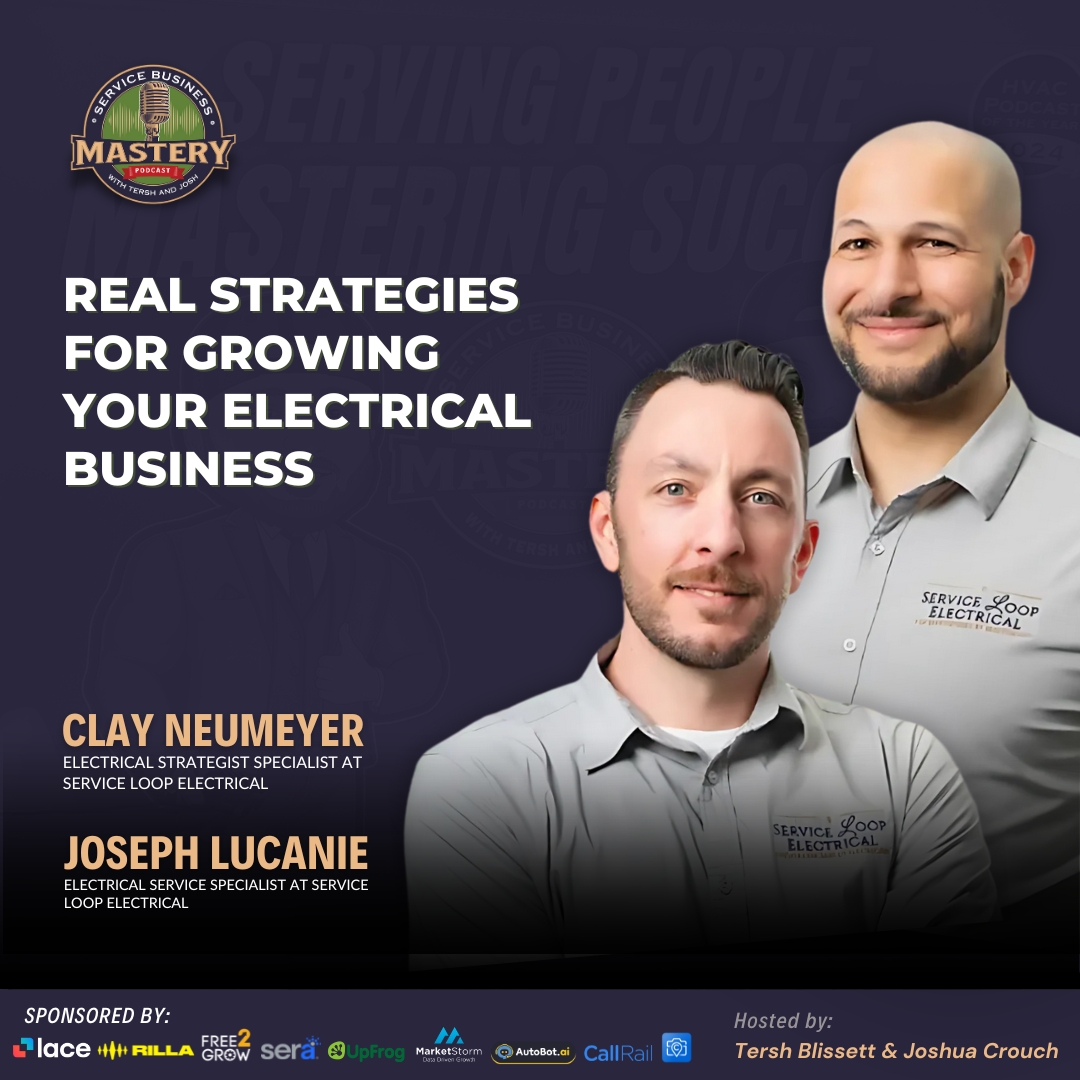
Service Business Mastery for Skilled Trades: HVAC, Plumbing & Electrical Home Service
How Contractors Escape Burnout and Build Wealth by Pricing Right and Slowing Down with Clay & Joseph
00:56:08
Learn how to automate tasks, save time, and increase your profit. No Coding required! 👉 Enroll Today - ---------------------------------------------------- Welcome to the Service Business Mastery Podcast! Visit our website for more episodes and...
Loading summary
Transcript123 lines
- [00:00]
Joe
He bought my top option without even really worrying about it and it was 20,000 plus. So you think about going back. It was a free door hanger, a $238 maintenance at the time, but just kept leading to more and more and more work and he kept referring me and being a great testimonial all through those years. So it doesn't matter how small it is, it matters the intention that you put behind it and how well you can keep up with it.
- [00:31]
Podcast Announcer
Are you looking for valuable business advice to reach that seven figure revenue mark? Do you want actionable tips to properly navigate through every business challenge you encounter along the way? Let Tersh Blissett and Josh Crouch be your guide in getting you to the top here at Service Business Mastery. Tune in as they sit down with world renowned authors in business leadership and personal growth who share valuable insights about management, marketing, pricing, human resources and so much more. Let their nuggets of wisdom gold guide you in owning a thriving, profitable and ever growing business. Here are your hosts, Tersh and Josh.
- [01:17]
Sponsor Voice
Today's episode is powered by Rilla Voice.
- [01:19]
Josh Crouch
Rilla has taken those cumbersome, time consuming ride alongs and streamlined the entire process by leveraging AI technology to do dozens of or hundreds of ride alongs virtually every single day.
- [01:30]
Sponsor Voice
They also provide you the owner or manager with the top performers KPI metrics designed easily for you to coach your team into rock stars.
- [01:37]
Josh Crouch
Schedule a demo today@www.riLa.com. today's episode is powered by Ciro Systems.
- [01:44]
Sponsor Voice
Cira is all about removing the clutter and unnecessary touch points to run your home service business profitably.
- [01:49]
Josh Crouch
They use AI dispatching to get the right tech to the right call automatically and job time efficiency to ensure your entire team runs like a profit generating machine.
- [01:58]
Sponsor Voice
Get a tech upgrade for your business at Get Sarah Tech Service Business Mastery what's up friends? Never miss a call again so our partners with free to grow their world class AI Voice CSR platform is designed specifically for trades businesses with industry leading integrations, dedicated onboarding team. You'll never have to worry about missing calls or losing leads again. Whether it's booking, rescheduling, answering customer questions or escalating to your internal staff. Their AI handles it all 247 and not only that, it can book directly into your fsm. So stop wasting time and money on leads that get fumbled. Let free to grow. Turn every call into a book job.
- [02:46]
Josh Crouch
Hey guys, welcome back to another episode of Service Business Mastery. I am one half of your host Joshua Crouch. Tersch is not going to be with us today. He is actually in New Orleans presenting for the home building conference or something like that in New Orleans. Joseph and Clay. I couldn't remember the name of the event that he's at, but he is presenting on AI and automation, trying to help out that industry. So. But today we are going to be talking about service that scales, which might sound really simple, but I was just talking to someone the other day and talking about just how terrible customer service is. Like we're getting a pool built in our backyard right now because we've literally just nothing to dirt. Like if you're familiar with Arizona, there's like, there's no vegetation. So we had to do something with our backyard. And obviously it's gonna. It's already in the upper 90s here today when we're recording this. So we're gonna pool built. And the GC sucks at communication. We actually had to have him come over to the house and yell at him because he literally won't tell us when someone's come with three dogs, cat like all this stuff going on in our house. Plus in just different thing with the kids. And I have no idea when he's coming, who's coming, when they're leaving. Should I put the dogs away or do you want my pitbull running after you? I don't think they want the pitbull running after you. We've had a lot of contractors over the years do work. Back in our house in Wisconsin, I had an electrician. You guys will love this and I'll. I'll let you guys introduce yourself. In Wisconsin. When I first started Relentless Digital, we didn't really do anything in our basement. It was kind of cold. You know, basements up in the north just. They're always kind of cold and dingy unless you really kind of build them out. We got lights installed so that way we could build my office down there. And this guy never told us when he was coming. He just showed up one day, didn't give us a price ahead of time. He cut holes in the ceiling and.
- [04:36]
Joe
He did fine there.
- [04:37]
Josh Crouch
Didn't vacuum the floor, it was carpet. Just left a mess. Didn't tell us he was leaving. Just sent us an invoice later. No review link, no how did I do nothing? I mean, he was very cheap, of course, because type of service we got. But that stuff happens a lot. And I think the Facebook you guys see, and we surround ourselves with. There's really great operators that operate in that space and they're the ones that are really engaged with all that stuff. But there's so much of the industry, home service, whether it's electrical, H vac, plumbing, like they don't even know a lot of this stuff exists and how to really raise the level. And I've been chatting with you guys for over a year, year and a half now.
- [05:17]
Joe
A little bit.
- [05:18]
Josh Crouch
Yeah, yeah. And paying attention, you guys, Facebook group and the success stories you guys have had, and I definitely wanted to bring you guys on. So with that said, we're interviewing Clay and Joseph from Service Loop Electrical today. So I'll let you guys introduce yourself and we'll get started.
- [05:32]
Clay
You know, I'll start out just by saying thank you for having us here. We had Josh on our podcast, Million Dollar Electrician. We had a great time, great discussion. So thanks for having us. And I'll just explore it.
- [05:45]
Josh Crouch
I'll figure out how I'm going to get you guys here. I don't usually press the button, so now we're good. This actually works.
- [05:52]
Joe
I'm totally down with this view.
- [05:54]
Josh Crouch
I don't know what I'm doing. If you're watching this. I'm sorry. Terse usually presses the buttons and I don't know what the hell he normally does, but we'll figure it out.
- [06:03]
Clay
We'll get that part. So Service Loop literally stands for that little bit extra for future serviceability. And it sounds easy, but it's actually hard. As you noted, that's why so few people do it. The path of least resistance is an electrical term we use often. And just like all electricians do this, all service providers do this often. We find ourselves in shortcuts from just treating the person in front of us like we want our own mother to be treated. And without boring you guys on the details. The sneak preview of all this is, of course, we're a couple of master electricians with business addictions helping electricians serve at the highest, highest level. But this stuff applies to everyone. The banker, butcher, candlestick maker, and everyone in between. They all tend to be falling short of service. And so I keep saying at a time where AI is really gripping and it's taken its hold and we're all excited at the next shiny object to maybe answer the phones for us or to DM for us in the chats to. To remove another friction point where we ourselves have to serve. I want this episode to be a call to action. For those of you true to heart service providers like King George IV said, the highest form of distinction is service to others. And Joe, I want to tag you in because you have a similar story that you need to share about your floor in the basement.
- [07:28]
Joe
Oh, my God, I love that one.
- [07:29]
Clay
Appalling.
- [07:30]
Joe
You're triggering some PTSD here.
- [07:32]
Josh Crouch
But here, let me dive into it.
- [07:34]
Joe
So similar to you, Josh, I ended up going with a cheaper contractor. One of the reasons why I was laughing when you started. Yeah, naturally.
- [07:43]
Clay
Right?
- [07:43]
Joe
So you know how you're talking about how basements can be dingy and all that. I'm in a basement office that I absolutely love because I put so much into it to make it really comfortable. But one thing that I really regret is going cheap on the floor. What ended up happening was we went for a provider, and he put everything in. And about, like, two months later, we started noticing some cracks between the boards. Like, okay, maybe it's a little bit. It was one may. It's one spot. And they started appearing in different places on my floor. And I reached out to him, like, hey, this is happening. And he's like, well, I didn't do it. It's not anything I did. Just so you know, it's not anything I did. I was like, okay, but what do we do about it? He's like, well, you're gonna have to submit a warranty, reclaim the manufacturer. I'm like, well, I bought it from you. He's like, yeah, but you're the customer, so you're gonna have to go. And so I called the manufacturer, and they said, well, you need the receipt. So I had to go back to the guy and be like, can I have the receipt for the flooring? I don't have the receipt. I don't know where it was. I have to find it. So then I come like this back and forth, and I'm finally like, listen, like, I've paid you several thousand dollars to do this. It's not a small investment of what we've done. So you've been here for a long time. Is there anything you can do? He's like, yes, I could sell you a new floor if you'd like. I can come back and we could just tear it up, and we can just do a whole new floor if you want. And I'm like, that's not what we're gonna do. Oh, yeah. So I literally had to, like, say that, oh, no, it's not. We're gonna do. Not gonna happen. It's a shame, because I'd like to have a nice, clean floor, but I also don't like being screwed by contractors. So my pride decided to let it happen.
- [09:15]
Josh Crouch
I don't think it's really, I mean there's, there's stories where it's intent, it seems like it's intentional where guys just try to sell something that they don't need and whatnot. A situation like that, it probably, it doesn't sound like that. Just the guy doesn't know what he's doing. He's not serving, he's just, you asked for a floor, he gave you a floor. It was a cheap price and he just moves on to the, he just keeps moving on to the next job and he doesn't keep his receipts, doesn't keep any of the stuff that actually a great operator would keep. So that way the service is five star.
- [09:42]
Joe
This is the cool part though, and this is how it actually ties specifically to this episode. I love doing renovations to my home. I love it. It makes me so happy. I do the electric, I do the walls, I do a lot to it. This next project we're taking on is going to be substantial. We're putting on additions to the home, we're renovating rooms, we're putting a lot into the home. And I want to almost call him and be like, hey, we've got a six figure project we're going to be taking on and I want you to know that you won't be getting it because of what happened to the floor. Hope you have a great day. Go f yourself. Take care. You know what I mean? Like, but that's the thing. He could have gotten all this extra work because I've done so much to my home and I could have had him be my consistent guy every single time. But because he dropped the ball on service, which could have been as simple as sending a tech out and just putting some floors in, he's lost substantial continuous income. Plus, yeah, the thing that's crazy is.
- [10:38]
Josh Crouch
He doesn't even know. He doesn't even know he lost that work. He just goes pays the marketing company or Google or Facebook to go get more leads because he needs more leads because he can't find more. You can't find enough business in his current customer database.
- [10:54]
Clay
Enter Relentless Digital. Right? But there's so much more into just that first touch with a new customer. It's so much deeper. We just recorded a podcast about this and actually beginning to assess your lifetime customer value, like legitimately. What if you found that, okay, over XYZ number of sales, we had 300 customers. And so each customer, maybe this surprises you and you learn that they're actually worth $15,000, not your average ticket of 1,500 and maybe that's over a period of three years. In fact, I'm reminded I'm going to go on a squirrel hunt here a little bit. But I'm reminded of. Alex Hormozi shared this at the end of one of his great videos. He said, welcome to the Coliseum. It looks like I do this all for free, but I'm just playing such a long game, you can't even see the money I'm making. But we know it's huge. What if you have those same opportunities not just in your business in this three years, but what if they're right before your feet today and it actually matters how you communicate to your next customer?
- [12:00]
Joe
You know, one thing that stands out that I remember specifically realizing was I had a customer who had bought a generator from us in year one, like, when we started working with him. And it was about, like, I think anywhere from a 15 to a $20,000 sale, which sounds great, but because we served him at such a level, he said, I'm exclusively using your company. And when I sold my company, this customer's total net value was $300,000 plus. And he was not a man of means. Like, it was. It wasn't like you showed up to an estate. This was like a bungalow in the middle of, like, northern New York. So the thing was, is because you serve at a level, the dividends are so substantial, and it's almost like, why wouldn't you want to go that direction? One, your reputation is going to grow. But two, even if you don't care about reputation, this direct income is going to be proportional to how well you serve your clients and how memorable you are. If you're not memorable, all the business cards and EDDM don't matter.
- [12:57]
Josh Crouch
Talk about service. And obviously, I think just even the couple stories and points we made already hit home. But, you know, the question would be, like, well, how come everyone doesn't do this then? Like, what do we miss? Why don't they do this stuff?
- [13:10]
Joe
If they.
- [13:10]
Josh Crouch
If we all. We've heard it. Everyone's listening to podcasts, books, Facebook. Like, there's so much information out there. They know that they're supposed to serve and provide value. And I think the word that a lot of people don't understand is the word value. Because people think that. They usually think price. Well, the price gotta be lower because they don't have enough value. They don't know what value means. And honestly, it took me a long time, too. I was training through a coaching group, and like, once the light bulb Clicks of what value is. It's like, oh, I can like add this, like the little things, things that honestly don't even cost a lot of money that the customer really cares about. But why don't contractors do this stuff? Like, why are they so busy just being busy?
- [13:51]
Clay
I will give you the most obvious example of immediate value that you can prove to your customers earlier. I'll share this in a story earlier because I'm bad with the worst of them. I'm driving down the road and I find myself, hey, someone's turning left and double yellow line, two lanes. So if someone's turning left in front of you and there's oncoming traffic, they can't turn left right away. Right. So it causes you to slow down and stop. And what do I do? I reach over my shoulder and do a shoulder check and I go to go in the right lane. Why? Because I don't want to wait the extra three seconds for this traffic to clear and this person to turn left. Everyone inherently knows this. We're all rushing around, treating time as the number one priority and it's making us grumpy about some really small stuff in life. But you can use this to your advantage by. While everyone else is rushing, you can actually slow down and say, you know what, I'm going to spend some extra time right here. And your customers begin to notice this. That's the most minuscule, simple explanation I could give you on that, Josh. Just as like a first outstanding value. Does that make sense?
- [15:04]
Josh Crouch
Yeah, I'm actually, I'm reading 10x is easier than 2x right now. If you guys have read it by Benjamin Hardy and Dan Sullivan, Literally. It's so funny because everything we think about success is opposite. Like you got the, the hustle and grind. Typically it's guys, I don't see too many females doing the grind, grind, grind type thing. Work 16 hour, 18 hour days. But the whole premise of the book is to get rid of the things that you don't like doing you're not good at. Like, I think he's actually in your group. He's local here to me. His name is Ren. Because he's small, he's. He's trying to figure out the admin side of things. Right. And the admin side of things bogs him down. It bogs down. So. And I'm sure you guys run this a lot because you guys work with a lot of six figure electricians trying to get to seven and and beyond seven figures and above. They're doing everything. They're Invoicing, they're handling the calls, they're handling website inquiries, they're dealing with a marketing company, they're putting out fires. They're trying to network with local people, they're trying to their business out there by posting on Facebook. And then they're also trying to sell, and then they're trying to install, and then they're trying to implement a new CRM. There's just so many things that they get caught in the busy work that the customer is like the last thing on their mind. Like, I got customers coming in, it's fine. And they don't think about that next job that that customer might hire you for. They might hire you to fix a light switch or something now something really small, but eventually need a panel rewire. Maybe they want a generator. Because they live in the part of the country that's in shambles, or at least the U.S. clay, I know you're from Canada. The part of the US that's in shambles right now from all the weather and stuff, they don't think about that stuff. It's like very short term. Like, just take care of that little thing in front of me. And I'm not looking beyond that. Like you said, playing the long game with Alex Hermosi and what he's doing, like all he pushes out so much free value to anyone that pays attention to him that you almost feel like, can I pay? You can at least just can I buy something from you? Because you literally give me so much free information to help me grow, I feel like I need to pay you.
- [17:11]
Joe
There is an example that came up that you just triggered my memory for. That I want to say is a perfect example of what you're talking about. Clay, remember customer that I was talking about who bought a maintenance and then ended up going and upgrading? So year one, Joe, my partner and I are just. We're broke as a joke. And we're just handing out door hangers, going to neighborhoods that are high impact for generators. And all it was was just door hangers for maintenance agreements for generators. I sold one agreement on one day of a walk. And the guy had me maintain a generator that he had installed by someone else. And every single year he would call us back for this maintenance because we would sell the next year in advance. And every year he would add a little bit to it, like, well, I need something inside the home, little bit. And about five years went by and the generator that we kept telling him was going eventually failed. It completely shit the bed. And what ended up happening Was we were able to sit down and present him a whole suite of options from a complete like, let's upgrade everything, let's make your home office good. Let's really put in a system and down to like I'll just put in what you have. But we had so much rapport over that five year period of time. He bought my top option without even really worrying about it and it was 20,000 plus. So you think about going back. It was a free door hanger, a $238 maintenance at the time, but just kept leading to more and more and more work and he kept referring me and being a great testimony all through those years. So it doesn't matter how small it is, it matters the intention that you put behind it and how well you can keep up with it.
- [18:47]
Clay
Can I try to tie this all together for you guys? Because we've talked about a few topics and I have an exact example that I use when I'm teaching classes about operations in this service realm. By the way, guys, we've got a ton of good stuff and this is going to lead to pricing shortly and we've got this awesome value piece for anyone that wants help with their pricing. So please stick around. I want to go back to this impatient game for a sec. Josh, let me ask you a question. You probably have a regular fuel station that you go to to put petrol in your vehicle, truck, car, whatever it is. But what happens if when you're driving by, you see a lineup at the pump that you need? Do you go and wait in line or do you go to the next station?
- [19:27]
Josh Crouch
I would usually go to the next one.
- [19:29]
Clay
And me too. Most people answer that the same way. It's again, this little rush thing that we're doing, rushing through life, trying to get the most results.
- [19:37]
Josh Crouch
That's probably not going to save me time.
- [19:39]
Clay
No, no. There's two ways to go with this, but I'm going to share a key strategy that I would use if I owned a gas station. And this is actually something that's also built really off of Alex Hormozi's value driver framework. It's something that we accept to be true. There's a few things that we need to control. We want to increase desired outcome. Josh wants fuel and faster time. Right. We want to limit the risk. Well, the current risk is that Josh would have to wait and then there's no telling how much time this person takes. The negatives on the bottom we're trying to release, remove entirely our time delay, which we just spoke to you don't want to wait. That hurts you. That's pain in your life. And you don't want effort and sacrifice. So as an example of that, at the gas station, what if this guy then goes in for snacks after he's done fueling and gets some chips and maybe orders a coffee, and that takes a few minutes, and now you've got to back your vehicle up and go to another pump. This is all super painful to you in a general experience, right?
- [20:39]
Joe
I'm with you there.
- [20:41]
Clay
So let me solve this very quickly. Some gas station owners might say, well, what we need is faster pumps, because I'll have less lines and I'll invest in the faster pump. And that's the way a lot of electricians and other service providers think about their business. Well, maybe I make the team faster, right? If we could just do our services faster. But there's actually another way to solve this problem. What if I put a meter above the pump that communicated how full or what percentage complete that person filling up was? And when you were driving by, you noticed, hey, it's at 90% full. The next spot's open. Now, would you drive to the next gas station?
- [21:23]
Josh Crouch
You know what's funny? Costco actually does. Not the percentage, but I don't know if they do this for all of them, but I know the one here. When you get in line, there's four. Four in a row. And there's probably six or eight rows. But they have just like, some parking garages have this too. Actually, I've seen this at airports in the bathroom, like, there's a little greener red light above. So, like, when it's in use, the red light goes on. It's not open. It's the same thing with the gas pump where it's. Because then I know, like, oh, I'm not gonna go in that line. I'm gonna go in this one over here because this one's got a green one the second out of fourth slot, and I can slide in. So very similar to what you were saying that in Regardless, I know Costco's gotten into politics lately, but regardless, the operation of their business is one of the best in. In all of business. They understand why the hot dog is a dollar 99 cents to bring people in, because they buy a bunch of other things even though they're losing money on that. They understand the concept of those sorts of things that cause pain. And then they get people in the door, and then we go buy 300 worth of stuff every time we're there. Because we need water and food and everything else.
- [22:29]
Clay
We're going to learn so much from Costco because there's another way. They help, too. But in this case, what did we change? Just the communication. All I did was communicate with the customer better. Yeah.
- [22:40]
Josh Crouch
Same pump, same station. They didn't move anything. They didn't add any pumps. They didn't make it any faster. This was available sooner. Might be okay to wait in line because they're at 90% full.
- [22:50]
Clay
So how do we implement that in our service business? We slow down. We commit ourselves to full communication when it counts, and we do the right thing by the customer in front of us and ignore everything else during that time because it doesn't matter right now. And so you mentioned, like, a friend, Ren and smaller guys that are overwhelmed. Well, I had a mentor explain. And, in fact, it's a question he asked me. He said, clay, do you think that how you do one thing is how you do everything? And it was at that point I realized, holy crap, I'm doing a lot of stuff really shitty.
- [23:24]
Josh Crouch
You're busy being busy.
- [23:25]
Clay
I was not having a great impact anywhere, and I was willingly walking into that every single day of the week. Overwhelmed, not sleeping well. And my customers were confused. Does that sound familiar to anyone?
- [23:38]
Josh Crouch
Well, and I feel like this gets into. And I. I told you guys we'd talk about this because this is such a. I see it a lot. I'm sure you guys do. I'm sure a lot of people that serve contractors see this. But the problem is we don't price ourselves properly in order to make a profit. So we can actually sit there and take our time with customer in front of us. Because if we don't price ourselves properly, the only other way for us to win is on volume. That means we have to do more jobs. So instead of maybe three or four jobs for your electricians, we got to do six or eight. We got to speed. Speed it up so we can make more dollars because our profit is too low. And I know you guys, this is, like, one of the first things I think you guys talk about with anyone I've ever seen come into your group or your program. So I'd love to hear your guys's take on, like, how you guys approach that conversation to get people to start really looking inward. Because starting out when you're small is a lot easier to fix your pricing than when you're bigger and you have a big team and bloated overhead and all these sorts of things. Like fixing this stuff early allows for growth it allows for marketing, it allows to go get more customers, it allows for time to hire people. It allows for a lot of I'll call it luxuries because you've set yourself up for success. So I'd love to hear your guys take on how you guys approach that. And if there's any tips or tricks you guys have for contractors to look at their like really sit back and look at their pricing.
- [25:00]
Sponsor Voice
Hello home service professionals. Do you want to maximize your marketing budget? Then you need to be using call tracking from Call Rail. Let's say you've noticed a spike in new leads this month. To find out what's driving them, you just log into your CallRail dashboard. Is my new Facebook ad outperforming my other ads or is paid search knocking it out of the park? Or maybe it's time to retire those newspaper ads. Since CallRail assigns a unique phone number to each of my marketing efforts, I know where my best leads come from and which efforts to scrap. CallRail shows you your most cost effective marketing channels so you can get back to business. Go to CallRail.com sbmpod and try it for free. Today's episode is brought to you by one of our show partners, upfrog.
- [25:47]
Josh Crouch
Upfrog is the OG when it comes to pricing transparency online. They find system replacement leads through paid ads and have developed an entire system to drive those hard to find system replacement opportunities. Nurture the leads and book them into sold systems before your team arrives to help you grow your business.
- [26:04]
Sponsor Voice
Learn more@upfrogio. If you're a contractor with multiple CSRs, check out this service Business Mastery podcast partner Lace AI Lace uses Cutting Edge AI to analyze your phone calls, uncover lost revenue opportunities, and empower your CSRs to convert more leads. You can significantly increase revenue without spending extra on marketing or hiring. By using LACE AI to boost your conversion rates for the first time, you can gain deep insights into customer needs at scale with minimal effort. Elevate your call center to achieve industry leading booking rates and revenue. Visit www.lace.AI to book a demo today. Now back to the show.
- [26:48]
Clay
I think first and foremost the analogy of the boat really helps. You can see ships at bay if you're just starting out your ships at the dock and if you've been out there for a while, we'll come back in. Let's pull into the dock for a second. How many holes are in your boat? Are you bleeding right now? You know what I mean? More month at the end of the money than money at the end of the Month. Things aren't adding up. It's time to come to dock and assess this. Because being out there, bailing the boat every, every minute of every day, that's that busy stuff, it's not adding up. And we keep telling ourselves out of fear that everyone else is priced the same. And usually we priced ourselves off of the last employer, or we mystery shopped someone and just use their rate and then wonder why the money's not adding up. We talked about value earlier, now we're talking about pricing. The truth is we need to flip our priorities and prioritize learning, value, articulation and service, and how to structure and systematically price in a way that you literally give choices and they will choose you. And once in a while, as Joe's become the expert of creating these choices, these solutions, once in a while, they'll choose you at your best. And there's no better feeling than someone choosing you at your best. Except for this one thing. When you hire and train someone to work for you and they get chosen at your best when you weren't even there. You were filming a podcast here, Joe.
- [28:12]
Josh Crouch
That's how you get the business to work for you, not with you in it all the time.
- [28:17]
Joe
I really do agree with you guys. It's amazing how sometimes the slowing down is actually what allows you to be better. Like, I've always viewed it as we're great electricians, like, we all consider ourselves great electricians, and then those same great electricians find themselves not having work. It's like, why aren't you having work? It's not because you're not a good person or you're not good a worker. It's that if you can't communicate what makes you better in a way that the customer can understand and see value in, they have no reason to pay more to hire you. So if you can make sure that you've slowed your process down so they can see it, you're actually spending more effective time. Because in that situation, now they can choose you willingly. Not only now, but they can see the difference between you and your competitor. And the difference between you and your competitor isn't just in skill. It's in saying, I can serve you in a way that you can appreciate and understand. And it's a consistent, safe bet every time.
- [29:12]
Clay
Many people have called Joe the sales bot. Here's the thing, Josh. I've seen Joe help electricians and other service providers even with price objections at $150 an hour. And I've seen Joe help providers with price objections at $700 an hour and everywhere in between. And it's always the same amount of objections.
- [29:35]
Josh Crouch
It's the fact that they don't think they're getting enough for that price. It goes back to that value proposition. And I think all too often in the trades, we're problem solvers. We fix the current problem, but that's all we fix. We fix the thing in front of us. We kind of have blinders on, if you will, like horse blinders. See what else is going on. Like, what originally caused the lights to be flickering in the house? Was there something else in the wiring that caused that? Was there something in the panel? Something that's loose? Like we tighten something. We fix that problem. In H vac, which is my background, that's capacitors. Like, literally in the summer, those things pop like crazy. You're just throwing them in. The first house we had here in Arizona the first summer, of course, the house is like 4 years old. So newer system thing popped. Literally, the house went from like 68 or 70 to like 85 in like three hours. Like, it just got hot fast. We literally. We had two systems. So we were like, all in our bedroom because the bedroom one was working. And they did 20 minutes. They threw it in. Didn't give me any options, didn't talk about anything else. No maintenance plans, nothing. And they were going. And I'm like, okay, I guess that's it. It's 200 bucks and we're done. I never called them back. I don't know anything else about their company. Right. Like, obviously I know, but if they're not going to try to win my business long term, why would I care? And I think, honestly, early in my trades career, we were literally going. We were shotgunning. We would literally take jobs anywhere. We weren't trying to become five mile famous. My text, we drive in 45 minutes between jobs. And I'm sorry if they're ever listening to one of these, that I did that to you because that was really stupid. I didn't know at the time. We were just trying to get as many jobs in as we could. And because I. We needed cash that in the first business I worked at, really needed cash. Like, we were behind on a lot of stuff when I started, and we just didn't slow down. We didn't train our customers what we offered. We didn't have that conversation at the kitchen table and show them all the different options for their home that they could have upgraded into, that could have made them more comfortable. They could have made Their. Their basement more comfortable, or their office that's in the SEC on the second floor. We just didn't have those conversations. And I think the busy. Being busy is a thing I keep coming back to because that's literally. It talks a lot about that. And 10x is easier than 2x because a lot of people live 2x thinking that that's the way just grind through it, just keep pushing, just work a little longer, take another job, work on the weekends, and they don't back up and just stop. Like, literally just. I'm not answering the phone, I'm not answering my email. I'm not doing anything until I fix this problem in front of me, because this problem is going to solve everything else. What are their pricing? I keep. Sorry, there's just so much good information here. What are the common things that you guys have a initial consult with somebody, you're talking about this. And I'm sure pricing comes up almost immediately. What are the common pitfalls and problems that contractors face?
- [32:33]
Clay
Yeah, I'll unpack this for you for sure. One of the first things that our tool and training does is actually has someone assess the personal requirements they have as a business owner. And we know that there are thresholds later that will come into play that will literally tell you based on some of the best of the best. Are you overpaying yourself? But at first, I don't really think that matters because you took a chance. You're in business for yourself. You likely started business for two reasons. You wanted more money for your time, and you wanted more control of your time. And ironically, most.
- [33:07]
Josh Crouch
There might be a third. They might just be unemployable.
- [33:09]
Clay
They might be unemployed. That happens. Scoot. We've seen that happen. But the reality is you end up with less sleep, less time, and less money than you ever had before because you don't have any skills yet. So, number one, what do I need to earn to pay the bills so that, as we say in our values, health, family, then business. Josh, if your health is crap, I know you're working out. I'm seeing your videos, hearing about all the stuff you're doing. Why is that? Why do you prioritize your health?
- [33:38]
Josh Crouch
Ever since I started, like, honestly, I'll get through days before I started this journey, just crap. Just like, I would push through it. Like everyone you know, it's like, oh, you just got to keep. This is life, right?
- [33:48]
Clay
This is.
- [33:48]
Josh Crouch
This is as good as it's going to get. You just got to push through it. It's normal, right? You hear that stuff until you start working out and you start eating right and you start taking some supplements for. Because your body needs some different stuff. Now I feel like a freaking king. Like I can just keep working and I, I don't have to stop when I work. I can actually give it 100. I'm not like, oh man, I'm just like dreading doing this thing. Biggest thing too. Like Monday, I had one of those days where we were training for the Spartan race. We had 5 miles hour long session at Augment, which was compression therapy, sauna, cold, hot, cold, hot, cold. And then we were outside for three hours at a 90 degree temps at a soccer game. And then Monday I was just like not feeling it at all. Cancel my appointments. And I literally just knew, like. But because we've set ourselves up in the business where we have people that do things, we price ourselves, right? We, we took the time to, to fix the processes of the business. I took the day off for the most part. I still answered some stuff, but I took the day off and I just recuperated. And now yesterday was Tuesday, today, Wednesday. I feel great and I feel awesome. But I'm able to do that and a lot of people can't. They can't take the. I literally, I put out a post and sorry, I'm like totally getting back.
- [34:58]
Joe
It's all good.
- [34:59]
Clay
I'm keeping track. I'm ready.
- [35:00]
Josh Crouch
Yeah, no, I'm glad. Keep me on track. But this is why I'm glad church isn't here. You can't yell at me. They can't mute me either. But I put out a post about like, if you lost your business, what would you do? And some people are like, oh, start it over again. And one guy said, take a vacation.
- [35:16]
Joe
I said, why can't you do that.
- [35:17]
Josh Crouch
Now I'm too busy. That's. That was his reply. And I'm like, then you don't own a business. The business. You own a job because you constantly have to be working.
- [35:26]
Clay
Yeah.
- [35:26]
Josh Crouch
You should be able to take time away and your business should still flourish and grow and you should still have a team that's able to sell at the different options like Joseph talked about. But I think everyone's too busy. Well then all of a sudden you're either divorced, you're 50, 60 years old, and your body hurts and you've done nothing. You've never traveled, you've never experienced life, your health is crap. And we're just in this cycle of like, no, that's just life. That's how it go. That's how it goes, right? That's.
- [35:52]
Clay
Yep.
- [35:52]
Josh Crouch
And I feel like that's. We just accept mediocrity with our life when in reality we work to live. To your guys's point about health, family, business, then business.
- [36:03]
Clay
Yep. You nailed it, man. And that's it. So if your health falls apart, so does your family. If your family falls apart, so does your business. There's no other way. So we prioritize you paying yourself enough to survive that. Because this is going to be a grind for a bit. Let's not sugarcoat it. What premium service really is, is I'm going to quiet my own needs for a moment to focus on a person across from me. And for that reason we can do incredible things. So the first thing in the pricing framework is what do I need to earn that needs to go in my burdens right now? And that's step two. What are the burdens? What are the costs of business today as it stands? What do I got to pay? How do I run this? What's my overhead? What are my cost of goods sold? That all has to be baked into this calculation. Next step is growth. Most people don't factor this in. You might be driving a caravan still, you might be that fresh or you might have two vans. But if you're not everywhere that you want to be today, then you need to be priced differently. Because guess what? Newsflash, guys. You don't need a loan, you don't need investors to be successful in service business. You need confidence and value articulation. And if you set those systems up right, then that means that you're pricing for growth as well. So if the vision you have in mind includes a shop, then start charging for a shop. There's no reason to wait until you have the shop to then decide, oh, the magical day came where money just magically appeared and now I can afford this thing. You've got to live a life by your design or you'll fall into someone else's.
- [37:39]
Josh Crouch
Is there some sort of exercise or questions that you guys ask someone to, like, think that stuff? Because I think a lot of times people just get started because we talked about maybe they didn't want to work for someone else or they thought they could do it better or maybe they just were unemployable. They start a business, they open it up. Well, I'm going to charge 95 an hour because that's what they charge at the last company. I have no idea what six months looks down the line. Looks like 12 months, 24 months, like a shop, like, that's like a pipe dream, right? Because I've not even thought about it yet. Other questions you guys ask people that when you guys go through this pricing conversation that, like, get them thinking, kind of get that creative juices flowing.
- [38:13]
Clay
Honestly, it's as simple as, what do you want? I mean, everyone's got to be able to answer this question. And honestly, if you can't answer it, then I would take a vacation. Like the suggestion the last guy mentioned, Josh, because I don't know about you, but that's where I have my clearest thinking. When I'm away from everything, just focused in the afternoon on the sun hitting my skin, or on the book in front of me or listening to a podcast. Maybe it's this. Listening to an audiobook, all of that just inspires me to be something greater. And I use that to get clear on what it is I want next. It's as simple as that. You can readjust this plan, and we suggest you revisit your pricing twice a year at least.
- [38:52]
Josh Crouch
How often should we be asking ourselves those questions? Because, like, I. I know we're. This is Mar. April. Good Lord. Lord. The year's already flying. 2025.
- [39:00]
Joe
Is that.
- [39:01]
Clay
It is.
- [39:02]
Josh Crouch
By the time. By the time this gets released, it'll probably be sometime in the summer. Should we be revisiting what we want once a year, twice a year, Every month? I know there's probably no perfect answer, but what would you guys say to that?
- [39:14]
Clay
There is. Let me just say this, Joe, and I'm gonna tag you right in. No problem. You mentioned Dan Sullivan earlier and Ben Hardy and the book. What was it called again, Josh?
- [39:24]
Josh Crouch
10X is easier than 2x.
- [39:26]
Clay
I haven't read that book, but I know Ben Hardy and Dan Sullivan, and what he committed to was writing a book every quarter until he got to 25 books. That's strategic. Coach is the company that he owns, massive group coaching company, and they work on something called Power Quarters. And that's a philosophy that we believe in, too. Every quarter, we come back to the drawing board and look at what's next. Joe, you're up, brother. Thanks for the patience.
- [39:51]
Joe
So I almost have a slightly different approach of what you can ground yourself on. And for me, it's what is your why? And is your why bigger than your why not? The reason why I say that is I remember keeping a picture of my wife and my infant daughter at the time right on my dash of my van. And every call, I looked at them, and I was like, I have to provide for them. This is something I have to do. I don't care how late it is. I don't care how hard it is. They're right there. They're my everything. They're my life. And it was my grounding moment to say, that's why I'm going to work so hard. And if you put your faith behind what you're doing, your faith can override your fears. And once you're a man without fears, you're unstoppable.
- [40:39]
Josh Crouch
Not deep, but not like it's. It's easy to digest, but I like that. Just putting some sort of simple reminder of why. Because I think a lot of times we lose track of why. We're just doing it because we want to make a paycheck. Maybe we want to make. Get a bigger house or move or, you know, whatever. And those things are. Things sound nice, but they're not. It's not living. That's not the reason why we should be doing anything. Of course, it's a byproduct. But never be the primary reason, because at some point, you're gonna have all this money, and then what?
- [41:12]
Joe
This is the quote that shakes me and. And makes my hair stand up every time I hear it. The only people who will remember that you work late are your children. In 10 years, that's the only people who will know. And I cannot allow my children to go through what I had to go through. I can't. It's unallowable. So I'll find a way to work hard now, but also to clock off. I will consciously clock off so that I'm actually living. And if you're not actually living, you're just dying in a slow way every single day. Yeah.
- [41:45]
Josh Crouch
There was a recent story, I don't know if you guys saw this one circulating Internet, about the guy that sold Loom. You guys see that story? He sold for, like, a billion dollars. And he went on a podcast, something, talking about just how unhappy he was afterwards because he felt like he had no purpose. That was everything to him. And I can relate to that. I'm sure you guys tend to at some point in your career where your business was your identity, it was your entire existence. And if you lose that, then who are you? What do you stand for? What do you live for?
- [42:16]
Clay
Right?
- [42:17]
Josh Crouch
What are you gonna do every day? Like, you're gonna wake up and just kind of die. And I think a lot of times when people retire, the same problem happened. This work was everything. And then they retire, and then they Just could fall apart because they don't know what to do. They don't have hobbies, they don't have interests, their. Their families probably not that close to them anymore or whatever. And it just. They fall apart.
- [42:39]
Joe
You know, a way of looking at that. It's almost like having a retirement account. If you were to sit down and talk to someone about money and say, hey, are you planning for your retirement? They'd be like, oh, yeah, I got my 401k, I've got my money. I'm putting my IRAs. I'm good. But the retirement isn't just the things. It's what are you investing in that actually matters? Me clocking off and saying I'm going to have dinner with my family is putting a coin in my future retirement. Because what that's doing is saying, at the end of all of this, I know even if my body breaks even, if my business fails at the end of this, what I have to lean on is all those time coins I put into my family. Because if I have that, I truly have everything in the world and everything else just a bonus. Faith and family are the two most important things to me. So if I can keep investing into those two categories, I'm set. The money can come and go, but as long as I have those things, I'm good.
- [43:33]
Clay
I had a massive life shift too, and it was about money. And it was from a guy named Kyle Cease. And what he did. He wrote a book and did a little documentary called the Illusion of Money. And he talked about money in three concepts. He said there's A money, B money, and C money. A money being today money. It's gone already, right? It's expendable. It's just going. It's your food, it's your gas, it's everything. The rent. The B money is the money you put away to make, to be valuable later, to make you money. But C money is the money you invest in yourself, and C money is the only money that, barring any cataclysmic events where you lose your head, although we're close to putting heads in jars and actually talking to them, no one can take this away from you. I doubled down on C money, and I use discomfort as a compass. I just commit myself to being a lifelong student and knowing that if I continue to learn more and grow my skill set, then I will always be more intrinsically valuable. And what I've seen as a result is my extrinsic value exponentially rise directly with it. Does that make sense?
- [44:41]
Josh Crouch
It's a byproduct of the fact that you're putting more value into the world. One of the sales guys at Genius Network, actually someone who was on the podcast last year, Jonathan Wispon Porter of who Hire which doesn't think they can find good talent. That's a great, great hiring system if yours ever look into it. It automates most of the process. It's really nice. He is part of Genius Network and the Joe Paulus part of their thing is to. I can't remember the name of the title. I don't have it right in front of me, but it's the Life gives to the giver or something like that. It's all about the giver's gain. It's such a different mindset from what we are taught when we grow up. Like we're not taught to create value for other people. We're caught. We're taught to go get a job, work seven, eight hours a day, you know, come home and then just do your thing. Like, we're not taught to give any value to anybody. So when we start a business, the word value, we don't understand the meaning. And everyone keeps saying you got to give more value because if you're raising your price, ideally you give more value. Otherwise that's where you have the price complaints or you have. You start getting more no's at at the kitchen table. I just can't figure out what makes our service more valuable, what makes us different. Just like we talked about podcasts, audiobooks, like reach out to people. There's been some great recommendations for books here, some great questions to ask yourself and to stop. Take time and do those things. Find time. You have time. Everybody has time. I hate when people say they don't have time because you can always make time for the things that are important. Great example. Two and a half years ago, I wasn't working out. Occasionally once here and there, we literally rearrange our entire calendar to put our our slot with our trainer in Monday, Wednesday, Friday and Saturday. It's during the workday, so we have team members reach out. I'm not available right now, period. Like this comes before the other thing. You have time if it's important. And I think a lot. All too often we never have time for anything. Yeah, you do. If it's important enough to you, you just have to prioritize it better.
- [46:37]
Joe
It's not just working late either. Like, that's the crazy thing. People are like, I'll make time. I'll just do it at the end of it the things you do at the end of your rope will always be the least energetic and least passionate things. And if you save you for the end of your rope, you're really not really doing a whole lot of good.
- [46:54]
Josh Crouch
Investment or your relationship with your significant other. The breadcrumbs left on the table. Your business, your employees, your customers, get all the rest of you. That's why relationships ended. That's why we have such a. I mean, I don't know what it is in Canada, Clay, but I'm sure the divorce rate is not that much different from the US Divorce rate's been high for a long time because we don't build meaningful relationships with people anymore. It's very transactional. And then when we have meaningful time, we're all staring at this stupid thing, watching the funniest videos or whatever is on. On Facebook or TikTok these days. Thank you to Company Cam for supporting today's episode.
- [47:30]
Sponsor Voice
These guys are changing the game for contractors with their smart photo app.
- [47:34]
Josh Crouch
Keep your projects documented and streamline your team's communication with even your most complicated jobs.
- [47:39]
Sponsor Voice
Try it for free for 14 days and get 25 off off of your first two months@companycam.com SBM.
- [47:48]
Joe
You know, it's crazy because if you think about what the end result is is that I never want my wife to think I'm treating my clients better than her. You know, I don't ever want her looking at it and saying, I would trade the money to have you, because that's the wrong direction. That means I failed as a person. I. I want the people closest to me to say, yeah, he worked hard, but, man, did he make time for us. And if you can go down, if I get hit by a bus tomorrow, I know I can do that. And if you can do that, you can, you can die happy. You know, I want to put a.
- [48:17]
Clay
Cap on the price thing before we lose it if I can, just because I know. Speaking. The irony here is that we do have a time.
- [48:24]
Josh Crouch
I want to drop your guys podcast and I mean, I know your Facebook groups for electricians, but drop that stuff in here so that way people listening. That way we can get the information out to them.
- [48:33]
Clay
Perfect. Let's do a shameless plug grade after this, then. So, guys, if you're inspired by this episode at all and you want to get your pricing right and you want to factor in all those things we talked about, plus the ideal profitability that we see in service industries, which for electricians means you're 50 to 60% gross profit at least with a 20% net. That means for every 100k, you're keeping 20k, able to allocate that to your family, your health, whatever you need as a business owner, that's what makes it worthwhile. If you think that that's somewhere you want to go, then there's tons of available resources for you on top of just this episode. Your next steps are making sure that you're providing flat rate and you're providing choice for your customers, not just in your sales process, but in the options that you present them to shop with you at different levels. Do you remember we talked about Costco? Can we just say this quick? And then, Joe, I want you to share the win of the week for just proof of this. Costco is not filled with rich people, is it? It's full of the middle class, and yet they paid for memberships in advance just to be able to go there and spend more than anywhere else. The last time my partner went to Costco, she came home with a $700 receipt, and I was like, what happened? Well, we don't have to buy our favorite cookies for six months.
- [49:54]
Joe
I'd kill that. I'd kill it so quickly. Maple cookies not survive in my house.
- [49:59]
Josh Crouch
That'd be like six weeks.
- [50:00]
Joe
You're done. Done.
- [50:03]
Clay
That's just proof that there's different buyer archetypes and that your options are going to serve them with choices to work with you at different levels, from the most permanent to the most temporary solutions you could provide. And if you do that, it won't matter the price. And Joe's going to tell you a quick story right now about one of our guys who just proved that with a massive win.
- [50:23]
Joe
Awesome. I assume we're talking about Charlie, correct?
- [50:25]
Clay
Yeah, man.
- [50:25]
Joe
Awesome. I am so proud of our client, Charlie, because the thing was, when he first started, he was as anti options as you can get. Like, it was like, I don't do options. That's salesy. I'm just gonna do this. And, you know, I respect the guy for it. You know, he's got his opinion and stick to it. But I did everything I could to show him the value of options. And eventually he got to a point where he's like, no, I'm only doing options. I love that. So we made a huge shift. But the win that he made was that he went to a competitive call and was in an apples to apples comparison situation, and he sold an ultra platinum, meaning that he had sold the best of what he could get. It was like a $35,000 platinum. But the huge win isn't even the number. It's that in an apples to apples comparison scenario, he was $10,000 over the next quote and they still willingly chose him. And they were happy about it. Like, they were like, I'm choosing you because of this. And the ultimate win behind that is he invested more time with this client. He offered them more choices, he gave them better, you know, understanding what they had. He explained the benefit of why it's going to benefit them now and later and tied it to personal and emotional reasons. And the customer just saw a clear win. Like, if I go with him, not only did I win in this capacity, but I'll have more of what I want and I deserve that, and that's huge.
- [51:53]
Clay
First sale. It's just the first sale. Wonderful. How did you change?
- [51:58]
Josh Crouch
It changes the entire perspective that you can do the same for the most part, the same work, same material, same same everything. Do it at the price that you set and find the customers you want, not whoever's going to pay the cheaper rate.
- [52:13]
Joe
And going back to the beginning of the call, remember when we first started and we're like, well, you just do more calls, do more calls, do more calls. He doesn't have to now because he took more time with one client. He did the two call close, set it up the right way, made the extra time, and has a substantial dividend reward from it. And now the customer is going to keep using them in the future. It was a win right now and it'll be a win in the future. All because he took the extra time and now could make a sale that allows him to scale.
- [52:41]
Josh Crouch
So I know you guys have your own podcast, so I'd love to, you know, share that with people because whether you're an electrician or not, these things, these concepts are, they go across any service business. So I'd love to get that information out there for people that want to learn more.
- [52:56]
Clay
Million dollar electrician podcast sale to scale for home service pros. It's everywhere that you listen to podcasts. Apple, Spotify, we're on YouTube. Released pretty much every Wednesday, pretty accurately for a while. We did five episodes a week. We were going live every day. So we did that until we hit 250 episodes. We wanted you to have enough inspiration to be with us or us be with you in the van five days a week for a whole year.
- [53:24]
Josh Crouch
When you guys share a lot of stories from. You guys share a lot of stories from the people that you worked with too, like the kind of their Transition from where they were to where they got after they started understanding these concepts. Correct.
- [53:34]
Clay
Yeah. Our latest client interview was last week with one of our great guys. Nathan started his business March 1st and April 2nd was on the podcast Shotgun Client Interview with $75,000 first month following these principles verbatim talks about it on the podcast guys, if you're interested in that come find us Million Dollar Electrician podcast. We're also on Facebook, Facebook groups Million Dollar Electrician as well. And you can find out more about Joe, myself and the team@serviceloop electrical.com Love that guys.
- [54:07]
Josh Crouch
Awesome. Thank you guys so much. I honestly, I think we just barely scratched the surface of going deeper into some of these topics. Such important fundamental principles of growing a service business. Because there's a lot of things you can layer on top of this once you get to 3, 5, 10, 10, 15 million. But a lot of people struggle to get to a million or two. I've seen the post over and over again. I've been at 500000 for six years. They just can't figure it out. They think it's the market, nobody wants to work for them. They can't find good help. All the things. And I'm just like it's just taking that. You got to take the time to learn, listen and be willing to make a change in what you're doing. Stop doing it the same way you've been doing it because it's not working. So.
- [54:50]
Clay
And that's really appreciate you brother. Helping people. Just see that. Find that thing again. Service loop. It's that little bit extra for future serviceability. Don't just listen to what we say, watch what we do. It's the same thing.
- [55:03]
Josh Crouch
Yeah. Awesome guys. Thank you so much for joining. If you guys have listened to this episode and it was valuable to you, don't forget to leave us a review because we always love seeing those. If it's less than five star, email tershervicebusinessmastery.com and tell them why and then he'll forward it to me and I'll just probably throw it in my junkyard email.
- [55:20]
Clay
So I'm leaving a review for sure and sending Tertian email. Thanks.
- [55:26]
Josh Crouch
Until next time guys. We'll see you.
- [55:28]
Joe
It's really been our pleasure. Thank you very much for having us.
- [55:41]
Podcast Announcer
Thank you for listening to this episode of Service Business Mastery. Now that you are a quick equipped with essential business advice from this impactful conversation, you are one step closer to becoming the successful owner of your dreams. If this episode has been helpful to your business journey. Don't forget to subscribe to the show, leave a rating and share it with other owners as well. Visit servicebusinessmastery.com to learn more.