← Service Business Mastery for Skilled Trades: HVAC, Plumbing & Electrical Home Service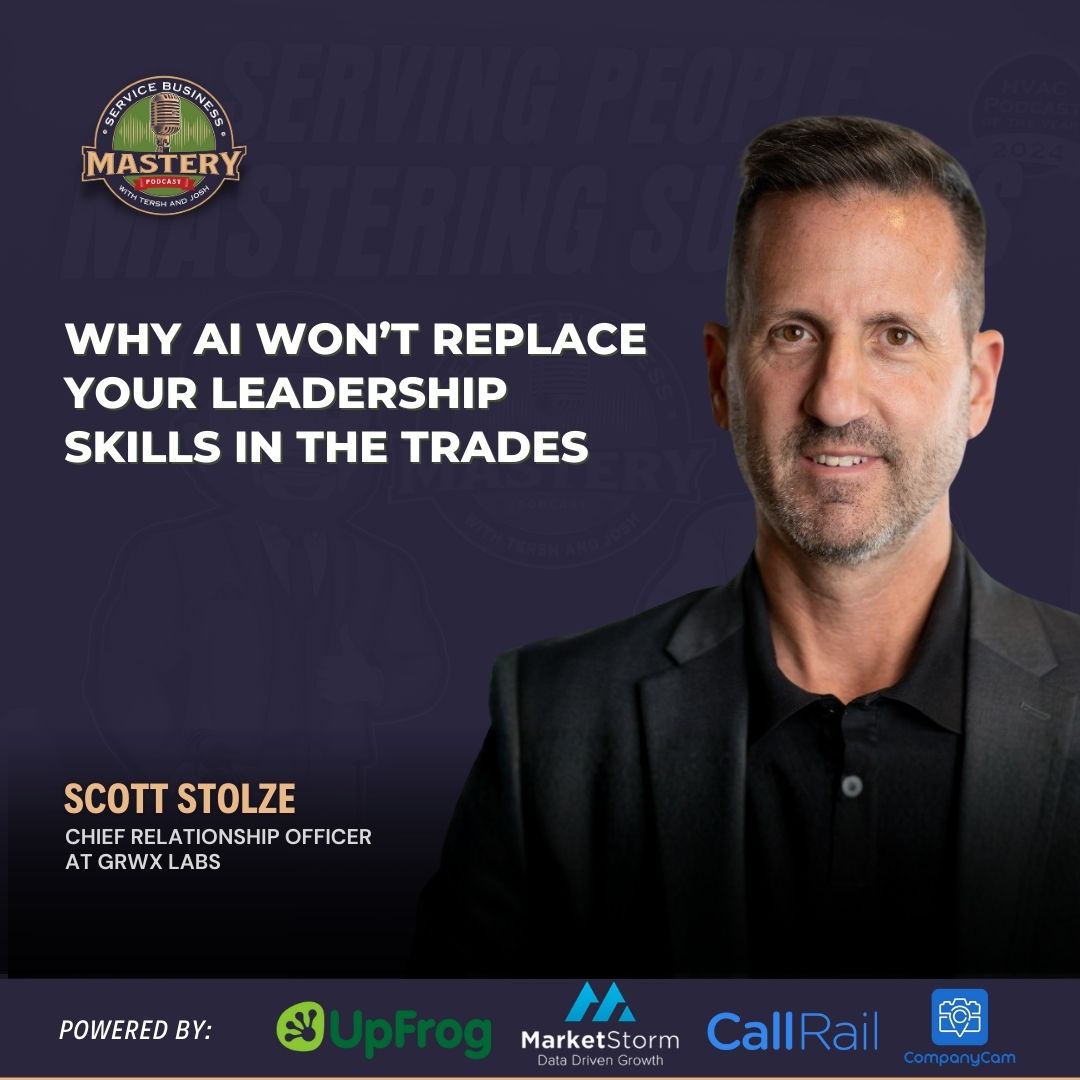
Service Business Mastery for Skilled Trades: HVAC, Plumbing & Electrical Home Service
Why AI Won't Replace Your Leadership Skills in the Trades
00:39:59
Loading summary
Transcript113 lines
- [00:00]
Scott
But it's really good when you do it in a meeting too because and then you can just fill in the blank, you know, the group hearing it, it leads to more dialogue, it's going to help bring us together, et cetera. So that's one thing encourage them in out of meeting settings. And then the other thing that I think is really important and good leaders do this, good leaders give sort of that energetic permission. It's okay to ask a question even if you don't know the answer. You have to encourage them through action, not just words. And doing that in front of others lets people feel safer. Like this is something I've learned from Simon Sinek. A lot of us know is creating that energy of it's okay to be to ask questions and it's okay to be wrong.
- [00:40]
Host Announcer
This episode is brought to you by one of our show partners, upfrog.
- [00:44]
Sponsor Representative
Upfrog is the OG when it comes to pricing transparency online. They find system replacement leads through paid ads and have developed an entire system to drive those hard to find system replacement opportunities, nurture the leads and book them into sold systems before your team arrives to help you grow your business.
- [01:01]
Tersh Blissett
Learn more@upfrogio.
- [01:02]
Host Announcer
I want to give a huge shout
- [01:03]
Tersh Blissett
out to Marketstorm for sponsoring today's episode.
- [01:06]
Sponsor Representative
You've heard of Google Ads, Facebook ads
- [01:08]
Josh
and SEO, but did you know that
- [01:09]
Sponsor Representative
there's an entire ecosystem, like 80% of the Internet that ads can be served on that you've barely heard about?
- [01:14]
Tersh Blissett
That's where marketstorm operates.
- [01:16]
Sponsor Representative
They leverage data science and AI to build customer profiles for your ideal customers and get your ads in front of prospects before they are ready to hire a pro. Planting your brand in their minds early
- [01:27]
Josh
and often to chat with a team
- [01:28]
Host Announcer
about how they can help you grow your business.
- [01:30]
Tersh Blissett
Visit marketstorm AI hello everyone out there in podcast world. I did it to Scott this time as a Josh. Hope you're having a wonderful day. You are listening to or watching Service Business Mastery Podcast. I am Tersh Blissett and sitting next to my co host virtually Joshua Crouch and we have Scott on the show today and we're going to talk a little bit about communicating and how AI like there's certain communications that humans can do a lot better than AI. And if you've ever watched the show, listen to the show, you know that we talk a lot about AI and automation in the trades and if by the way, if you're not already subscribed, please click that subscribe button so you don't miss any any future episodes. But with that Being said, Josh, is there anything you want to add?
- [02:20]
Josh
Yeah, actually. So, I mean, communicating is only becoming more important. Like, you know, you feel like you stress things all the time. But communication, especially within the world of AI and setting boundaries and guidelines and what your team can use it for, can't use it for what you're going to allow. Because some people might be able to get their eight hours of work done in 30 minutes when that happens.
- [02:45]
Tersh Blissett
Because I listened to and read a ton of productivity books and, and one of the things that Mike McCallowitz preface, I mean, he, he really, like, beat this into the pages of the book, was the fact that once you, once you've automated these processes, once you've used whatever tool it is to. To make yourself more productive, don't fill that time with more busy work.
- [03:12]
Josh
You know, I must have missed that chapter.
- [03:16]
Tersh Blissett
You and I both 100%.
- [03:17]
Josh
I feel like I keep finding things after I've delegated and how.
- [03:22]
Tersh Blissett
How have we automated so many things, but we are so stinking busy?
- [03:28]
Josh
That's a great topic right there.
- [03:30]
Tersh Blissett
Yeah, it is that.
- [03:33]
Scott
That's one of the things, you know, on the people and communication side, the beauty in this time right now, with so much advancement in the AI and automation front, which is a big reason why I was drawn to the work that you're doing. It's an opportunity. It's an opportunity for us to learn how we can leverage people skills that much better. Because one thing a lot of us are learning, and I don't have the skill set that you two do when it comes to the technology side. Mine's a very basic level, but I keep reminding the people that I work with and the people that I learn from that this is a great time to leverage our people and communication skills even more because that's how we're going to stand out. The automation and AI is great. It's going to make things more efficient, effective. The time is going to be. We're going to be able to manage our time, in some cases a little bit better. But then in between, what are you doing on the people and communication side that's going to help you connect better, build better relationships, relate to people, be it customers or coworkers. So. So I think this is a great, A great time in terms of opportunity to really stand out.
- [04:36]
Josh
I had, I've had a couple of conversations, like, I had some digital marketing friends that we were having a, like a Facebook group chat, and I've talked about it with, you know, like, some team members and some other people But I feel like with the more inauthentic stuff that gets put out online that we're going to crave authenticity. We're going to crave that connection even more.
- [04:56]
Scott
Right.
- [04:56]
Josh
Like, not that we're going back to Covid, because Covid was like the same thing. Kind, Kind of the same thing.
- [05:02]
Sponsor Representative
Right?
- [05:02]
Josh
Like, we, we got.
- [05:03]
Scott
We couldn't.
- [05:03]
Josh
We couldn't interact with humans, we couldn't talk to humans, we couldn't shake their hand or hug them or whatever. And at our core, that's what we thrive on. I mean, whether you're an extrovert or introvert, because even introverts, like, we still thrive on that. We still need it.
- [05:18]
Scott
We just.
- [05:18]
Josh
It drains us versus extroverts, where they get energy from it. So everybody needs that. They need that energy from other people. They need that, that connection to feel like they belong as part of society and different groups and stuff. And I think it's only going to become more, More important for companies to really figure out ways to keep people off of these things and have some authentic conversations and authentic connections.
- [05:46]
Tersh Blissett
Yeah, I, I agree. But I mean, I will say that I did, I did enjoy a little bit of the. Not being. Not having meetings, not going places during COVID time, but I am such an ext. Introvert that, like, I, I know that I'm not the norm, but I, I really did. Like, it was a, it was like an aha moment for me.
- [06:15]
Scott
I, I think that time, we all remember it so well. It's not that long ago was. And I, I wasn't aligned with it. I struggled with it. And by the way, I'm an introvert too. My. I've worked really hard the last 20 plus years on my communication because I was quiet and shy as a kid and I knew I had to. But that time where we were not around people as much as we need or want. I totally agree, Josh. We crave community. We crave human connection in a lot of good ways. It taught us what we miss, what we like. And I really feel. I don't know what you guys think. I think we learn even more. We always hear you learn more from failure. We know that's pretty much spot on. That's true. We also learn more from what we don't want than often we do from what we do want. And I knew in that time, I'm like, okay, I don't want to be home every day. I'm fine a couple of days a week, but not every day. And I'm. I don't I don't want every meaning I have to be over Zoom or another platform. I need to get out and connect. So. So learning at the time, it did have a silver lining. I think it opened a lot of people's eyes. That's.
- [07:36]
Josh
That's a new con, like the last five years. That's. I mean, ter, you've been doing it for a while. There's some other people we've run into that have been doing that a little bit. But, like, I feel like that. And then with all this technology and stuff, and honestly, you. You're almost limiting your talent pool a little bit when you're always local, right? Because now instead of sourcing in just your micro community or within, you know, the, the county or whatever, where someone can have a commute, you can. Like, we're. We found our podcast managers from El Salvador, and she's freaking amazing. Like, she's amazing. Like, we literally probably couldn't move forward without her at this point. Like, she's great. She organizes both of us tremendously. But we find talent from all over the place, and these people are very excited to work with companies that treat them well, especially when you're communicating with them and you're. You're treating them well, which is. I feel like a lot of overseas offshore talent has not been treated well by companies in the US because companies in the US Especially the larger ones that need large pools of talent, don't treat people very well. They're kind of like just a number. Well, we need you now. And then we're going to cut you. Like, there's no. There's just very cold. It's like a spreadsheet, right? It's like, oh, we need to save some money. See ya.
- [08:47]
Tersh Blissett
How, Scott, what would you say the difference, like, what's the communication that specifically a human can do that AI still is not capable of doing well?
- [09:00]
Scott
That's a great question. So one thing that always stands out to me when I see people, because I like to watch people who communicate well, as much as feel and learn it myself, is okay, so we know they're good listeners. Another thing that we hear all the time. But how do you become a good listener by asking good questions and then let the conversation breathe, let people answer. You know, a lot of human nature where you can literally feel the pull right in your gut. I'm sure you guys know what I'm talking about. Like, you ready to say your next word, your next sentence, but let conversations breathe and follow up a second or third time with a really good question. And I share with people because I think it's better for people to learn on their own than we just tell them, go to a meeting or go to an event and just be intentional to the best of your ability. If it doesn't quite work out that way, that's fine. But try to be as intentional as possible about asking a lot of questions and listening and learning. If you come out of a day's worth of meetings or connecting with people at an event and most of what you did is asking good questions and then allow people to share with you, you have like two or three wins from that. Number one, you're definitely learning because you're listening to other people's perspectives, but also you're increasing your likability because people love to talk about themselves or what they're doing. So just by the fact that you've allowed them to do that and given them that space, they're going to like you more. Now, it doesn't mean. Last point is if, say you meet 10 people in one given day and doesn't mean all 10 are going to like you so much to the point that they're going to call you the next day or the next week. But maybe two or three will. Maybe two or three will say, you know what, that guy, I definitely want to talk or connect with him more. Or I'd love to work with him because they're not thinking this in the moment, but you made them feel good. So to answer your question, it's some of this nuanced things that while AI and technology are great at spitting out questions and results to us, it's really good, really helpful. But the human side is letting conversations breathe and leading with curiosity and questions.
- [11:02]
Tersh Blissett
How do you know what's a good question?
- [11:05]
Scott
Well, there's context.
- [11:07]
Josh
I know that was a terrible question, so thanks.
- [11:12]
Scott
Thanks. Kidding.
- [11:13]
Josh
Of course,
- [11:15]
Scott
it really does depend on them. If it's somebody you're meeting for the first time, you would want to dig now. Now we all we're learning more about, right? Stay away from some of the canned traditional questions along the lines of, you know, what do you do? Or I like questions more along the lines of. And I've been doing this for five plus years, since the late 20 teens when I was doing a lot of events in Boston in my previous life. I just like to ask people, you know, what brought you here today? What are you most excited to learn? What is it about this speaker, this event, or this meeting that compelled you to sign up or register or even drive down here? Those questions Are the good things about those is they're more expansive than what somebody just does and it gives the person reason to look further within themselves. They may not even have thought all the, all that through and, but when they're answering you, they're like, oh man, you know, I'm here today because I just feel good when that person, when I'm listening to that person speak on YouTube and now I can see him in person or I know that I want to connect with other like minded people like Tersh, like Josh. So, so, so those kind of questions that, that are more feel based than transactional, like what you do, those are, those are really good and effective.
- [12:28]
Josh
That's a great point because I hate small talk.
- [12:31]
Tersh Blissett
Yeah, me too.
- [12:32]
Josh
Like I know it's just a, I think it's a busy body, how you doing? Blah blah, blah, like the, the. But like I want to get into like the meat and potatoes of the conversation. Like I don't want to talk about the same thing that anyone can talk to you, but I want to talk about things that are like deeper, on a deeper level. That's why I don't typically like, like big groups, I like small, tiny groups. Because you can get into better, deeper conversations about things that matter versus like big groups. It's all gonna be kind of like making fun of each other. I mean that's fun too. But if you really want to have like a conversation, having those smaller, more intimate like tables or groups at events are really beneficial because you can really learn a lot from just a couple people sitting right next to you versus, you know, how's it recommend something like
- [13:14]
Tersh Blissett
a Toastmasters or have you ever.
- [13:17]
Scott
Yes, I have done Toastmasters and, and because so, so I'll let you both know, I used to have a incredibly high fear of public speaking to the point where, yeah, I won't even just know that. There were two or three occasions where I literally was in, in front of a room full of people shaking and I could barely get words out. So I did all the Toastmasters. I did all. But what I really learned while Toastmasters is pretty good and helpful, honestly. And it's good to do one series because usually you can go to a set for like a four to six week period and you'll learn a few good things. But what's better is just having the mindset of, you know what, I'm going to speak up more. That's a big thing that helped me was I was working at CVS Health in, not on the, on the retail side, but on The PBM side, the pharmacy benefits side. So I was in a lot of corporate meetings and I just told myself I'm going to start asking more questions in these meetings, which then will get me comfortable speaking up in front of others and also will likely lead to dialogue back because somebody will answer and then I can follow up and I'll get more comfortable speaking in front of those. Those real life events had a bigger impact on me because Toastmasters is good, but it's very safe. So you want to do that, but you also want to do the more uncomfortable moments where not everybody in the room is your friend or even, you
- [14:36]
Josh
know, I look at, because we church and I see a lot of, I mean thousands or tens of thousands of people a year in person at these different trade shows and small events. And there's always people like they, they have questions because they'll come up to us after we're done. And they always like, sometimes they'll talk to us for 45 minutes 1 on one. But I'm like, they didn't have a, they didn't have a single question. They wouldn't raise their hand in the group.
- [14:58]
Scott
Why is that? You know?
- [14:59]
Josh
Yeah. And to your point, I mean, honestly, I, I felt that way too. Like when we would go out, see award events, there's a room of 150 people. I don't want to sound like an idiot, right. Like, well, maybe I missed something and the question's just not a good question, so I'll go ask someone one on one. But it's that fear that holds us back from, you know, the more we put ourselves out there, I think to your point, the, the easier it becomes because you just get used to it. It's not a big deal anymore. Like you make it. It's a big deal in here, in your head.
- [15:25]
Scott
Yeah, right.
- [15:26]
Tersh Blissett
And that's whenever I began to learn the most. Whenever I was, I was no longer afraid of, of looking dumb or like I was no longer afraid of asking a stupid question. That's whenever I learned a ton because I asked questions about everything that I could. And when I was a technician starting out, I was asking questions left and right. And if it, if I'm the type person where, if you tell me the answer but it doesn't make sense, I'm going to ask you again, like, can you tell? Can you explain it in a different way? And I know that annoyed some of the technicians that were training me initially, but I learned a ton by doing it that, doing it that way. And I tried my Best to not ask the same question over and over again unless I just didn't have clarification on it. But yeah, that was, that was a big thing for me. And knowing that, like, I have a speech impediment and that was the reason for even, you know, starting the podcast. One of the reasons starting the podcast and to think about the fact that, you know, Josh and I get up on stage in front of, you know, thousands of people every year.
- [16:42]
Josh
Well, and even that, like, speak to our personal experience. Like, man, the first few times we did that, I was shaking.
- [16:49]
Tersh Blissett
Oh, yeah.
- [16:50]
Josh
We were like, like, it literally was just like, oh, my God, I just want to get this over with. Like, you just literally want to get through it and not pass out on stage. And now, I mean, we still get nervous. I still feel it in my gut and I'm just, you know, just kind of like nervous energy. I'm just like, can't sit still. But I know, I know we know what we're talking about. I know we're going to get through it. I know we're going to deliver. But we've also, like, anything in life. We've hired coaches. I mean, I'm taking a public speaking course. Tertia and I have a person that we send all of our con, like all of our public speaking stuff we send to and he gives us feedback. It's kind of like asynchronous communication that way. But we're always looking to get better. And I think that's, for me, that's a, that's a takeaway from, for anyone listening to this is if this resonates with you when you're listening to this, start doing something about it. Don't sit there and just hide in the back of the room. Expect. I mean, we look at, like teams, we all know that there's probably someone on your team that never speaks up. At least in a group setting, they don't speak up. And I was going to ask you, Scott, what you know, when, if, if you know who that person is, Because I'm sure people listening, they probably can think of someone right off the top of their head, someone that they always have something to say, but they never say it in the group setting. They never really speak up. What kind of things or what kind of tips or tricks or things can we try to help them as leaders to get there? Because the leaders are listening to this, wanting to grow. Right? Because leaders typically want more and want more education and training. But how do we, how do we bring this down to our team?
- [18:20]
Scott
Members.
- [18:20]
Josh
So they improve and they get better.
- [18:23]
Scott
Yeah, Tersh, that's a great question. Terse. Josh, if you don't mind, I'm going to come right back to that question. If I, if I may comment on, on two things I heard from each of you in the last minute or two. I think it's really helpful for your audience Think about this. For anybody who sees, listens, hears this is one thing about what Tersh said is he started asking more questions. And yeah, that helps you work through maybe some of the anxiety in, in your gut and in your head, which is really good. But also what that does is it helps other people see it's okay to speak up. That guy setting the example that he's asking a question and then asking another question. You two have probably felt this and anybody listening, you know, think back to a meeting and, and how you felt when somebody asked the very first question, especially if it was like a more intense meeting with a higher up in the room and people are hesitant to speak up. So not only are you working through some of the anxiety of your own when you ask good questions in meetings and settings like that, but also you're helping other people, which is really good thing to do for a whole variety of reasons. And then Josh, you know, thinking about your time on the stage, which we've all been, most of us who've done that kind of front of room or on stage speaking, and the shaking and the anxiety, the nervous energy. One thing that I learned about seven or eight years ago because I started to do more speaking formally at events in Boston was I have got to think that this is value for other people. The moment I, because I used to do this in my corporate career all the time. The moment I go in front of a room or in a presentation and I think, I hope I do well, I better sound good. Please let this, let this work out. I'm in my head and I'm making it about me. It's all self serving. So you know, you and others who are listening may have seen or heard this before. It's really, I think that's what made the biggest difference for me was now I still have a lot of that nervous energy like you do, Josh, but I channel it and I'm like, you know what, I have some wisdom and experience I'm going to share with people in this room and I'm going to make it about them. So those are really important points. And then as far as your question, Josh, about how do we help draw out from those people who might Be quiet. I think a couple things are really key. One is having an offline conversations you have with them and encourage them by things like, hey, you know what, when you share your ideas, you hit on some great things, like you have a lot of good things to say. So I love hearing them from you, but I would also love if our team could hear them in some of the meeting. And I know you could talk to them offline and share them one to one. But it's really good when you do it in a meeting too, because. And then you can just fill in the blank. You know, the group hearing it, it leads to more dialogue. It's going to help bring us together, et cetera. So that's one thing. Encourage them in out of meeting settings. And then the other thing that I think is really important and good leaders do this, and I know you guys are probably very connected to this. Good leaders give sort of that energetic permission, like it's okay to ask a question if even if you don't know the answer or if we get it wrong, we're going to figure it out. And what that means is, practically speaking, that you're not letting, you're not helping people feel bad. You're not, you're not putting down somebody when they ask a question or if they don't know the answer, you're actually, oh, that's a great question. You know, that's not really where we're headed right now. But, but let me tell you a little bit more about where we are going. And let's build off of the topic you brought up. You have to encourage them through action, not just words. And doing that in front of others lets people feel safer. Like, this is something I've learned from Simon Sinek, who a lot of us know is creating that energy of it's okay to be, to ask questions and it's okay to be wrong.
- [22:07]
Josh
Yeah, that's a, that's, that's a challenging, that's a challenging thing. Right? Cause everyone wants to feel accepted, feel like their peers think they're smart or they're, you know, they. Because nobody wants to look dumb. I think this is human nature. We just don't. I mean, at this point, Trisha, I don't mind if we look dumb. You get to a certain point, you're like, whatever, like, it's not a big deal, but you got to get to that point of confidence first where, you know, you can recover from it if we look dumb. But that's, that's a great point. So getting on to Josh Can I,
- [22:39]
Scott
can I hit on one thing real quick?
- [22:40]
Josh
I'll keep it short.
- [22:42]
Scott
So that's where empathy comes in. And, and I just want to share and I, I just speak from experience of learning because I feel like I was pretty empathetic from my early days. It wasn't something I was completely disassociated with. But the. I realized, the more I raised my level of understanding of others and what that means in the workspace is, you know what I'm. Because you two definitely are. You two. Myself, I'm further along. Like, I've worked some of the stuff he or she is struggling with. I've worked through a lot of that. I'm not in the clear yet. I'm always learning and getting better and working on it, but I'm a little further down the road than they are. So when you just in your own mind run those loops in your, in your head about, you know that that's empathy in action. It does. Because I hear you. You got to get shit done. You're talking. You have work to do. You can't always baby people. That's not necessarily what I'm saying. But just raise those, those thoughts in your mind from an empathy standpoint. You know, I'm just further along than they are. So let me, let me help them down the road. I'm going to be a guide for them.
- [23:46]
Tersh Blissett
Scott, are you. Do I hear you say. I feel like you're calling Josh old. You're saying he's further along, so that means he's older than everybody else.
- [23:54]
Scott
Josh, I only go by accident.
- [23:55]
Josh
Someone needs to work on his listening skills.
- [23:59]
Scott
I don't mean that.
- [24:02]
Tersh Blissett
I mean that we were.
- [24:04]
Scott
He and I were both smart enough.
- [24:05]
Josh
I'm just further along in my journey. I like that. I'm gonna use that.
- [24:10]
Tersh Blissett
Hello, home service professionals.
- [24:12]
Host Announcer
Do you want to maximize your marketing budget? Then you need to be using call tracking from CallRail. Let's say you've noticed a spike in new leads this month. To find out what's driving them, you just log into your CallRail dashboard. Is my new Facebook ad outperforming my other ads? Or is paid search knocking it out of the park? Or maybe it's time to retire those newspaper ads. Since CallRail assigns a unique phone number to each of my marketing efforts, I know where my best leads come from and which efforts to scrap. CallRail shows you your most cost effective marketing channels so you can get back to business. Go to CallRail.com sbmpod and try it for free.
- [24:55]
Sponsor Representative
Today's Episode is powered by Ciro Systems.
- [24:57]
Host Announcer
Sir is all about removing the clutter and unnecessary touch points to run your home service business profitably.
- [25:02]
Sponsor Representative
They use AI dispatching to get the right tech to the right call automatically and job time efficiency to ensure your entire entire team runs like a profit generating machine.
- [25:11]
Host Announcer
Get a tech upgrade for your business at Get Sarah Tech forward slash service business mastery.
- [25:21]
Tersh Blissett
That's great.
- [25:22]
Josh
I was so. Thank you for adding that, Scott. That's, that's a great point. And I think if people look at it that way where they're help, like wanting to help their team develop those skills because those skills are going to come in handy when they're dealing with homeowners or whatever business that they're in. So that's going to help them become
- [25:40]
Sponsor Representative
more confident having those conversations too and
- [25:42]
Josh
asking tougher questions to that homeowner so they can get deeper into the objections or why they're not moving forward with something.
- [25:47]
Scott
Right.
- [25:49]
Josh
I wanted to transition a little bit to kind of like the AI versus human thing because one thing that I've noticed in terms, I don't know if you've noticed. I'm pretty sure you have because we've gotten pretty good at the prompting. But when we prompt AI, I feel like when I try to ask my team to do something now because I have to be very clear and concise on what I want the output to be, I feel like I, I used to, when I would send stuff to my team before ChatGPT and everything came along, I would just kind of like write me an email about this right now. It like, we know that's not a good prompt because it's not going to get a great outcome. So now we're like, you are an email writing expert, copywriting expert. I need an email talking about this. You know, you go, you have kind of like a specific set point. I feel like that's actually helped me when I give instructions to my team who tasks are delegated to her, it's their responsibility. I feel like I'm able to communicate that more effectively and get a better result the first time instead of like, oh, sorry. Yep, I didn't explain that very well. I, I felt like I used to do that all the time. Like, yep, that was my fault. I didn't explain that very well what I wanted. Have you seen that with, with other people or in your experience? Have you experienced that?
- [27:02]
Scott
You're, you're, you're directing that question to me? Josh, whoever. Yeah, you.
- [27:06]
Josh
But they know the church and I really haven't haven't talked about. I mean, I've.
- [27:10]
Scott
Why don't you. I don't know. Yeah, why don't you run with that for a second? Because I actually would love to hear your take on that. Quite. That's a good, that's a really good topic and question. And then I'll, I'll, I'll give you guys my experience.
- [27:20]
Tersh Blissett
Absolutely. So for me, I, I do agree with Josh. They all heard that.
- [27:27]
Josh
Y' all heard that. He agreed it's not recorded. Y' all heard that. It is recorded. It's live too. I'm gonna put that in the banner. Tersh agreed with me. I actually, Scott, real quick, I'm gonna interrupt her. He said something nice about me on Facebook. I screenshotted that crap so fast that I reposted it online because he never says anything nice about me. And then people were like, no, that was an AI generated text message.
- [27:51]
Scott
I hope, I hope that one got a million views. Nope.
- [27:56]
Tersh Blissett
Absolutely not. No, I, I do agree that the, it's, it's forced us to acknowledge our shortcomings when it comes to communication. And either you just dealt with it and you're okay with media mediocre results coming back from the prompt, or you've improved one or the other. And I will say, personally, I've trained my, most of my AI assistants to interpret what I was saying. Like I've dumbed it down instead of improved my communication skills on certain things. I will say though, that it's definitely, you know, crap in, crap out. So if I give a very short and abbreviated prompt, then I can't be upset whenever the results aren't amazing. And what happens is the same thing that happens in life. If I give a very brief prompt to an AI assistant and it gives me the results and then all of a sudden I have to give it more prompts and then it gives me more results and then I give it more prompts and it gives me more results. And if I had just given it all that initially, then it would have given me the. Exactly what I was looking for as a result.
- [29:27]
Josh
Almost like slowing down to speed up.
- [29:29]
Tersh Blissett
Yeah.
- [29:30]
Josh
And, and, or just trying to throw it out there.
- [29:34]
Tersh Blissett
Some of it's just being lazy. Like, see what I can get with. With just doing as little as possible.
- [29:39]
Josh
Hoping you're going to strike gold with a one sentence prompt or one sentence thing to the team and hope like they understand what's in your head.
- [29:47]
Tersh Blissett
Yeah. Scott, what's your thoughts?
- [29:49]
Scott
Well, that this feeds and fortunately I'm in a position where with the kind of work that I do that I'm aligned with this, it, this is a great time to experiment and learn. And I think that this also aligns with human nature because we love experimenting and we look the things that we do where we make a mistake or it's just even a little off and we have to correct or adjust or do it again. Those are the real sticky moments that make an impact. Right. So in the work that we do with growx Labs, and even when I'm with a client, a partner or just a colleague, I'm very receptive to and open to, hey, we, what did you get when you tried that or when you were working on this particular piece of output or deliverable? What worked for you, what didn't? And I'm just learning a lot of capabilities on the AI side. My team and colleagues often need to show me what I can do more of. So honestly, if you can afford it, and I don't mean financially, maybe there's a little of that in there, but just in general time wise and with experimentation to do that, have that mindset of we're all learning together, there's always going to be people further down the road or people who are more tuned in and we need that. I need a T to be able to automate a process for a business that we're working with and get it done quickly. Timely. But we should all be having the mindset these days of, you know, let's see what these next few months, even this rest of this year brings. What are we learning through the technology as well as with the people that we're communicating with and just keep evolving together. Because the last thing is that evolution is what makes us feel good, special. Because ultimately a lot of us were creators and builders. I'm sure you two are. I know church is. And so evolution allows us to be in that mode almost all the time. It's not the perfect result that that is fun or advantageous so much as it is what did we do and experiment with and learn along the way? So I know that's a high level answer, but that's how, that's truly how I look at it.
- [32:00]
Tersh Blissett
Scott, as we wrap up on our time here, can you share what's, what is growx Labs?
- [32:07]
Scott
Growx Labs is we are out to help small businesses solve their biggest problem. It's that simple. One thing I've learned the last three years, Josh and Tersh, is there's so many great businesses out there. And you know, small is relative. You know, it could Be anything from are you going by the revenue, are you going by the people in the organization, both, et cetera. But all I know is that there's a number of organizations all over this country where the owner had a mission and an objective in mind to make a difference for people to solve a problem. And ultimately, as you two know, usually what happens is they're really good at one or two things, typically their product or service because they came up in it, they were trained in it or they created something that is of high value and it's out there and it's working. We typically work with small businesses that have been around for a little bit of time, have sales doing at least a million and a half to 2 million in revenue, but they're dysfunctional in one or two areas. So. And the reason we landed on this. Well, there's several but one of the biggest ones is because we have discovered our team has met so many amazing high caliber people who are really good at what they do, be it finance, technology and automation, people in hr, marketing, sales. There's always somebody to find who's really good at what a business owner isn't. So our mission at growx is to help that business and his or her team solve their biggest problem. But we primarily do it by bringing them the right resource or resources. We solve some of the problems directly ourselves but we're small tersh as you know, we, we actually want to create a bigger ecosystem where we're not reinventing the wheel and we're leaning into. People have been doing some great work for a number for an amount of time and, and then just say you need to talk to this owner over here or owner, you need to talk to this resource over here because together you're going to solve that problem and then it's going to help you get more of what you want.
- [33:59]
Josh
Yeah, I feel like that's a lot of what Tertia and I do when we're. We travel or people reach out to us is we, hey, can, who do you got? Do you know someone that does this or. I'm really struggling with this. I'm like oh, hang on, let me. It's like hang on, let me grab your hand and walk you over here because we got someone for you. I feel like that's half our half our job is to just connect people and that way people and it's, it's really important us that people, you know, speaking of communication, people trust the, the things that we say and which is a, it's a lot more challenging. You Got a lot of businesses. You want to promote your own stuff and, and, and we have partners and sponsors but we always want to be upfront and honest with people as much as possible. And I think there's a lot of, and we've seen it a lot in the trades where people will just become a affiliate partner or something. They just push the crap out of something and that business we all know sucks. Like their service sucks. They don't take care of people, they lock them in long term contracts and they're like ironclad. Like it's just not a good place for, for small businesses and it wasn't the right fit for that specific person. But they do it because they get a commission and because so much money is poured into the trades. We see that a lot. There's a lot of, still a lot of money being poured into the trades. Not quite as, where it was as Apex maybe two years ago, but it's still, we've seen some big roll ups with Silas Services and some of these other ones are like billion dollar acquisitions which I don't think anyone ever thought was possible in the trades, but it is becoming possible. I think there was another one, I can't remember who it was recently, but that authenticity, that trust and I think that comes even down to your communication with your team. If your team feels like you're lying and not telling the truth and not being authentic with them, they're not going to listen to you, they're not going to speak up, they're not going to want to willingly engage because they think you're full of crap. And I think some of that really gets down to like that just that small group thing where they feel like it's safe, where they can speak up. They're not going to be ridiculed, they're not going to be talked about behind their back. Things like that, creating that culture where we're able to actually fully be ourselves and communicate properly I think is, is something that a lot of business owners struggle with because like you said, they're really good at certain things. They, most business owners are not the best communicators. I mean it's just, it's just true. There are some that are really good naturally there's a lot that aren't because we're just moving fast. We have a lot of ideas, we just want to get to the next thing, move to the next thing and we just don't think about people's feelings very well. Sometimes I, I'm, I'm fortunate that my significant other that I'm getting married too soon, is a great listener because she handles all the people. Because I'm not the best.
- [36:38]
Scott
There you go.
- [36:38]
Josh
But you know, there's, there's things like that if, if, but if that self reflection, if we look inside ourselves and we're like, I know I'm not the best communicator. Go find one, find one to work at your company and be that people person, that glue, that culture person. Because it, it pays a lot of dividends. At least it has in our case.
- [36:57]
Scott
Yep.
- [36:58]
Tersh Blissett
Scott, where's the best place for people to connect with you and, and learn and grow more?
- [37:04]
Scott
LinkedIn and Instagram. So both my pages on LinkedIn and Instagram, simply my name, which you see below.
- [37:11]
Josh
I'm glad you added Instagram because if you just said LinkedIn, I would be like, ooh, that's like a, it's like a no go zone for the trades. I love LinkedIn because it's a different type of outreach, but a lot of contractors just don't have a profile there.
- [37:24]
Scott
They don't. And I've worked with a lot of home services the last few years, so my usage of it has gone down. But also because LinkedIn I don't believe is in another conversation for another day, is used in the way that it should or could be. But nevertheless, we're on there. You can engage us there. Instagram is a little bit more flexibility and dynamic, as you guys know, and what kind of content and material and how we can engage with other people on there. And Tersh, do I have just a second to say one last thing?
- [37:53]
Josh
Absolutely, yeah.
- [37:56]
Scott
You know, and this is a great thing to leave your audience with. If I can encourage people of anything and there's many things we can all be working on, it's, this is, look at today's times and today's world. Josh laid out an example. You know, connecting people is high value in such a way where people are going to feel relief, they're going to feel seen and heard, they're going to be excited because they were just connected to somebody who might be able to solve their biggest problem. And, and you know, when we have tech and technology is great, I'm embracing it like never before in my career. And I think when we blend the two, it's going to be really, it's going to continue to be really special. But for us people, people, for the human side is think about how you're allowing other people to succeed. Prop them up, shine a light on them, help them feel good and little things like asking the right quite or asking a good question. Not even the right just ask a good question and and lead them down the road of solving their biggest problems. You're. You're gonna win. You're gonna win just by doing that because people are gonna like how they feel when your name comes up or when they see you in a row.
- [39:01]
Josh
It's a good point. That's a great way to end.
- [39:04]
Tersh Blissett
I appreciate it. If anybody has any questions at all, we'll we will put Scott and his team's contact information in the show notes. Don't hesitate to reach out to him. He's a great, great source resource. And with that being said, I hope you have a wonderful and safe week. Until we talk again next time. Thank you, Scott for hanging out with us.
- [39:23]
Scott
Thanks for having me.
- [39:27]
Closing Announcer
Thank you for listening to this episode of Service Business Mastery. Now that you are equipped with essential business advice from this impactful conversation, you are one step closer to becoming the successful owner of your dreams. If this episode has been helpful to your business journey, don't forget to subscribe to the show, leave a rating, and share it with other owners as well. Visit servicebusinessmastery.com to learn more.
- [39:51]
Scott
It.