← Service Business Mastery for Skilled Trades: HVAC, Plumbing & Electrical Home Service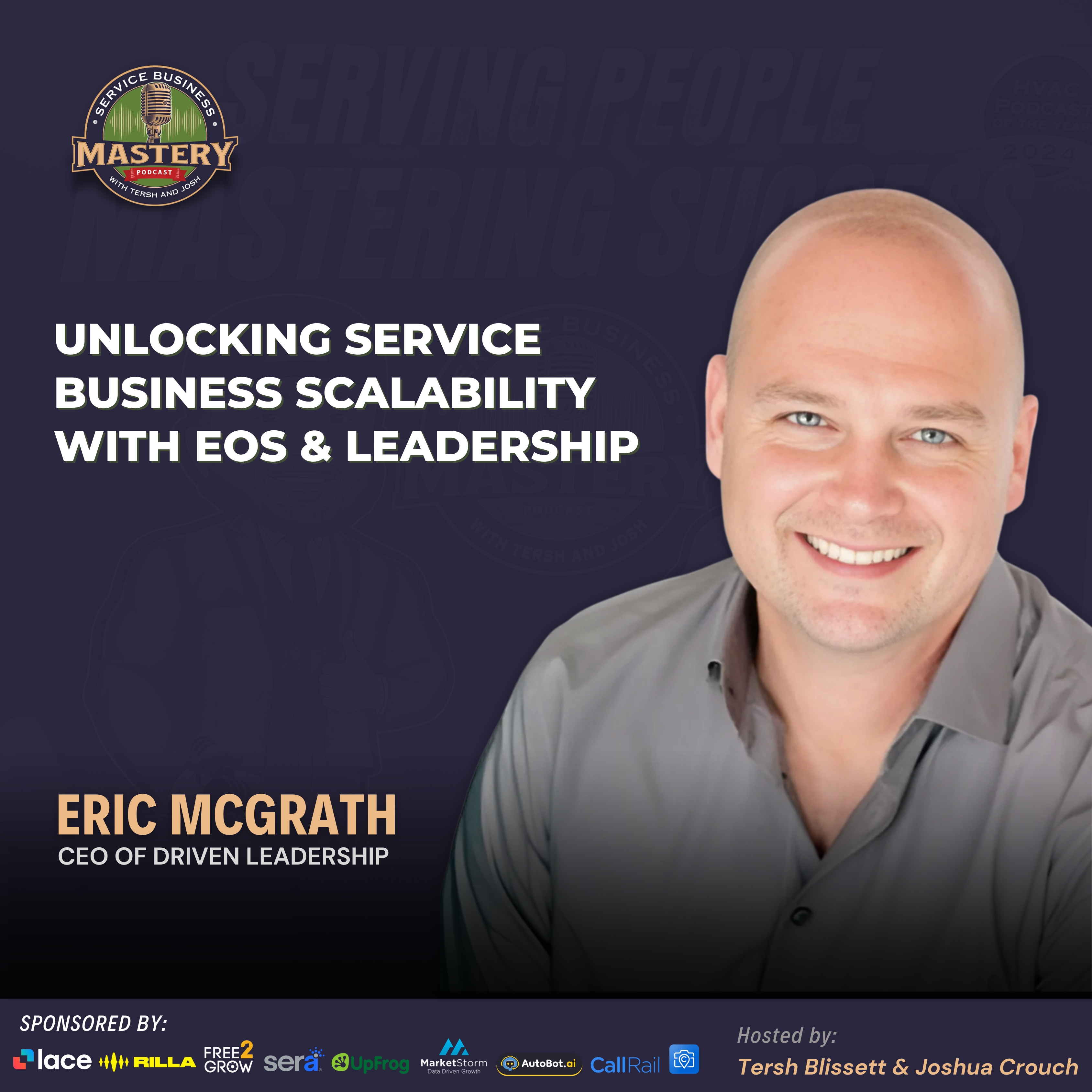
Service Business Mastery for Skilled Trades: HVAC, Plumbing & Electrical Home Service
Why Trade Business Founders Fail to Scale and How EOS Fixes Leadership Gaps with Eric McGrath
00:50:52
Learn how to automate tasks, save time, and increase your profit. No Coding required! 👉 Enroll Today - ---------------------------------------------------- Welcome to the Service Business Mastery Podcast! Visit our website for more episodes and...
Loading summary
Transcript85 lines
- [00:00]
Eric McGrath
Take a $10 million business and I've been in several where they're they're wanting to make this leap 25 or 50 or 100 and they're wanting to make this run a scalability but they keep hitting the ceiling. They go a little bit and then yeah, we make some progress but then we're back and we're just we keep butting our head up against it and usually it comes down to a wide range of things within traction that starts to solve that. That's what it focuses on. And main three things that EOS is focused on is vision, traction and healthy.
- [00:31]
Podcast Narrator
Are you looking for valuable business advice to reach that seven figure revenue mark? Do you want actionable tips to properly navigate through every business challenge you encounter along the way? Let Tersh Blissett and Josh Crouch be your guide in getting you to the top here at Service Business Mastery. Tune in as they sit down with world renowned authors in business leadership and personal growth who share valuable insights about management, marketing, pricing, human resources and so much more. Let their nuggets of wisdom gold guide you in owning a thriving, profitable and ever growing business. Here are your hosts, Tersh and Josh.
- [01:17]
Sponsor/Advertisement Voice
Today's episode is powered by Rilla Voice.
- [01:19]
Josh Crouch
Rilla has taken those cumbersome time consuming ride alongs and streamlined the entire process by leveraging AI technology to do dozens or or hundreds of ride alongs virtually every single day.
- [01:29]
Sponsor/Advertisement Voice
They also provide you the owner or manager with the top performers KPI Metrics designed easily for you to coach your team into rock stars.
- [01:37]
Josh Crouch
Schedule a demo today@www.riLa.com. today's episode is powered by Ciro Systems.
- [01:44]
Sponsor/Advertisement Voice
Cira is all about removing the clutter and unnecessary touch points to run your home service business profitably.
- [01:49]
Josh Crouch
They use AI dispatching to get the right tech to the right call automatically and job time efficiency to ensure your entire team runs like a profit generating machine.
- [01:58]
Sponsor/Advertisement Voice
Get a tech upgrade for your business at Get Sarah Tech Service Business Mastery what's up friends? Never miss a call again. So our partners with free to grow their world class AI Voice CSR platform is designed specifically for trades businesses with industry leading integrations and dedicated onboarding team to worry about missing calls or losing leads again. Whether it's booking, rescheduling, answering customer questions or escalating to your internal staff, their AI handles it all 247 and not only that, it can book directly into your fsm. So stop wasting time on and money on leads that get fumbled. Let free to grow. Turn every call into a book job.
- [02:46]
Josh Crouch
All right. Welcome back to another episode of Service Business Mastery. I am here live with Eric McGrath of Driven Leadership. We are going to be talking about a few different things today. We're going to be talking about eos, which I have a lot of my own experience with. And we're also going to be talking about developing leaders inside of your company and for the business owner to develop leadership skills. Because we all know that in the trades, a lot of people that start a business, they're either a really good plumber, an H vac technician, a salesperson, maybe they're good at marketing, they want to start their own business, they don't want to work for someone else, but they've never let a. A team of people and, and driven the bus, so to speak. And we're going to talk about ways to enhance those skills and get some tips and stuff like that today. So I am joined by Eric. So welcome to the show.
- [03:36]
Eric McGrath
Thanks for having me.
- [03:37]
Josh Crouch
Yeah. So for people that don't know who you are, could you tell us a somewhat brief.
- [03:42]
Eric McGrath
I know everyone.
- [03:43]
Josh Crouch
I say brief, and everyone's like, well, how far back do you want me to go? But I'll let you drive the bus on that one and tell us, you know, kind of your background and how you got to this point.
- [03:53]
Eric McGrath
Yeah. So just excited to be here. You know, interesting thing about and, and why we got into this kind of line of work in the first place was for me, my upbringing. I grew up around entrepreneurs. I was really inspired by my grandfather early on. He had a. He had a business where I got to work in it day in, day out, kind of be there with him and see the positives, the. The day downside. And one of the biggest things he always struggled with was the people and how to work with them and how to develop them. And I started my first.
- [04:24]
Josh Crouch
We can just. Can we just like, create robots now? I mean.
- [04:26]
Eric McGrath
Yeah, well, I mean, we're getting there. I think it's all going to change with AI quite a bit. But I started my first business out of college with my college roommates and it kind of took off. And I found my role in that was developing salespeople and actually training. And I fell in love with the development side of watching people really get concepts and get ideas. Since I've spent over 25 years now in leadership development and just developing, you know, really the management, the leadership of a company to produce amazing results within that company, what they're after and what they go for. And you mentioned eos. A few years ago, we started noticing a trend so we're developing leaders and helping them with everything from conflict to how to run a meeting, how to build great teams. And we started noticing that there's these companies that were running on eos, which stands for Entrepreneurial Operating System. And it comes out of the book Traction by Gino Wickman. And we started noticing some really incredible success when they partnered, when we partnered these two together, the development of people and having this operating system together. And so last year, actually, I became an implementer of EOS and all these methodologies. And it's just been kind of gangbuster since. It's pretty amazing what takes place when you combine these concepts.
- [05:45]
Josh Crouch
I can think that having being in the leadership side of things and then also being able to put some sort of operating system that says, we're going to meet on this day from this time to this time. Here's the structure of the meeting. And it just makes it simple. Like I. I told you before we went on, the last H Vac company I worked at was the most structured company that I worked out of the three. We would meet every Monday with our business administrator, who is actually now our bookkeeper. She has her own business. Our service manager, the owner, myself and I was in charge of operations and marketing. And we would talk a lot about stuff.
- [06:24]
Eric McGrath
Stuff.
- [06:25]
Josh Crouch
Sometimes the meeting would be 45 minutes, sometimes it'd be two hours. And we had these meeting minutes that just like. And honestly, I remember one day the business admin and myself, we. I'm a. When I'm bored, I'm a. Like, I'll fill in the letters. I'll just scribble in the letters. I'm just. I'm a doodler. Yeah. When I have a piece of paper in front of me and I literally had, like, the entire page filled up. Cause I was so bored. We were just talking, but nothing was getting done. And I think a lot of businesses struggle with that because they don't know how to. There's no system. Like, there's. There's no guidelines in a structure in place. And nobody teaches you how to have a meeting. Everyone's like, well, you got to have meetings, you got to have huddles, you.
- [07:04]
Eric McGrath
Got to have trainings.
- [07:05]
Josh Crouch
And it's like, well, how, like, do I just make it up? You know?
- [07:09]
Eric McGrath
And.
- [07:09]
Josh Crouch
And I think a lot of people.
- [07:10]
Eric McGrath
Struggle with that, the structure and. And how do we stay on task? There's so many bright, shiny objects. Right? We're talking about one thing, and then we bounce to another and we're moving around. I think the power of EOS is, yes, they create that kind of structure to meetings, but it's also that relationship and defining clearly and within eos, they talk about the. The visionary of an organization and they have a role called an integrator. And as I've been doing this more and more, what we find is often the person that is a visionary. That's a person that, you know, they have 10,000 ideas, they kind of jump and move. And as a company gets bigger, that's great as a business is starting up. But as it gets bigger, we need systems and we need people to follow those systems and we need efficiencies in the business and all those things. And usually the same person that started is the same one that's hurting those systems from taking place place because they're shifting and moving all the time. And so this relationship between a visionary and an integrator is the visionary still coming up with the ideas. They're in R and D. They care about the culture and what's going on, and they're really focused in their sweet spot where they're great. And then there's this other role. It's almost like a governor in some ways. They take all that information and they filter it down into something we can take action on, something we can deliver some results on. And they're driving the team with this filtered idea system. And when these two people work really well together in a company, it's unbelievable what happens, because you get these incredible ideas, you can solve things that other people can't. When you talk about that meeting, that sounds like a meeting where we're going into ideas or we're just having connection, but we're not getting to the implementation and how do we drive the results for it and then track the results as well, Right? Do we have a good scoreboard that's helping us drive those things and move them forward? So to me, it's that missing piece in a lot of businesses to where we can have a structure to it. We can still have the great conversations, we can still solve things, but everybody knows their role. We're working from the same sheet of music, meaning data. And the processes and the problem solving become very collaborative. Throwing problems up against the wall and going, okay, how do we solve this one today? And getting into it and having really healthy discussions. But not only discussions. We come out of there and it's like, okay, Josh, you're taking this on and you're going to make sure this happens. And we're going to be checking in on a weekly basis. Gets a lot harder to fail when you've got these things thrown right in front of you. And we're having the conversations that a lot of businesses don't even have.
- [09:39]
Josh Crouch
Yeah. And I, for us, when we started Relentless and we hired our first operations manager, we would meet twice a week and we, because of my past history with the last H vac company, like we had a Google Doc with a lot of stuff, we call it just operations meetings. And we again talk about a lot. Some we, we're a little more productive I think overall. But something was missing. Like it was just bigger things were just not getting done. We weren't, we didn't have a focus on rocks, we didn't have a focus on the to do items. We, we didn't have a deadline, a due date to like no. And I think that's the biggest sandman when we started the implementation process of EOs, the, and when we read the books and all that kind of stuff, because that was part of the process to read the books and whatnot. But it was, you know, when you're going through the first couple times with an implementer of developing your first rocks and you're developing your core, your core target, your three year, your one year and kind of really bringing like. Because I think a lot of times, you know, it's funny, Tertia and I were, and I'm jumping around a little bit, but Trish and I were at a AI tech conference with like 10 ever business owners yesterday in Phoenix. And when I say yesterday, March, if you're watching this live, March 2025. I don't know when this is going to go live on the podcast Catchers, but they asked us, you know, because we don't have EOs for that business. It's a very new thing that we've developed over the last year, but we haven't really launched it yet. And like what are your goals? What does that look like? How many clients do you need? What, what kind of valuation? Like all these things. And I'm like, these are the type of people I need to be around because you know, I have that for Relentless. I know what those goals are because we have a structure. But these other businesses, we haven't implemented those things. So it's, it's kind of still the same thing. So anyone that starts a new business, we all start the same, no matter how, how much experience, how much time. It's not like, you know, like Tommy Mellow is a big name in the industry. It's not like if he started a New pest control business tomorrow. If I wouldn't have that stuff initially, he might think about it now because he's very successful. But he's still got to build it, and you still got to build it with people. I think too often we're, we're deep in the weeds, we roll up our sleeves and like, what's in front of me, let me take care of that. What's the next thing in front of me, let me take care of that. We don't actually step back, look at the big picture and be like, what do I want to be in a year? Like, what, what would be a successful 90 days? What would be a successful year? Three years, five years. And the EOS process. And I'm sure some of this, you know, outside of EOs, with driven leadership, you guys are talking about things that aren't day to day. We're talking about what do we want down the line? Because the future comes at a very fast pace. And if we don't have a target or a set point to look at, we don't know where we're going to end up. That ship could go way off course versus where we, where we set out to go. So what, you know, when it comes to, can we real briefly before we get into some of the driven leadership, like the meeting structure? Because I think a lot of people would be really interested in understanding, like, what is a, what does a typical meeting look like for eos? Because that alone might be like, oh, I need that. Yeah, that would be my thought if I didn't have EOs.
- [12:49]
Eric McGrath
Great question. And you know, it's. Now they've gotten it to where you can kind of cheat with it a little bit. And there's a, there's a, so there's a couple different softwares out there, but there's one called 90 that I think is really powerful because it literally walks you through the meeting cadence of how to do it. So the meetings typically start with a short little segment on some positives that are going on. And so we're connecting at the beginning, but then it quickly moves into, we're reviewing a scorecard, so we're reviewing actual dashboard on the metrics that are going on in the business. So now it's not, hey, revenue's off. And let's spend 20 minutes talking about why revenue's off because that'll, that'll take us off path right away. So it is, we're going through the metrics, we're gathering the information, make sure we all see them, we see what's updated and we're updating them weekly. And then we're moving on. And we move on to the next segment, which is rocks. You mentioned the word rocks. Some people may not be familiar with that term, but it, it comes down to, you know, there's actually a really cool video out there. And I know the story's been around forever, but it's. It's a professor standing up front of the room and he has a jar. You've seen it? Yeah.
- [13:53]
Josh Crouch
That's a very, very popular video. I've seen it a couple of times.
- [13:56]
Eric McGrath
Right. I would assume a lot, a lot of people have seen this one. But you put these big rocks in there and he goes, is it full? And most people say yes. And then he goes, and he puts smaller rocks and then he says it's full. And he puts sand eventually puts water in there. It's just showing how much capacity we have. Well, the term rocks comes from those big kind of boulder like things when we look at our business that we got to make sure we're moving forward. Covey calls it the whirlwind, the 8020 rule. Right. So it's 80% of our business is this whirlwind that's taken us away. And for a lot, especially new business owners, that 80% does take us away when we miss the 20%, which are these rocks, these things that we have to move forward and make sure we're accomplishing. And so within EOS and within this meeting structure, we have a segment where we've identified what are the rocks of the business for this 90 days, what do we got to get done? And we're looking at it every single week going, are we hitting it again? We're not spending a mountain amount of time of why it is or why it isn't. And if there's an issue, let's say a rock is off track. And you know, some of our metrics are off track. We simply bring that into what they call ids, which is later on in the segment. In the bulk of the meeting is spent around a collaborative session where I stands for identify. We're going to identify what are these issues that are going on. D stands for discuss. We're going to discuss what's taking place. And S is solve. And it's not just solve it in the moment, it is assign someone to it, a due date, what's got to take place. And in that the goal is to solve it forever. So these issues don't continue to repeat. Because within businessman, as you saw, you put a Band aid on it. Because we're moving so quick and things are going on and we don't solve it for the long term. And when we start solving issues for the long term, it frees us up to be able to take on the new things and to move the business forward. And there's more to the meeting, but in general, you're starting this meeting. It's a 90 minute meeting and you're diving in. You're spending 30 minutes on review and going through kind of the initial of what is our scorecard? What are the rocks? What's taking place in the business? What are the highlights that happened this week? Headlines with our customers?
- [16:09]
Josh Crouch
Those are things that are like, even I was gonna. Because we, we didn't mention head. But the first five minutes is like personal and professional. Win. You get to know your team. Yeah. I mean, think about when's the last time you asked? Like we, we ask you, we always ask each other, hey, good morning. How you doing? Everyone says good or all right or whatever. That's it.
- [16:27]
Eric McGrath
Yeah.
- [16:27]
Josh Crouch
We don't like. What outside of work did you accomplish? People, they read books, they just think they, they, you know, accomplish something or they, they went on a trip or they did, you know, it's cool to celebrate those things. You get to know your team on a deeper level, at least in my opinion.
- [16:41]
Eric McGrath
Yeah.
- [16:42]
Josh Crouch
And you get to know the people you work with regularly where you can actually like, oh, hey, remember that thing? Or might jog something like, hey, I want to try that. Yeah. You know, and then the headlines I like because honestly, sometimes I don't know what goes on in some of these department meetings. I don't know everything that goes on as the business owner. And it's like, oh, well, that was cool. Customer signed up, got a review. Brian hit 50 close rate last week, whatever those metrics are for the, for that department. And it's really important just to know what things are because I mean, if you think about it, this is like the one meeting a week, the leadership one for us. We have it rolled out across departments now and we have different people running those meetings, which is kind of like the ultimate goal.
- [17:22]
Eric McGrath
Right?
- [17:22]
Josh Crouch
The ultimate goal is to bring this work.
- [17:24]
Eric McGrath
Yeah.
- [17:25]
Josh Crouch
Like, if you ever want, if anyone ever wants to talk about this, like if you get to a certain point, like you want department meetings, because I'm telling you, it makes, it will make. It will transform your business completely. Like now they're solving problems that you don't even know exist. But the leadership team specifically bring the important stuff. You don't worry about like oh one got a one star review. Like you worry about where the sales are, where the marketing's at, where the operations, systems, processes. Big things like big problems that are coming up over and over. Maybe there's a supply chain problem or you're, you're constantly getting H vac equipment with bad coils as an example. Like just things that really need to be discussed and not just like man, we'll just keep doing what we're doing. And then what I love is you solve it with to do's and, and platforms like 90 we use Bloom Growth. I think there's EOS one, there's a couple of them out there. Yeah, they, they track all that, they keep it all in there for you. So that way you just log in, it's got everything and you just put the data in and it's really simple. That's been great for us too as far as like so the implementation process now it went smooth for us because of the people we had, but I'm assuming not every implementation goes smoothly.
- [18:42]
Eric McGrath
It does not.
- [18:43]
Josh Crouch
You smiled as soon as I said that, so I kind of assumed that was the case, you know.
- [18:47]
Eric McGrath
And when you say smoothly, there's a process. It depends where they are. If you've got a business that's running on sheer willpower and I can tell you also that's a business full of a lot of frustration as we start to add the complexity and the added people to the business. So if you know, you take a $10 million business and I've been in several where they're, they're wanting to make this leap to 25 or 50 or 100 and they're wanting to make this run of scalability, but they keep hitting the ceiling. They go a little bit and then yeah, we make some progress but then we're back and we're just, we keep butting our head up against it and usually it comes down to a wide range of things within traction. It starts to solve that. That's what it focuses on. And main three things that EOS is focused on is vision, traction and healthy. Where are we going? Do we have alignment and is there traction? And people are solving these issues as we move forward and are we doing it in a healthy way? Meaning that leadership team works well together. And the reality is most companies don't run that way. They don't even have clear data. Most of them are working on hunches. And you know, large companies are like, how are you not looking at real data? Or they look at data, that's old. You know, it might be two months, three months old before they're actually sitting down and going through it. So you're asking about what do I. What do you walk into? I would say no two are the same.
- [20:04]
Josh Crouch
No two are the same. And I know there's. I'm sure there are companies out there where there's like a CEO or owner that's like very. A type. You got to do it my way. And then there's other ones that are more collaborative. I'm more in the collaborative space. Like, I don't want to solve all the problems. I want my team to solve the problems. Has there been any story that sticks out or anything that's like, you realize either the people working there realize they're not working at a company they want to work at, or the owner's realizing that they don't have the right people on the bus.
- [20:31]
Eric McGrath
I'll tell you the most consistent one, and I'll give you a real example. Leaving the names out, but it walked into a business and really dynamic known this business now we've worked with them for eight years. I believe we worked with them. Okay. And when we first walked in, overbearing is not even the right word. Leader. Fantastic woman that had a marketing mind and what I call a true visionary. 10,000 ideas a second, going 100 miles an hour, but couldn't keep records, books, anything to work to save their life, even with a team around, because she come in and she'd absolutely disrupt what's taking place. I actually, before ever engaging, sat in a couple of team meetings and just kind of want to see what we're dealing with. And had what I call an autocratic leader, one that's more telling, more directive, more controlling. The style, kind of the opposite of that. Collaborative or democratic is what business school calls it type of a leader where they're. They're more collaborative in nature. She was anything but so. And could. Didn't have the awareness. And that's usually the. The tough spot is when that leader doesn't recognize. If somebody says, hey, I want the results to change, but I'm not willing to change. That's usually the toughest one you're walking into because they say, oh, it's. It's outside of me. That usually means I don't have the awareness that I'm creating or interacting or, you know, moving the needle in this direction one way or another. So in this particular example, I sat through the meetings and I said, hey, I appreciate the opportunity to work with you guys, but we're not a fit. And this is before we were doing eos and had the structure. We're working strictly with behavior. I'm going, if, when, if it becomes painful enough to where you want to. Where we want to start. I said it nicer than this, but we want to start with you. You know, if you're willing to do the work, not want to fix your team, then we're going to get somewhere. But if your whole job is, you want to bring us in to go develop your team, but you're not willing to make the shifts with them, we're not going to get anywhere. They're just going to keep hitting this wall. So amazingly, she did what doesn't typically happen. She goes, okay, I'm open. And she made a shift. And it took, it literally took a couple of years. Several programs that we put her through. What I did, one on one, consulting and coaching, we're doing all this stuff. But what was happening and part of the success of her business, she started growing almost immediately. She started having some structure. She started listening to her team when conflict showed up. Instead of her being as reactionary, it's still one she works on, but being as reactionary to actually pause and to listen and to go, where are they coming from? And have empathy and understanding versus just where am I coming from? And so which is a process. That's a personal growth process. That's, that's a discovery process.
- [23:15]
Josh Crouch
Yeah, that's, that's like being severely overweight and hoping that you have a six pack in like a, like a month. It's not going to happen. Like, you gotta, you gotta work. Like it's incremental increases. Because one, it's really interesting that they had the awareness to do that because I think a lot of people, and I could speak this from my own example, business owners have an ego. Actually yesterday at the conference, the thing we were at, they literally said, this meeting is going to be egoless. I know every single person in here is a business owner and you all got egos because you can't own a business without an ego. You think you're good at something, right? And you start a business and you think you can do something that is helpful to the market to actually listen to someone and be like, oh, maybe I'm the problem. And maybe she knew that and it was like she just needed to be told. But I think a lot of people are like, no, I'm not the problem. My team, I can't find good people. I hear that all the Time. I'm like, can't. Are you sure?
- [24:09]
Eric McGrath
Yeah, because you're meeting good people all the time. It's whether or not those good people want to meet and stay with you. But in. In her particular case, and this is usually. Usually where it is, there's enough pain. So she was having enough pain, hit her head against the wall enough. And then she had some people that really cared about her around her, like, going, hey, you make some shifts. So I wasn't the first one giving her that. I just happened to be like the.
- [24:31]
Josh Crouch
You were like. So, like, when a parent tells a kid they got to do something, and then the outside person, a coach or mentor tells them, it's like, oh, hey, yeah, I learned this thing. Even though mom and dad have been saying it for three years, all of a sudden they. They pick it up, right?
- [24:46]
Eric McGrath
Sometimes I got to be direct and just say, hey, you got to change this. But my goal is typically to help them see for themselves and have their own awareness. Hey, I got a problem over here. The way I handle this. And so I do that. You know, I'm sitting in the meeting. She's running them over. I go, so how you think that went? And she's like, man, that was. That was great meeting. I go, cool. What did you think of their ideas? And just silence. Because they never voiced an idea and they never do. Because if they voice an idea, she just runs them over and goes in her direction anyway. And so just through questions and discovery, a lot of times people start to go, well, maybe there's something here. Anyway, long and short of it, we're eight years later. She's been the Inc. 5002 years running. She's. She's grown her business. I don't know the multiplier, but let's go with. I guess I can do the math real quick. I think if I'm doing the math right, she's over 2000% growth over the. I mean, it's just cool story, you know, the reason being she changed. And now to your point, now the people that work with her are higher quality, you know, because she attracts people because they want to work in that environment versus repelling. Culture is so powerful when you're recruiting, especially in a scarce market like the traits.
- [25:58]
Sponsor/Advertisement Voice
Hello, home service professionals do. You want to maximize your marketing budget, then you need to be using call tracking from CallRail. Let's say you've noticed a spike in new leads this month. To find out what's driving them, you just log into your CallRail dashboard. Is my new Facebook ad outperforming my other ads or is paid search knocking it out of the park. Or maybe it's time to retire those newspaper ads. Since CallRail assigns a unique phone number to each of my marketing efforts, I know where my best leads come from and which efforts to scrap. CallRail shows you your most cost effective marketing channels so you can get back to business. Go to CallRail.com sbmpod and try it for free. Today's episode is brought to you by one of our show partners, Uprog.
- [26:46]
Josh Crouch
Upfrog is the OG when it comes to pricing transparency online. They find system replacement leads through paid ads and have developed an entire system to drive those hard to find system replacement opportunities. Nurture the leads and book them into sold systems before your team arrives to help you grow your business.
- [27:03]
Sponsor/Advertisement Voice
Learn more@upfrogio. If you're a contractor with multiple CSRs, check out this service Business Mastery podcast partner Lace AI. Lace uses Cutting Edge AI to analyze your phone calls, uncover lost revenue opportunities and empower your CSRs to convert more leads. You can significantly increase revenue without spending extra on marketing or hiring. By using LACE AI to boost your conversion rates for the first time, you can gain deep insights into customer needs at scale with minimal effort. Elevate your call center to achieve industry leading booking rates and revenue. Visit www.lace.AI to book a demo today. Now back to the show.
- [27:47]
Josh Crouch
They're so talked about. Like I see posts and group messages and podcasts and books and, and people talk about it all the time but it's, it's like it doesn't stick. They just, you know, there's so many new businesses that get started, especially the trades, have had a lot of acquisition mergers and acquisitions and which spawns a lot of new business owners because they don't want to work for the private equity company or the venture capitalist firm that doesn't care about them and they're just a number. And so it spawns a lot of new businesses. And those people have no exposure to actual leading a team. They're, they're very good at what they do. And now there's tasks with being the visionary and the COO as a small company or the integrator. They're, they're tasked with both and it's, it is two completely different roles. And I think that's hard for people to understand, like, well, I can do both. Like no you can't. Not effectively.
- [28:34]
Eric McGrath
Right.
- [28:34]
Josh Crouch
And I think some of that stuff comes where you know, early on and I, I understand it's sometimes It's a, people look at it as a, an expense versus an investment. Hiring people like yourself, like a, like a coach or someone that can help them really drive like the personal growth. I tell people I've shared this with people. I wasn't always this way. But as we've progressed, I have like five coaches in my life now. I have a personal trainer. We have a group coach for digital marketing agencies so I can get specific strategic questions answered. We have a one on one coach for our business. More of a consultant. We had our EOS implementer. I try to find coaches anywhere I can. I'm like, yep, come on in, let's. If you're solving a specific problem for me, yes. Because I want to make sure I'm getting the best information from all that years of experience. It's like taking, you know, someone like yourself has been doing this for 25 years. You said all of your experience and I get that experience without having to necessarily make all the mistakes that led you to the 25 years. It's like reading a book, right? Like a lot of people that publish books are. They've studied something for 10 years, 15 years, 50 years. In some cases you're getting all of their information in 200 pages and you don't have to go through 50 years of learning to, to get there.
- [29:51]
Eric McGrath
Yeah.
- [29:52]
Josh Crouch
So that's just my personal opinion. And I, I know sometimes it's, it's a, it is a financial thing, but the people skills is something that never dies, never goes out of style. Even with AI and robots and automation and all the stuff that we talk about on this podcast and Ter and I talk about a lot. You got to be able to deal with people and do it well because otherwise you're not going to have partnerships. Nobody's going to like you, nobody's going to trust you. You're not going to have customers that stick around. There's just so many different things that you're not going to be able to do.
- [30:20]
Eric McGrath
You know, to that point we, it's funny, we found ourselves working and I say service businesses, but it was heavy in H Vac pretty early and it was this. You and I were talking a little offline beforehand, but it was exactly what you said. You'd have these amazing people that are doers, right. They get in, they make it happen and they get grow a business and then somewhere along the way they got to lead some people, you know, then they got to build these teams and their mindset is so, and, and usually they're smarter than everybody. In the room, they're moving quicker. They, they're kind of, they're in that space, but they don't know how to bring the team along. And so what happens, that's that hitting the ceiling part. They, they kind of get there and you go, how do I build a great culture? Because I've heard it too, Josh. I've heard it all over the place. You got to build a great culture to attract these people, which is true. But I think some people think building a great culture is like having ping pong tables or, or I do think.
- [31:14]
Josh Crouch
That'S what people think when they're like the, the tech companies got the pool table in the office and the. We're, we're giving them breakfast every week and doing stuff like that, which, fine.
- [31:23]
Eric McGrath
Okay, not saying those are, those can be applied if they're done in a healthy way and all those things. Great, but really great culture actually comes down to a term called psychological safety. It is when we show up in that meeting and I'm the quiet one in the room, I still feel safe enough to voice my opinion because I'm heard, it's encouraged to voice my opinion. There's a crazy study by Google, they did like 15, 20 years ago. They called it Project Aristotle. And they went after examining what created the best teams in Google because they wanted to crush everybody and have these best teams. And they did. First year, they did all this looking at what built great teams. But they have preconceived notions like they put the high performers with the good followers or this personality with this personality type or whatever they did. And the end result was after an entire year, they had zero correlation, meaning they couldn't figure it out. They couldn't prove what built great teams. And so they went back another year, but this time with no filters. They just observed really great teams and they came up with these five factors. And the number one, which is psychological safety, they said was more important than the other four. If you have number one, if you go after psychological safety, it's a bit of a silver bullet to performance. And so what they would see is teams that had this trust, this ability to voice their opinion, to push back, especially on leadership. And you know, my manager's in the room and I go, hey, I hear you. And I do it in a respectful way, not, not, you know, not just being hostile, but being in a place of going, hey, Josh, I hear your idea and I hear we want to go left. I really think we should go right and I'd like to talk about that. And it's okay to have that in the meeting and in a healthy space. Those companies outperform everybody. Their retention goes through the roof, their engagement goes through the roof. They've even been able to track sick days go down and injuries go down because the engagement gets so high. So it's, it's kind of a silver bullet. It's not easy to create. You need a good leader, you need a good manager and you need somebody that actually cares and they're authentic and they connect with people and at the same time create accountability and hold the line and have structure kind of all the things. But when you do it, and I've seen it specifically in H Vac, the ones that get this right and they lead from that place, it sounds a lot like how you talk about you lead your teams. This collaborative place. They are not losing people at the same rate. People are fighting to get in. People work for less money to be in that culture than they do taking the jobs. And granted money sometimes trumps, but in general they're willing to take less to be in this great environment. That's what people are looking for.
- [33:59]
Josh Crouch
Now I can 100 attest to what you're saying because some people that we brought on really high level people now eventually, usually after that first year we get them back above where they're. Maybe their initial salary was. But it allows us to also test and make sure that they're a great fit. Because, you know, the hiring process to find great people is also challenging. You know, leading them is one thing, but finding the people that are great to lead is. Is kind of a. I don't know if it's a preemptive stage. I guess it all kind of goes in hand, hand in hand with some of the leadership skills. Do you guys that you focus on, you know, obviously getting the leader right and leadership team right. Is some of that part of your coaching and your processes to okay, once that's set? Because obviously that's got to be set first. Either the leader or the leadership team's got to be really good. Because without that it doesn't matter. It doesn't matter who you hire, it doesn't matter who you fire is the next piece is like how do we find more of those people and how. What do we look for? Is that kind of like the next step or part of the process?
- [35:02]
Eric McGrath
It does depend on where they're at. But if let's say we've got that great leader in place, then typically they've got some great lieutenants, so to speak. You Know they've got some good people in there, but that may not always be the case. They may have some people that have been in there for 15 years and the business has outgrown them. And figuring out how to get the right people in the right seat is vital. So yes, if they don't, do we have ways and coaching and working with them on being able to help the hiring process?
- [35:28]
Josh Crouch
For sure.
- [35:29]
Eric McGrath
Where we spend the majority of our energy, though, is once you have those right people is making sure they're growing and developing. And we put it in three buckets. We put it in the kind of what we spent a lot of time on here, which is the system side. Do we have the. An EOS takes care of that we're walking through. Do we have the right process? Do we have the right data? Do we have all those things that we've already talked about? So that's one of the buckets. The other bucket. As a leader, not a manager, as a leader is the actual personal growth side. Do I have a growth mindset? Am I advancing my skills? Where are my strengths and weaknesses personally, you know, what are those things that I constantly shy away from that if I did them, not only would the business grow, but more than likely my life would be better, my quality of life would be better. So we're getting into figuring out and unlocking them as a leader. And then I go into management skills. How do I actually manage people? And some of those are soft skills such as conflict. And what is the. Do I know the five modes? Do I know which one to use? How do I select the mode to get into conflict and be able to handle this situation well? And some of it's just interpersonal. Man, a great manager. They can connect. They got emotional intelligence. They understand how to work with people. They're doing all that. They we, you know, we're five dysfunctions of a team certified. And, you know, I'm throwing all these things out there because they all matter. You know, you got to understand how the team works. I got to understand how I work. I've got to have the skills. I've got to have the mental focus and the mental in the right place. And then I got to have the structure and how to do it. So when we put all these together, it's kind of hard for a company not to succeed if they're in the mind frame of working on themselves and growing.
- [37:05]
Josh Crouch
Thank you to Company Cam for supporting today's episode.
- [37:08]
Sponsor/Advertisement Voice
These guys are changing the game for contractors with their smart photo app.
- [37:12]
Josh Crouch
Keep your projects documented and streamline your team's communication with even your most complicated jobs.
- [37:17]
Sponsor/Advertisement Voice
Try it for free for 14 days and get 25% off of your first two months at companycam.com forward/sbm.
- [37:25]
Josh Crouch
If I'm a business owner and I'm looking at adding to my leadership team asking kind of from example because we, we did a, our top producing tech. Actually Terse would tell this story if he was here today that he was the top producing revenue technician at his company before he started his own. This is years ago. Yeah. And his boss and Terse even admits like it was not the right fit for him to be the service manager. And this happens a lot in the trades. Top performer becomes the, the manager of the department. But we don't assess them for leadership skills. How do you, I'm assuming you have conversations like that with people like hey, I really want to think about promoting this person because that person probably wants to be promoted. Can become a very difficult conversation because you, you risk losing a top producer completely. Yeah. Because maybe they're not the right fit for the role. How do you handle that conversation? Identify if that person's the right fit for that role.
- [38:23]
Eric McGrath
It's actually in doing this years I'd say that's actually an easier one when things are set up the right way. Right. So. So let's say I'm working for you, Josh, and I'm your top salesperson and I want to become the sales manager. And we're talking about that. We're doing all that long before if I'm. Whenever that comes on the radar as a potential thing. We're talking about this and talking about the gaps between being the top producer and what it means to be a top manager because they're two different skill sets completely. So a top manager. For me, my number one trait I'm looking for in a manager is actually emotional intelligence. And that that is self management ability. The ability to read the situation and what's going on in other people and how those kind of collide. That's an easy definition for it. And when a manager has those they'll have a different level of awareness in the communication. That's on the behavioral side. But if as a sales representative some of them have that, some of them are killers and they're great at closing and they're doing wonderful things but they're not really good at the relationship side. Great managers are good at the relationship side. So we're looking at looking at a manager not as do they have the knowledge to do the sales of course they do. But do they have the knowledge to be a great manager? Do they. You know, motivation is one, right? Motivation matters. Do you have the ability to truly inspire people to provide, perform, but doing it not from a rah rah standpoint. I don't mean you go in there and you got great energy every morning, which in some cases is applicable. But I'm talking about what you want to really inspire people. You got to know what they're after. You got to know them. You got to. And if you're not one who's willing to authentically connect with people, you're not willing to understand what their goals are and where they're going and really drive them from the inside out. You're going to constantly be running around, running Spiffs and. Which are great, they're good to do, but you can't rely on them. If you're relying on external, what's called extrinsic motivation to get your team going, your end result is going to be you're constantly doing it and then eventually it doesn't work and it gets frustrating. So great managers inspire from within intrinsic motivation. And they do this through knowing their people and connecting. So I'm. I'm just giving examples. So we, we're looking at a different group of skill sets. We're looking for this ability to connect. Are they organized? Do they know how to communicate well so that they can get everybody on the same page, heading in the same direction and aligned? When they're in a conflict, do they respond in a healthy way? You know, we brought conflict up many times, but we've all been with those managers that are terrible at it. You know, something happens and their response makes it worse. They feed the fire instead of bringing that down. So you take a top salesperson, they got a fire to them. So that's why sales is such a hard one, because you need somebody who brings stability into challenging, chaotic situations. You need somebody while they're emotionally connected, they also have a reasoning side to them in that role. And so to have both of those, to be a top sales producer and be great at management, is pretty unique. Gallup did a study. I don't know, it's been, it's been years. I don't know the date on it, but they said managers that are not trained naturally in the wild, so to speak, they put it at a 10% ratio out of everybody out there in the workforce. So one in ten can naturally step in and be a manager and have the skill set. And they've got different Skill sets. They have a book called it's the manager that kind of lists those out. Highly recommend it. But it's. And it talks about these, what you look for in a manager. So 10% and then they go. If you train and work with them, you can get it up to around 40%, 60% out there should never be managers. And we got to know what we're looking for.
- [42:04]
Josh Crouch
That's a big number.
- [42:05]
Eric McGrath
It's a huge number. If you're just playing roulette and you don't know what you're looking for, then you got a 40% chance of hitting it if you're developing your people and if not, you got a 1 in 10 shot. And people go, well, why am I having so much trouble with managers? Because you keep promoting somebody that was good in a role instead of somebody that will be good or developing them in to being good at managing. So how do you have that conversation when they show interest or we have an interest in them developing out of that role into something else? We're talking, you know, if, if I'm that person, you're sitting down with me, Josh, and you're going, okay, here's what we're seeing.
- [42:40]
Josh Crouch
So we talked about meeting structure. I know US has some tools and we, we've done some of our own things. As far as one on ones, do you have any, like how often should we do in one on ones with team members? Any thoughts on that? Or like you're successful, you're really successful companies that you've worked with over the last 25 years. You know, what are they, what are they doing on that to really under, like to, to develop that. We talked about like a psychological safe space. Yeah. Which sometimes people don't talk in groups, but one on one they'll spill everything. Like they got a lot to say. You just don't know. It's just like sometimes with your kids, if you're like in a family setting, they're not going to say a lot. But you sit down with them in their room in their comfortable space and you talk to them. All of a sudden it's like, oh, I didn't even know you felt that way.
- [43:22]
Sponsor/Advertisement Voice
Right.
- [43:23]
Josh Crouch
Like I had no idea. You didn't. Never told me, never said anything. I never pick up on it. So I'm curious what your thoughts are like on one on ones and looks like from potentially structure. Because I don't think a lot. I never had a one on one in the trades like ever. Annual review. Yes. Never a regular consistent one on one schedule.
- [43:39]
Eric McGrath
Well, let's start with the methodology of one on ones is so vital and I couldn't agree with you more. It seems so rare that they're happening. Especially you take an install manager that's got 20 people reporting to them and how do they get, how do you do it?
- [43:53]
Josh Crouch
Well, because they feel like, well, If I take 30 minutes from one, well that could be a job they're on. Like, yes, but what are you missing out on that you don't know about that you could make better and bring back to your leadership meeting because somebody told you something. It's like, oh, I didn't even know this was a problem. And it makes their life better. Now they want to stay and they don't necessarily need a $5,000 a year raise. They're happy because they're just, they're able to do their job and do it well.
- [44:17]
Eric McGrath
That connection is more valuable than the 30 minutes that they're on the job. It's easy to say sitting from the bleachers though, when you're in the business and you got to hit numbers, you got to do all that. But what we see in the companies that are consistent with the one on Ones, they have lower turnover, they have the ability to react. By the way, these people are out on the jobs, they're seeing things. You're going to hear things that you wouldn't normally hear by doing these one on ones. They're going to have creative solutions and when they're in that safe place with you and that, you know, you're sitting there talking, they're going to come up with those. You're also going to hear all the stuff you don't want to hear. But you need to know. I was with an H Vac company last month and through the one on ones they found out one of their installers was actually urinating in the systems. When they were done, they were so disgruntled as a worker, they would do the work and then they would urinate in the system. And they found out because they went back out and they're like, okay, what's going on? They found this liquid, they figured out what it was. They visited several of them. It was all over the place. Okay, it horrible story. I, I don't even know if this makes. But the point being they discover this stuff through other employees going, I think something weird's going on there, I don't know what it is. And they started doing a little detective work and a few upset clients.
- [45:32]
Josh Crouch
Could you imagine if a customer caught you on a camera and you know.
- [45:36]
Eric McGrath
It'S, it's probably out there. I don't know. But I go, I go back here next week. I can't wait to hear. I know obviously that person was let go, but I want to hear more about how they resolve that. But, but anyway, my. So one on one, first of all, cadence. So it depends and I don't want to give a. First of all, if you're not doing them, do them. And if you're like, gosh, I don't have time, do what you can. Some people go, I do it once a quarter. You can do it once a quarter. But that becomes more like quarterly review. It becomes more formal because we don't have the relationship. Yeah, it takes at least once a month to have any type of cadence of relationship that carries over that we can connect the dots if you can do that. Some companies go once a week. Sometimes that's more than you need, you know, because that becomes. We're in it. We know each other. But you get in a company, and especially tech companies, which they're moving and changing all the time. A lot of times they go at a faster pace because there's more, they have more cadence to it because there's so much change. But I like the sweet spot is usually around every two weeks. It gives us enough time to have things that happen, but at the same time, it's not so overbearing that we're doing it all the time. And then what do we do in these meetings? So there's, there's three main parts to them. One is just connection. How are you doing? And I'm remembering important things. Your dog was in the hospital. How's your dog? You know, I'm, I'm asking the questions. How's. I know their goals. What do you want to achieve? Well, I'm getting at night, I'm taking night classes and I'm getting educated on this. How's that going? I'm a big one that like if somebody's coming in and their dream is to start their own business, I help them do it in my company because as I'm helping them be successful, I've got the best employee possible. And when it's time for them to go off, we knew it. They told me well in advance we can plan for it well.
- [47:17]
Josh Crouch
And usually those people will give you notice and they'll, they'll make sure that you're set up and trained for the next person. They give you a path we shy away from because we, oh, we don't want anyone to Leave like what? A lot of times if you treat them that well, they may just become your chief marketing officer, your chief installer or whatever the, you know, whatever the term is that you want to. Depends on how big your business is. But they just might become a really great director for you and make 150, 200 grand. They're happy as can be because their life's fantastic.
- [47:48]
Eric McGrath
It's so often what you just said is true. It's like they don't know. They're figuring it out. But if we have this open, honest conversation and we're on the same page, I'm all in. Why would I shy away from that? Because I can be honest about it and I go there. But so the first part is connection. And if it's a 30 minute meeting, which I usually don't need more than that, I spend about 10 minutes on connection. I'm talking about, they're asking me questions, I'm asking them questions, just back and forth. Next segment is on their needs. What do you need to be more successful? What would help you any, any place from that? Their needs. And then usually, and that's usually about 10 minutes. And the final is more cleanup. And if you do I have a message, Do I have needs? Do I have something that we need done differently or any of that stuff? We get into it and often that that can be a one minute or two minute conversation because we're having it on a consistent basis. But what comes out of those meetings can be business altering. You get, as we said before, you're getting all this information you didn't have, you know where they are. And most importantly, you think about it, you want to change something in the business, okay, we're no longer going to do it this way and we're going to do it that way. Well, most people, it's an uphill battle that changes so hard. When I've got connection, they understand where I'm coming from and I sit down with them and I go, hey, we're going to change this way. They'll ask questions, they'll want to know why. They might even push back. But that change is going to be so much easier because that connection's there and they're going to be striving to perform because they know we care. So it's win win all the way around.
- [49:14]
Josh Crouch
I have another meeting coming up. I would love to. This conversation was great. And I hopefully anyone that's listening to this or watch this got a lot of value from this because there's so much more you can be doing by taking the right steps and having a conversation with someone that has a lot of experience like yourself. With that being said, what is the best way for someone to reach out to you if they want to have a conversation and start going down this road?
- [49:36]
Eric McGrath
Easy to reach out on our website drivenleadership.com you can reach out to me directly. At Eric drivenleadership.com we're pretty easy to get hold of. Just look us up.
- [49:45]
Josh Crouch
Awesome. That's great. We'll put that in the show notes as well for everyone. So that way you guys can reach out directly if this is something you want to do because we talked a lot about EOS and some of those other things today. You can also reach out to me for questions we run We've been running on EOS for 18ish months or so and we have it built out with all the departments and all the tools and all that kind of stuff. So I'm happy to answer questions as well. But Eric, thanks for this. This was a great conversation. I really appreciate it. So thanks for coming on and until next time, we'll see you guys.
- [50:13]
Eric McGrath
Take care.
- [50:24]
Podcast Narrator
Thank you for listening to this episode of Service Business Mastery. Now that you are equipped with essential business advice from this impactful conversation, you are one step closer to becoming the successful owner of your dreams. If this episode has been helpful to your business journey, don't forget to subscribe to the show, leave a rating, and share it with other owners as well. Visit servicebusinessmastery.com to learn more.