← Shopify Masters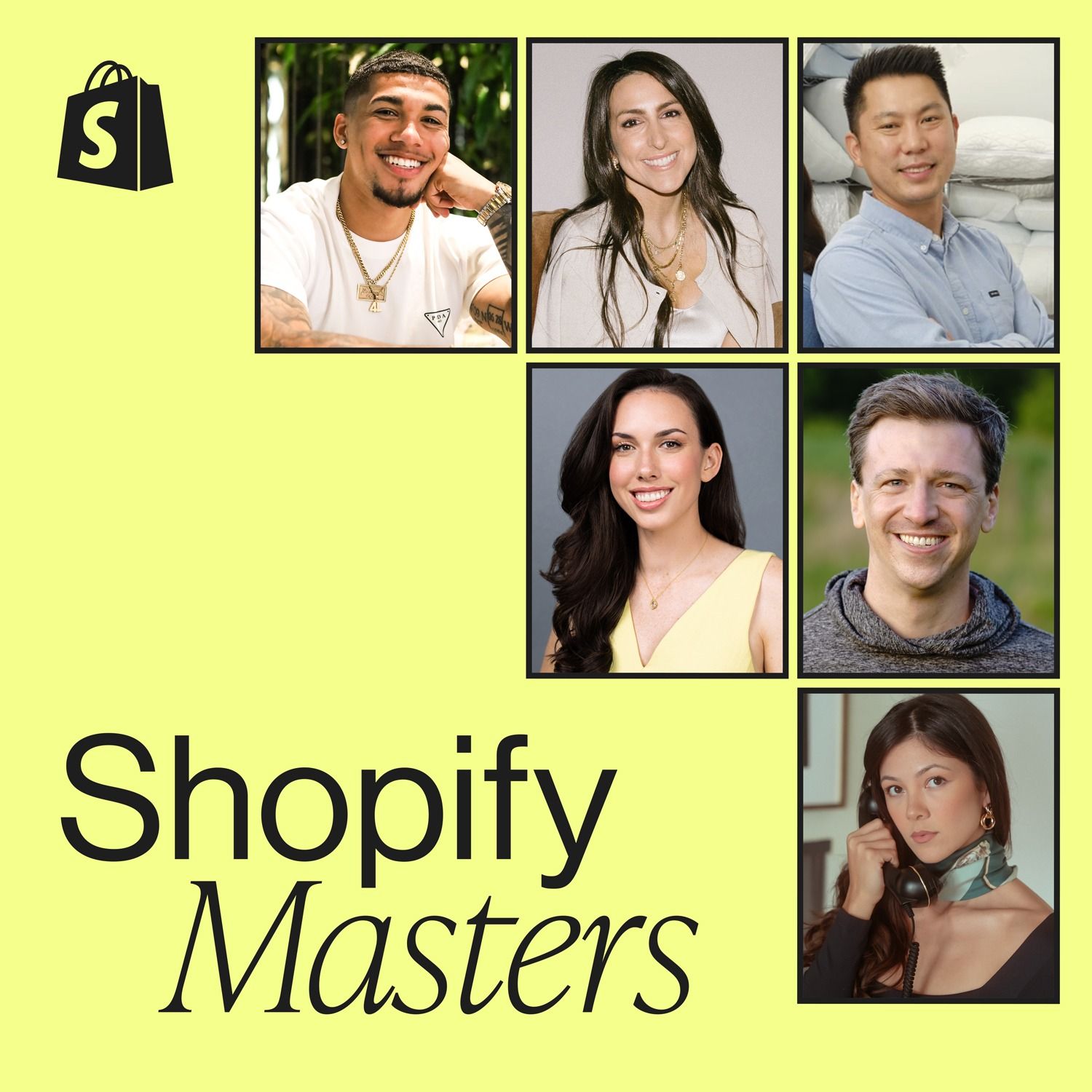
Shopify Masters
How 12 Founders Are Using AI To Get Ahead
00:27:37
Twelve founders building on Shopify reveal exactly how they’re using AI right now—the tools, the tactics, and where to draw the line. Here’s the playbook being written in real time by the founders of Figs, Therabody, The Black Tux, Loftie, and more.
Loading summary
Transcript80 lines
- [00:01]
Host
Right now, in this exact Moment, this founder's AI agents are running his business.
- [00:06]
A.C. Hampton
It's running 24 hours a day. It's like replying back to customer emails from me right now and I'm not doing any work.
- [00:12]
Host
Another founder was told point blank by her own factory that a critical product flaw just couldn't be fixed.
- [00:18]
Kathryn Goetze
The factory at that point was like, that's just how Bluetooth works. Like, we don't really know what to tell you.
- [00:22]
Host
So instead of accepting it, her team solved the problem with AI.
- [00:25]
Kathryn Goetze
ChatGPT recommended this, like, technical workaround, and sure enough, it fixed the problem.
- [00:29]
Host
Then there's the founder answering the question everyone's afraid to ask. Ask out loud. Can you actually do more with less?
- [00:35]
Andrew Blackmon
We are able to have a much smaller engineering team due to AI and being on the Shopify platform.
- [00:41]
Host
We brought 12 of the most forward thinking founders building on Shopify right now. We asked every single one of them the same question. How are you actually using AI in your business today? What we got back wasn't theory and it wasn't hype. It was a playbook.
- [00:54]
Dr. Jason Worstland
When I look at what it can do in just a click of an enter button, I'm like, wait a minute.
- [00:59]
A.C. Hampton
Wow.
- [01:01]
Host
But here's what felt unexpected. Not every founder is handing over the keys.
- [01:05]
Chloe Sapienza
I think that the creative spirit should be reserved for humans.
- [01:09]
Host
And that's the real question. Not what AI can do, but what should it do?
- [01:14]
Sarah Sugarman
This conversation's gonna be changing from week to week.
- [01:16]
Host
12 founders, the tools, the workflows, and the ways they're actually making AI work inside their businesses right now. This is Shopify Masters, your companion for starting and scaling your business. Let's kick things off with Kathryn Goetze, founder and CEO of Physical Phones. She's an AI educator who went analog and used the very tools she teaches to build a hardware company that made $800,000 in its first six months.
- [01:39]
Kathryn Goetze
We're actually using AI constantly to build this business because we're navigating such unclear territories and things we've never done before. Yeah, 100%. So we've given actual very technical electrical engineering feedback to the factory that was recommended to us by, you know, the different AI models that we're using to fix issues that we've run into.
- [02:02]
Host
So can you give me an example?
- [02:03]
Kathryn Goetze
100%. So when we sent out our first round of phones, when we met our Christmas delivery, the number one most common piece of feedback that we heard from customers was this bug where basically imagine you're sitting at home, you're paired to the physical phone. The physical phone is in the kitchen or it's across the room. And you're not taking a call right now, but you open up your phone, you're sitting on the couch and you start scrolling Instagram and you click on a reel and the audio from that reel starts coming out of the physical phone. Oh, right, because it's kind of like a Bluetooth speaker, right? Super annoying, very weird. You're like, oh, disconnect Bluetooth, change the speaker, whatever. There's like some workarounds, but mostly it's just annoying. That was the number one piece of feedback that we got. And Josh, who is heading up product at the time, has since been promoted to the CEO. He went back to the factory and said, look, we got to fix this. And the factory at that point was like, that's just how Bluetooth works. Like, we don't really know what to tell you. And he, not taking no for an answer, basically took that to ChatGPT, explained the situation in detail. And ChatGPT recommended this like technical workar, I think it's called like HFP or something like that. And he just sort of like lifted and shifted and brought it to the, to the team. And they were like, okay, we can try it. And sure enough, it fixed the problem.
- [03:10]
Sarah Sugarman
Wow.
- [03:10]
Kathryn Goetze
So now on all future physical phones, audio from Spotify, Instagram, TikTok, they don't come out of the phone. They just will take calls essentially.
- [03:19]
Host
On that front, do you have any advice for, I mean for, for entrepreneurs, but also just all, all of us regular humans, it feels like there are new AI tools coming out every day. Sometimes it feels like they're coming out every few hours in terms of like how to keep your arms wrapped around it without getting totally overwhelmed.
- [03:38]
Kathryn Goetze
I know, I know. It's. Believe me, I. First thing I want to say is just like, you're so not alone. And nobody who feels this way is alone. This is literally my full time job and I am also like, how do I stay up to date with everything that's happening? What I will say is that I think there's a total misconception that in order to be on top of things with AI, you're using like 50 different tools in a. We use one or two tools in the office on a regular basis and we just know how to use them really, really well. It's way more about how we're using ChatGPT, how we're using Claude, which are the kind of two main frontrunners that I would point people to and Gemini probably would be a close third to just really get the most out of those tools.
- [04:18]
Host
Go deep rather than broad.
- [04:19]
Kathryn Goetze
Yeah, exactly.
- [04:20]
Host
What does a business look like when it runs itself supreme? ECOM founder and CEO A.C. hampton is living that answer. Ads getting cut, emails getting answered, agents running 24 7. Whether he's working or not.
- [04:33]
A.C. Hampton
I'm building three softwares. I'm actually launching three softwares this year. One of the softwares that I'm releasing is called Ecom Boss. It's actually about to release into the market next month. It's a AI video creation model where all you have to do is just upload your product from Shopify and within 45 seconds it can create you 10 different ads of real people holding the product, moving with the product.
- [04:57]
Trina Spear
Wow.
- [04:58]
A.C. Hampton
Like walking around a park with the product, showing it being used, even like acting like they're eating it. Like if it's a tangible product, it creates you product images for your website. It gives you ad copy for your ads and it gives you everything that you need to start running ads right away. The content, the ad copy, the hooks, everything. And all you have to do is just talk to it, give it a text prompt, upload your product and it can make you, you know, like I said, 100 ads in probably less than 10 minutes, which is absolutely crazy. But you know, we have that, we have an AI store builder that builds people's Shopify stores out in less than 10 minutes for 100% free. We use AI for product research to scan the market and see the, you know, the, the products that are working the best. I mean we're using AI in every single part of the, of our, of our funnel and it's speeding it up so much and the decision making too. Like you have Chat, GPT, Claude, Gemini, these places that you can go and ask real professional experience to give them a prom. Be like you have 10 plus years of media buying experience. How would you handle this or handle that and having that second voice to be able to do the things that are needed. And then you know, nowadays I've even been able to start pushing out Open Claw if you know what OpenClaw is. It's like a, an AI that connects to Claude or, or Gemini or ChatGPT and it's running on your, on your laptop 24 hours a day. So it's like cutting my ads for me like right now and I'm not doing any work. It's like replying back to customer emails for me right now and I, and it just sends me A text message. And it's like, hey, this customer came in and complained about this. Do you want me to send this over to your supplier? So it's like a whole operator that I just have been able to build up to keep running the store even when I'm doing things like this. So AI has, like completely taken over. Obviously, AI is never going to replace people, but it will replace the people who don't know how to use it. And that's kind of like we're integrating it across every single part of running this business.
- [07:00]
Host
I mean, when you started this, basically the entire thing was like your own human manual labor. And now you've got all these tools. Are there places where that human touch is still super important?
- [07:15]
A.C. Hampton
1000%? The human touch comes with knowing the avatar. I think that that is the most important thing because AI can't feel emotion. And the one thing you do with marketing is push out emotion. So that's where I don't allow AI to touch in at all, is pain points, how I'm solving problems. What are the, you know, desires that these people have? What are the complaints that they're having? How do I solve it? What are the, you know, what are the real feelings that these people have? You can't make that up with AI. And I don't, I don't like to push emotion over to that side. So really knowing who I'm talking to and the emotion that goes behind it, that's kind of like where it just can't be replaced. But yeah, I mean, when I first started, I used to, I mean, it used to take me, I'd say, what, five to seven days to probably build out a Shopify store. And now I can probably get a whole store and product pages built in under 30 minutes.
- [08:03]
Host
Personalization and scale. Most brands pick one. FIG's co founder and CEO Trina Spear is using AI to do both.
- [08:11]
Trina Spear
AI is transforming businesses. It's definitely something that we're focused on. And I do think we are at the tip of the Spear just being a digitally native company, being born on the Internet before most businesses having the amount of data that we have, how are you utilizing that data in interesting ways in impactful ways for who you're serving? And I think that's where it is and will continue to change the game. How are you more personalized? Right to a nurse who's 26 years old, living in Boston, working at M and G H, what she's doing, what she's wearing, how she's working, how she's interacted with us, not just on our site, but out in the world, across the Internet and utilizing all that to be more personalized and be more impactful to her experience. And so I think that's where I'm really excited to be, delivering a better experience to our community. And then on the operational side, there's so much efficiency that we've already seen from a customer service perspective, from a marketing tools. And how are you, you know, really moving faster and getting more efficiency over time. And so I think we're still at the beginning stage and so much more to come. But yeah, it's super exciting.
- [09:26]
Host
I like what you're saying about utilizing it in some ways to make things feel more human versus less human.
- [09:32]
Trina Spear
100%. How do we get closer to you? Like, we're super close and that's what we think about that all the time.
- [09:37]
Sarah Sugarman
How do we.
- [09:38]
Trina Spear
How do we make that relationship even deeper digitally? Right. Which has been hard to do because so much of our business is a digital experience. But you can make that feel just like this conversation I'm having with you online. Maybe not even on our site with agentic commerce and things like that. Right. So it's gonna just be on your fingertips.
- [09:58]
Kathryn Goetze
Right.
- [09:58]
Host
Are you playing around with that right now?
- [10:00]
Trina Spear
100%. I think we're, like I said, at the forefront of it and utilizing it in the right way because you can't do it if you don't have the data. You can't utilize AI at the highest level if you don't have millions. We have one of the largest healthcare databases in the world. Right. So it's all ripe to utilize these tools to better connect. And that's the power.
- [10:22]
Host
Train it on the data and then
- [10:23]
Trina Spear
utilize it to get closer to people, to the individual. How do I build individual connection at scale? How can I personalize at scale?
- [10:34]
Host
He was a skeptic and then he wasn't. Founder of TheRabody, Dr. Jason Worstland on what flipped the switch and how Dr. J in youn Pocket went from tagline to real product. AI is inescapable these days. I have to imagine it's being incorporated at therabody somehow.
- [10:50]
Dr. Jason Worstland
I mean, there's a lot of ways our tech team, our cto is super on top of that. And it's just as important to have it outside as it is have it inside and to know where your boundaries are and to know how you're training these large language models. Like, how are you teaching it? To know what you're doing inside of the practice. So originally, it Was sort of structured, like, let us figure out how we're going to incorporate AI into our daily work. And then when you look at our app, for example, there's a lot of information that comes in our app. I mean, we've got over 500,000 users a month, which is insane to me, but that's a lot of data and AI can aggregate that stuff so quickly. So if we have how many people are on our app for back pain, it's X amount of people. Okay, what's. And then you start drilling that down. That takes weeks. But when you have AI, it's super quick. And the goal with all of that is for us to be able to kick out a protocol or find the most important protocol so that we can focus on that. And then with AI, a lot of that stuff you can have. We have it, we call it Dr. J in your pocket. Like you can literally have your own bespoke treatments built in the product. So we have what we call Coach by therabody. And if you sign up for Coach in our app, it's basically an AI driven thing. It's just aggregating all this information. It's just giving you what I would give you. It's literally the same thing. So it just makes scaling me and our protocols much easier. That's probably the easiest, the lowest hanging fruit around AI with TheraBody that I could talk about is that.
- [12:40]
Host
Did you have any initial reticence to that?
- [12:44]
Dr. Jason Worstland
Yes, 100%. Because I'm like, I've doubted it. Like, how is it not going to know how tall this person is?
- [12:53]
Host
It can't be me.
- [12:54]
Dr. Jason Worstland
It can't be me. Like, I don't. They're not looking at the person's affect. You know, your right side of your face is different than the left side of your face. And kind of got to read that and like, how are they moving? How do they walk? Like, where's their pain? Like, I for sure doubted it for sure.
- [13:09]
Host
What got you on board?
- [13:11]
Dr. Jason Worstland
I saw how it could aggregate information. I saw how quickly it could come up with an answer because we'd worked manually on a lot of those things. I mean, if I showed you the number of spreadsheets we made with algorithms, pick this one, and then it goes to this one, and then it goes to this one. I mean, to build that out, we did it. And so I know what that takes. And so when I look at what it can do in just literally a click of an enter button and I'm like, wait a minute.
- [13:41]
A.C. Hampton
Wow.
- [13:43]
Dr. Jason Worstland
And what we're doing isn't so personal that it bothers me anyway because what I'm providing for you is a protocol that you're going to ultimately do to yourself anyway or you're going to have a physical therapist or someone around you do that to you anyway. So it's not AI that's providing the service, it's AI that's providing the protocols. Does that make sense? So that's how we've. That's one of the ways we've incorporated it. I know we do it across the board with engineering and operations. You know, there's so many things like that that just helps take off the burden.
- [14:23]
Host
Not every founder is racing to automate everything. Melanie Bender, co founder and CEO of Lore, is drawing a deliberate line. Using AI as a supporting tool while keeping the craft firmly in human hands.
- [14:34]
Melanie Bender
Where a lot of brands use AI is generative AI for imagery, for copy, for all the creative side to a brand. And it's certainly to do that. It's helpful in a way. But you know, for me, I really wanted to be a human led organization. A human led organization in terms of what we're creating for. Like I'm creating fragrances for humans. But also I think that flows through to how we create as well. We've experimented with it, some things have worked well, some things, you know, we ended up not moving forward with and we're I land if that really feels right. Is using generative AI as a supporting tool, not a central one, and using it when what we're trying to do
- [15:21]
Host
defies the laws of physics.
- [15:22]
Melanie Bender
It's either physically not possible, like making a squeegee in the crop circle, which is one brief that we had, or it's not prudent to do in the real world. But not using AI as kind of a cheaper replacement for the real world. And that comes from just a love and a dedication for craft. There's incredible photographers out there, amazing videographers, prop stylists, you know, all these creatives who are contributing to making beautiful images. And I want us to be a part of supporting and contributing to that. Most of the copy for the brand I write myself, so there's also not a lot of AI in that. You know where I find it helpful is just kind of more copy editing. But as a whole, I want minds and hands to be making the. The vast majority of what Laura is
- [16:16]
Host
putting out into the world. What if the right tools just made Mondays easier? Shock Surplus founder and CEO Sean Reyes breaks down exactly what that looks like.
- [16:25]
Andrew Blackmon
AI has become A huge part of business models. What tools do you use specifically at Shock Surplus?
- [16:31]
Sean Reyes
Yeah, I mean the, the answer to that even a month ago is not the same answer as today. You know, there is AI slop has been, you know, a meme right across the Internet. But the tools now are incredibly precise. One of the ones that we've, I've been, you know, using and I don't mind sharing about is, is Claude. I've changed over From Gemini and ChatGPT and Claude seems to really nail brand voice, you know. And so we, we have over 200 blog posts and I've lo a ton of them into Claude in order to help develop future content. And so, you know, we're able to load for instance all content pieces on a vehicle which could be seven, ten different content pieces across different brands. All these robust 2,000, 3,000 word blog posts. Right. And so, you know, now compile me a comparison between all of these or now compile, summarize all of this stuff for us instead so that like obviously customers do not want to read, right? Or a lot of people don't have the time to do a 15 minute read. They want a three minute, a three minute piece that they can browse on their phone, right. And so we're using Claude to kind of stay on brand, summarize, you know, succinct, succinctly do quality work. It also does extremely well on data analysis and creating kind of project outline. Same thing with NotebookLM, which is Google's kind of tool, which is like here are my analytics for the first quarter, here's my YouTube analytics and here's our meta ad performance. Talk to me about what the gr. What's the having the biggest impact right now on my Shopify store and it'll point out things that I wouldn't even like, I wouldn't make those connections. But it's able to see all these data points and then load it visually, which is the crazier part because you can be looking at all this analysis but it creating a visual story for you outputted in a minute is the most incredible thing for a marketer and a store operator that I've ever seen because once again, this would take hours for someone to put together for you when you can automate that. Now with Claude automating the retrieval of all the information and then on Monday morning having that report for you visualized. And so I think that's one of the most incredible things that's only popped up literally within the past month. And so it's moving Very fast customer service coding.
- [19:15]
Host
Creative AI is woven into almost everything at Lulu in Georgia, but founder and CEO Sarah Sugarman has one line she won't cross.
- [19:24]
Sarah Sugarman
For sure. We're leveraging AI and I think this conversation is going to be changing from week to week. Honestly, it's the biggest topic in the company currently. We use it for everywhere from customer service to business intelligence. We use AI for AB testing. I mean, it's coding. It's pretty infiltrated into the fabric of the business at this point. We use it for product development. We'll use it to kind of do our first proof of concept. Where we're not using it and where I don't foresee us using it is in our lifestyle imagery. Our lifestyle imagery is all shot in homes and it's. And I think that's really important to the brand. As you said, when you're looking at it, it's aspirational and we're getting a real feel of how it would be in somebody's home. So that's not somewhere we're using it today or I foresee in the future.
- [20:08]
Host
She ran an internal AI hackathon and she's also the one in the room saying, pump the brakes. Co founder and creative director of Telescope Studio, Chloe Sapienza shares how she holds both positions at once.
- [20:20]
Chloe Sapienza
At this moment, we're doing a lot of iteration, we're doing a lot of research and learning. We actually have an AI hackathon scheduled for Thursday, is that tomorrow? So our team is really trying to understand at this point all of the different tools that are available and how we can implement them. At this point, we're probably a pretty low level user of AI across our different systems, but we're starting to incrementally introduce it in different parts of the process. And I think personally, you know, I use it daily to kind of iterate or get certain ideas outlined or that sort of thing.
- [20:55]
Host
More from a creative standpoint or more from like a. More like brass tacks. Operational standpoint.
- [21:02]
Chloe Sapienza
Operational, yeah. I am probably on the far end of the spectrum of avoiding it for creative. Yeah, not necessarily because it's not a great tool for people to iterate creatively. I think just as a sort of final product. I think I still feel like a designer needs to be involved in some way at the final stages of creativity with AI, but I do see a lot of value in it and I can see a lot of our customers too, being able to share ideas more easily because they're using AI and creative AI tools. And so, yeah, Nothing against it, just for ourselves and what we do. We mostly used it for operational improvements,
- [21:43]
Host
but, like, maybe a little bit of philosophical reticence when it comes to the creative stuff.
- [21:48]
Chloe Sapienza
A little bit, yeah, yeah, it's, it's. I think that the creative spirit in general should be reserved for humans, I think, across any output, right. Music or film or television or design, like, those things are the things that really reflect the human spirit. And so using technology to create a complete output of that, I think takes away the joy of what makes it imperfect and human.
- [22:18]
Host
He cut his engineering team in half on purpose. Co founder and CEO of the Black Tux Andrew Blackmon on how AI and Shopify made that not just possible, but the right call.
- [22:29]
Andrew Blackmon
So we are able to have a much smaller engineering team due to AI and being on the Shopify platform. But a lot of it's AI, like, you can generate code at a much more efficient way with some of these tools. So, yes, it's had an impact there. It's had an impact on some creative production as well. These tools can, like, basically do graphic design and create photography and all these different things in like a very beautiful way. We don't use it quite as much there, but we're starting to a little bit. And then we also use it in our FIT algorithm. And so we have so much data from our customers about their body type and how our garments will fit. And AI has been useful in training that day.
- [23:11]
Host
Coop, HomeGoods founders Kevin and Jinshan built a GPT trained entirely on their own brand voice. Here's what it unlocked and what it still can't replace.
- [23:20]
Kevin or Jinshan
So we have actually a custom GPT that we created in house. Obviously, you know, brand guidelines, FTC white papers on regulations within our space and a variety of those things and have marketing running through that. In addition, we leverage it for a lot of brainstorming, but then taking the human element, the personal knowledge of the brand and of the industry, and then taking that and using it for a variety of things. Copywriting, marketing, iterations of successful campaigns and moving on from there.
- [23:51]
Host
Lofty is a small team doing a lot. Founder and CEO Matthew Hassett shares the AI tools running in the background and how they make that possible.
- [24:00]
Matthew Hassett
We are an early and frequent adopter of AI at Lofty. When you're a small company and we're only seven people full time, so you need software to help deliver the right customer experience. And so we adopted customer support AI very, very early. We've been working with this company, Sienna, for three years. And so there's just so many customer support tickets that are the same and, and so you really want to be able to focus your human customer support on harder issues. So if someone writes in and says, where's my order? You know, our AI can write them right back with a tracking number and it can do it any time of the day. So that frees up our human agents to, you know, hop on a phone, call, help someone set up their clock, that kind of thing. You know, that's one part of AI. We've also incorporated AI in our products a lot. We were very early with that. We have a magic story maker feature where you can make a bedtime story and it narrates it. And that's pretty commonplace today. But when we launched it two years ago, that was pretty novel. And now we're just incorporating AI throughout our business. And so our developers, our software developers are working with each member of our team to figure out what can be automated. We talked about inventory forecasting, but marketing, trying new email headlines, building emails. I just use it everywhere.
- [25:25]
Host
Their rule. AI owns the first 80%. Humans own the last 20 feel goods. Founders Dustin Prabhava and Brian Wong on why that line is everything.
- [25:34]
Dustin Prabhava or Brian Wong
Product development is incredibly important for us. Which ingredients? We use the dosages of those ingredients. ChatGPT, for example, we're using that all the time on product development, product innovation. We still have a team of nutritionists and doctors that we work with, but it saves us a ton of upfront time, really. Just, you know, testing different theories. If there's a new product that, you know, comes into my mind, can I make it with these various ingredients, what would that look like? What would be the effect? That's one aspect. We're using it a ton. On the content side.
- [26:06]
Andrew Blackmon
Yeah, I think what's been great, I don't think, you know, AI necessarily is like, you know, creating content just now for us, but it's a great way to kind of just start with, you know, scripting and having ideas. I'll feed Claude literally all the content we produce and have it really learn about, like, what works, what doesn't. And then, you know, it's great for idea generation when you're just like kind of hitting a wall sometimes. That's one area. We use it a lot, trying to integrate it more with, you know, customer experience and just giving people an even quicker, more personalized response and resolution to whatever problem they have with the, you know, their products.
- [26:43]
Dustin Prabhava or Brian Wong
It's great for 80% of the initial lift. I mean, even on landing pages, right? We want to make a landing page for our gutline that is highly specific to regularity. For example. Cool. Spit out that prompt for me. Based on this landing page template that we already have. It'll do, you know, again, 80% of it. And then myself and, you know, maybe one or two of our nutritionists will go in and and tinker with it and, you know, update it accordingly. But it's just saving us a lot of time on the initial draft of different things.
- [27:16]
Host
Thanks for tuning in to Shopify Masters.
- [27:18]
Sarah Sugarman
Want more?
- [27:19]
Host
Subscribe to our YouTube channel so you never miss the strategies founders are actually using. The AI tools are here, the rules are being written in real time, and now you have them. We'll see you next time on Shopify Masters.