← Shopify Masters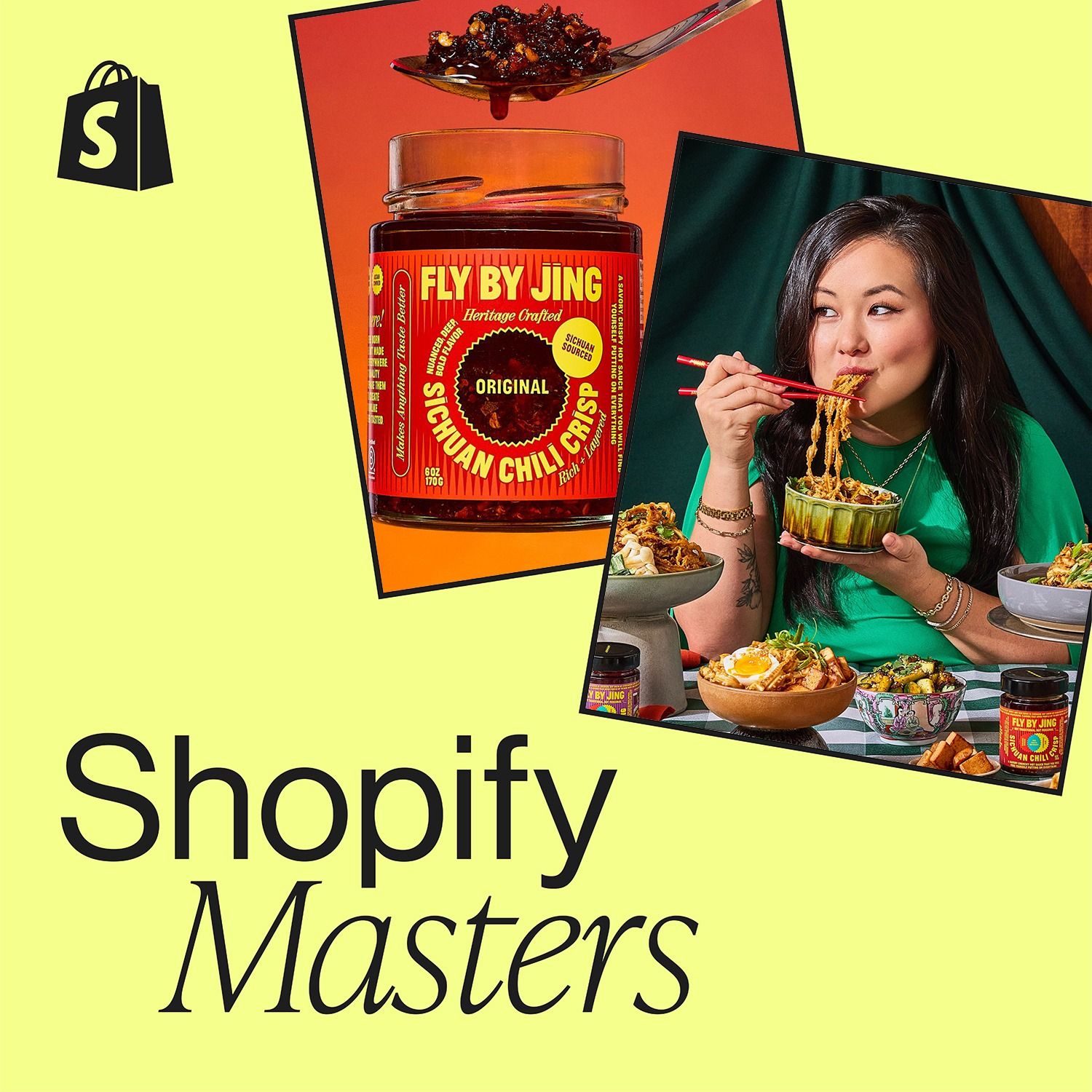
Shopify Masters
How Fly By Jing Turned Chili Crisp Into an 8-Figure Brand
00:45:58
When Jing Gao launched Fly By Jing, she wasn’'t just selling chili crisp—she was challenging a century-old story about the value of Chinese food. Starting from an underground supper club and a scrappy Kickstarter, she built a brand now found in Target, Walmart, and Whole Foods that has inspired a generation of Asian food founders.
Loading summary
Transcript82 lines
- [00:00]
A
The reaction to these flavors were really universal. People's eyes would pop wide open. Oh, my God, what is this?
- [00:11]
B
What happens when you reclaim your identity and let flavor tell your story? Jing Gao fused self discovery with bold entrepreneurship, launching Fly by Jing. From Kickstarter roots to a now eight figure flavor revolution, iconic chili crisps, sauces and noodles can now be found in 12,000 stores nationwide at places like Target, Walmart, and Whole Foods Market. Jing is changing how the world experiences Chinese flavors. With 70% of shoppers tasting Asian hot sauce for the very first time, this movement is rewriting the rules of food culture and brand building. I'm Serena Smith, and this is Shopify Masters, your companion for starting and scaling a business. Jing, thanks so much for being here today.
- [00:48]
A
Thanks for having me.
- [00:49]
B
Take us into the world of chili crisp. When were you first introduced to it and what role did it play in your life?
- [00:56]
A
Growing up, I think I must have been five, five or six. I grew up. So I was born in Chengdu, which is the capital city of Sichuan province, the food capital of China. And it's known for its spicy cuisine, and that is usually like, you know, takes the form of chili oil. Every family has their own, you know, different style of chili crisp because most families make their own. You don't. It's rare that you buy it and then they kind of put their own accent on it. And so, you know, growing up, we always had it in the. In the fridge and yeah, it was just kind of a part of every meal.
- [01:34]
B
And tell me about the restaurants that you would go to growing up in China.
- [01:38]
A
Yeah, so every time, you know, we would get together as a family on the weekends, we would go out to eat at these, like, street stalls doing, like, Sichuan is really famous for street snacks and, you know, comfort food and stuff. And so they would be served at these restaurants called fly restaurants. And these are really bare bones, hole in the walls that are usually family run. You know, sometimes hidden down alleys, but hard to find. But somehow, you know, Sichuan people will always be able to find the most delicious spots. And so they're called fly restaurants because they're so delicious. They attract people like flies.
- [02:15]
B
Mm, fun. I love that. You didn't stay in China for the entirety of your childhood, right?
- [02:22]
A
No. You left in Jungkook. I was born there, but my dad was a professor at the time, and so he was traveling a lot for work. And eventually we moved as a family to Europe. So we moved around quite a lot growing up, I think we were in every country for just about A year, and then we would move to the next one. Usually a different language, different culture. And then eventually we ended up in Canada. But, you know, every couple of years, we would go back and, you know, see our family in Sichuan and load up on the delicious food.
- [02:56]
B
You moved every year? That is incredibly intense.
- [02:59]
A
Yeah, until, like, high school, almost.
- [03:01]
B
Wow.
- [03:01]
A
Yeah.
- [03:02]
B
I mean, there's something to be said for probably what it contributed to your palate and your culinary sensibilities, but that is also incredibly difficult as a kid.
- [03:12]
A
Yeah. I mean, I don't think I really appreciated just how, you know, the toll that it had on me. I think it was just the norm for me. But it was definitely kind of weird, like, every year saying goodbye to friends that you made and then being like, okay, I probably will never see this person again, and then having to make new friends. And, you know, at the time in Europe especially, you know, we lived in Germany, England, Austria. It was. I was often the only Asian kid. It definitely made me want to assimilate however I could and not stand out as a kid. You never want to be the odd one out, right? And so pretty early on, I learned to, like, try to blend in, you know?
- [03:56]
B
Yeah, I moved a lot as a kid also, and I was raised by a single mom. I'm half Persian, but my father was never in the picture. And I went through a similar thing where it was just like, I'm white passing. It feels. Felt so much easier to just cover it up for a really long time. And it wasn't really until, like, deep in my adulthood that I was like, oh, there's this, like, whole other piece of my identity that's, like, dying to come forth, that I've, like, sort of engaged in this, like, erasure. This, like, voluntary erasure around. When did you find your way back?
- [04:32]
A
It was kind of a long, meandering kind of route. But I. Well, I think what was good was, you know, I spent most of my formative years in Canada, where it was quite diverse, you know, and I went to college there, and I ended up with an opportunity to study abroad in China. And so I found myself, you know, in China in, you know, in my early 20s, and really was shocked by how modern and amazing and dynamic it was. And, you know, I had become so removed from it. Like, we go and visit our family, you know, in the summer. So, you know, being in. In a dynamic city like Beijing and Shanghai, I was really surprised and loved it and fell in love with the energy. So I ended up finding my way back there with a job. And that was kind of when I started to really, you know, reconnect with my roots, peel back the layers a bit and, you know, kind of try to find, figure out my identity and. Yeah, and surprisingly, like, food became this vehicle for me to. To do so.
- [05:41]
B
So how did the exploration of food contribute to that?
- [05:45]
A
Yeah, so I. I think I just, like, you know, it started out as just being really curious, eating. You know, everything I saw Beijing is really interesting, is it's. It's the capital, and there's all these, like, provincial government offices that have. That have buildings in Beijing, and the officials from those provinces would come and work there, and they wanted food from their hometowns, and so they would bring in these chefs and they would all operate restaurants that are open to the public so you can actually go and enjoy the cuisine from all these different provinces. And that was the first lesson was how diverse Chinese cuisine is. I think in the west, like, it
- [06:24]
B
was a shock to you.
- [06:25]
A
It was a shock to me, yeah. Because in the West, Chinese food is flattened and you think of it as only one thing. And especially in America, right? It's Chinese. American cuisine is its own evolution. And whereas in China, you realize, wow, this place is massive. It's like a continent, and every region is like a different country and how different it is from the others. And, you know, so that was like a really amazing display. So in one city in Beijing, you could actually go around and eat, like, dozens of different, wildly diverse cuisines, and it's like the most authentic version that you can get in these government offices. So that's kind of, you know, it just started out as curiosity. I was like, wow, this is delicious. It's so layered. And then I had a friend who ran food tours in Beijing, and I started doing food tours for her. I like, you know, tagged along, learned a lot, and started leading these tours. And that, you know, got me deeper into, you know, the history and the heritage behind these cuisines. And, you know, I think I was really interested in it also as a form of self discovery and eventually, like, self expression as well. But, you know, I think when I was learning about all of this, just through eating it, I realized I also wanted to share it with the rest of the world. You know, I had a blog at the time, and it was one of the few blogs, you know, back then that wrote about Chinese food culture in English. And so I just started sharing what I was learning and eating. And then that became more of a mission to me for me later on to just, like, you know, shine light on this incredible culinary heritage.
- [08:14]
B
And you found that that blog was resonating right away.
- [08:17]
A
I mean, I don't know. I don't know how many people really read it, but it definitely reached a lot of food folks. And, you know, I would have, like, celebrity chefs who would film in China, reach out and, you know, had me as a guide on their shows or, you know, help produce, you know, their. Their TV shows and stuff. So I think it definitely reached, like a kind of a foodie audience. Yeah.
- [08:43]
B
You had originally been sent back to China as an adult. You were pursuing business at the time, and then eventually you left to open up your own restaurant, right?
- [08:53]
A
Yeah.
- [08:54]
B
That transition sounds crazy to me, knowing the extent to which the restaurant business is no walk in the park. I mean, what felt like it was so worth it to you that you had to do it in that moment?
- [09:05]
A
Yeah, so I had a tech job that actually brought me to Asia. And, you know, but it was. It was great because it allowed me to travel a lot all over Asia. And, you know, I had a lot of free time on the weekends and stuff, so I would. I would just eat and explore. But I think, you know, as I was writing more, sharing more, doing more, kind of like, projects, food media, like side projects, I started realizing this is where my passion really lies and that I wanted to devote myself full time to it. I didn't know what it was going to be. I just knew that I wanted to spend more time on it in order to find out. And so I, like, had saved up a little bit of money from my job. And so I quit without a plan. Jump and then, yeah, jump right into the deep end. Because I think I realized I was like, that if I didn't have a safety net was the only way that I could just take that plunge.
- [10:02]
B
And so you got to have that sense of urgency.
- [10:04]
A
Yeah. And eventually I met a business partner who also had this desire to start a restaurant. And what I was noticing at the time was that fast casual restaurants in the US Were really taking off, like the Chipotle's and the Sweet Greens. And I was really inspired by that, that model. But I wanted to apply, like, it to modern Chinese cuisine. At the time, in Shanghai, that wasn't really a thing. It was either, like, you know, big restaurants or mom and pop shops, and nothing kind of in the fast casual in between. It also helped that we didn't know what we were doing and we didn't know how difficult it was going to be. So we were like, why not us, you know, so ignorance is bliss.
- [10:42]
B
Yeah. Okay, so you launched this restaurant, which ends up doing really well and winning. Winning awards. At that point, can you see in your future that you have a product line that's maybe coming to form? Or how does Fly by Jane come to be from there?
- [11:00]
A
Yeah, so definitely not. I had no idea. But that restaurant was successful. We had it for about two years. And as with most kind of first time businesses, I had a falling out with my business partner. We ended up parting ways and learned a ton of lessons from that experience.
- [11:21]
B
Experience.
- [11:23]
A
And I ended up, you know, I wanted to go even deeper, you know, into Chinese food and particularly Sichuan food, which is where I'm from. So I actually just picked up and moved back to my hometown for a bit, which is Chengdu in southwest China. Spent some time there, and I was staging or like, you know, learning from this incredible chef there who is one of the most famous, like, master chefs in China. And he was kind enough to, like, take me under his wing. And I spent a lot of time just absorbing everything he had to teach. And he has this, like, deep respect for ingredients, especially from Sichuan. And so he would go on these, like, sourcing trips where he would find the highest quality, like peppers and the highest quality, like fermented bean pastes and all kinds of beautiful ingredients that were really, you know, I think that's when I learned to appreciate the quality of ingredients and how they really affect flavor and that, you know, as consumers who are just kind of peripherally consuming food, we don't really think about, you know, that and all that goes into what you eat, I think, you know, but when you're working with those ingredients, you really see just how impactful they are. And the highest quality ingredients are actually inaccessible to most people because you can't just buy it from a grocery store. The stuff that makes it on shelf at grocery stores, I realized, were generally more mass quality. And it's that way because it has to fit a certain price point, which tends to be cheaper. And so the highest quality ingredients were really, really rare. And they were also snatched up by these top chefs, you know, the moment that they're available. So you really have to develop those relationships over time to be able to access those ingredients even within China. Right. And then I started noticing that, you know, in the west, the highest quality stuff would really never make its way there, you know, for many reasons. But I, I just, I think, really developed an appreciation for really high quality ingredients and started cooking, you know, my own version of these, these flavors and started this underground Supper club. And I named it Fly by Jing because it was a nod to the Fly restaurants that I grew up with and loved. And I love that, the energy and the flavors. And I wanted to bring it to life in my pop up dinners. And so, yeah, that's kind of how I started cooking like, you know, my version of modern Sichuan food. And eventually that led to this line of products today.
- [14:24]
B
Well, but then how did, how did
- [14:25]
A
the product, how did the product come to be Jay? So, so, so I started doing this series of pop up dinners, and I was invited to cook with chefs all over the world. I would do pop up pop ups in like, as far away as New Zealand, Australia, Japan, New York, L.A. and I would have to travel with my ingredients with me because they're obviously not available anywhere else. And they were integral to the flavors. Right. And so I would, you know, pack suitcases full of ingredients. Eventually I started, you know, pre batching some of the sauces that would go into my dinners and into my dishes. And, and I would notice that, you know, the feedback or the reaction to these flavors were really universal. Like, people's eyes would pop wide open. They'd be like, oh, my God, what is this? Right?
- [15:24]
B
No matter where in the world you live.
- [15:25]
A
No matter where. Yeah. So, you know, it's not just flavors that I grew up loving. Like, people really appreciated these flavors, even if they had never heard of them, never accessed them. And so I started thinking about, how do I make this more accessible to people? And, you know, I was pre batching some of these sauces. And, you know, Sichuan is famous for flavor profiles. There's dozens and dozens of flavor profiles that Sichuan chefs can create with, like, just limited amount of ingredients. And a lot of the times those flavor profiles are in the form of sauces. And so I was already, you know, pre batching some of these to take with me on these trips. And guests would ask for, you know, the chili oils and the sauces later on. And so I sort started making it in my kitchen in Shanghai and selling it locally in China. And it was quite popular. And I was, you know, there was this like, kind of idea in my head, you know, what if I scaled this? What if I brought it to, you know, the West? And in 2018, I was with a friend in California, just traveling, and, you know, she's also in the food world. And we decided to go to this trade show called Expo West. It's the largest natural food trade show. It's huge for, like a food lover, it's like heaven. It's it's incredible. Massive, right? It's across several convention halls and thousands and thousands of brands are showcasing their products. And the people that go to the shows are often like the buyers of grocery stores, like Whole Foods and, you know, Target and so on. And I remember walking through this show because it's multi days, it's. It's massive. And just sampling everything as I was going. And at the end of like the three or four days, I remember feeling like, huh, that was weird. Like I had to have a craving for Asian food for some reason. Oh, it's because I haven't had any Asian flavors this entire week and total dearth of offerings. Yeah, yeah. And not only was like the, the, the brands represented not diverse, like there were barely any Asian food brands. Also just like the buyers and the whole ecosystem of people there was, it was lacking in diversity. And I remember being quite shocked by that. And also, you know, from kind of industry reports I was reading, I was seeing that, you know, spice, you know, flavors with a lot of heat and also multicultural flavors were where a lot of the growth in natural food was going to. Like, not only was there kind of a lack of Asian food brands, you know, a lot of the Asian brands that were in the market, you know, only lived in Chinese grocery stores and were not all natural. Right. Like, there was a lot of preservatives and, you know, flavor, artificial flavors and stuff added in order to get the price low. Right. And so that was kind of this observation that I had and I started thinking, well, what if, you know, the quality of the stuff that I was making in, in China I could bring here at scale? So that was kind of the beginning of that idea. And it took a long time still to be able to figure it out. And like, how do I scale this thing? How do I produce it? How do I maintain the quality while scaling a production so.
- [18:53]
B
Right, right. While trying to build a business that's actually profitable. Yeah, because you ended up doing a Kickstarter campaign. Crowdfunding is obviously not what it used to be, but it went gangbusters, right?
- [19:07]
A
Yeah. Yeah. So when I went back to Shanghai, I was like, okay, well how do I do this? I had no idea. I started looking into manufacturers, but the minimum runs were so high and I was running out of money by that point. And I realized that in order to produce this, I'm going to need to, you know, raise some money. And I didn't know any investors. My friends and family don't have, you know, that kind of money. And so I had some friends that did Kickstarter and I realized it was a really great way to not only, you know, you know, raise the funds, but also, you know, test out, drive the marketing story and see if there is demand for this. Right. And what I love about Kickstarter is that it is kind of this microcosm, you know, where their backers are really supportive of entrepreneurs and understand that things don't always go as planned, especially the first time around when you're, you know, when you're building something. And so there's a lot more kind of leeway that you're given to be able to figure things out. So it's not like when someone places an order, you need to deliver it within 48 hours. You can say like, hey, I'm going to need eight months to do this. Right, But I need this, this cash up front. And so it's really preorders rather than like a GoFundMe or something like that. So, yeah, so I made a video, you know, told my story about wanting to bring really high quality Chinese flavors to the US and, and to show that, you know, Chinese food can be some of the highest quality, you know, most delicious foods out there that are healthy and also like that command value and to shift some of these narratives that existed in, in the US for such a long time about Chinese food. And I think that message really resonated. I think it was the right time people were ready for a new paradigm about Chinese food.
- [20:56]
B
And was it resonating primarily with other Chinese people or was it resonating with a much broader demographic than that?
- [21:03]
A
I think it was, it was most people. I think it wasn't just about Chinese food either. I think it was kind of this, the moment that people felt ready for all sort of previously marginalized cuisines and cultures to be seen more, you know, for what they are. And yeah, I mean, I think it is crazy that in 2018 there weren't any modern Chinese food brands.
- [21:29]
B
Yeah, it's this double edged sword, right, because it's like, on the one hand it must have felt really gratifying, but on the other hand you're like, it's 2018 and this is where we are. You know, like, I gotta do something about this. It lights a fire under you.
- [21:42]
A
Yeah, exactly. And so I think my Kickstarter was, yeah, the summer of 2018 and it went kind of viral and ended up, you know, raising, you know, I think it was one of the highest funded food projects on Kickstarter.
- [21:59]
B
You think?
- [22:00]
A
I think, I mean, I Don't know, maybe since then, you know, maybe someone has topped that. But it's. Yeah, we had like, you know, 2500 backers and it was amazing to, to have that support. And those people became our earliest supporters. And it was through word of mouth, through them that we started growing.
- [22:21]
B
Amazing. I mean, I think like the pre order model, whether it's via crowdfunding or some other avenue, is such a great way to prove product market fit. Because it's like, not only are people saying, I'm interested in this, they're saying, I'm interested in this product and I'm willing to wait for it. And in like an immediate gratification universe, like, that's a big, that's a big testament to the potential power of your brand, especially when it's a food product, you know.
- [22:50]
A
Yeah. And I think just like Kickstarter backers are early adopters, they're, you know, trendsetters. They're people who believe in entrepreneurship and believe in supporting entrepreneurs, and that's a really supportive environment to like launch a business. Yeah.
- [23:07]
B
When you, when you finally launched the product and you were doing it D2C for years before you moved into retail, which we'll talk about, you launched at a much higher price point than the other competitors in the western markets. Maybe your Kickstarter supporters understood that. But I would imagine there was an uphill battle right out of the gate to convince people of its worth. Like, how did you convince consumers that it was worth it to pay three or four times the price?
- [23:36]
A
Well, I really highlighted just like the, you know, the rarity and the quality of the ingredients that we were putting in this product. You know, a kind of mass produced chili oil might have like three, four ingredients in it. And like, one of them is like, you know, artificial additives and flavors. And, you know, whereas my chili crisp, you know, and we still have the same recipe as we did back then, has like 18 ingredients in it. And the umami, the deep flavors in it are not, you know, through flavor shortcuts. It's through building that umami with layers and layers of ingredients. And also the element of thyme, like, we have ingredients in it that are fermented that you could not, you know, replicate without that time that it takes to go into it. And also, this is a very small business, Right. That you can't compare to the economies of scale of a billion dollar, you know, conglomerate that is, that that has the advantage of scale. So I think, you know, when people shop small, it's, you know, it is, it does come at a higher cost because you're supporting, you're supporting that. So I think there was resistance because for the longest time, people were so used to seeing Chinese food in that mass produced format. Right. Where that low price point, which was out of necessity, which was because for the longest time, you know, Chinese companies were told that Americans would not accept Chinese food that cost more than like $2. Right. So of course they're not going to put anything of quality in it. But I think this, this was introducing, like, a new paradigm that Chinese food, Chinese culture, Chinese people really have value that is worth paying for.
- [25:26]
B
Yeah. Hearing you say, you know, that you were told that American audiences wouldn't accept Chinese food past a certain price point feels really loaded to me. Like, it does feel like, oh, you're saying something that's not just about the food at that point. You know, we're saying something more deeply about the value of a cuisine, a culture, a group of. A group of people.
- [25:49]
A
Yeah, absolutely. So at the time, I think it was around the same time, there was a book that was published by a sociology professor at NYU called the Ethnic Restaurateur. And in it, he was discussing, you know, why do certain cuisines cost so much less than others? And why do we go to, you know, a French restaurant and we expect to pay top dollar, but then go to a Chinese or Thai restaurant and we expect it to be cheap. His theory that he put forth was that, you know, there is this hierarchy that we place on cuisines. He calls it the hierarchy of taste. And that hierarchy is actually determined by the judgment of the socioeconomic status of immigrants who brought those cuisines to America. And that this is also a dynamic hierarchy. It, you know, changes. 100 years ago, Italian cuisine was also looked down upon and, you know, made fun of. And, you know, 100 years later, today, you can go to a restaurant and pay $40 for a plate of pasta. Right. So these things change, and they change with, you know, migratory patterns, like, you know, socioeconomic status changing. And we've seen that happen over, I think, the last, like, decade with the rise of, you know, Asian cultures and soft power in the US and so I think that, you know, through brands like ours, like the others that, you know, have also launched since us, like, you know, that we're part of that change and that evolution.
- [27:24]
B
Oh, yeah. Launching at this higher price point also opened you up to a fair amount of criticism. I mean, so much so that there was even a New York Times piece written about you and other immigrant food founders. What kind of resistance were you coming up against?
- [27:42]
A
I think people who could not accept that Chinese food has any value. For so long, we've lived under this certain kind of mindset. Right. In America. This stems way back to the late 1800s when there was the Chinese Exclusion act. And that was kind of the first, you know, law that banned an entire, like, ethnic group from entering the country. And so, you know, that happened. But there was this loophole, apparently, so if you were in commerce and that included restaurants and laundromats, you could enter the country. So all of a sudden you had so many Chinese immigrants come in to open laundromats and restaurants. And that's why Chinese food sort of proliferated across the country. So it's, it's a cuisine that developed through resilience. You know, they were forced to price really low, otherwise they wouldn't have any customers. They were forced to adapt to an American palate. So they evolved a lot of the flavors to, to adapt to an American palette. So then Chinese, American cuisine sort of formed very independent from Chinese food in China. And so, and over you know, the last, you know, 100 plus years, those perceptions of Chinese food, that it has to be cheap, that it's, you know, laden with sugar and, you know, additives and unhealthy, you know, all of these perceptions kind of lasted for a really long time. And so I was coming up against those resistances. You know, people thinking, well, I've been to a Chinese restaurant before and it doesn't taste like this, so therefore I reject this. This is not real Chinese food. Or, you know, my grandmother makes Chinese food and this doesn't taste like that, so therefore this must not be authentic. I think, like, marginalized cultures often have so much weight on their shoulders that, you know, it's. It's hard to let go of, of the meaning of. Of something. And if the meaning has been so defined for so long, anything that is outside of it can feel very threatening.
- [29:57]
B
Yeah. Feels scary.
- [29:58]
A
Yeah, yeah.
- [30:00]
B
Right. And we have to contend with sort of our own internalized self oppression, which is a really nuanced and thorny conversation to be trying to have with people, let alone on social media.
- [30:13]
A
Yeah.
- [30:13]
B
When they're attacking you and the brand in weird ways, you decided to take like a different kind of approach. Like, you clapped back with humor.
- [30:22]
A
Right.
- [30:22]
B
Can you like, I mean, like, what were some of your favorites?
- [30:28]
A
Yeah. So this, you know, we've had, we've faced a lot of resistance throughout the entire journey, but I think there was definitely a crescendo around Covid, there was a lot of anti Asian sentiment as a whole, and a lot of it was directed towards us, and especially as a brand that makes Chinese food that is made in China. So you mentioned there was a New York Times article that talked about how women entrepreneurs are typically trolled more online. You know, and we were one the examples. And, you know, I think my team has always just like taken a pretty light hearted approach to that kind of thing. And so we were sort of famous for trolling back our trolls. And, you know, sometimes we didn't even have to do so. Like, our customers would just, you know, do so for us in the comment section. But I think there was this one comment that stands out. This guy was like, you know, you can make chili oil for 12 cents. Like, you don't have to buy this, you know, this crap. And then someone else actually a customer wrote, well, you can also make ketchup at home. I don't see you giving Heinz a hard time. And so I thought that was really funny. So it's always cool when your mission and your values are so clear that others and your customers can actually, you know, repeat them for you. So. So that was really great to see.
- [31:59]
B
Yeah, yeah, you, like, the, the troops are rallying around you to some degree. You don't even have to fight the battle on your own. I think that response also involved calling the guy a goober, which I just like. Like every time I read that I'm like that, it makes me laugh. I'm like, so perfect. Okay. But at the same time, this product, your, your chili crisp comes out and it develops this, like, pretty cult following quite fast. Right. Did it feel that way internally?
- [32:25]
A
Yeah, I mean, I think it definitely felt that way. Yeah. Especially in, like, cities like New York and la, where, you know, our initial Kickstarter backers kind of were based. And yeah, the word spread pretty quickly, probably because it was the first time that people had seen something like this. And I think it also helps that it is a spicy, you know, chili oil that's good on everything. And, you know, it's also a. It's, it's hot sauce, but it's different. It's got texture and people haven't really seen before a hot sauce that you need to use a spoon to use, you know, and so, you know, in Sichuan, like, even in China, Sichuan cuisine is quite popular amongst all the other cuisines. And that's because spicy flavors are actually addictive. Like they create this endorphin rush. Right. And they're addictive. So you kind of want to keep going back. And so Sichuan cuisine, I think, has really taken the world by storm because of that. And so once you try it, I feel like it's hard to go back to a world where, you know, you don't know that flavor.
- [33:38]
B
So how quickly did you know once you actually went to market that you were onto something that could have some real longevity?
- [33:48]
A
I think it was probably during COVID So, you know, it was a tough time because we didn't have, you know, we. We didn't know what was going to happen at the time. It was a very scary time. You know, anti Asian sentiment was really high. We didn't know whether we. We had a business. China was shut down for the first three months of the year because Covid hit there. You know, we didn't have a supply chain. But in the midst of all that, there was this article in the New York Times about us. And I didn't know that it was going to have the effect that it did, but it absolutely just went viral or it blew up or maybe that's just the reach of New York Times Sunday, you know, paper. And we almost immediately sold out of, like, four months of inventory, sold out of all the inventory that I had in the US And I started taking pre orders and, and then just hoping and praying I could figure something out with the supply chain. Luckily, by that point, this was in April, China was starting to come back online. So the factories were starting to, you know, get back into operations. And I had to, you know, figure out, like, how do I now fulfill and fulfill quickly? And there ended up being so many people on the wait list who, who ended up waiting, like, probably six, six months for their. For their sauces. But again, you know, it was Covid time, and it kind of felt like this, you know, microcosm, you know, again, where everyone was very supportive of companies and understood that, you know, everyone was experiencing supply chain challenges and they were willing to wait, you know, and there were so many mishaps that happened. You know, things that didn't get delivered on time, broken jars, you know, broken machines. And every step of the way, they were really understanding. And some of them said it was the most thrilling updates that they had been receiving during COVID because it was just really a comedy of errors, the amount of, like, stuff that was happening. So, yeah, so ultimately I felt like those people that, you know, pre ordered really felt like they were part of the journey as well, and so were even more supportive, you know, after they received the product. And then after that too, yeah.
- [36:13]
B
It builds long term loyalty in a different kind of way. In the end, you were building in public before people were even using that terminology. It sounds like, you know, you were sort of sharing the warts and all stories and it was working to your credit to not have too much of a shield between you and your customers. Were there, was there any particular mishap that like, really seared itself onto your soul?
- [36:38]
A
Yeah, you can share with us. Yeah. I would say, like the very first one really taught me a lot. Like, this was the first shipment that came in from the Kickstarter and I had just moved to la. I actually didn't know anybody here, but I thought, you know, because LA is closer to Asia, it might be a good base to, to kind of get started. So I moved into an Airbnb in LA and found a 3PL, which is a logistics company to do the shipping for me. And I had told them, you know, I've got these glass jars that are coming in from China. You're going to have to really protect them because glass, you know, it's very fragile. And they're like, yeah, yeah, we do this all day. We know how to do this. And, you know, so I remember the shipments came in and they shipped out like 2,500 orders in one day. And I was like, that's really fast. That's really amazing. And three days later, I get the first email from a backer who was like, what is this? And it was a photo of a manila envelope with just glass, shattered glass and chili oil inside. And. But I realized they did not, in fact, protect the jars. And they put like two jars next to each other in a manila envelope. Oh, my God. And that's how they sent it out. So it was devastating to say the least, because I was like, if they did this to all the jars, I don't know if. I mean, I can't refund people their money at that point. We had already spent it on the production and I thought that the business was over before it even started. So. So in a panic, you know, I wrote an email to every single person. I was like, this thing happened. Your jars may arrive broken. We will figure it out. We will reship you. You know, we'll figure it out. And. And people must have sensed, like, the panic in my voice. Like, they, they wrote back immediately. They were like, don't worry about it. This stuff happens. We'll let you know what happens. And, you know, I ended up that winter, you know, not going home for Christmas. And I was like doing customer service emails for the whole month. And somehow, by a miracle, you know, only 15% of shipments were broken. I don't know how that happened, but I was talking constantly to customers every single day. I realized just the importance of transparency and the trust that you can build through a crisis. And that was something that we took with us moving forward and how we approach, you know, customer service this, to this day.
- [39:15]
B
Sort of an unexpected upside, right?
- [39:17]
A
Totally.
- [39:18]
B
You. You want the path to be smooth and successful, but in so many ways, it's like. It's in those moments of mistakes and panic that the real learnings happen. And it sounds like there's been all these inflection points over the course of Flyby Jing where those moments have actually helped, like, really solidify the loyalty of your customer base.
- [39:37]
A
Absolutely.
- [39:37]
B
It's really beautiful. I want to. We could talk about so many more things, but I want to ask you about. I love the show. Nobody wants this. And Kristen Bell in the show is wearing a Fly By Jing sweatshirt. And that show is, like, really a love letter to la. Like, all of the product placement and the places that they go in LA are, like, so carefully chosen. It's kind of like an if, you know, you know, kind of show. How did that come to be? Did you reach out to them? Did they reach out to you?
- [40:07]
A
Yeah, I mean, we were so lucky to be featured on that show. And it was completely unexpected. I think. You know, what I had heard was that the cast and crew were already fans of Fly By Jing. One of the cast members actually is a friend of mine and of the brands. Her name is Sherry Cola.
- [40:24]
B
She's amazing.
- [40:24]
A
Yeah, she's amazing. And she was one day just wearing our sweatshirt on set, like, you know, when they weren't filming. And then Kristen Bell was like, oh, my God, I love Fly By Jing and I love that sweatshirt. I need it for the show. And so that was how it ended up in the show. And we had no idea that it would be featured so prominently and also was in the trailer. So we're just very lucky that, you know, they organically decided to feature us in that way.
- [40:51]
B
Were you able to see if that actually had any kind of impact on the business, on product sales, on merch sales?
- [41:00]
A
Well, you know, I think it was more so for awareness. But the. The sweatshirt definitely took off. We normally just, you know, sell a few dozen a month on our website, and then it completely sold out. We restocked. It sold out again, I think twice. And then we started seeing these bootleg sites Popping up that were selling our sweatshirts because we were sold out. Oh, my God. And so some of our customers actually bought them and sent us, like, photos being like, what is this? Because apparently it had, like, typos all over it. So when we started seeing that, we were like, oh, wow, you know, you. You know, you made it when you get bootlegged. And then we. We turned on, like, print on demand at that point. But, yeah, so the sweatshirt itself definitely had a life of its own.
- [41:51]
B
This is amazing. You're. This is clearly so much more than a condiment or a sauce to you. And you've had such massive success. You're in, like, 12, 000 doors now. I'm sure it still feels like there's. There's a lot to be growing, but your mission statement is to expand palates and minds. I mean, eight years into this journey, how far do you feel like you've come, and how far do you feel like you have to go?
- [42:19]
A
Yeah. So, you know, our purpose is to evolve culture through taste by expanding palates and minds. And I was just at Expo West. You know, we have a big booth at that show, and it's been really amazing to look back and see this is where it all started, where I just wander the halls. Didn't know a single person and, you know, didn't see any Asian brands. And today, when you go there, it looks very different. It's very diverse. There's countless Asian brands. Chinese, Korean, Vietnamese. So many. And over the years, actually, a lot of those founders come to us and told us that they were inspired to start their brands because of seeing Flyby. Jing and I realized just how important that visibility is. And as difficult as it has been to kind of forge a path when there wasn't one before, or when you're told that there's no opportunity, there's no direction, you know, for you, it's been so rewarding to see that there's strength in numbers and so many brands that have come in since, like, rising tides lifting all boats. And together, we're really changing the way that America eats. Because when we first started, you know, the ethnic food aisle in the grocery store was not an exciting one. It wasn't. It was kind of forgotten, and it was very small. And today, you know, we're seeing many of the largest retailers in America tell us that they're expanding their Asian set, they're doubling, tripling the space that they previously had because they're seeing the opportunity for growth in those. In those aisles. And then, you know, investors are focusing on Asian and other ethnic food brands now. So the entire ecosystem has really changed. And I think that's, you know, what we're the most proud of. And, but at the same time, you know, we're just getting started. We just launched at like, you know, 4,000 Walmarts a couple years ago. And that was the first time we really reached, like, pretty much every corner of America. And we realized, like, the majority of Americans still have no idea what. What we do, no idea what to do with our products. And so there's a lot of education, but we, we try to keep it fun. And, you know, the way that we've brought people into the culture has never been through, you know, proselytizing. Yeah. Or like preaching or like, you know, you have to learn how to make Sichuan cuisine if you want to enjoy this sauce. You know, we try to meet people where they are. So, you know, how do you eat today? Like, maybe this, you know, how can this fit into how you're already living and eating? So put it on your ice cream. Yeah. So put on your eggs in the morning, you know, your pizza, your tacos, and even ice cream. And so when we first launched, we did these pop ups with ice cream shops across the country. And just to showcase that this hot sauce can even go on ice cream. And when people saw that, they were shocked, but they were also like, you know, it kind of dragged their imagination and made them think, okay, well, what else can I put this on? And I really think that that's the approachability is kind of what has given us the growth.
- [45:35]
B
I hope you can savor how much of an impact you've had already. Thank you so much for being here.
- [45:40]
A
Thank you for having me.
- [45:42]
B
And thanks so much to you for tuning in. Make sure you subscribe to Shopify Masters so you never miss an episode. I'll catch you next next time.