← Shopify Masters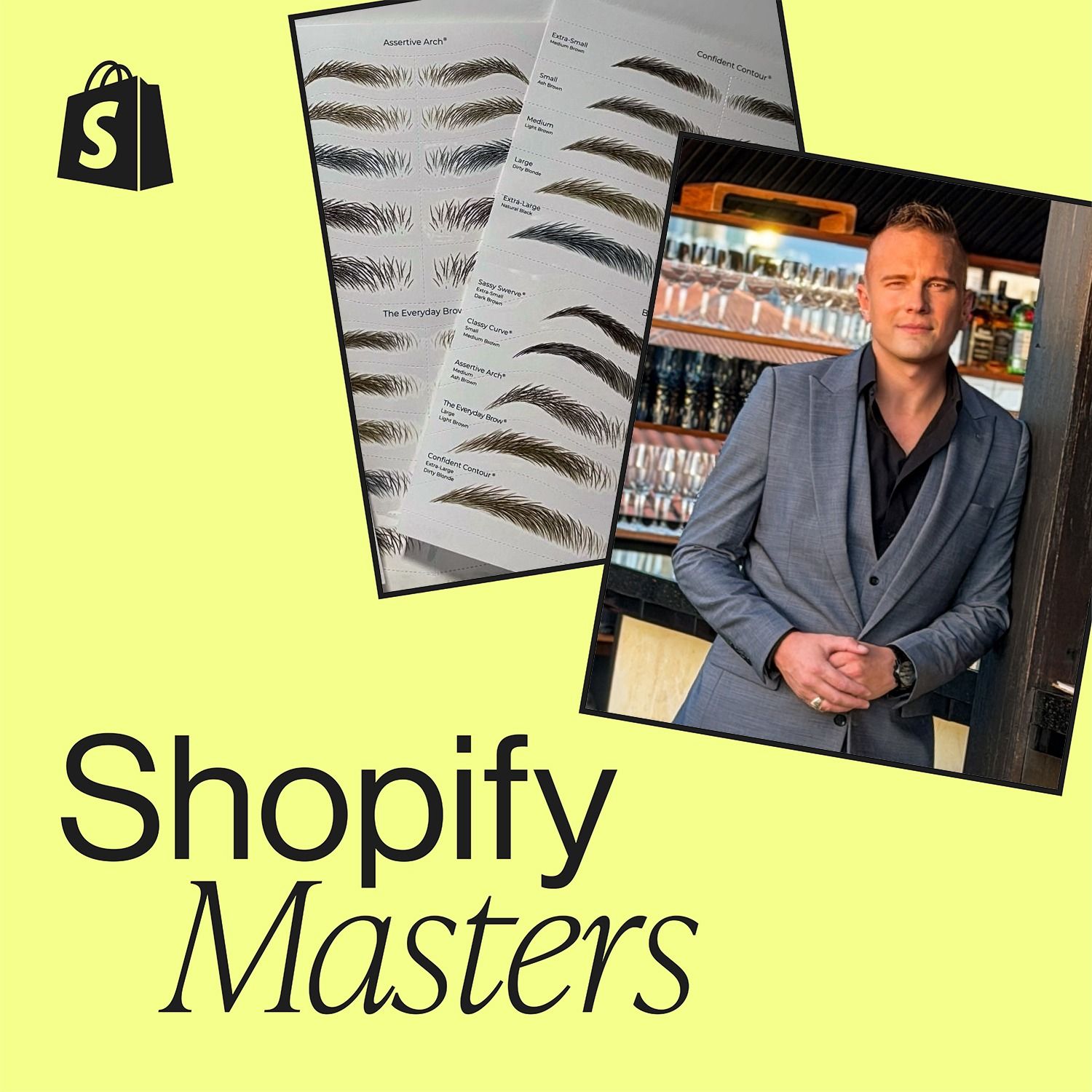
Shopify Masters
How My Two Brows Grew Into a Life-Changing Brand With 1 Million Sets Shipped
00:26:48
After losing his eyebrows to alopecia while serving as a Canadian Armed Forces fighter pilot, Jason Berndt bootstrapped My Two Brows with his military pension and tens of thousands in free samples. Today the brand has shipped over 1 million brow sets across 275 styles worldwide.
Loading summary
Transcript54 lines
- [00:00]
A
If you solve a big enough problem for, let's say, a proper niche of people, then you can create a successful business.
- [00:08]
B
Welcome to Shopify Masters, your companion for starting and scaling a business. I'm your host, Serena Smith. Today's guest has no shortage of mental and physical strength. He holds a degree in aeronautical engineering and served for 12 years as a fighter pilot in the Canadian Armed forces. But in the midst of his training, Jason Burndt lost all of his hair to alopecia, including his eyebrows. Disappointed with the expensive, unrealistic products on the market, he did what any engineer would do. He built something better.
- [00:34]
A
This company was created to help people to recapture as much of their facial identity as they can.
- [00:38]
B
Since launching the temporary eyebrow Tattoo brand My2Brows in 2021, Jason has shipped over a million brow sets and 275 styles to customers around the world.
- [00:48]
A
A lot of people, they email me and they say, hey, you've changed my life, this and that.
- [00:51]
B
Jason joins me now to talk problem solving, resilience, and building a brand with true purpose. Welcome to the show, Jason.
- [00:57]
A
Thanks, Serena. I'm happy to be here.
- [01:00]
B
Really happy to have you. We're going to talk all about the details of my two browse, but I'd be remiss not to dig into your background a little bit. I mean, years as a fighter pilot is incredibly badass. How did that come to be? And then how did you transition into entrepreneurship?
- [01:17]
A
I mean, ever since I was a kid, I wanted to be a fighter pilot and that was really my main goal. Although when I was a kid, my mom always makes jokes about how I was really into money. But my dad took me to an air show, I think, in 1998 in Victoria, British Columbia, and I saw an F18 fly over and I said I wanted to fly that and I said I was going to be a fighter pilot. And I joined the air cadets when I was 12 years old and, and I learned to fly gliders and little piston powered airplanes like Cessnas and things like that through the air cadet program. I joined the Royal Military College in Kingston, Ontario, and I was interested in airplanes and so I decided to do the aerospace engineering degree, which is very difficult. And it was a, you know, a tough four years at the military college. And then I got out, I guess, in 20 and I, you know, went through the training and kind of once I became a fighter pilot in the military, I became interested in more than just flying. I mean, I had an interest in things like real estate when I was younger and I bought a place when I was 22 and I, you know, I didn't really know much about cash flows and different things like that or anything to do with entrepreneurial stuff. And I read this book, and I'm sure you've heard of it, the book Rich Dad, Poor Dad. Have you heard of that book?
- [02:22]
B
Oh, my dad had me read that years and years ago.
- [02:26]
A
Yeah, I read that after it became a fighter pilot. I was 27 or 28 when I read it, and it opened my eyes to how you can make money with business. And if you solve a big enough problem for, let's say, a proper niche of people, then you can create a successful business. So that's what I did. I bought some places in Quebec, and then I created some Airbnbs with some passive income cash flows that allowed me to fund my life. And then I got out of the military at that point, which is about five years ago. And then it's crazy because what happened is I didn't even actually have a plan of starting my two browse right when I got the military. But then my brother and I were speaking, and he does business as well in British Columbia, and we're talking about some business ideas, we're talking about problems. And then I just happened to be talking about the eyebrow problem that I had, you know, that, that spawned when I was in the military. And then, you know, different things that I thought didn't work very well and what some solutions could be. And then we came up with this idea of making a product like temporary eyebrow eyebrow tattoos better, because I saw that a lot of things that were on the market weren't really serving people because they weren't serving me. And that's kind of how I started this, this company. So it kind of sucked. Obviously, when I lost Omahari, people made jokes about maybe making my fighter pilot call sign, Gollum, which I didn't really like very much. So I created the temporary eyebrow tattoos and it was received well right off the bat with a lot of people, generally mostly in America, also in Canada. Those are the two biggest markets that I'm serving in. I started by sending a lot of free samples, probably tens of thousands of dollars of free shipping samples all over North America to get the word out on this product. And then it was clear that there's a fit between this product and what people needed.
- [04:07]
B
Let's talk about that a little bit more because you had an interesting path in the early days of developing this product in that you initially were not using a product that you had designed. Right? You were sort of Doing the research, seeing what was out there in the market, and sending some of those things out to people to glean insights. Can you talk about that process a little?
- [04:31]
A
So when I lost my eyebrows, I remember I was surprised nobody had any real solutions. You know, eyebrow pencils, I tried those especially as a man. It just looked weird on me. You know, they're not waterproof. So that wasn't really a viable solution at all. You know, if I was lazy, maybe I'd try to just put powder over my eyebrows. But I mean, that didn't look very realistic as well.
- [04:51]
B
We can think about hair loss and eyebrow loss as like a vanity issue, but I would imagine it has like a really profound impact on your sense of self and your sense of confidence in the way you walk through the world.
- [05:05]
A
Absolutely. And that's a big part of the branding that I created with My2 browse, because not. It's not just a product, you know, and obviously I'm sure that a lot of entrepreneurs can agree with creating a brand rather than just selling a product. And this brand is all about taking back your identity. I mean, we have a trademark mark saying, take back your identity. And it's exactly that. These. This product isn't necessarily meant for somebody who wants to just make their brows look better, to go out on a Friday night, you know, and, and thicken their brows or something like that. This is meant to help you restore that feeling of identity that you have with yourself that so many people feel like they lose if they lose their brows from, you know, alopecia or chemotherapy or trichotillomania, you know, even burn victims, different things like that. Because, you know, you can feel it. It's one of those things that it's hard to put your finger on. But if you're talking to somebody and you don't have brows, it's almost like you can feel them looking face, like, even if they don't quite know, because some people do have light colored eyebrows. You think, well, maybe they just, you know, don't notice, but something feels off even when you're talking to somebody. I. I used to find it harder to even look at people in the eye when I was talking with them just by the fact that I didn't have eyebrows, you know, and you can't really express yourself as well, you know, I can't do this. Like right now when I'm talking to you, my eyes go up, my eyebrows go up and down and this and that, and it shows expression. So we don't have that. You can feel it. And I think the people that you're talking to can feel it as well. And so this, this company was created to help people recapture as much of their facial identity as they can.
- [06:28]
B
It's beautiful and so important. And I think, you know, so often we hear this that, like the eureka moment for a lot of entrepreneurs is when they're solving a problem that they personally have because it gives you real table stakes, you know, you understand the plight of your customer. And from what I understand, like you said, you're not really trying to serve the vast market of people who just like, you know, I use a pencil to like fill in sparse areas of my brow. But you're not really going after people like me. You're really sort of siphoned off into the more like medically oriented side of things. But I would imagine that as the company has grown, it's easy for it to feel a little bit sexy, to be like, oh, I could just, I could expand to that massive addressable market. Have you ever considered moving in that area? Or do you think that staying in the niche audience zone is where you're meant to be?
- [07:29]
A
I heard a quote once that's. I forget who said it, but essentially, if you try to sell to everybody, you'll sell to no one. And if you try to sell to a small amount of people, you do much better. So I've considered that and I have expanded the products that we sell, but I've only expanded within the niche. So. So like before, I was only selling the temporary eyebrow tattoos, but I did realize that there is a segment of this niche for people who have very, very thin brows, let's say people going through chemotherapy. And I think I'd be remiss not to sell to those people because there's a large segment of my audience that will come across my website and be looking for something that can fill in very, very sparse brows. So I've never taken the approach of actually trying to, like you said, sell the people who just want like a thicker brow to look better or something. But for the people still trying to fill in a very sparse bra, I have expanded the products with stick on stencils, with stamps, which is essentially like a powder that can help people that have very thin brows. Because this product itself is a temporary eyebrow tattoo, only works for people who have no brows whatsoever. And I'm very clear about that with my customers. So that I want to make sure that people are actually getting the right product. You know, if you end up, if somebody tries to order these and then let's say they have thin brows. Well, you can't really stick a temporary tattoo over top of the. Those thin brows. So I've expanded to that part of the audience, but certainly not to. To a broader one. I think it's good to serve what they say, like a niche that's like an inch wide and a mile deep. As. As maybe you've heard that before too.
- [08:54]
B
So totally, you're focused. You're focused and it's working. I want to go back to your R D process. You said, you know, you were trying all these different things on the market, and especially for you as a man like it, none of it was serving the purpose that you needed. It all looked unnatural. So where did you go from there?
- [09:12]
A
The concept of a temporary tattoo obviously, is not a new one. The concept of a temporary eyebrow tattoo in itself isn't something that I patented. It was patent, actually, I believe in the 90s, and the patent expired 20 years later in the mid teens or something like that. But from what I understood was that there's a product issue and there's a branding issue. As far as I was concerned, the product issue was that they weren't being sold in multiple size, style, color options particularly. They weren't being sold in such a way that people could choose a size, which I think is a very big problem. Imagine selling shoes and only like size 7 or something, you know, like, what about everybody who has a bigger or smaller foot? It's the same thing for eyebrows. And same with colors. Right. For a lot of people who are wearing wigs, let's say, or even just want to match what they had before, a lot of people are being presented with very limited color options. So color size options and style options. And it is difficult to print the number of designs that I do. But it is a unique selling point of the brand in that we sell five styles and 11 colors and five sizes, which is, like you said, 275 different variants. And so with minimum order quantity prints on these types of things, it can. It can lead to a large inventory that can be difficult to manage. And I think that's why a lot of people haven't done it. But I took advantage of that because it's probably a bit of a barrier to entry that a lot of people didn't want to overcome. And then in terms of branding, I didn't come across anyone that really offered a branded solution where it's like, hey, this isn't just a product, but there's a brand behind it. There's a Good story. Somebody who's tried and tested, I mean, in the hair loss space and probably a lot of other kind of quasi medical spaces or even medical spaces, there can be a lot of false information or people saying things work that don't and a lot of disappointment and this and that. So I think having a developed brand, particularly with my face on it and me saying, hey, look, I wear these myself and they work definitely added to the trust of the brand too. And so that's what that the brand is really built around me saying I wear these and they work for me and they'll work for you if you have the same kind of problem.
- [11:18]
B
Yeah, your face being all over this brand is really central to its branding. Did you immediately get the feedback like, okay, this is giving the audience a sense that like I'm coming from a place where I really know what I'm talking about?
- [11:33]
A
Yeah. Very quickly. I remember when I first started the company I was, you know, in some Facebook groups for alopecia or I joined different ones and I talked about the, the product and people came. But you know, especially when you don't have a developed brand, trust still could be quite low, even if they do see that you're wearing them yourself. And the way I got over a lot of that was sending free product to people and then requesting reviews, requesting word of mouth, things like that. And that really helped, I think, to get the word out and to establish the trust in the, and get those reviews and the user generated content that people are, you know, taking photos and videos and sending it and saying, hey, this changed my life. And I've had a lot of people, they email me and they say, hey, you've changed my life. This and that, you know, it's helped me with my confidence and made me feel happy with myself again. And I think that's, that's an awesome thing.
- [12:19]
B
So it's amazing how transformative an impact something like this can have on someone. Like you said, taking their identity back. I was reading some of the reviews on your website. I was in tears. Like, I mean it's just like it's revealed review after review of people saying like this changed my life or this changed my child's life. Right. Which is like a whole other segment of this is like kids who have alopecia are going through chemo or whatever, right. And how sensitive a time that is and how easily they could be bullied and whatever. Given your background in business outside of doing something that's so purpose driven, when you're building a business where there Is this like deep pull at the heartstrings, emotional component? Does it change the way you build it?
- [13:03]
A
Yeah, it does. Because the customer service has to be a very delicate thing for two reasons. One, it's not a faceless brand. It's like they're my friends. And so that's become a very, very important part. I don't think people want to, for example, show up to this company and be talking with, let's say an AI chatbot or something like that. I've been very careful to, as the business scales to making sure that we maintain that personal branding so that people, you know, feel what this business started as. And it can be tempting as a business scales to become less and less personalized as, as businesses do. And to an extent it can happen. But that's something that I've been very careful to keep in this brand because it's so central to it.
- [13:45]
B
I mean, from a practical perspective, how do you retain that personal one to one feeling as the company gets bigger?
- [13:52]
A
I actually review almost every single email that still comes through and the way people are talking on my behalf or for me, or helping people for me, or making changes to subscriptions or their orders and things like that. And I'm very particular with the way that I want my customer service to, to help customers generally, you know, I tell them at the end of the day, you need to treat these people like a friend and do what makes the customer feel best and help them and not just try to close a support ticket. You know what I mean? I know that sometimes people can consider something like customer service versus other things to, let's call it like high value activities and low value activities in business. And it could be easy for somebody to consider something like customer service to be a value activity, but I'm quite hands on with it because it's so central to the branding.
- [14:37]
B
So, and it sounds like this is part of what keeps your customers coming back. What else is keeping your customers coming back time and again.
- [14:47]
A
Yeah, so the personal relationship, I mean there are people that, that are extremely loyal to the brand just in that they, they feel that, that connection with me and with what I've gone through. So I think that's the biggest thing. And then beyond that, I, I really do think that it's the unique selling point that we have with these products that just no other brands are really doing which is offering those size, style, color options. I mean, when I started this brand I thought, well, what sizes of eyebrows would be ideal for people? And I remember on my birthday it was in May, and I put out a request to all my friends on Facebook. I said, listen, for my birthday, take a ruler and measure your eyebrows from tip to tail and tell me how big they are. From that I got the data points. I mean, it was clear that people's eyebrows were roughly between 45 and 65 millimeters long. And so that was easy. 45 millimeters extra small, 65 extra large, and every 5 millimeter increment between with small, medium, large. And we have a lot of kids too that are wearing these and they're not going to get something that's too big, let's say from another company. And then what, try to cut it, trim it down? Well, it kind of defeats the purpose of how simple and easy these are to use and apply. And then it's not going to look quite right. So. So the uniqueness is almost like a semi customization of the eyebrow from this company.
- [16:02]
B
You mentioned that you send people free product initially. Can you talk a little bit more about that and how that allows them to explore the product range? Because I would imagine that initially they might not know what style is going to work best on their face.
- [16:22]
A
We do have like a virtual mirror that people can try the brows on. So what I do is I encourage people to try it with the mirror and find a face size, style, color option they want or they want to try. But then what I also do is I include a free sample pack on everybody's first order. And what that allows them to do is at least get going with the eyebrows. They can try every single size and style that I carry, but not every color because otherwise I'd have to give them 275 sets of brows would be like a huge envelope. But we decided to offer all five styles, all five sizes, and then alternating in the best selling colors. So, you know, I think it was the six best selling colors. So we got black, you know, and then dark brown, medium brown, ash brown, light brown, and dirty blonde. And so they can at least see what the color looks like on them. And then they can try all the sizes and, and styles. And because I think that color is the easiest one for somebody to kind of know already, that shouldn't be too much of an issue. But what they can do for sure with the sample pack is try on each size and style and see which one fits their face best. And that's helped a lot. It also incentivizes people to make that first purchase. Hey, you get a free sample pack, that's a lot of value to the customer. It's also a very good thing for the business too, because it keeps people coming back. They're more pleased at the product and they know what they want, so it makes them more likely to return as a customer as well.
- [17:41]
B
And how much of your customer mix now is in the subscription model?
- [17:48]
A
It's, it's about 50, 50 right now. So about 50, 51 time orders. 50, 50 subscription. So it's definitely great. We, I think that's a big part of the, the business. I'm always trying to increase the subscription count, as probably a lot of subscription businesses are. And I think it makes sense in this company too, because I mean, it's a consumable product. Generally these browse last somewhere on the 2 to 3 ish days, Mark, let's say I put these ones on yesterday in the morning, so I don't know, about 26 hours, 20, maybe 28 hours ago. So they last a couple days. And the sheet comes with 10 sets. So you're looking at maybe one to two sheets a month, something like that for somebody. And so naturally they're going to want more. So it makes sense to subscribe not only from a standpoint of what's beneficial for me, but also for them because the number of tickets sometimes, you know, you'll see come through where people forgot to order their browse and then they realize that they're running out of browse and they have a wedding or something coming up or an important event and you know, and they're so used to having this identity, they don't want to go out of the house without it and they're freaking out and say, hey, can you send it overnight FedEx? Well, we can, sure, but you know, overnight FedEx costs 50 bucks for a sheet of browse that costs half that or, you know, maybe a third of that price. So I think the subscription model actually serves obviously both them and then me on, on the side of recurring revenue as well.
- [19:07]
B
So yeah, it makes sense. It's really smart. Like it very naturally lends itself to a subscription model because once this becomes a part of people's lives, they're not going to want to give it up.
- [19:16]
A
Yeah, that's right. Unless they get their brows back. And some people do. And in fact, a lot of chemo patients will get them back. Not all of them, but some people after chemo treatment they'll get their brows back and. Or some people with alopecia, you know, they get their brows back. And that's great for them too. I mean, if they come up, get a solution, then obviously then you don't need them. But for those people that don't get their brows back, which is a large percentage of people who lose their brows are over plucked or have trichotillomania or anything like that, where they pull their brows out when they're stressed, things like that. Yeah, they don't come back. And so it can be, you know, a very long time. We've had customers with my two browse ever since I started where we still have them on subscription, you know, like five years later.
- [19:53]
B
But you've also talked about recognizing at some point, like with any business that you got to make the move into profitability. Has that happened? And if so, when did you become profitable?
- [20:03]
A
Oh yeah, I guess if you consider discretionary funds and things like that, like, you know, profitability, probably a couple of years ago or something like that. But I haven't even distributed any money from the company yet. Generally what I do with the profits is they just get reinvested into more people to continue to, to expand the business. Because I don't think it's done expanding. If I chose to, I could decrease some of those expenses. I don't think I'm really at a point where I want to do that yet.
- [20:28]
B
So am I understanding correctly that you don't pay yourself?
- [20:32]
A
I haven't done it yet. I've left everything in the business so far to date, so.
- [20:36]
B
So how are you funding your life? You wear other hats?
- [20:40]
A
Yeah, I do. So before I got to the military and after reading a lot of books, I think over 50 books on different things with real estate and Robert Kiyosaki stuff and different things by his advisors became clear to me that if I want to get out and fund my lifestyle and passive investments initially, then I was going to have to find a few interesting things to do. And that's what I did. I created a couple Airbnbs and short term rentals in Quebec in the Sagnay area near Quebec City. And then I did some, some long term stuff in British Columbia. So I use that money. I'm also an airline pilot half time. So I take that money. I use that as well. So those are kind of the ways I do it. I mean I will start paying myself, you know, at some point, but it's not really a rush at this point. I'd rather reinvest the money in the business.
- [21:22]
B
Wow, you're running and building the business and you are also still flying planes.
- [21:27]
A
Yeah, yeah, it's fun. I mean it's a passion of Mine too. My biggest thing was I wanted to be a fighter pilot, and I did that. And then I thought, okay, well, I could do this for the next 20 years. I mean, but I've already done it, so I wanted to achieve something else. And that's when I thought, well, business could be probably a more productive use of my time. But then after about three years of not flying airplanes, I missed it. You know, I missed it. And so I decided to start doing again. And I have fun doing it. It's fun. It's fun flying, you know, airlines all over the world. You know, it makes money and, and it's a. It's a passion of mine too. I love it. Doesn't even feel like I go to work when I do that. Sometimes it can be difficult with some time zone changes and I got to do some stuff for business. I land and then I got to do some calls or inventory stuff or whatever I have to do. But it's certainly manageable and it's. And it's fun to do, too.
- [22:11]
B
So, you know, I think the advice that entrepreneurs are so often given is that they need to be singularly focused on their business and nothing else. You are proof that you can do something else. Is there an argument to be made that doing things in very different spheres, right, Flying versus being an entrepreneur and building a business, that they actually serve each other?
- [22:35]
A
For me, I think it's a little bit of a unique case where I actually fly because I just, I love it and it's kind of like a fun pastime for me. And it's great that it makes money too. It would probably be harder if I was just like, let's say if I were to be doing, I don't know, a 9 to 5 job and tired at the end of the day and grinding it and not doing, let's say, part time like I am, or half time in the airlines, perhaps that could make it difficult to really scale and work on a business. But I think the way I'm doing it, I don't feel like it's actually a lot of mental energy for the flying because I enjoy it, that it works for me.
- [23:09]
B
For so many people who are trying to start a business, they can't necessarily afford to do that full time right out of the gate. They have to have a job or some other kind of, you know, revenue flow so that they can be building the business on the side. Do you have any advice in terms of how to manage your energy and your time to make that work?
- [23:33]
A
Yeah, that's. That's an interesting one because that can be tough. I mean, especially if you have more of a complicated life, let's say with kids or, you know, a family, which I don't have. But perhaps something that could be worth considering is creating a cash flowing asset first that frees up a bunch of your time like I did with the real estate, a passive investment. And then, and then once you have a decent cash flowing investment, which isn't easy to create, but it's doable. Robert Kiyosaki said, naturally what will happen is once you have passive income and you're not working all the time, you're going to come up with ideas for business. And that's. And I didn't actually know, but that's exactly actually what ended up happening to me. And it wasn't necessarily pre planned that way, but I just kind of trusted that process and that's what I did and it worked out.
- [24:15]
B
Jason, I'm sure you have an endless number of these. But to finish us off, is there a story that's a particular favorite of yours of the impact these brows have had on someone's life that you can share with us?
- [24:32]
A
Yeah, Gitano. This guy Gitano, he calls me sometimes. Actually, I actually, I answer whenever people call my two browse, it goes to my cell phone. So not many people. Yeah, no, not many people actually expect this. And it's doable really, even though with the scale of orders we're doing, because not many people really use the phone. So if people want to use the phone and call, I answer. I mean, provided I'm available. But that's where the phone call goes. It doesn't go to a robot, it doesn't go to another agent. It goes to me.
- [25:02]
B
Wow, that is personal on a whole other level.
- [25:05]
A
Yeah, yeah, it really is. And this Gitano, he called me a few months ago, but he was just telling me some pretty deep stuff about his life and, and how he didn't have eyebrows. I think for decades. It was, and it was really difficult for him, like extremely difficult. And he was so over the moon when he found this product. He's like, Jason, like, you can't believe it. I tried your eyebrows on and they're just amazing. And I didn't know if they're going to really work. And then he's like, my wife's Latina and the Latinas love their brows. And he's like, and all our friends and I was showing them and they couldn't believe that they weren't real. And it's awesome that he follows up and he continues to make orders and I've certainly had a lot of people reach out. But for some reason Katana really sticks out when I think about it, just because how appreciative he seemed of this. And his quote was, you don't know how much you changed in my life, but I really want you to know how much you did. So that was awesome and I love to hear from him and he really sticks out in my mind.
- [25:54]
B
Amazing. Thank you for sharing that story. And not a piece of advice we get very often. You want to really feel the impact of your product, hand out your cell phone number.
- [26:07]
A
Yeah, yeah.
- [26:07]
B
Jason, thank you so much for being here. Really appreciate the conversation.
- [26:13]
A
Thank you.
- [26:14]
B
That's Jason Burnt, founder of MyTube Browse Shopify Masters is produced by Alicia Clark, Gogo Zoeger and Schwang Esther Shan. Our engineers are Matt Schwartz and Miku Beitlam and Rachel Reich is our senior Content lead and I'm your host, Serena Smith. Come back every Tuesday and Thursday to catch a brand new episode of Shopify Masters and be sure to check out our YouTube channel for video interviews. Until next time, thanks for listening.