← Shopify Masters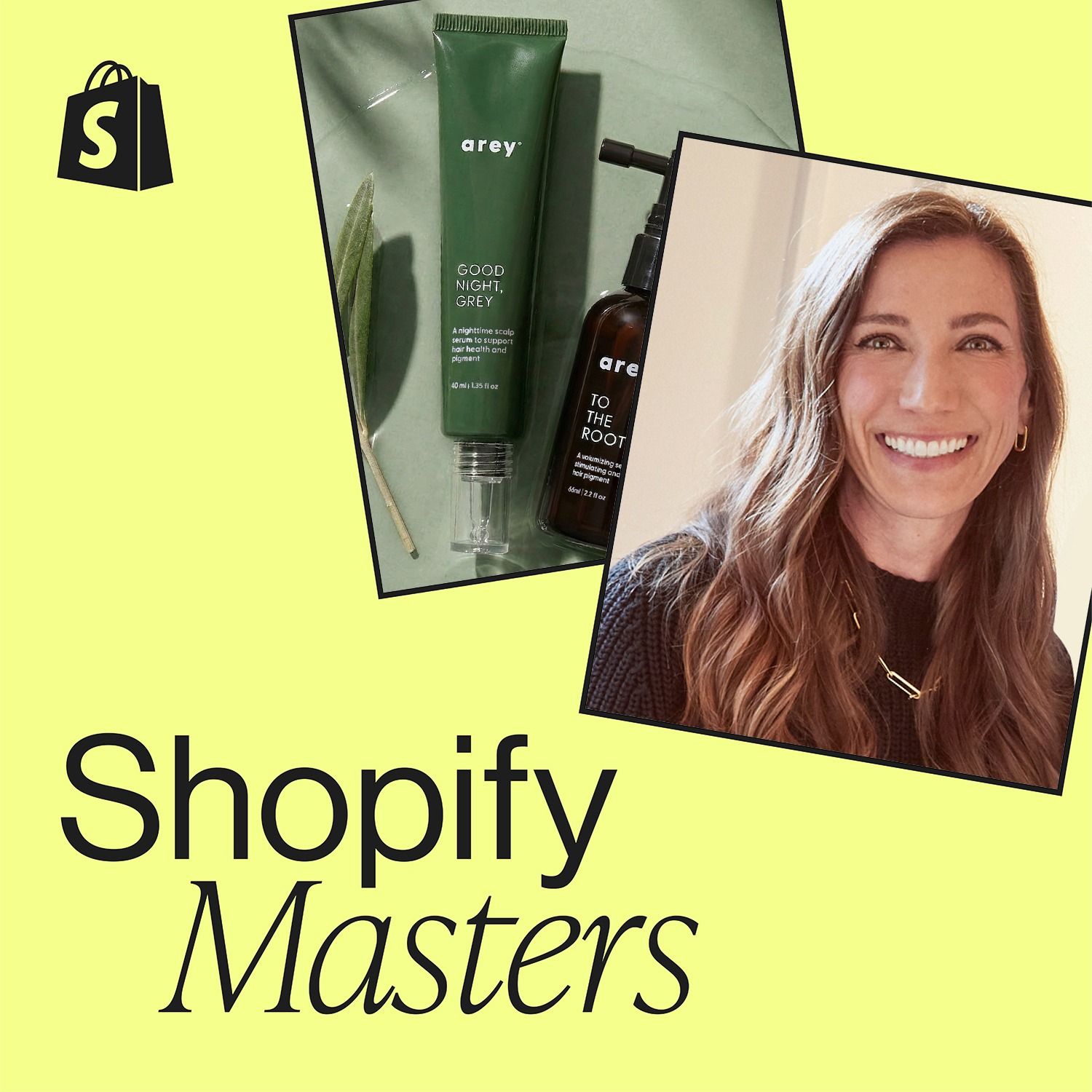
Shopify Masters
How One Founder Took on the Gray Hair Industry and Won With Science, Not Hype
00:40:20
Arey founder Allison Conrad turned an overlooked beauty category into a science-backed business, with a clinical study to prove it. Hear how she built a defensible brand, from securing a patent to mapping a retail strategy designed around when customers are actually ready to buy.
Loading summary
Transcript75 lines
- [00:00]
A
We weren't the first people to come up with a concept for a supplement or topical for gray hair, but we were the first people to actually do it effectively.
- [00:09]
B
Welcome to Shopify Masters, your companion for starting and scaling a business. I'm your host, Serena Smith. When Allison Conrad spotted her first grays, she went looking for a way to prevent them and found that nothing existed.
- [00:21]
A
You start early for your skin. Why are you not also doing that for your hair?
- [00:26]
B
So she built Array, a brand taking on something most of us have accepted as inevitable with a patented science backed approach to slowing and reversing gray hair.
- [00:33]
A
Nobody has ever done a study on how fast you get gray hair. It's never been done.
- [00:38]
B
Alison's here today to talk about what it actually takes to build a category from scratch. The science that makes Array unlike anything else on the market, and how she's growing the brand without losing what makes it special. Alison, thanks for being here today.
- [00:49]
A
What a great intro. Thank you so much for having me.
- [00:52]
B
Amazing. I feel like there are the brand of entrepreneur who sees a problem in the market to be solved, and then there's the brand of entrepreneur who goes after something that seems basically unsolvable. Aray and you are in that latter camp. Like, I can't think of how many times I've sat in the stylist's chair as he's like pouring gnarly chemicals onto my head and I'm thinking to myself, I eat so clean, I'm like avoiding microplastics. But like, this is what I'm doing to my head. You know, surely there must be a better option. But I think for so many of us, we just accepted there isn't one, this is the only way. Or you go gray and you accept it. What gave you the gumption to actually think that you could tackle this?
- [01:35]
A
Every entrepreneur has a little crazy in them. I think you have to to do something. The real reason we went after this was after looking into what causes gray hair. And my hairdresser, who's my co founder for the last five years, he was like, yeah, the only options are dye your hair or accept the gray. And I was like, God, there's gotta be a better way. So we found out there's only one gene that causes gray hair and it accounts for 30% of why we go gray. And there's so many other factors. Nutrition deficiencies, oxidative stress from the sun pollution, the things we eat. There were so many things that we did have some control over. So that gave us the hope that there was Something we could be doing and something we could internally put into our bodies. That's why we started with the supplement. And something we could topically be doing to counteract the oxidative stress that we're experiencing from hair dye, sun exposure, all these things. So yeah, I think it was a little bit like, why does this not exist? It must not actually work if it hasn't existed in the past. But you have to also understand that hair dye is a huge industry and we're not here to replace hair dye. Okay. We're not saying that this can completely solve your grays. A lot of people use hair dye in conjunction with our products, but the hair dye industry doesn't really have an incentive to create something to slow that process down. So yeah, I think we just looked at it differently than anybody had before.
- [03:06]
B
You had spent years advising other brands, including Vigamore. Right. For a couple of years prior to starting array. Was there something that you saw there that began to seed the idea for you?
- [03:21]
A
The idea sort of was seeded from Nutrafol and Vegamore of hair loss being affected by a pill. Right. And something topical. Obviously Minoxidil has existed for many years, so hair loss was trying to be fixed more proactively too. Like that's also something that you can't have total hair loss and then be like, I need to fix the problem. You need to get on top of it earlier rather than later. Same with gray. And so I literally thought to myself, why can't I just take a pill to solve this problem? And so the first step in this was researching ingredients. Our medical advisor at the beginning was my dad. He still is one of our medical advisors. He's a clinical pharmacologist, internal medicine doctor, and my mom's a dietitian, so that also helped. But I personally was just for myself, searching for ingredients I could be taking to slow this process. And we identified these 13 ingredients. I was individually taking many of these on their own. My Amazon cart was ridiculous in the amount of vitamins I was taking in minerals and antioxidants. And it was like, why can't there just be one pill to solve it? So, yes, I think people had been approaching hair loss obviously for many years prior to what we were doing. But nobody was thinking about gray hair in the same way.
- [04:41]
B
I love that you're both your dad and your mom are a part of this operation. Was that a no brainer for you? Was there any reticence to bring your parents on to the team?
- [04:52]
A
No, because it wasn't originally for A company. It was originally just for me personally. I was like, guys, can you find things I personally just myself, Allison, can take to solve this? And then it was like, okay, Jay, I'm doing this thing. And he's like, yeah, but you're not the only one who's coming to me with this question, Allison. Like many people have asked me this and I've never had a great answer for them. And so that was when we were like, huh, maybe this is beyond just for myself. And then my reticence was like, is this for men and women or is this only a woman problem? And Jay was like, no, it's definitely men. They just don't talk about it to others. So yes. It wasn't like I was like, I have this idea for a company, let's bring in my family to solve it. And it was actually interesting is I've always been the black sheep of the family. My sister's a doctor. I didn't take science in college. It was like back in the day when you could not take. They were like one subject you don't have to take. I was like, science. I'm out. AP Chemistry was the worst class I ever took in high school. So full circle. We came back and my sister was like, wait a second, you're working with our parents, I'm the doctor. What is happening? It was quite fun, but it's been really nice. And obviously when you start with your family, you trust them, you know they have your back. My dad is the most risk averse person probably on the planet. So the fact that he started digging into this and he was like, this is a really good idea. You are onto something. That also gave me the confidence of like, okay, maybe we're onto something.
- [06:27]
B
And yet you were trying to solve something that there was really no precedent for in the market.
- [06:32]
A
Right.
- [06:32]
B
It's not like you were taking something that already existed and then trying to improve upon it. You were a true disruptor in the industry. Can you talk about some of the early things that felt promising that turned out to be dead ends as you were trying to find the right ingredient, mix the right formulations.
- [06:50]
A
A great question. One ingredient that we came across was catalyse. And there, there were some supplements you could search on Amazon Gray hair supplements. When I was searching for it, they were very strange looking and you're like not trustworthy. And they had catalyse. If you look into that ingredient again, I'm not the scientist, I'm not going to be the one who's going to explain the Science here effectively, but it does nothing. It was not effective. All these people were including it and there was no scientific evidence. So we weren't the first people to come up with a concept for a supplement or topical for gray hair. But we were the first people to actually do it effectively with science backed ingredients. My parents looked into every ingredient of what actually had scientific evidence to be doing something for cell regeneration and recoloration. And it wasn't like, oh, in theory that should be doing something. It's like, no, it has to actually be doing something. And then once we did our clinical study on our products, of course that was the extreme validation of, of this actually works.
- [07:57]
B
So you're talking about ingredients that for some reason were included in everything and actually don't do anything. Similarly, on the flip side, were there specific discoveries or insights where things clicked? Like a sort of eureka moment where you're like, oh, this is it.
- [08:12]
A
I think the big moment was thinking about the inside out, outside in approach. The best analogy is like proactive the Acticare brand, you know, it's like oh yeah, the body itself, it makes such a big difference, the nutrients that we're putting into it. And then topically of course you can get to the source as well. But the most effective thing is to do it from both sides. And then the other big unlock was we use eastern ingredients and western scientific ingredients. The eastern ingredients were not my parents forte. So we brought in a chemical engineer from MIT to help with that. And that was another one where like for generations eastern medicine has been using faux D black sesame extract ingredients that here in the west we don't use all that often, aren't familiar with. But other countries have been relying on them heavily for anti aging. So that was another really interesting insight and a bit thinking outside of the box.
- [09:09]
B
You were the initial guinea pig I reckon, right? This started as you said, not because you thought you had a big business idea, but just because you were trying to tackle a problem in your own life, which is where so many of the best business ideas I think come from. What did you see in your own hair that indicated to you like, okay, well we've got it.
- [09:31]
A
Yeah, yeah. So it's more what I don't see. I've been using this product now for six years. So it's so interesting to think of like I don't know how gray I would be at. I don't really want to know how gray I would have been. Like I'm good with not knowing that. But once we did our clinical study showing Our placebo Sibo Group had 10% more gray hair over a course of six months. Nobody has ever done a study on how fast you get gray hair. It's never been done. Our active group had 13% less gray hair over six months on average. That's 23% delta between the two groups. I mean, for me, that I'm like, that's the validation. That's what I need to know. So it's just knowing clinically that this also works. And then I have the confidence knowing, okay, I'm doing something good for my hair, and it's. It's going to age as gracefully as humanly possible.
- [10:22]
B
Totally. Something that's so interesting that I was thinking about before we got on, which is like skincare. And it feels like psychologically, as consumers, we've all kind of accepted a more preventative approach when it comes to skincare. People are doing Botox before the wrinkles pop up. They're using retinol in their 20s before they really see signs of aging. And yet hair care feels like it's in this very, like, reactive, symptom driven place. Oh, your hair is dry. You use a deep conditioner, your hair is gray, you use dye to cover it up. So you're asking people to engage in a very real psychology shift. How hard has it been to shift that mindset?
- [11:02]
A
It's hard, it's not impossible. And we're definitely seeing it shift. And our customer is getting younger, which is so encouraging to see. And I think once we give the information, like, for example, your scalp ages six times faster than your skin on your face. So it's like, oh, crap, it is really aging. People think your hair is dead. You can't do anything today. Well, the roots of your scalp are not dead. They are very active and like little tiny microcosms of worlds inside of every hair follicle. So there is so much that we need to be doing. The skin on your face regenerates every 28 days when you're in your 20s. It gets longer as you age. Everything slows down as you age. It's a great, great thing. It's not great. So it's so interesting to me that we're doing so much for our face, which is rejuvenating so quickly. And our hair, we're just damaging it. And it's on our heads for years and years, and we're just expecting it to be great all the time and look beautiful and luscious and vibrant. It kind of blows your mind when you think of it in that Way like, oh my God, no. We need to be nurturing and caring for it from the roots and then while it's on our heads and like keep it when it's vibrant and beautiful. In your 20s and 30s, like that's what you want to hold on to. It's like that's when you need to start the process of preserving.
- [12:26]
B
You gave yourself a lot of uphill battles with this company. Right. You were creating a solution that truly didn't exist before you decided to go after both men and women, women who are generally marketed to differently. You're asking consumers to engage in like a pretty broad psychology shift in the way that they think about hair. And also as you brought up, cellular renewal happens every 28 days with skin. It slows down a little bit as you get older. But generally part of what also makes skincare so sticky for consumers is that like within a month or two they're going to see a result. With Array, you're also asking for like a longer term investment potential before they see a result and also a long term commitment.
- [13:12]
A
Right.
- [13:12]
B
You have to stay on the products for them to continue to work. That is a lot of things to try to get the consumer to understand and buy into. What have you found from a messaging perspective, from a channel perspective, from a brand building perspective that has really broken through.
- [13:34]
A
Yeah, I think the skin analogy has been our best way of explaining to people. You know, you do all these things for your skin, you start early for your skin. Why are you not also doing that for your hair? And you have to also think like hair is the least essential part of your body. You do not need hair, you want hair. It does not care about being on your head. Your skin is a, the biggest organ in your body. Like it you that is essential. So when your body doesn't prioritize hair, you need to prioritize your hair. Like your nutrients are not going to your head. So I think once people get that education and information like, oh yeah, that makes sense. You know, this is going to take time. It's fine, it takes time to change behavior. But we also think, can't believe like this hasn't been done before. Like how have we not taking care of our hair better? And then in terms of channels, I would say, you know, right now our biggest channel really is is Meta and TikTok. We were launching TikTok shops and connected TV. We're also advertising on. But it's a universal, I won't say problem because I don't want it to seem like a problem. But it's a universal experience to go gray. This happens to everybody. And so speaking to that, it's. People get that right, and everybody remembers the moment they found their first gray hair. It's such, like a pivotal moment in everyone's life. So, yeah, so it's. These are battles and it's hard, but we also see it's such a huge opportunity. And I used to get so annoyed in the beginning when we would explain this, like, barely, oh, this is so niche. Like, this is not niche. This is huge. Like, it's a huge market.
- [15:17]
B
It's universal, actually.
- [15:19]
A
Yeah, it's. Maybe it's specific. Maybe that's a better word for it that, you know, we're solving for the gray, but we also do so much more than the gray. It helps with thicker, fuller, softer, shinier, more vibrant hair. So it's again, I hate saying the word anti aging, because we're not against aging, but that's the best descriptor that people can then understand. It's anti aging for hair.
- [15:40]
B
Yeah, it's interesting, right? I think a lot of people also in the skincare world have a reticence to use the word anti aging because of what it connotes. And yet, like, that's where the SEO is. That's what people are googling and searching for. So if you decide not to use a term like that, you're to some degree putting yourself behind the eight ball. And also with a company like Array, you know, you're trying to reach customers when you're solving a problem that people don't even know has a solution. So how are you getting to them in the first place? When, for instance, for me, like, I didn't know that graze was like, even an issue that could be tackled in this way.
- [16:21]
A
I know this is the challenge because nobody's really googling, how do I prevent my gray hair? They're googling, how do I cover up my gray hair? How do I fix my gray hair? How do I solve my gray hair? So we have seen in the last five years too, like I mentioned, our cohort is going down in age. So people are getting that. It does start with that person who's experiencing maybe like 25 plus percent gray hair, which is not our ideal time to start the product, but it can work. Those customers came to us first and are still coming to us because they're acutely feeling the problem. But we're starting to see this younger demographic understand it. That's why we're very excited about TikTok shop and like, being Able to explain this in a platform where this audience is captive to understand what we're doing. Because it's also a challenge of like Everybody has a 1 second attention span and you're like, how do you explain all the science and everything for this concept in one second? It's, it's tricky. So yeah, all the different hooks we're trying and ways to get people to even come to the website just to learn more, to understand more and like,
- [17:29]
B
can you give me an example of one of those hooks that you have found really works?
- [17:35]
A
We just hired a new head of growth, so we're still developing that. But a lot of it is like slowing. Gray hair is a hook that works a lot for us. So it's, it's not even like the reverse your gray hair, you know what I mean? Like that, yes, we can do that. But if you're just expecting your whole all of your grays to be reversed in the next month, like that's not what's going to happen. So we don't want to over promise and under deliver. So it's really the messaging of, you know, see your first gray hair, do something about it. You're doing all these things for skin care, why are you not doing them for hair care? So it's like these different ways of getting people in that is not, you know, reverse your gray hair in three months. That is so not our brand. We've seen other competitors come up and position it that way and we're like, oh gross. And technically it's repigmentation, so it isn't. Reversal is not even the right way to speak to it. So yeah, so we're still developing that. It's always a work in progress of how you get people. But these facts of like 30% of your gray is genetics. Your scalp ages six times faster. Like these are all things that we're seeing people are resonating with.
- [18:44]
B
It speaks to a dedication to a particular degree of patience. So much of this company and what you're describing, it's really brick by brick. This isn't about flash in the pan or super quick overnight success. You're building something for longevity.
- [19:02]
A
It sure is that I'm the least patient person ever. So it has been very tough for me. Learning a lot about myself through this process. But Jay, who's my business partner, is very patient and he still sees clients. So he's a therapist. Like he talks to people about all their problems, including mine.
- [19:23]
B
All hairstylists are.
- [19:24]
A
Yeah, that is his job. And so it's a Very good balance. Because he's like, this is a marathon, not a sprint. And I'm like, I was literally a sprinter in high school. Like, that is what I did. That was my track and field game. So it's been. It's been interesting. But I think it's a good balance because I pushed the team to, like, work fast, test and iterate and go, go, go. And he's more of like, okay, let's. Let's build. It's okay. Let's build this thing in the right way.
- [19:52]
B
It's a very difficult and nuanced component of being an entrepreneur because you hear time and again, you gotta kind of keep your blinders on and keep your head down and just be focused on the race that you're running, your personal sprint or marathon, as it were. And at the same time, you kind of have to keep an eye and an ear open to what else is going on in the landscape. Over the course of the last six years, have you developed any strategies that have helped you hold that tension?
- [20:23]
A
I mean, funny story. Just yesterday, I was literally doing a headstand in my yoga practice on. I was watching a YouTube yoga video, and I got served an ad for a competitive product that had recently launched by a massive brand. And I. I pulled out my back. I was like, what the. I was so pissed. My kids were like, oh, my God, it's mom. Okay, what is happening? And I immediately called Jay and. But then. And this is why it's such a good partnership. He was like, oh, my God, Allison. Like, relax. Like X, Y and Z reasons why ours is so much better. The science, the clinical, all those things, of course the ip, but also just like, look at the brand, look at the packaging. Like, do you want to use that product? No, I don't want to use that product. So you have to know what's aware. You don't live in a hovel, like, anywhere. You're going to be hit by ads no matter where you are. But it's understanding, keeping core to what we're doing, always staying on top of the science. We just launched a new product that has an ingredient that we're the second brand that's ever had this ingredient in it. And people are coming to us for ingredient development and R and D. And so it's a very interesting now space to be once we become the leaders in here. But you can't take it for granted. You have to always be working and improving and making things better. But you cannot be so focused on what other people are doing because nothing Comes from that. Be aware of, but focus on what you're doing.
- [21:54]
B
Comparison's the thief of joy.
- [21:57]
A
That's just. Yes. I feel like that may be somebody famous. Yeah. No, it's.
- [22:03]
B
I didn't make it up.
- [22:04]
A
Did you just make that up? Because if. If you did that, you need to. It's known trademark that.
- [22:11]
B
Please do, please do borrow it. You did something else that I think is super fascinating and can feel like a little bit of a black box for people, which is that you got a patent which creates at least a degree of protection. Right. At what point did you recognize, like, oh, this isn't just a product, this is actually defensible ip?
- [22:32]
A
Pretty early on. I mean, we knew early on that we would have to go down that route and should go down that route. And that's more from my advising of other brands and understanding from like an investor VC perspective of what you look for in a brand. So we knew that very early on because it's not cheap to get a patent. So what is worth investing in and developing this patent for? We have another one pending. And so that took, of course, some guidance from legal folks as well. We couldn't just go into that. We surrounded ourselves with the right people to give guidance on that as well.
- [23:10]
B
I mean, for founders who are listening and thinking to themselves, like, I'll just patent it. What part of the process do people tend to underestimate or get wrong?
- [23:22]
A
Well, you definitely have to search what is already patented first. Like, because you could be going down a rabbit hole of trying to develop something that somebody already has ownership of. So I think. And now it's a little bit easier with AI and everything, you can. You can look that up, but you have to understand the playing field that you're in. To make sure that you're not spinning your wheels for nothing would be my biggest advice on that.
- [23:51]
B
You launched DTC and you were solely in that world for a period of time before what feels like very strategically transitioning and expanding into retail. Your first retail partnership was with Credo, which is a clean beauty retailer. Your second retail partnership was with Erewhon. These are two companies for people who aren't in LA or in cities where they're available that are highly curated and have incredibly exacting standards about the brands that they take on. They also have small footprint prints.
- [24:27]
A
Right.
- [24:27]
B
You're not launching into a target. It's a limited number of doors. What did those partnerships signal to the customer that D2C alone couldn't? How did it impact brand perception?
- [24:39]
A
Yeah, that's a great question and why we did do CREDO first was I know Annie Jackson, the founder of credo. She's a wonderful, wonderful human, first of all. And so that made me excited about working with credo, but also the clean standards that they held because our brand always, from the beginning, was developed to be clean and to EU standards. To us, it was like, that is going to be table stakes. So we should be just doing that. It was never a question, but it's not our number one focus. The number one focus is the scientific clinical efficacy. And a lot of people are skeptical that it can't be effective and clean. So we wanted to prove them wrong. But for those who do care about clean, they know about CREDO and the fact that we are up to the CREDO standards, they appreciate that, and then it's a smaller footprint. So Jay goes into stores and can talk to customers easily and understand, okay, what is making sense for these products? What are you not understanding? We were developing the packaging. A lot of our products didn't have boxes in the beginning because they were just D2C and we didn't need boxes. And so it was like understanding, okay, what on the box do you need to see in order to understand how this works? So that still continues to be very informative. So that was really. It was like, how do we get with a retailer who we can work with, we can partner with and learn from, and that understands the importance of the things that we value as a brand and they value as retailers? And now the next evolution is, okay, okay, how do we get to a larger audience with a retailer? But when is that going to happen? That's the question. Because we don't want to show up too early and people not understand. They're like, is this a hair dye? Like, what is this product? I don't. What is it going to actually do for me? So that's the big question next up for us, right?
- [26:40]
B
I think one of the biggest things that happens when people move from D2C to retail is just like, you're getting a lot less time with the consumer, right? You might have a couple of seconds for them to try to suss you out on shelf at a place like Erewhon or credo. I think there's a little bit more time that you still get to trust that the consumer might be engaging with your product. But if you are talking about a Target or a Whole Foods or whatever, that may no longer be the case. So what is it that would need to happen for you to be able to Go into more of a mass retailer, which sounds like you're considering right now, without it diluting the brand and getting lost.
- [27:20]
A
I don't know that this is the right thing. So I'm not by no means saying that this is our plan is just to raise the awareness. And that is really why TikTok shop for us is such a focus for the next six to nine months, is really how do we get in front of as many people as possible explaining this? And it's not just us explaining this product to people. It's affiliates and other people explaining this product to people. We think that is ideally the unlock. We're also partnering with a lot of experts, dermatologists, because we have our clinical study. Hairstylists, of course. Jay, that's his world. Nurse practitioners, internal medicine, doctors like people who have expertise and can explain and educate on the product as well. And so building that awareness so that when we do show up on a retail shelf, you're like, oh, yeah, that's that brand I saw on TikTok. I'm gonna go get that. I'm gonna try. Try using that.
- [28:15]
B
You mentioned earlier, too, that you are a clean brand and have been from Jump, and that that was table stakes. And yet I was kind of surprised to learn that, like, you really don't put it front and center. Is it as you were saying? Because it feels like it's almost in opposition to people trusting that it can work.
- [28:32]
A
There's only so much messaging you can. Like, that's been the challenge of, like, what is the hierarchy of messaging that matters to people? And, I mean, maybe with the help of AI and, you know, growing our team, at some point we'll be able to do this where we're saying the right message to the person who cares about that specific messaging. That would. Is an ideal world. Oh, my God. I would love it if every customer came and we would know, like, oh, okay, you're a woman in your 30s, and you have 5% gray hair, and you eat really healthy and care about your clean ingredients, and you want a product and like, oh, I will tailor the right messaging and products to you. That is the ideal state. We're not there yet, but I hope soon.
- [29:15]
B
Patience. You're. You're learning it, you know, whether you want to or not. This is not your first rodeo as an entrepreneur, as we've been talking about. You had been advising other brands for years, but also all the way back in 2004, you had another experience as a founder, which I would imagine felt markedly different in a lot of ways than coming back to being a founder in 2020. How did that time away change how you operate as present day founder Alison Conrad?
- [29:50]
A
Yeah, I was like one of the first websites I feel like selling direct. I had a fashion brand and it was literally made to order skirts because I was like I don't have the money to get keep inventory. So as orders come in, I'm going to make them so different. Now obviously I was in Daily Candy which if anybody is listening and knows Daily Candy, like oh my God, yes. Oh my God, can somebody bring that back? Like that was incredible. They, they likened me to Maria Montrapp. It was like the biggest compliment. So yeah, so different. I think what I learned then from being, you know, I worked corporate jobs. I was at Coach working in marketing and merchandising. I ran somebody else's idea was a startup called Blushington and I worked for a woman named Erin Condren and ran her business for a couple years. And so it was getting the experience of growing and scaling companies that were not mine and using those learnings then to my company and having a little bit more understanding to grow and build this company with profitability in mind and unit economics from the beginning, margins that made sense for retailers eventually. I mean all these things that I don't think I would have understood had this been my first time launching a startup. So yes, it was a lot of just learning by doing. I mean I went to business school so it's also like learning through that process. But I think you have to expect experience it and do it yourself to really fully understand for sure.
- [31:27]
B
But you also took a long break from being in the driver's seat as the founder where the company is yours versus building somebody else's. It sounds like that was at least to some degree deliberate on your part. Was there any reticence or any kind of internal processing that you had to go through to, to say, okay, I'm ready to take this role on again?
- [31:54]
A
Honestly, it was more of like. And I always give this advice to people who are thinking about starting something. It was the type of thing that going to bed at night, I would say to myself, like if somebody else does this, I will be so mad at myself. I will be kicking myself. I will be so pissed because I had the idea I was going after this, I was doing, doing it for myself. It's like almost like I had to do it. It wasn't like should I do? It was like how can I not do this? So yeah, it almost felt like like manifest destiny or Something I was like, I was just, there's no way I'm not doing this. And we had the people in place to do this. I really learned that from Drybar because so I. I ran the startup Blushington and we would co locate next to dry bars, and they were very generous with giving us insights and information. And the team of Drybar that launched it was just like they had all the right pieces of people in place to launch that company. And doing something again, totally disrupting, creating something completely new. And I learned so much from that of like, oh, yeah, you have to have the right people and expertise in place from the beginning. And it's such a luxury or benefit or honor, I don't know, to have those people for free. In the beginning, I mean, that was like, I can't afford my dad at the prices he charges pharmaceutical companies. Like, no way. Like, my mom's not cheap. But they were doing it because they believed in it. You know, Jay's wife lent her creative expertise to us and she's hugely valuable. And so equity, of course, was a huge driver of this rather than cash payments. But so it's those things too. It's like, all these pieces have to be in place. It's kind of like magic, really, when you put it together.
- [33:44]
B
Totally. And you. You could see that some of that alchemy was at play in your favor with this.
- [33:50]
A
Yeah. Okay.
- [33:51]
B
I have to ask. We sort of spoke to it in the beginning of the interview. Like, what is it like working with your parents and when push comes to shove, essentially being their boss?
- [34:04]
A
Oh, God. Well, I mean, they do not think of me as their boss. I don't. That is, like. Would be hilarious if my dad was on this podcast. He'd be like, what? No, no, it's so. It's awesome. It's so great. I mean, I live fairly close. They live in San Diego, I'm in la. So we see each other quite a lot. And it's just so nice to like, be able to pick up the phone. If I have a question for my dad on an ingredient, he's like, he's right there. I can trust him. I know he's gonna have the right answers. And yes, it's a real privilege. It's really fun. If you had asked me 20 years ago, will you be working with your family? I'd be like, what? No, I mean, my parents, when I did my. I love them so much and they're so, so lovely. But they were like, what are you doing? You're doing a skirt website? What is, why, why are you doing that? And I'm like, I had a full time job at the time, so I was like, don't worry, I have a job. I. And this is just something I'm doing on the side. And they're okay, okay. And then I applied to Stanford Business School and I was actually considering. I have never told anybody this, by the way. This is like a podcast exclusive. I wanted to be an interior designer or Stanford Business School and my parents were like, okay, think about that for a minute. And I was like, but it was so nice. They weren't like, don't do that. Go to Stanford Business School. They really gave me the opportunity of like exploring that, thinking about it because I've always been very creative but I've also been business minded. So it's like, how do you meld those two interests?
- [35:39]
B
Do you feel like you're able to do both at array that you are marrying your sort of business sided piece of your brain and also doing the creative work?
- [35:47]
A
Yes, definitely. I mean I'm certainly not the creative mind behind this. We had, we now have an art director who's incredible. Oh my God. She's just shout out to Abigail. She is so talented and just a wonderful human. But I am involved in still in marketing and you know, messaging and photo shoots and I love being a part of that. That's actually my favorite part of, of this is building the brand because it's, I want people to be proud to be using our products and excited about using our products. And so yeah, I, I love the creative part of it, but I also love the business side of it. I mean that still ignites me and gets me very excited to just think about running the company. So it's fun that I get to do both. But I'm also like, at some point I probably shouldn't be doing all these things. Like let's get some better experts in here who are better than me.
- [36:36]
B
So we'll have you back on to talk about the journey of learning to loosen the reins and relinquish control too. Because I think that's such a big learning lesson as well. It's not easy. What's the North Star for the company and long term vision?
- [36:54]
A
Oh my gosh. I always say, oh, I will be so happy the day people are like, can you believe we were just watching our hair go gray and not doing anything about it? Like that's insane. How, how was that even a thing? That's so dumb. So that's gonna be where it's exciting. Where it just makes sense to people and it isn't a question of, like, what does this work? How does it work? Are you sure? Like, nobody's being like, oh, does. Does retinol? Is SPF really, actually. Although people did question that. Right. Like last summer. So maybe it'll always be a challenge. But
- [37:33]
B
there's also a lot, you know, we've talked about it a little bit in this interview, but, like, do you see a lot of really quick successes in the CPG world right now? A product launches and immediately, you know, it's a hit on TikTok and it's flying off shelves and whatever. Do you have any advice for founders who are in a more similar boat to you, trying to build something that may take a little bit more time to really gain momentum in terms of knowing when to stay the course and also being able to recognize when you might need to pivot?
- [38:09]
A
Yeah, that's a great question. I would say, you know, you do have to recognize signs of it working. Like, if the signs are, like, nobody's buying it and like, people are not understanding what it is, you do have to pay attention to those signs, signals and not have too much, like, blinders on your. Where you're like, it's great, only I like it, but it's going to work and we're going to keep doing it. But yeah, I think it's really understanding. Every space is different. You can, of course, always improve upon something. So a product could already exist, but you're making it so much better. But how much better is it like, incrementally better? Is it like a lot better? And really, people are getting that? So, yeah, I think you do have to have a little understanding of, like, is this viable?
- [38:55]
B
Right. And maybe a co founder who can also hold up the mirror in moments.
- [39:00]
A
Yes, yes, yes. And your early customers are the best indicator. I mean, that's really. We tested all this, mostly the supplement in the beginning on Jay's clients. So that was the barometer of, like, are people first of all interested? Are they willing to take it? Are they willing to use it for a long time and give us feedback on it? And this was like a good amount of people. This wasn't like a couple people that were like, oh, yeah, sure, I'll do it. It was like, universally people like, oh, my God, yes, I've been searching for you, please, where can I sign up? Where can I take this? So that was the first, like, focus group for us before we then launched the website.
- [39:37]
B
I can't wait to see where you are a year from now and 5 and 10. Thank you so much for being here today today.
- [39:44]
A
Allison, thanks for having me.
- [39:46]
B
That's Alison Conrad, co founder and CEO of Array. Shopify Masters is produced by Alicia Clark and Schwang Esther Shan. Our engineers are Matt Schwartz and Miku Bedlam. And Rachel Reich is our senior content lead. And I'm your host, Serena Smith. Come back every Tuesday and Thursday to catch a brand new episode of Shopify Masters and be sure to check out our YouTube channel for video interviews. Until next time, thanks for listening.
- [40:10]
A
Sam.