← Shopify Masters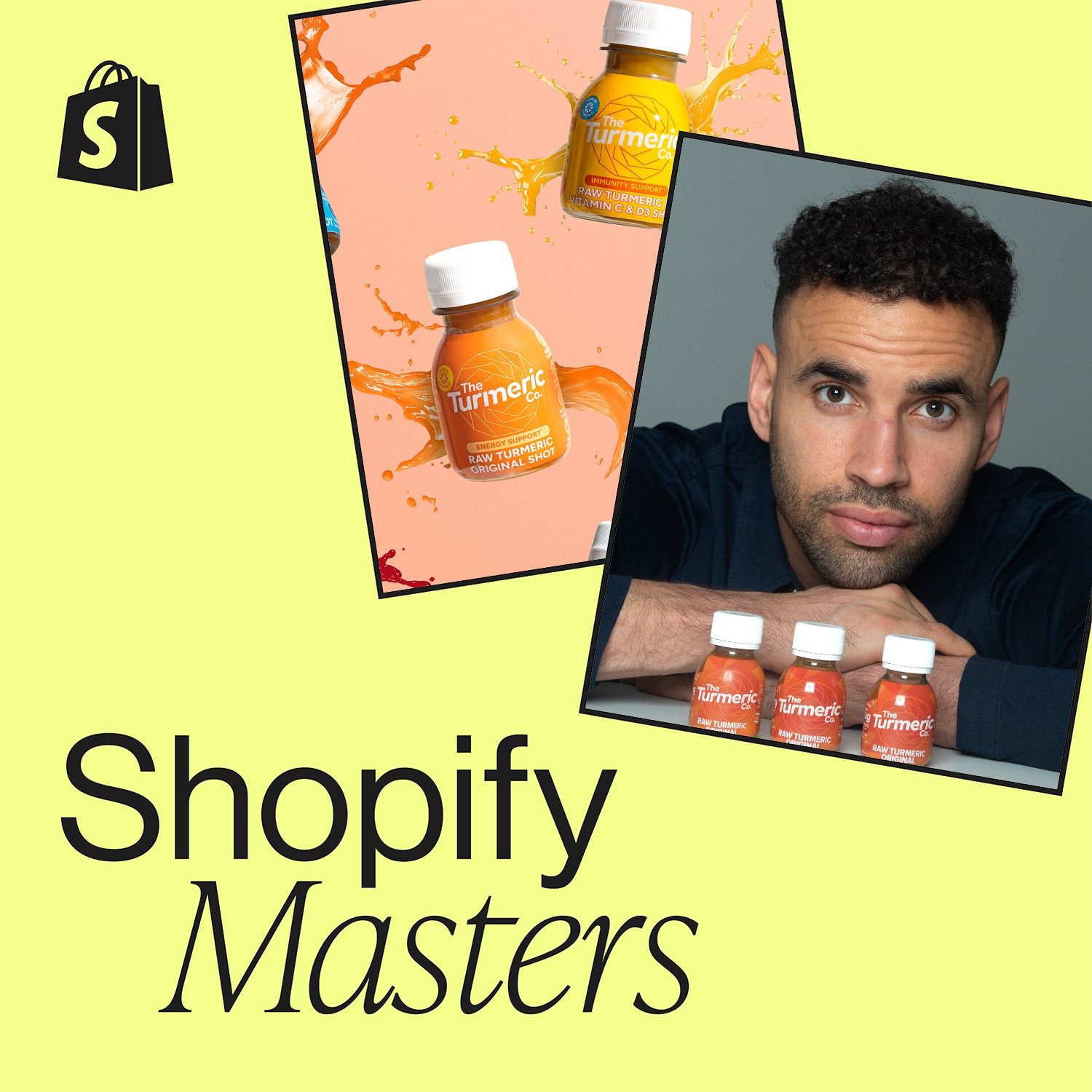
Shopify Masters
How One Ingredient Changed 20,000 Lives and Built a Wellness Empire
00:37:49
Premier League soccer player Thomas Robson-Kanu turned a career-threatening injury into a mission—building The Turmeric Co., a raw functional beverage brand now reaching customers across 15,000 UK retail locations.
Loading summary
Transcript50 lines
- [00:00]
Thomas Robson Khanu
Every new testimonial that we receive which has changed someone's life is, you know, 100 times better than scoring a goal at the highest level of football.
- [00:12]
Serena Smith
Welcome to Shopify Masters, your companion for starting and scaling a business. I'm your host, Serena Smith. Thomas Rabson Khanu was a Premier League soccer player or footballer, depending on where you sit. On the verge of losing his career to an injury until his father's homemade turmeric remedy changed everything.
- [00:28]
Thomas Robson Khanu
I used this blend completely as my secret weapon throughout my career.
- [00:31]
Serena Smith
That kitchen recipe became the Turmeric Co, now moving 300,000 units a week across nearly 15,000 stores throughout the UK. Today, Thomas is here to talk about scaling a family recipe into a thriving business and competing in one of the world's most crowded industries. Welcome to the show, Thomas. Thanks for being here.
- [00:48]
Thomas Robson Khanu
Thanks for having me, Serena. What an intro.
- [00:52]
Serena Smith
Listen. Deserved. You know, I think so often with entrepreneurs, they're entering the space because there's a problem that they see that needs to be solved. But for you, there was a deeply personal problem that needed to be solved. Can you take us back to tinkering around in the kitchen in the genesis of these turmeric shots?
- [01:11]
Thomas Robson Khanu
Yeah, definitely. Like, I certainly won't take credit for it. My father is the one who created the Turmeric Co blend and essentially, like, I've lived the experience of, you know, what turmeric in a functional bioavailable format can do. As a teenager, I suffered major surgeries, had two and a half years of rehabilitation, and by the time I was 17, I was basically hampered with chronic pain and inflammation in my knee following two major ACL reconstructions. And I simply couldn't shift the pain and inflammation. And the physios and doctors at the club at the time sort of told me that I was essentially going to have to live with this pain and inflammation all of my life. But what they then did was prescribe the anti inflammatories and painkillers. So I began taking things like ibuprofen, diclofenac, paracetamol, all pretty standard medication in the uk. But after two weeks of having this standard medication, my body had a complete adverse reaction to it. So my father and I basically began asking the question, like, there must be another way to sort of reduce the symptoms that I was experiencing. Like, surely there was a natural way to try and reduce pain, inflammation and swelling. And so we researched across, you know, various different herbs, medicines, spice, you know, resources, books which had been written, you know, some of them 100 years ago. And then we looked at, like, various cultures around the world where they use natural ingredients to reduce the symptoms that I was experiencing. You know, so ancient Asian cultures, Ayurvedic practices. And essentially we began to, like, identify relatively readily available ingredients, but ingredients that weren't in a convenient format to consume consistently over a period of time. So, yeah, essentially a long story short is six weeks after using this blend religiously, I woke up, rolled out beds, headed into the bathroom and into the shower. And I realized at that moment in time that that was the first time in over two and a half years I'd woken up without any pain or restriction in my knee. And so from that point onwards, I was able to get back to training, get back to playing. I made my first team debut in professional football. I made my international debut for Wales. My grandmother was Welsh. And I subsequently made my Premier League debut, which is the top flight of English Premier League football or soccer. And so I was able to do all of that completely pain free. And so I used this blend completely as my secret weapon throughout my career. And I began realizing I was recovering quicker than my teammates. You know, I would never get sick. You know, haven't had a cold in 20 years. You know, just don't get run down. And so we realized that there were these other, you know, real, tangible and meaningful benefits to this blend. And so we began prescribing it to friends and family. All of our friends and family began reporting, you know, meaningful changes to their health. And by a decade later, we saw this sort of growing trend within functional beverage. But we realized that actually a lot of the beverages on market weren't actually that functional. Like, they contain things like apple juice or orange juice or, you know, or the functional ingredient was, you know, few or far between. And so we essentially decided to bring this homemade recipe to market.
- [04:36]
Serena Smith
The state of desperation you must have felt like you were in, when you're young, you're injured, these meds aren't working. They're actually having, like, a more deleterious impact on your health. And you're seeing your future really at risk. And then I'm like imagining your dad tinkering away in like, a little apothecary in your kitchen. Were there other permutations of, you know, natural and functional ingredients that you guys tested out before landing on this sort of Eureka elixir? How much iterating went on?
- [05:10]
Thomas Robson Khanu
Yeah, there was like three or four weeks of iteration. And, you know, for example, we started with, you know, at the time, we could only source as an example like turmeric powder or turmeric capsules. And then we very quickly realized that, you know, turmeric capsules and powder actually contained turmeric in a spice format, which isn't a functional format. You know, you wouldn't sort of powder a steak and then eat it, you know, so it'd been denatured, heat treated, processed, you know, it's not fresh, it's not raw, you know, it's dead food. And so we, we then migrated to, then trying to source turmeric roots and eventually we must have been the highest, you know, sort of turmeric consumption family and in our area. And you know, at times we'd have to head to different markets and multiple locations just to source it. But, you know, a uniqueness about the blend, I would say, is that every ingredient within it is there for a functional purpose.
- [06:09]
Serena Smith
No filler?
- [06:09]
Thomas Robson Khanu
Yeah, no filler. Like we could easily add apple juice or orange juice to our product and it would, you know, reduce the price by half. But we would lose some key functional ingredients, you know, such as whole watermelon, such as whole pineapple, fresh pine pomegranates, which all have either antioxidant or potential anti inflammatory properties. And there's research and literature out there now which talks about watermelon being a really potent natural muscle soreness reducer as well as a fantastic hydrator. Right. And that's the base of every single one of our shots. So I think it was definitely the combination of the blend and the sort of proprietary ingredients that we used to support with the absorption and efficacy. And then obviously turmeric root has been used for millennia and you know, a lot of its active compounds have significant amounts of research attached to them. I think there's over 40, 000 published clinical studies on turmeric root supporting, you know, a wide array of health ailments. So yeah, it was definitely an interesting experience to try and like find the best solution. But yeah, the one we landed on, it felt fresh, it felt natural, you know, it felt functional.
- [07:22]
Serena Smith
You know, can you talk about that process when you decided, okay, there's a business opportunity here? How do we take this from something that's just like existing in our kitchen, that we're handing out to friends and family in the neighborhood to something that can actually scale.
- [07:37]
Thomas Robson Khanu
So essentially we spoke to the leading beverage manufacturers in the UK and Europe and we said, look, this is our process, this is what we want to achieve. Fresh, raw ingredients, quite a unique extraction process. Like it needs to be extracted multiple times and they basically just laughed at us and said, you know, this isn't scalable, it's not possible, and we wouldn't touch it. So we very quickly learned that in order to bring this product to market, we would have to become a functional beverage manufacturer first and foremost before launching the brand. And so, yeah, what we did was eventually figured out what machinery would work to replicate that kitchen process. You know, that took us about a year to figure out. Once we figured that out, we were like, okay, where are we going to manufacture it? And yeah, we eventually decided to flatten some garages to the rear of my dad's house in London and we created a mini bespoke manufacturing unit, got it food safety certified. And yeah, by 2018, we were ready to bring this blend to market.
- [08:42]
Serena Smith
I think something about the founder's journey is that like, in so many ways, especially if you're a first time founder, like, you just don't know what you don't know until you're in it and you're like, oh man, okay, here's the next mountain that I have to climb, right? Like, you're thinking, okay, we can find a manufacturer to help us with this. You're running into roadblock after roadblock. You realize, I have to do it myself, we have to do it ourselves as a family affair. All of a sudden you're getting into the manufacturing your business yourself, which is just like such an enormous beast and undertaking.
- [09:15]
Thomas Robson Khanu
Yeah, I. And so, you know, obviously, having scaled the way we've scaled, you know, there's a lot of entrepreneurs who will reach out to me and say, I'm thinking about doing this product. Like, you know, what would you advise? And yeah, like I tell them, like, don't, don't start your own manufacturer. Like, because you will have to build two businesses at the same time. You know, as much as you increase your sales, you'll have to increase your manufacturing capability. And yeah, that, that is a real challenge. But the whole genesis of the Turmeric Co was very much purpose driven. So, you know, to your point around, you know, overcoming these hurdles and these barriers and you know, just consistently persevering, it was simply because, like, we felt a real passion in the impact that we could have within society if our range of turmeric based shots through the Turmeric code was available to all right? And so, yeah, we persevered through many, many challenges. And as I said, we were in a position to launch in 2018 and we were sort of looking at the market and it was almost like, how do what's the best route to market. Like, you know, It's a small 60 milliliter shot. So it's not like you've got a massive amount of, you know, packaging real estate to communicate the message of the product or the brand.
- [10:35]
Serena Smith
Totally.
- [10:35]
Thomas Robson Khanu
And so, yeah, we, we specifically decided to launch the business Direct Consumer. We wanted to essentially take consumers on the journey that they would go on when using our range and use that ability to have first party data and engage directly with the consumer to help inform, you know, the direction that we, you know, took the brand and the messaging and the, you know, consumer experience and journey. And the most important thing for us was that ability to actually capture the impact that our product was having on people's lives. And so within four weeks of selling our first product, we received our first life changing customer testimonial.
- [11:20]
Serena Smith
What was that?
- [11:22]
Thomas Robson Khanu
So basically it was a lady who had chronic back pain, you know, really struggled in terms of arthritis and yeah, she used the range for, I think three and a half weeks religiously and it reduced the pain that she was having, you know, gave her mobility back and fundamentally changed her life. And to put things in perspective, we've now had over 20,000 life changing customer testimonials across, you know, the widest array of health ailments. And yeah, we're very passionate about what we're doing through functional nutrition in the form of the Turmeric range.
- [12:01]
Serena Smith
Does it ever lose its luster when you're getting just like glowing testimonial after glowing testimonial?
- [12:10]
Thomas Robson Khanu
I would say no it doesn't. I would say like I've, you know, I was fortunate enough to have a career in, you know, professional football and it's, you know, it's every kid's dream to, you know, play in the Premier League and play an international level. And you know, I was very fortunate to have incredible experiences within a sport and profession that I loved. But actually I would say now having the impact that we have on people's lives, for me that's a lot more rewarding than obviously, you know, bringing joy to fans and, you know, winning on the weekend and, you know, it's all fantastic, but actually we genuinely have a sense of purpose, a real sense of meaning. And yeah, I think if, you know, if I was to read some of the testimonials that we've received even over the last couple of weeks, your mind would be blown. It's a humbling experience.
- [13:03]
Serena Smith
When you launched Turmeric Company, you were also still a professional footballer. I mean, being an entrepreneur and being a professional athlete are both like completely full throttle endeavors. How were you managing your time and energy as you were doing both?
- [13:21]
Thomas Robson Khanu
Yeah, I think when, when I look back at my career, when we launched the tour in 2018, it was very much like a bit of a side hustle and it kept my mind busy, you know, allowed me to sort of like focus my energy outside of football without exerting any sort of physical energy. And so like, for me, I was just really passionate about growing the business. So I was able to, you know, build the business, build some processes, you know, communicate in terms of, you know, our marketing message input in terms of, you know, route to market and, you know, web design, web development and you know, consumer journey analysis. And so, so I kind of was doing it completely in tandem, but I felt that they almost like complemented each other and it gave me a bit of a mental release outside of elite professional sports.
- [14:14]
Serena Smith
Complemented each other, you're saying? I mean, as much as being a professional athlete is a physical game, it's deeply a mental game as well. Just in terms of discipline and self regulation and all these other elements. What from being a professional athlete do you feel like ended up being a really valuable, transferable skill to building this business?
- [14:38]
Thomas Robson Khanu
I would say that the importance that you put on like your attention to detail and your application to your craft, I think when you're trying to become a professional athlete, you really need to hone in on your skills. You need to practice, practice and practice again. You need to almost be obsessive with it in order to build that talent, you know, build that ability to then perform. And so, yeah, like within that, there's an element of meticulousness that you have to apply to your profession, particularly in the early days of building it. And so, you know, a lot of people would maybe call that obsessive or, you know, OCD or whatever it is, but you know, you, you just sort of do that as a norm because you're passionate about it. And because you're passionate about it, it doesn't feel like a chore. And so, yeah, I would say applying that into the business world, like you need to really, particularly in the early days, have a real focus on attention to detail. You need to really have a massive amount of care for quality and you need to be able to do monotonous things consistently well, get the basics right. And that's very similar in terms of sport. I would also say that understanding and the importance of team, whether you're playing a team sport or even if you're playing an individual sport, you will require a team to deliver your performance. Whether that's the driver who takes you to your fixtures, or whether that's your training coach, or whether that's your teammates, or whether that's your manager. The people around you and the team that you have around you is like paramount. And, you know, within business, like, you have to really be over obsessed with the culture and with the mission and vision of what you're trying to create and make sure that that's, you know, instilled as part of every element of why you do what you do and across every individual within the business. And if you begin to sort of create that environment, create that culture, you begin to, you know, overcome those roadblocks and you begin to, you know, drive traction into the business. And, you know, you can really move mountains.
- [17:01]
Serena Smith
The functional beverage space in particular is incredibly crowded. I'm always amazed by the sheer number of brands I see at my local Whole Foods or Erewhon. Right. And it feels like every time I go, somehow there's three or four more that have suddenly appeared on shelf. How saturated was it in 2018 and what helped you in those early days to break through in D2C?
- [17:27]
Thomas Robson Khanu
Yeah, I think it was, it was definitely a new market in sort of 2018, really niche, a real low level of understanding, you know, why would you have a shot versus a 500 milliliter serving, which also you can drink, right? Like, yeah, you know, but actually what's in the ingredients, you know, what's the ingredient list, what's the processing, you know, what's the efficacy behind the ingredients that you're consuming? And then what's the sort of need state that that product is, is serving? And, and so there was, I'd say, almost like no awareness of functional shots per se. And when I sort of look at this space now, it's definitely got a lot more crowded, but it's actually not very competitive. If you're talking about the fundamentals of functional. You know, I'm a former Premier League football player. Like, optimization of health and high performance was my job, you know, so I had to understand what is good for you, what is not good for you. Like, if I consume this today, will I feel better for it tomorrow? And if I wouldn't, then I wouldn't consume it because, you know, I was being paid and being judged based on my performance. And so I would literally say that right now, even in the market today, the reality is like, you know, 95% of the sort of functional products on Shelf, like, as an elite athlete who genuinely cared about my health, I wouldn't consume, you know, and so that's the reality. But there is marketing and there's brand and there's hype and there's influencers who can move the needle of consumption. But we're kind of in a space now where it's been saturated with noise. But over the next, you know, five and 10 years, you know, the brands and products who are bringing real efficacy, who are genuinely changing people's lives through natural and functional nutrition, will be the brands and products that last. And those that aren't doing that, you know, won't. It's as simple as that. Because actually, why would I consume a functional beverage which isn't functional? I would much prefer just to enjoy a Coke or enjoy a soda. You know, just. Just have a Coke and enjoy it. Like, don't consume something functional and think you're being, you know, better for it when actually you're not. So I think that education will be the next layer in terms of, like, launching D2C as a brand. And again, this was all organic. Like, we had, you know, in hindsight, you look back and you're like, oh, yeah, we did that. You know, that was clever. And that was, you know, good, good move. But we, we tested a lot.
- [20:25]
Serena Smith
What did that testing look like?
- [20:26]
Thomas Robson Khanu
So, yeah, so we tested in terms of sampling the product. We tested in terms of, you know, social. Like, social wasn't what it was today. Terms of media spend and in terms of, you know, algorithms, influencers, you know, how you can sort of leverage content. So a lot of our growth was driven through word of mouth and organic content sharing, based on the sort of testimonials that we were generating.
- [20:58]
Serena Smith
And how were you generating those testimonials?
- [21:00]
Thomas Robson Khanu
So our orders were 28 shopbox, you know, 28 days of product where, you know, consumers would commit to using it. Right. And so we then applied a review app into our, obviously our E commerce store and tech stack. And then that allowed us to begin to capture those reviews. But then we very quickly incorporated the ability to, like, track the reviews coming in. And then we. We implemented a process, a manual process where we would then reach back out to that customer, engage with that customer, ask them for, you know, would they be willing to do a video piece? Would they be, you know, willing to share more about their review and what they experience when using the product? So we kind of just sort of growth hacked the system in that way, which was not as sophisticated as a lot of sort of, like, D2C businesses would launch in this day and age. But yeah, the, the outcome was, was that we were able to reach more and more people in terms of awareness. And because of the benefits and the experience that people would have when using our range, we. We had a really strong retention rate and a really strong lifetime value. And so, you know, our focus was therefore around, like, how do we really nurture our customers and take them on the journey that they would go on when using our range.
- [22:26]
Serena Smith
When you go to your website, even today, it's chock full of these video testimonials. And like, I felt it when I was on the website. I was like, oh, there's something meaningful about seeing somebody's face and listening to them communicate about the benefits of this thing and the impact that it's having on their lives. How instrumental were those video testimonials in the early days in terms of building brand equity and getting consumers to take a chance on this?
- [22:52]
Thomas Robson Khanu
Yeah, they were massive. I'd probably say, you know, those video testimonials became assets to us and, you know, we would, you know, request permission to then use that within our marketing. So then these video testimonials would be incorporated into some of the email funnels and campaigns that we'd run for existing purchases or, you know, potential customers, subscribers who had captured through our email capture. So it was a pivotal decision to really focus in on that, and that was only possible because of the product, you know, so if we had done a product which had the orange juice in it and, you know, it wouldn't have had the efficacy and the health benefit that, you know, our range, full of all function ingredients had, you know, because consumers would say, you know, I use that for 28 days. And I really, actually didn't really feel a difference. Right. So I think that that was a pivotal decision to focus in on the experience our range delivers. But it was only possible because we invested and spent the time to really make sure and ensure product quality and efficacy.
- [24:05]
Serena Smith
You know, when you launched the brand, something that I find interesting is that despite the fact that you had a public profile, you weren't really leveraging that in the early days of building the Turmeric company. Right. It was kind of like you had your footballer career and then you were building this on the side and you were sort of letting the product and the customer testimonials speak for themselves, and you weren't necessarily at the front and center of it. And it feels like maybe there's been something of a transition in the years since Then like, was that by design initially? And what's your relationship with how forward facing you are now?
- [24:43]
Thomas Robson Khanu
Yeah, no, it's a good observation, I think, you know, I was playing at the highest level of professional football, you know, when we launched the business. And so I purposefully chose not to shout about it from the rafters. And actually looking back, I, I wish I had done because, you know, launching a business into, you know, this functional beverage space, it was a crazy, crazy journey. But I was also conscious that I had responsibilities as a professional athlete. And I'd say for the first three years of the business, you probably wouldn't have known that. It was me responding to some of the customer service inquiries, you know, it was me writing our email flows and trying to figure out, you know, how some of the platforms within email marketing work. And I was in the DMs of our social channels and responding to people, right. And so no one would ever know that, but it was me, right? So I was in that level of detail and I wasn't able to sort of maintain that handle on the business and really drive it to where I wanted to take the business, you know, and we're certainly still not there yet. And so, yeah, I made the decision in 2021 to, you know, respectively, retire early from professional football. I was 31 years of age. Physically, I felt better than I had ever felt in my career. My final game was in the Premier League way against Leeds in May 2021. Finished that and had the weekend, woke up on Monday and I didn't need to go into training because, you know, I finished my contract with the club and I sort of had 10, 15 minutes where I was thinking, okay, this is quite strange, I don't have to get up for training, but I opened my laptop and I had 25 emails to get through to respond to some suppliers and talk about some of the plans for moving our site a couple of miles outside of London. And so we'd had maybe two or three thousand life changing testimonials at that point in time. And the decision was, how far do we want to take this business? And I made the commitment and finished professional football on my terms and committed fully to growing this business to a place where, yeah, we believe it can change the shape of the health of society.
- [27:08]
Serena Smith
I mean, you went out on top. That's the way everybody wants to do it, right? And that's so powerful. And also like, oof, giving up a career at the highest level of being a professional athlete is difficult. Was there a degree of reticence to let that piece of you go.
- [27:27]
Thomas Robson Khanu
I think I'd made the decision beforehand. I'm incredibly grateful for the career that I had in sport, but I'm also, like, acutely aware that that career was only possible because of this blend. And so actually it kind of like, ties into the fact that. Well, no, like, my purpose is to bring this blend to as many people as possible. You know, there's people who live with pain as if it's the norm. It's that invisible illness. People living in pain is one of the most debilitating things in life. And it's only when you're experiencing that and it's only, you know, when you, you are in pain and you are in ill health that you realize that your most valuable asset is your health. And so, yeah, the more and more you sort of thought about this and you're sort of mulling it and you're like, well, no, like, imagine if there was like a natural way to prevent ailments, you know, and then also if there was a natural way to help reduce pain, reduce inflammation. And so, yeah, like, it's been a crazy journey. And we, since launch, we've invested into clinical research, you know, so now we've done independent clinical studies on our range. You know, I don't think there's any brands in the space or products in the space who would even think about doing that. Right? Because actually there's going to be no impact on health markers. Right. So we invested in that early on and some of the data that we received was around, you know, significant and meaningful reductions in inflammation, blood markers, you know, changes in gut permeability, you know, positively things like, you know, immunity, support. And so all of these elements led to this sort of core and fundamental belief that, yeah, like, we can actually make a difference.
- [29:25]
Serena Smith
You have the utmost faith in the efficacy of your product. And you launched dtc, which means that you had some space in real estate to be able to communicate that to your consumer. At a certain point, you make the expansion into retail. You're now in 15,000 doors across the UK. That puts you in a position where you have now another mountain to climb, right? Because a consumers are looking at a bunch of things on shelf, right? But something that strikes me as like an even greater challenge for the turmeric company is that your bottles are physically so small, right? They're just not necessarily catching the eye in the way that like some other, you know, to your point, 500 milliliter bottle would. How have you figured out how to stand out on shelf.
- [30:13]
Thomas Robson Khanu
Yeah. I think to launch into retail is a massive like achievement. When you go into retail like you're, you are now competing against the big boys of food and beverage. Like because there's only a finite amount of shelf space, you know, so the shelf space that we sit in now, that was owned by a large multinational brand three, four, five years ago. Right. So one thing we did well was obviously build that community, build that advocacy, build that testimony and scale from a social and digital and E Com perspective. And that gave us the data to show that there was consumer demand within truly functional beverages. But then taking that step into retail, you enter into a completely different world. Like this is now a different language. You know, these are processes and terminology and you have to learn quickly. Yeah, like I would say, like retail is the toughest thing in the world but when you then couple that with a 2 inch high bottle, it's impossible to communicate the difference between our product and another product on shelf. Like it's, it is absolutely impossible.
- [31:27]
Serena Smith
You literally can't fit it on the label.
- [31:29]
Thomas Robson Khanu
You can't. You, you literally cannot. Right. And so, you know, we were in a fortunate position where we had built a strong enough brand, where we had an okay amount of brand recall, you know, and it'd be like, oh well, what's that? Why turmeric? And then you know, a search on Google search would show you know, the turmeric co and then you know, that would take that consumer on that journey of discovery for the brand and product range. But yeah, I think there are ways that you can drive traction on shelf. And as much as, you know, visibility of the product and brand is, is really important that you need to be able to drive conversion. You know, you need to be able to incrementally improve rate of sale. But the key is can you get that consumer to make that decision to trial the product? And then the key one again is does that consumer buy that again? And if you can really move the needle through whether again it's through sampling at local retail locations where you're maybe performing really well or you feel you can improve performance and running incentives and discovery and there's mechanics that you can use to try and accelerate that discovery process which then you want to drive into conversion. So again fixture like how are you showing up? So that messaging around the brand and product is so important. So you have to rely on point of sale, you have to rely on things like barkers and things like aisle fins. And then after that it's then about the product, you know, so for us, we're fortunate. We have a very unique product which you can't replicate it. Right. So it's unique to us. So as soon as we get that, we have that high level of loyalty. And so that has allowed us to scale into retail and drive growth into the business.
- [33:41]
Serena Smith
It's clear that you're operating with a lot of integrity and you take your commitment to your customer very seriously. Do you have any advice for aspiring entrepreneurs in terms of establishing credibility and authenticity into their brand early on and maintaining that over the long term?
- [34:02]
Thomas Robson Khanu
It sort of ties back into some of the sort of fundamentals mainly around, like, vision and I think really being clear on what you stand for. Firstly, like, if you don't understand what you stand for, how do you expect a consumer who's never heard about the brand or never heard about products in this category to get that?
- [34:20]
Serena Smith
Or your team.
- [34:20]
Thomas Robson Khanu
Yeah, or your team. Yeah. And so, like, being really clear about that is key. And then I would say the next thing which is imperative is like, you just have to be consistent. You have to reinforce that core message and then understand who you're talking to. And through that sort of threads, like, create your message. And that message is what you just repeat and repeat and repeat. And a great example of that is, you know, Coca Cola, like, you know, Coke have been so consistent. That red bottle, that message around, you know, enjoyment with this, you know, really sugary, you know, soda products, you know, it's great, like, even at Christmas, you know, even Santa Claus drinks it. You know, it's like if you drink this, you smile. And so that is really, really key. And I think for founders and for startups and even for scale ups, like, it's so hard to be patient because, you know, you're bored of hearing it. You're what, you want to try something different, but actually you're just creating confusion. And you're also creating an element of basically a lack of consistency, which will mean that you have to wait twice as long to convey that same message.
- [35:43]
Serena Smith
Stay the course. It's a great piece of advice. Thomas, what are you most looking forward to with the Turmeric company in 2026 and beyond?
- [35:53]
Thomas Robson Khanu
I'd say the thing that I'm most looking forward to is really just continuing to do what we're doing. You know, every new testimonial that we receive which has changed someone's life is, you know, 100 times better than scoring a goal at the highest level of football, you know, so I'm just like, as many of those as we can receive as possible. And so, yeah, I think how do we do that? We need to keep building, you know, into new audiences, into new markets, you know, new distribution. You know, it's all really important. But actually, the reason why we're doing that is to change someone's life. Everyone knows someone who's living in pain right now, you know, how different would their life be? And again, how different would your life be if that person didn't have to live in pain, you know? And so I think through lifestyle and through functional medicine and through education, you know, through functional medicine. The core pillar of functional medicine is nutrition, you know, and so through education, like, people can begin to lead healthy, happy lives consistently because they are adopting preventative measures as opposed to just wait until you get sick and try and treat it.
- [37:08]
Serena Smith
Effy, Thomas, thank you so much for being here. This was wonderful.
- [37:11]
Thomas Robson Khanu
Great. Thank you. Samina. Thank you for having me.
- [37:13]
Serena Smith
That's Thomas Robson Khanu, founder of the Turmeric company Shopify Masters is produced by Alicia Clark, Gogo Zogar and Schwang Esther Shan. Our engineers are Matt Schwartz and Miku Bedlam and Rachel Reich is our senior content lead. And I'm your host, Serena Smith. Come back every Tuesday and Thursday to catch a brand new episode of Shopify Masters. And be sure to check out our YouTube channel for all of our video interviews. Until next time, thanks for listening.