← Shopify Masters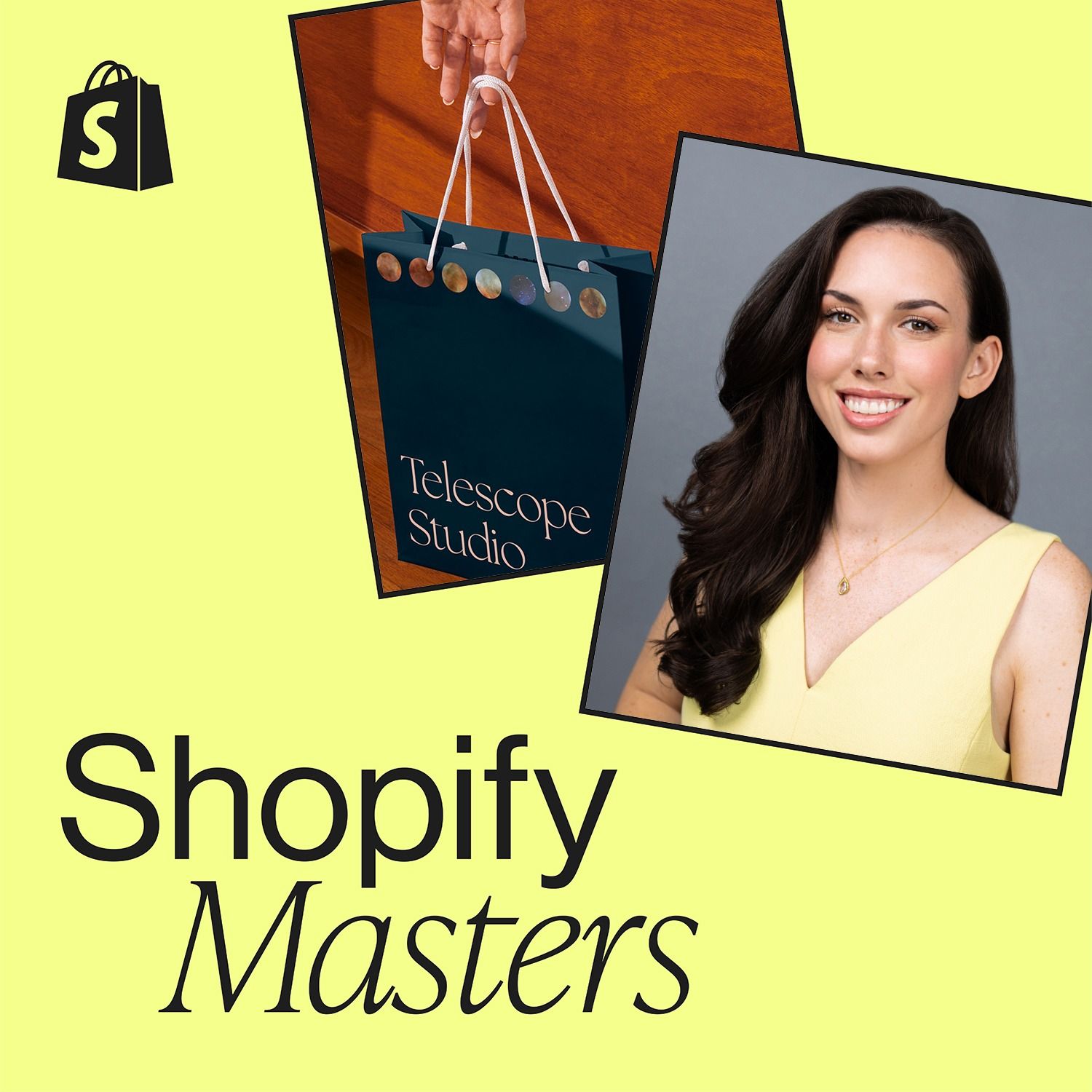
Shopify Masters
How This Studio Became the Secret Weapon Behind Fortune 500 Gifting
00:29:25
Chloe Sapienza built Telescope Studio on a simple but radical idea: A single well-sourced gift tells more of a brand’s story than a bag full of forgettable gifts. Starting from her living room during the pandemic, she grew Telescope into a full-service creative studio—designing, warehousing, and shipping gifts for companies with teams of hundreds—by betting on local makers and the power of intentional design.
Loading summary
Transcript106 lines
- [00:00]
A
A really great gift has an outcome that should be the intended purpose.
- [00:07]
B
Chloe Sapienza doesn't chase individual sales.
- [00:09]
A
The stuff we do behind the scenes is really crazy.
- [00:12]
B
She builds Shopify stores for corporations, then designs their merch, stocks her own warehouse and ships every single order.
- [00:18]
A
Creativity, no matter what, like your job function is or what role you're playing, I think is a really key part of collaboration.
- [00:24]
B
Today Chloe's breaking down exactly how her company Telescope Studio cracked the corporate gifting space and and how she turned company swag into a design forward business.
- [00:33]
A
How do you solve it within the parameters that you're given?
- [00:35]
B
Chloe, thanks so much for being here today.
- [00:37]
A
Thank you for having me.
- [00:38]
B
We have all been at parties or company events where you're like so stoked to get the swag bag and then you open it up and it is just like disappointingly awful. Is telescope essentially the antidote to that?
- [00:54]
A
I hope so. I think that that's what we're going for and that was definitely the original inspiration. Right. Like it's very easy to come across these products in parties or in daily life or at company events and they're not always the best gifts that you could give someone. It's a lot of things have already been done. And yeah, we're really trying to help people think critically about why they're choosing that product type and what they're doing with design and gearing people towards better choices in general.
- [01:22]
B
I'd imagine that like in moments that can be a little bit of an uphill battle. You're dealing with either like a larger corpor or a smaller company, they've got a bunch of other priorities on their plate and you have to convince them like that this gifting component is actually really important.
- [01:40]
A
Yeah, there are a lot of variables. There's the budget, there's their existing branding and staying really close to their brand guidelines. There are timeline parameters and then, yeah, preferences that people have and then the outcome is often that there's a desire for everything to be very uniformly liked.
- [01:56]
B
Right.
- [01:56]
A
Because you're giving to a group and not to an individual. So all of those things come into play. It's what makes it really fun and exciting though to at least for us to creatively problem solve within those guidelines. Like I think that's what makes any creative endeavor really interesting is how do you solve it within the parameters that you're given.
- [02:13]
B
Totally.
- [02:13]
A
And convincing people is just giving them unique and inspiring ideas that they maybe hadn't thought of or finding new ways to showcase their idea on a product. That is within what they wanted, but maybe has a bit of your influence in it as well.
- [02:29]
B
How do you take a company's brand or their voice or their philosophy and translate it into a physical object? Like, is there a framework that you follow?
- [02:40]
A
Yeah, there are different approaches for how you can translate different brands or different philosophies or different ideas into products. I think that one of the best ways to do it is to think about metaphor and use metaphor as a way to pull out elements of what is being communicated through the branding and translating it into the objects that you're sourcing. So an example might be if a company has brand values that are to be transparent, we may choose a transparent water bottle that's made out of glass or something like that that really calls to action the value that's being presented.
- [03:16]
B
What ultimately do you think is the difference between a gift that really lands within this context versus one that ends up in the back of our closets, or worse yet, as so often happens, the trash?
- [03:28]
A
I think it's a hard thing for people to solve and even for us to solve sometimes. But an example comes to mind. We just did a company off site with a team in Hawaii, and it was 600 employees, and we sourced from local makers in Hawaii. And they did a survey after the event. And so many people talked about how that was meaningful for them and that it was a reason they kept the products afterwards. So they were like, this tout and this tote bag are great. They were super useful during the event, and we loved that it connected to, like, the local economy and to brands from the area that we were celebrating in. And so even though those are kind of classic items, it's the story that you tell around it and the way that you source it and the makers that you work with, I think, and the brands that really make products land for people and make them things that people want to keep.
- [04:18]
B
Right. Like, it might still be a water bottle or a candle or a yoga mat or whatever, but the depth can sort of come through who you've chosen to be the purveyor. I mean, and I think the assumption would probably be that with, like, a lot of corporate gifting, that you're just, like, going to these sort of big behemoth suppliers, right?
- [04:37]
A
Yeah.
- [04:38]
B
That can just easily churn things out. It sounds like you're trying to lean into more local artisanal options wherever possible.
- [04:47]
A
Yeah, definitely. It's one of our main goals with the business is to draw more of this industry toward local economy and to smaller brands and to makers and local manufacturers. I have such a passion for product and product design and I get a lot of joy out of knowing that we're helping to bring those brands into the fold of this world. Because like you're saying, there are so many larger suppliers in the industry that source from overseas. And it's really been what's catapulted this industry to where it is. But it's, it's not the way I think that it's going to go in the future. I think that, that a lot more of these projects and a lot more intention behind the gifting is gonna mean that we're gonna want to source locally. And I think that's what most consumers and most people are looking for.
- [05:33]
B
Then it becomes beneficial on multiple levels. Right. Your clients are happy with you. They're happy because their employees have gotten a gift that they're stoked about. But you're also potentially making like a really meaningful difference for these like smaller scale suppliers for whom like a big order like that can make a big difference.
- [05:52]
A
Yeah, definitely. And I think about that a lot. And we try to communicate that with makers too, that this is another way that their wholesale line can really boost revenue for them and it gets their products into the hands of future qualified customers. Right. Who get it in a really delightful setting. Right. They're getting it as a, as a gift. It's coming to them in a way that makes it accessible for them. So if it's like a new product or a new brand, I think it's really smart to get involved in corporate gifting as a way to get your product out there and your brand out there.
- [06:22]
B
A lot of our audience is either smaller scale entrepreneurs or early stage or aspiring. So for those people like, how do they get their products onto the radar of a company like Telescope?
- [06:36]
A
We constantly do research and reach out to brands we use like wholesale marketplaces. We use Instagram brands do reach out to us as well. From the last time that we spoke with Shopify, we had a lot of brands reaching out to us, trying to get involved in working with us, which was amazing. We have a way on our website to contact us and get involved with our business. I think generally speaking, making sure that they're set up for wholesale and open to kind of slightly larger scale orders.
- [07:05]
B
What do they need to be able to churn out?
- [07:07]
A
Anywhere from maybe 25 units per item up to 2,500 units per item is sort of the general range. Some orders are much larger, but I think for smaller makers that would be kind of the upper end. Even just having 500 units of a certain colorway in a certain ski was really useful and like, makes it a much more appealing thing for people in our industry to pitch. Just because we're often kind of throwing a bunch of ideas out in front of customers to try to figure out what they're going to be excited about and how they're going to sort of cater the gift that they're trying to put together.
- [07:43]
B
You're somewhat vertically integrated. You're not just doing the design process. You also have a warehouse. And so you're warehousing at least some product, you're fulfilling orders and you're shipping them. Right. Why was it strategically important for Telescope to own those parts of the process?
- [07:59]
A
For us, quality and customer experience are two of our major pillars of what really differentiates our business over other distributors. And keeping those things in house really allows us to make that unified experience across each step of the process. It was also kind of table stakes within our industry. There are a lot of brands out there selling in a self serve way with like standard customer service and like you're just ordering this online and getting it to a place. Whereas having those additional parts of our business for fulfillment and warehousing and setting up stores for our customers ends up being a much more holistic service that they can then lean on and then it brings in different parts of their business too. So we then end up working with like their HR team and their marketing team and you know, all their smaller teams. We do like erg, gifting and a lot of different, smaller initiatives too within the company because we offer those services. So keeping them in house was important to create, I think just a consistent experience for our customers.
- [09:00]
B
Was it that way from Jump?
- [09:02]
A
Yeah, we started the business from home. It is one that you can do from home, which is nice. And the pandemic hit. And so we very quickly needed to find a way to service our customers who were now working from home instead of in their office or going to an event. And so a lot of the orders in sort of that first year of our business were to distribute packages for virtual events or holiday gifts to remind everyone that they were part of a company that was now distributed. So we very quickly had to figure out the fulfillment and warehousing component. And honestly, at the scale that we were at at that point, it can sometimes be hard to find the right partner if you're kind of smaller. But you need high touch, like really quality presentation with a lot of variability. And so we took it on ourselves and ended up finding a great space downtown that we moved into our studio warehouse and have been building it out from there ever since.
- [09:56]
B
Do I have this right that you have your warehouse and also like the office that your team works from, they're all kind of in the same place?
- [10:04]
A
Yeah, yeah. And we have it so that we also have like our photo studios there. We have a stage for live music and we put on events and like community is very important to us and the arts in general. And so we wanted to make sure that the space had a cohesive but multidisciplinary feel to it. And again, to lean into that element of really high customer service and quality. It felt important for us to have the designers and people who were sourcing products in the same space as the products when they came in. Right. And like having that quick connection to between different departments and people being able to just walk over and talk to each other ends up being really valuable for problem solving when inevitably problems arise.
- [10:44]
B
God, it sounds like almost romantic. In this day and age, everyone in
- [10:51]
A
a physical space together know. Yeah, it's nice. We have a great team. We have like a really great energy in the space. We hire a lot of creatives too in our warehouse team. So a lot of the people on our team are full time staff, but they're also musicians and writers. And so it's been a great experience.
- [11:10]
B
What do you think are some of the lesser known contributors to customer satisfaction that we as founders and entrepreneurs might not consider when it comes to not just design, but things like fulfillment and shipping? What are the details that you've seen actually move the needle?
- [11:33]
A
It's a little bit amorphous as all customer experiences, but it feels like obviously timing, like as long as you're getting things to where they're supposed to be on time, that's number one. Cost is a big concern. People are used to Amazon and free shipping and it's not quite that way with our industry. And so finding the right like cost effective methods that also get them there reliably. We often ship globally or we'll have teams that have like, you know, 500 people in the US and 500 people all over the world. And so we have to kind of time things as well. So orchestration on timing and cost I think are the major factors for delivery. But I do think that the product itself is what really ends up delivering. Because if we got everything there and it ends up not being liked or it looks wrong, it kind of defeats the whole purpose. So we really focus on quality. We really Focus on trying to make sure that what we have shown our customers is what we end up making. And hopefully it's better than they expect.
- [12:32]
B
Okay, you have to tell me about, like, an early misstep or panic moment where a product didn't turn out as anticipated and how you worked through it.
- [12:41]
A
Oh, man. Yeah. The stuff we do behind the scenes is really crazy. I'm sure we keep it completely hidden from our customers, but there are so many, so many mistakes that happen in this industry. Scale is a funny one. Right. Like, sometimes things look a certain way on your screen and then it comes out and it doesn't look that same way. We made these tote bags that I, you know, I knew what size they were, but the customer got them and was like, oh, my God, these are tiny. You know, and they, they were, they were small. They were a very small tote bag. It was sort of maybe like handbag sized. They're really cute. And it seemed intentional that they wanted this small tote bag. Turned out they did not. So that was kind of an issue we had to handle delicately because we did everything right technically, except the perception of the scale was off.
- [13:25]
B
What did you do?
- [13:26]
A
We ended up letting them make new tote bags for their next order, but they ended up choosing the same bag for the next.
- [13:33]
B
Stop it.
- [13:34]
A
We were like, we'll get a different bag for you and we'll make it. We'll cover some of the cost. And. And they ended up liking the tiny tote bags.
- [13:40]
B
They had a conversion experience.
- [13:41]
A
They had a conversion experience. Yeah. So that was great.
- [13:44]
B
You never know.
- [13:45]
A
You never know. But other mistakes that, like, you know, candles have melted in transit or like, chocolates have melted. And we've, you know, we've had to deal with those types of things where we just have to get things remade quickly. And that often, I think, is the biggest strain on, like, our operations team is like, the sales team and the creative team building in enough time for those, like, things that happen that are out of our control. If you're developing a brand and you're developing a product line, you're often getting tons of, you know, samples along the way and making renderings and, like, getting it perfect. And because of the sort of short timelines that we're working with, we're relying on brands to do a lot of that work and the makers and the production teams that we work with to do a lot of that work for us up front. We see a lot of the products that we sell before they go to customers, but we don't always get to see all of them. And so there's a bit of risk there of, you know, making sure that it meets our. Our standards and the customer standards.
- [14:36]
B
Right. Like if you have a CPG brand, you have to figure out the particularities of, you know, for instance, shipping a jar of pickles so that they don't break theoretically once. Right?
- [14:49]
A
Yeah.
- [14:49]
B
And then. And then you've got it. Right. But with you, it's like there's a whole litany of issues that could pop up at any given time because you're dealing with different clients in different places and all kinds of different products.
- [15:02]
A
Yeah. And when we're doing gift boxes, it's really a creative problem solving puzzle because the customer wants to pick, you know, whatever they'd like to pick. And then it really changes what kind of box those things can go into and how you need to pack them safely. And so there's a lot of, kind of ebb and flow of like, issue handling there, of making sure that. And testing. Making sure that we're packing things the right way to be presented beautifully while also not breaking in transit or getting, you know, crinkle paper dust on a white T shirt or, you know, there are so many small details when you're putting together products that have never been together in a box that we solve
- [15:37]
B
for the devil is in the details. My God.
- [15:41]
A
Are you a perfectionist in some ways? In other ways? No, not at all. I think that I obsess over design details, and I have particular things that I like to go a certain way, but I come from a family of artists, and so I have a lot more flexibility, I think, than. Than some people.
- [16:04]
B
You came to this via graphic design, right?
- [16:07]
A
Yeah.
- [16:08]
B
Prior to that, you were actually pursuing being potentially a professional soccer player. Is that true?
- [16:14]
A
That's true. Yeah. Yeah. I grew up playing soccer since I was 4 years old and played until I was about 20. Had a very strong career and trajectory and was recruited to play in college and loved the sport. But when I got there and was in the sort of final home stretch, it. It was not aligning with, I think, my own expectations and what I needed mentally and physically for myself at that time. And so I had to make a pretty hard pivot at an early age. And I think that that taught me a lot about what I'm capable of and what kind of strain and change can do for you too. And I knew that, like, I waited until it was sort of a forced decision to make that change for myself. What I eventually realized when I got into developing telescope is that, you know, if something's not working right or not feeling right to kind of just try to make the change sooner before you're forced to make a change. It's always better to do something else and try something new than to keep trying to do the same thing and it not quite working.
- [17:18]
B
It's excellent advice and I think the answer to this is often kind of intuitive and nebulous. But like, do you have any kind of like internal process for assessing when it might be time to move on from something or make a change?
- [17:32]
A
I do a lot of imagining and I do a lot of like future thinking. And so I try my best to kind of future plan anything that I'm considering changing. It's never, never turns out the way that you imagine it.
- [17:45]
B
Best laid plans.
- [17:46]
A
Yeah.
- [17:46]
B
Yeah.
- [17:47]
A
There are really no right answers until you've done it. And you may have made the wrong choice by, by changing, but it's the very least you known that at that point and you can kind of then iterate from there. I don't know. I think it's. For me, I take a much more fluid approach to change and luckily less fearful of it now since that early change. Yeah.
- [18:06]
B
Are there times in the trajectory of telescope where you have been forced with a decision like that and you've had
- [18:14]
A
to make a big change, Taking on like the fulfillment in warehousing and really like getting the space to do that was a change that felt a little bit out of our control. Like it was sort of just happening and we had to make a decision like were we going to outsource this or were we going to do it ourselves and ended up choosing to do it ourselves for the reasons we talked about. But I think that anytime a decision like that comes up and it's a big decision, I still feel in my mind that there's a way to try the other, the other thing. If that didn't work out, like it's not a, a straight line, one direction. If we absolutely needed to, we could always try something else.
- [18:55]
B
It's like it's serious, but it's not that serious.
- [18:58]
A
Yeah, I mean it could be. No, I mean it makes me think
- [19:05]
B
of the fact that you run this company with your husband. He's your co founder. I also work with my husband sometimes. And so I know like when it works, it can be really beautiful. When it doesn't work, it's like a recipe for disaster. It also means that like the boundaries between work and life and love become like really porous. How do you manage it.
- [19:30]
A
We get asked this question so frequently and there isn't. I don't know. I think that we're a little bit unusual in that we intended this to be the outcome. Like, when we first met, we liked working on projects together. I was still in school. We did things like we made music videos together, we did photo shoots together, we built our apartment together. Like, we really liked working together, working on projects. And we then had to enter the workforce and we were kind of bummed out that you got separated. Yeah, we were like, this is not as fun. So we, Our goal was to be able to start a business together and have that experience. So when it finally came to be, we were just so excited. And we take our executive meetings, like in the car on the way to and from work. And we own different parts of what we do at Telescope. So I think that really helps with the balance.
- [20:16]
B
Clear division of labor.
- [20:18]
A
Yeah.
- [20:18]
B
Do you have any kinds of rules or boundaries around places where work does not belong?
- [20:23]
A
We probably should not currently, because sometimes, you know, even at home when we're just hanging out, like, if something exciting is happening or one of us has a good idea, like, it's really fun to talk about and to get into it. I think if it's like really serious or like harder conversations, we usually both don't want to deal with that at home.
- [20:44]
B
It's really lovely to be able to like, share passion.
- [20:47]
A
Yeah.
- [20:47]
B
It's invigorating.
- [20:49]
A
It's. It's amazing. And we have a lot of continuous memories now together of like, stuff that we've shared and done and hard things that we've solved and amazing things that have happened. And it shortens the distance of having to communicate those things for us. And it just, I don't know, we really like it.
- [21:05]
B
You made this hard pivot from soccer and this trajectory that you were on at an early age, which takes like a lot of self possession and poise to have that awareness. Soccer is also a team sport. Like how has it influenced how you function as a leader?
- [21:23]
A
Yeah, the hard pivot taught me a lot about myself. I really had to think about what I needed and what I liked and what I wanted to do and what I wanted to spend my time doing. Playing any sport on a team, I think is incredibly useful for business. Like, you learn so much about intuition and communication, body language and the things that are really important when you start dealing with people. So much of running a business is the human interaction that happens and the collaboration and motivating people and making sure that they feel inspired and supported and excited about what we're all doing together. And a lot of that I learned from soccer. It was so ingrained in me from such an early age to just feel like everyone's going to do their job and do it well if we get in sync and we can, you know, streamline how we're working together and communicating and being creative too. I always viewed soccer as like a creative endeavor. It's a very creative sport. And I think that creativity, no matter what, like your job function is or what role you're playing, I think is a really key part of collaboration.
- [22:26]
B
What lessons in leadership do you have in terms of getting your team jazzed and also keeping them motivated?
- [22:36]
A
I try to be very hands off. I'm not fond of micromanaging, but there are certain things that I try to reiterate on a daily basis about what matters to the business or what matters to the type of customer interaction or to our sourcing. Like, I try to focus kind of on just a few key things that can't be missed. And then I like to let our team take it from there. And we try to hire people that want to be self sufficient and really operate within their role and really drive part of the company with us too, because we are a small business and so it's important that we have people on the team that want to take ownership of aspects of what we're doing. And because customer service is such a particular area where we really shine compared to our competitors, we put a lot of time and energy and money into making sure that our customers have an. A place where they can communicate directly with account managers and creative consultants who are always on their account. So there's like consistency there and accessibility for the creative side. I think quality is really the main thing for me. So even if it's. If a customer comes to us and is asking for a $10 backpack or even, you know, even a $30 backpack at this point, it's. It's hard, it's hard to get a backpack that's of quality at $30 for these lower quantities that are, you know, like they only need 50 or that sort of thing. With my team, I'm constantly trying to make sure that they understand how to help guide the customer towards something that they then really like and that they're going to enjoy. Because the idea of a $30 backpack sounds great until they get it and then they might not be happy even though we found one and even though it was what they asked for and it fits their budget and all those things. So quality and really good customer service are the main things that I'm really trying to make sure that we don't move at all on and that we're really staying strong on those things.
- [24:29]
B
Seasonality is a big consideration for a lot of CPG companies, but it feels like it's probably takes on an even more intense tenor for you, like around the holidays. Yeah, you're getting requests from all kinds of clients and they're all coalescing at the same time. What operationally do you have to do throughout the year to make sure that you're ready for that?
- [24:52]
A
Yeah, we spend a lot of time between now and sort of the beginning of fall doing a lot more of our internal projects, making operational improvements, working on those things that have been kind of slowing us down, trying out new tools, trying out new software. All of that happens during this period. Hiring, if we need to. That way, when we get into that home stretch, we can just go. Because like you're saying, it is crazy at the end of the year. Every year it's so busy. Everyone is doing as much as they can, as fast as they can for as long as they can. And it is kind of nice in that way, though. It gives the team, like a moment where they can really focus and go hard and then a moment where we can breathe and relax. So I like the seasonality, but it does require a bit of planning to make sure that you're doing projects at the right time.
- [25:39]
B
What do you do to make sure your teams are supported during that time?
- [25:42]
A
We'll do more team meals in the office or we'll make sure that we're flexible if they need to travel to see family or for a wedding during that time or something. We always try to be really supportive of our team. And during that time too, even Andrew and I. I mean, the whole. Every person is just at absolute max capacity. And if I see things that need attention, we move resources around to make sure that people are covered. So I think just being very vigilant during times where your team is strapped for time and resources to make sure you're kind of attending to their needs. And if things are falling by the wayside, is it solvable with a shift in resources or finding another person or, you know, like being open to making changes on the go that aren't permanent, but that can help with. With that moment to make sure that. Yeah, that that person feels supported and not like you're just leaving, leaving them out.
- [26:33]
B
Which is also the creative process.
- [26:36]
A
Right.
- [26:36]
B
Like making decisions on the Fly, being flexible, changing even in a structure that feels like it maybe wants to be unchangeable.
- [26:46]
A
Yeah.
- [26:47]
B
What goes into a good online store? What should people be considering?
- [26:50]
A
It really depends on the type of product, I think. But generally I think a great online store has a really easy to use interface, like some stores I'll go to. And there's a lot going on and it's a little bit complex, but I think just focusing on usability and access to the products that you've created and letting the product kind of shine through, simplifying the design, making it all about the products, all about what you've created and then from there kind of seeing what other content makes sense around that. A lot of designers especially or makers or entrepreneurs really want to come up with like a finished, full fledged design for their website or for their store. And those things will continue to change. And I think, you know, that's something that I did early on in Telescope. I thought that I had like a finished version of our brand and finished versions of the services that we were going to offer. And I spent a lot of time painstakingly making sure, like probably too much time working on that. And it starts to change immediately because it's a living organism.
- [27:52]
B
Right.
- [27:52]
A
There's no need to be overly stressed about the way that your store looks immediately. Just sort of 85%, I think, is what I always say. I'm like, just if it's 85%, it's ready.
- [28:03]
B
You can do all the planning in the world, but invariably things are going to change once you're actually out, like you said, and it's like its own breathing organism and you're getting real feedback from actual human beings who are engaging with it.
- [28:15]
A
Yeah, exactly.
- [28:16]
B
What have you seen can be the impact of a really good gift within your industry? Like, can it shift morale, can it change a relationship?
- [28:27]
A
All of the things I think a really, a really great gift has an outcome. Right. And it's. That should be the intended purpose. So whether it's retention for employees, like feeling really more supported and more part of a team recognition celebration for milestones for like sales teams and marketing teams, it does lead to conversion or to a better relationship with that customer because it feels more personal.
- [28:52]
B
Right.
- [28:52]
A
It's not just an email, it's a physical object that reminds you of that person, of that company, of that reason you're engaging with someone. So a really good gift does exactly that, like has that intended outcome.
- [29:06]
B
Chloe, thank you so much for being here today.
- [29:08]
A
Yeah, thank you. I really appreciate it.
- [29:11]
B
And thanks to all of you for tuning in. As always, hit that subscribe button so you never miss out on a new episode, and we'll see you next time.