Loading summary
Transcript35 lines
- [00:00]
Sponsor Announcer
This message comes from Ezcater, making it easy for organizations to order food for meetings and events from favorite restaurants, set up meal programs for their employees, and manage food. Spend all in one place@ezcator.com youm're listening.
- [00:16]
Regina Barber
To Shortwave from NPR. The universe that you and I see with our eyes, things that make up matter, like galaxies, stars, planets, grass. That's only 15% of the universe's total mass. The rest is called dark matter. This is mass in the universe that doesn't interact with light. Astronomers know that dark matter is there, but they don't know what it's made out of.
- [00:46]
Narrator/Host
So we don't know what dark matter is, but we know what it's not. So when you think of a galaxy like our Milky Way, it has three main components. It has stars, it has gas, but most of it is dark matter.
- [00:57]
Regina Barber
That's Jorge Moreno, a computational astrophysicist, cosmologist, and professor at Pomona College in California. Like many scientists out there, he would love to find out what exactly dark matter is. And a new clue just dropped. It's called Cloud 9.
- [01:16]
Narrator/Host
Cloud 9. I like to think of it as a bit of an underachiever. He actually had all the resources he needed to make a galaxy. He had the fuel, it had all the conditions. But he just chose not to.
- [01:28]
Regina Barber
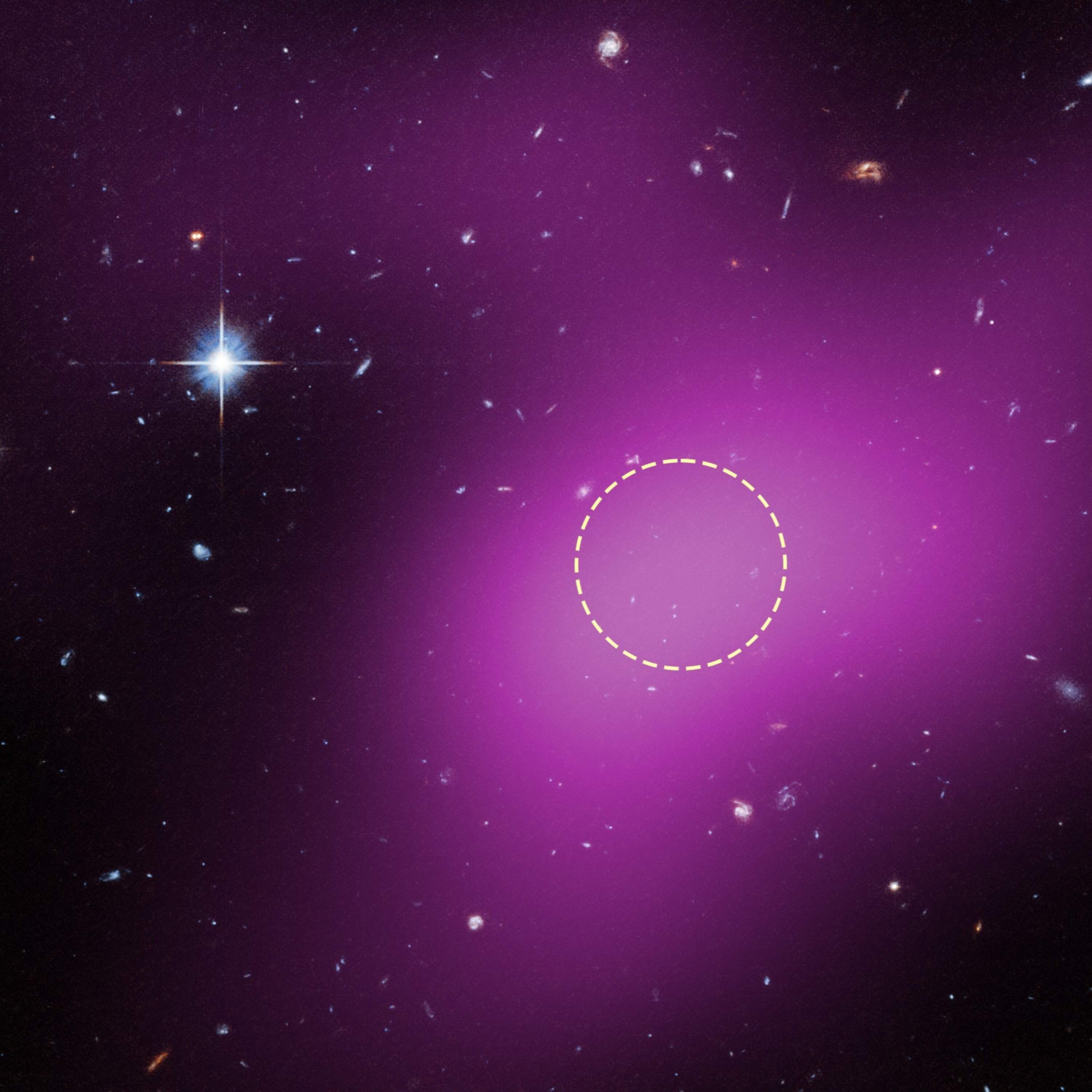
Cloud 9 is a failed galaxy. It's a dark matter halo with a cloud of gas devoid of stars. It's on the outskirts of a Beautiful spiral galaxy, M94. But what's a dark matter halo?
- [01:41]
Narrator/Host
A clump of dark matter.
- [01:43]
Regina Barber
And while it may be an underachiever, Cloud9 is a big deal. The current model of our universe predicts this kind of dark matter halo exists, one that didn't help make a galaxy or stars, but this is the first time astronomers have observed one.
- [01:59]
Narrator/Host
It not only teaches us about the nature of galaxy formation, but also the nature of dark matter itself.
- [02:08]
Regina Barber
Today on the show, why this failed galaxy could be the key to finding out one of astronomy's biggest mysteries. Answering what is dark matter? I'm Regina Barber, and you're listening to Shortwave, the science podcast from npr.
- [02:42]
Sponsor Announcer
This message comes from Whole Foods Market. Follow your wellness goals and save big with sales on supplements and vitamins. Explore an abundance of high quality multivitamins, probiotics and protein powders. Keep good habits going strong. Cook homemade meals featuring sustainable wild caught sockeye salmon and many more delicious and lean protein options for wellness when you need it. Shop smart meal shortcuts to stay motivated like ready to eat salad kits. Shop all things wellness at Whole Foods Market.
- [03:12]
This message comes from NPR sponsor NetSuite. Every business is asking the same question. How do they make AI work for them, the possibilities are endless. No more waiting. With NetSuite by Oracle, you can put AI to work. Today, NetSuite is the number one AI Cloud ERP trusted by over 43,000 businesses. Whether your company earns millions or even hundreds of millions, NetSuite helps you stay ahead of the pack. Right now, get their free business guide demystifying AI@netsuite.com shortwave.
- [03:46]
Regina Barber
I'm talking with Andrew Fox and Gagan Deep Anand, two astronomers from the Space Telescope Science Institute in Baltimore, Maryland. And you two were on the team that found this dark matter halo. First of all, Andy, how did you feel when you realized what you found?
- [04:00]
Andrew Fox
We were excited because we been studying this cloud near the Galaxy M94. This cloud's been known for a few years, but we pointed the Hubble Space Telescope at this cloud expecting to find some stars. And if we'd seen stars, that would have confirmed that this cloud is really a small galaxy, something like many other galaxies that are out there. But what we found was that there are no stars, even though we pointed at this object for a very long time with the Hubble telescope. And that told us that it's a different type of object, an object that is gas rich but that is almost completely starless. And so we were excited because in a way that was a surprise. We didn't find the stars we were expecting to see. We found just a blank piece of sky, a completely empty cloud. And that's a really interesting clue about what the nature of this object is.
- [04:53]
Regina Barber
And Deep, can you help our listeners understand what is a dark matter halo? Why is this such a big deal?
- [05:01]
Gagan Deep Anand
Yeah, so galaxies form within side dark matter halo. So the dark matter is the prevailing structure, actually, even though we can't see it. And then all of the matter that makes up, you know, the things we know like stars and planets, normal matter or baryonic matter, that is, you know, that's the stuff that we know and love and that you see in the pictures. But the prevailing model of our universe, the what's called lambda cdm or the model that describes dark energy and dark matter, it predicts that you should have dark matter halos that are actually not massive enough to form stars in the centers. And so this has been a prediction of the theory. And with the discovery of this RELIC object, Cloud 9, it's a confirmation that you actually do indeed have Dark matter halos that are not massive enough to form stars, just like the simulations predict.
- [05:56]
Regina Barber
Okay, so, Andy, can you help explain this lambda CDM model and how it really tells us how galaxies are being put together?
- [06:05]
Andrew Fox
Yeah, it's a great question because as. As Deep mentioned, most of the matter in the universe is not thought to be in atoms and molecules, the regular matter we can see around us on Earth and in our solar system. Most of the matter is thought to be dark, which means it doesn't emit any light. We can only infer it by seeing on its effects on the matter around it, for example, the gravity that the dark matter can provide. Now, this lambda CDM model is accepted as the prevailing. The commonly accepted model of where the matter is in the universe and the matter condenses into galaxies. And those live in what we call halos because the matter is concentrated into different patches, we call those halos. Most massive halos have galaxies in them. So when we look out into the night sky, we see those galaxies. But the cool thing about this model is that it predicts there are smaller halos, smaller halos that are beneath the scale that can form a galaxy, essentially failed galaxies, things that didn't quite have enough mass to form a galaxy, emit light and become like any other galaxy we can see. Those smaller halos are called relics. That's a technical term, but you can think of it as a relic left over from this time when galaxies formed. But there were some leftover clouds that were not massive enough to form galaxies. And, and this is part of this, this, this theory, the CDM theory.
- [07:26]
Regina Barber
How big are we talking about? Like, if you can kind of compare it to our galaxy and things maybe around it. When we're talking about these relics, how big are they?
- [07:34]
Andrew Fox
So this relic we've been studying, called Cloud 9 is about a kiloparsec across. That's a unit astronomers use. That's about 3,000 light years. The Milky Way would be, I don't know, maybe 50 kiloparsecs or 150,000 light years across. So this object is much smaller than the Milky Way. It's small and it's dense with. With no stars in it. But so we think of these, these relics as the leftover clouds that didn't quite make it to become galaxies. And they've just been hanging out there in the universe. But they're very hard to observe. And that's why we had to look really to very deep levels, look with very sensitive imaging with the Hubble telescope to actually confirm this thing and show that it had no stars in it. And that's really the side of this story we're most excited about, is that these objects have been predicted by theory. They come out of this Lambda CDN theory. But with Cloud9, we finally have a chance to observe one and see what its real properties are like and deep.
- [08:32]
Regina Barber
I think this is a good time to, like, take a step back for people, you know, who aren't astronomers. How do galaxies form? Like, what is the consensus, you know, in the astronomy community?
- [08:46]
Gagan Deep Anand
Yeah. So before, you know, if you go back way in time, before galaxies formed, you have the universe, and you have certain parts of the universe that are just slightly more dense than other parts, and those are the regions that become galaxies. And so we think that galaxies form in halos, or roughly spherical regions of dark matter. And so these halos trap gas and. And that gas collapses and then forms galaxies. But our models predict that you have to have a halo that is above a critical mass to actually collapse and form a galaxy. And so, as Andy was saying earlier, you should also have dark matter halos that are just below this critical mass threshold that remain starless. Basically adding on to what Andy was saying earlier, too. Relics live in the sweet spot where they're not massive enough to collapse and form galaxies, but they are just massive enough to hold on to some of the gas still. And that's the key part, is that since they're able to hold on to the neutral hydrogen gas, we can actually go with radio telescopes and look for the glow of that. That neutral hydrogen. And we see it in the radio observations. And that's how the Chinese team that detected Cloud 9 in the first place, that's how they were able to find.
- [10:09]
Regina Barber
And Andy, before this discovery, there was that gap in the theory, Right. We hadn't seen any of these dark matter halos this size. I remember there might have been other candidates. So have there been other possibilities before you found this dark matter halo?
- [10:25]
Andrew Fox
Yeah, that's right. There have been other candidates. There's been cases where people have seen these gas clouds without any obvious stars. But we've never found one Quite like Cloud9 before the new one in our latest research, and in particular, we've never pointed just so long with the Hubble telescope at one of these clouds. In other words, we were really taking a very deep, long exposure to see if there's anything there. So we wouldn't really have expected that it would be so empty. That was the great surprise and the great finding here is that even with the Hubble with some of the sharpest eyes we have in space, we still couldn't find any stars. And that tells you that there really is very little stellar content, very little stars in this thing at all.
- [11:07]
Regina Barber
So deep what does this discovery mean? Now we finally filled in this gap of theory. What does this mean for theory? What does this mean for astronomy going forward?
- [11:17]
Gagan Deep Anand
Yeah, so first of all, it's a big win for the theory. It's a big prediction of the model that these objects should exist. And just by finding one, you know you're on the right track. The other thing is that these things are really useful. Right. And so if you look at normal galaxies like the Milky Way, yes, they have dark matter halos, but they also have a lot of other stuff going on. There's stars, there's gas, there's dust. And so the idea is if you look at the distribution of mass in Cloud nine in more detail, we'd be able to sort of put more constrict constraints on what dark matter actually is. And so by mapping out Cloud nine and higher resolution in the future, we might have a better hold on what the dark matter particle, or if it's not a particle, whatever else it is really is.
- [12:05]
Regina Barber
Yeah. Andy, do you have anything to add to that? Because this is a big deal, we might be able to find what dark matter is.
- [12:11]
Andrew Fox
I think it's a very promising direction. Yeah, absolutely. I mean, these clouds, you can think of them as a window into a dark matter dominated cloud, a window into the dark universe. We don't have many places we can look without stars because the stars are so bright. They, they take your attention and they make it harder to see what's happening underneath. With Cloud 9, the lack of stars, we can turn that to our advantage. Where we found Cloud 9 is not close to M94. It's way out in the outer halo, in the outskirts of that system. And we think that's really important because if it had been found much closer in nearby to the galaxy, there's all sorts of processes that could have destroyed it by now. But it's quite happy sitting where it is in the outer halo and giving us this great chance to study it and to look at what the cloud is actually made of in terms of its dark matter content. Getting the first one is always the hardest thing. But we want to look for more of a population of clouds with similar properties. That's certainly going to be helpful for following up on this.
- [13:14]
Regina Barber
Yeah. Andy Deep, thank you so much for talking to me about Cloud 9.
- [13:18]
Gagan Deep Anand
Yeah, thank you. Thank you very much for this opportunity.
- [13:22]
Andrew Fox
Thank you. It's been our pleasure.
- [13:27]
Regina Barber
If you liked this episode, follow us on the NPR app or wherever you get your podcasts. Also, you may want to check out our episode with astrophysicist Jorge on the mysterious Great Attractor or our whole summer series on space. We'll link to them in our show notes. I'm Regina Barber. Thank you for listening to Short Wave from npr.
- [14:06]
Sponsor Announcer
This message comes from Greenlight Ready to start talking to your kids about financial literacy? Meet Greenlight, the debit card and money app that teaches kids and teens how to earn, save, spend wisely and invest. Start your risk free trial@greenlight.com NPR this.
- [14:22]
Message comes from Rosetta Stone. If you're planning travel this year, imagine going into that trip. Understanding the Language Rosetta Stone has been a trusted leader in language for over 30 years, 25 languages to choose from. It immerses you in your new language naturally, helping you communicate with confidence. Access lessons from your desktop or mobile app. Receive 50% off a lifetime membership with unlimited access to 25 language courses for life. Visit rosettastone.com NPR and start learning today.
- [14:56]
This message comes from the John D. And Catherine T. MacArthur foundation, recognizing extraordinarily creative individuals whose ideas, solutions and discoveries expand people's expectations of what's possible. Macfound.org.