Loading summary
Transcript81 lines
- [00:00]
NPR Sponsor/Advertisement Voice
This message comes from Capital One. Say hello to stress free subscription management, easily track block or cancel recurring charges right from the Capital One mobile app. Simple as that. Learn more@Capital1.com Subscriptions Terms and Conditions apply.
- [00:19]
Emily Kwong
You're listening to short wave from NPR. Hey, shortwavers. Emily Kwong here with Julia Simon from NPR's Climate Desk.
- [00:28]
Julia Simon
Hey, Julia. Hey, Emily. It's so good to be here.
- [00:31]
Emily Kwong
I'm so excited to talk to because you just got back from COP 30, the UN Climate Change Conference in Belen, Brazil, at the edge of the Amazon rainforest. How was it?
- [00:40]
Julia Simon
Well, I would say eventful is a good word to describe it. The conference took place in these big plastic tents, and the day before the conference was supposed to end, I was on the phone with my editor in the US Sadie Babitz. And then people started running through the tent saying, there's a fire. Okay, there's really a fire. Jesus effing Christ, Sadie.
- [01:01]
Emily Kwong
Oh, no.
- [01:02]
Julia Simon
I know. I gotta move on. Sadie's telling me to get out. The Brazilians are pretty upset and they speak the language. So what happened? It seems to have been an electrical issue. Something caught fire. There was a huge blaze enveloping part of the tent. At least a dozen people were treated for smoke inhalation. Tens of thousands of us were evacuated. But when I ran out of the tent, the first thing I did was was find this guy named Andres Gomez. Because, Emily, today's podcast, it's not about the fire. It's about what was supposed to happen just 15 minutes after the fire broke out. Andres is from Colombia, and he was working with the Colombian government and a group of about 20 other countries to make this big announcement, something that climate experts say promised to be one of the most important things to come out of this conference. Yikes. So you guys are trying to reschedule, I'm guessing.
- [02:01]
Andres Gomez
Who knows? We need everything to calm down. And the Colombian government.
- [02:08]
Unidentified Short Interjection Speaker
Oh, man.
- [02:09]
Emily Kwong
Today on the show, what almost didn't happen at the climate conference in Brazil.
- [02:15]
Julia Simon
A fire upends a major announcement about tackling the biggest driver of global warming, fossil fuels. We came to Berlin with a clear goal. Keep the 1.5 limit within reach. Of course, align with science. This is powerful war science. We need to trust science.
- [02:36]
Emily Kwong
Will this announcement happen? Will it not happen?
- [02:39]
Julia Simon
Stay with us.
- [02:41]
Fernando Madera
I'm going to stress eat chocolate. Anyone want to do that?
- [02:44]
Julia Simon
That would be a lovely idea.
- [02:47]
Emily Kwong
Thank you. You're listening to Short Wave, the Science podcast from NPR.
- [02:55]
NPR Sponsor/Advertisement Voice
This message comes from LinkedIn ads. One of the hardest parts about B2B marketing is reaching the right audience. That's why you need LinkedIn ads. You can target your buyers by job title, company role, seniority and skills. All the professionals you need to reach in one place. Get a $250 credit on your next campaign so you can try it yourself. Just go to LinkedIn.com nprpod that's LinkedIn.com nprpod Terms and conditions apply only on LinkedIn ads. This message comes from BetterHelp. As a dad, BetterHelp President Fernando Madera relates to needing flexibility when it comes to scheduling therapy.
- [03:35]
Fernando Madera
I have kids under 18, so, like, time is very limited. That's why at BetterHelp, our therapists try to have sessions, sometimes at night, depending on the therapist, or during the weekend. So I think that's what we need to tell the parents. You're not alone. We can help you out.
- [03:51]
NPR Sponsor/Advertisement Voice
If a flexible schedule would help you, visit betterhelp.com NPR for 10% off your first month of online therapy. This message comes from NPR sponsor Veeam. AI promised intelligence, but it also exposed everything people couldn't see, like scattered data and hidden risks. Now there's a new way forward where protection, governance and AI trust move together. With Veeam Security AI, you can see your entire data estate in real time. Because when resilience, security, governance and AI trust come together, innovation moves safely and faster. Learn more about accelerating safe AI at scale@veeam.com okay, Julia, so before we talk.
- [04:37]
Emily Kwong
About whether this announcement happens or not, what was on the table at this year's UN climate conference called COP30?
- [04:44]
Julia Simon
Well, quick refresher course. About 70% of the greenhouse gas emissions heating our planet, Emily, they come from burning fossil fuels. Facts.
- [04:52]
Emily Kwong
Burning coal, oil and natural gas is the single biggest driver of global warming.
- [04:57]
Julia Simon
Exactly. And for the past 30 years, countries have been coming to these UN climate conferences to discuss how to tackle global warming. But many countries say these conferences, they're called cops, do not have nearly enough emphasis on the need to transition away from fossil fuels, again, which is the main driver of climate change. I spoke to Juan Carlos Monterey, he's special representative for Climate Change of Panama, about this topic.
- [05:23]
Juan Carlos Monterey
Every time that we come to this cup, we try to re debate science. We try to avoid talking about fossil fuels. It's really, really stupid. It's like trying to deal with a patient that has Covid but not treating the patient for Covid.
- [05:36]
Julia Simon
Yeah, Emily, it took 28 years for the COP agreement to even mention transitioning away from fossil fuels.
- [05:44]
Emily Kwong
Ooh, I imagine that's really frustrating for so many countries who come to this conference.
- [05:49]
Julia Simon
I would say some of the countries I spoke to would say frustrating is an understatement. Climate change is happening, and many countries came to Belen explicitly demanding language in the final agreement about a roadmap away from fossil fuels. In fact, many countries like the United Kingdom, Mexico, Norway, they said they didn't want to leave the conference without that fossil fuel roadmap language. Hmm.
- [06:14]
Emily Kwong
Did they get their roadmap?
- [06:15]
Julia Simon
No. No mention of fossil fuels. Wow. And so, like we said, many countries are deeply frustrated with this UN process. It's a process by consensus, Emily. So every country has to agree to the text of this agreement. And you have close to 200 countries in the process. And while Norway and Mexico are oil producers and they want a roadmap off of fossil fuels, some other big oil producers like Saudi Arabia, they do not. So you have some countries pretty consistently blocking text that mentions fossil fuels.
- [06:50]
Emily Kwong
Interesting. So this is the dynamic at cop. Is anyone doing anything about it?
- [06:54]
Julia Simon
Well, remember that guy we met from the top of the episode, Andres Gomez from Colombia? Yes. You.
- [07:00]
Emily Kwong
You found him after the fire.
- [07:01]
Julia Simon
Exactly. He works for a group that is developing something new. I met with and that morning before the fire, and he told me what was supposed to happen later that day. I consider this under embargo. This isn't going to go out until later today.
- [07:17]
Emily Kwong
Famous last words.
- [07:18]
Julia Simon
I know, right?
- [07:20]
Andres Gomez
Yeah, it's very interesting. Countries like Mexico, for instance.
- [07:24]
Julia Simon
Andres was showing me on his phone a list of about 20 countries that plan to announce something called the first international conference on the Just Transition Away from Fossil Fuels, or the Santa Marta Conference for short.
- [07:39]
Emily Kwong
What is the Santa Marta Conference?
- [07:41]
Julia Simon
Well, like we said before, some of those countries that really want this roadmap away from fossil fuels, they're again frustrated with those consensus rules of cop. Everybody has to agree. These countries want to take action urgently. And just like if you're doing a group project, Emily, and there's some people who are really into it and some people who are not so much these countries, some call them the high ambition countries. They're like, we want our own space, we want our own conference to really tackle the phase out of fossil fuels asap. Here's Andres.
- [08:16]
Andres Gomez
We have these high ambition countries which are 20, let's say that we get the same number that we have now. So we'll have these countries which are convinced that we need to do something really quickly, and we are going to do that in April.
- [08:29]
Julia Simon
So this conference in April 2026 that Andres is Helping to organize that will be the first global conference for the phase out of fossil fuels. It's in Santa Marta, Colombia, hence the name. And that's a big deal. Colombia's an oil, gas and coal producer. Here's Irene Velez Torres, Colombia's Environment Minister.
- [08:50]
Irene Velez Torres
The idea of the Santa Marta conference is to have this first space in which we are completely clear that the phasing out is necessary because it's not easy. No one is saying that it is easy, but if we don't face the problems, we cannot build the solutions.
- [09:06]
Emily Kwong
Okay. This is fascinating that this new conference has emerged.
- [09:11]
Julia Simon
Yeah.
- [09:11]
Emily Kwong
I gotta ask, though. Why. Why not just bring this to cop? I mean, COP is the place where the world came together around the Paris Agreement. Around 190 countries agreed to try to limit warming to 1.5 degrees Celsius. So why can't countries just, you know, stick to that?
- [09:28]
Julia Simon
I mean, it's an important question. And in the Paris Agreement, countries did agree to limit warming and cut their emissions. But the thing about the Paris Agreement, Emily, is that it doesn't specify the specific steps countries will take. Here's Nikki Reich. She's Climate and Energy Director at the center for International Environmental Law.
- [09:48]
Emily Kwong
The existing framework, the Paris Agreement, it doesn't contain a step by step playbook for how we're going to combat climate change or phase out fossil fuels.
- [09:59]
Julia Simon
Also, it turns out the pledges that countries are making for the Paris Agreement, they're not enough to limit warming to 1.5 degrees Celsius. A new UN report finds that right now countries are pursuing policies that would cut emissions by just 12% by 2035. What scientists say countries need to do is cut emissions in half by 2035.
- [10:22]
Jesse Diggins
Yeah.
- [10:23]
Emily Kwong
Okay, so how does the Santa Marta conference intend to be different?
- [10:28]
Julia Simon
They tell me they're still nailing down the official agenda, but the big conversation topic is how to transition away from fossil fuels in an equitable way. So globally, there are still lots of subsidies for the oil, gas and coal industries. One thing that organizers tell me that they'll probably be discussing is how to redirect that money away from oil, gas and coal to towards helping countries pay for things like more renewable energy and batteries. Also, there are tens of millions of people who work in the fossil fuel industries, people who work in coal mines, and people who work on drilling rigs. These organizers say countries are gonna have to find a way to get these people new jobs in an equitable and fair way.
- [11:11]
Emily Kwong
Yeah, I mean, it sounds like these would be concrete measures to help Countries actually deliver on the goals of the Paris Agreement?
- [11:18]
Julia Simon
Well, that's the goal, right, Is to make the transition away from fossil fuels really happen. Sophie Hermans is Minister of Climate Policy and Green Growth of the Netherlands. The Netherlands is co hosting this new conference with the Colombian government. And the Minister says the Santa Marta conference is complementary to what they promised in Paris.
- [11:38]
Unidentified Short Interjection Speaker
In Paris, 10 years ago, we all said, okay, we have this ambition. But after you have said you have the ambition, you also have to come to action. And that's what we are doing now.
- [11:49]
Julia Simon
But Emily, there is one other thing that they plan to discuss in Santa Marta in the spring, and that is something called the Fossil Fuel Treaty.
- [11:59]
Emily Kwong
Ooh, what is the Fossil Fuel Treaty?
- [12:02]
Julia Simon
It is an initiative to make a legally binding treaty for a just transition to phase out fossil fuels. So 18 countries are already signed on, including Colombia, Cambodia, also a number of small island nations like Tuvalu, Vanuatu, a number of big cities, Chicago, London, Kolkata. And this is the group that Andres works for. Nikki Reich, the lawyer we spoke to, advises them in her role at the center for International Environmental Law. The hope is that in Santa Marta they will get the ball rolling for another conference to begin this treaty writing process. The ultimate goal being to make this legally binding document that would commit countries to transition away from fossil fuels.
- [12:50]
Unidentified Short Interjection Speaker
This is a very, very big deal.
- [12:52]
Julia Simon
This is Jessica Green, political science professor at University of Toronto. She thinks this Santa Marta conference and this potential fossil fuel treaty represent an inflection point for global climate politics.
- [13:04]
Unidentified Short Interjection Speaker
Of course, it remains to be seen what they will accomplish together. But this is something that academics have been talking about for a long time, is that we need to sort of smaller groups of countries, coalitions of the willing to forge ahead because the laggards are not willing to get with the program.
- [13:21]
Julia Simon
And by the way, we reached out to the American Petroleum Institute, or API, about the conference. The API is the biggest oil and gas trade association in the US with offices around the world. API spokesperson Charlotte Law said in an email, quote, global energy demand is surging, and quote, ideological debates are about eliminating single energy sources are frozen in the past and distract from the real work ahead. Innovating to deliver the energy the world needs with a smaller environmental footprint.
- [13:52]
Emily Kwong
Okay, good to know. So back to this conference. Did Andres and everyone get to announce what they wanted to say at cop given the fire?
- [14:00]
Julia Simon
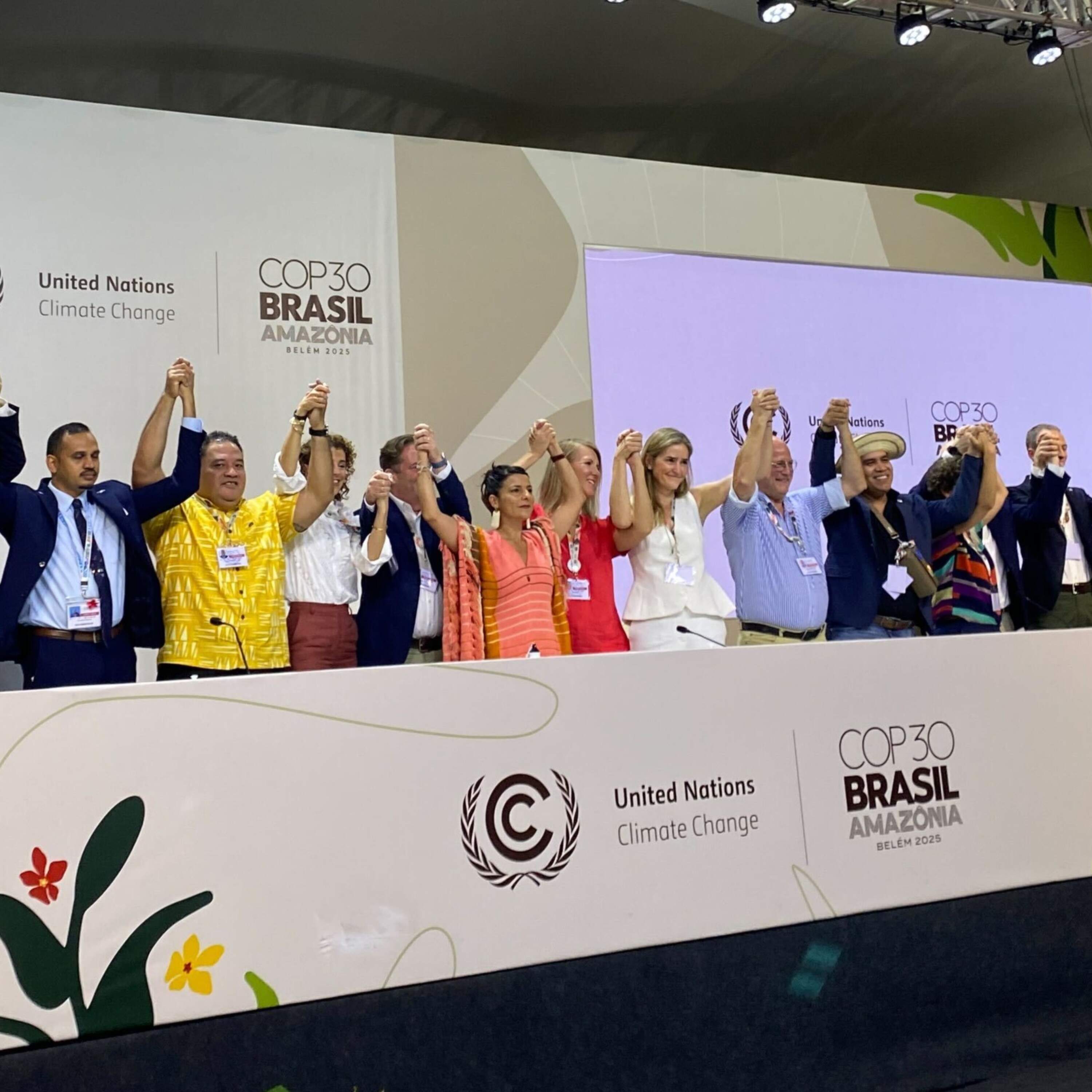
Well, we were all evacuated after the fire. We weren't sure what would happen. But the next morning, we all gathered in the press conference room.
- [14:10]
Irene Velez Torres
Thank you very much for being here.
- [14:12]
Julia Simon
And then Colombian Environment Minister Irene Velez Torres. She got on stage, flanked by about a dozen other country representatives and made this announcement.
- [14:23]
Irene Velez Torres
This declaration is grounded in a simple scientific truth. Fossil fuels are the primary driver of climate crisis. For that reason, the government of Colombia, in alliance with the government of the Netherlands, announces today the first international conference on just transition away from fossil fuels. This conference.
- [14:51]
Julia Simon
I looked over at Andres a few times during the press conference and he looked like he was tearing up. I caught up with him after Andres.
- [14:59]
Andres Gomez
That was just so great.
- [15:02]
Julia Simon
Were you tearing up?
- [15:04]
Andres Gomez
Almost. That was so moving and I don't know, like very inspiring. Like the perfect 10 for a cop that wasn't promising anything. Probably this would be the most important outcome of this cup.
- [15:19]
Julia Simon
And Emily, some climate experts agree with him. The fact that this conference announced the establishment of another conference to phase out fossil fuels, that may end up being one of the most important things to come out of this cop.
- [15:35]
Emily Kwong
I'm guessing you will be there in Santa Marta in April to cover it.
- [15:40]
Julia Simon
You know it. I will be there to cover it 100% Colombia, pal. Mundo Papa from Colombia for the World.
- [15:48]
Emily Kwong
Yes, Julia, thank you so much for coming on Short Wave.
- [15:52]
Julia Simon
Thank you, Emily.
- [15:54]
Emily Kwong
If you liked the this episode, follow us on the NPR app or your preferred podcasting platform. This episode was produced by Hannah Chin. It was edited by Sadie Babbitts and our showrunner, Rebecca Ramirez. Tyler Jones checked the facts. Jimmy Keeley was the audio engineer. Beth Donovan is our senior vice president of podcasting strategy. I'm Emily Kwong. Thank you for listening to Short Wave, the science podcast from npr.
- [16:24]
Jesse Diggins
This message comes from Saatva, the official mattress and restorative sleep provider for the U.S. olympic and Paralympic teams. U.S. olympic cross country skiing athlete and Saatva brand ambassador Jesse Diggins talks about the importance of sleep.
- [16:38]
Julia Simon
The best piece of advice that I've been given from fellow athletes or coaches about sleep is that it is the singular most important way to recover and get faster.
- [16:48]
Jesse Diggins
Saatva believes you deserve that kind of restorative sleep too. Visit saatva.com NPR to save $200 on $1,000 or more.
- [16:57]
NPR Sponsor/Advertisement Voice
This message comes from Vanta. What's your 2am security worry? Is it do I have the right controls in place or are my vendors secure? Enter Vanta. Vanta automates manual work so you can stop sweating over spreadsheets, chasing audit evidence and filling out endless questionnaires. Their trust management platform continuously monitors your systems, centralizes your data, and simplifies your security at scale. Get started Advantage. Com that's V A N T a.
- [17:27]
Jesse Diggins
Dot com this message comes from NPR sponsor Shopify. Start selling with Shopify today. Whether you're a garage entrepreneur or IPO ready, Shopify is the only tool you need to start, run and grow your business without the struggle. Go to shopify.com npr.