Loading summary
Transcript39 lines
- [00:00]
NPR Announcer
This message comes from U.S. bank, simplify how you do business with business Essentials. A powerful combination of no monthly maintenance fee checking and card payment processing. Deposit products are offered by U.S. bank National association member FDIC.
- [00:16]
NPR Host
You're listening to Short Wave from NPR.
- [00:21]
Regina Barber
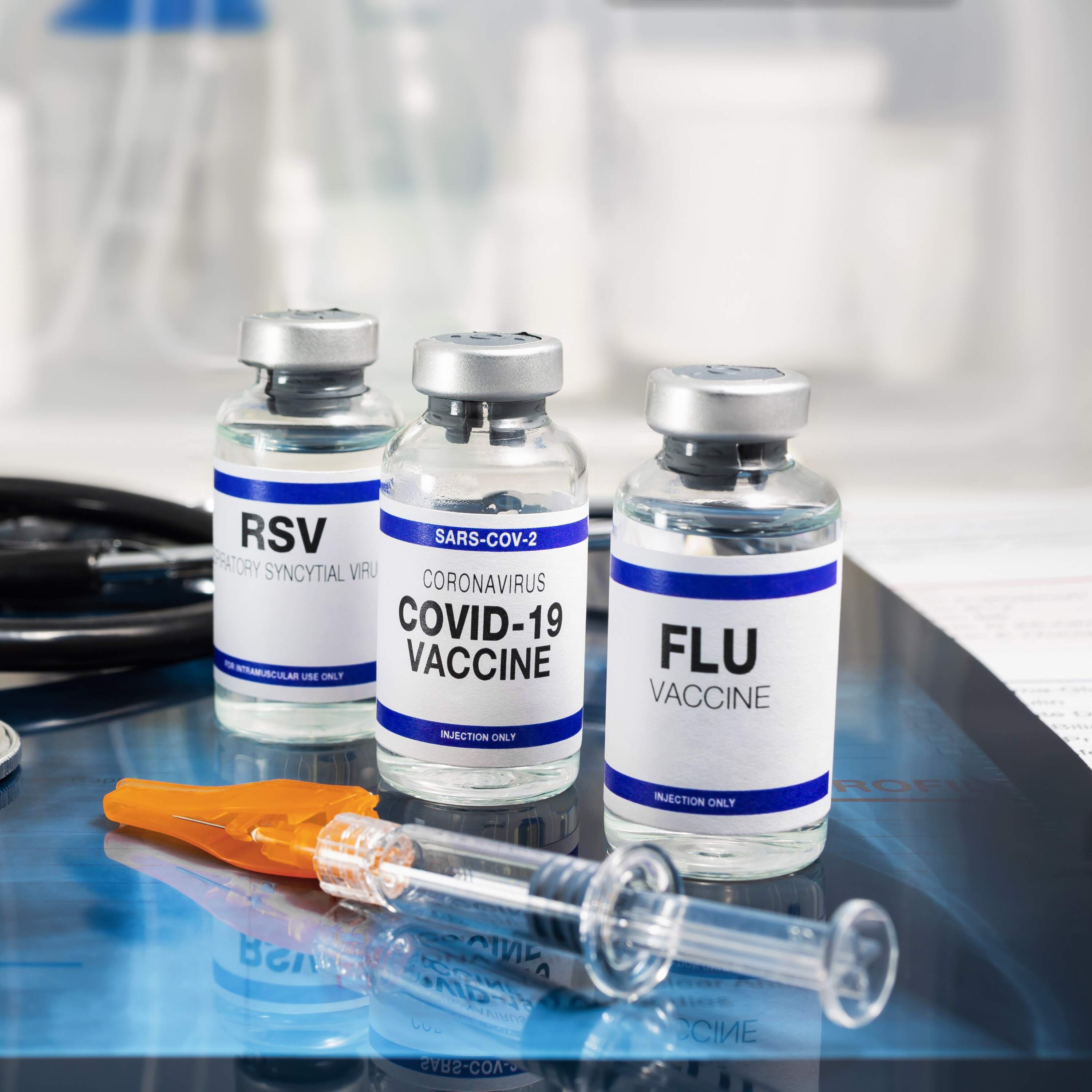
Hey, Short Wavers. Regina Barber here and Emily Kwong. And we're back with another episode of Tech Camp, our summer series scouting the technological frontier, tracking down the breakthroughs, experiments and innovations that could change everything. And this episode, em, we're talking to a scientist who's developing a universal vaccine. One vaccine to rule them all.
- [00:44]
NPR Host
That would be incredible because what we have now, of course, is a lot of different vaccines to protect against specific pathogens.
- [00:50]
Regina Barber
Yes, that's right.
- [00:51]
NPR Host
So in this future, there would be no annual flu and Covid and RSV shots. There would just be one shot for everything. How is that even possible?
- [00:58]
Regina Barber
Yeah. So Bali Palendran, an immunologist at Stanford University, started seriously thinking about this in the late 2000 and tens when he read a paper about tuberculosis. Okay, so the paper found that people vaccinated against tuberculosis were actually protected from other infections like hpv.
- [01:15]
NPR Announcer
Who.
- [01:15]
Regina Barber
And the TB shot could boost how effective vaccines were against diseases like the flu and yellow fever, too.
- [01:21]
Bali Palendran
And he wondered, why is a vaccine that's been developed to protect against TB inducing such broad immunity that is able to fight other kinds of infections? I felt that there has to be some underlying mechanism that would explain this.
- [01:41]
NPR Host
That sounds like a scientist on the hunt. Yeah.
- [01:44]
Regina Barber
And that led him to an ancient part of our immune system, one that treats all pathogens more or less the same. And using this knowledge, he and his team started making a universal vaccine, which. Which they now have shown can work in mice.
- [01:57]
Bali Palendran
So this new universal vaccine that we've developed really is a radical departure from pathogen specific vaccines.
- [02:06]
NPR Host
So today on the show the Future of Vaccines, Gina talks to Bali about why the key may be in our ancient immunity and why a simple nasal spray may be the answer.
- [02:17]
Regina Barber
And along the way, I get a little help from characters like Cinderella and the Cookie Monster to explain the immune system. You're listening to Short Wave, the science podcast from N. Foreign.
- [02:34]
Sponsor Announcer
Support for Shortwave TechCamp comes from Workday, the enterprise AI platform for HR finance. And it. When it comes to your company's finance and HR functions, you can't afford to get it almost right. Workday's AI platform empowers agents to work securely and accurately. Following your organization's unique context and guardrails, Agents operate within predefined permissions to complete tasks and they log every action to guarantee auditability. From automating routine data entry to flagging financial anomalies, every workflow runs within enterprise controls. So it does the work to drive real outcomes you can trust. This is the world workday is creating, where the limitless potential of AI is combined with the certainty and predictability your enterprise needs. It's a new workday. Learn more@workday.com okay, Bali.
- [03:26]
Regina Barber
We're talking today about your ongoing research into whether scientists can develop a universal vaccine that protects against many infections. And here is activating a different part of the immune system from what, you know, Covid or a flu vaccine would. What is that part of the immune system?
- [03:44]
Bali Palendran
That part of the immune system is called the innate immune system. Think of it as the Cinderella of the immune system. The innate immune system is a neglected part of the immune system. It hasn't received much attention for years. Why? Because really not many labs were studying the innate immune system. But, you know, it's the oldest immune system we have in our bodies. It's ancient. It's billions of years old. Whereas the younger antibody based or the T cell based immune system is only a few hundred million years old. That's still pretty old, but not nearly as the innate immune system. Now, the antibodies and T cells are incredibly specific. Each antibody can only neutralize or bind one virus or one microbe. Same thing with T cells. The innate immune system cells such as macrophages or dendritic cells can chew up pretty much anything and everything. They gobble things up and they gobble things like cookie monsters. They are like cookie monsters. And, you know, they are not very discriminatory in their taste. They don't go for the fine gourmet style of bacteria or virus. They pretty much eat up everything in the refrigerator. Any kind of virus, any kind of bacteria, any kind of fungi.
- [05:09]
Regina Barber
That's awesome. Okay, so your team published a paper showing you could do this in mice with a nasal spray. Like what's in this nasal spray.
- [05:18]
Bali Palendran
There are two components in this nasal spray. One, synthetic molecules that can activate cells of the innate immune system in the nose and in the lung. The other is an antigen. An antigen is a protein. And these two components were able to activate the innate immune system. And that provided not only very broad protection against many different viruses, bacteria, and even allergens, but could sustain this protection for three months. And it goes back to this innate immune system, these macrophages in the lung that were supercharged so that they were able to gobble up any kind of virus or Bacteria that came in through the nose into the lungs and chew them up very, very quickly and get rid of them.
- [06:15]
Regina Barber
So these mice, like, were protected for three months against what? What kind of things were they exposed to?
- [06:21]
Bali Palendran
Influenza, SARS, CoV, 2, other kinds of coronaviruses, bacteria such as staph aureus, and some other kinds of respiratory bacteria, and even allergens.
- [06:37]
Regina Barber
I'm just wondering about, like, future vaccines. If we had a universal vaccine, would this be an annual thing like the flu, or like, could it be longer?
- [06:48]
Bali Palendran
I could see two broadly different types of application for this universal vaccine. So imagine a scenario where one could give this nasal spray during the winter months and this would provide protection for about three months, maybe a bit longer, maybe up to six months against flu, respiratory syncytial virus, Covid, the common cold. So very broad protection. So that's one scenario.
- [07:18]
Regina Barber
What's the other scenario?
- [07:20]
Bali Palendran
The other scenario is during pandemic times.
- [07:23]
Regina Barber
Got it.
- [07:24]
Bali Palendran
Let's say it's the year 2030, and let's say we have a new virus that is spreading as quickly as Covid did back in 2020, but causing much more severe disease. We wouldn't have nine months to try and make a vaccine that was highly specific to that virus. And so we'd have to come up with something else. And here's where I think this universal nasal spray, if it's administered broadly across the populations at the very earliest signals of a pandemic, could have a profound impact on curbing the disease as a stopgap measure until such time as the conventional vaccines are developed, which could take months, probably longer.
- [08:12]
Regina Barber
And you said this work has been done in mice, and the first step is to show that it could possibly work in humans. But how long are we from that? Like, how long do we have to go to get this to start working in humans?
- [08:25]
Bali Palendran
So we are now in the process of fundraising to do a human study to show proof of concept in humans that this vaccine could elicit broad protection. And I'm optimistic, I'm hopeful that we can raise the funds. And what we would need to do is toxicology, meaning you do, in rabbits, you do these experiments and show and have a toxicity profile and then do a dose escalation study in humans. And then ultimately we do. We immunize humans intranasally with this vaccine and deliberately infect them with influenza under a clinical setting in what's called a control, and then see if it works or not. And we're about, I'd say about three to four years away from that.
- [09:17]
Regina Barber
Do you think just from those tests. But do you see a world where you have a universal vaccine that people are getting, like you said, in the winter months, within the next 10 years? Is that a hope? Is that a goal?
- [09:29]
Bali Palendran
It's certainly an aspirational dream, as in all cases, as in all cases, it's a long and tortuous road to that. I mean, the safety issue is a major concern. We have to do many, many clinical trials, phase one, phase two, phase three, to assess whether these are safe, what are the adverse reactions. But I think what our current study has is a roadmap, an immunology roadmap and proof of concept in mice that this is possible. It's not just theoretical, it's possible. The question is, how do you translate this safely into humans?
- [10:05]
Regina Barber
So when you imagine a world where there is this universal vaccine, it's become a reality. How do you envision the impact?
- [10:13]
Bali Palendran
It's hard to overstate this. And, you know, I'm very close to it, so I'm not a person who's best qualified. But my hope is that it would have a transformative impact because it would be a radical departure from how vaccines have been developed over the last 230 years since Edward Jenner. And it's a whole new way of thinking about vaccines. So there's much to go before we come to that stage. As I said, safety is of paramount concern. We have to demonstrate safety rigorously in many human studies.
- [10:46]
Regina Barber
Bali, thank you so much for talking to me about the potential of a universal vaccine.
- [10:51]
Bali Palendran
Thank you so much. That was wonderful to talk with you.
- [10:57]
Regina Barber
Short waivers. If you liked this episode, follow us on the NPR app or wherever you're listening from. This way, you'll never miss a new episode. We promise we'll always deliver you an interesting fact. This episode was Produced by Burleigh McCoy and edited by our showrunner, Rebecca Ramirez. It was fact checked by Tyler Jones and Jimmy Healy was the audio engineer. I'm Regina Barber. Thank you for listening to Tech Camp from Shortwave, the science podcast from npr. See you tomorrow.
- [11:33]
Sponsor Announcer
This message comes from ixl, a learning platform for helping students maintain summer academic progress. A single subscription covers math, science and reading for all children in a household. Receive 20% off@ixl.com NPR this message comes from Mint Mobile. If you're tired of spending hundreds on big wireless bills, bogus fees and free perks, Mint Mobile is for you. Shop plans@mintmobile.com Switch taxes and fees extra. See Mint Mobile for details.
- [12:07]
NPR Announcer
The NPR Network has always been powered by the people it serves not by shareholders or special interests, but by people like you and me who believe in free and independent press. We just passed the one year mark since Congress eliminated federal funding for public media. Please show your support before the end of the month. Visit plus.NPR.org.