Loading summary
Transcript82 lines
- [00:00]
NPR Sponsor Announcer
Support for this NPR podcast and the following message come from Carvana. Selling your car. Carvana has offers so good they're almost inexplicable. Sell your car 100% online in minutes. Visit Carvana.com today.
- [00:15]
Regina Barber
You're listening to Shortwave from NPR. Hey, shortwavers, Regina Barber here and Nate Rutt with our bi weekly science news roundup featuring fellow space nerd Scott Detrow of All Things Considered. Hey, Scott.
- [00:30]
Scott Detrow
I am slumming it here today, talking in an episode that contains non space news, but I'm doing that for you.
- [00:37]
Regina Barber
Excellent. We're going to talk more about space next week, too. But this week we've got a few mysteries unraveling. First up, how many different types of insects are there on the planet? Scott, do you have a guess, like
- [00:50]
Scott Detrow
overall raw, total, or like species?
- [00:52]
Nate Rutt
Species.
- [00:53]
Scott Detrow
Okay. I don't know. Four million? I don't know. I don't know.
- [01:00]
Nate Rutt
A lot. Well, you didn't go over, I'll give you that.
- [01:02]
Regina Barber
We're gonna tell you.
- [01:03]
Nate Rutt
Quick side question. Just because I'm a nerd, do either of you guys have a favorite insect?
- [01:07]
Regina Barber
Yes.
- [01:07]
Scott Detrow
What's yours?
- [01:08]
Regina Barber
It's a firefly. Because I never saw them on the west coast until I moved to the East Coast.
- [01:12]
NPR Sponsor Announcer
I like that.
- [01:12]
Scott Detrow
Oh, I was gonna say firefly.
- [01:13]
Regina Barber
Oh, we're the same. We're the same.
- [01:16]
Scott Detrow
Let's get firefly tattoos.
- [01:18]
Regina Barber
I was literally looking up during the 4th of July and I was looking at all the stars. We were out away from city lights and I saw the stars and I saw fireflies in the trees. It was so cool.
- [01:27]
Scott Detrow
What a win.
- [01:28]
Regina Barber
I know. Speaking of astronomy, you know, see, that was my segue. We have another story that looks at quasars, bright lights from ancient galaxies. So these are really, really old fireflies that can tell us more about the formation of the universe.
- [01:42]
Nate Rutt
Yeah. And the final study looks at the, let's say, unfortunate eating hats of California wolves. You are listening to Short Wave, the science podcast from npr.
- [02:03]
NPR Sponsor Announcer
This message comes from Schwab. With the new Schwab Teen Investor account, teens can gain hands on investing experience. It's co owned by you and your teen, so you can monitor the account while your teen learns how to invest and manage money. Learn more@schwab.com this message comes from NPR sponsor NetSuite. Don't want your business to fall behind because you're late to AI. NetSuite Next can help. NetSuite Next aims to be the next huge leap in how business gets done because AI is built into Everything you do. Try Netsuite next for free. If your revenues are at least in the seven figures, go to NetSuite AI Shortwave. Built for every industry, ready for every boardroom. Support for this NPR podcast and the following message come from Carvana. Selling your car. Carvana has offers so good, they're almost inexplicable. Sell your car 100% online in minutes. Visit Carvana.com today.
- [03:01]
Nate Rutt
All right, Regina and Scott, we've got a lot to get into.
- [03:05]
Scott Detrow
Let's start with the insects. We've established there are a lot of insects, and I guess, like, I'm wondering, how do you even go about counting them?
- [03:12]
Nate Rutt
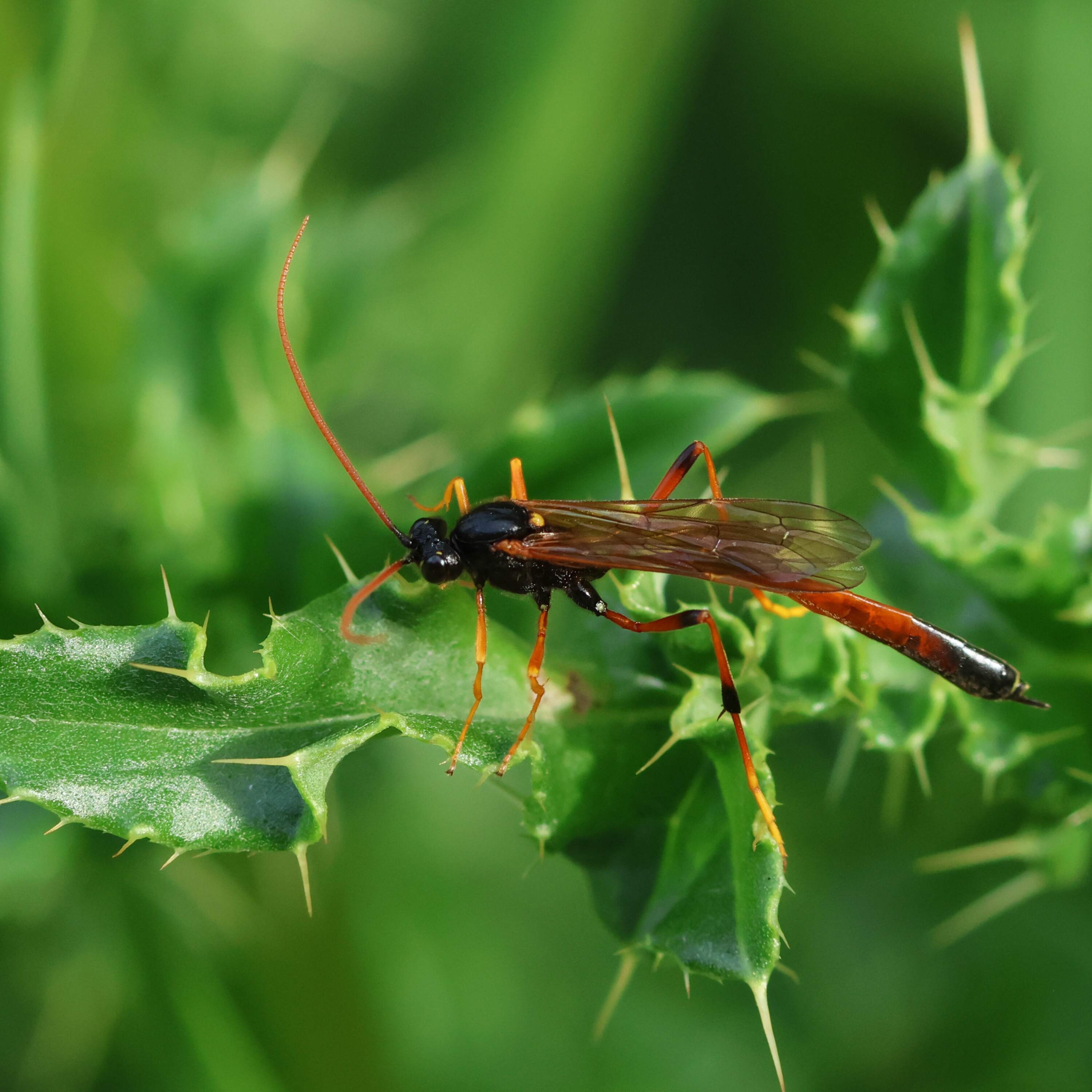
So this study starts in a protected area in Costa Rica, and it looks at a very specific subset of insects called parasitoid wasps.
- [03:21]
Regina Barber
And they're really diverse. They're these like tiny wasps, like really, really tiny, like millimeters tiny, says Melissa Guzman, an entomologist at Cornell University.
- [03:30]
Nate Rutt
And these itty bitty wasps are called parasitoids because they lay their eggs in or on other species like caterpillars.
- [03:38]
Scott Detrow
Can I say something? I saw a wasp do this to a cicada in my backyard, and it was horrifying. It was like alien in real life. It blew my mind.
- [03:48]
Nate Rutt
Life finds a way.
- [03:49]
Regina Barber
But don't worry, these are not hatching out of human chest.
- [03:51]
Nate Rutt
Good.
- [03:52]
Regina Barber
It's gonna be okay.
- [03:52]
Scott Detrow
Okay. Okay.
- [03:53]
Nate Rutt
Yeah. Yeah, for now. But because these wasps are so small, it's like really hard to tell one species from another. So the scientists looked at a specific sequence of DNA from these wasps, and using that and some fancy modeling, the they estimated there are 3400 different species of one subfamily of parasitoid wasps in this one nature reserve. What? A lot?
- [04:16]
Regina Barber
Yes, a lot. But scientists wanted to take it a step further to get a sense of how many types of all insects there were in the reserve in Costa Rica. So they used that modeling and a larger sample of insects to get a
- [04:27]
Nate Rutt
number, and then they used that number to try to solve this big scientific mystery.
- [04:31]
Scott Detrow
Scott, I love myself a good big scientific mystery. Which one was this?
- [04:35]
Regina Barber
So scientists wanted to know how many species of insects existed on the entire planet. And the best estimate to this point, based on studies of beetles, is that there are roughly 6 million.
- [04:45]
Nate Rutt
And for perspective, Scott, even the most generous estimates of how many bird species there are on the planet suggest only about 20,000.
- [04:52]
Scott Detrow
Okay, so it's more than 6 million, I'm assuming is where this is heading.
- [04:57]
Nate Rutt
Yes. So this new study, published in the Proceedings of the National Academy of sciences suggests that that 6 million number. You are right, Scott, is a huge undercount.
- [05:06]
Scott Detrow
How many insect species are there on earth? Yeah.
- [05:09]
Regina Barber
Between 14 and 20 million at minimum. So up to three times as many species as previously believed. Here's Melissa again. There's so much that we don't know. Right. And I think it's humbling just to get a sense of how much we have yet to discover.
- [05:24]
Scott Detrow
That's wild. Like, but what do you do next? Do you have, like, an insect census? How do you. How do you try and verify this in any way?
- [05:31]
Nate Rutt
I mean, yes, there's, like, a lot of uncertainty with this kind of mod modeling. And, you know, we've only taxonomically described about 1 million insects so far. So, you know, do the math. It would take a lot, a lot, a lot of work.
- [05:43]
Scott Detrow
Okay, next topic. Quasars. Fun word to say, cool thing. Remind us what they are.
- [05:50]
Regina Barber
Yeah. So they are blazing bright centers of galaxies, and at the center of that is a supermassive black hole. Millions of billions of times the mass of our sun, and dust and gas is spiraling into that black hole. It heats up and starts to glow. So when astronomers see these quasars. Quasars. The light that they see is a
- [06:07]
Nate Rutt
supermassive black hole caught in the act of feeding.
- [06:11]
Scott Detrow
What an amazing thing to think about.
- [06:13]
Regina Barber
Yeah. So that's Daming Yang. He's the first author of the study out this week in the journal Astronomy and Astrophysics, which reports the discovery of 31 quasars. And these are among the oldest quasars ever found. And before this study, astronomers only knew a handful of quasars this old.
- [06:27]
Nate Rutt
Yeah, And, Scott, something that's kind of cool about this is that these were all found with a space telescope that not a lot of people know exist. It's called Euclid. The European Space Agency launched it in 2020. And although it isn't as powerful as the Hubble Space Telescope or James Webb, it was designed to scan large swaths of the sky, which makes it really awesome at finding rare objects.
- [06:48]
Scott Detrow
I mean, this is a cool thing to think about and envision, but I assume astronomers need a little more than this is cool for doing this work. Like, what is the practical value of spending time trying to ID these?
- [07:00]
Regina Barber
Yeah, so these quasars are from, like, soon after the Big Bang. They're much bigger and brighter than astronomers would expect them to be that early in the universe. So, daming, there's a lot of questions about how they got so big so fast.
- [07:13]
Nate Rutt
Like, what are they grown from how do they grow? Like this? Question. By only collecting more of these quasars, we can answer this. And these ancient quasars might tell scientists more of the era when stars were born from the primordial hot goo that occurred after the Big Bang.
- [07:29]
Scott Detrow
We will save the primordial hot goo for another day.
- [07:33]
Regina Barber
Yes.
- [07:34]
Scott Detrow
And let's move on to topic three. Wolves.
- [07:37]
Nate Rutt
Yes. An animal that is often controversial wherever it is cohabitating with people. You know, whether that's in the western US where I am, the Midwest or Europe, you name it.
- [07:46]
Regina Barber
Yeah. And a new study out this week in the journal PLOS ONE is not going to soothe any of that hate some people feel about this predator.
- [07:52]
Scott Detrow
Why is that?
- [07:53]
Nate Rutt
So this study focuses specifically on wolves in California, which have migrated here from Oregon. And it looks at the impact they're having on cattle and consequentially, people ranchers.
- [08:04]
Regina Barber
Yeah. And researchers at UC Davis did a DNA analysis of the scat, you know, their poop, from two wolf packs in 2022 and 2023 to see what they were eating.
- [08:14]
Nate Rutt
In both years, Scott, they found that the primary food source for these packs was cattle.
- [08:19]
Scott Detrow
I mean, I, I guess my reaction. I'm not super surprised by that. Right. Because that's the particular reason that ranchers have such strong feelings about wolves. Like, what am I missing?
- [08:28]
Regina Barber
That's reasonable to think. But it's uncommon for livestock to be the primary food for these wolves. So Tina Seitone, the study's lead author, says in most states, wolves predominantly eat wild game.
- [08:39]
Scott Detrow
But when wolves come to a human dominated landscape like California with very little prey, you're gonna see a very different composition of prey.
- [08:50]
Nate Rutt
So in other words, you know, California doesn't have big populations of elk like Montana or Wyoming. We don't have as many deer as there are in the Midwest or the Northwest.
- [08:59]
Scott Detrow
So the wolves just don't have a choice then, Is that it?
- [09:02]
Regina Barber
Yeah, that's right. So Neil Carter, who studies wolves at the University of Michigan, says this study, which he wasn't involved with, underscores how complicated it is for carnivores to come back to places that have fundamentally changed.
- [09:13]
Nate Rutt
If you want to have these animals on the landscape, you know, you have to start kind of building back the full ecosystem, which in California would mean boosting mule deer populations, which are currently declining because of habitat loss, boosting other game species like elk that the wolves can eat. And look, that's not something that could happen overnight. But I think this study does give the people that manage wildlife and want to see fewer conflicts between wolves and humans. Something to think about and to aim for.
- [09:39]
Regina Barber
Scott, I hope you enjoyed this, you know, not space segment, but, you know, news segment.
- [09:44]
Nate Rutt
And a little bit of space. A little bit of space. Just enough. Just enough.
- [09:48]
Scott Detrow
I'll be back soon for spacing out, but in the meantime, always love being here.
- [09:52]
Regina Barber
Yeah, come back anytime.
- [09:53]
Nate Rutt
Yeah. Thanks man.
- [09:56]
Regina Barber
You can hear more of Scott Detrow on consider this and PR's afternoon podcast about what the news means for and
- [10:01]
Nate Rutt
for more side stories just like this one, follow Shortwave on whatever app you're listening to.
- [10:09]
Regina Barber
This episode was produced by Rachel Carlson and Jordan Marie Smith. It was edited by Rebecca Ramirez and Christopher Intalienta.
- [10:16]
Nate Rutt
Tyler Jones Check the facts. Anh Li Wong and Tiffany Vera Castro were the audio engineers. I'm Nate Rott.
- [10:23]
Regina Barber
And I'm Regina Barber. Thank you for listening to Short Wave, the science podcast from npr. This message comes from Mint Mobile. If you're tired of spending hundreds on big wireless bills, bogus fees and free perks, Mint Mobile is for you. Shop plans@mintmobile.com Switch taxes and fees extra. See Mint Mobile for details.
- [10:57]
NPR Sponsor Announcer
This message comes from Kera's Think, a daily interview and call in program covering a wide variety of topics from history, current events and emerging trends to food and wine, travel and entertainment. Subscribe to Think wherever you get your podcasts.
- [11:13]
Regina Barber
Nearly one year after Congress eliminated federal funding for public media, NPR remains committed to informing the public. But a free press doesn't just happen. It's something we must protect. We without federal funding, we are relying on your support. Now. Please show your Support today@plus.NPR.org.