Loading summary
Transcript92 lines
- [00:00]
NPR Sponsor Announcer
This message comes from Leesa. Beautifully crafted mattresses from Leesa are tailored for how you sleep and designed with specific preferences in mind. Go to leesa.com for 30% off mattresses, plus get an extra $50 off with promo code, NPR.
- [00:18]
Emily Kwong
You're listening to Short Wave from NPR. Welcome back. Short waivers, it's your science besties, Emily
- [00:25]
Regina Barber
Kwong and Regina Barber.
- [00:27]
Emily Kwong
And this summer we have a brand new series for you.
- [00:29]
Regina Barber
Tech Camp. That's right, every Monday. Check this feed for a new episode about the technological frontier, tracking down the breakthroughs, experiments and innovations that could change everything. And we're starting with a vehicle that's been promised to us for decades. This is where I thought technology was headed since the days of the Jetsons, flying cars.
- [00:56]
Emily Kwong
But this was a fantasy of the 60s. Like flying cars are not real.
- [01:00]
Regina Barber
And I'm gonna blow your mind. As long ago as 1953. You could order a flying taxi in New York City.
- [01:07]
NPR Sponsor Announcer
New York Airways introduces a new dimension of passenger comfort and convenience in helicopter travel.
- [01:13]
Regina Barber
Okay, so these weren't technically flying cars, they were helicopters. But these air taxis in New York would take passengers to the airport from maybe the roof of an office building in Manhattan. And this would cost about seven bucks in the mid-60s, which is a little over $70 today.
- [01:31]
NPR Sponsor Announcer
Taxis are comfortable too, but not as dependable as a scheduled airline that flies over obstacles and delivers passengers by helicopter from Newark airport to Idlewild in 12 minutes flying time.
- [01:48]
Regina Barber
And em, we might be on the cusp of air taxis making a constant humback in Florida. A law just went into effect to build infrastructures for them in places like airports.
- [01:59]
Emily Kwong
Get out of here. Are you serious? What do you mean? Like, like, like you're saying that I could order an air taxi to my house to take me to a major airport?
- [02:09]
Regina Barber
So that's the idea. I met Lee Witcher, an engineer at Georgia Tech in Atlanta, and I met him outside of an airplane hangar where they're trying to make flying taxis a reality.
- [02:20]
Lee Witcher
The legend is, is that this hangar used to belong to Ludacris.
- [02:23]
Regina Barber
And the prototype he showed me is for a pilotless flying taxi.
- [02:27]
Emily Kwong
A flying taxi that flies on its own?
- [02:29]
Regina Barber
Yes. This is a project called Raven, and it's a joint project with Georgia Tech and NASA.
- [02:34]
Lee Witcher
So over at our hangar in Fulton County Airport, we have a test rig for the Raven project. It will be a roughly 1300 pound electric vertical takeoff aircraft.
- [02:47]
Regina Barber
If you're going to be replacing some cars and maybe people going through the subway, you need to operate in densely populated areas where you just just can't build giant runways. And that means you need to take off vertically. But helicopters are loud and expensive and they require a lot of power to keep them moving around. So that's why we needed something new. And now a few companies say they're close to finally figuring out the science to overcome most of those barriers.
- [03:15]
Emily Kwong
Today on Tech Camp, flying taxis, how a new generation of air taxis could
- [03:20]
Regina Barber
revolutionize transportation and and how soon you could be riding in one.
- [03:25]
Emily Kwong
You're listening to Short Wave, the science podcast from npr.
- [03:36]
NPR Sponsor Announcer
This message comes from Workday Guessing is for game shows, not your business, especially when your margin for error is 0. Workday is the enterprise AI platform for HR finance and IT with a deep understanding of your organization's context and guardrails. So every AI action is permission aware, giving you accuracy 247 and the ability to not just get work done, but get it done right. It's a new work day. Support for this podcast and the following message come from Strawberry Me. Be honest. Are you happy with your job? Are you stuck in a job you've outgrown or never wanted in the first place? Are your reasons for staying really just excuses for not leaving? Let a career coach from Strawberry Me help you get unstuck, discover the benefits of having a dedicated career coach in your Corner and get 50% off your first coaching session at Strawberry Me.
- [04:31]
Emily Kwong
NPR okay, Gina, so there were air taxis in New York in the 1950s
- [04:38]
Regina Barber
and 60s and 70s. Yep. Wild.
- [04:41]
Emily Kwong
But they were basically helicopters.
- [04:42]
Bonnie Simi
Uh huh.
- [04:43]
Emily Kwong
Helicopters, of course, are still used for some personal travel today, especially among the wealthy.
- [04:48]
Regina Barber
Right? But even back then, the thinking was that air tax taxis would just be like another form of commercial air travel. In 1951, the Civil Aeronautics Board, a government agency, proposed a new class of air carrier, air taxis, that linked airline points with communities lacking airline service. I mean, the customers in the 1960s and 70s for these air taxis were mostly rich people and businessmen. And during that time business was good, like customers took helicopters, usually short trips to the airport. And it costs about the same that an Uber ride to the airport cost now.
- [05:22]
Emily Kwong
So what happened to all these air taxi companies?
- [05:25]
Regina Barber
They don't exist anymore. And this is because of a complex blend of financial and regulatory reasons, including a recession in the late 1970s and early 1980s. Plus in the 1960s Louisiana Airways suffered some crashes. And an aerospace engineer I talked to, Marilyn Smith, says that mistress hit a Peak in 1977. That is when tragedy struck a New York Airways flight. There was an accident on top of the Pan Am building, and parts of the helicopter fell to the street, and some people were injured and killed, and so that was the end of that. So Marilyn is the director of the Vertical Lift Research center of Excellence at Georgia Tech, and she says that the vehicles Georgia Tech students are working on are different from that old era of air taxis.
- [06:12]
Emily Kwong
No more helicopters.
- [06:13]
Regina Barber
No more helicopters.
- [06:14]
Emily Kwong
Okay, what are they making?
- [06:15]
Regina Barber
They're technically called vertical flight vehicles, and many companies brand them as air taxis. They're a combination of helicopter and airplane, and they're really ushered in by new science with a focus on safety and sustainability. For one, no more fuel. Most of the air taxis in development are electric. But building an aircraft that's light enough to take off but sturdy enough to be safe and house an electric battery and luggage, it's difficult. So some private companies are leading the way in this kind of research to build this new class vehicles.
- [06:47]
Emily Kwong
Yeah, that makes sense. It's like very startupy what's happening right now. So what kinds of startups are out there?
- [06:53]
Regina Barber
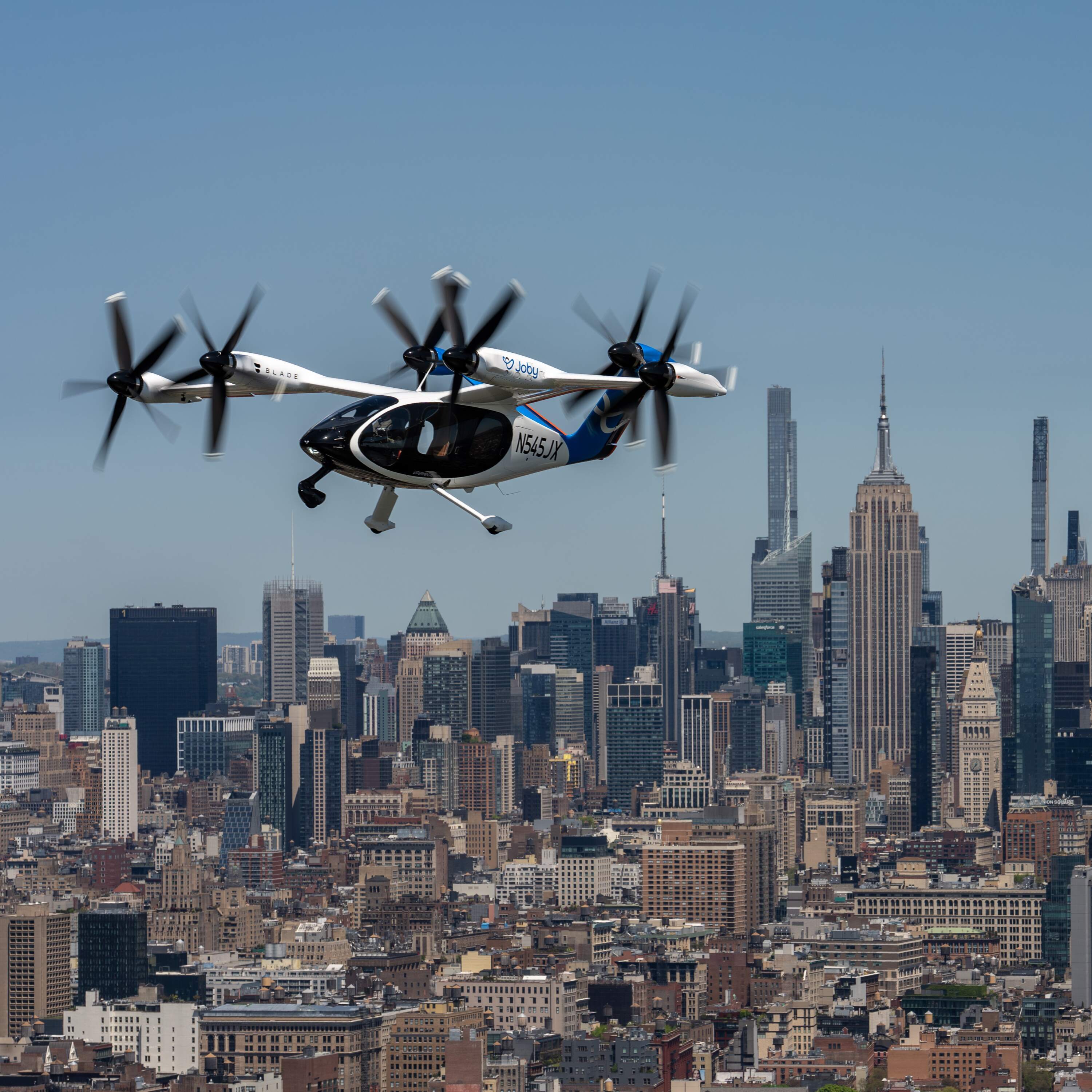
Yeah, so there's a few in the US There's Beta, a company based in Vermont, and two companies based in California, Archer and Joby. And Joby has partnered with Uber to try to get air taxis running for the public. They've already test flown with pilots in New York and San Francisco. And get this mjobian Uber, they claim that these air taxi flights will start in dubai this year 2026. Wild. I just want to show you a short video of Joby's test flight just so you can see what these things look like.
- [07:22]
Emily Kwong
It looks like a drone, but massive with multiple propellers, and it fits a lot of people. It looks a little like the Star Trek Enterprise.
- [07:31]
Regina Barber
I mean, I wish. I think it looks just like a Cessna with a lot of propellers, but I had the same thought. It is very drone like.
- [07:38]
Bonnie Simi
Yeah.
- [07:39]
Regina Barber
So I asked the president of operations at Joby, Bonnie Simi, if these aircrafts are just giant drones.
- [07:46]
Bonnie Simi
No, not at all. It's no more a drone than a helicopter is a drone or a small airplane is a drone. I mean, you see aircraft of our size at every municipal airport out there, and nobody confuses those with drones.
- [08:01]
Emily Kwong
Heard, not a drone. Yeah, apologies from this mere citizen non aviation expert over here. So what makes these Joby vertical takeoff aircraft so different?
- [08:11]
Regina Barber
Right, so it kind of looks like a drone because it has these propellers that are, like, pointing up when the aircraft takes off and lands. But these propellers, they rotate 90 degrees while the aircraft is in flight.
- [08:24]
Emily Kwong
Like the propellers that are on top
- [08:27]
Regina Barber
then move forward yeah, like a small propeller plane.
- [08:31]
Emily Kwong
So it's like a transformer.
- [08:32]
Regina Barber
It is, yeah. So basically it transforms from a helicopter to a propeller plane. Right. And this is important because then it can take advantage of physics.
- [08:42]
Bonnie Simi
There's so much more power required to keep you in the air for lift. But if you can transition forward onto a wing, now the wing is producing lift that keeps you in the air
- [08:52]
Regina Barber
and you use less batteries morphing into a plane, using the wings for lift saves a ton of energy it would need if the vehicle like stayed in this helicopter mode the whole time.
- [09:02]
Lee Witcher
Yeah.
- [09:02]
Regina Barber
Plus the aircraft is quieter in this mode because propellers are doing less work. The noise pollution is a concern. Right. So companies are working to minimize that.
- [09:13]
Emily Kwong
Very creative science. For sure.
- [09:15]
Regina Barber
Innovative.
- [09:16]
Emily Kwong
I'm seeing six propellers. I know they rotate forward. Is six propellers though safe? Is it too many?
- [09:26]
Regina Barber
It's all about redundancy, em, so if one fails, the others will compensate. Here's Bonnie again from Joby.
- [09:32]
Bonnie Simi
If an entire propulsion unit fails, then an opposing one will power down, the other four will power up, and the pilot actually doesn't even notice that they lost one of the propulsion units other than, you know, they'll be. They'll see a flashing light, of course, but the passengers won't feel it.
- [09:47]
Emily Kwong
Redundancies are always good, especially with air travel. I'm wondering though, what does the FAA have to say about all of this? The Federal Aviation Administration, because they're ultimately in charge of regulating what is allowed in American airspace.
- [09:59]
Regina Barber
Yeah, that's the big question for the whole industry. And to do any travel in airspace in the US you need certification with the faa, which Joby and other startups are seeking right now.
- [10:10]
Lee Witcher
So the regulatory question has been a challenge. The FAA were kind of ambushed, I think with this industry. They've really caught up and they're very proactive and very open minded.
- [10:21]
Regina Barber
That's Lee Witcher again from Georgia Tech. We heard from him earlier. So, Em, in January 2026, the FAA announced a new office to oversee the integration of air taxis and other vehicles, like drones into the airspace.
- [10:34]
Lee Witcher
Not just drones, but flying taxis into the airspace with all of the current aviation that and also how to integrate vertiports.
- [10:45]
Regina Barber
So a vertiport, that word that he just said, are basically just these like pads that these air taxis are going to land and take off from.
- [10:54]
Emily Kwong
Like in the Avengers. Like in Stark Tower.
- [10:56]
Regina Barber
Yeah, in the city. Right. This has already happened in la. So some existing skyscrapers have helipads. Right. So if those can be modified for air taxis, for air Taxis, then it's like, pretty cool, right? It's, it's easy to have this infrastructure easier. And in other places, they're building new, shorter buildings with big, wide, flat roofs for air taxis to land on. Joby is currently working with partners all around the world to either modify these other helipads that exist or build these small buildings.
- [11:26]
Emily Kwong
This whole enterprise is much more expansive than I imagined. Um, can you describe what a commercial ride would look like? Gina, this is tech camp. Take us to the future. You and I are going to order a Sky Uber. How does it work?
- [11:38]
Regina Barber
Right, so let's say you're in East LA at my grandma's house or my
- [11:42]
Emily Kwong
uncle's house in Pasadena.
- [11:43]
Regina Barber
Right. And you need to get to lax.
- [11:44]
Emily Kwong
Yeah.
- [11:45]
Bonnie Simi
So you open up your Uber app and you know, you've got Uber X and Uber XL and Uber Pet. And now there'll be Uber Air.
- [11:54]
Regina Barber
Uber Air, Yeah. So the app will tell you, hey, there's a vertiport that's only 15 minutes away if you want to take an air taxi. So you select that. And while the car is on its way to get you, it tells the system, get the aircraft ready.
- [12:09]
Bonnie Simi
So the Uber then brings you to the vertiport. You walk in through the door. We already know who you are because you're already part of the system. And then you walk right onto the aircraft. So the whole thing's seamless. You don't have to think about it.
- [12:20]
Regina Barber
There are no TSA lines here, but it's a rideshare.
- [12:23]
Emily Kwong
I have so many questions about the safety of this, but again, in this, like, futurist scenario, the pilot just takes you where you need to go.
- [12:30]
Regina Barber
Yeah. And then eventually they'll be self driving, no taxes, no pilot, no pilots. So the Georgia Tech project I mentioned earlier, that's a project to develop autonomous aircraft, although those are going to face a lot more hurdles in the regulation process. The people I spoke to told me that that's at least a few years off.
- [12:50]
Emily Kwong
Yeah, I should hope so. Human beings are very precious cargo. I am thinking about how there is a lot of congestion already in US Airspace with so many planes up in the air. There have been, there's been an increase in midair collisions over some airports. Do we really need air taxis?
- [13:08]
Regina Barber
Yeah, these are all good questions. Airspace infrastructure. What's interesting is I brought up this issue of congestion and the question of whether it would be more worth it to invest this type of money into public transit or. Or building more, you know, railways.
- [13:27]
Emily Kwong
Right. High speed trains, subway lines, metro centers. Et cetera.
- [13:30]
Bonnie Simi
Yeah.
- [13:30]
Regina Barber
So the experts I talked to for the story, they view this, you know, the air taxis as a complement to existing public transit. And this can be done in large part by modifying and scaling existing helipads rather than investing in major infrastructure projects. This would be in places where they think the initial audience for these air taxis are people who are taking Ubers and other ride shares instead of public transit. To this end, the FAA sent me guidance they've worked up for how to mod and scale existing helipads.
- [14:00]
Emily Kwong
I think what remains to be seen is just the demand this will get from regular folks from people like you and me. Yeah.
- [14:08]
Regina Barber
So, em, I totally hear you. And like most people don't even know these companies exist.
- [14:13]
Emily Kwong
I didn't know this was a thing until you brought it up.
- [14:15]
Regina Barber
Right, right. But the facts are they're building the infrastructure now. And that's maybe the most important point, is that air taxis are coming.
- [14:24]
Emily Kwong
Gina Barber, thank you for awakening us to the fact that we are already living in the era of the Jetsons. We are, and just maybe need to open our eyes to it.
- [14:32]
Regina Barber
Would you order an Uber Air with me?
- [14:34]
Emily Kwong
Absolutely not. I would wave hi to you from the ground. All right, for more science stories just like these, follow Short Wave on the NPR app or wherever else you are listening from. Also, if you know a friend who is obsessed with the idea of flying cars, like maybe wants to take a ride with Gina while I wait. To you both from the ground, please share this episode with them. Make their day. This episode was produced by Hannah Chin and Rachel Carlson. It was edited by our showrunner, Rebecca Ramirez. Tyler Jones checked the facts.
- [15:04]
Regina Barber
Jimmy Keeley was the audio engineer. I'm Regina Barber.
- [15:08]
Emily Kwong
I'm Emily Kwong. Thank you for listening to Short Wave, the science podcast from npr.
- [15:20]
NPR Sponsor Announcer
This message comes from NPR sponsor Shopify. No idea where to sell? Shopify puts you in control of every sales channel. It is the commerce platform revolutionizing millions of businesses worldwide. Whether you're a garage entrepreneur or IPO ready, Shopify is the only tool you need to start, run and grow your business without the struggle. Once you've reached your audience, Shopify has the Internet's best converting checkout to help you turn them from browsers to buyers. Go to Shopify.com NPR to take your business to the next level. Today.
- [15:49]
Emily Kwong
This message comes from Ethos. Protect your family when the unexpected happens. Get life insurance through Ethos, 100% online, covered in minutes. Get your free quote today@ethos.com NPR application times may vary every week on our series if youf Can Keep it, we tackle the biggest political stories and why they matter for our democracy. Join Me Jen White, Mondays on the One, a podcast from WAMU and NPR.