Loading summary
Transcript101 lines
- [00:00]
NPR Sponsor Announcer
This message comes from US Bank Simplify how you do business with business essentials. A powerful combination of no monthly maintenance fee, checking and card payment processing. Deposit products are offered by U.S. bank National association member FDIC.
- [00:16]
Regina Barber
You're listening to Short Wave from NPR. Hey, short waivers. Regina Barber here. And you know what time it is? It's time for us to talk space news for a whole episode. It's Spacing out with Gina. Here today is my co host, my fellow co creator and space cadet from All Things Considered, Scott Detrow.
- [00:37]
Scott Detrow
So excited to be back. Favorite time of the month. Let's space out.
- [00:41]
Regina Barber
Yeah, yeah. Okay. And joining us, Scott is a newcomer, NPR science correspondent, Ari Daniel. Welcome, Ari.
- [00:47]
Ari Daniel
Thank you.
- [00:47]
Regina Barber
And to start, did you know that in space no one can hear you scream?
- [00:51]
Ari Daniel
But here on Earth in the room next door, my cat can.
- [00:56]
Scott Detrow
Ari, welcome to Spacing Out.
- [00:57]
Ari Daniel
Oh, I'm so glad to be here.
- [00:59]
Regina Barber
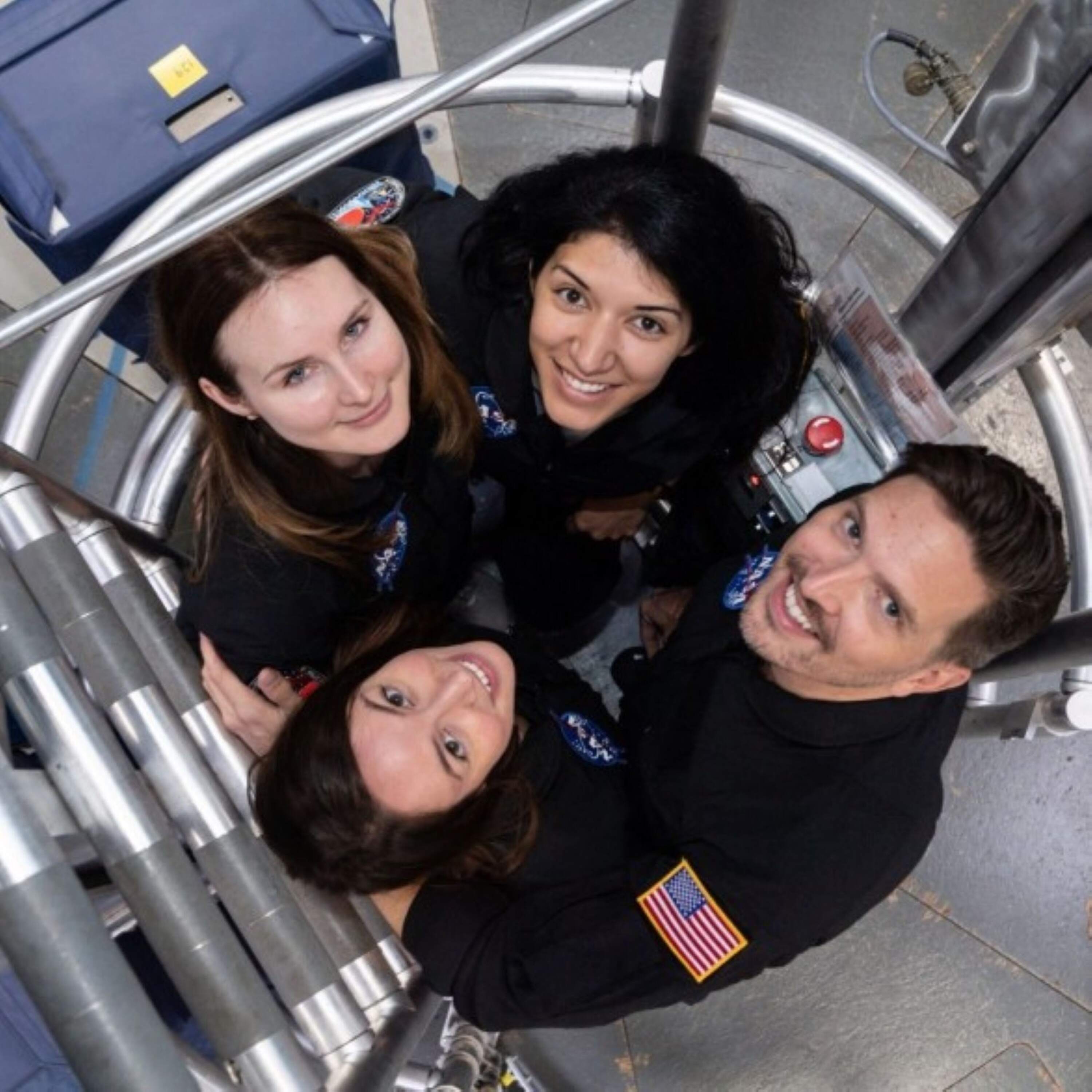
It's gonna be great, I promise, Ari. Okay, we're gonna talk about NASA's recruitment of volunteers to simulate a year long mission to the moon and then Mars. I have a question for both of you though. Would either of you do this simulation? Like a year long simulation?
- [01:15]
Scott Detrow
I think I would hold out for actually going to Mars if I was going to.
- [01:19]
Regina Barber
Would you really want to go? Oh my gosh, not me.
- [01:21]
Scott Detrow
I mean, I would be more interested in that than pretending to go to in Texas Fair.
- [01:27]
Regina Barber
What about you, Ari? Would you simulate going to the moon, then Mars?
- [01:31]
Ari Daniel
I don't think you could get me to do it either. I just feel like to clear the calendar for that long of a time to go to Houston, you know, I mean, I'd be happy to go to Houston for like a weekend, but.
- [01:44]
NPR Sponsor Announcer
Right.
- [01:44]
Regina Barber
Not a year though.
- [01:45]
Ari Daniel
A year in a room in an enclosure might be a hard sell, so.
- [01:50]
Regina Barber
I would miss my family too much. And honestly, like even being with them for a few days and like not going to work and not leaving the house turned me into a monster. So I am not the person to recruit for these missions.
- [02:02]
Scott Detrow
Yeah, I guess I will say there's blips of time where I'm like, this would seem appealing to just kind of hide for a year, but yeah, I think it would get old quickly.
- [02:09]
Regina Barber
Yeah, I'm not. I don't think I would be a team person after a week.
- [02:15]
Ari Daniel
Well, does sugar help, Gina? Because I'm bringing you and Scott a story about sugar molecules found in space. How about that for a segue?
- [02:25]
Regina Barber
You did amazing, Ari. I loved it. I appreciate it. Okay. And we'll end this spacing out party with a story about a spacecraft that just woke up on the edge of our solar system.
- [02:35]
Ari Daniel
Rise and shine.
- [02:38]
Regina Barber
So today on the show we got isolation, sugar and the edge of our solar system. This is real heady stuff.
- [02:44]
Scott Detrow
This is existential.
- [02:45]
Regina Barber
Yeah. You're listening to Short Wave, the science podcast from npr.
- [02:56]
NPR Sponsor Announcer
This message comes from NPR sponsor Carvana. Carvana believes selling your car should be easy. Get a real offer down to the penny picked up from your driveway. You may keep waiting for a catch. There isn't one. Sell today@carvana.com pickup fees may apply. This message comes from WISE. The smart way to manage your money around the world. With Wise, you can send, spend and receive Money in over 40 currencies at the mid market rate. Learn more@wise.com Ts and Cs apply.
- [03:28]
MIDI Health Announcer
This message comes from MIDI Health introducing Agewell Longevity Care designed by women for women. Whether you're looking to prevent future health issues or just feel more like yourself, learn more@join MIDI.com that's join M I
- [03:42]
Regina Barber
D I.com okay, Scott, Ari, should we start with human isolation?
- [03:50]
Scott Detrow
I mean no bigger question. But what I'm wondering is if these astronauts are not actually astronauts because they're not going to Mars, what exactly is it that NASA is focusing on here?
- [04:03]
Ari Daniel
Well, right now people can apply to join a year long four person simulated mission to the moon and Mars. It'll take place at the Johnson Space center in Houston and could start as soon as August of next year.
- [04:16]
Scott Detrow
These people are of course not actually going to the moon or Mars though. So what is it that they're doing when they don't leave Houston?
- [04:23]
Regina Barber
Yeah, so they spend most of their time isolated in a 650ish square foot enclosure. And they're simulating travel through deep space. And for two months in the middle, they'll move to a different, slightly bigger structure to simulate surface living on Mars.
- [04:39]
Ari Daniel
And this structure will have areas for sleeping, recreation, work, medical and food areas, plus an airlock and a place to grow crops. They'll do science experiments and test out protocols for living and working in deep space. But there's one big difference from actually being in space. They'll still be living under Earth's gravity.
- [05:01]
Scott Detrow
And that's one of the things that scientists wonder about long term long distance space travel is how being in zero gravity or low gravity that long affects your body. Since that can't be tested out, what exactly is it that NASA is hoping to learn here?
- [05:14]
Regina Barber
Yeah, so one of the big objectives is to understand how the crew deals with stress and isolation. Will they all get along? And how will they handle such long term separation from their loved ones? One thing they'll test is how the crew deals with communication delays. Because depending on where Mars is in the orbit, it could take a, hello, 20 minutes to get to Earth and 20 minutes to hear back. Which also means no instant communication with mission control.
- [05:37]
Ari Daniel
In current and past real life missions, astronauts have been able to talk to loved ones or mission control in real time. But a Mars mission could last two to three years. So they'll be dealing with these communication delays for a while.
- [05:51]
Scott Detrow
I think it's fair to say it takes a special kind of person to volunteer for a not real space mission for a year. And I'm just imagining the conversations with your spouse or kids like, hey, I'm going to Mars. And by Mars I mean this fake
- [06:05]
Ari Daniel
Mars, I mean Houston room.
- [06:07]
Scott Detrow
So I mean, but like, but that being said, the science is like important. So I'm curious, what kind of people is NASA looking for?
- [06:13]
Regina Barber
So the application asks for people 30 to 55. So we could go though they said that they'll consider other ages who can pass their physical and psychological tests. They want people with science backgrounds and astronaut like qualities. So resilient people who can work independently and with a team.
- [06:31]
Scott Detrow
When, if somebody's been interested by our conversation about this, when are applications due?
- [06:36]
Ari Daniel
NASA's website says the deadline is ongoing.
- [06:39]
Scott Detrow
Okay, second topic which was intriguing. Sugar in space. What's going on here?
- [06:44]
Regina Barber
So researchers have long wondered how life on Earth started. Like where did the ingredients come from and how did they get here?
- [06:51]
Scott Detrow
Big questions.
- [06:52]
Ari Daniel
Some of the biggest. Some scientists have been trying to answer it by scanning our galaxy for the building blocks of life and their precursors. One particularly good place to look is something called the interstellar medium, which is basically the space in between the stars.
- [07:08]
Scott Detrow
So this might be a dumb question.
- [07:11]
MIDI Health Announcer
No.
- [07:11]
Scott Detrow
But are there things in that space or. I thought it was just a vacuum.
- [07:15]
Regina Barber
Space, right?
- [07:15]
Scott Detrow
Yeah, I thought space.
- [07:16]
Regina Barber
So in certain areas there is. So my first research project was on the interstellar medium. Shout out to Kristin Larson, my advisor. It basically consists of all kinds of compounds in the form of dust particles and ices.
- [07:29]
Scott Detrow
Okay.
- [07:30]
Ari Daniel
It turns out that this interstellar medium, Scott, is an amazing chemical factory that can produce a range of organic molecules, including ones needed to fashion RNA proteins and cell membranes.
- [07:43]
Scott Detrow
And I assume a kind of sugar, perhaps.
- [07:46]
Ari Daniel
That's right. A team of scientists pointed two telescopes in Spain at the interstellar medium. That rich chemical brew in the center of our milky way galaxy, and they scanned it for radio signals of different molecules, which is how they found A4 carbon sugar, erythrulose.
- [08:03]
Regina Barber
I've heard of, like, glucose and fructose, but, like, how do you say that?
- [08:08]
Ari Daniel
Erythrolose?
- [08:09]
Regina Barber
Yeah, I don't.
- [08:10]
Scott Detrow
That feels like an odyssey character.
- [08:12]
Ari Daniel
Yeah, it's not that common, but it's found in raspberries. Itaskun Jimenez Serra, an astrophysicist at the center for astrobiology in Spain, says the discovery, which was published in Nature astronomy, was thrilling.
- [08:25]
Regina Barber
Your heart starts beating super fast, like, you get super excited. Very nice feeling.
- [08:33]
Scott Detrow
Why exactly is she so excited, though? Why. Why is this such a big deal?
- [08:36]
Ari Daniel
Well, living things make and use sugars, but we don't know how they come about without life around. These results suggest that sugars May have been made Inside a molecular cloud before stars or planets formed. They could then be incorporated into, say, an asteroid as it's being built from the material in the interstellar medium. And then such a space rock could have struck the early earth, Perhaps delivering a subset of key ingredients, Sweetening the st for the emergence of life here.
- [09:06]
Regina Barber
I saw what he did there.
- [09:10]
Scott Detrow
And maybe elsewhere.
- [09:11]
Ari Daniel
Yep, exactly. Scott. I spoke with angel mojaro, an organic geochemist at NASA's Goddard Space Flight center who wasn't involved in the research, and he says this discovery adds to evidence that these ingredients May have given rise to life not just on earth.
- [09:25]
Scott Detrow
So it's my guess that if we were to find life elsewhere, it's going to be using the same kind of chemistry. There's no reason to think that life is going to be based on something else. So let's talk about a spacecraft on an ongoing journey from here to elsewhere. This the spacecraft on the edge of our solar system?
- [09:40]
Regina Barber
Yeah. So this is the NASA's New Horizons spacecraft. It's famous for taking those first detailed images Of Pluto's surface.
- [09:47]
Scott Detrow
Right, that. That. That heart on Pluto. Those pictures were so vivid.
- [09:51]
Regina Barber
They were so beautiful, Scott. So since then, New horizons has continued to travel towards the edges of our solar system.
- [09:58]
Ari Daniel
Then last year, it went into about 11 months of hibernation. It does this periodically to save energy, and now it's woken up about 6 billion miles away from us and counting.
- [10:09]
Scott Detrow
Not unlike Ryan gosling and project hail
- [10:12]
Regina Barber
mary, he was even further.
- [10:13]
Scott Detrow
What. What is the spacecraft doing?
- [10:17]
Ari Daniel
It's studying the edges of our solar system.
- [10:19]
Regina Barber
So it's in the kuiper belt right now, and this is the region where Pluto lives. There's a lot of other icy Objects. The end of this belt is basically the end of our solar system. So our Sol system is in this bubble that the sun makes called the heliosphere. And that heliosphere protects the solar system from high energy radiation coming from other parts of the galaxy.
- [10:39]
Ari Daniel
Both of the Voyager spacecrafts have traveled out of the solar system, and they studied the edge of that bubble along the way. But scientists still don't know too much about this sphere of protection that the sun creates. And as New Horizons sails through the limits of our solar system, it might be able to gather more clues on how that bubble works or even what it is.
- [11:01]
Scott Detrow
We talked earlier about how it can take 20 minutes for a message to go back between Earth and Mars. This is Something that is 6 billion miles away. How does this spacecraft communicate with Earth?
- [11:14]
Ari Daniel
Scientists can talk to spacecraft this far out because of NASA's Deep Space Network. It's this array, Scott, of three radio dishes on Earth, one in California, one in Spain, one in Australia. And these things are giant.
- [11:29]
Regina Barber
The 70 meter antenna would. If you put it in the football stadium, it would take up the whole space. Yeah, it's huge. So that's Alice Bowman, a spacecraft engineer and the mission operations manager for New Horizons. And she was just so excited to be part of this New Horizons mission, which is truly a testament to human
- [11:48]
Scott Detrow
ingenuity, much like this recurring.
- [11:50]
Regina Barber
It's true. It's a testament to human ingenuity, our ingenuity. We thought it up. So, Scott, Ari, thank you for Spacing out with me. Ari, was it okay?
- [12:01]
Ari Daniel
It was great. The cat didn't even notice.
- [12:05]
Regina Barber
The cat didn't even notice.
- [12:06]
Scott Detrow
The cat's typing an application to be in a simulated Mars mission for a year.
- [12:10]
Ari Daniel
Yeah, he would go. He's got nothing on his calendar.
- [12:12]
NPR Sponsor Announcer
I guess.
- [12:12]
Scott Detrow
Cats would be great.
- [12:13]
Regina Barber
They would be amazing.
- [12:15]
Scott Detrow
Yes.
- [12:15]
Ari Daniel
Send cats to Mars.
- [12:18]
Regina Barber
Well, thank you. Thank you both for being here.
- [12:20]
Ari Daniel
Anita, thank you for having me.
- [12:25]
Regina Barber
If you like this Spacing out episode and you have a friend that loves space, too, share it with them. It will help our show. And, hey, give us a follow on the NPR app or wherever else you're listening from, so you'll never miss a new episode or a new episode of Spacing Out. This episode was Produced by Burly McCoy and Megan Lim. It was edited by Christopher Intagliota, Amina Khan, and our showrunner, Rebecca Ramirez.
- [12:49]
Ari Daniel
Tyler Jones checked the facts. Robert Rodriguez and Valentina Rodriguez Sanchez were the audio engineers. I'm Ari Daniel.
- [12:56]
Regina Barber
And I'm Regina Barber. Thank you for listening to Short Wave, the science podcast from npr.
- [13:11]
MIDI Health Announcer
This message comes from Bombas. From sharks to burnt hot dogs, comfy footwear is the last thing you want to worry about this summer. Bombas sandals and slides are perfect for beach days, barbecues and everything in between. Go to bombas.com NPR and use code NPR for 20% off.
- [13:30]
NPR Sponsor Announcer
This message comes from Cachava. It can be tough to stick to your wellness routine, especially when you're on the go. Cachava's new travel packs make it easier. Just one packet provides nutrition ready for wherever life takes you with protein, fiber, greens, probiotics, electrolytes, and more. Take your daily ritual with you. Go to cachava.com and use code NPR. New customers get 15% off their first order. That's K A C H A V A.com code NPR.