← Silver Linings with The Old Gays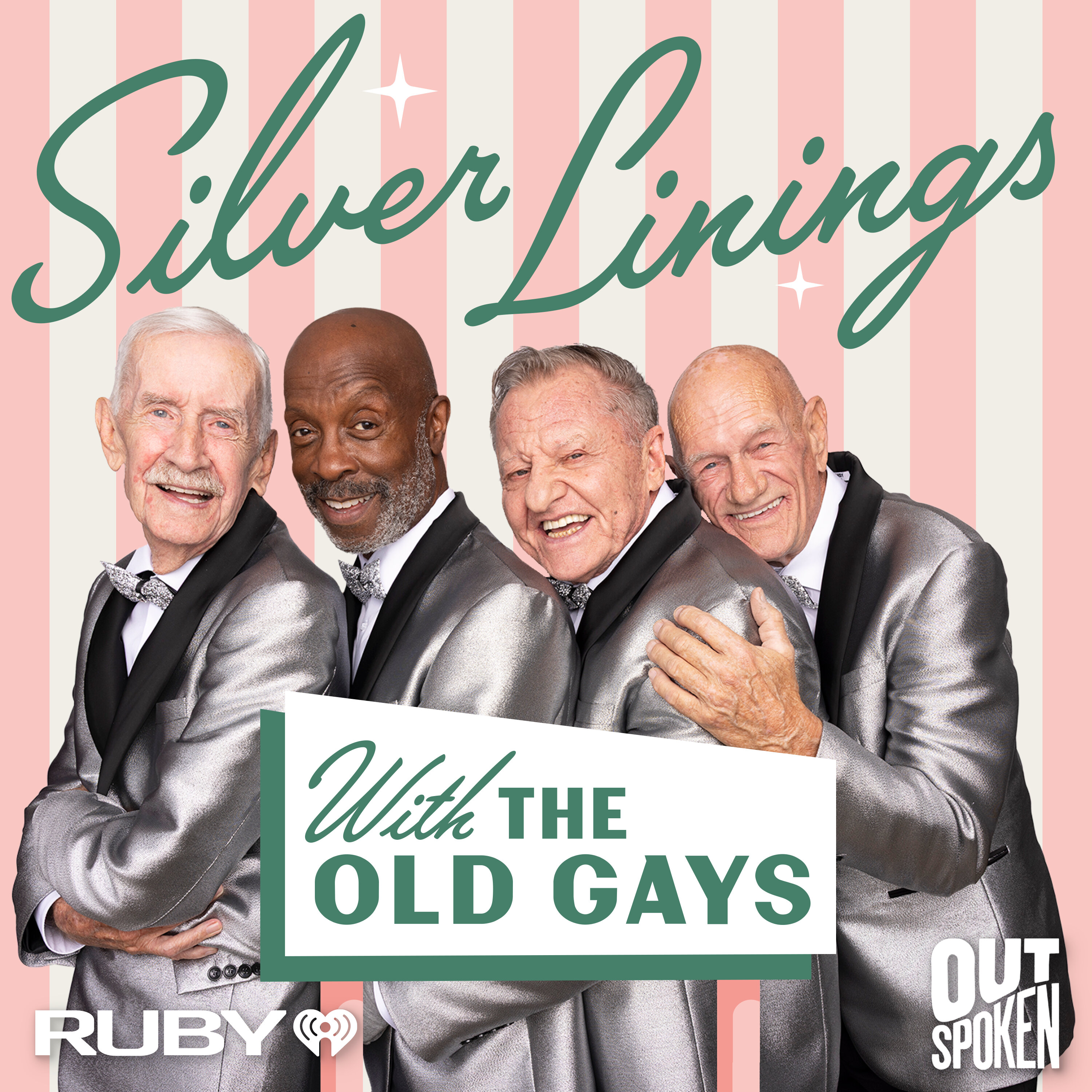
Silver Linings with The Old Gays
Art & Media, Mirrors of Ourselves: “You get more back than what you put in.”
00:34:56
Loading summary
Transcript197 lines
- [00:04]
Ruby
Ruby. She has not achieved diva status yet.
- [00:12]
Bill
What is Touch Gas, Touch grass?
- [00:17]
Ruby
It's a 70 millimeter screen, and Mike Henry comes out in a loincloth.
- [00:22]
Bill
From just beyond the lights of Los Angeles in steamy Palm Springs, California, it's Mick, Robert, Bill, Jesse, and this is.
- [00:34]
Ruby
Silver Linings with the Old Gays.
- [00:39]
Jesse
Welcome back, folks, to Silver Linings with the Old Gays. Today we're going to be talking all about the arts, the icons, and media in its many forms.
- [00:50]
Bill
We'll chat about our favorite forms of artistic and creative expression. The media before social media. We might even test our knowledge of the newest lingo.
- [01:01]
Nick
What the hell is a cheugy?
- [01:10]
Ruby
Queerness and the arts have always gone hand in hand. Many of the most iconic musicians, filmmakers, painters, and more have been a part of the LGBTQ community. Who are some of our fave artists, musicians, actors.
- [01:31]
Jesse
One of my favorite musicians and always has been is Freddie Mercury. I mean, the energy that Freddie had on the stage and enthusiasm for his things was absolutely overwhelming. And he was such a talented guy too. I mean, he wrote a lot of his own material. In fact, Bohemian Rhapsody is known as one of the best songs in the world.
- [02:02]
Bill
I have Billy Strayhorn, an amazing young man who wrote quite a bit for Duke Ellington. And Duke Ellington constantly was protecting him. He knew that he was gay, but he loved his work. And I do too. Just an amazing young artist at the time.
- [02:23]
Nick
Donna Summer is someone who had a tremendous impact on my gay life because of the disco era of the 70s. And I was out on that dance floor two or three nights a week.
- [02:43]
Jesse
Just moving to her, and also not on the stage, but in the bedroom. The Barry White helped the gay community tremendously.
- [02:57]
Bill
Y' all listen to him while y' all had sex, yo.
- [03:00]
Jesse
God. Yes.
- [03:02]
Ruby
In terms of the arts, one person comes to mind to me now, and that's Robert Mapplethorpe.
- [03:07]
Nick
Oh, yeah.
- [03:07]
Ruby
I mean, the contributions that he gave not just to art in terms of photography, but also to his work. Developing awareness of HIV and aids. He was very integral to that movement, and I'm sorry to have seen him passed.
- [03:26]
Nick
Yeah, he really tried to and succeeded, I think, in capturing the eroticism, the passion of gay sexual relationships through his photographic series of flowers. And he felt that structural form of flowers, such as orchids, particularly express those feelings. And those photographs are what really made his career. And because he started producing art that was more acceptable to the public, that is what established him in the elite circles of arts.
- [04:21]
Jesse
And he also, to me, was an absolute genius in the art of Black and white photography, that was his namesake. I mean he was absolutely incredible. He made black and white photography sensual.
- [04:40]
Ruby
I can think of another artist and that would be Keith Haring, who also died of aids. And oh gosh, his work is all over the world. It's in every museum that you can find. It's on people's wall. I mean, what a prolific talent he had, you know, over just a very short amount of time.
- [04:59]
Nick
And the color and the forms I think conveyed a certain kind of a celebration of life.
- [05:08]
Jesse
And to me he always expressed his figures as action figures. I could always see him almost kind of moving.
- [05:18]
Ruby
Does anybody remember Bette Midler headlining at the Continental Baths in New York City? I don't know how many I do. Bette Midler's first professional job was on Broadway in 1967. 68, something around there. She was cast as Zeitl in Fiddler on the Roof. And after she left that production, I guess she had no work to do. So she took up a gig doing standup and some songs and kind of a review at the Continental Baths. And she was foul mouthed. She told Bell Bart stories. She was just wicked. But she had so much fun on stage and captured the heart of the gay community. And now she does children's programming for Disney. And I think that's an incredible way to end one's career.
- [06:17]
Nick
We've been talking about famous people, what about ourselves, our forms of self expression. I know for me that it has been art. Art has just always been with me. My entire life I have attempted when I have the time to make art. When I was in my early years, grade school years, I took drawing lessons from a woman who lived in the neighborhood. And then in later years I took oil painting and pastels from a sister in a Catholic academy in Jonesboro, Arkansas. And I also have fortunately been able to express artistically through work that I've done over the years, including my 20 years of planning experience in St. Louis and San Francisco where I had an opportunity to help shape cities. And from that point till today, I have put my work energies into being a sculptor and making art. And that has been very giving to me. What about you, Bill?
- [07:57]
Jesse
Well, my. My self expression is making things pretty. I was born and raised into the restaurant family and I was always told how to make the plates look right and make them look good. And then I was in high school, I got a job in a men's store and it was my object to make everyone that came in look absolutely classic looking. And after that, for 20 years I went into the interior design business where I help people's homes be a glorious place to be. So I have tried all my life to make whatever profession I was in to make them beautiful.
- [08:47]
Bill
I have lived my life with music. It's all I've ever wanted to do since I first sang and made my sister pissed off at me on Easter Sunday in church, the song that she sang. And I just kept going until my voice changed and that scared me. So I didn't even hum for three years because I had to get used to the lower voice. But music has carried me. I've never wanted to be a fireman or anything else. I just wanted to sing. Didn't want to be popular or famous. I just wanted to sing. But money hips.
- [09:26]
Ruby
Currently my form of self expression I suppose is training and working out. I've made a recommitment to that over this year. I would say also a form of self expression for me of course are the videos that we do. I always put a little bit of myself into it and also I try to apply what the sense of aesthetic and also skills as an actor that I can bring to. And that's why I'm looking forward to beginning to reposting new video on a new account that I'm developing a new profile. So I'm keeping myself busy and I'm very pleased.
- [10:14]
Nick
I also have to say that my feeling is that when you do have a form of self expression of some artistic element of who you are, that it really helps in living because I feel like my doing art provides me with an internal energy that keeps me alive and keeps me fighting. And so that's why I'll keep doing it until my last breath.
- [10:54]
Jesse
Yeah.
- [10:55]
Ruby
The beauty of art. Any artist will tell you that you get more back than what you really put in. If you give your all, you get so much more back.
- [11:07]
Bill
Yes, you receive so much when you're giving it. In my singing, I am so truly blessed to feed off of people's energy. You can find that one or two people out there that you can connect with.
- [11:23]
Ruby
Speaking of that, how has social media changed the way we interact with the arts and creative media?
- [11:31]
Nick
Well, my feeling is that whatever your self expression is that social media brings into greater focus the relationship between you as an artist and one who consumes your art.
- [11:51]
Ruby
Yeah, it's immediate now. I mean you have to pre release media to get attention before the fact of something debuting. And that's the pressure I think on the arts now. You have to really deliver because we're competing with things that are authentic. And I think young people who follow social media are very much attuned to what is authentic and what is artifice. And I think that is where the rebellion is.
- [12:21]
Nick
And we have to be conscious about what we say in that. We need to be relevant to younger people.
- [12:32]
Ruby
Can somebody describe what life before social media was like?
- [12:37]
Bill
I can.
- [12:39]
Jesse
It was peaceful, and it was a lot easier to deal with.
- [12:43]
Bill
Yes. I loved not having a phone. I still love not having a phone. Sometimes it's harder not to live without it now. But we don't communicate like we used to. Everything is with your thumbs.
- [12:59]
Jesse
Yeah. The art of communication, the art of talking to one another, the art of writing letters to one another, that has gone away. And that was a very good way to have an interpersonal relationship with other.
- [13:16]
Ruby
People before you had to physically go to a place, wherever the action was, you didn't have to sit watching your phone and connecting through a dating app or chat rooms. And I also realized that there is less reliant on print media. And this is what I mean by saying things are more immediate now. Is that because it is instantaneous and because no thought is given prior to what you say? You know, this is where miscommunication takes place. And I think that art is being lost. But in defense of social media, first of all, it's not gonna go away. And there's a whole generation of young people who this is how they receive their information. And it's incumbent to us, if we want to be heard and for them to pay attention, we have to go where the action is. And that's the different. I guess what I'm saying is that the methods of communication have changed, but communication itself has not.
- [14:32]
Nick
It is a nice revelation when we do go out in public for appearances and such. It's like, hey, there's a world out here.
- [14:50]
Ruby
Just saying, will you reflect on a moment or period in your life where media before the Internet had a definite effect on an important choice you made?
- [15:03]
Bill
Ted Mac's original Amateur Hour. As a kid, I lived for that show every Sunday, and my goal was to get on it. And just as I was getting ready to audition, the show ended. But it didn't stop me. It gave me something to start with and to then start going on. And I will never forget it. Ted Mack and Ed Sullivan shows were the only shows where I saw my color people that looked like me. It was a rare thing. And I remember my family, we would get together around our little square TV and just watch. There's colored People, we're on here and it was a major thing because we didn't see ourselves all the time on tv. But that started me going with my music. It really did seriously with it.
- [15:59]
Nick
Were there any other TV music oriented shows that have affected you?
- [16:08]
Bill
Soul Train, definitely Soul Train, baby.
- [16:13]
Ruby
Yes.
- [16:13]
Bill
I wasn't supposed to be looking at it. It's a good church boy, but baby, did I see it. Soul Train, all, all the shows, just, just Amos and Andy, I loved them. I loved that show. The TV version, yeah. I didn't get the radio one but, but the TV version, I lived for that. To see Aubrey Della, which was my sister's name, and Amos and Andy and what? Sapphire and y' all don't know them, do you?
- [16:49]
Nick
Not all of them.
- [16:50]
Ruby
Oh yeah.
- [16:51]
Bill
When there's few far in between, you memorize. Yes, but those were, those were exciting days around our little square tiny tv.
- [17:01]
Jesse
Well, mine was when I was in the sixth grade and the LA county school system had buses that came and picked us up and took us to the Shriners Auditorium in Los Angeles. And that was the first time that I had ever seen an opera and it was so exhilarating to me. The costumes were gorgeous, the voices were wonderful. Having a full symphony orchestra there playing it started my love for opera and it has carried me on through my entire life.
- [17:47]
Ruby
Do you remember what opera that was?
- [17:48]
Jesse
Cosi Fantuti.
- [17:50]
Ruby
And do you remember any of the singers?
- [17:52]
Jesse
No, I wasn't familiar with the singers at all, but they all sang very well.
- [18:00]
Ruby
Bob.
- [18:01]
Nick
For me the media would be print media and very early in my life I was living in Jonesboro, Arkansas and I had an uncle who lived in la and when he came back to Arkansas on trips to visit the family, knowing that I was artistically inclined, he would always be bring me magazines. And the magazines were Palm Springs Life and Architectural Digests. And I would sit and I would thumb through those magazines. I probably 10 or so times until I just thoroughly absorbed the images that I was looking at. And I was just really so fascinated by these home designs that I was seeing. And it was only recently and thinking about that, that now living here in Palm Springs in a mid century modern house, I feel like I've come full circle.
- [19:24]
Ruby
Yes, for me it was Saturday afternoon at the movies. I was not more than 10 years old and I forget who I went with, but we saw Tarzan and the Valley of Gold. Now the actor playing Tarzan was a man named Mike Henry. Mike Henry played linebacker for the Steelers and then onto the Rams. And then when he was Cut from the Rams. He became Tarzan. And can you imagine? I was not more than 10 years old. It's a 70 millimeter screen, and Mike Henry comes out in a loincloth. He was 6 2, the broadest shoulders, huge chest, and he blew me away. He just blew me away. And I looked at him and I. My eyes were just big. And all I remember is in the movie theater that people were whistling and really my eyes were open and I just looked at him and I said to myself, I want to be like him. And I really do credit Mike Hendry. If you are still alive, you are my inspiration.
- [20:47]
Nick
And Mick did a very good job of becoming him.
- [20:53]
Ruby
Yeah. But Mike has, like six inches on me, so, you know, and I'm talking height.
- [21:02]
Jesse
We'll be right back after a quick break.
- [21:14]
Bill
Welcome back to Silver Linings with the old gays.
- [21:21]
Ruby
Since the days of Dorothy, many a pop diva has been embraced by the LGBT community, particularly by gay and bi men and trans femme people. Just say, who's your fave, diva?
- [21:37]
Bill
My favorite diva is Patti LaBelle. She taught me how to sing and to be free and not worry about what I'm looking like all the time. Just to get out there, sing, do your thing. I love it. And Aretha Franklin. Lord of mercy.
- [21:52]
Nick
Oh, yeah.
- [21:53]
Jesse
Oh, yeah.
- [21:54]
Bill
R E S P E C T Right up to the end. Bam. And Diana Ross.
- [22:00]
Nick
Let's not forget Whitney Houston.
- [22:03]
Bill
Oh, for goodness sake.
- [22:05]
Nick
I mean, talk about a voice. She went way too early.
- [22:11]
Ruby
Bill.
- [22:12]
Jesse
My favorite diva is Tina Turner because I just hear her voice and hear her start singing, and all I want to do is get up and dance. And I can just picture her shuffling across the floor and just give the greatest performance of all. She really, whenever I hear her, I just want to get up and cha cha.
- [22:41]
Bill
And you can do that, baby.
- [22:43]
Nick
Yes, he can. I suck at Bill's nomination there.
- [22:49]
Ruby
I'm going to go with Madonna. Madonna has. She is the biggest pop diva that I can think of. She's had a career that has spanned how many decades, and she still is relevant, and she commands an incredible audience, and it's because her material is really good and she is a incredible performer, and I just marvel watching her on stage. I was also thinking about Lady Gaga.
- [23:21]
Jesse
I'm really not that much on pop music and that I'm more classical and that. But when I heard Lady Gaga and saw her video of Poker Face, that just. That just sent me over the top.
- [23:39]
Ruby
I'm a big fan of Ariana Grande. I didn't think much of her at the start. But then I started listening to her lyrics and her vocalization, and then her performance in Wicked was a revelation. But she has not achieved diva status yet. You know, by the time they're 40, they're a diva. Yeah, that's my rule.
- [24:02]
Nick
And these were not necessarily people who were gay, but were very respectful of and catered to the gay public.
- [24:17]
Ruby
I think as artists, whether you are gay or not, you can appreciate the struggle that another human being is coming through. And I think music, what makes the connection is that we can make a connection. How many on TikTok and on Instagram that you see? How many guys are lip syncing to define gravity? If you listen to the lyrics, it's absolutely understandable as to why a gay person such as myself completely identifies, because I have lived that life and the lyrics express that. But when it's combined with artistry, with sound. Okay. It creates a whole different dimension and it adds to it, doesn't it? Yeah.
- [25:10]
Bill
And it lets us get away. To go in. It's like, oh, good, forget the world now. Let's go in this world.
- [25:17]
Ruby
Oh, yes. That's absolutely. You know, for 90 minutes, you forget your problems. Well, what do you think we're about? You know, tune into our videos. You know, we're there to entertain.
- [25:30]
Bill
Yes.
- [25:30]
Ruby
To make you forget a little bit about what's going on in your life and to make you smile.
- [25:35]
Bill
To bring joy into life and to live, just live. And it ain't easy nowadays, but we gonna keep trying.
- [25:43]
Ruby
We keep trying. So, Bill.
- [25:48]
Jesse
Yeah.
- [25:49]
Ruby
Do you have a favorite video that we have done that has stayed with you all this time?
- [25:55]
Jesse
Yes. The first major one we did, which was Good Day.
- [26:00]
Nick
Yes.
- [26:01]
Jesse
And that one just. I think it's because we had to work so hard, we had to do it in one take. And that one just stands out to me as. As just one of the best videos we did.
- [26:20]
Nick
Yeah, it had kind of a storyline to it.
- [26:24]
Jesse
Yeah.
- [26:24]
Nick
Like a mini opera. I agree. That's one of the most memorable for me.
- [26:30]
Bill
And it almost killed me. I had just. I had never done anything like that. You know, it was like. It was. I'm like, what the dickens are we doing? How am I gonna get this?
- [26:41]
Jesse
I was like, but you were the star of that one, too. I mean, you carry.
- [26:47]
Nick
But another very memorable one for me was when we did Wednesday. That was because of. Principally because of our costuming and how we were so somber and serious. We had to maintain that throughout the entire production.
- [27:10]
Ruby
And, you know, the sequel is being released.
- [27:12]
Nick
I know I just saw that when.
- [27:15]
Jesse
And what just amazed me is that jumped over to 100 million views.
- [27:21]
Nick
I know.
- [27:22]
Jesse
I mean, that was just. And here we were just as somber as we could be.
- [27:30]
Ruby
Well, of course we were somber, because by the end, how many takes, people don't know. And it was hot that day. And there we. And the makeup, it just. Oh, it's gross.
- [27:46]
Bill
And you know what another one is? When I found out that Bill can't sing doing. Oh, wicked.
- [27:52]
Ruby
It was awesome.
- [27:54]
Bill
I am. I go. When I'm down, I will go. And just look at us, and it's just hilarious. I love us. I says this was real because we didn't have time to rehearse a lot. That was awesome.
- [28:06]
Jesse
I didn't even know what we were.
- [28:07]
Nick
Doing.
- [28:10]
Jesse
So I just gave my.
- [28:15]
Nick
Another very memorable one for me is when we did the shower scene from Little Nas X. Little Nas X where we were all naked in the studio with how many people around?
- [28:37]
Bill
I don't know.
- [28:38]
Nick
Production people.
- [28:39]
Jesse
Well, we were supposed to have these little modesty panels.
- [28:43]
Nick
Yes.
- [28:44]
Jesse
But they only really worked if you shave everywhere. And so it got so frustrating, Mom. We just all got them and threw them and just said, I don't care if 15 people watching us. We're going to get through this.
- [29:01]
Nick
Yeah. Yes.
- [29:04]
Bill
And that floor was cold.
- [29:07]
Nick
That was. That studio was cold.
- [29:10]
Jesse
Yeah, it was.
- [29:12]
Bill
Oh, the memories, when you look back at it.
- [29:14]
Nick
Oh, I know. I figured we've probably done somewhere in the neighborhood of a thousand videos since we started doing this, if not more.
- [29:27]
Jesse
Really?
- [29:28]
Nick
Yeah. It's been a fun trip.
- [29:33]
Bill
Before we wrap, are you guys up for a little challenge? Let's see who can guess what these Gen Z terms are.
- [29:41]
Nick
Okay.
- [29:43]
Bill
What do you think this word means, Riz?
- [29:48]
Jesse
Well, it rhymes with something else, but I don't know if that has anything to do with it or not.
- [29:56]
Bill
They change the.
- [29:56]
Jesse
Jeff.
- [29:58]
Nick
The association that comes to mind for me is ritzy.
- [30:04]
Jesse
Ritzy?
- [30:05]
Nick
Ritzy, rich. Kind of splashy.
- [30:11]
Ruby
Rich, charismatic.
- [30:15]
Bill
Is that what Riz is?
- [30:17]
Nick
Oh, he looked it up. I bet.
- [30:21]
Bill
That's okay, babe. I did, too.
- [30:23]
Nick
I didn't.
- [30:24]
Bill
Okay, what about Delulu Delusion? Wonder why kids can't spell nowadays. Okay, left no crumbs now, come on.
- [30:37]
Jesse
Well, to me, that's when you've made love to someone and you've done everything and there's nothing left to do.
- [30:45]
Ruby
I would say that's accepted.
- [30:47]
Bill
So left no crumbs means it was perfection. You ate the whole thing. There's nothing left.
- [30:54]
Nick
Sounds right.
- [30:56]
Bill
What is touch Gas.
- [30:57]
Nick
I mean, touch grass.
- [31:01]
Ruby
Oh. What touch grass means.
- [31:03]
Bill
Touch grass.
- [31:04]
Ruby
What do you think it means?
- [31:07]
Nick
You need to get more grounded.
- [31:10]
Ruby
Close.
- [31:12]
Bill
I have absolutely no idea.
- [31:15]
Ruby
Just say you've been spending too much time indoors. You really need to touch grass.
- [31:22]
Bill
Just get outside.
- [31:23]
Jesse
Get outside.
- [31:24]
Bill
That's beautiful.
- [31:25]
Nick
Close to nature.
- [31:27]
Bill
Well, just get outside and then just.
- [31:30]
Ruby
Say it's to touch a cactus.
- [31:33]
Bill
Okay.
- [31:34]
Nick
That's right. You don't have any grass.
- [31:37]
Bill
I don't have any grass. It's all rocks and it's pretty sand. Yeah. Okay. And the favorite one. Chewy.
- [31:47]
Nick
Isn't that a character from Star Wars?
- [31:52]
Jesse
No, that's Chewie.
- [31:53]
Nick
Oh, that's close.
- [31:57]
Bill
So cheugy.
- [31:58]
Nick
Cheugy. I have no idea what it means.
- [32:01]
Jesse
It sounds bad to me. It just sounds bad to me.
- [32:06]
Nick
Yeah, that's.
- [32:07]
Ruby
In what way?
- [32:08]
Bill
No, her look is cheugy.
- [32:10]
Jesse
Is that a good look or bad luck?
- [32:13]
Bill
Am I smiling or not?
- [32:15]
Ruby
Actually, it means uncool.
- [32:18]
Jesse
Oh, okay. So I was.
- [32:19]
Ruby
You were right.
- [32:20]
Nick
Okay. How do they learn these words?
- [32:25]
Ruby
Because they're on social media and chat rooms. Where have you been?
- [32:28]
Bill
That's where they live.
- [32:29]
Nick
I guess anybody can just create a word.
- [32:33]
Ruby
You can.
- [32:33]
Nick
In time, it becomes popular sometimes. That's social media.
- [32:40]
Jesse
And also, it's amazing to me how words change and bounce back and forth between positive and negative and positive and negative.
- [32:51]
Ruby
Yeah, well, actually, that's how language began.
- [32:54]
Bill
Yeah. Skibidi toilet.
- [33:01]
Jesse
All right, boys, we're reaching the end of today's episode. You know the drill, since this show is called Silver Linings. Thinking back on our conversation, what is the silver lining you've gained from loving and learning from the media?
- [33:18]
Bill
Before social media, less can be more, sometimes better.
- [33:24]
Nick
Understanding the world you live in.
- [33:28]
Ruby
What is the silver lining that I take? Well, it gave me the motivation and the inspiration and the tools by which I can continue to create.
- [33:42]
Jesse
And for me, it fostered my love of opera, which I've had for my entire life.
- [33:52]
Bill
That's all for today on Silver Linings with the Old Gays. Silver Linings is a production of iHeart's Ruby Studio and the Outspoken Network. We're your hosts, Bill Lyon, Jesse Martin.
- [34:05]
Nick
Nick Peterson, and Robert Reeves.
- [34:08]
Bill
Our executive producer is Sierra Kaiser. The episode was written by Ryan Amador, with post production by Eric Zeiler. Our theme music was composed by Max Hirschenau with audio, direction and design by Matt Stillo. And if you're having fun with us, please subscribe to follow along and don't forget to rate and review the show. Wherever you get your podcast thanks for listening. See you in two weeks.
- [34:37]
Jesse
In the 1980s, the virus spread rapidly throughout the gay community.
- [34:43]
Ruby
I actually knew about five people who.
- [34:46]
Bill
Had died from it, which was more.
- [34:48]
Ruby
Than enough for me when I told my partner that was the end of our marriage.
- [34:56]
Bill
This is an I Heart podcast.