← Silver Linings with The Old Gays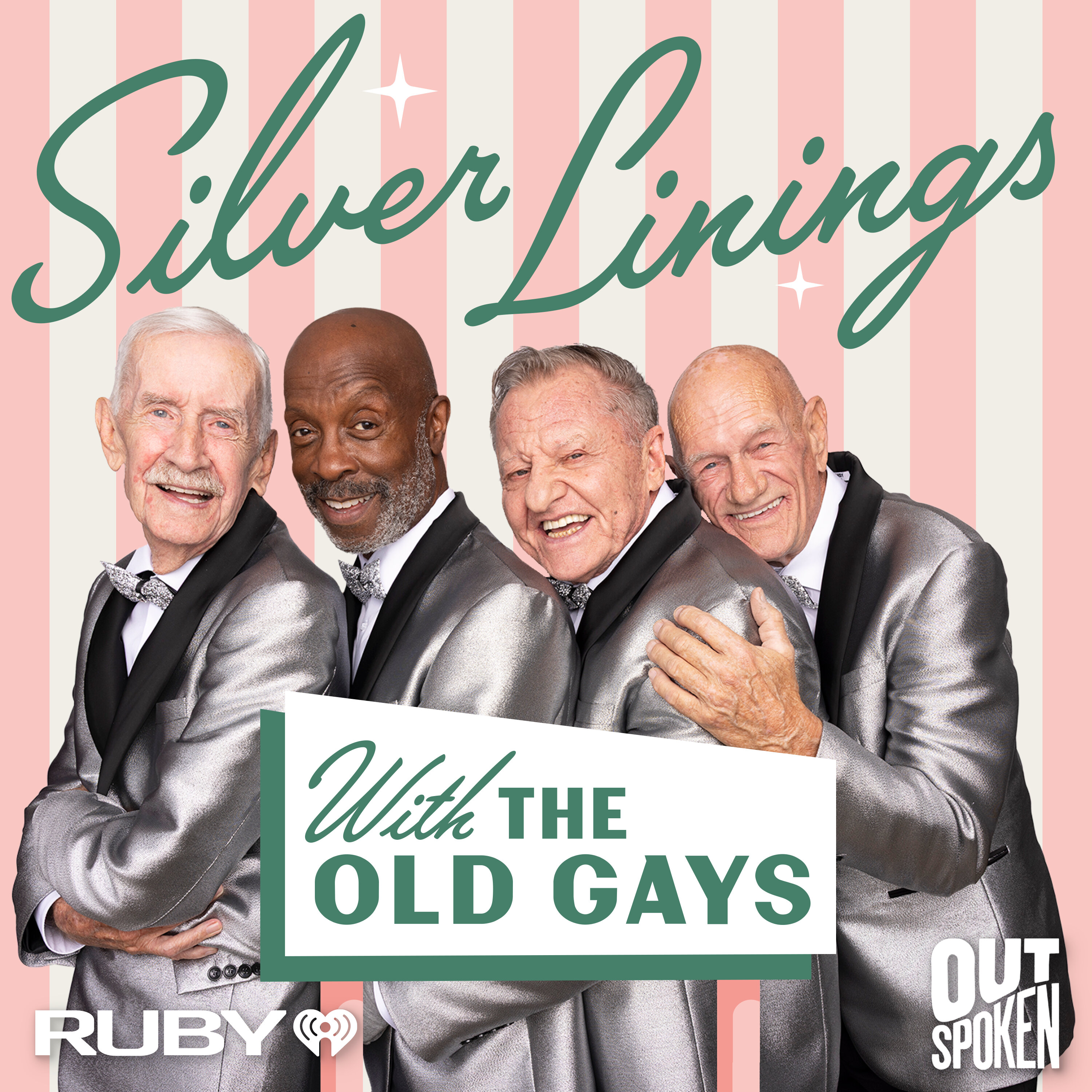
Silver Linings with The Old Gays
Queer Spaces & Meeting Places: “Being around your people, that makes a difference.”
00:30:39
Loading summary
Transcript135 lines
- [00:04]
Ruby
Ruby.
- [00:08]
Bill
Church is definitely a queer space. It's wonderful.
- [00:13]
Robert
That was the first drag show I ever saw.
- [00:17]
Ruby
I said, guys, wash your mouths out and get out of here.
- [00:22]
Bill
From just beyond the lights of Los Angeles in steamy Palm Springs, California, it's Mick, Robert, Bill, Jesse, and this is.
- [00:34]
Ruby
Silver Linings with the Old Gays.
- [00:39]
Robert
Have you ever been to a gay bar, Robert?
- [00:42]
Bill
Me?
- [00:43]
Mick
Never.
- [00:44]
Bill
I've never even heard of such a thing.
- [00:46]
Ruby
Mick, I can show you my play spaces.
- [00:49]
Mick
We're back. And hasn't Silver Lining just been such a delightful space to share our memories, thoughts, feelings, musings, ideas, and all things gay and old?
- [01:09]
Ruby
Would you say this podcast is a queer space then, Robert?
- [01:13]
Mick
Well, yes, I would.
- [01:16]
Ruby
Good.
- [01:20]
Bill
Today's episode is all about the queer spaces, gay places and gathering spots that have supported us over the years and continue to do so today.
- [01:29]
Robert
Whether it's a venue, a club, or a weekly meeting group, these spaces can have a great influence on how comfortable we feel to let our authenticity bloom.
- [01:41]
Mick
And our free flag fly.
- [01:45]
Bill
So, fellows, what comes to mind when you think of queer spaces, and how do you think they helped us become who we are?
- [01:52]
Mick
Well, certainly, I think bars and nightclubs of varying types have played an important part in most all of our lives because they've been places that we can meet other people like us, such as back in St. Louis. It was not really until the 70s, mid-70s, that I became comfortable in the gay spaces, because in the late 60s, when I was first exploring the gay world, the few bars that existed in St. Louis, they were all controlled by the mafia that was well known in the community. And they were all places where you would enter from back alleys or dark parking lots. They really weren't that comfortable. But if you wanted to meet other people like yourself, you were forced to go there.
- [03:09]
Ruby
That sounds very primitive.
- [03:11]
Mick
It was very primitive. And I think a lot of it had to do with it being the Midwest. I just kind of exploded when I moved to San Francisco. Exploded in a good way.
- [03:29]
Ruby
And I hope you brought a towel.
- [03:34]
Bill
One of the earlier memories for me was seeing drag.
- [03:39]
Mick
I don't think I ever witnessed a drag performance until well into the 1980s in San Francisco. And there you almost not everywhere.
- [03:53]
Bill
My first drag show was at the Go Go Club in downtown Chattanooga. And I can't remember this queen's name, but I swear her legs were like 10ft tall, and she would kick them and go up and split. And she had to be about 60 years old then. And I'm going, how's she doing? All that but now I know, don't we guys? We've learned all. But. But that, that was cute, being in my little church village and then sneaking out at 12 o' clock after room check and going downtown to Chattanooga in San Francisco.
- [04:26]
Robert
I mean, the big star there was Charles Pierce, who was an absolute legend in his own time. He would be in a swing and he'd swing over the entire audience, back and forth and back and forth. And that was the first drag show I ever saw. And it was probably the best one I've ever seen. But I really didn't start out in bars because I just come out in Laguna beach when I was 16 years old and my next step was Hollywood. And they had a wonderful coffee shop called the 8727 Melrose. And it was where young guys could go and meet without having any interference from the police or anything, wandering the streets. So the 8727 was a big savior for me because I had no peers to talk about in high school and it really filled the bill. But in the 70s and in the Castro, the most popular place was the Midnight sun, where you could go and they played the greatest videos, short clips from Broadway shows, and it was just a fun place to be. It was just a really happy time. And San Francisco, wasn't that one of.
- [05:58]
Mick
The first video bars ever anywhere?
- [06:03]
Ruby
Yeah, for me, the first bar I walked into in West Hollywood was in 1978 and it was a place called the Blue Parrot. It was the first of its kind west of the Mississippi. It was open windows, floor to ceiling windows that looked onto Santa Monica Boulevard and you could look into the bar to see who was there. And the windows were painted in a very tropical kind of scene of banana palms and that kind of stuff. So it was very inviting. And it was the first place I saw bare chested guys behind the bar. And I knew some of them from, as it turns out, from the old Jim Morris club that I was training at, which was the first openly gay gym in America. And that was opened by a man named Jim Morris, who was an Olympic weightlifter. He went to the Olympics and he meddled. And he was also the first professional bodybuilder to come out. And he opened a gym, a hole in the wall gym behind the skating rink at La Cienega in Santa Monica. There were cult models, professional porn stars, members of law enforcement. It was a bodybuilders gay heaven. I met a lot of people there. You made dates and things like that. I mean, it's gay exchange recipes and all that sort of stuff. But when you were on the gym floor, you worked out, it was a serious gym. It really shaped kind of who I am.
- [07:40]
Mick
Was there a big difference between gay gyms and straight gyms?
- [07:48]
Ruby
Well, it was a lot more fun. It was a lot more naughty. I mean, for a few years I worked there at the front desk. And so I had to do what we call dick patrol, which means right before the gym closed, you had to go around to all the little nicks and crannies around the gym, but particularly in the sauna. You never saw so many bodies just flying on the other side of the wall. And I said, guys, we're closing in 15 minutes. Wash your mouths out and get out of here. That's what I used to say.
- [08:22]
Robert
And that was the dick patrol.
- [08:23]
Ruby
That was dick patrol.
- [08:24]
Bill
Yes.
- [08:25]
Ruby
We used to do dick patrol.
- [08:26]
Bill
Did you really tell them to wash their mouths out?
- [08:28]
Ruby
Yes.
- [08:29]
Bill
How cute.
- [08:30]
Mick
And they probably needed.
- [08:35]
Robert
I have to tell you, I have never felt better in a queer space than during the 70s and dancing in San Francisco. I would get out there and I would just let myself go on the dance floor and I absolutely loved it. I literally, I was stepping out of the body that was Bill and into another person because it was just so exhilarating to be dancing with all these hundreds of men.
- [09:11]
Mick
It was that disco music. It was gets into your blood.
- [09:16]
Robert
I mean, there were so many great places to go and dance. And I literally felt like I had an out of body experience when I was dancing. I just let it all go.
- [09:27]
Bill
Yeah. 8,000 Club Sparks for me in Miami. I will never forget walking in there in my little 28 inch waist jumpsuit and this smell was in there. And I'm like going, what is this? And somebody heard me from around me and came and just like popped something in my nose and I inhaled, let's just say. Ah, dang. I was going. I went, what is it? It's poppers, man. I go, what? And then it came out the other side and did the same thing over here. Okay, I get it.
- [10:11]
Robert
And you know, let's not forget, when the bars closed and you hadn't picked up anyone, the natural place to go was the baths for me, especially on the weekends. And San Francisco had probably 15, 16 different bath houses that time in the 70s, and they were extremely, extremely popular. There was Rich street south of Market, but then there was also Dave's Baths down at the end of Broadway in San Francisco. And that was always jammed with people.
- [10:58]
Ruby
Yeah, I really didn't frequent the baths all that much. There is one place that I hold very dear in my heart to me, however, and it was a place called Prowell. This place, Prowl, was the creation of one Michael John. Inside, it was like a three story building, and the entire building was gutted. And instead, this wonderful craftsman by the name of Michael Pereira, who was a cult model and a Mr. Iml, he lives out here in the desert now. And he built, literally rebuilt the set for Mad Max Thunderdome. And so when you walked in, you were transported to this wild world in which there were dark crawl spaces. It was built on three levels. You took this big stairway up to the upper level where there were crawl spaces and dark rooms. But I remember the very center was like a jail, all made of wood, and inside was a sling. And so it was very much a place where the voyeurs and the players would meet. And there are just some wild nights about it. And like I said, I meant a lot of hot guys there. And then, remember, this is unlicensed. Okay. This is. This is like illegal. Okay. And there too you would meet not undercover, but off duty law enforcement. Because, of course, Michael was paying off the LAPD for it. So that's how things had changed.
- [12:44]
Mick
Times have changed. Changed.
- [12:48]
Robert
We'll be right back after a quick break.
- [13:03]
Bill
Welcome back to Silver Linings with the old gays.
- [13:08]
Mick
What are some other queer spaces that have had an impact on your life?
- [13:16]
Bill
Church is definitely a queer space. It's wonderful.
- [13:19]
Mick
Was it?
- [13:20]
Bill
It still is. Church is fun. People think of it as this boring religious place, but gay people, we bring it all up. Every church I've been in is. Luckily, I've been in churches that have been open to gays and questioning because they didn't know a lot about it. My current church is the same. My pastor is getting ready to go to a gay function that I'm attending just to understand. But then I just found out his brother's gay, too.
- [13:47]
Ruby
Speaking of. Also about other public spaces. There's a place known as the One Institute, and it's based at usc, and it is the first research library into queer life. And if you want to know the history of being queer in America, not just in America, but around the world. And. And it's an incredible resource library, and it's a place to really understand the history of being queer. But the beauty of a gay bar or a place like the One Institute, these are places where you could just be yourself with other people who were just being themselves.
- [14:29]
Bill
Yeah. Because back when I was first entering gay spaces, you definitely experienced Racism, the segregation was still there. When you walked in, you still got stared at and people made you feel like you weren't worth shit. Why are you here? And it hurt, it hurt dearly because I would go in with this big smile, ready to go, and they would turn around if there were a bunch of people of color there. And so it was hard, but I trudged through it and kept going back. But I've seen it evolve. And the thing is, it's a two sided thing. It's a two sided thing, but someday I hope we get it in this country.
- [15:15]
Ruby
Yeah. When I first moved to Los Angeles, this was a pretty racist place. And what changed? It was the civil unrest.
- [15:24]
Mick
Well, I know that even before I moved to California, the LA police had a reputation for targeting the gay community.
- [15:36]
Ruby
I remember times actually where it wasn't safe in West Hollywood. The parking lot at the Jim Morris Club, when it was the Athletic Club, was on two sides of West Knoll. And I remember walking from the parking lot on West Knoll, crossing the street to get to the entrance and a car pulled up and a guy pointed a gun at me. And, you know, that did exist, you know, and that's why these were places of real refuge for us. I don't think many people understand that now, you know, because especially here, because California has become so much more accommodating because there are so many queer people here, you know, and other minorities, you know, I mean, we're literally a state of minorities.
- [16:29]
Mick
Yeah.
- [16:30]
Ruby
And so we all have to get along with each other and we all.
- [16:34]
Mick
Know we're in it together.
- [16:36]
Ruby
That's right.
- [16:37]
Mick
You've often talked about activism throughout our conversations. Do you want to talk about how that was a space for community?
- [16:47]
Ruby
Yeah, it actually, what happens is it kind of develops within a queer space and then it moved outside. Like my time at the Athletic Club coincided with aids. And I remember many times the guys in the gym were organizing the marches. And I also remember a demonstration in the early 90s where this is when Pete Wilson, then the Governor of California, who said he was going to support gay rights and then turned around and signed one of the most homophobic pieces of legislation. Basically he. And there were protests and I remember marching down Santa Monica Boulevard past the gyms and we marched down La Cienega and into the Beverly center and we all got in a huge circle in the atrium and we ummed for about 10 minutes. And at that point I felt an energy I'd never felt before and I felt a strength that we never had before. And, you know, in coalition with the Latinos who had been screwed over and by a lot of other people in the state as a result of that, California is not a Republican state anymore.
- [18:12]
Mick
Yeah. I think when we're talking about being comfortable and public spaces, we can't overlook the pride parades and pride festivals that now exist throughout the country. But I know that the first Pride Parade I experienced was in 1980, right after I had arrived in San Francisco. And going down to Market street and being among hundreds of thousands of your fellow human beings is one of the most uplifting, magical experiences I think you can possibly describe. And it's such a wonderful sight to see people in that number celebrating life.
- [19:18]
Bill
Yep.
- [19:18]
Robert
Yes.
- [19:19]
Bill
I remember I was at Palm Springs. First one here, it was so cute and short in about 15 to 20 minutes at Ruth Hardy Park. And then was Long beach, their first one downtown. They were small, but they were so mighty, you know. And now to see how both. Both have grown a lot, it's like, okay, it's getting like LA now.
- [19:42]
Robert
And especially the Palm Springs Parade, too. There are so many straight people there that are just absolutely enjoying themselves.
- [19:53]
Mick
And talking about the Palm Springs Parade, I know you and I have talked about this before, but seeing the high school group that Gay straight alliances these young people marching down the street, I.
- [20:12]
Robert
Go back to my high school days where I'd have been kicked out. But the straight gay alliances, to me, are the highlight of the parade.
- [20:22]
Mick
Yes. What about any significant gay or queer owned spaces that stand out to you either today or throughout your life?
- [20:35]
Ruby
Well, you know, there are restaurants. There were restaurants in Los Angeles that were gay owned. One of them that I was looking at was called the Academy. And the Academy was a leather uniform kind of a place you would go there for, like, Sunday brunch. And the big one, Studio One.
- [20:54]
Mick
Hello.
- [20:55]
Ruby
Hello, Studio One. And the backlot. Hello. That was gay owned. Like, Studio 54 was gay owned. Studio 1 was in this big warehouse building in West Hollywood, and it had the first I'd ever seen of a circular urinal in the center. It also had giant reels, like, to look like movie reels, like 35 millimeter, you know, big prints. And they were always hanging from the rafters. And the light show was fantastic. And Studio One was an experience.
- [21:31]
Bill
Studio One's the first secular show that I ever did. I was scared shitless. The owner didn't know who I was, but my partner went in and says, killed till the show. He goes, well, do you think you can fill it up? And he goes, yeah, So I filled up two shows up there in the back lot.
- [21:48]
Ruby
Yeah, the back lot was always lots of cabaret.
- [21:50]
Bill
Oh, my God. It was fun. It was. It was. I can't remember anything bigger in my life musically than that because it was the first. The beginning. I had just gotten back from the Philippines. I had shoulder pads out here, waist cinch everywhere. It was. It was cute. Oh, and I had hair and I had a ponytail.
- [22:07]
Robert
A ponytail?
- [22:09]
Bill
Yeah, the earrings and the ponytail went away, but yes. Oh, thanks for bringing that up, Mick.
- [22:15]
Ruby
Well, yeah, Studio One was an experience. And I've forgotten how much fun I used to have.
- [22:22]
Bill
Oh, yes.
- [22:23]
Ruby
Yeah.
- [22:25]
Robert
As far as queer owned places in Palm Springs, there is one particular place that I have always loved, and you can find anything gay in there, and that is the Q Trading Company. I mean, they have greeting cards, they have magazines, they have books, they have calendars, they have lube, they have poppers, they have dildos. It's almost. It's like a gift gay department store. You can get anything in the world there that you want that's gay.
- [23:07]
Bill
Where is that?
- [23:08]
Robert
It's right down from the tool shed on the same side of the street. Literally next door to the tool shed. It's been there for years and years.
- [23:17]
Mick
I think it's next door to gear.
- [23:20]
Robert
It's up from gear.
- [23:22]
Mick
Okay.
- [23:22]
Robert
Yeah.
- [23:23]
Mick
One of the things I enjoy so much, particularly in my neighborhood of the Cathedral, Cathedral City Cove, is seeing how many houses display the pride flag every day, all day long. And sometimes I'll get up on the roof of my house and I'll just look over the neighborhood and I see all of these pride flags waving. And that gives me a really wonderful feeling of belonging.
- [24:02]
Robert
And also, I think it's so great that at city hall right now that they are putting up the pride flag.
- [24:10]
Bill
Every morning because they all pride and gay.
- [24:17]
Ruby
Yes. You know, I would be remiss. I think we would be remiss in not mentioning the investment that Lands Bass has made in West Hollywood. He's bought a couple of bars, I think, and really helped to revive the street after Covid because I don't know if you know, but Covid really devastated the small businesses in Los Angeles. And, you know, the investment of somebody of Lance's stature in West Hollywood should be recognized. Plus, he has a nice bar.
- [24:53]
Mick
Yeah.
- [24:54]
Robert
And doesn't he also have an underwear store?
- [24:56]
Ruby
Yeah. I mean, he bought like three or four properties in that block.
- [25:00]
Bill
Yeah.
- [25:01]
Mick
What about online queer spaces?
- [25:05]
Ruby
I was reading where, contrary to what we have been talking about, that actually today we are living in the golden age of gay liberation. And the reason why are you. Three things. I'm trying to remember them. Prep.
- [25:22]
Mick
Okay.
- [25:23]
Ruby
GPS location.
- [25:26]
Mick
Okay.
- [25:27]
Ruby
And dating apps. It doesn't matter whether you're on any of them. The fact that those three things are now a part of gay life means it's a freedom. It exists in cyberspace. It is a whole new world, and it has a whole different set of norms and values and language and lingo. And I'm just learning.
- [25:54]
Robert
And I really like the old days of just walking into a bar and you could talk to someone and pick them up. But today it seems like the gays that go to bars, it's strictly a social kind of a thing, and everyone is just talking together and everything. And then, of course, when you want to go home, first thing they do is they get onto the gay dating sites. And I really preferred meeting someone in person because on the gay dating sites, you don't really know what you're dealing with.
- [26:36]
Ruby
Well, you should go to the tool chat.
- [26:38]
Bill
You should go to. A lot of.
- [26:39]
Ruby
You should go to the tool shed, because behind the tool shield is a little business. The tool shield, where you can plunk down a little bit of money and go inside. And it's a sex club.
- [26:51]
Robert
Oh, it's the one behind the antique Mart.
- [26:54]
Ruby
That's right.
- [26:54]
Bill
Yeah. Bill, go there.
- [26:56]
Robert
No, I, I, I'm through. No, I'm.
- [27:02]
Mick
Bill, you were there when you were young.
- [27:06]
Ruby
You pick up somebody at the tool shed and then you go over to the other place. That means you don't have to bring that person home. Frequently. On the dating apps, I get these calls from guys saying, meet me at the tool shed and then we'll go next door.
- [27:23]
Robert
Really?
- [27:24]
Ruby
Yes.
- [27:25]
Mick
Times haven't changed. Really.
- [27:27]
Bill
No, they haven't.
- [27:32]
Ruby
In closing, let's ask the question, what is our silver lining about cultivating and being in queer spaces?
- [27:42]
Robert
Well, mine is strictly being comfortable and at ease with myself. That's what I love about it the most.
- [27:55]
Mick
And being able to discover who you are and. And interacting with really very interesting people.
- [28:08]
Bill
And being around your people. Yeah, that makes a difference. So many people are lonely out there.
- [28:14]
Mick
Yeah. It feels natural to be among your friends.
- [28:20]
Ruby
You know, for me, it's just simply about being myself. Which is a slut. No, I'm joking. Not really. It's a place where you could be yourself and where your friends are always alert to your needs. I guess because you got to have.
- [28:42]
Bill
Friends, you gotta have friends. There goes all gays chorus.
- [28:54]
Ruby
To make the day last long had some friends, but they're gone? Someone came and took him away? But from the dusk until the dawn, Here is where I'll stay.
- [29:10]
Robert
Yay.
- [29:12]
Bill
And you young people are saying, what's that?
- [29:14]
Ruby
Thank you, Bette Midler.
- [29:21]
Mick
That's a wrap for today. Silver Linings is a production of iHeart's Ruby Studio and the Outspoken Network. We're your hosts, Bill Lyons, Robert Reeves.
- [29:37]
Bill
Nick Peterson and Jesse Martin.
- [29:40]
Mick
Our executive producer is Sierra Kaiser. The episode was written by Ryan Amador with post production by Eric Zeiler. Our theme music was composed by Max Herchenau with audio direction and designed by Matt Stilo. And if you're having fun with us, please subscribe to follow along. And don't forget to rate and review the show wherever you get your podcast. Thanks for listening.
- [30:20]
Bill
All we do is spend our lives at Doctors Now.
- [30:23]
Mick
I tried all kinds of hair restoration products.
- [30:30]
Bill
Don't work, does it?
- [30:32]
Ruby
Our younger listeners are thinking, oh, fun. This is what I have to look forward to. Sleep. This is an I Heart podcast.