← Skin Anarchy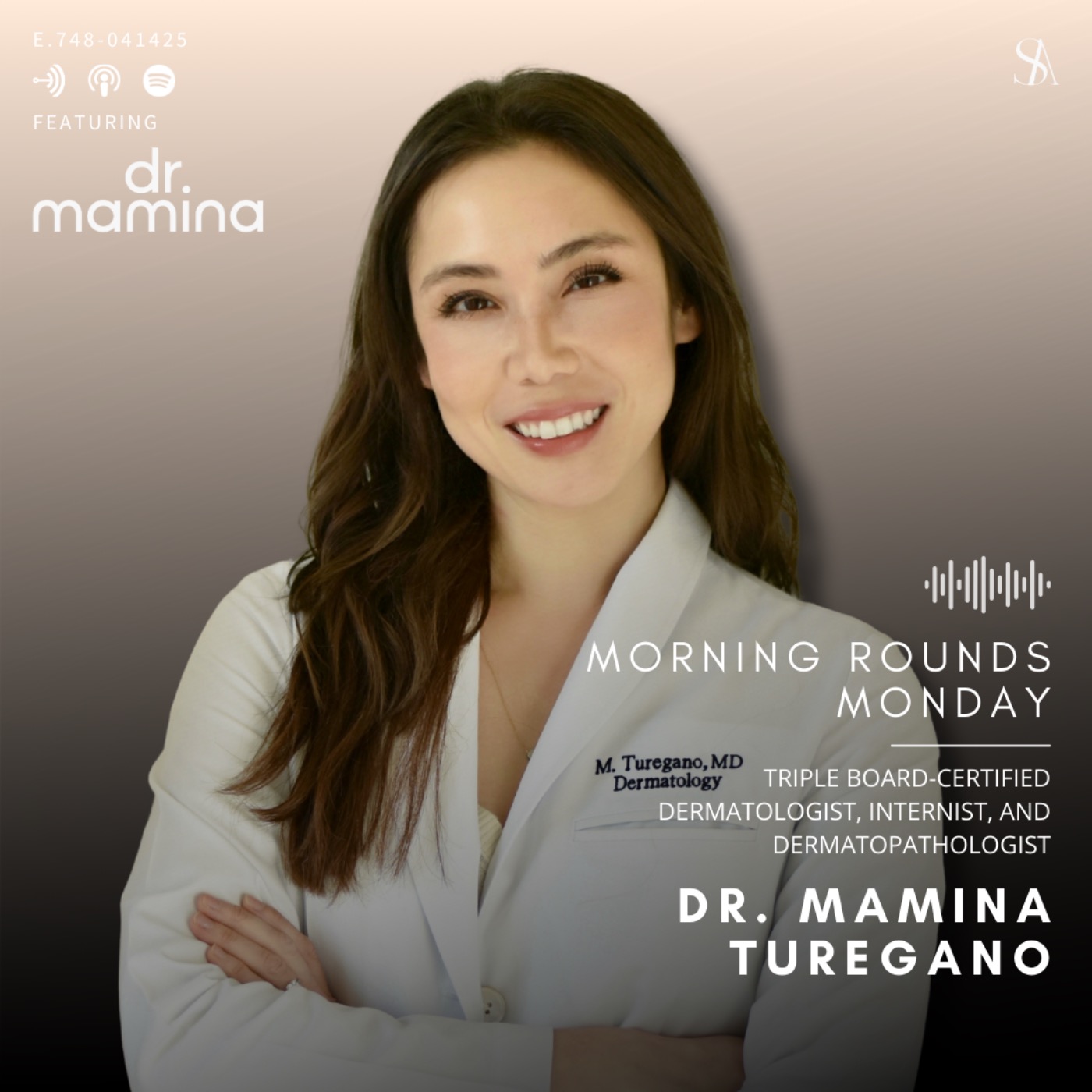
Skin Anarchy
The Connection Between Lifestyle, Inflammation and Your Skin with Dr. Mamina Turegano
00:35:20
Morning Rounds Monday
Loading summary
Transcript81 lines
- [00:00]
Host (possibly a name like Sarah or Emily)
Hey, all. Welcome back to another episode of Skin Anarchy. I'm so thrilled about our guest today because she is a triple board certified dermatologist. She is an internist and a dramatopathologist. So we can basically ask her anything that we want about skin health. And she will know because she has done such extensive training in this field and all related fields. So without further ado, please welcome Dr. Mamina Tarragono. Welcome to show. I'm so excited to host you and I'm so excited to dive in.
- [00:26]
Dr. Mamina Tarragono
Thank you so much for having me. It's an honor to be here. Thank you.
- [00:30]
Host (possibly a name like Sarah or Emily)
Oh, no, the honor is truly mine. I'm really excited to chat with you. More importantly, learn from you. I mean, it's so impressive that you have board certifications, not just dermatology, but also internal medicine and dramatopathology. That's huge, you know? So like I said, I'm very, very excited that we can pretty much ask you anything.
- [00:49]
Dr. Mamina Tarragono
We'll see about that. We'll see about that. But thank you.
- [00:52]
Host (possibly a name like Sarah or Emily)
I'd love to start off by learning more about you and what really got you into to, you know, dermatology overall. Was there something that happened in medical school that sparked your interest or how did this all start?
- [01:02]
Dr. Mamina Tarragono
Yeah, it. It was actually medical school because I had the intention going into medical school to go into primary care. And the years leading up to me going to medical school, I've always had a passion also for integrative medicine, taking a more holistic approach to medicine. And I thought primary care was the best avenue to take to integrate this approach. And when I was doing my rheumatology rotation, which is a subset of internal medicine, rheumatology deals with a lot of OD autoimmune diseases, and there's a lot of overlap with autoimmune diseases and skin diseases. And I just saw that I was so drawn to the patients with autoimmune cutaneous issues, whether it is cutaneous lupus or dermatomyositis or scleroderma. And to see the skin manifestations, and some of them were very debilitating. And I had so much empathy for these patients. And I was like, wait, maybe I like derm. I didn't think that I was a derm person, but maybe I like derm. And then I also. So when I did my derm rotation, I fell more in love with derm because it just covers the whole gamut. Like, you see both adults, you see kids. Because I was torn. I was. I was really interested in both adult Medicine and pediatrics. And you also do a little bit of everything. You do a little bit of surgery. I knew I couldn't be in the or. I was not that person. I didn't want to manipulate bowel, but I loved, like, simple, just cutaneous surgeries. And I also loved pathology so much. I, like, knew I didn't want to work in a basement, be a pathologist. But you get so much pathology with derm. And I was like, okay, this is. Derm is where it's at. And I was so bummed because most people know early on if they want to do derm because it's such a competitive field. And I kind of decided sort of late in the game, and I feel like I barely got in by the skin of my teeth. It's. It was. It was a lot of luck.
- [02:44]
Host (possibly a name like Sarah or Emily)
That's so cool, though. And I love that you did this integrative approach, like you said. Because when I look at. Especially right now, because I feel like we have so many consumers that have so many new questions. I feel like. I don't know. Do you see that a lot, like, in your practice, that people are asking, like, just more educated questions now? Then we'll start.
- [03:02]
Dr. Mamina Tarragono
Definitely. Yeah. I feel like patients are definitely keeping us on our toes because they'll sometimes bring up topics that I haven't heard about. And I think I was, like, introduced to double cleansing. I mean, this was, like, 10 years ago by a patient. And so it's just, like, things like that, for sure. And then, you know, they'll also ask about, like, what do you think about this chemical? Is this okay? Am I harming myself? Or if I'm pregnant, Like, is this fine? So, yeah, definitely. I have to thank my patients a lot for staying on top of some of my knowledge.
- [03:32]
Host (possibly a name like Sarah or Emily)
Yeah, no, that's really cool. I mean, I think that's. It's really, really neat how much education is now out there, you know, for the general consumer. Like, I. It's crazy that we can go on and they're reliable people, you know, that are telling you about actual. You know, whether it's, like, the skin condition you're dealing with, or even just trying to figure out what should I do routinely? You know, I remember when I started hierarchy, like, literally, I was, like, searching, right? Like. Cause you look for guests, and you're like, what can I bring on that can, like, educate my audience? And at the time, even the derms that I. I invited on, they were like, God, you know, I wish there were more of us out here, because there's so much misinformation, you know? And I remember, I think one of the first questions I asked was, do you really need to apply eye cream with your third finger? Like, you know, so it's funny. Yeah, there's a lot of stuff, but I want to. I want to dive a little bit into this integrative dermatology, because you have that. Yeah. And it. I mean, what really inspired you to explore the more holistic side than the traditional medicine route?
- [04:32]
Dr. Mamina Tarragono
Yeah. You know, I want attribute a lot of my interest to my mom. My mom is Japanese, and growing up, she would definitely incorporate alternative therapies just into any of our healing. So she was very anti Tylenol, like, whenever we had a fever, and she would make us sweat it out, and she would make, like, weird concoctions. Like, I remember it was sake and a raw egg, and we would have to just down it, and it would knock us out. And I'd wake up the next morning feeling like a million bucks. But ye. So she would just do these other remedies. She would massage different, like, acupressure points. If I was constipated, there was, like, a certain spot on my index finger that she would massage. Or if I had a sore throat, there was, like, a spot on the bottom of my foot. And I don't know if it was placebo, but I felt like some of it did help and work. And so she kind of instilled that interest in me. And then I was also exposed a lot to just Asian culture in general. I lived in Korea when I was in seventh and eighth grade. I went to boarding school there. My family was still living in New York at the time. But just living there, you also get exposed to Eastern healing modal things like moxibustion, and, like, just drinking, like, different tinctures, like herbal remedies. So to me, that approach to health was normal. Of course, I saw a regular, conventional doctor when I was just growing up, but I saw multiple angles of how health was approached. And in college, I also became really interested in how food can impact our health and even things like our breathing. And I was super inspired by Dr. Andrew Weil, who is an integrative medicine physician. And I feel like he was one of the biggest pioneers for this, and he was probably one of the biggest reasons why I decided to get an MD he also has a medical degree. And so I was like, you know what? I feel like if I have an md, I have kind of more options in front of me to be able to take an integrative approach. Like, I could just get the foundation in conventional or allopathic medicine, and then I can always learn other healing modalities with that kind of basis of education.
- [06:32]
Host (possibly a name like Sarah or Emily)
That's so cool. Yeah. I interviewed Dr. Weil and he was amazing to talk.
- [06:35]
Dr. Mamina Tarragono
Oh, that's so awesome.
- [06:36]
Host (possibly a name like Sarah or Emily)
Yeah, no, he was really, really cool. And there was a lot of cool stuff he brought up, too. But that's. That's really. Yeah, that's really neat that you did that and that you got this, you know, like, different perspective. Because I always wonder this as well, because we're sitting in the west and I think an old mentor of mine a long time ago said, the west practices with their machines and the east practices with their knowledge. And I was like, you know, it sounded very harsh at the time because you're in the west, you're learning, and then you grow into it and you start to realize, like, yeah, you know, there's a lot of stuff like in Eastern philosophies and Eastern medicine that's still being employed, and it works, genuinely works. And there's people who live and die by this stuff, you know, and it's not. Yeah, it's not hocus pocus. I feel like the west kind of makes it feel like it is, you know, and it. We talk about it in a way where it's like, oh, yeah, you know, those are just ancient remedies or like cultural stuff. And it's like, no, there's value here. We could learn a lot in allopathic medicine. We can learn from that. So.
- [07:34]
Dr. Mamina Tarragono
Yeah, I love that you say that. I. I do think there's sometimes this automatic almost narrow mindedness about it from the conventional group, and it's like, nope, where are the scientific studies and all this stuff? And they automatically shut it down. And one of my goals is to be that bridge to open the eyes of people in the conventional world to see these other perspectives and approaches to healing.
- [07:54]
Host (possibly a name like Sarah or Emily)
Absolutely. I want to talk to you about two very common pathologies that people. I mean, you hear a lot about them on social media. There's a lot of stuff floating around. Is acne and psoriasis.
- [08:05]
Dr. Mamina Tarragono
Yeah.
- [08:05]
Host (possibly a name like Sarah or Emily)
What are some conventional treatments that you can tell us about that are used and then what are your thoughts about those treatments? What do you think? We're doing it right?
- [08:14]
Dr. Mamina Tarragono
Yeah. When it comes to acne, so much focus is at the follicular unit, and that is where the pathology is. With acne, if you just look at it kind of superficially, the follicular unit or the pore where it gets clogged with dead skin cells and oil and bacteria that naturally live on our skin can get trapped. And then you start off with whiteheads, blackheads, and then they can become inflamed bumps. So when look at the conventional treatment for acne, we're addressing like those different components of the follicular unit, whether it's medicines to decrease the keratin proliferation so you stop getting the clogged pore from the keratin or dead skin cell buildup. Things like retinoids like retin H, retinoin, tazarotene. There's also oral retinoids like isotretinoin, AKA accutane. We also recommend medicines that stop oil production. So things like salicylic acid. And then Accutane also addresses that as well. And then like antibacterial things, whether it's topical antibiotics like clindamycin, benzoyl peroxide or oral antibiotics, doxycycline is given out like candy. I think we have a little bit more stewardship now with, with how we're prescribing antibiotics. But people were on antibiotics for years, like if you spoke to some derms from like 20 years ago. And so I think we're. There's a little bit of a movement away from that. But yes, antibiotics is still part of a huge treatment regimen for people with acne. And then medicines that address the inflammatory compone. So I mean retinoids are anti inflammatory. Benzoyl peroxide can be anti inflammatory, things like azelaic acid and sulfur, which also can potentially also have some antimicrobial properties too. And then the other huge component too with acne is the hormonal component that drives the oil production. So the big one that is prescribed is oral spironolactone for adult female acne. It could also be given to teenage girls with acne too. We don't give it to men because it's like an androgen receptor blocker. So androgens include things like testosterone. So that's not something we give to men. But definitely addressing hormonal component. And birth control pills is another treatment. I don't really do birth control pills. I actually find spironolactone to be safer. But that's another commonly prescribed treatment for people with acne.
- [10:20]
Host (possibly a name like Sarah or Emily)
Do you think that that's an approach that we should be following more so than like sin care? I mean, I feel like that's where I see a lot of misunderstanding is this idea of like, should I go to a dermatologist versus like, let me buy a bunch of products, you know, and try to treat this myself. Especially with acne.
- [10:36]
Dr. Mamina Tarragono
Yeah. You know, with acne, it's very easy to get caught up in a rabbit hole and spend a lot of money on different products over the counter. And I think that you can save a lot of time and hassle by seeing a dermatologist who can look at your skin and tell you what products are helpful, what prescriptions are helpful. And sometimes it can be inconvenient, of course. I mean, but I think there's just like, even so many that are even online that are so EAS accessible. And if you want something gone quickly, a dermatologist is there to give you the tools and the guidance, which is what I really appreciate. But they're not going to get to the root cause for the most part. And so just an FYI with that.
- [11:19]
Host (possibly a name like Sarah or Emily)
Yeah, no, I mean, that's why. That's why I asked you just to debunk anything that's floating around. Because right now, what I see a lot of. And, you know, I'm just observing and that is that people are taking things like. Like acne has turned into. Rather than a word that is indicating a path, it's turned into a buzzword. You know what I mean? It's turned into a word that is like, oh, yeah, it's something you just get like a rash or something. No, it's. And that's where I think there needs to be so much more education, because it is something you go to a doctor for. I remember having that totally teenager and I got the antibiotics and, you know, but at the same time, I also discovered proactive. At the time, proactive worked beautifully, and it worked really well for my skin. But. But here's the really weird part is proactive, as much as I loved it and was, I'm still thankful for that care. It sensitized my skin to benzoyl peroxide. So now when I apply benzoyl peroxide, I turn into a lobster, even like a little dot of it. And so that's where I personally get frustrated. Right. Because I'm like, you should just go to a dermatologist, because if you don't ever go to a medical professional, you're never going to know what the right treatment is. And then you're going to overdo it, you know, with a lot of the products and create other things, you know, it's just going to mess. So.
- [12:36]
Dr. Mamina Tarragono
Yes.
- [12:37]
Host (possibly a name like Sarah or Emily)
Yeah.
- [12:38]
Dr. Mamina Tarragono
Yes. Having the guidance. Yeah. That you bring up. Another interesting point is like, yeah, people will just go all out. They'll buy every active over the counter. They're like, oh, I need benzoyl peroxide, I need adaptoline, I need salicylic acid. And then they'll end up ruining their skin barrier. And when your skin barrier is ruined, your acne can get worse. A lot of people don't realize, like, gentle cleansers, moisturization, like, these are really crucial parts of having a solid acne skincare routine.
- [13:03]
Host (possibly a name like Sarah or Emily)
Absolutely. No, I want to talk about, because you spoke on antibiotics, and that brings up gut health. You know, explain to us how does gut health and diet really play a role in acne? And are there any other foods that you could recommend or tell us to avoid in that regard?
- [13:17]
Dr. Mamina Tarragono
Definitely, yeah. So it's a little bit complex, but I love this topic. So we're just learning so much more about the. Our gut and the microbiome, which is the trillions of organisms that live in our intestines. I mean, they're. They're also in our mouth, on our skin, and. And these play such a huge role with inflammatory pathways in our body, our immune system. And there are multiple ways that problems in our gut can manifest as inflammatory issues like acne. So one of the ways is when you get an imbalance in your gut microbiome, AKA dysbiosis, and when there's a higher population of, quote, bad bacteria, they can potentially increase more inflammatory signaling in the body, and that can create more systemic inflammation. The other potential problem is this concept called leaky gut, where you could potentially eat certain foods, and usually the culprits are more, quote, processed foods. So things that have really high sugar or some people, it could be gluten. That could be a trigger for leaky gut. Certain processed vegetable oils, of course, things like antibiotics and whatnot. And leaky gut is essentially just a kind of a more casual term for increased gut permeability. So the damage to the gut lining causes these holes that allow larger molecules to enter your blood circulation, and that can set off also more inflammation in the body. And that can manifest in multiple ways, whether it's like joint pain or migraines or acne. So it's different in everyone. The other interesting part about gut health is that there is such a close communication with signaling in the gut and our hormones, too. The gut signals very closely with your immune system. Our immune system has a very close, intricate relationship with our endocrine system, all of our hormones. So when things are thrown off in the gut indirectly, our hormones can be impacted as well. So things like Androgen levels can be imbalanced, can go higher. Even things like insulin and cortisol, those are also considered hormones. Those can affect acne too. So there's the hormonal component. I think there's so much more to it. But one other thing I do want to say is that if your gut's not working optimally, you also may not be absorbing nutrients optimally. And so if you're not absorbing nutrients optimally, then that can have a whole downstream effect. Effect of skin issues.
- [15:35]
Host (possibly a name like Sarah or Emily)
Yeah. Yeah. No, that's huge. It's absolutely huge. I love what you said. And one thing that came to mind when you're talking about hormones are also very tied. So are neuroendocrine modulators like serotonin. And I think nobody even talks about stuff like that. You know, the serotonin pathway always blows my mind in the gut. Like, it's like huge. So you only hear about it in the brain, but one of the most regulatory molecules in our body is serotonin, and that's health. And it's like we have all this complexity, right, to like, unwrap and. But, you know, I think people are starting to get behind it where they're like, you know what? Yeah, there is something to this because I mean, just look at how many people have vitamin D deficiencies now. Like, it's insane.
- [16:16]
Dr. Mamina Tarragono
It's like, it's crazy.
- [16:18]
Host (possibly a name like Sarah or Emily)
Every single person I personally know in my life has a vitamin D deficiency. Like, it's crazy.
- [16:24]
Dr. Mamina Tarragono
Oh, yeah. It's almost abnormal. Like, I'm shocked when I'm checking vitamin D on someone and it's normal. And I'm like, okay, you have to be like, you have to be taking like, high amounts. Like, what's going on? And if they, if it is normal, they usually are on, like a really high dose supplement.
- [16:39]
Host (possibly a name like Sarah or Emily)
Exactly. And like. And it's exactly what you said. It's also affecting how you absorb things.
- [16:45]
Dr. Mamina Tarragono
Definitely.
- [16:46]
Host (possibly a name like Sarah or Emily)
And people now, like, you know, it used to be where it was like someone has celiacs, and then that's when you suspect that they're not absorbing their vitamins or something, you know, but now it's like, no, it's pretty much everybody. You got to check everybody now because we're all not absorbing something. Exactly.
- [17:02]
Dr. Mamina Tarragono
It's such a thing. Yeah.
- [17:04]
Host (possibly a name like Sarah or Emily)
It's turned into a whole thing. But, you know, I really think that that whole axis, the gut skin axis, is something that is so worth exploring. So I want to talk about. You know, you have a whole book on this, so, you know, your new book is the Holistic Psoriasis Management Guide. And it introduces a very different perspective. I mean, what, what do you think? What should people know about managing psoriasis beyond just prescriptions?
- [17:29]
Dr. Mamina Tarragono
Yeah, I know. Such a common condition that is potentially very debilitating. So beyond the conventional therapies, which oftentimes is things like topical steroids or there's like oral anti inflammatories and things like biologics. But psoriasis, I kind of tell people maybe just to kind of look at it more positively. Having psoriasis is kind of like having a canary in the coal mine. It's like your body's way of telling you that there's something going on internally that's deeper. We're having so many more publications and literature coming out. I mean, it's very well established that there's a strong connection between psoriasis and underlying chronic diseases, namely cardiovascular diseases. But there's also a lot of association with other chronic illnesses, whether it's diabetes and even things like hypothyroidism. And so it's like, if you have a little bit of psoriasis, it can help you kind of relook at your overall health and realize, okay, maybe I need to do something. Maybe I need to, like, look at what's affecting my cholesterol, or maybe I need to make sure I'm going on a certain exercise regimen. So for me, when it comes to counseling patients with psoriasis beyond the conventional treatments, it's looking so much at lifestyle. And there is a lot of established research that that definitely shows connection between certain factors in people's environments that can trigger psoriasis. Alcohol and cigarettes. We 100% know that those can certainly trigger psoriasis. And, you know, those are huge players too, with cardiovascular disease. Like, it's just very overall helpful to minimize those things. It's hard for people to give some of these things up. And, you know, obviously I. I tell people, you don't want to be so hard on yourself because then that creates stress. And stress also is huge when it comes to psoriasis. It's like having people kind of stop and reevaluating their lives. You know, a lot of people deal stress and the way that they cope with it is going out and partying and staying out all night, drinking lots of alcohol. And I also say staying out all night because it's interesting. A pattern that I have noticed in my patients with psoriasis. A lot of them were doing stuff at night, whether they were students, partying at night. Or staying up, doing all nighters. They would notice flares or even like my night shift workers, like nurses who did night shifts for some reason I just had a higher proportion of night shift female nurses with psoriasis. And then I also had like a stripper. She would just drink and be up all night. And so it's interesting, I looked up a. There was an interesting article that talked about how disruption in your circadian rhythm plays a huge role in psoriasis in women. So sleep and, and these are all such basic things. Managing stress, sleeping at normal times, minimizing alcohol and cigarettes. But these are all huge players with psoriasis. And then the other huge component too with the book because, because I would say the last 25% of the book is, is on kind of meal plans, is also looking at food. We've seen just that ultra processed diet play a really big role. So things that are high in like processed sugars, processed vegetable oils. The most consistent evidence that we have in terms of a diet that's helpful for psoriasis is the Mediterranean diet. So focusing more on like whole foods, increased fiber, increased plants and vegetables, healthy fats. And I do recommend that People supplement with Omega 3s as well as vitamin.
- [20:46]
Host (possibly a name like Sarah or Emily)
D. Yeah, that's really, that's really fascinating though that there's such a tie in with stress and you know, huge. So I'm interested like how these people certain, I mean, I guess you could measure certain markers, right? You could look at cortisol and, and all that. But did you see that like there was certain other, you know, comorbidities also tied to it? Because if they're so stressed out, I would think that there's some other indicator also that goes. There's rises.
- [21:13]
Dr. Mamina Tarragono
Yeah, definitely. I would say the majority of my patients with psoriasis, over 90% of them are overweight or obese, oftentimes will have at least one other chronic disease, whether it is diabetes or high blood pressure or high cholesterol. So it's like a full, It's. Yeah, just taking that whole picture into consideration. And then something else that's interesting. You know, GLP1 drugs are becoming such a huge thing in so many ways and like in such, such amazing ways too, like helping so many people who have obesity and obesity related illnesses. And we're seeing promise with GLP1s in the setting of psoriasis. Interestingly, even if people are not overweight or obese, we're seeing that there's like some kind of anti inflammatory component from GLP1. I think it Was Tirzepatide specifically. That was looked at so. More to come with that. But I. I think that that potentially could be a promising therapy because I say all of these things. I say, like, all of these lifestyle changes that are helpful, but it's so much easier said than done.
- [22:12]
Host (possibly a name like Sarah or Emily)
It's hard.
- [22:13]
Dr. Mamina Tarragono
Sometimes stress is. Is unavoidable, but people need to put food on the table and, like, there's only certain jobs that they can have to do that.
- [22:21]
Host (possibly a name like Sarah or Emily)
It's very difficult.
- [22:22]
Dr. Mamina Tarragono
It's. It's hard. It's hard in our society with. And also just the inundation of, like, these processed foods. It's like an uphill battle as doctors trying to counsel patients.
- [22:32]
Host (possibly a name like Sarah or Emily)
Yeah. You know, it's crazy. I think about our ancestors so much. I've said this so many times on the show where it's like, I've literally, I think, think people know more about my grandparents at this point than myself, because I bring them up, like, every episode. But my grandparents on my mother's side both lived to be centennials, and. Yeah. And they lived in rural India. Lived in India, Haryana. They never went to the city. They never lived in the city. They had their own land. They would grow their food, they would grind their grains. They would make their. Yeah. And that's how they lived, and that's how they raised seven children. And even in their last days, I think they were the healthiest people I've ever seen in that situation where, you know, you're coming to the end. And it was just. I mean, I think about that, and I'm like, how the heck did we go from that to this society where we're all basically eating plastic? You know, like. Yeah. And then. And then you have all these crazy health conditions popping up. I mean, you had brought up autoimmune earlier, and I wanted to say something because I have Hashimoto motives. I got diagnosed Hashimoto's, like, when I was, like, you know, late 20s or something like that. And at the same time, you won't believe it, you know, at the same time, my mom was diagnosed, my friend was diagnosed, my dad was diagnosed, and my brother was diagnosed. And I was like, how the heck do we all have. We all all. Yeah. And I was like. And it really made you think, like, you know what? It's not about just genetics, and it's really about our lifestyle in America west. And definitely, you know, and. And we're eating all this stuff. And even today, you know, you go to the grocery store, you're trying to eat healthier trying to do better for yourself. And all you ever see are options that are just riddled and in something or other, you know, whether it's like, you're not really buying products that are truly cleaned when it comes from the angle of pesticides or whatever is being used to preserve them, or, like, you know, know, you can't get away from it anymore. And just the other day, I was having a conversation about nanoplastics now in our water supply, you know, and how big it is. I'm actually working on a manuscript right now about nanoplastics because they're starting to deposit in the liver and they're starting to deposit kidneys. And it's a whole thing.
- [24:43]
Dr. Mamina Tarragono
It's a whole thing. Like, yeah, the rates of, like, thyroid issues are skyrocketing. The rates of infertility is skyrocketing. The rates of acne is skyrocketing. There's, like, something going on.
- [24:54]
Host (possibly a name like Sarah or Emily)
Yeah. There's a common denominator in this, and that's where it's. It's so frustrating because people ask you questions. I mean, do you get the questions of, like, how can I detox?
- [25:03]
Dr. Mamina Tarragono
Because I get them sometimes. Yes. Yes. Huh.
- [25:06]
Host (possibly a name like Sarah or Emily)
And it's just kind of like, what do you say to that patient? It's like, you can't detox. I don't know how to tell you how to flush out nanoplastics. I don't know.
- [25:13]
Dr. Mamina Tarragono
Yeah. What I tell patients is that our bodies naturally know how to detox, but you just want to minimize the things that are interfering with the detoxification pathways.
- [25:24]
Host (possibly a name like Sarah or Emily)
Yes.
- [25:24]
Dr. Mamina Tarragono
You want to minimize the use of plastics. You want to minimize alcohol. You want to minimize, like, processed foods, because, like, all of these are interfering with your natural detoxification pathways. But, yeah, no, I do get that question, too. And it's like. So they're. They think they're expecting to go on a specific cleanse or something.
- [25:40]
Host (possibly a name like Sarah or Emily)
Yeah, exactly. There's no cleanse. Like, that's. That was my point. Like, there's no cleanse. There's no beet juice that you can drink that's gonna, you know, unfortunately. So it is very important, I think, more than ever right now to be very mindful of nutrition and really where we're getting it. I mean, I. I genuinely think everyone should have a home garden at this point. Point.
- [25:58]
Dr. Mamina Tarragono
Oh, my God.
- [25:59]
Host (possibly a name like Sarah or Emily)
Seriously, you know, like, just something small, but, like, you know that you're getting all your veggies from this. Something that grew out of the ground and, you know, you know, fact that it was grown out of the ground.
- [26:09]
Dr. Mamina Tarragono
Yes. You know, that would be amazing.
- [26:12]
Host (possibly a name like Sarah or Emily)
Yeah, yeah. But I wanted, I want to talk to you because this is, you know, Dr. Weil earlier and I, I've been waiting to ask you this and you know, one of the conversation pieces that I had with him was around psychedelics because he's worked a lot with psychedelics and I know you have as well. You understand their role as therapeutics and how much potential there is. And I'd love for you to speak to us about this. It's just so fascinating, you know, so I know, I.
- [26:37]
Dr. Mamina Tarragono
So I think that we're getting so much exciting data with the role of psychedelics in the setting of mental health and things like depression, ptsd, anxiety, and I think that it's starting to carry over into things like autoimmune diseases and cancer. And it's interesting. So it's like, okay, could there be some anti inflammatory components? The reason why I'm so interested in it is because I do think that there is such a strong connection. You brought up the gut skin access, but I think there's this huge mind, body, also gut, skin, brain access too, but the mind. And this is probably getting a little bit more like esoteric. But I do really believe that our minds are way more powerful than we believe and that they can play a role with how we release certain inflammatory signals in our body. Like even just thinking about things that you're grateful for can decrease inflammation. It can change even the shape of your hippocampus, which is so cool. So we know that there's physical downstream effects from how we think. And there's a lot of healing on the mental aspect with psychedelics. So it's more just like an indirect way that it can help with other physical aspects of health. And this. There's another derm who's also interested, not going to say his name, but he's also interested in. He's done some research with psychedelics, but we were looking into doing a study with psychedelics and certain skin issues. Nothing has come of that yet, but I do think that it's promising. And so much of what I see, like acne and hair loss and psoriasis, like there's such a huge mental component to them that I think is driving the inflammation.
- [28:17]
Host (possibly a name like Sarah or Emily)
Yeah, absolutely. And you know what's really, really fascinating? So, so, like, I'll be honest, I experimented a lot in college, you know, like being a millennial. It comes with the territory.
- [28:26]
Dr. Mamina Tarragono
Yeah, it comes with the territory.
- [28:28]
Host (possibly a name like Sarah or Emily)
It does. And I feel like there was A point where I was. Because I had heard about a study or something. I mean, I. I used to listen to the Timothy Leary conversations, you know, and it made you think about, like, microdosing, right? And it was like a big thing. And then there were like a bunch of people who started publishing about this, about how microdosing LSD or psilocybin, like, it was actually helping people with their depression. It was people with anxiety. And it was like conversation started up. And it really did make you think, because you're absolutely right in what you said. The brain chemistry is such that, you know, people think like, okay, right now, for example, people talk with dopamine a lot, right? They're like, oh, yeah, you're getting a dopamine response. But what we never talk about is how neurotransmitters are released in conjunction with each other, you know, and that there is this rhythm that takes place, this cycle that takes place where your brain decides when it's going to release serotonin with dopamine or whatever it is, is. Yeah. And there's a whole area of mental health, not only mental health, but the brain that hasn't been explored when it comes to truly, like, neurochemistry. And I think one of my favorite quotes, I. I forget who it was now, but a biologist said this. He said, the mind is not contained inside of your brain. The mind is like an energy field. Think of it like an energy field around your brain. So when you start approaching things like depression and anxiety, you start thinking about it a little differently, because it's not just like, okay, your serotonin is whacked out, you know what I mean? Or like, you're. Whatever. It's more so about. There's an interplay going on. And everything outside, everything you consume is. Is playing into that. And there was also another very renowned neurologist. He did studies. He used to bring patients into his labs where he had a whole imaging setup, Right. And so he'd bring everybody in, and no matter what you had, whether it was adhd, depression, anxiety, whatever, right, he would bring you in, he would neuro image you, and then he would treat you. It's fascinating stuff. And all of these pioneers were doing this back in the 90s and early 2000s. And so. Yeah, and that's why I'm like, now I'm looking. We're in 2025 now. And it's like, we should be digging into this, you know, because there's untapped potential with what we could do. I mean, how many people have you seen that suffer with things like mental health, but then that impacts the rest of their health. You start getting dermatological manifestations and, you know, anything else, like cardiovascular manifestations, like all of it. And you. We don't even get to the root cause because it's all. It's your brain, you know. Yeah, yeah.
- [30:58]
Dr. Mamina Tarragono
So much. And I also think past traumas can manifest also as physical ailments later in life. And so, like different psychedelics can help so much with uncovering some past traumas and heal that. And then like that then in turn can manifest as just like an overall physically healthier body. Like, there's that book the Body Keeps the Score, with which I, I haven't read it. I've just read some excerpts from it. But it's so fascinating, that concept that our body doesn't forget when it undergoes mental or physical trauma and it, it's like holding a place for it and there needs to be healing, otherwise it's going to manifest in warped ways, like certain illnesses.
- [31:37]
Host (possibly a name like Sarah or Emily)
Right, right. No, absolutely, 100%. And I remember the. The doctor I was referencing was Bruce Lipton.
- [31:44]
Dr. Mamina Tarragono
Bruce.
- [31:45]
Host (possibly a name like Sarah or Emily)
Yeah. He's amazing. And, and I completely agree with what you said because I think we're now finally where integrative health is taking center stage in the most amazing way. And this conversation about psychedelics, I would love to see this go really far. You know, like, I mean, they've done studies with PTSD patients that's proven that it works, you know? Yes.
- [32:07]
Dr. Mamina Tarragono
Yeah, definitely.
- [32:10]
Host (possibly a name like Sarah or Emily)
It's amazing. But, you know, this is. I could talk to you for hours about this.
- [32:14]
Dr. Mamina Tarragono
Yes, I know. I love that you're also so open and on board with, with this perspective. So that's so great.
- [32:20]
Host (possibly a name like Sarah or Emily)
Yeah, no, I love it. I think that anything that actually is, I mean, truly, you know, if you ask, I don't know many doctors or anyone who even studied science that doesn't believe in the true power of integrative understanding of the human body. And I really feel like consumers, like, if anyone's listening in right now and you're dealing with something and you can't figure out what's really going on with your body, try to approach it like that, where you go and you seek the house help from people who are pro this concept of integrative medicine. I feel like you're going to get more success if you do that. You have to target the whole environment.
- [32:54]
Dr. Mamina Tarragono
And that's exactly.
- [32:55]
Host (possibly a name like Sarah or Emily)
You know what I mean? Like, even cancer knows that.
- [32:58]
Dr. Mamina Tarragono
Yep.
- [32:59]
Host (possibly a name like Sarah or Emily)
Foreign invader in your body is understanding the concept of integration, you know, so we need to approach our health like that. So I really applaud you for. For kind of doing this and, and just integrating this into your practice, you know, that's one thing.
- [33:14]
Dr. Mamina Tarragono
Wonderful. Yeah. No, thank you so much. It's. It's definitely a passion, and I'm hoping that, like, medical education will continue to shift and that other doctors will also be just more open to this.
- [33:26]
Host (possibly a name like Sarah or Emily)
Absolutely. Before you go, though, I gotta get some advice from you, if you don't mind. I gotta ask you to give us some words of wisdom, because I know there's people who are listening in. Maybe somebody who wants to go into medicine, or they're there and they want to switch specialties. What's your advice about medicine overall as a career path? Any words of wisdom you could offer here?
- [33:43]
Dr. Mamina Tarragono
Yes. I do have to say that if medicine. Medicine is something that you're interested in, I think that it is an amazing field because you can do so much to help people. It is a tough road. So you really want to go into it with the intention that it is your calling and that you want to help people. I think if you go into it thinking that it'll provide job security or, you know, give you, like, a certain status, you're going to have a tough time because, yeah, going through it is a very humbling experience. And there's so many other careers you can choose if. If that's what you're more interested in. But, yeah, if. If you are passionate about it, then, yeah, you can 100 get through it and just don't give up. Just think about all the other people who've become doctors. Yeah, it's. It's definitely possible There's a light at the end of the tunnel.
- [34:30]
Host (possibly a name like Sarah or Emily)
Yeah, absolutely. No, I love that. And I can't wait to see a Gen Alpha. And, you know, doctors, like, I'm so. I'm so.
- [34:37]
Dr. Mamina Tarragono
I know. Yeah.
- [34:39]
Host (possibly a name like Sarah or Emily)
I feel like they're gonna be doing this really holistic approach a lot more. More than we saw.
- [34:43]
Dr. Mamina Tarragono
Yes. Yeah, yeah, yeah. I'm excited.
- [34:46]
Host (possibly a name like Sarah or Emily)
Yeah. But Dr. Trno, thank you so much. This was such an honor to host you and learn from you and. And just be able to chat with you. It's been. It's been so, so.
- [34:54]
Dr. Mamina Tarragono
Oh, this was awesome. I love being able to talk about things like this, like where we. Where we go deeper and look at the root cause, look at things that are beyond the skin. So thank you so much.
- [35:04]
Host (possibly a name like Sarah or Emily)
Yeah, thank you. And for everyone listening in, please make sure you check out our show notes. I'll be linking some of the books that were referenced and some of the materials. Also, Dr. Trno's book will be linked the captions in the show notes of this episode. So please go check that out and we'll be back next time. Thank you. Thank you. Hey guys, so I hope you love that episode. Please make sure to hit subscribe if you're tuning in to us on any podcast platform. We are available on so many different platforms, so wherever it is that you're tuning in, just go hit subscribe. You will be immediately notified when we publish new episodes. This way you're able to tune in to amazing insights from experts, brand founders, industry leaders, authors, all the wonderful people that we host. And that's very important for me because I love to hear from you guys and really understand what you love and what you want to hear more of. Also, make sure to give us a follow on all of our social media outlets. We're available on Instagram, TikTok X, you name it, we're there. We also have a blog on Medium, so if you're a reader and you love Medium blogs, check us out on Medium. We publish some really great articles on there that do deeper dives than just what's available on the podcast, and it's really a great place for all of you science geeks out there that want to learn a little bit more. We go above and beyond with our research and making sure we're bringing you information that you usually probably won't hear about in other outlets. So check us out, leave us a comment, leave us a review, and we'll be back next time with another episode. Thank you.