← Skin Anarchy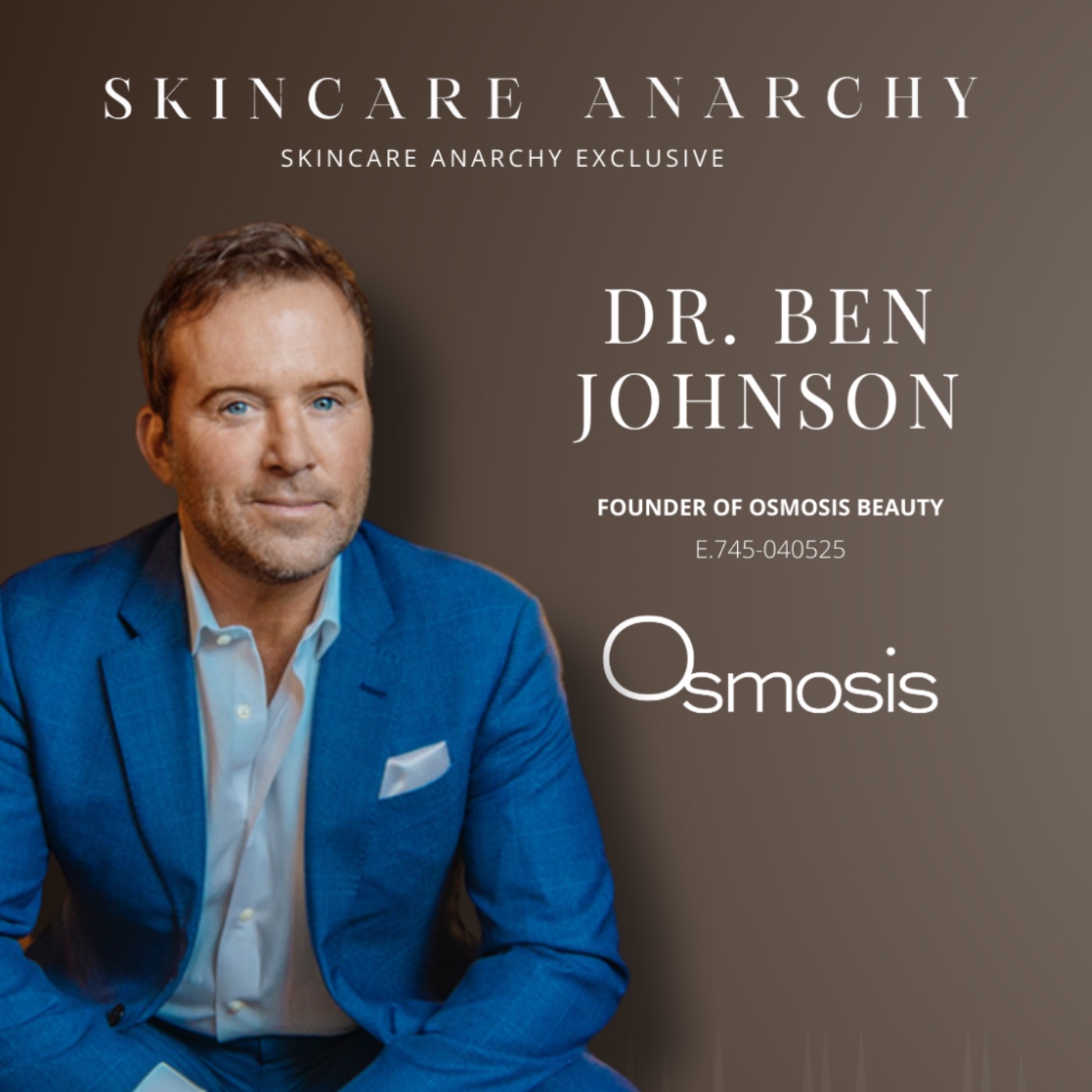
Loading summary
Transcript47 lines
- [00:00]
A
Hey, guys, welcome back to Skin Anarchy. This is your host, Ekta, and I'm really excited about our guest today because we're welcoming him back after a couple of years. A lot of you might recognize his wonderful skincare brand, Osmosis. We hosted him before about it. But welcome back Dr. Ben Johnson. I'm so excited to host you.
- [00:17]
B
Oh, yeah, I'm so excited to be here. Thank you, Ekta.
- [00:19]
A
Yeah, no, I'd love to dive in. You've been such a trailblazer, you know, in the space of skin care, obviously, dermatology, but also bringing that to the OTC space and. And really kind of bringing products that actually work for various skin conditions. And I' love to talk to you about that. You know, in terms of when was it in your career when you realized that traditional dermatology and the model was kind of flawed?
- [00:41]
B
I mean, out of the outset, I could see that, you know, because we all know the damaging effects of antibiotics, accutane, steroids. But it just has been a growing trend that they're. They're using these as their only strategy, and they're just never seemingly looking for the source of skin conditions. And if you're not trying to troubleshoot and listen to your patient about their dietary habits and what the influences those have, it can be really disheartening for the patients. And I know a lot of your listeners have probably had that experience. So, yeah, the idea here was, listen, that's not good enough. You know, we're in a day and age now where we can use our mental faculties to explore all the possible reasons why people's skin suddenly changes. And, you know, that's the thing. It's like sudden change in your skin just to say, oh, your body, that, you know, what are you going to do? It doesn't work for me. And so right now, there's. There's a few, like, epidemics, I'll call them, of skin issues. And so more needs to get out to the consumers and your listeners that let them know that they can empower themselves here and they don't always have to just rely on what is oftentimes unsatisfactory answers.
- [01:50]
A
Yeah, no, you know, I love that you're saying this because there was a point where, like, I've been doing this podcast now for four years, and there was a point where I stopped and I was like, there's so many outdated drugs and dermatology. I feel like there's so many things that are being used and they're actually damaging people in. In some ways. Because I was put on antibiotics when I was a teenager. I remember that. And I remember thinking even at that time as a kid, like, I don't really want to be on an antibiotic, much less something like Accutane. So there is a flaw in the way that it's being approached. You know, when it comes to things like acne or even more severe conditions like eczema, there's this almost like very aggressive immediate reaction that happens right from that classic allopathic response, you know, or that treat that you get at a dermatologist office. So it's very off putting in some ways.
- [02:37]
B
Yeah, I just think people must be so frustrated. And not to mention that a lot of times these toxic approaches aren't even working well. So, you know, it's really just getting down to understanding what environmental exposures are involved in creating these issues and what we can do about it in our diets and realizing where the minefields are.
- [02:58]
A
Right. Right now. I know like with your skincare line, you take a very unique approach and it's a different approach which moves away from things like you really harsh exfoliation or peels or these just really, I think aggressive treatments. Right. That people do. Why do you think the industry has been so obsessed with something like exfoliation? And I mean, can you educate us a little bit on exfoliation in general?
- [03:21]
B
Yeah, well, first of all, I would say I've, I've heard that epidermal barrier health is a trend now. I'm so glad to hear that. And so it does seem to be coming around. And even these damaging procedures, you just keep seeing them dial them down and try to pitch, pitch them in different ways or actually reduce the, the inflammatory effects that they're creating. Because they also realized that though it was too much. And so what was it? Just the other day I heard a pitch for high intensity ultrasound where they just realized, oh, we just need to do it for fewer minutes because it took, well, you know, a decade of, of damaging people's skin permanently with things like, I'm thinking right now of thermage where now they're like, oh, well, now we just know we do it for, you know, shorter periods of time and we let pain be the tell for when we stop. And it's like, oh my God. But when are we talking about the fact that damage itself does not create a rejuvenation event? So the summary of exfoliation is that it dehydrates the skin and it causes increased sun damage because when you lose the protective fat part of what that fat does is it reflects light. So you're getting a natural UV protection from those 15 layers of stratum corneum and from the lipids that are intertwined. And so when you tear that down, you're dehydrating, which people find themselves constantly complaining about dry skin and don't realize they're doing it themselves. Oily T zone, a common complaint is also something that's caused by exfoliation. And so, you know, what's the point? Well, the goal was to increase the turnover rate because they think more new younger cells are coming in. I have news for everyone. You're not getting newer cells. Like your skin is going to produce a similar level of cellular, let's just call it age. Whether you push them to go at a faster rate or not, that you know that it's not going to change the, let's just say the age of the cells of your skin now. Yes, it's also true that when you exfoliate, oftentimes the effect on the skin is harmful enough that there's some plumping. So sometimes people are like, oh, I like it because my fine lines look better. But that is not the way to improve your fine lines. You don't want to wound your skin anymore and create more challenges than your skin already has. So one of the things we all understand is your skin has trouble. Keep keeping up with the ongoing damage on a day to day basis as it is. And so anything you do to add to that damage is going to make it even harder. And where the consumer gets confused is they see an improvement from the effect. And so they think that must mean the skin has benefited and they just need to understand that that's edema, that's swelling in the skin and it is not serving you the way that you think it is. So yeah, I try to push people away from exfoliation. I'm glad that trend is somewhat fading in many respects. But again, people don't realize most retinols cause this. You know, if you're using an aha, of course it's causing it. So they may think, well, I'm not exfoliating because they don't see it happening, but they need to be mindful of the ingredients they're using as well.
- [06:27]
A
No, that's such a great set of points that you've made because I think that with exfoliation, you know, I can't tell you how many times I've been scrolling right on social media and I've seen these girls that have like the little heart sponges and they're like using them with cleanser and they're rubbing their face and then they have a peel that they're doing at home. And it's like, oh my gosh, you know, like you're literally ripping your face off at the end of the day. That's what's going on. And so it's crazy. Like it's gone way overboard. And I think also a lot of people I've heard say, well, if I don't exfoliate two, three times a week, my skin just doesn't glow. And it's like, well, you know, I mean, I think that's like a big thing, right? As people say that, like, it doesn't feel like my skin is refreshed looking or whatever. And it's just like, well, there must be something else we can use to still get that right.
- [07:15]
B
Here's where I would go with that. Because one of the biggest reasons for aging, I can't remember if we talked about this a few years ago, but one of the biggest reasons for aging is a loss of circulation in the skin over time. And so the idea of glow is an interesting one because if you wound the skin, you might actually see an increase in circulation and that might give you more of a glow. And that's what they're identifying. But there are ingredients for that. You know, niacinamide is a, is a vasodilator. That means that the blood vessels expand for your audience. And so that ingredient alone can add a glow if it's in your products. If you use a stimulating product, meaning you have ingredients that are getting deeper into the skin, that are asking the skin to do more. They actually have like a chemical message. They're sending in a request for more activity that on its own will also trigger the skin to increase its activity. And that's been my approach to sort of an inside out approach to getting more turnover and to getting more glow is to say, let's, let's ask the skin to do more while keeping your barrier intact. That way you are moist, that way you are protected from the environment in the sun. And to me, it's just so logical. And that's also part of the, you know, going back to the dermatology conversation. I think still today, 75 of dermatologists would tell you you should have exfoliation in your daily routine. So it's wild when the science tells us that that's actually not a good idea.
- [08:40]
A
Yeah, that's, that's what's crazy to me is because we keep Hearing these conflicted opinions and. And at the end of the day, though, I do see what you're saying, because protection mechanism. And also one of the biggest arguments I think any physiologist would make. Right. Is that there's nothing going on in your body that doesn't serve an actual purpose. Like, the body is the most intelligent machine. So if we look at it from that perspective, there is a reason why we have a certain amount of dead skin cells that are usually at the top. You know, they serve their purpose. There's real logic behind that. So when you're taking that off. Yeah, you're really messing with normal human physiology, which is going to eventually lead to pathology. That's. That's, I think, the most common sense way to think about it. I'd love to actually get your opinion on this because I love your products, by the way. I think they're all wonderful. Yeah, no, I really mean that. And I've been using them for some time now because we first connected a few years ago, you know, so I got to try them back then, and I'm still using them. And one of the favorite ones, as basic as this step, is, is the cleansing. I love your cleanser. And I use it. Yeah, I use it regularly, like, literally morning and night. And it's. It's made the biggest difference for me because.
- [09:47]
B
Yeah.
- [09:47]
A
Yeah, because I feel like the cleansing step for me was something I was doing wrong or something. I don't know, like, maybe I was just for many years not doing it, because when I properly just started cleansing my face without something that's super harsh, it almost balanced everything out to where I don't get those random acne breakouts, you know, for the adult acne and. And whatnot. So I want you to talk a little bit about this step and what cleansing actually is supposed to do for our skin rather than what people are doing now.
- [10:14]
B
Yeah, you funny, because cleansers are sort of like, everyone's got one, and there are a lot of choices you can make. I would say. The majority of skincare lines usually throw an alpha hydroxy in and have an exfoliating cleanser. And the real challenge is finding the right balance of surfactants so that you don't pull too much of the fat off the skin, because the bottom line is dirt on the skin is stuck to fat. And so it's this fine line of how much dirt do I want to remove in order to feel clean and look clean and. And be a healthy clean as far as the skin goes versus over Cleaning. And then I'm. Now I've got significant loss of lipids that are going to result in my skin feeling dry. And so some people, they, they love the aggressive cleanser because your skin feels so tight afterwards. But that tightness is a sign of damage. You know that tightness means you have overstripped your lipids on your skin, and that'll be a problem for you for a variety of reasons. So we tried to find balance of that. I don't know if you have the cleanse or the purify.
- [11:21]
A
Purify. Purify is the one I love. I love that. Yeah.
- [11:25]
B
And so that one uses enzymes to get any dead skin cells that might be on the surface. And the reason why we use that option is because it doesn't pull lipids away, has no impact on lipids whatsoever. And so you still get a gentle cleanse, but it's refreshing. But I do want to speak to something that's really interesting because I see the ads for the post, Cleanse wipes. Right. A lot of people have, and they love to, like, put the wipe across their nose and then show the screen and you're like, whoa, there's still more dirt on my face after I washed. Oh, no. And I just want to remind all the listeners, dirt on your face is actually not a problem. And you don't want to cleanse to the point where you don't see anything at all. Because at the whole point of you certainly want to get your makeup off and, you know, there's always that balance. And purify does a pretty good job of it. But, yeah, there's certain types of makeup that are going to require their own, you know, secondary step. And, and most women are used to that. But remember that you're not supposed to cleanse to the point where some alcohol or really aggressive lipid remover isn't pulling off all the lipids on, on that part of your face that will show dirt. And, and that's okay. It's okay to have a little bit of dust on the face. It. It doesn't cause any harm at all. Your skin is actually designed to tolerate it really well. For all of us who have had kids, they can run, you know, three, four days easy.
- [12:45]
A
Yeah.
- [12:46]
B
And so. And they don't break out from it. They don't. There's no infection from it. So it's not, it's just a matter of you're not trying to get to the point where you're so clean that when you take one of those alcohol wipes, and rub it across your skin. It doesn't show any grime. That's going too far. And that's the balance people need to take.
- [13:02]
A
That makes a lot of sense. And I think what you had mentioned earlier, I mean, if you are wearing a heavy layer of makeup every day, like, that's fine where you're using something to remove that makeup before you. But before, for skin purposes, right. When it's actually just your skin, you don't need to be going crazy with the three step cleansing routine. Like, yes, you know, it's kind of wild these days. So.
- [13:22]
B
And to your point, you don't need, you don't need the scrub brush. And some people love it. You know, there's those rubber vibrating devices and all of that is, is a bit overkill. But you know, some people run sebum heavy. You know, they run, I don't want to even say oily. They just, they have a lot of natural sebum in their skin. They can tolerate these things. Things. I'm not going to say that everyone can't get away with it, but generally I find for, for just about everybody, a modest cleanse is really the goal because the lipids on your skin are one of the most important. Hey, you know, just go into the microbiome on the skin, which I believe the skin's microbiome is created by our own DNA and it is easily replaced if you have the lipids present. But if you keep stripping your lipids, your microbiome is damaged and that'll be part of your skin's issue. You've got to keep your lipids on your skin, not just for moisture, but for the microbiome. And, and so that's another important reason.
- [14:18]
A
No, that's actually really such a great point that you bring up. Because in research for something like cancer, we often study like cancers. But more importantly than just the cancer cells will study their micro environment. And I think this is like an example of how important it is for, like, it's not just that your cells are there, but it's important what the environment they're existing in is. So that's the same principle that I'm relating to when the microbiome is. I think this is what no one's really discussing is that, yeah, it's one thing to have a certain species of bacterium in whatever synergy they're existing in, but it's a whole different conversation to then talk about what is actually supposed to be on the skin to feed them, to help them grow, to help with the cell signaling between them. You know, like those kind of things are really what the microbiome and a healthy microbiome boils down to, to much more than the bacterial species. You know, so it's like that's a very very, I think, very in depth conversation that needs to be had in the scientific community is this idea that the microbiome, yeah, it's great and it's impacted by many things including what you eat and what you run into in the environment. But it's more importantly the things we've talked about here, which is over exfoliation, making sure that you're not stripping everything away so that those bacteria, what are they going to eat? Eat? What are they going to feed off of? You know, what are they going to interact with?
- [15:38]
B
So yeah, you know, one of my biggest talking points these days has been about epigenetics and this, the shifting of our existing bacteria based on the environment. Because in the gut it's, it's a huge issue right now. And I think people have been sensitized since COVID There's, there's something changed in, in our bacteria's response to everyday supplements. But yeah, when it comes to the skin, the same thing, those bacteria are going to shift into survival mod and you're not going to get the best performance from them when they do that. And so you really want to keep that barrier intact as much as possible.
- [16:13]
A
Absolutely. Now I would actually love to dive into that whole idea of inner balance is also very, very important when we're talking about skin issues. I'd love for you to talk about this gut health and everything that we, we need to understand from this holistic perspective about what it takes to truly have healthy skin from the inside out.
- [16:32]
B
Oh boy. So I get so excited these days because one of the biggest things, and I don't think I was spe this way last time we talked. I was trying to make a probiotic under the same premise that we all have good bacteria and more good bacteria has to be better. But then I started to really see all the amazingly exotic strains that are present and they're primarily only available to labs. You know, they're not available to the consumer right now. But if the consumer only knew the thousands of strains that we all have different variations of and they're so exotic. And so then I started, I put my, you know, I put my hat on. I was like, huh, huh. Well then how are we getting exposed to these strains in our 0 to 2 age, which is when everyone is told that their microbiome is formed if, if, you know, these strains aren't in the Gerber baby food, they're not in the milk powder. Yes. They're in some of the breast milk. If you're breastfeeding your child, but you have a different microbiome than them, so it doesn't even appear that you're getting them from the breast milk. So what must be happening here? And I came to the conclusion that I'm absolutely convinced of, which is our DNA is 100 responsible for each of our own microbio, and it builds all of these trillions of cells in order to manage our gut based on our other DNA preferences. So there, there's all these different things because, you know, there's that book eat right for your blood type, which I saw a lot of people resonate with. It's not to me 100% true. But what it means is your blood type is also genetic. And so the same thing, your microbiome and your blood type are being created by the same code, the same source code. Right. And so in understanding that idea that it doesn't as much, well, it doesn't matter what you eat. That matters a great deal what you eat. If you horrible food, then your microbiome forms poorly. But the point being that food in general will feed the microbiome. And then I started to explore, well, what about prebiotics then? So how does that work in the, in the concept of how we restore our gut health? And I realized that in prebiotics like inulin, they have a bias towards the Lactobacillus family, and that actually is shown to increase weight gain. And so people who are taking inulin are more likely to gain weight over time. And it, and it's a distortion of your DNA decided microbiome. So I learned that sea buckthorn and actually oils like olive oil, things like that, are actually the best prebiotic that you can take. It's not kimchi, it's not sauerkraut, it's not fermented this or that. In fact, all of those things distort the microbiome from what I'm learning. And we made a prebiotic supplement called Recovery. And it really has helped so many people restore digestive health. The problem is right now, as I mentioned, since COVID there seems to have been an epigenetic shift. So your listeners know, like epigenetic shift is just when the, your cells modify in particular these, these, these good bacteria that we have, they will modify certain aspects of their behavior, certain proteins that they make, all based on the situation that they're in. They all want to survive and they sometimes won't survive in different ways. Place. So I'm going to throw something at you. I don't know if you agree with or not. Ekta. It's a theory that I believe is a Dr. Beauchamp and Louis Pasteur were fighting over back in the early 1900s, and that is that most infections are actually a shift of your good bacteria into a bad form of itself. And that as a result of what we're seeing right now, is some crazy stuff. So what I'm finding is people have very little tolerance for magnesium, creating mucus excess in their gut. It's some. It's a wounding event. Citric acid, which is in so many foods, it's in most sour drinks, is creating a wounding event that's creating excess mucus. And I'll tell people what that causes in a second. But then you have oral B12 and probiotics. As I just said, you can't do probiotics because probiotics are trying to dictate to your microbiome a new population and your microbiome doesn't like it. And so what's happening in the stomach. Stomach. And this is, you know, I guess controversial because I've not heard anyone else say it is H. Pylori is for those people don't know. H. Pylori is the bacteria that was, I don't know, discovered a decade or two ago to be associated with ulcers in the stomach. But it's also an epidemic in every day. And I know that when I hear other physicians talk about it, they're like, oh, it's an infection and you get it from your partner, you get it from family members. I have not found that at all. What I have found found is it's an epigenetic shift of your normal stomach bacteria and we call it H. Pylori. And it's coming from B12 probiotics and what's. And multivitamins more often than you can believe. And how it presents on the skin is super fascinating. And one of my favorite things to talk about because now when you watch Tick Tock, you just watch and see how many people have this condition. It's redness around the nostrils, not redness on the nostrils because I've skin. I do skin mapping and I've associated redness on the nostrils with acid reflux. But redness around the nostrils is. And by the way, H. Pylori will cause that. But redness around the nostrils and, and capillaries around the nostrils and bumps around the nostrils so it can extend out a bit like an inch or two and down. And it oftentimes will lead to perioral dermatitis. Because what ends up happening when you have H. Pylori and most people know it, they're like, I have stomach problems, like when I eat certain foods, I really don't feel good. Or they are starting to develop perioral dermatitis, which I believe is caused by exc. Candida in the gut. And. Or they develop other digestive issues, bloating and things like that. And it's all because their supplement they were taking affected their stomach bacteria in this way. And it's an epigenetic shift. And just to finish that thought, the one other place I see this is sibo. So a lot of people say, oh, bacterial overgrowth, how did it happen? I don't see it as that. I see it as when people take antacids or acid blockers or otherwise heavily dilute, or they drink alkalinized water or they heavily dilute their meals with water or other beverages. They're the food that's coming out of the stomach, hits the small intestine and is not good. It's toxic food. It's poorly digested food. And that changes the bacteria and causes sibo. So I've found like these two things, sibo and H. Pylori are the two big things coming out of this problem. And the problem is they're going to the doctor and the doctor's giving them antibiotics for. For it. And they don't realize that it's their supplement they're taking that's going to keep them having it. They're not going to get better even. And antibiotics can kill the H. Pylori strain, but it takes six weeks. It's really aggressive therapy. And yet you get it right back. And there gets so frustrated. And so once people realize that it's our environment once again influencing things, it's a real eye opener for them.
- [23:28]
A
No, that's huge. I love everything you said. I didn't want to interrupt you at all because it's very, very actually cutting edge. You know, your, your insights here because H. Pylori, for many years people have just said, oh yeah, this is the bacteria that causes ulcers, you know. But then, yeah, they don't understand that. No, once it can actually survive that DNA methylation that takes place is what allows it to then change its microenvironment. So you're right. Like that epigenetic shift that actually is allowed to occur because we've now taken too many PPIs or histamine blockers or whatever, right? That's actually allowing it to go through this epigenetic modification, which then will in turn modify its microenviron and then that microenvironment will allow for the development of downstream cancer, which is often what happens with H. Pylori infections. You end up leading to, like, you know, an actual cancer. So that's like a very, like, great example, I think, of how everything happens in the body. And I agree with you. Where, you know, the microbiome and studying the microbiome. We do need to put an emphasis on this idea that epigenetic modifications don't just happen in the human genome, they're also happening in the microbiome's genome. You know what I mean? That's why, you know, when they say things like everybody's microbiome is like a fingerprint, it's different, it's more true than ever. Because how those bacteria process every nutrient that we take in, everything that we want to absorb, whether it gets absorbed or not, that's. This is what plays a role in all of that, you know, so it's more important now than ever for a lot of people. I mean, I would say medicine, you know, to start focusing on this. But even like brands that are making stuff like probiotics, right? Like, they're making all of these products, like, it's important to understand, like, what is the actual need of this population of bacteria that we call our microbiome. Like, what's the actual need? Because we've now come to into a society where we've destroyed a lot of our natural defenses. That's why everyone has an autoimmune disorder. You know what I mean? That's why everyone's breaking out with like, you know, like allergic reactions to everything. Because over time, we've created an environment for ourselves where, I mean, you know.
- [25:36]
B
The US Uses twice the amount of pesticides of any other country in the world. And pesticides not only being carcinogenic, are horrible for the microbiome. And so kids who grow up in farming communities or eat a lot of foods that have pesticides, they're the ones with leaky gut, they're the ones who have food impact intolerances. And it all stems back to this epigenetic shift that triggered something else you said. Oh, I was thinking of one of the things I hear a lot these days. You know, it's kind of a fad is the carnivore diet. Diet, yeah. One of the things I hear from people that start on it is like, oh, well, I have like diarrhea for two weeks. Well, what you're doing there is your, your microbiome is trying to figure out how is it going to feed off of only meat.
- [26:19]
A
Yeah.
- [26:19]
B
And so, and then it does, and then you don't have that diarrhea after that. But that's not necessarily a good thing. Now you've again, once again shifted your microbiome into warrior mode and your system won't do as well in that, in my opinion. I know some people swear by, by that, but I don't see that as being a good long term healthy option, maybe a short term weight loss option, if anything. But.
- [26:40]
A
Yeah, yeah, yeah, no, that's a really great point. And you know, this actually brings up something for me because right now there's a lot of brands out there that are talking about longevity science and longevity science. When they talk about that, they always bring up epigenetics. And I have a kind of a problem with that because epigenetics can be positive or negative. You know, I mean, it doesn't always mean it's, it's not all a positive term in every way. Right. That's what consumers don't seem to like, understand yet is that when someone says to you this is causing epigenetic modifications, that could mean a bad thing, like a very bad thing. So like when you're shopping for supplements and stuff, right? Like, you have to actually understand, like, what does this actually mean for me? Because your body might have epigenetic modifications that are taking place that are actually protecting you right now from a lot of things like viruses and, you know, how to deal with infections, how to combat certain, certain stressors and, you know, antigens that pop up. So I would love your thought on this in terms of when we deal with toxins and like how people should approach things like doing a detox or like taking a supplement or whatever because they think they're bettering themselves.
- [27:45]
B
Yeah, well, I mean, I want to kind of go. So here's one of the other things that seems to have happened again, I'm calling this an epigenetic shift since COVID and that is that Candida, which is, you know, naturally occurring in our body bodies. There's 56 known strains. There might be more now, and they're perfectly good for you and your body has whatever percentage of each one of them that your DNA has determined. But since COVID I, I feel like now these Candida strains in our bodies are more reactive so here's one of the things I've noticed. Now, I don't know if you recall, but I have found Candida in the gut to be connected to eczema, psoriasis, sebaceous hyperplasia, seborrheic dermatitis, KP keratosis, pilaris, acne of the upper face. And so I focus a lot of my protocols on a candida regimen, trying to change the candida back into its normal healthy self, let's call it, or shrink the population if it's overgrown, which there's a lot of studies out there that support the idea that, I don't know, 80% of Americans have an overgrowth of Candida because of our heavy dairy and our heavy sugar diets. And so I have been approaching that, looking at, well, what are supplements doing right now? So I'll give you some supplements that might surprise you that I have found found and this won't be in everybody. And again, it has to do with which strains your DNA is chosen for you and, and how activated they are. So Ashwagandha is one example where I find that that promotes Candida. B12 is promoting Candida. When I say promoting candida, it could either increasing or changing it for the worse, causing skin conditions. So one of the things I have is that I have this forum where I have a bunch of mostly estheticians, but some physicians in there called the mastermind group. There's thousands of of them and I've had it for years. And so I've done over 10,000 cases where I'm reviewing the supplements, the medicines, their skin presentation. And so I'm learning by seeing when they fail the protocol. I start looking at what supplements they're on. And over the years I've got this list of supplements to avoid. So almost all forms of magnesium cause mucus accumulation, so that'll lead to more allergies and that'll lead to constipation. I know mucus. So a lot of magnesium is for treating con. There's so many ironic uses out there right now. People taking magnesium should be careful, in my opinion. And then so many people are taking probiotics, so they're ending up with H. Pylori acne, maybe a worsening of their eczema. And they don't realize that the supplements that are involved are, are promoting that. Let me see if I can think of one other one. Minerals, mineral, liquid minerals are promoting candida right now in a lot of people through ones are escaping me at the moment, but it is Another one of these kind of epidemics where acne has gotten out of control, eczema is worse than ever. And I think a lot of it has to do with candida overgrowth.
- [30:35]
A
Yeah. And, you know, it actually makes me think of the true state of our body's inflammatory response. Because this is a conversation, I feel like, you know, I feel you see the word inflammat aging come up a lot right now in the skincare space. And I wish people would talk about kind of what you're discussing here because. Because, you know, you don't see Canada in people who aren't immunocompromised. Usually it's not supposed to be overgrown. And anyone who has, like, a robust immune response, you know, it's. Yeah, it's like a. It's a commensal organism, but it's still like, not supposed to be there where it's causing these, like, downstream effects. Right. But, like, our immune response is so blunted now, right. As a society because of all of the things that are going on. And I wish people would start studying this more. You know what I mean? It's like. Because all I hear about is, like, you know, there's a lot of brands that are focusing on inflammation, right. Because they realize, like, there are a lot of the skin pathologies are rooted in inflammation, uncontrolled inflammation. But at the end of the day, you have to start with the gut because that's where we decide, right. What gets absorbed, what nutrients are fed to what organ systems, what goes into the bloodstream, what doesn't, you know, in. In that regard. So, like, when you have something like Canada overgrowth, it makes me think, well, why. Why have we induced these immunocompromised states then in everybody, you know, that no one's talking about, like, that's wild. So the research dollars should go towards this, you know, rather than, like.
- [32:03]
B
Yeah, So, I mean, that gets me the most. Like, I, like, I remind people all the time, like, look, you know, I know we're trying to solve the cancer issues, first of all, like, the number of cancers that have been identified to be caused by viruses is increasing.
- [32:17]
A
It's insane. Yeah, yeah.
- [32:19]
B
So viruses and having good antiviral capability is so important. And I mean, I have. I can go down a rabbit hole with that one about not over, not. Not mega dosing antioxidants because that actually lowers your viral fighting capacity because it'll squelch free radicals. And there were studies done on, I think it was all. Or something in kids, and they gave Them resveratrol, thinking it would help them, and that accelerated their death rate. And so they stopped. And I'm just. With these cancers, don't be thinking antioxidants are a solution. So when you say inflamma aging, inflamma.
- [32:50]
A
Ag is that it triggers something for.
- [32:53]
B
Me because you, you mentioned early on about how brilliant the body is. And that is like my driving force. And every time I look at a new study, I look at it from that lens. And so I'll, I'll just remind you, and I know you know this, but like your, your listeners, when. When you sprain your knee and you tear that ligament, a whole bunch of these quote unquote inflammatory cells come running in and your knee swells up and we all look at and go, ooh, inflammation that bad? Let's ice it down. Let's take ibuprofen. But the reality is, is the only problem was the actual sprain, the tear. Everything else that happened was a brilliant body doing its best job to figure out what cells it needs. And so I'm of the opinion that all of these interleukins that are being hated on are actually involved in the repair. And we're identifying repair as part of inflammation, when in fact, it's not going to rise. It's carefully controlled repair trying to happen. Right. If I burn my face with an acid and it turns red, that redness is, is not causing the aging, is trying to fix the burn damage which caused the aging. And so I'm always looking to the source of inflammation. I'm looking to say, okay, well, what started this? So for a lot of people, they're like, well, my body's, you know, it's inflamed. Well, yeah, it's inflamed because maybe you are using a vape or you drink too much alcohol or, you know, our food choices. You can't almost escape the toxic food. And I just, you know, I hate to sound too conspiratorial, but if you notice that it's all the healthy stuff that we just keep finding out. Oh, that's bad for you now, like, you know.
- [34:30]
A
Yeah, it is.
- [34:31]
B
You know, have fruit. Fruit's so good for you. Oh, except for all those pesticides that are inside of it.
- [34:36]
A
Yeah, it's like kind of good luck these days.
- [34:40]
B
Yeah. And even just tap water, they won't let you have tap water without putting a bunch of chlorine in it, which is a horrible toxin for the body. And so I'm just frustrated that I can't go to a restaurant anymore without knowing that with this nutrition is, is automatically coming a toxin load that my body's going to have to deal with. Our liver is just constantly being beaten up. And that's another thing I see in skin is a lot of people think they're getting age spots when they're getting all these brown spots, but it's, it's liver. I truly believe all these spots are actually kind coming from liver hits. I see it a lot with people who are on medication. So they're all of a sudden they're like, why am I getting all these big brown spots on my face? Well, what medicine are I on? Oh, you're on metformin. Oh, you're on, you know, some biomodulation. You know, all these things are hurting your liver while they're controlling the inflammatory process. So I look to it and I go, well, what's actually causing that condition? And I don't, I just don't always subscribe to the idea that it's. Your body is attacking itself. Itself. I think there's a, something deeper, you know, causing it.
- [35:41]
A
Yeah, I agree. And I, I think that, you know, with that thing that's deeper, it's also like, I think the inflammation, like the way it normally happens is wonderful. But then you also have these like rebound effects now with inflammation, right? So it's like if you suppressed your, you know, say like IL6 by something that you're taking, right. When your body does respond, it's going to be in an exaggerated way. So like you will see these like hyper and you know what I mean?
- [36:07]
B
Hyper, hyper reactions to like steroid use or. Yeah, no, you're right. And part of that may be your body going, hey, I meant to get started on this earlier, but you wouldn't let me because of the drug you were on. And so now I got to crank up my efforts. And so part of it may be that, but there's also just the damage that a steroid itself inflicts when it interrupts all the normal immune processes of repair care. So yeah, it's so hard for all our listeners to know where to go because they go to other MDs and they're telling them the opposite like this, you know, they need to take more drugs in order to help their problem. And you know, they all seem credible. They all went to medical school and have, I assume, well meaning, you know, great educations. And yet we're coming away with different answers and, and it's hard to know who to listen to. But here we are Saying listen to us, right?
- [36:57]
A
No, but I mean, I think it's, it's really the, the principle of like follow the log, right. Follow the logic. And I think we live in a world now, intuition and logic. And also like, you know, for all of our listeners. I mean, I always encourage everyone listening in. You know, you guys got to do your homework. You know, it doesn't matter whatever doctor you go to, whatever product you try, whatever thing you're doing that's supposed to help you on a health level, you got to look it up. You know what I mean? I do believe in the phrase like, you know, your, your Google search is not the equivalent to my medical degree. I do believe in that. But at the same time I also believe that, you know, knowledge is power and like, if you know, know that this is normally how my body is supposed to function and you have that baseline understanding, you can then approach your needs a lot differently. Right. Than somebody who's completely blindsided. And, and that's where I think a lot of this industry makes its money is it is relying on the fact that you guys are blindsided and you know, that you guys have no idea what's going on and you know, you don't know what's good for you. And so, you know, I really do encourage our listeners, do your homework, read up on this stuff. It's real and you know, know like so many people, Dr. Johnson, I'm sure you've seen it. So many people, you brought up steroids earlier. They're reporting more and more like steroid based, like you know, adverse reactions these days than ever before, you know.
- [38:11]
B
Yeah, it's because they were passing it out like candy. It's, it's a bit of a tragedy. And now we have of course AI and all the chats, chat GPTs of the world that are trying to replace medicine. And I just want to remind everybody, you know, it's garbage in, garbage out. Like all these AI engines are feeding off of pharmaceutical driven data to tell you that the answer. And so you're not going to likely get the holistic answer. I mean, maybe if you ask the right questions they might do that. But that's the other thing to be aware of.
- [38:38]
A
Absolutely. I want to remind everybody, you guys got to check out osmosis though, because I do really love the brand though. Like I, I want to circle back to this because I feel like it's very, very difficult to find well researched skincare options these days. I know a lot of people kind of toot that horn from the marketing side. But really got Guy is like, science does not lie. And these products are very, very tried and true. Like I said, I've been using them for multiple years now. You know, I met Dr. Johnson a few years back, you know, when the podcast was just getting started. And I've loved the product since then, you know, so it's like very. It's very easy to tell when something's actually working. That's my point, you know, so, like, thank you.
- [39:15]
B
Well, and I want to say congratulations to your success. It's been awesome to see it grow, and I do. My podcast IS hashtag Ask Dr. Ben. I don't nearly do the good, you know, keep up with my episodes. Like, doing this is awesome, but. But lots of good information there. And so I appreciate that and I really enjoyed today. I think your listeners got a lot out of it.
- [39:35]
A
Absolutely. No, it's been an honor. And for everyone listening, I'll be linking a lot of stuff in the show, notes of this episode, you know, including the website for the brand and some of the things that we discussed here, maybe some papers and stuff. Hey, guys. So I hope you love that episode. Please make sure to hit subscribe if you're tuning in to us on any podcast platform. We are available on so many different platforms, so wherever it is that you're tuning in, just go, hit subscribe. You'll be immediately notified when we publish new episodes. This way, you're able to tune in to amazing insights from experts, brand founders, industry leaders, authors, all the wonderful people that we host. And that's very important for me because I love to hear from you guys and really understand what you love and what you want to hear more of. Also, make sure to give us a follow on all of our social media outlets. We're available on Instagram, TikTok X, you name it, we're there. We also have a blog on Medium, so if you're a reader and you love Medium blogs, check us out on Medium. We publish some really great articles on there that do deeper dives than just what's available on the podcast. And it's really a great place for all of you science geeks out there that want to learn a little bit more. We go above and beyond with our research and making sure we're bringing you information that you usually probably won't hear about in other outlets. So check us out, leave us a comment, leave us a review, and we'll be back next time with another episode. Thank you.