← Slow Burn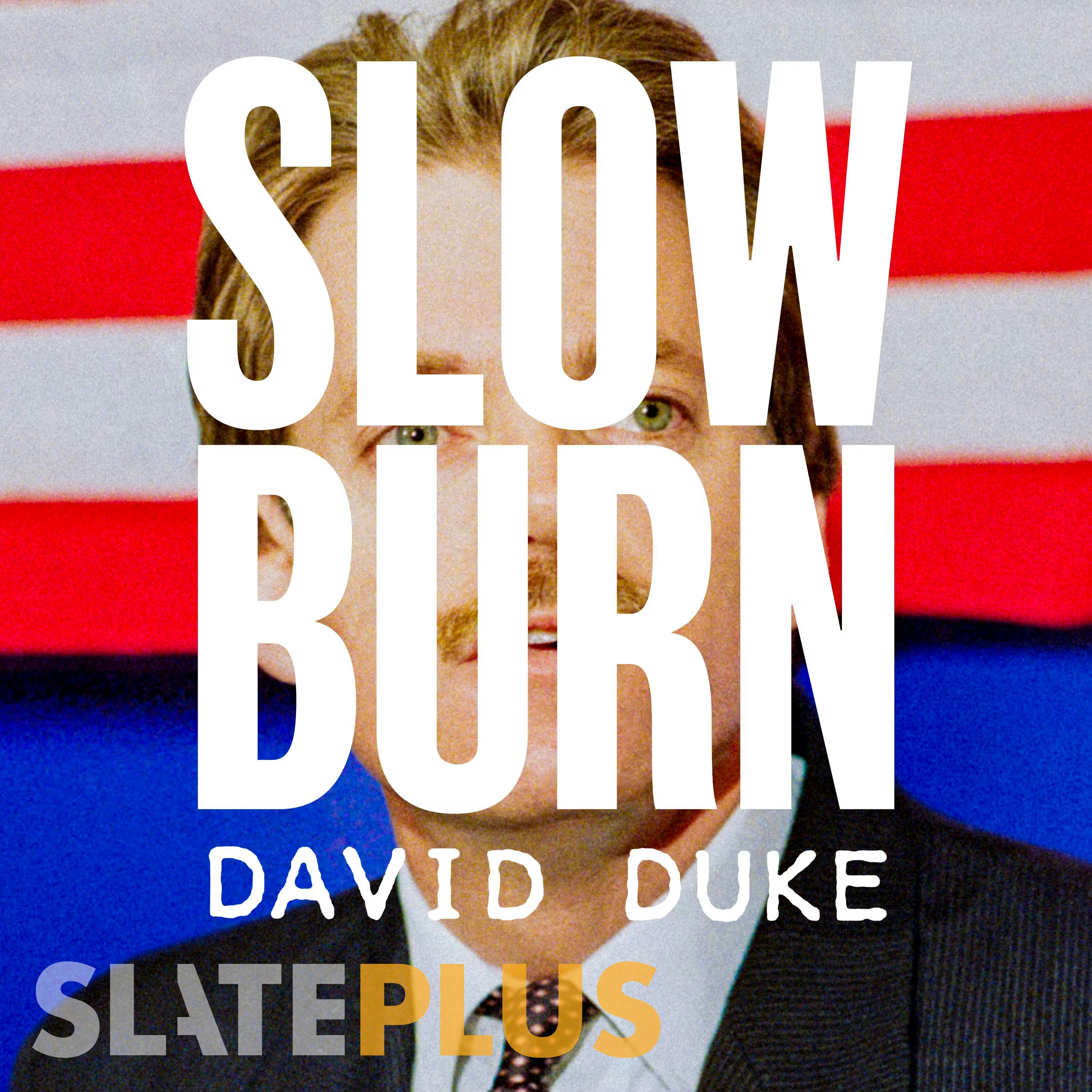
Slow Burn
David Duke | 6. A Concerned Citizen
00:09:22
David Duke nearly became the governor of Louisiana. What did it take to stop him?
Loading summary
Transcript37 lines
- [00:00]
Rakuten Advertiser
Shop with Rakuten and you'll get it. What's it? It's the real deal. Cash back and savings on almost everything you buy. Join Rakuten and start getting cash back at cvs, Instacart, YSL Beauty and other stores you love. You can even stack sales on top of cash back. Just start shopping with Rakuten to save money and get that cash back feeling. Join for free@rakuten.com or get the free Rakuten app that's R a K u t e n rakuten.com.
- [00:32]
Narrator (Josh Levin)
This podcast contains language that some listeners might find offensive. It was comforting to imagine that the David Duke phenomenon was an illusion or a fad that people would get wise that Duke would hit a ceiling. Plenty of people thought that. But in the fall of 1991, Duke's movement just kept building.
- [00:55]
Interviewee/Participant
Louisiana politician David Duke has a new listing on his resume. He is not only a former grand wizard in the Ku Klux Klan, he is also now a runoff candidate for governor.
- [01:07]
Narrator (Josh Levin)
He was repudiated by both state and national Republican parties, yet finished a strong second with 32% of the vote.
- [01:15]
Interviewee/Participant
We have no support from a lot of the major publications and newspapers, but we have the endorsement that counts for this state, the endorsement of the people of Louisiana.
- [01:29]
Narrator (Josh Levin)
There were four weeks between the primary in the governor's race and the Nov. 16 runoff. For Duke, those 28 days were his best chance to become a real force in American politics. Duke was running as a Republican against Democrat Edwin Edwards, who'd served three terms as governor in the 1970s and 80s. Edwards had long been accused of running Louisiana as his personal fiefdom, using his position to enrich himself and his friends. Republicans who'd been on the rise in the state for more than a decade despised Edwards and the style of politics he represented. David Duke looked at the power Edwards had wielded and wanted some of it for himself.
- [02:10]
Interviewee/Participant
In this state, the governor is like a king. He basically does what he wants. So I have the opportunity to make great changes if I'm elected, and that's.
- [02:18]
Narrator (Josh Levin)
What I want to do for everyone, fighting to keep David Duke from gaining that kind of power. The runoff was the time to make a final stand to convince the people of Louisiana that this was an emergency.
- [02:31]
Interviewee/Participant
In my mind, you had to vote for Edwin Edwards even if you didn't want to. Cause without that vote, then David Duke would win.
- [02:44]
Narrator (Josh Levin)
Kirby Neuberger lived in the New Orleans suburb of Metairie, and he worked in wealth management. When Neuberger's Candidate, the reform minded Republican Buddy Romer finished third in the gubernatorial primary. He was left with two unappealing choices. But for Neuberger, it was an easy call.
- [03:02]
Interviewee/Participant
And it was the morning after the election when I called my printer and I said, I would like for you to print up for me a thousand bumper stickers. They'd say, vote for the Crook. It's important. He said, I'll do it. I said, do you need to know the color scheme? He said, no, I got it. I said, great.
- [03:25]
Narrator (Josh Levin)
The color scheme was white text on a blue background, the same as David Duke's campaign signs. Neuberger says it cost him about $820 to print those backhandedly pro Edwards stickers. He plastered the first one on the bumper of his Oldsmobile Cutlass convertible.
- [03:43]
Interviewee/Participant
I would be driving around and people would honk their horn and say, that's a great bumper sticker. Where did you get it? And I'd say, do you want one? And I'd pull over and open my trunk and take one out and hand one to them.
- [04:01]
Narrator (Josh Levin)
There were other anti Duke slogans. No Dukes, Nuke Duke. David Dork for Fuhrer. Vote for the Lizard, not the Wizard. But it was Neuberger's message that took off. Vote for the Crook. It's Important captured the dark comedy of an election in which the least horrifying candidate was a guy widely seen as the quintessentially shady Louisiana politician. But the bumper sticker also made it clear that this race wasn't a joke, that the stakes for the state had never been higher. Neuberger was trying to reach people in his own demographic. White conservatives who weren't sympathetic to Duke's bigotry but who had defined themselves in opposition to Edwards. Together, the Republican candidates had gotten 64% of the votes in the primary. If those votes stayed with the gop, then David Duke would be the next governor. Neuberger was asking his fellow Republicans to recognize that some things were even more important than vanquishing Edwin Edwards. The outcome of the governor's race wouldn't just be decided by Kirby Newberger types. Kent Smith was the student body president at the historically black Southern University in Baton Rouge.
- [05:13]
Kent Smith
Just felt like we had to get engaged and kind of one of those not on our watch kind of things. As a student, even then, it was kind of, this can't be happening.
- [05:27]
Narrator (Josh Levin)
When Duke made it to the runoff, Smith joined his fellow students in marching to the state Capitol. He also helped organize a voter registration drive with entertainment provided by the Southern University Marching Band.
- [05:40]
Kent Smith
We're talking about over a thousand people, you know, in lines. And the concern was that they would leave when they saw the lines being so long to register. And so, you know, having the band there, the band for Southern nights, is a really, really big deal. And it made all the difference in the world. And so it became a festive gathering of positivity, if you will.
- [06:10]
Narrator (Josh Levin)
The students at Southern University weren't alone. Close to 65,000 Louisianans would register in the two days after the primary in Jefferson Parish, David Duke's home Turf, more than 2,000 people were still in line when the office was scheduled to close at 8pm with three weeks to go until election Day, the race looked extremely tight. One poll showed Edwards with 46% of the vote and Duke at 42%, with 12% of voters still undecided. Lance Hill hadn't expected Duke to make the runoff and he found Duke's strength at the polls profoundly worrying. Hill was the executive director of the Louisiana Coalition Against Racism and Nazism, the state's most prominent anti Duke organization. He'd read most everything that Duke had written and he'd heard Duke disparage blacks and Jews in the harshest possible terms. He was constantly thinking about persuasion, about how to convince as many people as possible to see David Duke like he saw David Duke. During the month long stretch between the primary and the runoff, Hill got to talking with a man at a bar, a white working class guy who said he liked Duke and what Duke stood for. Hill tried to sway him. He said that Duke admired Adolf Hitler and that as governor, Duke would follow Hitler's playbook, winning power at the ballot box, then demolishing democratic institutions.
- [07:37]
Lance Hill
And the guy said he was incredulous. He said, well he, he can't do that. And I said, what do you mean he can't do that? He said, this is America. You can't just get rid of democracy. And it really sunk into me that aside from the racism of Duke's movement and how it attracted people, they also believed that democracy was always safe. And that's very difficult objection to overcome in an argument.
- [08:11]
Narrator (Josh Levin)
What arguments did David Duke's opponents make? Who did they hope to persuade? And what did it mean in those four weeks in 1991 to stand up and be counted? One of the most divisive elections any.
- [08:25]
Lance Hill
State has seen in a long time.
- [08:27]
Interviewee/Participant
Louisiana will tell us a good deal about the state of race relations and middle class frustration everywhere. Somehow the word has gotten out that.
- [08:36]
Kent Smith
There'S a possibility that this could happen anywhere in America.
- [08:43]
Narrator (Josh Levin)
This is slow burn. I'm josh levine. Episode 6 a concerned citizen. Hi. I hope you're enjoying this season of Slow burn. The last two episodes are available only to Slate plus members. You can sign up by going to slate.com slowburn or by clicking on the link in the show notes. It's only $15 for your first three months with your subscription. You also get access to bonus Slow Burn episodes with extra interviews and behind the scenes stories. And your membership lets you listen to every Slate show ad free and gives you unlimited access to Slate's website. So to hear the rest of the season and become a member, go to slate.com slowburn or click the link in the Episode Notes. Thanks for supporting our work.
- [09:56]
Interviewee/Participant
Wasn't that delicious?
- [09:58]
Rakuten Advertiser
So good.
- [09:58]
Lance Hill
Your bill, ladies.
- [09:59]
Rakuten Advertiser
I got it.
- [10:00]
Lance Hill
I got it.
- [10:00]
Rakuten Advertiser
No, I got it. Seriously, I insist. I insisted first. Oh, don't be silly. You don't be silly.
- [10:07]
Interviewee/Participant
People with the Wells Fargo Active Cash.
- [10:09]
Narrator (Josh Levin)
Credit card prefer to pay because they earn unlimited 2% cash rewards on purchases.
- [10:14]
Lance Hill
Okay.
- [10:14]
Rakuten Advertiser
Rock, paper, scissors for it. Rock, paper, scissors.
- [10:17]
Lance Hill
Shoot.
- [10:18]
Narrator (Josh Levin)
No. The Wells Fargo Active Cash credit card.
- [10:21]
Interviewee/Participant
Visit Wells Fargo.com ActiveCash Terms apply.