Podcast
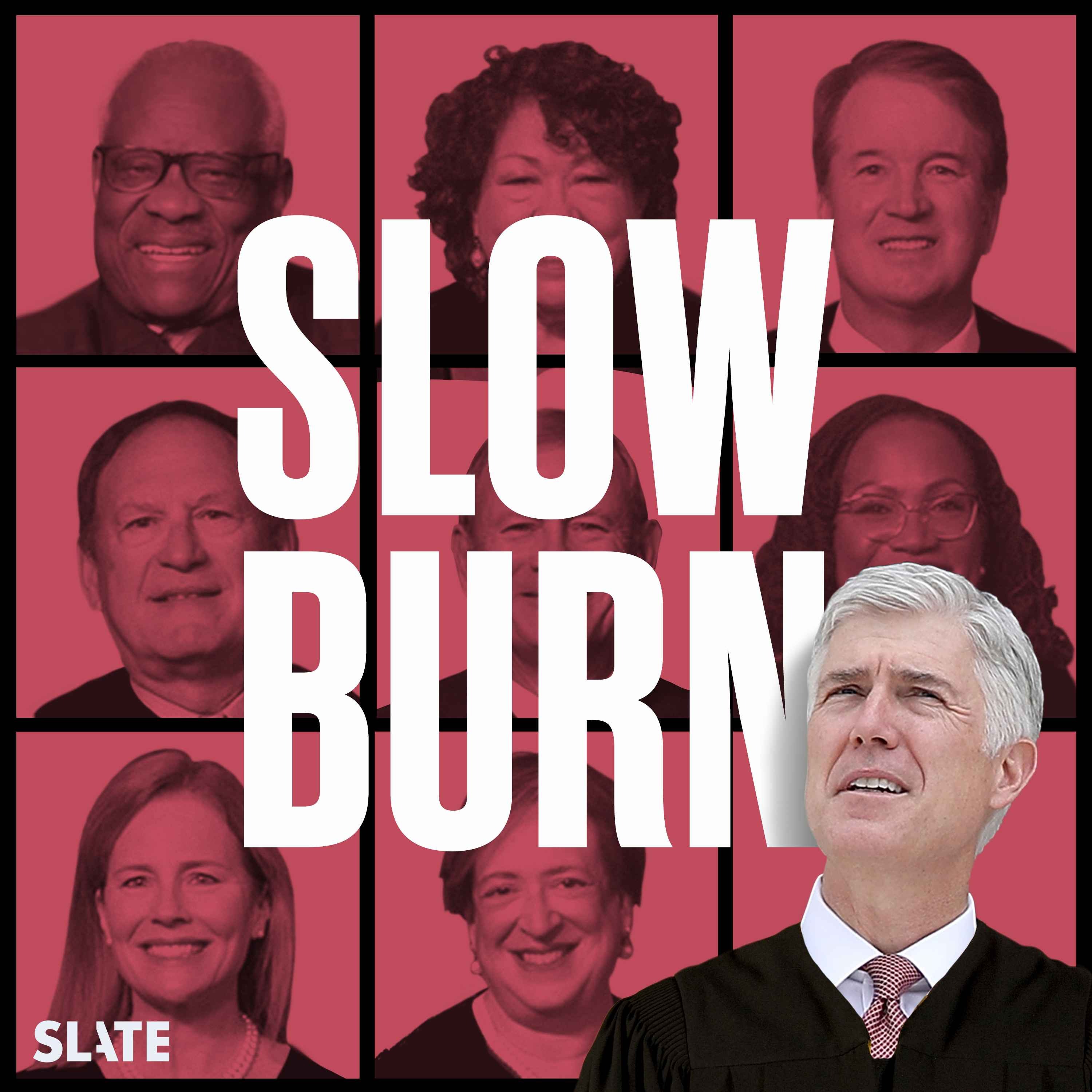
Slow Burn
Hosted by Slate Podcasts · EN
Slow Burn illuminates America’s most consequential moments, making sense of the past to better understand the present. Through archival tape and first-person interviews, the series uncovers the surprising events and little-known characters lurking within the biggest stories of our time.
Join Slate Plus to unlock full, ad-free access to Slow Burn and your other favorite Slate podcasts. You can subscribe from the Slow Burn show page on Apple Podcasts and Spotify. Or visit slate.com/slowburnplus to get access wherever you listen.
Season 11: Becoming Justice Gorsuch
How Neil Gorsuch laid the foundation for a SCOTUS supermajority and then became its most unexpected wild card.
Season 10: The Rise of Fox News
How a cable news channel became a cultural and political force—and how a whole bunch of people rose up to try and stop it.
Season 9: Gays Against Briggs
A nationwide moral panic, a California legislator who rode the anti-gay wave, and the LGBTQ+ people who stepped up and came out to try and stop him.
Season 8: Becoming Justice Thomas
Where Clarence Thomas came from, how he rose to power, and how he’s brought the rest of us along with him, whether we like it or not. Winner of the Podcast of the Year at the 2024 Ambies Awards.
Season 7: Roe v. Wade
The women who fought for legal abortion, the activists who pushed back, and the justices who thought they could solve the issue for good. Winner of Apple Podcasts Show of the Year in 2022.
Season 6: The L.A. Riots
How decades of police brutality, a broken justice system, and a video tape set off six days of unrest in Los Angeles.
Season 5: The Road to the Iraq War
Eighteen months after 9/11, the United States invaded a country that had nothing to do with the attacks. Who’s to blame? And was there any way to stop it?
Season 4: David Duke
America’s most famous white supremacist came within a runoff of controlling Louisiana. How did David Duke rise to power? And what did it take to stop him?
Season 3: Biggie and Tupac
How is it that two of the most famous performers in the world were murdered within a year of each other—and their killings were never solved?
Season 2: The Clinton Impeachment
A reexamination of the scandals that nearly destroyed the 42nd president and forever changed the life of a former White House intern.
Season 1: Watergate
What did it feel like to live through the scandal that brought down President Nixon?
Hosted on Acast. See acast.com/privacy for more information.
187episodes
Episodes
Newest firstAll episodes
Decoder Ring | McGruff Takes a Bite Out of Crime, Part 1 (Encore)
Today00:33:44Summary readyMcGruff the Crime Dog arrived on the scene at the dawn of the 1980s, just as a firehose of anti-drug PSAs was inundating the youth of America. These messages didn’t always work as intended—but they did work their way into the long term memories of the kids who heard them.In the first of two episodes, originally released in 2022, we take a look at PSAs and their strange afterlife through the lens of a trench-coat wearing bloodhound and his bizarre, yet catchy anti-drug songs. We’ll talk to Dan Danger, Sherry Nemmers, Joseph Cappella, David Farber, Mike Hawes, and Robin Nelson to discover how the McGruff Smart Kids Album came to exist in the first place.This episode was written by Willa Paskin. It was produced by Willa Paskin and Katie Shepherd. We had production help from Sam Kim. Editing by Jamie York and Derek John. Decoder Ring is produced by Max Freedman and Evan Chung, our supervising producer. Merritt Jacob is Senior Technical Director. Our intern is Phoebe Mulder.Thank you to Wendy Melillo, Dan McQuade, Dale Mantley, Larissa Zargeris, Daisy Rosario, Dave Bledsoe, Larre Johnson, Duane Poole, Ari Merkin, Charles and Karen Rosen, and Eric Greenberg.If you have any cultural mysteries you want us to decode, email us at DecoderRing@slate.com or leave a message on our hotline at (347) 460-7281.Get more of Decoder Ring with Slate Plus! Join for exclusive bonus episodes of Decoder Ring and ad-free listening on all your favorite Slate podcasts. Subscribe from the Decoder Ring show page on Apple Podcasts or Spotify. Or, visit slate.com/decoderplus for access wherever you listen.Need to set up your Slate Plus feed? If you subscribed through Slate.com, check out our FAQ at slate.com/podcastfaqs for easy instructions. Members subscribed via Apple Podcasts get automatic access—no setup required. Hosted on Acast. See acast.com/privacy for more information.
SummaryDecoder Ring | The Fight Over Sunlight
2w ago00:52:21Summary readyThe sun has always been a hot topic. For centuries, we’ve flip-flopped over whether our health depends on soaking up its rays—or shielding ourselves from them. The current conventional wisdom is clear: Avoid sunburns at all costs, using shade, hats, long sleeves, and the highest SPF sunscreen your drugstore has to offer.But in a historical sense, that advice is pretty new. Not long ago, doctors told parents to slather babies in oil and let them roast in the afternoon sun. Tanning was once medically prescribed. Though we’ve lived under it for all of human history, we’ve never quite figured out how much sun is actually good for us. So where has the pendulum landed today? And why does it keep swinging in the first place?In this episode of Decoder Ring, Willa talks to Rowan Jacobsen, author of the new book In Defense of Sunlight: The Surprising Science of Sun Exposure, who argues that our current guidelines have gone too far in emphasizing the risks of the sun. She also speaks with Catherine Cocks, the director of the Syracuse University Press and author of Tropical Whites: The Rise of the Tourist South in the Americas, about how race drove our cultural obsession with suntanning.This episode was written by Willa Paskin and our supervising producer, Evan Chung, who also produced this episode. Decoder Ring is also produced by Max Freedman. Merritt Jacob is Senior Technical Director. Our intern is Phoebe Mulder.If you have any cultural mysteries you want us to decode, email us at DecoderRing@slate.com or leave a message on our hotline at (347) 460-7281.Get more of Decoder Ring with Slate Plus! Join for exclusive bonus episodes of Decoder Ring and ad-free listening on all your favorite Slate podcasts. Subscribe from the Decoder Ring show page on Apple Podcasts or Spotify. Or, visit slate.com/decoderplus for access wherever you listen.Need to set up your Slate Plus feed? If you subscribed through Slate.com, check out our FAQ at slate.com/podcastfaqs for easy instructions. Members subscribed via Apple Podcasts get automatic access—no setup required. Hosted on Acast. See acast.com/privacy for more information.
SummaryDecoder Ring | Weapons of Map Destruction
4w ago00:48:55Summary readyMost of us use GPS—the Global Positioning System—on a daily basis: to find our location when we’re driving, running, shopping, dating, and so much more. But GPS is even more important, and more vulnerable, than you think.In the last few years, GPS interference has been reported all over the world, from war zones to shipping routes to public squares. What was once the fanciful plot of a Bond movie—bad guy manipulates GPS to start World War III—is increasingly plausible. How did the world come to rely so heavily on such an unreliable system?In this episode of Decoder Ring, host Willa Paskin talks to journalist Katherine Dunn, author of the new book Little Blue Dot: How GPS Shaped the Modern World. You’ll learn how GPS works, why it was created, how it became so ubiquitous, and why it’s now under attack. You’ll also hear from Dr. Todd Humphreys, an aerospace engineer who manipulated GPS to trick an $85 million superyacht into following his direction—for science, of course.This episode was written and produced by Max Freedman. It was edited by Willa Paskin and Evan Chung, our supervising producer. Merritt Jacob is Senior Technical Director. Our intern is Phoebe Mulder.If you have any cultural mysteries you want us to decode, email us at DecoderRing@slate.com or leave a message on our hotline at (347) 460-7281.Sources for This Episode Burgess, Matt. “When a tanker vanishes, all the evidence points to Russia,” WIRED, Sep. 21, 2017.Dunn, Katherine. Little Blue Dot: How GPS Shaped the Modern World, Bloomsbury Publishing, 2026.Dunn, Katherine. “How to Hack a Superyacht,” The Walrus, Jun. 13, 2026.Hopper, Nate. “The Thorny Problem of Keeping the Internet’s Time,” The New Yorker, Sep. 30, 2022.Hopper, Nate. “The Timekeeper of Ukraine,” The Atlantic, Sep. 21, 2024.Need to set up your Slate Plus feed? If you subscribed through Slate.com, check out our FAQ at slate.com/podcastfaqs for easy instructions. Members subscribed via Apple Podcasts get automatic access—no setup required. Hosted on Acast. See acast.com/privacy for more information.
Summary
Introducing First America: “Merciless Indian Savages”
Jul 800:37:04Summary readyHere at Slow Burn, we explore the events and people who shaped America as we know it today. As the country marks its 250th birthday this summer, we want to introduce you to the first installment of First America, a great podcast series that explores a truly consequential moment from our nation’s past. We have been told the American Revolution was fought over taxation and representation. First America reveals the real story of why the colonists rebelled, what kind of government they created, and how it led to America’s current political moment. Hosted by Rebecca Nagle, an Indigenous author and former host of Crooked Media’s This Land podcast, the series looks at the hunger for Indigenous land that fueled the American Revolution—and questions how an entire country missed the point of its own founding document. The show's first episode takes its title from the lesser-known last grievance in the Declaration of Independence. Listen to “Merciless Indian Savages,” from First America—and find the rest of the series wherever you get podcasts.Need to set up your Slate Plus feed? If you subscribed through Slate.com, check out our FAQ at slate.com/podcastfaqs for easy instructions. Members subscribed via Apple Podcasts get automatic access—no setup required. Hosted on Acast. See acast.com/privacy for more information.
SummaryDecoder Ring | We Are Monumentally Bad at Statues
Jul 100:48:50Summary readyIt seems like the only time you hear about new statues these days is when something goes horribly wrong. Unfortunate bronze renditions of Lucille Ball, Cristiano Ronaldo, Dwayne Wade, and many others are always going viral, becoming a fixture of late-night shows and mocking comment sections. Is the internet too harsh a critic? Or is American statuary a total bust?In this episode of Decoder Ring, host Willa Paskin talks to artist Atalanta Arden-Miller about what’s happened to one of the oldest artistic traditions in the world—why so many contemporary statues turn out off-center, off-kilter, and off-putting. The answer takes us from ancient Greece to Nazi Germany to North Korea.This episode was written by Willa Paskin. It was produced by Max Freedman. It was edited by Josh Levin and Evan Chung, our supervising producer. Merritt Jacob is Senior Technical Director. Our intern is Phoebe Mulder.Special thanks to the Works in Progress Podcast, where we first heard Atalanta talk about the dismal state of statuary today.If you have any cultural mysteries you want us to decode, email us at DecoderRing@slate.com or leave a message on our hotline at (347) 460-7281.Get more of Decoder Ring with Slate Plus! Join for exclusive bonus episodes of Decoder Ring and ad-free listening on all your favorite Slate podcasts. Subscribe from the Decoder Ring show page on Apple Podcasts or Spotify. Or, visit slate.com/decoderplus for access wherever you listen.Need to set up your Slate Plus feed? If you subscribed through Slate.com, check out our FAQ at slate.com/podcastfaqs for easy instructions. Members subscribed via Apple Podcasts get automatic access—no setup required. Hosted on Acast. See acast.com/privacy for more information.
SummaryDecoder Ring | Tina Turner and the Dance That Conquered Australia
Jun 1700:49:09Summary readyIn Australia, no wedding or school dance is complete without the Nutbush, Australia’s unofficial national dance. The Nutbush – a simple line dance to the song “Nutbush City Limits,” by Ike and Tina Turner – has become as stereotypically Australian as kangaroos, boomerangs, and Vegemite.And yet, hardly anyone outside of Australia even knows the Nutbush exists. Here at Decoder Ring, we certainly didn’t – until we started getting emails from Australians asking us to investigate its origins. How did an American song become the soundtrack for an Australian national tradition? Who invented the iconic steps, and why does every Australian know them?Our producer Max Freedman put on his dancing shoes to get some answers. The global, century-spanning story of the Nutbush involves Australia, Tennessee, Denmark, primary schools, gay discos, and demonstrates that even the goofiest cultural touchstones can go surprisingly deep.In this episode you’ll hear from culture journalists David Mack and Angus Kidman; Nutbush researchers Panizza Allmark and Jon Stratton; dance historians Erica Okamura and Richard Powers; Dr. Fiona Chatteur, Jeremy Santolin, and Brian Kerr.This episode was written and produced by Max Freedman and edited by Evan Chung, our supervising producer. Merritt Jacob is Senior Technical Director.If you have any cultural mysteries you want us to decode, email us at DecoderRing@slate.com or leave a message on our hotline at (347) 460-7281.Get more of Decoder Ring with Slate Plus! Join for exclusive bonus episodes of Decoder Ring and ad-free listening on all your favorite Slate podcasts. Subscribe from the Decoder Ring show page on Apple Podcasts or Spotify. Or, visit slate.com/decoderplus for access wherever you listen.Need to set up your Slate Plus feed? If you subscribed through Slate.com, check out our FAQ at slate.com/podcastfaqs for easy instructions. Members subscribed via Apple Podcasts get automatic access—no setup required. Hosted on Acast. See acast.com/privacy for more information.
SummaryBecoming Justice Gorsuch | 3. A Lunch Room for Life
May 2700:53:59Summary readyIn our final episode, it’s time to talk about Neil Gorsuch and the future of SCOTUS. Host Susan Matthews enlists Slate’s jurisprudence team—Amicus co-hosts Dahlia Lithwick and Mark Joseph Stern—to discuss Gorsuch’s key rulings to date, his unpredictability, and how this textualist will shape this court (and our country) for decades to come.Want more Slow Burn? Join Slate Plus to binge every episode of Becoming Justice Gorsuch—and every season of Slow Burn, including Becoming Justice Thomas. You’ll also enjoy ad-free listening to all of your favorite Slate podcasts. Visit slate.com/slowburnplus to get access wherever you listen.Season 11 of Slow Burn was written and reported by Susan Matthews. It was produced by Sophie Summergrad and Joel Meyer. It was edited by Mia Lobel, Hillary Frey, and Evan Chung. Original music by Hannis Brown. Merritt Jacob mixed this episode. Mia Lobel is the executive producer of Slate Podcasts.Need to set up your Slate Plus feed? If you subscribed through Slate.com, check out our FAQ at slate.com/podcastfaqs for easy instructions. Members subscribed via Apple Podcasts get automatic access—no setup required. Hosted on Acast. See acast.com/privacy for more information.
SummaryBecoming Justice Gorsuch | 2. The Stolen Seat
May 2000:44:43Summary readyWhen Justice Antonin Scalia died in February of 2016, the Supreme Court appeared to be headed for a 5-4 liberal majority. Instead, a staggering blockade by Senate Republicans and a shocking electoral upset helped steal a seat and clear the way for today’s conservative supermajority. In our second episode, we examine Neil Gorsuch’s politically fraught path to power and his time on the bench so far, including the unpredictability that has made him the high court’s wild card.Want more Slow Burn? Join Slate Plus to binge every episode of Becoming Justice Gorsuch—and every season of Slow Burn, including Becoming Justice Thomas. You’ll also enjoy ad-free listening to all of your favorite Slate podcasts. Visit slate.com/slowburnplus to get access wherever you listen. Season 11 of Slow Burn was written and reported by Susan Matthews. It was produced by Sophie Summergrad and Joel Meyer. It was edited by Mia Lobel, Hillary Frey, and Evan Chung. Original music and sound design by Hannis Brown. Mia Lobel is the executive producer of Slate Podcasts.Our legal editor is Mark Joseph Stern. Special thanks to Dahlia Lithwick, Sara Burningham, and Patrick Fort. Episode artwork by Natalie Matthews-Ramo.Need to set up your Slate Plus feed? If you subscribed through Slate.com, check out our FAQ at slate.com/podcastfaqs for easy instructions. Members subscribed via Apple Podcasts get automatic access—no setup required. Hosted on Acast. See acast.com/privacy for more information.
SummaryBecoming Justice Gorsuch | 1. Man With a Plan
May 1300:36:39Summary readyNeil Gorsuch may not be the most well-known justice on the Supreme Court, but he might just be the key to understanding how and why the current court has come to wield so much power over our day-to-day lives. In our first episode, host Susan Matthews examines Gorsuch’s early years, what he took away from his iconoclastic mother’s rocky tenure in the Reagan administration, and how his worldview was shaped by his time on a liberal college campus and in 1980s conservative circles. Plus: the controversial court case that might have gotten Gorsuch noticed by just the right people at just the right time.Want more Slow Burn? Join Slate Plus to binge every episode of Becoming Justice Gorsuch—and every season of Slow Burn, including Becoming Justice Thomas. You’ll also enjoy ad-free listening to all of your favorite Slate podcasts. Visit slate.com/slowburnplus to get access wherever you listen. Season 11 of Slow Burn was written and reported by Susan Matthews. It was produced by Sophie Summergrad and Joel Meyer. It was edited by Mia Lobel, Hillary Frey, and Evan Chung. Original music and sound design by Hannis Brown. Mia Lobel is the executive producer of Slate Podcasts.Our legal editor is Mark Joseph Stern. Special thanks to Dahlia Lithwick, Sara Burningham, and Patrick Fort. Episode artwork by Natalie Matthews-Ramo.Need to set up your Slate Plus feed? If you subscribed through Slate.com, check out our FAQ at slate.com/podcastfaqs for easy instructions. Members subscribed via Apple Podcasts get automatic access—no setup required. Hosted on Acast. See acast.com/privacy for more information.
Summary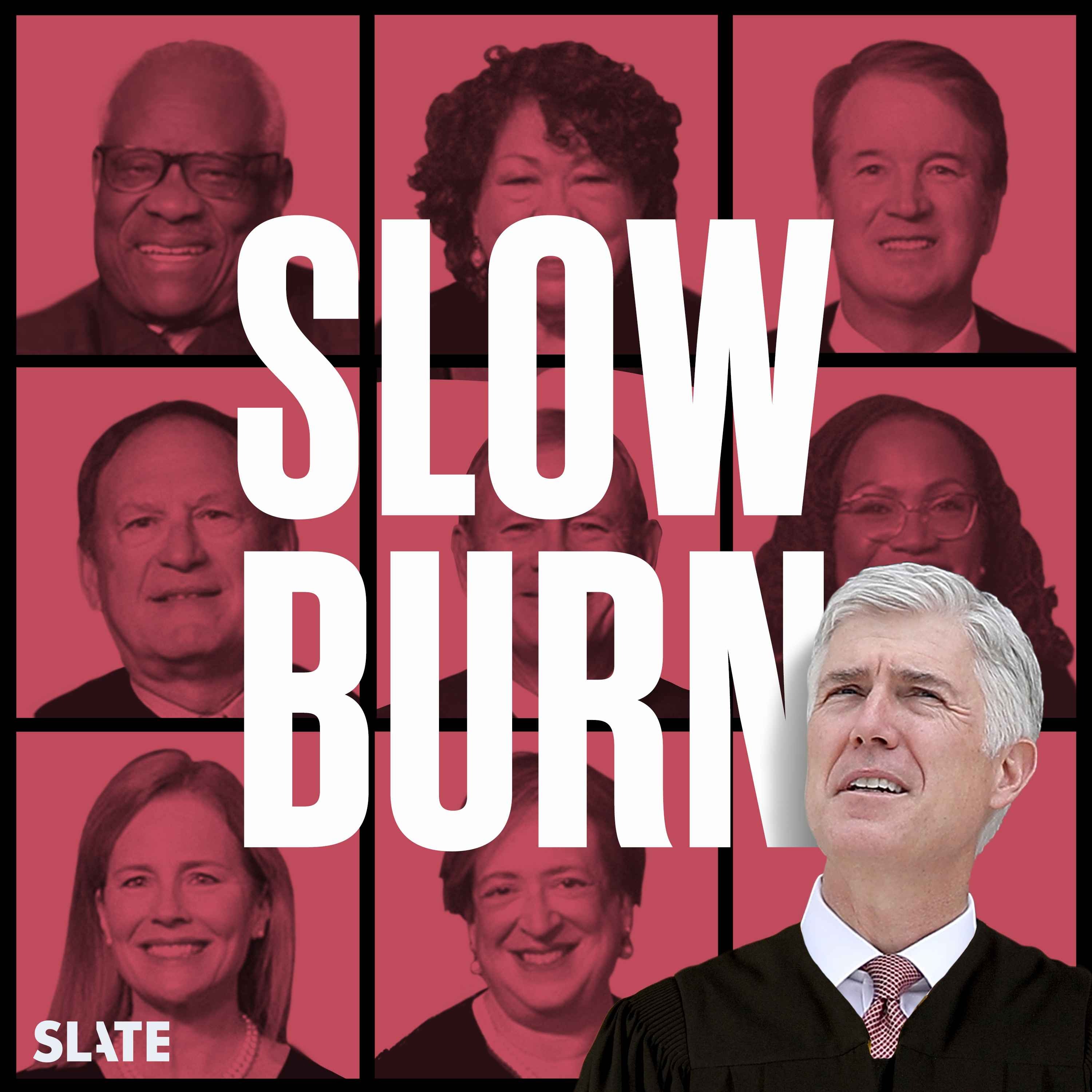
Season 11 Trailer: Becoming Justice Gorsuch
May 700:02:09Summary readyComing May 13: Host Susan Matthews traces the rise of Neil Gorsuch, from his formative years as a young conservative through his nomination to a “stolen seat” on the U.S. Supreme Court. Through interviews, legal analysis, and archival research, the mild-mannered Westerner emerges as the court’s most unpredictable—and most important—sitting justice.Need to set up your Slate Plus feed? If you subscribed through Slate.com, check out our FAQ at slate.com/podcastfaqs for easy instructions. Members subscribed via Apple Podcasts get automatic access—no setup required. Hosted on Acast. See acast.com/privacy for more information.
Summary