← Slow Burn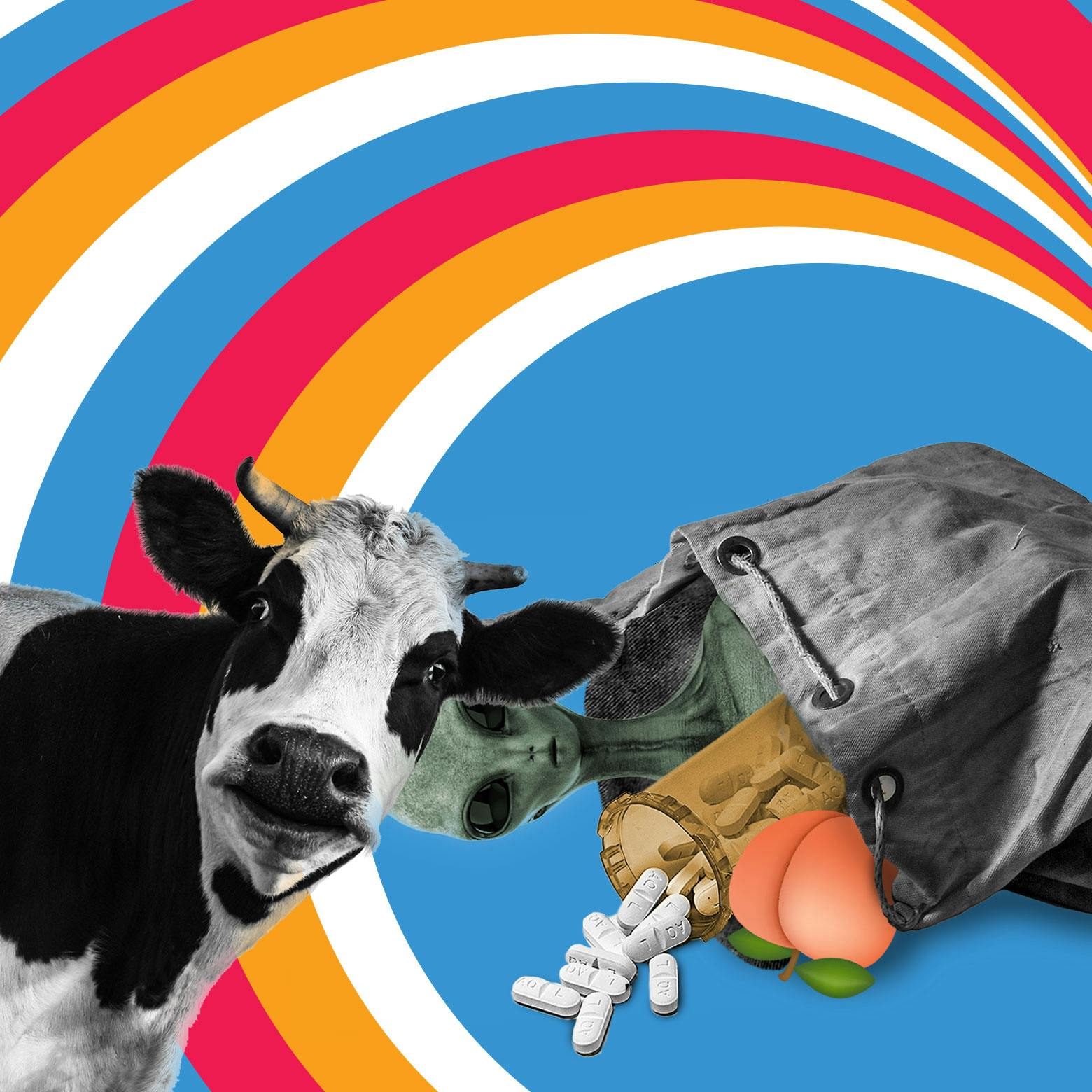
Slow Burn
Decoder Ring | Mailbag: Drug Names, Cow Abductions, and the “Ass-Intensifier”
00:50:01
Why aliens might take an interest in livestock, how pharmaceuticals get such wacky names, and more listener questions.
Loading summary
Transcript216 lines
- [00:01]
Willa Paskin
This podcast is brought to you by Progressive Insurance. You chose to hit play on this podcast today. Smart Choice make another smart choice with Auto Quote Explorer to compare rates from multiple car insurance companies all at once. Try it@progressive.com Progressive Casualty Insurance Company and affiliates not available in all states or situations. Prices vary based on how you buy. In case you haven't heard, it's officially an Abercrombie Summer. The A and M Vacation Shop has everything on your packing mood board. I desperately need their new one piece, the A and F Marina. It's strapless, so flattering and paired with denim shorts will be my go to beach outfit this summer. Finally, your suitcase isn't complete without finding that dress.
- [00:51]
Nicole Holliday
You know, the one for the photo shoot.
- [00:53]
Willa Paskin
Abercrombie's boho dresses have that perfect beachy romantic look. Make it an Abercrombie Summer shot their newest arrivals in store, online and in the app. It has been noted by stoner movies and people with too much time on their hands that if you say a word enough times in a row, you can make it strange. I'm not even talking about the obvious words like arboreal or bureaucracy or water, but even just like cat, cat, cat. Why is that our word for our most self possessed house pet? Sometimes a word doesn't need repetition or narcotics to get weird to you. In fact, in the ots, a word behaving in a very specific way tried jumped out to Eric Scheuer, an animator in Portland, Oregon, just in the course of a regular conversation.
- [01:57]
Eric Scheuer
I definitely remember the first time a friend of mine came to me and said like somebody was talking about her son being a grown ass man. I've never heard that before.
- [02:07]
Willa Paskin
Eric couldn't remember hearing or noticing someone drop ass into a phrase for emphasis before either.
- [02:14]
Eric Scheuer
I'm pretty white, I'm pretty Caucasian, most of my friends are. And I know that slang. By the time that we're using it or me, it is old news by.
- [02:24]
Willa Paskin
Decades elsewhere, old news or otherwise. He took a shine to it somehow.
- [02:29]
Eric Scheuer
To my ears, it made complete sense.
- [02:31]
Willa Paskin
Immediately after that he couldn't stop hearing it.
- [02:34]
Eric Scheuer
You know, he's a grown ass man. You're, you know, get your stupid ass face away from me or whatever.
- [02:39]
Nicole Holliday
Hey, hey, hey, I'm a grown ass man.
- [02:41]
Eric Scheuer
Campbell's soup. It's just wet ass food.
- [02:44]
Laurel Sutton
I think I wore this nice ass.
- [02:45]
Eric Scheuer
Shirt for her today.
- [02:46]
Laurel Sutton
You know you got a big ass knife sticking out of you.
- [02:48]
Willa Paskin
Big ass, nice ass, grown ass, dead ass, hard ass, badass, stupid ass, silly ass, goofy ass, loud ass, There seems to be no adjective you can't make funnier or more forceful just by dropping an ass on it.
- [03:02]
Eric Scheuer
It just seems like the word ass intensifies. It's like it's a slightly more risque way of saying very.
- [03:08]
Willa Paskin
Eric has even come to think of this linguistic quirk by a special name, the ass intensifier. He's now spent years wondering about the ass intensifier, and he's accumul a number of questions about it.
- [03:22]
Eric Scheuer
I'm curious about how the word ask got in there and linguistically, functionally, what's what it's doing there. I'd like to know, like in English, like historically, what records do we have of it? And then I'd be curious about similar phenomena in other languages. Do other languages have similar things?
- [03:43]
Willa Paskin
Luckily, he emailed exactly the right people to get him some answers. This is Decoder Ring. I'm Willa Paskin. We're very lucky to get a lot of fascinating questions from our listeners, and so as we do from time to time, we're opening up our mailbag to try and answer some of them. In addition to looking at the creative ass use of, well, the word asks, we're going to make sense of the seemingly wild world of pharmaceutical names and probe the special relationship between cows and aliens. That's all today on Decoder Ring. Thanks to you.
- [04:38]
Laurel Sutton
Foreign.
- [04:43]
Willa Paskin
Can use a little help to shape the direction of their lives. From fitness routines to mental resilience to navigating personal goals and tackling burnout. That's what the Life Kit podcast from NPR is here to help you do. If you're looking to move with more intention or just need thoughtful guidance on living better, Life Kit delivers strategies to help you make meaningful, sustainable changes. Life Kit offers real stories, relevant insights, and clear takeaways to help you meet those large and small decision making moments with confidence and clarity. Trusted voices and expert advice can help take you to the next step, however big or small. Listen to Life Kit to hear thoughtful conversations that unpack the emotional and practical side of personal wellness along with actionable guidance you can actually use. No fluff, no judgment. Listen now to the Life Kit Podcast from npr.
- [05:42]
Eric Scheuer
This podcast is brought to you by Progressive Insurance. Do you ever think about switching insurance companies to see if you could save some cash? Progressive makes it easy. Just drop in some details about yourself and see if you're eligible to save money when you bundle your home and auto policies. The process only takes minutes and it could mean hundreds more in your pocket. Visit progressive.com after this episode to see if you could save Progressive Casualty Insurance Company and affiliates. Potential savings will vary. Not available in all states.
- [06:17]
Willa Paskin
So we're going to pick up with Eric's question about the origins of what he calls the ass intensifier, which turns out to be its proper ass name.
- [06:26]
Nicole Holliday
We actually do call it ass intensifier in the scholarly literature.
- [06:30]
Willa Paskin
Nicole Holliday is an acting linguistics professor at the University of California, Berkeley.
- [06:35]
Nicole Holliday
There is another, like, wonderful scholar who calls it the anal emphatic, which, like, wow, chef, kiss.
- [06:44]
Willa Paskin
Nicole explained to me that linguistically, an intensifier is any word or phrase that emphasizes another word.
- [06:51]
Nicole Holliday
Something that can basically replace anything where you're trying to use like, very or extremely.
- [06:56]
Willa Paskin
So, like, she's a grown ass woman. That's just saying, like, she's very grown.
- [07:00]
Nicole Holliday
Yes, that is the intensifier.
- [07:02]
Willa Paskin
And like, similarly, like, I woke up at ass o' clock in the morning. That's just like, I woke up very early in the morning.
- [07:07]
Nicole Holliday
Right. But it also carries some association of informality, naughtiness, familiarity. Right. I could say I'm very tired, but I could also say I'm ass tired. And then it doesn't just mean, yes, I'm extremely exhausted. It means I'm extremely exhausted.
- [07:24]
Laurel Sutton
Ha ha.
- [07:25]
Nicole Holliday
Or we're informal, or we're joking, or we're friends.
- [07:29]
Willa Paskin
And why do we do this?
- [07:30]
Nicole Holliday
Because we're creative and it's fun.
- [07:35]
Willa Paskin
A researcher named Wilson J. Miller traced the usage of the ass intensifier back to 1942 and Marines serving in the Second World War.
- [07:43]
Eric Scheuer
Somewhere in the South Pacific, a powerful.
- [07:45]
Willa Paskin
Task force of United States Marines begins.
- [07:47]
Eric Scheuer
Offensive action to retake the strategic Solomon Islands.
- [07:50]
Nicole Holliday
They had this abbreviation, bam, Bam for big asked Marine, and used it on women. Like women Marines at that time, big assed Marines. And so it's asked, and you can see how you get that as sort of an adjective. Big asked. But then it starts to get dropped, because that sound like a T or a D when it follows an S, like, gets dropped all the time. Right. That spinal sound sort of disappears. So then you see a little bit later, the Marines also calling a plane a big ass bird. So then you get big ass.
- [08:25]
Willa Paskin
These are the oldest written examples we have of the ass intensifier, but it was almost surely used in spoken language earlier. And Nicole says it's a real possibility that it came out of one community in particular.
- [08:37]
Nicole Holliday
It could be African American English that was introduced to white GIs during that time. It wouldn't be surprising. It's very widespread in African American English. But we, we don't exactly have recordings from pre1940s to know that for sure.
- [08:50]
Willa Paskin
Whenever exactly it started after the war, it began to spread.
- [08:54]
Nicole Holliday
The first time that you see it attested outside of this military usage is the Oxford English Dictionary has it in 1945, talking about a police with a nightstick, a big ass nightstick. And it sort of seems to flow out from there into the culture and expand in use for the next 80 years.
- [09:11]
Willa Paskin
I mean, how many more times am I gonna have to listen to a sad ass pity party?
- [09:14]
Eric Scheuer
Shit, I can't afford this nice ass car.
- [09:16]
Willa Paskin
I swear, I don't know who is the wor between you and that lazy ass brother yours. Have we just been using it as much as we use it now for a long time, or do you think we use it more now?
- [09:26]
Nicole Holliday
I think we use it more now. This is interesting because things like intensifiers are not supposed to be invented, right. They're supposed to be what we call a closed class. So we come up with new nouns every day. Who knew what an uber was as a noun before ten years ago? Right, right. So nouns open class, intensifiers are supposed to be closed class. We don't invent new things like very all the time, but when you get one that starts to function way, it becomes extremely productive. So words like very are very, very high frequency. We say that word every day.
- [09:55]
Willa Paskin
Right.
- [09:55]
Nicole Holliday
So once you see that it can be used like this, it becomes sort of expansive. The other thing is this big ass thing has to occur in an informal register, so we're just less formal. You can see it like in clothes. Nobody's wearing stockings and suits to the office all the time, unless you're like on Wall street or something. So there's some arguments that profanity has become more socially acceptable, especially in the last like 20 years. And so as we've become more accepting of profanity, I think it just allows for this to be used in informal and humorous contexts more often.
- [10:28]
Willa Paskin
I also just noticed in sort of like big ass marine, big ass bird, big ass nightstick. Like a literalism almost in the early examples of it, where it's like an ass can be big, right? Like the thing on our bodies.
- [10:44]
Nicole Holliday
Yes.
- [10:44]
Willa Paskin
Can an ass be crazy? It can't. I'm a miss her crazy ass.
- [10:48]
Nicole Holliday
Yeah. So ass itself is a really interesting word. So its original meaning is donkey. And it's attested from the 11th century. So that is when we were speaking something like German. That's before the Norman conquest of 1066, when English got all these French words, so it's an old, old word as far as English goes. And it was ass, like donkey, which we still use that way, but it's kind of antiquated. Then you start seeing it used as a pejorative in the 13th century. So, like, ass, like that guy's an ass, like a fool or a jerk or something. Right. So for 900 years we have this word as a noun. And then in the 40s, you get it with this kind of usage.
- [11:27]
Willa Paskin
When did it start to be buts?
- [11:29]
Nicole Holliday
It looks like ass for but is from the 17th century. So, yes, it's had that meaning since long before we got this big ass.
- [11:41]
Willa Paskin
Are there other things that behave like this in English? Yes.
- [11:46]
Nicole Holliday
I was thinking a lot about dead.
- [11:47]
Willa Paskin
Yeah.
- [11:48]
Nicole Holliday
So in New York City, you get dead ass.
- [11:50]
Eric Scheuer
Are you serious?
- [11:52]
Willa Paskin
Dead ass.
- [11:53]
Nicole Holliday
So, like, it means seriously. Yeah, I'm deadass. Or like, he was dead ass. Right. That kind of thing. Right. And you get things like dead tired.
- [12:01]
Willa Paskin
Yeah, yeah, dead tired. Like, it just never occurred to me until this moment that dead is working as an intensifier.
- [12:07]
Nicole Holliday
Yeah. You can also be dead broke, right?
- [12:09]
Willa Paskin
Yeah, yeah, yeah.
- [12:10]
Nicole Holliday
And like, we do this with butt, right? So like butt ass ugly, butt ass, butt, ass ugly. You could also be butt ugly. Yeah, yeah, right. Just like ugly ass or ass ugly. I guess the other thing is, a lot of the examples that we've been talking about are like stupid, ugly, dumb, one and two syllable words. But there have been claims that ass can't attach to words that are longer than three syllables or that people kind of don't like it. You can't say like, that was a significant ass claim.
- [12:41]
Willa Paskin
Fantastic ass.
- [12:43]
Nicole Holliday
Yeah, Fantastic ass argument. Like, maybe, but it doesn't sound as good as ugly ass.
- [12:48]
Willa Paskin
It's like just something about that sounds wrong to all of us.
- [12:51]
Nicole Holliday
And the linguist Jeff Pullum says that that's actually because it has to be informal. And long words in English tend to come from Latin. All of our fancy words are Latin and they' longer. So that's why you shouldn't get something like articulate ass. Like, he's an articulate ass guy. Like, is it because it's long or is it because it's a fancy word? Like, we don't know.
- [13:13]
Willa Paskin
Do other languages have things like this? Or do you?
- [13:15]
Nicole Holliday
I mean. Yes. So I found a paper from 2021 by a Danish guy, Bingston, who says that Danish has ass intensifier. And it's ROV R O V O with the, like slash through it. So it's a vowel we don't have.
- [13:29]
Willa Paskin
Does that word mean ass?
- [13:31]
Nicole Holliday
Yes. And it does exactly the same thing.
- [13:35]
Willa Paskin
That's amazing. It's crazy how much we all just know what everything means, even though we can't articulate it.
- [13:42]
Nicole Holliday
Yeah. And so because we're all using language all the time, like we are creative, we make mistakes, we're accidentally hilarious, right? The language is changing. One mandate that children and teenagers have is to change the language. Like in every society that has ever existed, the children will change the language because they need it to work for them. And they'll do it sometimes in really dramatic ways and sometimes in really subtle ways. And there's this interaction with like, what's happening in the society and identity and race and culture and gender and all this stuff. But that is why we get so frustrated when the old people complain about language change. It's just like, you did it too. And all of this tells us something about the cognitive ability of humans that is really awesome.
- [14:25]
Eric Scheuer
Right?
- [14:25]
Nicole Holliday
Like one day submarines were like, literally. One dude probably was like, big ass marine. And everyone was like, that cooks like we like it this lap.
- [14:42]
Willa Paskin
When we come back, some cow ass loving aliens. This message is sponsored by Greenlight. With school out, summer is the perfect time to teach our kids real world money skills they'll use forever. Greenlight is a debit card in the number one family finance and safety app used by millions of families, helping kids learn how to save, invest and spend wisely. Parents can send their kids money and track their spending and saving while kids build money, confidence and skills in fun ways. Start your risk free Greenlight trial today@greenlight.com Spotify that's greenlight.com Spotify Jack Daniels is.
- [15:26]
Eric Scheuer
Proudly served in fine establishments, questionable joints.
- [15:30]
Laurel Sutton
And everywhere in between. So no matter where you go in every bar, you'll always know someone by name.
- [15:38]
Nicole Holliday
Jack Jack and Coke.
- [15:40]
Eric Scheuer
Shot of Jack.
- [15:41]
Willa Paskin
Jack Daniels, please.
- [15:43]
Eric Scheuer
Right away. That's what makes Jack Jack. Please drink responsibly. Responsibility.org Jack Daniels and old number seven are registered trademarks. Copyright 2025 Jack Daniels Tennessee Whiskey. 40% alcohol by volume 80 proof.
- [15:57]
Willa Paskin
Our next listener question comes from Stacen Goldman in Stowe, Massachusetts. It occurred to her a few months ago when she was watching her son play a video game called Scribblenauts.
- [16:07]
Laurel Sutton
And he was very, very frustrated. On the screen was an alien that was telling him, give me what you want and I'll leave in peace. And he looked at me and he said, I don't know what the alien wants. And I Looked at the screen and it was a little green man in a ufo. And I said, oh, he wants a cow.
- [16:30]
Willa Paskin
Stacen's son was baffled.
- [16:32]
Laurel Sutton
He did not understand why the alien would want a cow. And I said, just trust me. That alien wants a cow.
- [16:38]
Willa Paskin
So he dutifully typed in the word cow and then a cow appeared on screen.
- [16:46]
Laurel Sutton
And the alien took the cow and flew off in peace. And my son was even more confused. He said, why did he want that? How did you know that he wanted that? And I couldn't tell him.
- [17:00]
Willa Paskin
I had no idea.
- [17:02]
Laurel Sutton
But I knew as soon as I saw the alien in the UFO that aliens abduct cows. I have no idea where I got this notion.
- [17:11]
Willa Paskin
I don't know where I saw it.
- [17:12]
Laurel Sutton
The first time, but I know that I've seen it around. It's just in the culture. Aliens just abduct cows.
- [17:21]
Willa Paskin
Stason's right. Aliens particular interest in cows is all over the culture. Moo, moo, moo, moo. It's there in the first episode of south park when aliens determine that cows are the most intelligent beings on planet Earth. Moo, moo, moo, moo. What the hell are they talking about? It's in the opening scene of the movie Mars Attacks when the Martians set a herd of cattle on fire. In a classic Got Milk? Ad from the mid aughts, a couple of aliens are awed by the image of a cow on a dairy barn.
- [17:58]
Laurel Sutton
Da. Eerie is the supreme line. Got milk.
- [18:05]
Willa Paskin
And yes, cows and aliens also co star in many, many video games. Which brings us to Stason's question.
- [18:15]
Laurel Sutton
How do we all think this? Why do we all think this?
- [18:19]
Willa Paskin
As ubiquitous as the idea of cow abducting ETs has become, it didn't originate in movies, TV games or even in the 20th century.
- [18:28]
Eric Scheuer
So this idea that aliens like to abduct cows seems to have started in the year 1897 with a farmer from Kansas by the name of Alexander Hamilton.
- [18:40]
Willa Paskin
Greg Egigian is a historian at Penn State University and the author of after the Flying Saucers, a global history of the UFO phenomenon.
- [18:50]
Eric Scheuer
Alexander Hamilton gets awakened one night. It's about 10:30pm his tenant and his son are also there because they hear this kind of unrest among their cattle.
- [19:04]
Willa Paskin
His cows are going crazy, making a racket. So he goes outside and he says.
- [19:09]
Eric Scheuer
What he sees about 600ft in the sky is this massive, massive, what he called airshell.
- [19:16]
Willa Paskin
It's huge, 300ft long and mostly red. And there's a carriage on the underside made of glass so that he can see six alien beings inside. And then he notices something that makes it all even stranger.
- [19:31]
Eric Scheuer
There are wires or cables or something along those lines that has a hold of one of his heifers by the neck, lifting this heifer off of the ground. The ship then flies off with the heifer in tower.
- [19:51]
Willa Paskin
The next day, he gets a visit from a local farmer who lives around four miles away, who says he's made a gruesome discovery.
- [19:57]
Eric Scheuer
I have found the hide, the legs, and the head of your heifer. Everything else is gone. And what's really, really strange is all of those remains were on my farm, but there were no footprints around it. And that's the story Alexander Hamilton told.
- [20:14]
Willa Paskin
And Hamilton wasn't the only one to report seeing mysterious airships in the sky. For a couple of years in the late 1890s, people around the world were sharing stories of similar sightings. Alexander Hamilton's version caught on so quickly that it didn't seem to matter when he confessed just a month after his initial story ran in a local Kansas newspaper that he had made the whole thing up.
- [20:41]
Eric Scheuer
Alexander Hamilton belonged to a community of men called the Liars Club. And the Liars Club was a group of guys who would spend their free time trying to tell the most outlandish story. It was kind of a competitive thing, and so all of this seems to have been part of that.
- [21:00]
Willa Paskin
Despite his confession, Hamilton's tall tale lived on for decades. It was relatively obscure, even among scholars of the supernatural. But then came the atomic age, and with it, the golden era of the flying saucer.
- [21:14]
Eric Scheuer
They looked something like a pie plate that was cut in half with a sort of a convex triangle in the rear. They appear to be hovering in midair with what I believe to be a spinning action. I believe that the flying saucers are objects from another planet. In the mid-1960s, when flying saucers are a really, really big thing, some of the very famous really advocates and proponents of flying saucers start to repeat the story as if it is a hundred percent the God's honest truth.
- [21:49]
Willa Paskin
And then, in the 1970s, this notion of aliens abducting cows zoomed into the mainstream, thanks to a phenomenon that at first didn't seem like it had to do with extraterrestrials at all.
- [22:01]
Eric Scheuer
You start to hear these stories of cattle mutilations.
- [22:06]
Willa Paskin
Thousands of cattle, horses, and other animals have been cut up in strange ways.
- [22:11]
Eric Scheuer
Today, nearly 15,000 mutilation reports have been.
- [22:14]
Willa Paskin
Received across the country, but especially in the west and southwest. Wyoming, New Mexico, Colorado, Ranchers reported coming across dead cows missing some unusual body parts, usually an ear, an eye, the.
- [22:28]
Eric Scheuer
Tongue, sex organs, udders, rectums. It's been a very, very precise surgical type incision. The body, more often than not, has been drained of blood, though no blood has been found on the ground. No tracks of any kind, human or otherwise, led to or from the animals. The fear was that they were being mutilated by someone or something.
- [22:52]
Willa Paskin
Mike Goleman wrote about this wave of cattle mutilations While getting his PhD in history from Mississippi State.
- [22:58]
Eric Scheuer
Initially, when these ranchers are reporting what they're seeing, they're reporting it to the local authorities. And the sheriff is coming there and looks at this dead animal and says, wow, I've never seen anything like this before. Because they literally haven't. Then what starts to happen is reporters come out who really have never seen anything like this before. Have you ever seen anything like this in your life? I don't know.
- [23:20]
Willa Paskin
The story gets picked up by national news outlets like Time magazine, Newsweek, even.
- [23:25]
Eric Scheuer
Playboy, and it starts to kind of take a life of its own.
- [23:29]
Willa Paskin
With all this attention came a flurry of investigations from local and state law enforcement, university researchers, and more. And they all came up empty.
- [23:39]
Eric Scheuer
No one could find any evidence that it was anything but natural scavenger activity in predation.
- [23:48]
Willa Paskin
The idea of finding a dead cow with its eyes, tongue, genitals, and udders missing might seem strange to those of us who don't deal with cattle with any regularity. But those are actually the soft tissues that scavengers like flies, skunks, and vultures go for first. And what looked like the draining of the animal's blood also had a mundane explanation. The blood most likely pooled and coagulated out of sight. In other words, what was happening with the cattle was in reality, pretty ordinary.
- [24:20]
Eric Scheuer
Unfortunately, yes.
- [24:23]
Willa Paskin
But for those cattle ranchers, ordinary wouldn't cut it. Every cow they found dead and mutilated was a huge financial hit. So they went looking for someone to blame. And at first, that was not aliens.
- [24:37]
Eric Scheuer
Most of them believed that the federal government had something to do with it.
- [24:43]
Willa Paskin
Ranchers were already PR the government for their troubles. The peak of these reported cattle mutilations almost exactly overlapped with an economic period so catastrophic for the cattle industry, it became known as the Wreck.
- [24:58]
Eric Scheuer
These cattle are a liability to the men who own them. At today's prices, the cost of raising and feeding them is more than the animals bring on the wholesale market.
- [25:06]
Willa Paskin
And the wreck was largely blamed on the federal government.
- [25:10]
Eric Scheuer
Once you put the Government in your cattle business, you're in trouble. They just cannot regulate that business. It just is unbelievable how they can mess it up. We start to see their frustrations with the federal government manifest and how they respond to these mutilations that are being reported. Oftentimes what they reported seeing were helicopters that were hovering in the area either prior to or after a series of mutilations. Now, these helicopters, they probably are federal government helicopters, but they're part of the Bureau of Land Management, who frequently would fly in these areas.
- [25:46]
Willa Paskin
But many cattle ranchers became convinced that these helicopters had a more nefarious purpose.
- [25:51]
Eric Scheuer
There were several incidents where ranchers, when they would see a helicopter in the sky, they'd shoot at it.
- [25:59]
Willa Paskin
Conspiracy thinking was also in the zeitgeist, not just for cattle ranchers. Americans were learning just how much they didn't know about the war in Vietnam and the JFK assassination and Watergate.
- [26:10]
Eric Scheuer
The institutions that Americans trusted were no longer being trusted. There was a lot of reasons to not take what was being said at face value.
- [26:22]
Willa Paskin
So how did a conspiracy theory about the federal government turn into a conspiracy theory about aliens? Mike Goldman credits a Colorado TV reporter named Linda Moulton Howe. Who, or what, is killing and mutilating these animals? A Strange Harvest. Linda Moulton Howe's hour long documentary was first broadcast in May 1980.
- [26:45]
Eric Scheuer
Could it be cults?
- [26:47]
Willa Paskin
Predators? Helicopters, UFOs?
- [26:53]
Eric Scheuer
She had an agenda beyond just reporting about the mutilations themselves. She was involved in the UFO community and very quickly tied these mutilations to extraterrestrial activity.
- [27:07]
Laurel Sutton
If extraterrestrials are the ones mutilating animals.
- [27:12]
Willa Paskin
What do you think the implications are.
- [27:14]
Eric Scheuer
Then for this planet? All of us involved have been concerned with the possibility of the mutilations going from animals to human beings.
- [27:21]
Willa Paskin
Understandably, the movie ends with a long, strange scene in which a woman under hypnosis describes having actually witnessed a cow being abducted and mutilated by aliens.
- [27:32]
Laurel Sutton
I can see an animal squirming and trying to get free and it's like it's being sucked up.
- [27:44]
Willa Paskin
Linda Moulton Howe won a regional Emmy award for A Strange Harvest. She wrote a book expanding on it, and she became a kind of celebrity in the UFO community.
- [27:52]
Eric Scheuer
She really is the key person who bangs this drum of the idea that cattle mutilation represent some kind of escalation of alien contact.
- [28:05]
Willa Paskin
Again, historian Greg Egigian that the aliens.
- [28:08]
Eric Scheuer
Are invested in experimenting with trying to create human alien hybrids, and somehow the cattle are involved.
- [28:17]
Willa Paskin
And this idea has been remarkably durable since the 1980s cattle mutilations, as well as the more benign and less disgusting cattle abductions have shown up regularly in pop culture.
- [28:30]
Laurel Sutton
Mulder, why would alien beings travel light years to Earth in order to play doctor on cattle?
- [28:35]
Eric Scheuer
For the same reason we cut up frogs and monkeys. Cattle mutilations, possible homicide. And here's the fun part. The perp, according to the rancher, is an alien life form. Another cow up another tree. This is, to my mind, some sort of extraterrestrial activity.
- [28:53]
Willa Paskin
In New Mexico, you can find T shirts and vinyl stickers with an image that looks like the yellow road sign for a cattle crossing. And except above the black silhouette of a cow, there's a flying saucer. The National Museum of the Air Force sells an alien abduction cow T shirt. And there are socks, coffee mugs, toys, and even a table lamp shaped like a UFO beaming up a cow. Ironically, Greg says the belief in cattle abductions is pretty fringe, even among dedicated ufologists. So why is it so sticky for the rest of us? It's true that believers like Linda Moulton Howe are still out there spreading the Gospel.
- [29:32]
Laurel Sutton
It's now 2025 February, and nothing has changed.
- [29:37]
Willa Paskin
The government of the United States has.
- [29:39]
Laurel Sutton
Still not told people the truth.
- [29:41]
Willa Paskin
And that every few years there's a new crop of stories about mysterious cattle deaths. Someone is killing cows. 20 so far, the latest just on Monday.
- [29:50]
Eric Scheuer
This ranch in Northeastern Utah lost 14 expensive animals in less than two years. Carved up with surgical precision. Their owner is rational explanations, and that has her looking to the sky.
- [30:02]
Willa Paskin
But for those of us who fret neither about alien visitation nor the health of our herd, the appeal of the alien cow connection may be pretty straightforward.
- [30:12]
Eric Scheuer
The likeliest explanation is because it's kind of funny, this image of a cow being sucked up by a beam of light. Cows, you know, have this kind of nonplussed facial expression. They have. They're very large, they're very bulky. So to see them in the sky is already kind of goofy and silly.
- [30:36]
Willa Paskin
Though maybe not so silly if you happen to be a cow, you better.
- [30:41]
Eric Scheuer
Pray to the Lord when you see those flying saucers.
- [30:45]
Willa Paskin
It may be the coming of the Judgment Day.
- [30:50]
Eric Scheuer
It's a sign.
- [30:51]
Willa Paskin
There's no doubt of the judgment trouble laughs about.
- [30:55]
Eric Scheuer
So I say, my friends, you'd better start to pray.
- [30:59]
Willa Paskin
When we come back, something nearly as strange sounding as cow abductions. Zavzaprat. Hey, business owners, we know you know the importance of maximizing every dollar. With the Delta SkyMiles Reserve business American Express card, you can make your expenses work just as hard as you from afternoon coffee runs to stocking office supplies and even team dinners, you can earn miles on all your business expenses. Plus, you can earn 110,000 bonus miles for a limited time through July 16th. The Delta SkyMiles Reserve business card. If you travel, you know minimum spending requirements and terms apply. Offer in 71625 Our listener Amy Goldfine lives in Marin County, California, and she called in to ask about something that's been bugging her every time she goes to the pharmacy why are prescription drug names so bonkers? I get migraines, and some of the new meds have names that look like someone's cat just walked all over the keyboard. You've got Culypta, Viepti, Ubrelvi, and my favorite name, Zabspret. Am I saying that right? Honestly, not sure. I'm sure there's a perfectly good reason behind these weird names, but I can't figure it out. Those migraine meds are just the tip of the iceberg. Pharmaceutical names in general have been getting pretty esoteric.
- [32:34]
Eric Scheuer
What you may need is Xgeva Discover, Gemtessa.
- [32:38]
Willa Paskin
Novage is simple, Cutensa is different, Tyrvaya it's not another drop.
- [32:43]
Laurel Sutton
I will say at the start, naming pharmaceuticals is a pain in the ass.
- [32:48]
Willa Paskin
Laurel Sutton is a professional namer and it turns out, Amy's neighbor.
- [32:52]
Laurel Sutton
I co founded Catchword, a naming firm here in the Bay Area of California, and I've been doing professional naming for more than 25 years.
- [33:00]
Willa Paskin
And have you gotten to name any pharmaceuticals?
- [33:03]
Laurel Sutton
Yes. People tend to think of naming sometimes as a Mad Men effort, where you're sitting around in a bar after work and you're writing stuff down on napkins as you're quaffing your beer. That is not how it works. Works. It's people sitting at their desks, combing through thesauri and all sorts of reference books and online resources to just come up with different ways of finding a word. Any word that's pronounceable and spellable. Well, sometimes pharmaceutical names aren't really spellable, but that's because of the availability part of it. It is so much work, and the return that you get on the amount of work you put into it is sort of not worth it. So while I've done it, I don't like doing it. Why not?
- [33:47]
Willa Paskin
So tell me, why is it such a pain in the butt when you're.
- [33:50]
Laurel Sutton
Coming up with a name for anything? Whether it's a product or a service or a company, you need to come up with names that are appropriate for the thing that you're naming, but also available. They have to be legally available as trademarks and sometimes also as domain names. So finding a name that is the intersection of those two things is very difficult for anything. When you start naming pharmaceuticals, they need to pass an additional level of scrutiny that's imposed by the FDA here in the United states and the EU's Medical Approval Board. And that is far more difficult because the names need to be distinct from each other. As you can imagine, if a prescription is written and interpreted incorrectly, you could kill someone by giving them the wrong drug. Part of the testing that they do is things like having people say drug names over the phone. So can you hear it clearly over the phone? Can you read it if it's written in a doctor's terrible handwriting? So the name has to be unique enough that it will not be confused for anything else. And finding names that have not already been used that are also available as trademarks is asking an awful lot from a creative firm.
- [35:03]
Willa Paskin
The names that Laurel's talking about, the ones a drug company hires a naming firm to generate, are called brand names. But every drug also has another name, its generic name.
- [35:15]
Laurel Sutton
Those names are rarely seen by the public. Sometimes, you know, when drugs have been around long enough, like Tylenol, for example. The generic name for that is acetaminophen, and people know that now. But when Tylenol was first introduced, nobody knew that it was called acetaminophen. That came later as people learned a little bit more about it.
- [35:34]
Willa Paskin
A generic name like acetaminophen, ibuprofen, or fluoxtine, the generic name for Prozac, is assigned by a consortium of medical and pharmaceutical bodies following strict guidelines. And the generic name's most important quality is that, unlike the brand name, it conveys concrete medical information. The part that does this is called the stem, which is usually the syllables at the end of the name. All drugs of the same class will have the same stem. So, for example, any name ending in triptan will treat migraines. Any drug ending in statin tries to lower cholesterol. Generic names also typically include a couple syllables in front of the stem. These prefixes are meant to make each drug sound very different. So there's simvastatin, lovastatin, fluvastatin, and atorvastatin, which you probably know by its brand name, Lipitor.
- [36:32]
Eric Scheuer
I've been eating healthier, exercising more, and now I'm also taking Lipitor.
- [36:36]
Willa Paskin
All right, so there's the drug names, which are mostly we don't know. Like Viagra is sildenafil. Like, honestly, no one's ever heard that. Slunesta eskio ezo pisioni. I'm like, saying it like it's Italian. I don't know if that's correct or not. But just like, really words we haven't heard. And then there's the brand names, which theoretically they should be more accessible, I assume. Like, what are you thinking about when you're trying to name a drug? Like, what's the ideal set of concerns?
- [37:05]
Laurel Sutton
The ideal situation is when you have a drug and you are trying to name to its benefits. Lunesta is a really good example, in my opinion, as a namer. Lunesta is a great name for that drug because it implies something about what the drug does, which is that it puts you to sleep and it has a. You get a good night's rest, right? And it's got the loon word part in it, which is moon. And it has this beautiful soft ending. Lunesta, right. It sounds peaceful. So it's a really good brand name in that regard.
- [37:36]
Willa Paskin
There's a land of restful sleep. We can help you go there.
- [37:40]
Laurel Sutton
On the wings of Lunesta, Viagra is sort of the opposite in tonality, right? Viagra sounds vigorous. It sounds like Niagara Falls, which brings to mind all sorts of imagery, which, you know, I'm not going to talk about that, but you can imagine it just sounds really tough and powerful and manly. And that's absolutely, absolutely what they were going for.
- [38:03]
Eric Scheuer
This is the age of taking action.
- [38:05]
Laurel Sutton
Viagra. Talk to your doctor. So both of those names are quite memorable and they imply something about the drug. One of the restrictions about drug names in the United States anyway is that a drug name cannot over promise. So you can't ever say that a drug cures a disease if in fact it doesn't cure a disease. So if you can't guarantee the result of it, you can't say that in the name. And one of the funnest, I will say, stories about drug naming in that regard is the drug Rogaine. In other parts of the world, it's called Regain. And they couldn't name it Regain in the United States because they could not guarantee that it would help you regain your hair. So they had to change one letter and they made it Rogaine instead.
- [38:49]
Willa Paskin
But even if you're not calling it Regain, as an English speaker, that association is sort of there in the way that it is for Lunesta or Viagra. So it's kind of, like, doing the same thing. It's just not as explicit.
- [39:00]
Laurel Sutton
Right. You just can't be explicit about it. It is incredible. But sometimes there are drug names that actually kind of say what they do, and I can give you a few examples.
- [39:08]
Willa Paskin
Yeah. Yeah, please.
- [39:09]
Laurel Sutton
One of the names that we came up with long, long ago was for Merck, and that was the name for the first shingles vaccine, which they don't do anymore because Shingrix is the new one. But the name that we came up with was Zostavax, which is a vaccine for Herpes zoster. Zostavax. Pretty obvious. It's good. Says what it does on the tin. And I like that name. Gardasil, another name. So the guard part is like. It guards and Sil. Sil is the medical name for that type of infection. Right. It's squamous intraepithelial lesions, so it guards against sil. Gardasil, Gardasil. Gardasil, Gardasil, Gardasil. With Gardasil, you could be one less. That's a great name. You know, like, could not be more obvious. And they managed to get it, and it was available, and the FDA approved it. That's fantastic. What a success story.
- [40:04]
Willa Paskin
How does it actually work between a brand and the FDA when they're figuring out if something can be a brand name?
- [40:10]
Laurel Sutton
It's a collaborative process from the drug company and the fda. So typically, in a naming effort to name a pharmaceutical, thousands and thousands of names are developed. And then the people at the company, like at Pfizer, for example, will go through those thousands and whittle it down to a couple hundred. And then the legal screenings start, and then they will send names to the fda, one by one, their favorite names. And the FDA will either say yes or no. And if they say no, then they got to go back and submit another name. And that process can go on for months and years. Sometimes the Runway for pharmaceutical naming is years. It can be eight years between when you develop a name and when the drug actually launches, because often the drug is still in development and testing while you're doing the naming for it.
- [40:57]
Willa Paskin
There's sort of these names that I think sort of sound and look like real words. You know, Viagra, Lunesta, Wellbutrin, an antidepressant that has the name. Well, right in there. And then there is lately. Not lately. I mean, for years, something that's happened where you have these drug names that look like Scrabble words.
- [41:19]
Laurel Sutton
Yes.
- [41:19]
Willa Paskin
Like. Like there's. There's no vowels. Like, viepti. Zayprat. It's gotten very elaborate and sort of strange. Like, do you think that they have gotten stranger names?
- [41:31]
Laurel Sutton
Oh, definitely, yeah. Just because of the availability thing. Because you gotta go for little used letters. You know, English doesn't use the letter X very much. It didn't used to anyway, and it does now. There's that one drug that's called Zeljans. Right. The sequence of X, E, L, J is very unusual. Like that does not occur in any English word and probably. Probably in very few words in any language. But it's available. So therefore it's a good name, even if you got to teach people how to pronounce it.
- [42:06]
Willa Paskin
Does it? I mean, it sort of feels like the good names have been taken.
- [42:12]
Laurel Sutton
Well, you know, good. What does good mean? Right. Let's take a new name that's on the market which is very popular right now. Ozempic. Is that a good name? I don't know. It's all over the place. People say it all the time. It's become almost the generic name for weight loss drugs. People will just say Ozempic when they mean one of the other drugs, like Wegovy. But it's out there. People know it. That might qualify as a good name. It's pronounceable. I think the Oz at the beginning is definitely meant to connote a little bit of Oz, like Land of Oz. You're going into this new place and everybody thinks of the movie where you go from black and white to color. It's sort of opening things up in this very beautiful way. But then the name itself has become what we would call productive in that other phrases have been coined off of it. So people will say ozempic face. Right. And there are terms like faux as a name for drugs that aren't Ozempic but are trying to mimic it. So it's become a word that has produced other words and phrases built on top of it. And that's pretty successful for a brand name.
- [43:25]
Willa Paskin
Can I. So I. I actually realized we got some specific. Like some listeners specifically wrote in. Can I just ask you about them? Okay, so zavpret. Like, what does that make you hear? Like, what do you hear? Zavpret? Like, what are you getting anything? What comes through.
- [43:43]
Laurel Sutton
Oh, I mean, okay, so it starts with a zav. Makes it sound a little fast. So in English, the S and Z, the sibilance conveys speed. It's just the way English works. The word pret in French means ready. So I don't know if that's what they were trying to go for. Sound wise. It ends with a T, so it's a plosive. That sounds kind of strong. So to me, just from the sound of it, it's like, works fast, gets it done. Sounds kind of strong.
- [44:13]
Eric Scheuer
Yeah.
- [44:14]
Laurel Sutton
I don't know where the name came from, but that would be my impression.
- [44:18]
Willa Paskin
One of my favorites is Skyrizi. I have moderate to severe plaque psoriasis. Now there's Skyrizi.
- [44:25]
Laurel Sutton
Things are getting clearer. Oh, that's a great name. I love that name.
- [44:31]
Willa Paskin
Why?
- [44:32]
Laurel Sutton
Because the sky part is amazing that they were actually able to incorporate that. And, you know, for us in the western world, sky, you know, blue sky opens things up, makes you feel like it's a beautiful day. And then it's got Riz in it, which I'm not sure if they were trying to do Rizz, but it's there. And then again, it has those S's and Z sounds. So it sounds like it does something really fast, like it lifts you up into the sky. You know, it. It has endless possibilities to it. It's. It's a really good drug name.
- [45:01]
Willa Paskin
Do you think that there's any danger in it just being, like, too hard to name things and so the names just suck?
- [45:09]
Laurel Sutton
Yeah. You know, I worry about this a lot. Having done this for so long, I don't, I don't know where we're headed. I don't know if we're going to run out of names. I don't think we will. But it has gotten exponentially harder to come up with appropriate and available names since I started doing this. It really, really has the addition of requirements like, you know, we need to have the exact dot com. Well, they're all registered, so it is getting harder and I don't know where we're going to end.
- [45:50]
Willa Paskin
This is Decoder Ring. Thank you to everyone who sent us questions. If you have any cultural mysteries you want us to decode, you can please email us@decoderinglate.com you can also call us at 347-460-7281. We love to hear any and all of your ideas for the show. If you aren't already a Slate plus member, you can subscribe now on Apple Podcasts by clicking Try Free at the top of the Decoder Ring show page or visit slate.com decoderplus to get access. Wherever you listen, Slate plus members get access to our bonus episodes and to hear our show and every other Slate podcast without any ads. And there are so many great Slate Podcasts that also take listener questions like Care and Feeding. Our show for Parenting Advice, which recently devoted an episode to a listener's concern about screen time. Like, for example, does a podcast count as screen time? Will we rot your children's brains? You'll have to listen to Care and Feeding to find out. Don't forget, you can subscribe on Apple Podcasts by clicking Try free or visit slate.comdecoderplus to sign up. We'd like to thank Hannah Pullman and Marilyn Ferdinand, who also wrote in Asking about pharmaceutical names. I'm Willa Paskin. Decoder Ring is produced by me, Max Friedman and Katie Shepard. Evan Chung is our supervising producer. Merritt Jacob is senior technical director. We'll see you in two weeks.
- [47:36]
Eric Scheuer
Hi, I'm Josh Levine. My podcast, the Queen tells the story of Linda Taylor. She was a con artist, a kidnapper, and maybe even a murderer. She was also given the title the Welfare Fair Queen, and her story was used by Ronald Reagan to justify slashing aid to the poor. Now it's time to hear her real story. Over the course of four episodes, you'll find out what was done to Linda Taylor, what she did to others, and what was done in her name. The great lesson of this for me.
- [48:09]
Laurel Sutton
Is that people will come to their own conclusions based on what their prejudices are.
- [48:14]
Eric Scheuer
Subscribe to the Queen on Apple Podcasts or wherever you're listening right now.