← Smart Girl Dumb Questions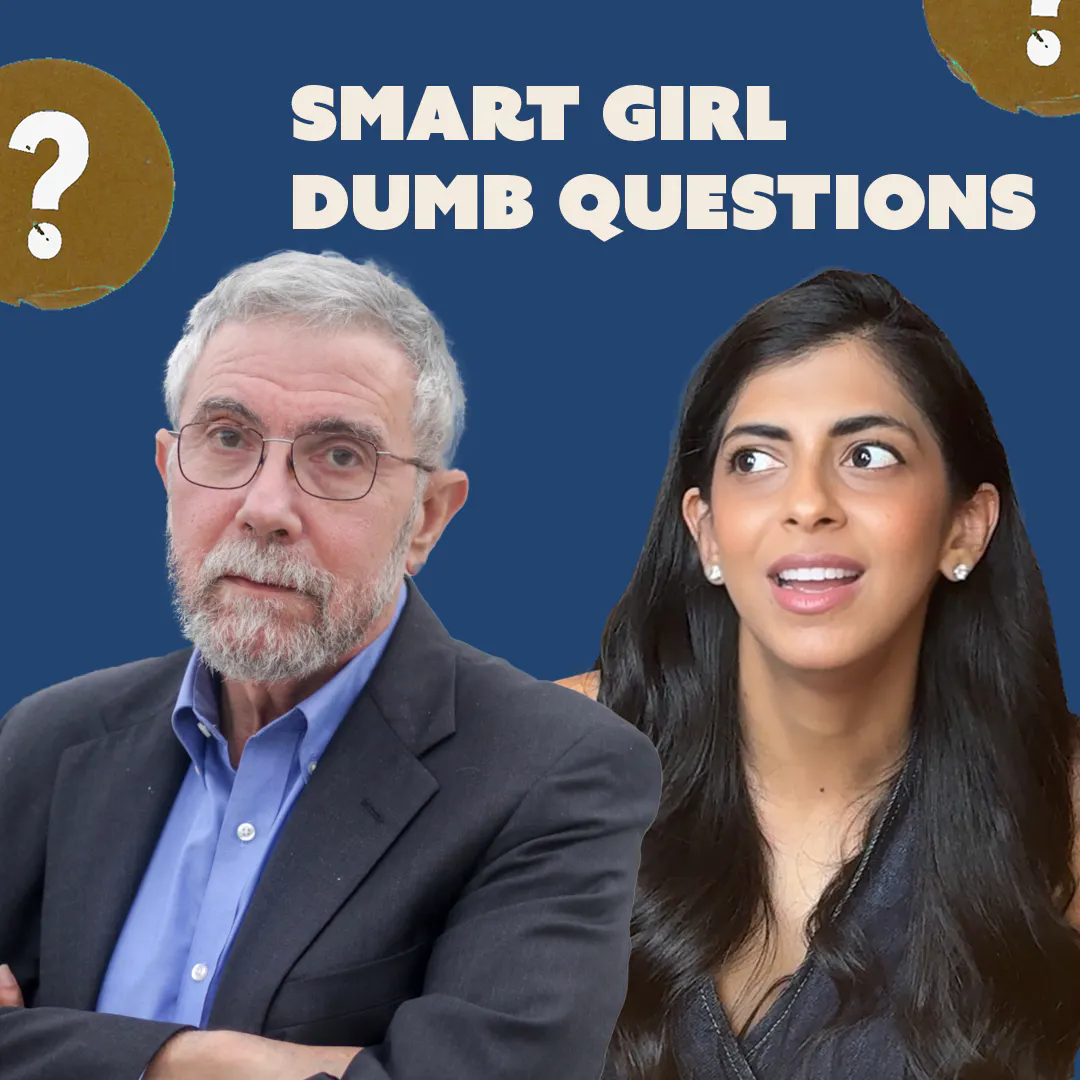
Smart Girl Dumb Questions
Wait… What’s up with the Economy? with Paul Krugman
00:53:02
Are we in a trade war with China? Will BTC replace USD? What’s the latest on tariffs? And are millennials the most screwed generation? Also: can I blame the economy for my difficult dating life?
Loading summary
Transcript142 lines
- [00:00]
Naima Raza
Tariffs. If you had 30 seconds to summarize in the group chat where we are.
- [00:04]
Paul Krugman
Today, the nursery song about the Duke of York. He had 10,000 men. He marched them up to the top of the hill. Then he marched them all back down again. I mean, we're on this.
- [00:16]
Naima Raza
Smart Girl.
- [00:19]
Dumb Questions welcome to Smart Girl Dumb Questions. I'm Naima Reza and that is Paul Krugman, the Nobel Prize winning economist and former New York Times columnist turned independent substacker who has authored thousands of essays, hundreds of papers, dozens of books, and had the ears and attention of many presidents. This economy is hot and cold, like your worst last relationship. So I had so many dumb questions for Paul, like why do the numbers economists and politicians cling to seem so out of sync with the vibes of everyday life? And what's the latest with this tariff drama? Is it going to be solved through the art of 180 trade deals? With Is there a world where we look back and despite all this uncertainty, say that the tariffs were actually a great idea? And why is China responding to them by threatening to send us less stuff? Also, is it possible that crypto is going to replace the US Dollar as the world's key currency? Finally, Selfishly, I needed to know, are millennials the most screwed generation? And can we blame the economy for our difficult dating lives? Here's my conversation with Paul Krugman.
- [01:31]
Paul, thank you so much for doing this.
- [01:33]
Paul Krugman
Well, it's great to be on.
- [01:34]
Naima Raza
I want to start zooming out a little bit. You just put out a 101 primer on your substack around trade policy.
- [01:42]
Paul Krugman
A little bit of politics in there, but mostly just how does this thing work?
- [01:45]
Naima Raza
You started it with saying even generally well informed readers often know less about the basics of trade than economists tend to assume.
- [01:52]
Paul Krugman
Whenever you work in a technical field, as I did for most of my life, it's actually kind of hard to put yourself in the mindset of an intelligent person who follows the news, tries to pay attention to events, but hasn't cracked a textbook in a long time. Just clearly with international trade so much on everybody's radar thanks to Donald Trump, it's really clear from reading, paying attention, talking to people that actually a lot of people don't really have a good sense of why do we have international trade? What are the benefits to the extent that there are costs, whatever.
- [02:29]
Naima Raza
I really appreciated the primer because I do think that we live in a culture where we just nod along or assume to know things, or we're kind of inheriting opinions from Podcasters and quick reads of headlines. And so I think it's really useful to step back and unpack what certain things mean. Do you think people understand economics better or worse than most economists understand regular people's lives?
- [02:51]
Paul Krugman
Most economists are in fact regular people, although they are ordinary people and quite aware of what life is like. And most are not billionaires disabled, least that the formalisms, the stuff that you learned with great effort in grad school tends to get in the way of communication sometimes.
- [03:13]
Naima Raza
So economists are in the business of making predictions, but they're often wrong. So I guess a dumb question I have is, are economists just astrologists with spreadsheets, or is meteorologists a better analogy?
- [03:23]
Paul Krugman
I actually make the analogy with meteorology. You're talking about an extremely complex system where you're going to get stuff wrong. And your prediction of what will happen five days from now, or in the case of may come is probably more like five months from now, is highly uncertain, but it doesn't mean that there's nothing there. And the aftermath of the financial crisis, where I was very involved with that, what was shocking to me was that after we didn't see the crisis coming, but there were reasons for that. It was mostly not understanding how the institutions had changed, but everything that happened after that was right. And before the crisis, if you asked, what is the multiplier, how much does an increase in government spending increase gdp? And the sort of estimate, sort of before we really had strong evidence was that it was around 1.5. And in the aftermath of the crisis, we got a lot of direct evidence, and the answer was it was 1.5. The models worked really, really well.
- [04:24]
Naima Raza
So I want to run through some economic indicators that are treated as gospel in economics and to some extent, politics. But people seem to itch at first up is the unemployment rate.
- [04:35]
Paul Krugman
So look, the Bureau of Labor Statistics, which is an excellent professional organization, they do a survey every month and they ask people a bunch of questions. You know, a large number of people, One of them they ask is, are you working? And then the second one is, if you aren't working, have you been looking for work in the last month? People who are unemployed are people who have been looking for work but haven't found it. Does that properly capture the extent to which people have trouble getting jobs? No, I mean, if you take it literally, there are people who are looking for work who are not unhappy about it, because there takes a while. And there are also people who have given up looking for work because they know there's no jobs available. So it's not a really good indicator of the actual amount of distress, but it's a consistent indicator. And when it moves up, you know that things are getting worse, and when it moves down, you know that things are getting better. So you want to treat it as just an indicator, not as a literal measure of job, you know, availability of jobs.
- [05:34]
Naima Raza
Why don't we use a different indicator, the labor force participation rate?
- [05:38]
Paul Krugman
So labor force participation is everybody who is either working or looking for work as a percentage of adults.
- [05:45]
Naima Raza
Basically, everybody else is not in the workforce.
- [05:48]
Paul Krugman
Right. And so you should know that there are. First of all, there actually there are six measures of the unemployment rate. What we always call the unemployment rate is actually U3. And U6 includes people who are working part time when they want to work full time. It includes people who've given up looking for work. The reason that we use U3 is it's the best measured. There's more subjectivity in the higher numbers. Labor force participation is a really hard one because it changes as society changes. So labor force participation these days is a lot higher than it was in 1960 because women are mostly now part of the paid labor force. A society in which women are much closer to being equal participants in the economy is gonna have a higher labor force participation. But that's not really telling you how easy it is to get jobs.
- [06:44]
Naima Raza
The labor force participation rate amongst white men has gone down in recent history, and that kind of correlates to some of the politics we're seeing.
- [06:53]
Paul Krugman
It used to be that almost every white man in his prime. 25, 54 is the official sort of category.
- [07:04]
Naima Raza
You're just in there, Paul.
- [07:05]
Paul Krugman
No, not nearly. Unlike Ms. Jean Brody, I'm no longer in my prime. But that used to be 90% or more. It used to be that everybody was working. It's considerably lower. And some of that is not necessarily bad stuff. Some of that is more people in school for extended education. Some of it is there's a lot of talk about everybody's playing video games, which is probably grossly exaggerated, but it's not nothing. Some of it is people who are in eastern Kentucky, where there are no jobs, or people who are incapacitated by drugs or. So it's not a good thing. By and large, something has gone wrong, and that is a real issue.
- [07:50]
Naima Raza
Yeah, it feels like, to me, a better indicator in some ways than the unemployment rate because it's indicative of larger structural problems versus, you know, politicians telling us, oh, we added this many jobs. The unemployment rate hovering is still at 4%. And people feeling like their lives are worse, that they can't get a job.
- [08:09]
Paul Krugman
There's no one number. I had an old teacher who used to say that people want a number and what you really want is a story. And so the question is, do we have a problem mostly in kind of the eastern heartland, do we have a problem of prime age men who cannot find jobs or cannot find jobs that they're willing to take? And that is real and it's a serious problem.
- [08:34]
Naima Raza
So the answer is, yes, we do have this problem.
- [08:36]
Paul Krugman
Yeah, we do have this problem.
- [08:37]
Naima Raza
Yeah.
- [08:37]
Paul Krugman
Things look a whole lot better if you were looking at New Jersey.
- [08:42]
Naima Raza
That's rarely said about New Jersey.
- [08:44]
Paul Krugman
Wow. I know. I moved from New Jersey to New York, but grew up around in New York. And you know, New Jersey was always a place where. Where everybody knew that the drivers were crazy, aggressive and stupid. And it's true. But the. But New Jersey and Connecticut are two wealthiest states and. And you can see it. And it shows up in the labor force numbers. But this is all diagnostic. We actually have higher prime age employment, the share of adults for both men and women, especially for women. But the overall number is still the best it's been since the sort of Clinton era boom.
- [09:27]
Naima Raza
Another indicator or kind of system that we look a lot at is the stock market. Why is the stock market a good indicator of the economy?
- [09:35]
Paul Krugman
It isn't. The stock market is a terrible indicator of the economy because. Because first of all, to the extent that it's accurately reflecting what firms should be worth, it's a measure of the discounted value of future profits. And it doesn't tell you anything about wages. So if you have an economy where profits are high because wages are low, stock market may be doing great. But that doesn't mean that the economy is doing great.
- [10:02]
Naima Raza
When you say it's a discounted value of future profits, you mean because we're looking at the projection of how a company or an equity will do in the future. And you're buying it because you believe it will go up.
- [10:12]
Paul Krugman
Yeah, in principle. In principle, the value of a company should be all of the profits going to make in the future. But with profits five years from now worth a lot less than profits now.
- [10:25]
Naima Raza
Got it.
- [10:26]
Paul Krugman
Now, in practice, the market is very subjective. It's based upon a lot of people are buying stocks in the belief that they can sell them again to someone else for more. And it's notoriously volatile, unrelated often to the real economy. Paul Samuelson famously said that the stock market had predicted nine of the last Five recessions. Obviously people are interested in it, but it's not a good indicator of how we're doing.
- [10:57]
Naima Raza
And there's a extreme inequity in kind of who participates in this market. Like 10% of Americans own 90% of the market or something to that effect.
- [11:04]
Paul Krugman
Half the population has nothing, no exposure in the market. Most of the rest have a little bit and they're 401ks. But basically the stock market is the wealth of a very small group of people.
- [11:15]
Naima Raza
But those small group of people, the capitalists, they provide jobs, et cetera. So is it some kind of a leading indicator? If companies are doing well, that means that there will be more jobs created.
- [11:25]
Paul Krugman
If you actually think about how companies pay for investments, sometimes they sell stock, but mostly they either borrow or they finance investment out of retained profits. And if you try to find the impact of the stock market on actual real investment, it's there if you squint hard, but it's not really strong inflation.
- [11:50]
Naima Raza
Next indicator. How is it calculated?
- [11:53]
Paul Krugman
Again, this Bureau of Labor Statistics, if that ever gets corrupted politically, which is a real issue that we're worried about now, then we're in big trouble. But it sends people out to stores to check the prices of things in multiple locations. They accumulate that altogether. And in principle, the Consumer Price Index is the price of a basket of goods. It literally requires adding together apples and oranges and eggs and gasoline and everything else. But it's a pretty good way to measure stuff. Like any economic measure it has, there can be places when it kind of falls down. They try, they try to adjust for changes in quality. I mean, how does the Consumer Price Index take account of particularly long term comparisons? How do we deal with smartphones? They didn't even exist before 2006.
- [12:53]
Naima Raza
They're not in the basket of goods.
- [12:54]
Paul Krugman
Yeah. So they try and do a kind of adjustment. They try to do hedonic quality adjustments on a one year basis. It's a pretty good indicator. If you ask how did the cost of living in 1950 compare with the cost of living now? That's a real problem because they're just, there's just a lot of stuff available now that wasn't available then. If you take all of these things, it's always a judgment issue. Never, never take a number as, as gospel.
- [13:20]
Naima Raza
If inflation is bad, but deflation is also bad, what is the Goldilocks zone here? Just eternal mild discomfort?
- [13:28]
Paul Krugman
Or you might think that having prices, the overall price level stable so that a dollar is a dollar forever would be a good thing. And There would be a pretty good case for that, except we have learned from bitter experience that zero inflation is actually a little problematic. That a little bit of inflation kind of lubricates the economy a couple of ways. The most important probably is that if inflation is 2% on average, then interest rates on average will be about 2% higher than they would have been otherwise. Which means that there's more room to cut interest rates when there's a recession. So that extra little bit of inflation makes it easier to deal with bad stuff. It also, in any given year, some wages will be going up and some wages will be going down. And it is really hard to cut wages, people, for good reasons. If your employer says, look, given conditions, we need to cut your wages by 2% this year, a lot of people will justifiably be suspicious that they're just being taken advantage of. So a little bit of inflation, so that you very rarely need to actually cut wages also makes things a little bit function a little bit better.
- [14:46]
Naima Raza
So what's the sweet spot?
- [14:47]
Paul Krugman
Well, 2% is the official target of the Federal Reserve. It's the norm around the world. And if you try to delve into why two, it's a funny story. There's a lot of. It happened to be a number that just didn't upset anybody too much. And if you actually ask specifically who to blame, it would actually be the Central bank of New Zealand, which is the first. There are very few things in the world that you can blame on New Zealand, but this is one of them.
- [15:16]
Naima Raza
Blame the Kiwis. Okay, what are the other things you can blame on New Zealand?
- [15:21]
Paul Krugman
Yeah, not much, I think.
- [15:22]
Naima Raza
Not much.
- [15:23]
Paul Krugman
Harry Potter, they didn't write it, they just filmed it. I have no problems with their scenery. It is one of those things where a lot of economic policy, there are norms that get established and become what people, everybody thinks is responsible. Then it's very difficult to deviate from them. And sometimes they're just wrong. I mean, once upon a time we had the gold standard, and the gold standard turned out to be crippling as a constraint during the Great Depression. And when Britain went off gold, things got a lot better. And the previous Chancellor of the Exchequer, before they went off, seen that, said, nobody told me I could do that.
- [16:02]
Naima Raza
So a lot of it is just kind of inertia.
- [16:06]
Paul Krugman
Well, and focal points. Focal points. You get an idea of what should. To some extent, you need that. But sometimes, particularly in times of stress, the old norms can become. They can become straitjackets.
- [16:22]
Naima Raza
You said no single number matters. Yet politicians and economists cite them often to tell Americans that they are inaccurate in their vibes, let's say. So when the vibes are so different to the data, what needs to change? How we measure the data or how we vibe?
- [16:40]
Paul Krugman
Sometimes it's one, sometimes it's the other. In this case, I actually do think that the vibes were wrong, that we had a period. If we look at the economy as it was in January 2025 at the end of the Biden years, very negative vibes about the economy. But all of the numbers said that we were actually in pretty good shape. Unemployment to low by historical standards, inflation around 2.5%, not too far from where we think it should be. And yet people said things are lousy. How do you know which is right? Well, part of the answer is you just look at how people behave, and people were not acting as if they were under financial stress. Consumer spending was strong. The rate at which people quit their jobs was pretty high. And that is a. People quit their jobs when they're pretty sure they can find another one. So the fact that people were quitting was saying that the labor market was in pretty good shape, that jobs were pretty available. So all of the indicators, if you looked at what people did as opposed to what they said, they were not acting stressed.
- [17:49]
Naima Raza
Here's a question for you, though. When you talk about those two indicators that you were looking at people saying they're upset but consumption's continuing and quitting is continuing. I can think of two cultural, psychological trends that grab the American, you know, the average American, which is one, by stuff, we've huge number, huge numbers of credit card debt, consumption in this country, gambling, et cetera. So there's a consumption furor in this country. And then two, quitting, you know, that was time to burn out. All this conversation around toxic work culture, burnout, entitlement, et cetera. Is it possible that these are, you know, emotional behaviors that are being confused for economic indicators? Rational economic indicators, the number of people.
- [18:33]
Paul Krugman
Who quit because they're just feeling dissatisfied and looking for some greener fields on the other side of the hill is a lot smaller than privileged, highly educated people tend to think. Most people just can't indulge themselves that way.
- [18:55]
Naima Raza
Even post Covid when there were better unemployment benefits, et cetera.
- [18:59]
Paul Krugman
Yeah, there was a little bit, but you actually really found it hard to see that in the data. And anyway, those didn't last very long. So by 2024, that was all gone. We had a really good economy by historical standards. Last year But a really good economy by historical standards is still, life can be tough for lots of people. America is a rich country, but with a lot of inequality, and a lot of people are not all that well off. And so the question is, was the economy in 2024 a lot worse than the economy in 2019, when people were pretty upbeat about it? And nothing I had no indicator I can think of, and nothing I can see in the informal descriptions of what was going on would have justified the belief that we were in much worse shape than we had been before the pandemic. So this is a thinking we have all the time. I'm in panels where somebody talks about, well, I know a family or I've been talking to families who are having trouble making end and it's true. But when has that not been true?
- [20:06]
Naima Raza
Speaking of that anecdotal evidence, settle the score. Because I'm a millennial, I feel millennials, we believe we are the most screwed generation. Are millennials the most screwed generation or are we just the whiniest?
- [20:17]
Paul Krugman
No, there's a lot of reality to that. I mean, the truth is, look, I grew up at a time when living standards were rising fast. I mean, although I say that was a pretty good economy last year, it wasn't an economy where basically everybody was making twice as much as they had a generation before, which is what happened after World War II. Some things, housing really has become less affordable. I mean, I grew up in a mostly middle class nation and we are definitely not that now. So there are real ways in which, and if you were a baby boomer, grew up at a time when there were what were perceived as good jobs, they didn't pay that much by modern standards. But still, what were perceived as good jobs, easily available when it was easy to buy a house, which is now vastly appreciated in value. Yeah, Boomers on average have had a pretty good run of it, and millennials much less so. And so, no, I'm not going to.
- [21:23]
Naima Raza
Deny that there is also a boomer big blaming of the economy and the disparate economy between men and women, for example, for the crisis in heterosexual relationships and the largest population of single women between the ages of 1840. Can we blame the economy for our dating lives?
- [21:41]
Paul Krugman
Wow. I'm 72. I wouldn't know one thing that has happened, and this is really kind of subjective, but I've looked a lot at, particularly at the, the regions where things are bad. Looking at Appalachia, the eastern heartland, and there's a definite shortage of jobs. West Virginia thinks it's a coal mining state. It really isn't. There's hardly any coal miners left. What there really is, there are still a significant number of pretty good jobs which are mostly in healthcare and human services. And the trouble is that aside from there not being enough of those, they're also still female coded. So the good jobs out there tend to be in the service sector and they tend to be traditionally female coded. And you can see that from the current administration is talking about we need to bring back manly jobs. Well, not gonna happen because that's not the 21st century economy doesn't generate manly jobs.
- [22:40]
Naima Raza
It's really interesting what you're saying because I think there's a lot of conversation in the kind of dating world for the non 72 year olds around. We need to change our expectations when it comes to dating. We need change gender expectations. And you're saying we kind of need to change our gender expectations when it comes to jobs. Just not, you know, nurses or teachers shouldn't just be female only jobs.
- [22:58]
Paul Krugman
There's absolutely no reason why nursing can't be a gender neutral job. And it by the way, is a quite skilled job. But there is a real problem because in a lot of ways our expectations of what jobs should look like have not caught up with the reality.
- [23:13]
Naima Raza
Speaking of jobs, you know the solution that is being kind of leveled by Washington these days is tariffs. Tariffs are going to bring back the jobs. So tariffs have been this on again, off again thing that like makes Jennifer Lopez and Ben Affleck look like a calm couple. If you had 30 seconds to summarize in the group chat where we are today when it comes to tariffs, I.
- [23:36]
Paul Krugman
Just posted on Substack, the nursery song about the Duke of York. He had 10,000 men. He marched them up to the top of the hill. Then he marched them all back down again. I mean we're. Trump has a fixation on tax and for once this is really personal. You want to say why is there a groundswell of support for tariffs? There isn't. Most people don't like it. There is really no strong movement demanding tariffs. This is really just the mind of the man sitting in the White House. And there's a quirk of the way US Law is written. There's a reason for it. But the president has enormous discretion. He doesn't need legislation. He can basically just order tariffs up or down.
- [24:23]
Naima Raza
And it wasn't always that way, right?
- [24:25]
Paul Krugman
No, it's been that way for a long time. It's actually, it's a. It more than you want to know. But we have laws that set tariffs. We have international agreements. But it's always been understood that we needed an escape valve when the pressure got to be too large. And so that the way we did that was by giving the president a lot of discretion to impose tariffs when they seem to be needed, which always based on the idea that the president would have a wider view of the national interest than Congress would. And then came Donald Trump. One remarkable thing is that there has been no white paper from the administration laying out the basis of their trade policy. They're just doing stuff. They haven't ever tried to explain why they're doing it. Probably because they can't.
- [25:09]
Naima Raza
And what they're doing has changed a lot when it comes to China. There were these 145% tariffs. And you know, there are tariffs on every other country. Every other country got a 90 day pause. China was still up. And then this past weekend, the weekend culminating May 12, China and the U.S. you know, through Scott Benson, the Treasury secretary, seem to have had some productive talks. And now There is a 90 day pause on China as well.
- [25:31]
Paul Krugman
I got up at 6 this morning, which is a little late the morning we're taping this and to find a frantic text from my wife who happens to be in another time zone, say you need to look at the news now. So because. And I had a substack post all ready to go on something else and not today.
- [25:54]
Naima Raza
Your wife and editor.
- [25:55]
Paul Krugman
Wife and editor. We're both working full time on my substack these days and the marriage survives.
- [26:04]
Naima Raza
We'll ask you for tips on that in a second. I get your grief that there's no white paper, but you're going to be hard pressed to find a lot of economists that are unhappy, a lot of non economists who are unhappy that there isn't more paper printed by the White House. Tariffs have been put out as a solution to America's problems. Nationalist protective policy to bring America back to its great glory of the 80s or 90s or wherever it was. It strikes me that if the tariffs effectively go away, is there going to be something where we look back and Donald Trump says all of this was a grand plan to bring countries to the table to renegotiate the terms of our trade with them. And you know, was never about the tariffs, but it was about renegotiating the terms of agreement. Will then the tariffs have been a good thing?
- [26:51]
Paul Krugman
The whole premise of what Trump says, or one of the is that we've been treated very unfairly and we need to make countries stop doing that. But when you actually get down to the specifics, what is it that you think that the other countries are doing? Now China is a complicated case, but you know, he put on tariffs on everybody. Britain has an average tariff on U.S. goods of 0.5%. The European Union, it's about 1%. We have a free trade agreement with Canada, we have a free trade agreement with Mexico. What is it they're supposedly doing? And if it's someplace like China, you could say, well, behind the scenes the Chinese government or the Communist Party is orchestrating stuff. But that's clearly not true in the European Union. So there is no actual grievance. We climbed down to 10% tariffs or something like that. And other countries maintain their existing tariffs. Well, we're basically just a little bit worse off than we were when we started with an enormous amount of drama and disruption along the way.
- [27:52]
Naima Raza
The only grievance I can think of that American businesses have kind of leveled against the Europeans is Mark Zuckerberg's six point screen where he said the regulations and the fining of social media companies, the Digital Markets act and all the regulation of Europe as being oppressive. Now I personally think regulating is a good thing.
- [28:11]
Paul Krugman
That's not really aimed at the United States, although the social media companies happen to be US based and for the most part not necessarily in detail, but you know, I wish we had more of that. So no, the Europeans doing reasonable stuff to protect themselves is well within any country's rights.
- [28:29]
Naima Raza
So you don't buy that this is some grand plan to bring countries to the table and renegotiate things and you don't buy that it was ever unfair to begin with. Potentially in the case of China, China's.
- [28:39]
Paul Krugman
Yeah, yeah, yeah.
- [28:40]
Naima Raza
But your problem with tariffs, as I understand your writings, is less about the instrument of tariff, but more around the uncertainty that has resulted in the application of tariffs.
- [28:51]
Paul Krugman
It's actually both. I mean, a tariff, you know, one way of thinking about tariff is it's saying that we're going to force consumers and businesses who rely a lot on imported stuff to turn away from the low cost sources and get their stuff from someplace that supplies worse stuff at higher prices. This is bad for the economy and that's Econ101. And it's also true, you can really see it in what's happening and the uncertainty, the fact that nobody, everything has been taking place in terms of, well, we have 90 days under the current regime, except for the first set of tariffs were completely revised after only seven days. How Is a certainly. How is a business supposed to plan, how are you supposed to make investments when you have no idea what the global economy will look like in 90 days? And even to some extent, consumers. If you're planning a home renovation project, should you rush to carry it out before we run out of, of plumbing fixtures from China? Should you wait until the tariffs come off again? It's just crazy.
- [30:09]
Naima Raza
Are tariffs more Republican or Democrat in their use or are they the only kind of politically neutral thing left?
- [30:17]
Paul Krugman
I mean, historically they were a Republican thing, but that's really going back. That was the days of William McKinley. There's a funny thing about the last few decades, which is that, that Republicans talk more about the virtues of free trade than Democrats do, but in practice are more protectionist. So Ronald Reagan was a lot more protectionist than people realize with the import quotas on Japanese cars and stuff like that. But it's not especially a partisan thing. I mean, I think if we had a Republican president who was anybody but Donald Trump, all kinds of terrible things would be happening. We'd probably still be slashing Medicaid, but I don't think the terrorists would happen if it was anybody but him.
- [31:01]
Naima Raza
I mean, I am a product of globalization. My dad was at the World Bank. I grew up in Indonesia and Sudan. There's a huge backlash to globalization right now. And it has been there, you know, 15, 20 years ago when I was in school and we were studying about, you know, China's IP theft when it comes to manufacturing, et cetera, the concentrated losses of American jobs, the, you know, the challenge in redistributing the benefits of globalization. I know you've been a critic of economic nationalism, but do you think protectionism is always bad or are there moments in which protectionism can be good?
- [31:35]
Paul Krugman
There are a couple of places where you really do want to be where protectionism makes sense and certainly some places where economic nationalism makes sense. I mean, I'm all in on the US subsidizing domestic production of advanced semiconductors. The fact that matters, relying on China for stuff like that or rare earths is, look, it's a dangerous world out there. If there's one thing I'd say, what's the biggest surprise about recent events? It's that full scale conventional war is back. And so Ukraine has had an enormous impact on how I think about these issues. And so national security is a good reason. Technologies that you have pretty good reason to think generate spillovers are kind of driving technology across the board is another reason. Although it's really Hard to identify those. But again, semiconductors, advanced technology. And then if you're trying to sell a good policy, but you need to build a political coalition like climate change. We had what was, I thought pretty good, not inadequate, but more better than we'd done before. We had serious climate change policy under Biden, which included a lot of highly nationalistic domestic subsidies to domestic manufacturing, which were not actually good in straight economic terms, but they were the price of building, of getting the votes.
- [33:03]
Naima Raza
So I hear you saying there's kind of three good reasons, national security. The second is things that have cluster or spillover effects, things that can really drive the innovation of your economy, like chips. And the third being kind of values driven or moral imperatives, climate change being one. What I find surprising actually in this last week's news, and which I think hasn't gotten as much coverage, is at the same time that Donald Trump has been hawkish on China when it comes to economic policy. He's also said that he will not put into effect the restrictions that Biden had put in place in terms of exports from US Companies to China, of sensitive technologies. Tech companies have been pushing for this. They want to push out all kinds of AI powered chips to China. National security, you know, experts, some are very concerned. What do you make of this?
- [33:51]
Paul Krugman
If you're serious about national security reasons to intervene in trade, then that's what you should be doing. And there's no reason why only restrictions on imports should be part of that. Restrictions on exports are arguably at least as important because the United States is. Our national security is not endangered by importing toys from China.
- [34:17]
Naima Raza
Unless those toys have spy devices.
- [34:20]
Paul Krugman
Well, maybe, yeah. And that was the. No, I mean, barbinomics is becoming a new subfield. But our national security is arguably compromised by selling China advanced technology. So in areas where the United States has an edge, and so a targeted, strategic, national security oriented trade policy is pretty reasonable. It's really telling that Trump is abandoning the piece of that that was probably most effective.
- [34:55]
Naima Raza
This is also the shocking thing about the kind of the trade battle that's been playing out between Washington and Beijing in the last month. And a bit which is that the most effective Chinese response to the threat of U.S. tariffs or the increase of U.S. tariffs to 145% was like, actually we're going to, to put on some export controls. So we would like to send you less stuff, particularly rare earth minerals, magnets. Things of that effect completely disrupt your supply chain by taking away the base elements of economic production.
- [35:27]
Paul Krugman
And that's of course in the end, the reason you trade is not to export. The reason you trade is to import. You export to earn the money that lets you buy stuff. If you get into a really serious full on, knock down, drag out trade war, export restraints are probably a more effective tool. And specifically, if we think about US versus China, maybe the trade war is off. As of when we're having this conversation, don't ask me again in a few days. But if we did get into that kind of conflict, probably the Chinese have the upper hand because it's a lot easier for China to replace lost export jobs with government stimulus programs. That is for the United States to stand up on a new manufacturing base to replace all the stuff that we've been importing from China. I never imagined in my life that we would be at odds with Canada, but if we do think about Canada, they're a much smaller economy, which means that in a way they're more vulnerable. But on the other hand, she asked, what do we import from Canada? Well, it's oil for the Midwest and electricity for the Northeast. And the Canadians actually have quite a lot of leverage if they're willing to start cutting that off.
- [36:49]
Naima Raza
So you're saying Canada is a better girlfriend than China, both in terms of.
- [36:53]
Paul Krugman
Manner, how they act. And I've seen some fantasy stories about the U.S. canada War in which every time the Canadians drop a bomb they say sorry, Sorry. But also in terms of policy, they are as blameless as you can get. They are good friends with a nearly open border and no significant barriers to US Exports. So it's utterly bizarre.
- [37:26]
Naima Raza
We'll be back in a minute. Outside of Smart Girl Dumb Questions, there's another place I get to ask questions. It's called Open to Debate, a weekly podcast series which I've been guest moderating since 2023. It is so rare in our society to hear people who disagree with each other actually talk to each other. And that's what Open to Debate makes happen. Every week. They bring together big thinkers with opposing viewpoints to go head to head with facts, reason and civility. I know, a wild combination, right? I've moderated debates on whether the American dream is still alive, what we should do, if anything, to fix the Gender Wage Gap app. And my most recent Is it time to Break up with the Dating Apps? I'm going to let you decide that for yourself. You can check out Open to Debate wherever you get your podcasts.
- [38:15]
I want to get to another straightjacket test that we talked about earlier, which is is a strong US Dollar always A good thing. It sounds like a good thing.
- [38:23]
Paul Krugman
Economists have never thought that. We used to have this system of an international monetary system with fixed exchange rates among currencies. The Bretton woods system. The United States broke that up, and we broke it up by demanding that other countries strengthen their currencies against the dollar. It was the US Demand for a weaker dollar because we argued that the strength of the dollar was making US Manufacturing uncompetitive.
- [38:49]
Naima Raza
A strong US Dollar is good for US Consumers, that is, they can buy products, they can buy things from other places more cheaply, but it's bad for US Manufacturers, exporters, because your goods become more expensive relative to the rest of the world.
- [39:03]
Paul Krugman
That's right. Now with a little qualification, because in the modern world, a lot of what we import is actually inputs into manufacturing. So it's not all manufacturers welcome a weak dollar because although it makes it easier for them to compete with foreign goods, it also raises their costs.
- [39:20]
Naima Raza
Yeah, their input costs. Yeah.
- [39:21]
Paul Krugman
And I think the main thing that most economists who do, who work on this stuff, as I have, would say, is that in the long run, there really isn't that much you can do. The value of the dollar is mostly determined by market forces. And if you try and push it to a level that's inappropriate, that the market doesn't want, you can maybe do that for a while. But sooner or later, the market will have its revenge.
- [39:46]
Naima Raza
Elements of the Trump administration are making the argument that the dollar has gotten too strong, it needs to get weaker and weaker. This is not a new argument to your point. This has been an argument that's been leveled by various administrations of both parties in the past. But there's also this challenging of. I mean, the US is effectively the world's. Is the world's reserve currency. This is an explicit outcome from the post war era. Right from the Bretton woods agreement a little bit.
- [40:08]
Paul Krugman
I mean, although, again, official policy has less to do with that than people think. Mostly it's nobody's decision, but it just happened.
- [40:16]
Naima Raza
It just happens that most central banks would like to hold assets mostly in US dollars.
- [40:21]
Paul Krugman
And that's the least of it. Yes, central banks hold assets in dollars, but mostly the dollar is the international. It's how business is conducted. It's the currency in which invoices are signed. It's the currency that banks use when they want to make foreign exchange transactions.
- [40:39]
Naima Raza
Is that the definition of a reserve currency? What is the definition of a reserve.
- [40:42]
Paul Krugman
We actually tend to prefer. I tend to prefer key currency because it's a bunch of different factors. So the reserve decision is. Yeah, it's made by central banks. It's an official decision, which is a.
- [40:51]
Naima Raza
Decision to hold assets, be their U.S. treasury bills or bonds or whatever in.
- [40:56]
Paul Krugman
Eurodollar deposits in London. I mean, it's not necessarily claims on the United States.
- [41:00]
Naima Raza
But the benefit of this, what's called, what economists, I believe called the exorbitant privilege of the. Of the dollar as the reserve currency or the key currency, is this idea that, you know, not only is it convenient for consumers and businesses who happen to be from America, not only does it kind of help keep, you know, the money flowing and the interest rates a little lower, but it's also the ability of the United States to weaponize the economic system and the banking system as a recourse for economic sanctions. Because everybody is relying not just on the dollar being on the invoice, but Swift codes in our banking system to process exchanges. Is that correct?
- [41:36]
Paul Krugman
Yeah. So when used, exorbitant privilege used to be the claim that there was a financial subsidy to the United States that came out of the role of the dollar, which probably exists, but it's very small. But the US does have a lot of leverage. It does have the ability to cut countries of the world financial system, although most of that is less the role of the dollar than the role of New York as the world's premier financial center. And just the leverage that the United States has because it's such a big market. And so actually, if you want to, the world financial system is dominated A by New York and B, by London. And until the other day, I knew.
- [42:23]
Naima Raza
New Jersey would have no role in this.
- [42:25]
Paul Krugman
Well, you'd be amazed at how much. Yeah. But yes, the back offices are mostly across the river. But anyway, you have Swift, you mentioned Swift, which is a system for payment settlements between banks and which in turn are one underlie commerce. Swift is actually based in Belgium.
- [42:43]
Naima Raza
Huh, I didn't know that.
- [42:44]
Paul Krugman
Yeah. Swift is actually a Belgian operation. However, Swift takes instructions from the United States and delivers all of the data it collects to the United States. Because banks know that if the United States cuts them out from our market, that really ruins them. So they feel obliged to be deferential to the U.S. treasury Department. But it's not. Swift is not an American institution. It's one of those wild things.
- [43:14]
Naima Raza
So it's a Belgian under the thumb of the Americans. Effectively. It used to be that the percentage of global central bank reserves that were held in US dollars was like something closer to 75%. That was 20 years ago. Now that number is trending towards 50%. I think it's like 58, 57, something like that. Now, to expand the hotel metaphor, does lower occupancy rate mean that we're going out of business as the reserve currency?
- [43:41]
Paul Krugman
No. I mean, one thing that you see about that data is it's not so much that someone else is taking our place as just that central banks are diversifying more. And one of the weird things about, again, about the word I use weird, I guess. But it's a weird world to a large extent. It's not even clear why. What are foreign exchange reserves for anymore? Back in the days when countries pegged their currencies to a particular foreign currency, you needed foreign exchange reserves to have the money to intervene if necessary. But mostly now we're in a world where exchange rates fluctuate with the market. Why does, you know, European countries don't need foreign exchange reserves? Maybe the euro area does, but not much. China is a special case because they do peg and they have capital controls and all of that. And so the fact that those foreign exchange reserves are being diversified, which is mostly what's happening, it's really not an important story.
- [44:34]
Naima Raza
And to your point, it's less about the reserve and more about this key currency concept and what underpins the value of the US as the key currency. And to some extent the reserve currency is the value of the underlying institutions. Right. The fact that you believe you trust.
- [44:46]
Paul Krugman
No, some of that, but mostly it's just we use it because we use it. So my own teacher, Charles Kindleberger, had a brilliant essay 60 years ago about the dollar as an international currency and English as an international language. An awful lot of world business is conducted in English, even if it doesn't involve the United States. Because if somebody from Bolivia runs into somebody from Laos, the most likely common language they have is English. If they're going to be doing business, they're likely to do it in dollars. So it's largely self. I mean, it can be self sustaining for a long time. Even if the United States becomes a rogue nation that can't be trusted, a lot of world business will continue to be done in dollars and in English.
- [45:37]
Naima Raza
I've heard some people, some would call them crypto bros, Say that over time the crypto could replace US Dollar as the reserve currency or as the key currency. Do you think that could happen?
- [45:48]
Paul Krugman
No. Remember, bitcoin was introduced in 2008. I mean, this is not a new idea and has made no inroads into legitimate business because crypto there's nothing it does except possibly help conceal illegal activities. But there's nothing it does that Venmo and PayPal don't do equally well or better.
- [46:17]
Naima Raza
Well, one thing it does is it circumvents Swift. Or, you know, you could say that's more criminal. I mean, I'm not a crypto enthusiast, but I'm just going to say there's, you know, probably more crime in cash than in crypto right now. Just because criminals haven't caught up to the blockchain technology. But also, you know, the idea that the system could exist outside the rails. Already you're seeing Saudi conduct oil deals in tether, which is a stablecoin that's pegged to to fiat currency, pegged to the dollar. But that other countries being so upset with the US's exorbitant privilege power creates an incentive for people to move outside of the dollar system, right?
- [46:56]
Paul Krugman
Maybe. But again, it's mostly about evading regulation and control, not about it actually being a better way to do business. If the United States were still sane, there would be absolutely no reason to use crypto, except if you're engaged in extortion or concealing your drug proceeds, which that's a significant business. I mean, there's also really no reason to use hundred dollar bills. And yet there's a lot of them. The great bulk of the US currency supply is actually $100 bills.
- [47:30]
Naima Raza
Oh, wow. Interesting. It's because of the crime that's transacted in $100 bills.
- [47:34]
Paul Krugman
It doesn't have to be, but mostly it is.
- [47:36]
Naima Raza
I just think everything costs $100 these days.
- [47:38]
Paul Krugman
Well, maybe inflation will bring hundred dollar.
- [47:40]
Naima Raza
Bills tights for less than $100.
- [47:42]
Paul Krugman
Yeah, but do you pay cash? In fact, you tap your card or use your. And the thing is, the fruit and vegetable stand at 81st and Broadway takes Venmo, but doesn't take Bitcoin. It doesn't take tethers, and that's telling you that digital payment is a great idea, but blockchain is not.
- [48:06]
Naima Raza
If you project out what the world will look like, the economy will look like in the next 20 years or 30 years, is it going to be incremental or is it going to be wildly different in your imagination?
- [48:16]
Paul Krugman
Generally speaking, things change. Fundamentals change a lot more slowly than people tend to imagine. I like to look at, even though Scott Adams has turned out to be a problematic character, I like to look.
- [48:32]
Naima Raza
At the creator of Dilbert.
- [48:33]
Paul Krugman
Yeah, but look at Dilbert cartoons from the early 1990s portraying the Office. And is that an unrecognizable. They actually work. They still work. The offices in 1993 or whatever looked a whole lot like the office in severance. Right. We really haven't changed that much. And so things do change. I mean, it's. But there's a lot of continuity. The only thing crisis can really make, you know, if. If the United States is. Goes completely rogue, if China invades Taiwan, then the world could look very different. But barring that, it'll be incremental. We will probably move, you know, not, Not. Not a radical thing.
- [49:20]
Naima Raza
Last question we ask every single person on this podcast. You're smart about a lot of things, Paul. You've been right about a lot of things. You've been wrong about some things, too. Par for the course for a meteorologist or an economist. What are you dumb about? What's a question that you haven't been able to ask out loud or figure out that we could go and answer for you?
- [49:36]
Paul Krugman
Oh, it's not something I'm afraid to ask out loud, but I have no idea. The really important question in economics is why do some countries get rich and others don't and we don't know? I mean, we can talk about a lot of stuff, but if you ask just at the large, how do we turn? I mean, Bangladesh is doing a lot better than it was before it became a pajama republic, exporting all of the clothing, but it's still vastly poor. How do we turn Bangladesh into a European level? We have no idea. We don't know how to make that happen. Even little things. Right now there's a big debate about why has Europe lagged the United States for the past 25 years. And I've read the Draghi report and I've done a fair and fundamentally, we don't know. So that's the hard part.
- [50:22]
Naima Raza
Thank you so much, Paul, for your time.
- [50:23]
Paul Krugman
Appreciate you. Thank you. Thanks for having me on.
- [50:34]
Naima Raza
Paul Krugman is so professorial, so earnest, and so influential. He really has the ear of so many economists and policymakers and politicians. I mean, I was so grateful that.
- [50:44]
He actually took the time to get.
- [50:46]
Into the basics with me to explain the numbers, to explain the history of how we got here. And of course, I super appreciated his answers to my questions about millennials or about our dating lives. Lives. His point about gender coding of jobs was so interesting and I think really does relate to the kind of challenges we're seeing in kind of heterosexual dating in our current environment. But more than anything, I left that conversation with Paul really thinking about the inertia of economic policy, like the stories he told about the former Chancellor of the Exchequer who didn't know that it was even an option to get off the gold standard, or the fact that we can blame our 2% inflation standard on New Zealand. It just seems that so much of economic policy, so much of politics is incremental and we're in this moment of really radical change. Like I think the AI revolution is going to be on par with the agricultural revolution or the industrial revolution in terms of how much it reshapes and kind of knocks around our economy. And I think so much of our conversation and our politics are not really meeting that moment. I don't think it's about kind of vast uncertainty and these tumultuous tariff deals and crypto dealing. And I also don't think it's about the kind of incremental policy we have seen from so many administrations in the past. I'm really curious to keep exploring on this show what the future of our economy might look like and continue to unpack kind of how we address artificial intelligence in particular. That's what I'll be thinking about next week when I'm actually off. But if you have ideas, if you want to tell me how you're vibing with this economy, you should drop me a note at naimarazzo101gmail.com I'll be back the week after next with an all new episode of Smart Girl Dumb Questions. And by the way, I'm going to be traveling. I might be using some of the points that I talked to the Points guys about. You should definitely check out that episode. And also if you like this episode, you're really going to like the Mark Cuban conversation about capitalism and whether billionaires can save us. So you can check that out. Thanks for tuning in. This episode was produced with Claire lichtenstein, Diana Duncan DaCosta and Healy Cruz, with additional editorial from Dana Bellout, Cass Agnew and Holly Thele. Our theme music is by David Khan and I'm your host, Naima Raza. If you like this show, leave us a review or better yet, share it with 10 of your friends. I'll see you the week after next on Smart Girl Dumb Questions.