← Snap Judgment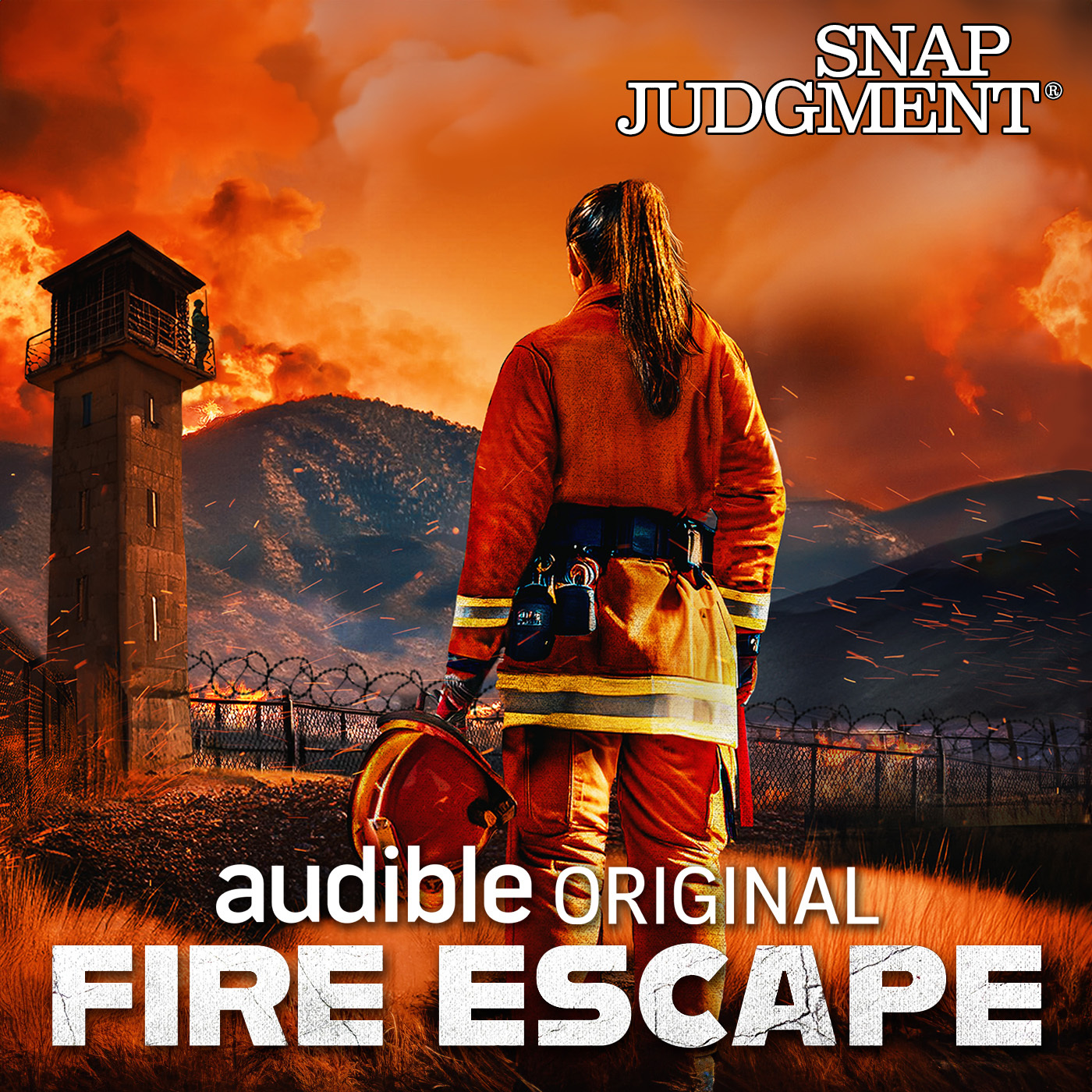
Snap Judgment
Fire Escape: Caught EP3
00:32:02
At the firehouse, Amika plans a drop – a secret plan to sneak forbidden cell phones to her friends still on the inside. She begins to worry she might get caught. And then she’s called to an emergency involving one of her jailers.
Loading summary
Transcript135 lines
- [00:03]
Narrator/Host
SNAP Studios Snap Judgment is brought to you by Progressive Insurance. Fiscally responsible financial geniuses, monetary magicians. These are things people say about drivers who switch their car insurance to Progressive and save hundreds. Visit progressive.com to see if you could save Progressive Casualty Insurance Company and affiliates. Potential savings will vary. Not not available in all states or situations. Okay, if you're a billionaire you can skip this part. But if you're not, if you don't appreciate putting your paycheck into a bank only to see it immediately zapped with fees for this, with fee for that and the fee on the fee, you should know that Chime is changing the way real people bank Fee free and smarter banking built for you Because Chime isn't just another banking app. They unlock smarter banking for everyday people with products like MyPay giving you access to up to $500 of your paycheck anytime and getting paid up to two days early with direct deposit. Some banks still don't do this. And yes, I wish the younger me would have learned about this a long time ago. Chime is not just smarter banking. It is the most rewarding way to bank join the millions who are already banking fee free today. It just takes a few minutes to sign up. Head to chime to.com snap that's chime.com
- [01:30]
Anna Sussman
snap Chime is a financial technology company, not a bank. Banking services and the secured Chime Visa credit card are provided by the Bancorp Bank NA or Stride bank na. Optional services and products may have fees or charges. See chime.com feesinfo terms apply. Limited time only. Must open the new account and complete qualifying activities to earn rewards. Advertised annual percentage yield with Chime plus status only. Otherwise, 1% APY applies. No minimum balance required. Chime card on time. Payment history may have a positive impact on your credit score. Results may vary. See chime.com for details on applicable terms.
- [01:53]
Narrator/Host
Today on Snap Judgment, we're bringing you episode three of our Fire Escape series. The story of a woman whose world burned down before she learned to fight fire from behind bars. If you haven't listened to the Fire Escape previous episodes, you'll want to start at episode one. Sensitive listeners are advised.
- [02:18]
Anna Sussman
After six years in prison, Amica waited on the edge of her bed. She had a small bag of her belongings. And then the prison fire captain came in with two other fire girls and they walked her out of a door in the back of the prison.
- [02:31]
Amika Mota
And so, you know, we jump in this fire truck and drive out the gates of the prison. And that was, that was a Pretty intense moment because I hadn't left the walls. I haven't gone past the barbed w.
- [02:49]
Anna Sussman
They pulled into the fire station, a neat one story brick building with a screen door and a garden on the prison ring road. She hopped off the truck and Captain Rodriguez led her behind the building and started pulling oxygen tanks and hoses and masks from a huge crate. It was time for a test of her mental and physical strength.
- [03:12]
Amika Mota
I got fitted for my turnout gear, which is the gear that we slide on over our everyday clothes. And it is, you know, the really heavy kind of insulated piece. And she's sizing me up, you know, and picking sizes for me because they don't want them to be too tight and revealing. Like even your just your regular gear, they want to make sure they're not too small so your boobs don't show and not too tight on your butt or whatever. So she likes to make sure it's just a little bit baggy. You have suspenders that hold your pants up. The boots are the most important part. And the boots I got fitted for and they, they, they just kind of sit in your turnout gear. So when you actually jump in to get your gear on, you jump first into the booth.
- [03:56]
Anna Sussman
And once she was fully suited up in all the gear, she was handed the metal end of a fire hose and it was heavy and she walked out to the front of the station.
- [04:06]
Amika Mota
So you had about 50 pounds of gear on a 25 pound piece of hose attachment. And you had to circle the firehouse and you just had to see how many times you could circle. And it was like a thing to be able to make at least seven times.
- [04:27]
Anna Sussman
Everyone came and gathered outside the firehouse to see kind of what she was made of.
- [04:32]
Amika Mota
I mean, all of the women on the side and the kind of captains are all watching to kind of see how hardcore I am. You're literally, you're walking in this gear that you've never experienced. You can barely breathe one step and then the next. Physically exhausted, literally body shaking. And it was designed to let us know what it feels like to be in a fire. The underlying thread is if you can't do this, you're not cut out to be here, which means you're getting sent back inside. It's like you better, you know, sink or swim on this one.
- [05:19]
Anna Sussman
She made it seven times around the fire station. She did it and all the fire girls cheered.
- [05:25]
Amika Mota
I just knew that I had just taken like a step into a whole new little piece of my life in prison. I mean, I remember Taking off the gear and just being so soaked with sweat. Everything stuck to me and blisters on my feet from the boots. But I felt like I did it because I didn't know if I could do it when I started. So I felt proud and I felt
- [05:50]
Anna Sussman
exhausted, sweaty, and limbs shaking. Amica stepped into the firehouse that would be her new home.
- [05:58]
Amika Mota
Literally in, like, 300ft from the gate of the prison, you go to this little. What feels like a little sanctuary, right? Just couldn't even believe what I was seeing. Trees. I had trees and flowers and a window, actually, in the quarters where you could hear animals and birds. Just my whole environment changed in an instant.
- [06:23]
Anna Sussman
And inside the firehouse, there was stuff like the stuff of normal houses.
- [06:29]
Amika Mota
We have a fridge. That's the first time I'd seen a refrigerator that you could open and, you know, grab something out of a stove. This is the first bed I'd seen in five years, too, Right. So we went from the mat on the steel bunk to an actual mattress. And I think that may have been the most exciting thing of all was that mattress. It was like, oh, my God. And a pillow. We had real pillows. From the inside, people looking out at the firehouse, those things were enticing, like the bed and the mattress and the state food. So, like, from the inside looking out, it kind of looked like this illusion of more freedom, but there. We still used a payphone. We got counted and flashlights checked on, you know, like, every night. We were not free.
- [07:25]
Anna Sussman
And she didn't forget what Captain Lott had told her. If she kept in contact with her friends inside the main prison, if she made any trouble, she could be sent back in.
- [07:34]
Amika Mota
I think that was the hardest part for me is like, oh, I've always been a little outspoken. And then I thought, like, I don't know how that's gonna fly here.
- [07:51]
Anna Sussman
From Wondry and Snap Studios at kqed.
- [07:53]
Amika Mota
Anna.
- [07:54]
Anna Sussman
I'm Anna Sussman, and this is Fire Escape, the story of a woman whose world burned down, and then she learned to fight fire from behind bars. This is episode three, Caught. Amika knew that now, as a fire girl, she had, from the position of the women inside, a very powerful position.
- [08:20]
Amika Mota
I mean, we were in our positions as fire girls. It was a place that the majority of folks in prison would never get to.
- [08:32]
Anna Sussman
Why not?
- [08:35]
Amika Mota
Because it's difficult to get in.
- [08:39]
Anna Sussman
Only about 12 folks were accepted into the firehouse out of the thousands that were incarcerated in that prison group.
- [08:46]
Amika Mota
It was really difficult in particular for black women to get into the firehouse. So much so that they used to call the firehouse the White House. That was part of why I didn't know if I belonged there.
- [08:59]
Laquisha
I was like, hey, I want to go to the firehouse. Has anybody heard about it? And so most of the girls were like, well, you're not going to get in there. And they described the firehouse as like a place for white girls. Who doesn't have.
- [09:11]
Anna Sussman
This is Laquisha. She worked at the firehouse with Amika. And like Amika, she also didn't know if she belonged because I was black.
- [09:20]
Laquisha
I knew that I would get treated differently because I did get treated like that when I did get there.
- [09:28]
Anna Sussman
When she got to station five, there was only one other black person there. Almost all the other firefighters were white.
- [09:35]
Laquisha
Like they picked the same type of white girl.
- [09:38]
Anna Sussman
You know, Laquisha was coming from living in a very diverse eight person cell inside.
- [09:45]
Laquisha
The cells that I were in were pretty mixed. So, you know, there was white, black,
- [09:51]
Anna Sussman
Hawaiian and she missed those folks. Now she was surrounded by the almost all white fire girl team.
- [09:58]
Laquisha
But I just knew that they didn't trust me because I was black. And it sucked not to just be able to communicate with like minded, you know, not like minded people that are like me based off of race because, you know, we share certain things based off of culture and things like that.
- [10:15]
Anna Sussman
Both Laquesha and Ameca said that was really part of the reason they both kept close ties with the people inside, even though it was against the rules,
- [10:25]
Laquisha
you know, because we still had friends on the inside. We still wanted to help. You know, it wasn't like we just wanted to disconnect from them because we all have something in common. And so I never wanted to disconnect from that.
- [10:39]
Anna Sussman
Did you find yourself looking forward to calls on the inside?
- [10:43]
Amika Mota
Oh yeah. Oh yeah, I couldn't.
- [10:46]
Anna Sussman
The firefighters from Station 5 were sometimes called into the prison to help with smoke alarms or kitchen fires, things like that. And it was thrilling because it was a chance to see old friends.
- [10:58]
Amika Mota
Every time we went inside, I wanted to see everybody I could possibly see. Like, which yard are we going? If we're going to sea yard, I am going. That's it. Like, I hope I get to see my friends and just, even if I can't say hi or I see them from the truck, like, you know, blowing kisses and just.
- [11:17]
Anna Sussman
You allowed to blow a kiss?
- [11:18]
Amika Mota
No, we're not allowed to do any of that. We're not allowed to wave, we're not allowed to blow a kiss. We're not allowed to do any of that.
- [11:23]
Anna Sussman
But her friends inside, when they saw her coming, they'd start singing the Alicia
- [11:27]
Amika Mota
Keys Girl on Fire. The girls inside, they would joke and start singing that to me when I would come in.
- [11:34]
Anna Sussman
They'd try to think of ways to support their folks inside. Laquisha and Amiko would bring in kind of innocuous but comforting things like CDs or gum or cheese.
- [11:46]
Amika Mota
I could definitely have gotten in trouble for cheese, but what's the trouble look like? I probably would have gotten kicked out of the firehouse.
- [11:53]
Anna Sussman
Are you serious?
- [11:53]
Amika Mota
Yeah. Yeah.
- [11:55]
Anna Sussman
Okay. I don't understand why you were willing to risk getting kicked out of the firehouse to bring a pound of cheese
- [12:00]
Amika Mota
when you love folks in there. It's like, you know, that's how we do it. We share what we have always.
- [12:06]
Anna Sussman
They'd bring in little pieces of love to the prison church, which was one of the rare times they'd get to be together. So they'd sneak in a treat and pass it between them. But then a friend asked them for something bigger.
- [12:20]
Laquisha
You know, when you go to church, the girls inside the prison would try to, like, get you to do stuff. And so I can't believe I'm saying this, but I did, did agree with one girl to get some cell phones.
- [12:36]
Anna Sussman
Cell phones are probably the most valuable thing to people locked away from their loved ones.
- [12:42]
Laquisha
It was like I was in there when we couldn't do phone calls because our parents couldn't afford the calls. You know, I was in there where you're paying somebody, like, can you three way? My mom, you know, I remember my mom got sick and I couldn't get in contact with her. I was freaking going crazy. And so, you know, and that's how the prison makes money, you know, so if I could provide the opportunity for somebody to talk to a family member, I was willing to risk it.
- [13:16]
Anna Sussman
So Laquesha decided she would approach Amica and tell her that she had an idea to bring in some phones, and she even had this potential cell phone hookup.
- [13:26]
Laquisha
So I went. I had put so much trust into her. Like, I had went to her and I was like, look, this is what I have, and this is what I'm. She's like, what? And I'm like, yeah, I got these phones, and I don't know what to do.
- [13:41]
Amika Mota
It's a big deal to have a phone. You know what I mean? And it's a huge commodity on the inside. We wanted to share that commodity with folks on the inside.
- [13:48]
Anna Sussman
So Amica And Laquisha planned a drop.
- [13:52]
Amika Mota
A drop is when somebody from the outside either leaves cell phones or whatever on the outside perimeter or as close as they can get to the inside perimeter. And we're instructed on where it is, and we pick it up.
- [14:06]
Anna Sussman
The fire girls would run these training runs along the perimeter of the prison through the almond orchards all around.
- [14:13]
Amika Mota
And we knew where the towers were. We knew where patrol was.
- [14:20]
Anna Sussman
So one morning on one of those training runs through the orchards, she and laqueisha went to the drop point.
- [14:26]
Amika Mota
We just basically wore our sweats with, like, tight, stretchy pants underneath them and big sweaters.
- [14:33]
Anna Sussman
The drop point was marked by a pile of rocks, and the phones were piled up underneath.
- [14:38]
Laquisha
And they were flip phones at that. Oh, my. Like, and they were big. So can you imagine? Like, flip phones wrapped in Saran wrap. And it was like six of them, too. It was like six phones.
- [14:50]
Anna Sussman
They stuffed them inside their sweatshirts and kept running. And when they got back, they reburied them in the garden outside the firehouse.
- [14:57]
Amika Mota
We buried the phones in my. I call it my garden. I know it was a communal garden, but it was my garden. That was my baby. We started burying them in my garden
- [15:05]
Anna Sussman
to save for later.
- [15:07]
Amika Mota
Yeah, to save for later. And we figured out who we're actually supposed to get them to or if we were going to do that or if we were going to sell them ourselves.
- [15:15]
Anna Sussman
So they waited with those cell phones just beneath the dirt in the firehouse garden, praying nobody would notice.
- [15:23]
Amika Mota
Yeah, after maybe a couple months at the firehouse, and, I mean, I thought I was really doing good. I was running the program and doing the routine and kind of doing everything I thought I was supposed to do.
- [15:39]
Anna Sussman
She was in living quarters one day, and it was just after mail call,
- [15:43]
Amika Mota
and Captain Lott and Captain Rodriguez called me into the office. I remember Captain Lott with his feet up on the desk. They said to me, you're here because we need to talk to you about your connection to the inside.
- [16:01]
Anna Sussman
They caught her writing letters to the women inside. They didn't seem to know anything about the cell phones, but they were upset about the letters.
- [16:10]
Amika Mota
And they kept telling me, you're not ready to be here. You're not ready, and you. You need to let go.
- [16:17]
Anna Sussman
In the office at the fire station, the captain was very clear with her. If they caught her connecting with her friends inside, she'd be sent back over that wall. She said she looked down and nodded along, but her head was swimming.
- [16:31]
Amika Mota
Do I really belong here? Should I be here or should I Go back in.
- [16:44]
Anna Sussman
Don't go anywhere. The story continues right after this break. Welcome back to Snap Judgment. This is Fire Escape, the story of a woman whose world burned down, and then she learned to fight fire from behind bars. In the office at the fire station, the captain was very clear with her. If they caught her connecting with her friends inside, she'd be sent back over that wall.
- [17:22]
Amika Mota
Do I really belong here? Should I be here or should I go back in?
- [17:29]
Anna Sussman
Why didn't you want to go back inside?
- [17:32]
Amika Mota
I had just been in prison for years. Like, do I want to go back into an eight man cell? Do I want to go back to staring at bars on the window? Do I want to go back to shitty ass correctional officers that have this level of power over me? No.
- [17:52]
Anna Sussman
She knew she never again wanted to put herself in the position of living under the whims of the green cops. And she kept thinking about all these accidents and fires and the lives they were saving and the lives they lost.
- [18:07]
Amika Mota
Cotton bale, fires, overdoses, heart attacks, strokes. There was a dialysis lady. I remember we went to her house often. Really young, really young mother who was really ill. And we went to her house a lot. We're going out on calls. We're doing things that are kind of amazing and productive and things we never even imagined. It just shifted me. It just shifted me all the way around. It was like, oh, we're saving somebody's fucking life, right? Like we're breathing air into a child's lungs.
- [18:52]
Laquisha
I'm going through these experiences and you're being around family, different people, families. And some of these calls are so traumatic that you're like, I'm not about to risk, you know, bringing stuff illegally on the inside. Maybe there's a different way we could do it, you know? But the problem was we still had them.
- [19:12]
Anna Sussman
The problem was they still had those cell phones under the dirt outside the firehouse.
- [19:18]
Amika Mota
I got really nervous about them being buried in the garden. It just felt like a little critter could get in there or something. Like something could go wrong and maybe I didn't bury it deep enough.
- [19:30]
Laquisha
She used to give me these intense looks, like every time anybody went near these phones. She used to give me this intense look, like she used to be like, baby. And that was her thing. She'd be like, baby, oh, you're such a baby. And I'm like, I don't know what to do.
- [19:44]
Amika Mota
What am I supposed to do?
- [19:45]
Laquisha
But I think when we finally was like, I told her, like, I'm not taking it in Anymore. I don't know. We need to. We can hide them or we can get rid of them. Like, we really sat there and thought about how to get rid of these phones.
- [19:57]
Amika Mota
We just wanted to be, like, free of them and not have to deal with this thing hanging over us. I just. I didn't want to do it.
- [20:10]
Laquisha
I think she came up with the idea of putting him in the field, and I was like, okay.
- [20:18]
Anna Sussman
They made a plan to ditch the phones on an early morning run because
- [20:22]
Laquisha
we used to get up at, like, five in the morning every day, and so, you know, the captains are pretty sleepy around that time, so they're not really, you know, watching you.
- [20:32]
Anna Sussman
So before sunrise, they dug up the cell phones from the garden, looked around to be sure nobody was watching from the towers or inside the firehouse. And halfway through their run, in the middle of rows and rows of almond trees, they buried their phones in the sandy dirt at a marked spot so someone else could pick them up and they wouldn't go to waste.
- [20:52]
Laquisha
I think that's when we felt some relief. Like, you know, we didn't want to
- [20:57]
Amika Mota
get caught, and we buried our phones, and we're like, fuck that. We're going home. It's a similar process to, like, you know, what it meant to detach from the outside. And my family and my kids, I had to kind of detach again from people that I really cared about. One of the things about prison is that you. The one thing that you're always ready for is change, and you are. People leave all the time. People leave you all the time. And it just. It was just time. I just wanted to do my job well, and I wanted to go home.
- [21:36]
Anna Sussman
Amica focused on her training on the fires and accidents they responded to each day. One morning, a call came in, and Amika and the other firefighters all jumped on the truck. They heard from bits and pieces over the radio that they were headed to a car accident.
- [21:54]
Amika Mota
You know, we roll up on scene and see a car seat kind of like up against the window. I mean, that's always. It's a baby, like, oh, my God. And so the sense of urgency, you take it to a different level at that point. It's just. It's an awful feeling. You know, everybody's heart drops, and the whole car was crumbled into a tree. So it hit a tree, and mom and baby were pinned inside. So the airbag had gone off. Mom was in the front seat, but pinned in, couldn't really get out. And the baby's car seat was in the Back we had to cut open the door to get mom out. Okay, I can do this. I can do this. You have to kind of clear your mind and. And get ready. Okay, I can do this. I can do this shit. Like, I haven't done this yet. Okay, I can do this. I can do this. I don't know who called the CO or if. I don't know how he knew. But I saw the green first.
- [23:10]
Anna Sussman
Ameca looked up, and there at the scene of the accident was the green cop, the corrections officer with the gray hair, who she said looked at her like a piece of shit all those years. The stickler,
- [23:24]
Amika Mota
you know, I definitely recognized him from the yard. He came probably right from the prison, actually in his uniform. He was the father and grandfather of the mother and child that were in the car. We were doing definitely eye contact through the whole, you know, scene. So it was the first baby I had ever C spined and C spining means you need to straighten, stabilize their neck and spine. Hoping. I remember the steps along the way. You have this little delicate being, like, don't let me fuck this up. Don't let me fuck this up.
- [24:10]
Anna Sussman
Amika carefully held the co's grandbaby's spine stable with her hands while quietly talking in her ear. The CO's daughter, the baby's mom, was loaded into a life flight helicopter, which lifted off the roadside in a swirl of dust.
- [24:27]
Amika Mota
And the emotion coming from him, you know, to see his family being, you know, pretty injured and being life flighted out. And for him to actually show those emotions in front of us was pretty intense too, because they don't do that, right? It's his daughter and his granddaughter. And so he was in tears.
- [24:52]
Anna Sussman
Did he become more of a human?
- [24:55]
Amika Mota
Yeah, because you could maybe see expressions you wouldn't see on the inside. You know, seeing fear, seeing tears, seeing somebody in the place of being a caregiver and loving on their children, like, we certainly don't see that peace on the inside.
- [25:13]
Anna Sussman
After Amica and the firefighters got both mom and baby to safety, she picked up the metal wrappers and the bits of broken car and climbed back into the truck and headed to the prison. And she kept thinking about the CEO in the green uniform.
- [25:30]
Amika Mota
I felt like, I hope, you know, I loved your child just the way I would love my child. You know, I hope that they saw that in us. It was like a strange and beautiful thing, you know, it was humanity.
- [25:46]
Anna Sussman
But even in that fragile moment, this man was still her jailer.
- [25:51]
Amika Mota
We are situated as an us and a them Right. So there's only so far you allow yourself to feel compassion. I imagine that's kind of their take on us too, Right. It is hard to humanize an oppressor without feeling like you're compromising some something within yourself.
- [26:16]
Anna Sussman
Chowchilla is a prison town. The prison is the biggest employer. And the fire girls were often the ones who showed up when the guards and their families had an emergency.
- [26:26]
Laquisha
I wondered if they knew we were the inmates. I'm pretty sure they did because it was like, all girls. Yeah, we were all girls, so. And I think, you know what? In seeing them in the vulnerable position, they treated us nicer because I think we were in their private space, we were in their home, and we seen them in a vulnerable position. So they're like, nice, like, okay. But they were different compared to if they were in uniform. It's different energy.
- [26:55]
Anna Sussman
When they were called out to emergencies with pregnant women or little babies, something deep in Amica's brain would take over.
- [27:03]
Amika Mota
I was able to call on my previous skills as a midwife. I knew my way around a baby's body, right? Like, I knew the little parts that made up their skull and their chin, and I knew how to take their vitals with just my fingers and not having to, like, use, you know, the kind of tools, right? So I knew, like, I felt confident about working, having my hands on a baby, for sure.
- [27:37]
Anna Sussman
I talked to you in ways that were like, oh, there it is. You know what I mean?
- [27:40]
Amika Mota
Oh, yeah. As soon as I got to the baby, it was like, it felt calm. It felt like a calm washed over me in a way.
- [27:46]
Anna Sussman
Right, because your body knew how to do it.
- [27:47]
Amika Mota
Because my body knew how to do it. You know, in my old life as a midwife, I stood at the gates of life, right? And so it's a similar intensity. And I loved the work and I was good at it because I can get really calm in chaos.
- [28:08]
Anna Sussman
Before she was incarcerated, Amika had so many times held that gate between life and death for others. She'd held that trust and those powers. One time, she was delivering a baby for a husband and wife who were musicians, and they wanted to name their
- [28:25]
Amika Mota
baby Cadence and Beautiful Birth. And then Cadence didn't want to breathe. And I worked on her for a good 30 minutes. I mean, it's so hard to even explain how intense it is to be working on, like, a little six pound baby and trying to breathe for them. Her mom and dad were talking to her the whole time. It was so incredible. I was breathing for her and her little heart would pick up when she heard her daddy's voice, even though she wasn't breathing. And then in those last few minutes, it was like. I mean, I could see her spirit. She started to just. Her whole color started to shift. But it was more than just like the color of the skin. It did feel very much like an aura, almost of light, and it felt warm, and it felt like light and heat. The last couple of minutes before
- [29:31]
Anna Sussman
her
- [29:31]
Amika Mota
heart rate normalized and she stabilized.
- [29:36]
Anna Sussman
A lot of people would not want to be in that room at that moment. Why do you want to be in that room at that moment?
- [29:43]
Amika Mota
Oh, God. I mean, to me, that's like the sacred moments of life. Like, what an honor to be able to be in that space. There's always a level of the responsibility that is really hard to carry, especially when it is like, you know, if someone thinks the health of their baby is in your hands or that life or death is in your hands as a midwife.
- [30:06]
Anna Sussman
But does that mean that you believe it's not in your hands? Is that right?
- [30:11]
Amika Mota
No, it's not in my hands. I am a vessel, but I am not so cocky that I think that I have the strings that control life and death.
- [30:24]
Anna Sussman
Now. She was helping teeny babies trapped in cars and.
- [30:29]
Amika Mota
And then the other piece that came naturally is just the mothering part, right? Which is you're calming down an upset baby and you're trying to make them laugh and you're trying to make distract them as you're wrapping these things around their head, and they're like, where's my mama? So, you know, it was all those things.
- [30:52]
Anna Sussman
Back at the fire station, she had again learned to navigate the rules. She was learning the dials and the hose protocols. She was cleaning out her garden and planting new flowers. It seemed like she was making it work.
- [31:06]
Amika Mota
A few months later, I got called in to the captain's office again.
- [31:11]
Anna Sussman
Again, she was called into the captain's glass walled office where the whole firehouse could watch.
- [31:18]
Amika Mota
They called out my last name and, you know, said, get in the. Get in the office. We want you in the captain's office. You know, you worry about the worst. You think it could be a call that they've received, like you lost a family member or something has gone wrong or your date isn't going to stick.
- [31:39]
Anna Sussman
They had already told her they were watching her, watching for any reason to send her back inside.
- [31:46]
Amika Mota
I'm ready. Whatever I gotta be ready for. It's like. Like I kind of try to get my shoulders straight and you know, head up, look them in the eyes. Like I don't, I don't wanna show a whole lot of emotion or. Walking into the captain's office. Captain Lott's got his feet up on the desk, hands behind his head. He looks mad. I just walk in and they shut the door behind me.
- [32:31]
Anna Sussman
Fire Escape is a production of Snap Studios and Wonders. The series was created, written and produced by me, Anna Sussman and I want to thank Amika Mota for her help and generosity in sharing her story with us. For SNAP Studios, our senior story editors are Mark Ristich and Nancy Lopez. Marissa Dodge is our director of production. Original music by Renzo Gorio and Doug Stewart. Doug Stewart also created our theme song. Sound design and engineering by Miles Lassie for Wondry. Our senior story editor is Phil Phyllis Fletcher. Our development producer is Eliza Mills. Claire Chambers, Lauren D. And Mandy Gorenstein are our senior producers and Sarah Mathis is our managing producer. Our executive producers for Snap Studios are Glenn Washington and Mark Ristich. Executive producers for Wondry are Marshall Louie, Morgan Jones, George Lavender and Jen Sargent. On Team snap, the union represented producers, artists, editors and engineers are members of the the national association of Broadcast Employees and Technicians Communication workers of America, AFL CIO Local 51 fire escape. The full six part series is dropping weekly on the Snap Judgment feed. You can listen wherever you get your podcasts and on our website snapjudgment.org.