← Snap Judgment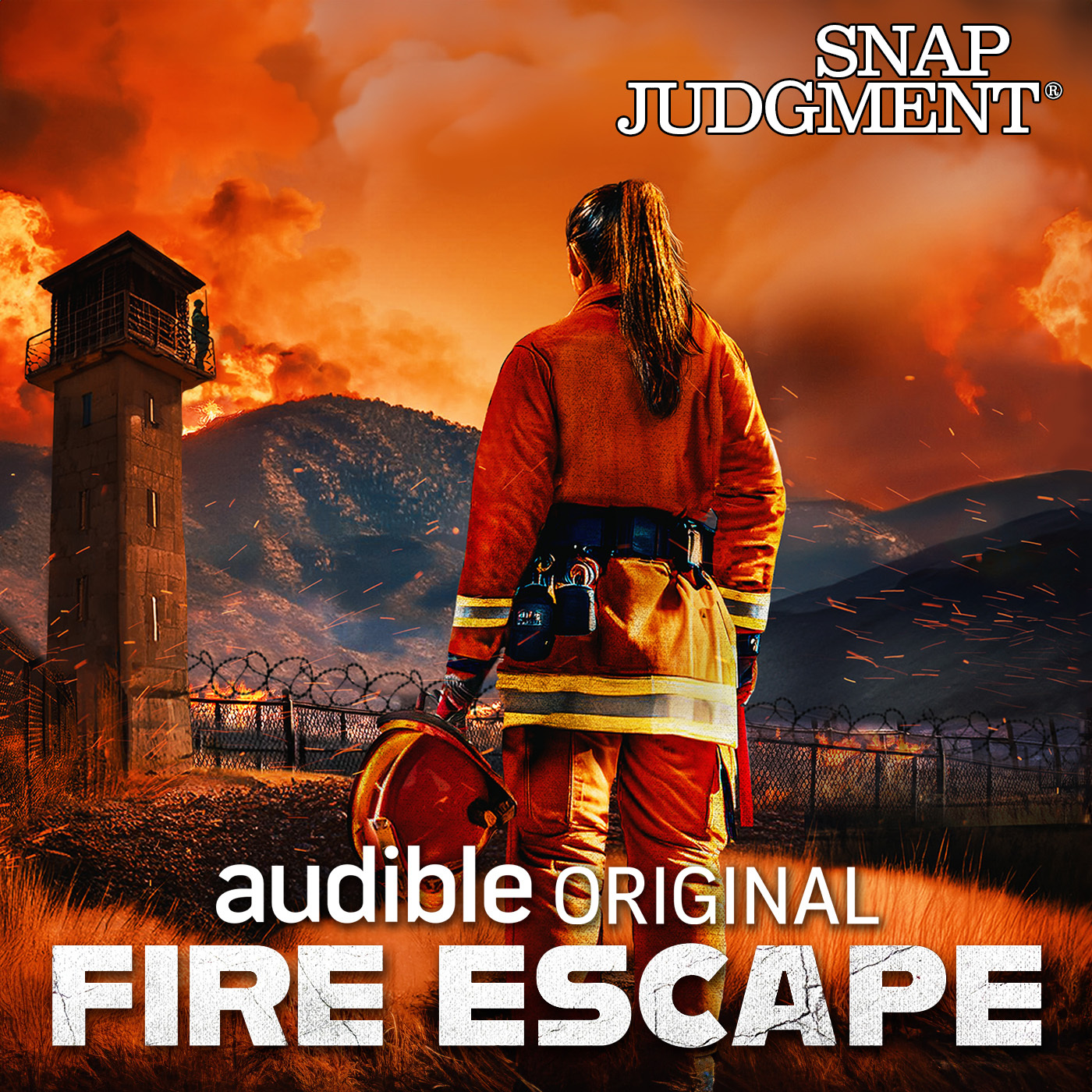
Snap Judgment
Fire Escape: Escape EP2
00:31:06
Amika is thrown in the hole for forty days. Locked in a windowless cell, she can hear the women through the walls losing their sanity. To protect herself, Amika must shut down all connections with everyone she loves: her cellies, her mom, and even her kids. The world looks dark until she sees a small light that may illuminate a path to her new life when she gets a call from the firehouse.
Loading summary
Transcript90 lines
- [00:03]
Narrator
Snap Studios Snap Judgment is brought to you by Progressive Insurance. Do you ever think about switching insurance companies to see if you could save some cash? Progressive makes it easy to see if you could save when you bundle your home and auto policies. Try it@progressive.com Progressive Casualty Insurance Company and affiliates. Potential savings will vary. Not available you in all states. Okay, if you're a billionaire you can skip this part. But if you're not, if you don't appreciate putting your paycheck into a bank only to see it immediately zapped with fees for this, with fee for that and the fee on the fee, you should know that Chime is changing the way real people bank Fee free and smarter Banking built for you Because Chime isn't just another banking app. They unlock smarter banking for everyday people with products like MyPay giving you access to up to $500 of your paycheck anytime and getting paid up to two days early with direct deposit. Some banks still don't do this. And yes, I wish the younger me would have learned about this a long time ago. Chime is not just smarter banking. It is the most rewarding way to bank Join the millions who are already banking fee free today. It just takes a few minutes to sign up. Head to chime to.com snap that's chime.com
- [01:29]
Anna Sussman
snap Chime is a financial technology company, not a bank. Banking services and the secured Chime Visa credit card are provided by the Bancorp Bank NA or Stride bank na. Optional services and products may have fees or charges. See chime.com feesinfo terms apply. Limited time only. Must open the new account and complete qualifying activities to earn rewards. Advertised annual percentage yield with Chime plus status only. Otherwise, 1% APY applies. No minimum balance required. Chime card on time Payment history may have a positive impact on your credit score. Results may vary. See chime.com for details on applicable terms.
- [01:52]
Narrator
Welcome back to episode two of the Fire Escape series, the story of one woman whose world burned down before she learned to fight fire from behind bars. If you haven't yet listened to episode one, you want to go back and start there. Sensitive listeners are advised.
- [02:20]
Anna Sussman
Amika Mota had been in California State Prison for less than three months when she was forced into solitary confinement. A guard marched her across the prison yard and down the concrete corridor towards the Secured Housing Unit. She knew that the people in the cells on either side had been there for months or even years and they screamed a lot.
- [02:46]
Amika Mota
You know, isolated housing like that makes folks mentally ill. Like what it takes to survive in that environment is to kind of disconnect yourself as this, this identity of a mother. It's super high, you know, maximum security. You're in your cell 23 hours a day. There's a, like, you know, fold down door on your metal door where your meal is slid through three times a day.
- [03:24]
Anna Sussman
What did you do all day?
- [03:26]
Amika Mota
Like, stupid things like make, you know, flowers out of your tampons or like make things out of the little box lunch boxes we would get. We had mice in the shoe. Some people would make pets of mice and it's just total isolation.
- [03:51]
Anna Sussman
She would not speak to or have physical contact with another human for 45 days. From Wondry and Snap studios at kqed, I'm Anna Sussman and this is Fire Escape, the story of a woman whose world burned down. And then she learned to fight fire from behind bars. This is episode two Escape. Up until this moment, Amika's life had been both very ordinary and terribly extraordinary. She was born in Santa Rosa, California, and when she was a week old, she was adopted by a famous 1970s feminist sex icon. What kind of mom was she?
- [04:42]
Amika Mota
You know, I just, I don't, I don't want to do the like, good mom, bad mom, sweet mom. Like, my mom was a fucking visionary, dude. My mom was like, my mom was. That's who my mom was. My mom was a visionary and a leader. That's who she was. Well, what can I say about my guest? Except Joni Blank is a legend.
- [05:05]
Anna Sussman
I'm told that I'm a pioneer, and
- [05:06]
Amika Mota
I guess it's true because Good Vibrations was the first store of its kind in the country. So the year I was born, in 77, my mom founded Good Vibrations, which is a women's run sex shop. She was kind of determined to get sexuality out of this, like, dark, seedy place.
- [05:33]
Anna Sussman
Amica's mom, Joni Blank, wrote 12 books for the publishing company she started called Down There Press, Like A Complete Guide to Vibrators and I Am My Lover.
- [05:43]
Amika Mota
She did print a book called 32
- [05:47]
Anna Sussman
Full Color Photographs of Women's Vulvas.
- [05:51]
Amika Mota
And I remember during the, when that book was coming together, yes, there was pictures of yonis all over my dining room. Most of my memories are of my mom obsessing on her work. And that was all my mom could relate to. Right? She had a mission and that was it. My mom was a revolutionary.
- [06:14]
Anna Sussman
Like, revolutionaries don't make great parents.
- [06:19]
Amika Mota
Oh, fuck yeah. Oh, yes. I'm finally figuring that out. Like, maybe that's my problem.
- [06:29]
Anna Sussman
Amica's relationship with her mom, Joni, was tough from a young age. Joni had adopted Emika when she was a newborn. By the time she became a teenager, Amica saw Joni as a hippie Berkeley mom who she couldn't really relate to.
- [06:44]
Amika Mota
I mean, I remember being like 8, 6 years old, 8 years old when I first tried to run away. And then, you know, like, 10, 11 was when I started drinking and using and getting police contact and all that. It was like, very, very early.
- [06:58]
Anna Sussman
When she was a teenager, Amica was sent to youth diversion programs, and she was placed in kind of halfway houses, and she ran away from almost all of those programs.
- [07:08]
Amika Mota
I mean, I feel like my life has been dominated in many ways by kind of my dance with addiction throughout my whole life, since, as, you know, early as I can remember, it's like I always danced with drugs, always.
- [07:28]
Anna Sussman
When she was 16, she ran away pregnant and had a baby boy named Milo. And when Milo was a few weeks old, something happened that would shift Amika from the kind of wild lifestyle she had felt drawn to, Something that would actually keep her completely and totally sober for more than a decade. She heard a friend talking about something called a midwife.
- [07:52]
Amika Mota
Because I heard about somebody that had their baby at home. I was like, oh, my God, that's what I want to do. It was just that it was a comment. I was like, that's what I'm going to be.
- [08:01]
Anna Sussman
Do you think there's a connection between your mom's interest and women's control over their bodies and your being drawn to midwifery?
- [08:12]
Amika Mota
Oh, yeah. Like I've always said that, I was raised by a mother that was doing women's work since the day I can remember.
- [08:25]
Anna Sussman
So amica, who was never one for a formal education, started to seek out mentors and elders.
- [08:32]
Amika Mota
You know, midwife means with woman, and I wanted to be with women as they gave birth. It was such a beautiful, sacred space. And birth work was just deep work, you know, So a lot of what I wanted to bring to that was the ability for folks to see themselves as who they were, as powerful women.
- [08:57]
Anna Sussman
She started as an apprentice and became a full fledged midwife when she was in her early 20s, driving out to women's houses day and night to catch babies. She was on call 24 hours a day for six years. She had two more kids while she was a midwife, Soleil and Blossom. She worked with her own babies on her lap. It was an intense lifestyle, and it suited her needs.
- [09:21]
Amika Mota
You know, midwifery gave me a purpose and it was one of the reasons that I stepped all the way back from using drugs. Kind of the life that I'd been living before was because I was committed to focusing on this, like, new love of mine, midwifery. And there was something about that feeling as a midwife and this focused intensity that it required kind of this out of body experience.
- [09:56]
Anna Sussman
Sounds parallel to being on drugs.
- [09:59]
Amika Mota
Yeah, absolutely. Actually, there's nothing for anybody that's ever, you know, injected cocaine. Your ears ring, things get silent, and there's this bubble. And that is as close to the feeling as I can describe. I actually would say that I used to get that same feeling, like when I injected drugs, I could taste my breath. Something changed and it was just like, just a massive adrenaline rush that did something that was like a kind of calming, strange effect.
- [10:39]
Anna Sussman
Midwifing was amazing and fulfilling in so many ways for so many years. And then amica made this huge, life changing decision.
- [10:50]
Amika Mota
I walked away from what I loved.
- [10:52]
Anna Sussman
Why did you walk away from what you loved?
- [10:56]
Amika Mota
I was working as a midwife for six or seven years and I had been on call for 24, 7. I was exhausted.
- [11:05]
Anna Sussman
It was too demanding for a mother with three kids. So she left it. And when she quit her job and moved with her husband and three kids to this remote mountain area in California, that's when things started to unravel. The story continues right after this break. Welcome back to Snap Judgment. My name is Anna Sussman. Today we're listening to our series Fire Escape already in progress.
- [11:49]
Amika Mota
I stepped away and I moved to a different state and was like super, super isolated. I didn't have that work that gave me this type of purpose, you know, this time where I had tried to kind of restart my life as a mama and just be with my children actually got really complicated and I got really tangled up.
- [12:15]
Anna Sussman
She did have the three bedroom house with a wraparound porch. She had this goal to reconnect with her kids, and she was able to go to football practice and do the things her kids had asked for all those years. Those years when she was called away in the middle of the night as a midwife. But there was a lot of hardship to it. She didn't have midwifing to ground her. Her marriage was falling apart and she had moved to a place where she really didn't need know anyone. She relapsed quietly, holding down a job and using when no one else was around.
- [12:47]
Amika Mota
I think the reason that I ended up in a position of, like, wanting to use again after almost 13 years of being clean. I was away from my community. I was in a really, you know, bad relationship.
- [13:04]
Anna Sussman
She said that when the marriage got really ugly, the father of her kids took them away and said she'd never see them again. And then a little While later, on August 18, less than two months before the crash, he filed for divorce. Amica was caught off guard by all of it. She said she knew things were bad in their marriage, but she didn't know things would escalate so quickly.
- [13:27]
Amika Mota
So I was losing my mind, literally. I mean, the drugs were bad enough, and then. And then this, and so I literally just, like, I was losing my mind.
- [13:41]
Anna Sussman
In court, both Amika and the father of her kids accused the other of drug use and ordered the other to drug test. Amika knew her test would come back positive and she could lose custody of her kids. So she decided to go someplace to get clean and get well.
- [13:57]
Amika Mota
And so I packed up the family photos, the books, the journals, things that were. Those were what were important to me.
- [14:06]
Anna Sussman
She checked herself into a rehab center, South Coast Recovery, not far from Laguna Beach. But a few days later, she checked herself out again in order to eventually make it to a custody hearing back home. She walked from the rehab facility to a rental car agency and rented a black double cab Chevy with a cap on the back. On the day that would become the day of the accident, she ended up at Huntington beach off Highway 1. She was running out of gas.
- [14:38]
Amika Mota
And so in the Huntington beach parking lot, I. Oh, I had. I went and swam on the beach. I got tomatoes. Like, I'll never forget this. I got tomatoes and fruits, just whatever. And. And I was in this parking lot, and, like, surfer guy approaches me, and I was like, oh, do you smoke? I was like, yeah, I thought he meant weed. And I went to walk on the beach with him, and he actually had a meth pipe. And so I was. He had a meth pipe? Yeah. So I was kind of blown away because I kind of was like, people like surfer guys. I really was, like, kind of naive to this idea that it was, like, everywhere the way it is.
- [15:23]
Anna Sussman
Oh, my. I think that surprises me.
- [15:25]
Amika Mota
It totally shocked me because I just thought it was this, like, world that I lived in of, like, you know, whatever, the underworld of drugs. It wasn't like, somebody asks you to smoke at the beach, and then it's meth instead of weed, right? And so I ended up smoking with him. And then. Oh, he filled up my gas tank, though, so he was, like, trying to hit on me, all that whatever but he filled up my gas tank, so mission accomplished. I had gas in my car, and I was ready now to go. The Lancaster was where I was going to head to, because there is this Buddhist monastery there. The whole time I had thought, I just need to rest and eat. That's what I need. I need to be by myself. Rest and eat and think and have some quiet and some space. It was now evening, and I drive by this Catholic church, and I hadn't been to a Catholic Church for 17 years. I went to mass. I pull over and I go to mass. And it's like a late evening mass. And it's at this. This church. It's a beautiful church. And I just wanted to go, you know, be moved by the spirit. And so I go into church, and I'm having this, like, very powerful experience. And, you know, I don't know what they're called, but the incense that they're burning, like, the whole church is full of the smoke and the. And I'm praying, and there's tears coming down my eyes. And I just. You know, everything was just very intense. And it was intense for, like, a number of reasons. I think definitely the drugs. But I'm also having this, like, insane moment in my life. And I was really, like, feeling the spirit. And there's these kind of pews that pop down, and you can kneel down and pray, right? So I started on my knees praying, and then when I rose up, it was like the people sitting next to me were, like, starting to do double takes, and, like, look at me a little too hard. I get up to leave, and the priest said, you shouldn't be here. And I was so shocked that I was told that I shouldn't be here. And so I get in my truck, and I kick out of church mode, and I kick into just rage. I don't even know how to describe my state of mind. I was angry. It was crazy. The whole scene was so crazy. Like, leaving Catholic church, like, having, like, on my knees praying in the back. And then to this, right? I don't remember the moment of impact. I don't remember those things. I do remember approaching the light that I ran and, like, seeing the light. I don't remember if I saw it red, but I just. I. Like, I was gonna burn through it.
- [18:40]
Anna Sussman
All of that led to this moment in prison, in isolation. It had been more than a year since she'd seen her kids in isolation. There was a toilet and a colony of mice who ran through the ceiling. She'd be led out to an outdoor cage called the Dog Run. For an hour every few days, she'd put her hand through a slot in the door to be cuffed to take into a shower. There were no phone calls. Her food was slid to her through the slot in the door for 45 days. And she made a promise to herself to never be sent back to the shu. So she built a wall around her, a wall between her and everyone she'd loved. When she was returned back to her cell, she opened up her locker, and there were the pictures of Milo Soleil and Blossom.
- [19:33]
Amika Mota
And so I remember taking the pictures down and taking them down and putting them all into this little envelope that I had with all the other pictures that I had and, you know, just sticking it in the back of my locker. Like, in particular, the picture of Blossom and her freckles. You know, that picture, it just. It was just too much. And I know that sounds strange for folks that don't understand, you know, that, like, how incredibly painful it is to see your children every day, but you can't hold them, you can't touch them, you can't talk to them when you want to. And it just hurts too much sometimes. There, you know, is this idea of what you've done to your children and, like, what. And all of those things are real. And I'm also sitting in a cell with not a damn thing I can do about any of it.
- [20:44]
Anna Sussman
More Fire Escape after the break. Stay tuned. Welcome back to Snap Judgment. This is Fire Escape, the story of a woman whose world burned down, and then she learned to fight fire from behind bars. Friends on the outside who she thought would support her stopped writing her back. Her mom, Joanie, never wavered in her support. She sent her articles about the accident that she'd print out from the Internet, but said she wouldn't send the comments because they were too hurtful.
- [21:23]
Amika Mota
I was like, actually, can you please send the comments? I really need to see the comments. And it's like this. You start realizing, like, what does it really mean to be now labeled as someone that has killed someone, Someone that has, like, committed this horrific, reckless crime?
- [21:47]
Anna Sussman
Did you at that moment not know who you were anymore? Was it just that other people didn't know who you were?
- [21:52]
Amika Mota
No, I didn't know who I was either. I mean, I think it was at that point I knew I could never go back to some pieces of my life.
- [22:02]
Anna Sussman
Amika didn't really reach out to anyone much during this time. But there was another woman in her cell named Casper. She was pale, and Casper and Amica would sometimes watch TV together or eat together, and Casper was really young. Amika didn't quite realize the significance of that until one night in their cell.
- [22:21]
Amika Mota
Casper had just had a pretty rough day. I think things were hitting her really hard. And she just climbed up the bunk and laid her head on me and cried.
- [22:35]
Anna Sussman
In the top bunk in the dim cell, Amica hugged her and wiped her tears.
- [22:41]
Amika Mota
She needed me to rub her head. She needed me to just love her up like a mama would. Just hold her, just listen to her. And that was just a moment that really, it was strange for me, and it was kind of uncomfortable because I always kept this guard up, and I didn't connect with many people like that.
- [23:07]
Anna Sussman
Amica started waking up at the 5am count when the flashlight hit her pillow. And one morning, she dug her journal out of her locker.
- [23:15]
Amika Mota
I had a dream, and it was like. It was just. I woke up with this clear, like, the words ringing in my ear that it was. I was doing a different type of midwifing there. And so I remember that moment of like, oh, I'm not here for my kids, but I had a purpose on the yard, and I was there as a mother, and I was there as a sister, and I was there. It just. My purpose was clear. I could be that good person, and I could be a good mama. And so I took that role.
- [23:58]
Anna Sussman
Amica said this is how she survived in prison for a long time. She allowed herself to be a mom, despite the fact that she felt she was no longer entitled to that role. She loved people in prison. She'd spend hours helping folks with their cases in the law library. She'd help younger ones who didn't know they were about to get into a lot of trouble. But after about five years, it was all taking a toll on her because loving women who are living in this system is hard. Loving women in prison is hard.
- [24:31]
Amika Mota
You know, like five years in when. Yeah, just seeing people you love kind of deteriorate in prison and not just caught up in the rules and the whatever, but, like, their lives are. They're dying inside, you know, And I. I didn't want to be there. I didn't want to watch my friends dying.
- [24:58]
Anna Sussman
But there was nowhere she could go. You can't just take a break from prison. She had years left to live out on her sentence. There was one option I remember, you
- [25:10]
Amika Mota
know, definitely seeing the fire crews walk onto the yard. Everybody would stop and stare because it was the fire girls and they looked different than us, you know, and colored shirts and they're different. They look different, really, like solid. Always kind of like badasses, you know.
- [25:26]
Anna Sussman
So they would wear real denim, dark blue denim shirts and denim pants, boots.
- [25:33]
Amika Mota
I always wondered what it was like on that side, right, because we knew they live right outside the gate. And so it's kind of this other world. It just is imagined. It's like, where are they? What are they doing?
- [25:44]
Anna Sussman
If she became a firefighter, she wouldn't be on the yard anymore. She would live and work at Station 5, a little house on the prison grounds with no cells or bars and only a handful of people. So the next time a fire captain from the station came inside the prison to give informational interviews, Amico went and talked to him. And one of the things he explained to her was that as a firefighter there, she would respond to calls inside the prison, prison fires and fire alarms, and also respond to calls in the surrounding area, like house fires, structure fires, car accidents.
- [26:20]
Amika Mota
I didn't know that they went out in the community and that they were actually, you know, responding to legit fires on the outside or car accidents. I didn't know any of that. Just gave me this picture of what it would look like, and I wanted it.
- [26:41]
Anna Sussman
After she interviewed with the fire captain, she waited every day for three months to hear back from Station 5.
- [26:48]
Amika Mota
It's called a ducat, and they deliver your ducat at mail time.
- [26:53]
Anna Sussman
The ducat told her her new job, institutional firefighter. She'd been moving from an eight person prison cell to the prison firehouse just over the wall.
- [27:04]
Amika Mota
It was scary and exciting and I was kind of freaking out and kind of just like really ready to go.
- [27:12]
Anna Sussman
They wanted to see if she had what it took. She had to meet with the fire captain again to sign her contract. And there was a lot of fine print, which.
- [27:23]
Amika Mota
Can I just read it?
- [27:24]
Anna Sussman
Yeah. You have it?
- [27:24]
Amika Mota
I've got it, Yep. I brought this home with me. Let there be no doubt in your mind, firefighting is a dangerous business. Firefighters suffer one of the highest on the job injury and death rates in the world. The fire, explosion, electrocution, entrapment, unruly people, animals, drowning, weapons and booby traps. Every inmate that I bring out here, I sit down in my office and go over the rules, and they sign a bunch of paperwork, liability stuff, and, you know, explain to them what they're getting into the rules of the firehouse, consequences if they break the rules.
- [28:07]
Anna Sussman
Captain Lott was one of the captains from Station 5 that explained and enforced the rules. He explained that the prison wasn't responsible if they were injured or killed on the job. He explained the rule that firefighters couldn't be friends with women on the inside.
- [28:25]
Amika Mota
They're not allowed to communicate with them and approach them because we don't want people to think that they're passing notes back and forth or food or contraband that they found out here.
- [28:39]
Anna Sussman
Do you remember that being part of the deal?
- [28:42]
Amika Mota
Yeah, I remember that being part of the deal. I knew that we weren't supposed to wave at people or hug people or say hi to folks.
- [28:50]
Anna Sussman
If she broke one of the rules, she'd be locked back inside, out of options, and maybe even with more time added to her sentence.
- [28:59]
Amika Mota
I didn't want to let go. And there was. I didn't feel like I should have to let go. Like, who are you to tell me to let go of my family? Don't tell me that. Like, we. This is what we have. And I have love for these people.
- [29:18]
Anna Sussman
When her family inside found out that she was moving to the firehouse, they threw her a party.
- [29:24]
Amika Mota
So I came back to the cell and there was confetti that takes forever to make in there, too. It's like cutting up whatever. Anyway, so confetti all over my bed. A little cake with paper candles. They would roll up the magazines and make little candles looking candles and then wet burritos we had that night. And just so it was. It was excitement and I was being sent off with love. And it was also really sad because I knew that there, you know, some of these folks I wouldn't see again, you know, especially the folks like serving long term sentences or life sentences.
- [30:07]
Anna Sussman
Amika had helped one friend inside through chemo. She'd helped others write legal briefs to challenge their cases. The women inside were each other's entire world. She didn't take kindly to the instruction that she wall them off.
- [30:23]
Amika Mota
To be honest with her, I was worried about it because I knew that she helped a lot of the inmates on the inside. So I was like, oh, man, I hope she doesn't come out here and trying to, you know, stir things up.
- [30:36]
Anna Sussman
Amika knew she didn't have other choices. So in Captain Lott's office, wearing a polka dot mumu, she signed the contract. She was agreeing to cut all communication with anyone incarcerated in the prison. And when you agreed to that, were you like, yes, I'm doing this. This is painful, but I'm fully doing it. Or were you like, yeah, okay, sure.
- [30:57]
Amika Mota
No, no, I never. I mean, I signed it, but I did not agree to that in my mind.
- [31:03]
Anna Sussman
And Pretty soon after arriving at the firehouse, it became clear that it was going to be a problem.
- [31:11]
Amika Mota
They, you know, kept telling me, you're not ready to be here. You're not ready. And you, you need to let go. Do I really belong here? Should I be here or should I go back in?
- [31:34]
Anna Sussman
Fire Escape is a production of Snap Studios and Wondry. The series was created, written and produced by me, Anna Sussman and I want to thank Amika Mota for her help and generosity in sharing her story with us. For SNAP Studios, our senior story editors are Mark Ristich and Nancy Lopez. Marissa Dodge is our director of production. Original music by Renzo Gorio and Doug Stewart. Doug Stewart also created our theme song. Sound design and engineering by Miles Lassie for Wondry. Our senior story editor is Phyllis Fletcher. Our development producer is Eliza Mills. Claire Claire Chambers, Lauren D. And Mandy Gorenstein are our senior producers and Sarah Mathis is our managing producer. Our executive producers for Snap Studios are Glenn Washington and Mark Risch. Executive producers for Wondry are Marshall Louie, Morgan Jones, George Lavender and Jen Sargent. On Team snap, the union represented producers, artists, editors and engineers are members of the national association of Broadcast Employees and Technicians, Communication workers of America, AFL CIO Local 51 fire escape. The full six part series is dropping weekly on the SNAP Judgment feed. You can listen wherever you get your podcasts and on our website snapjudgment.org.