← Snap Judgment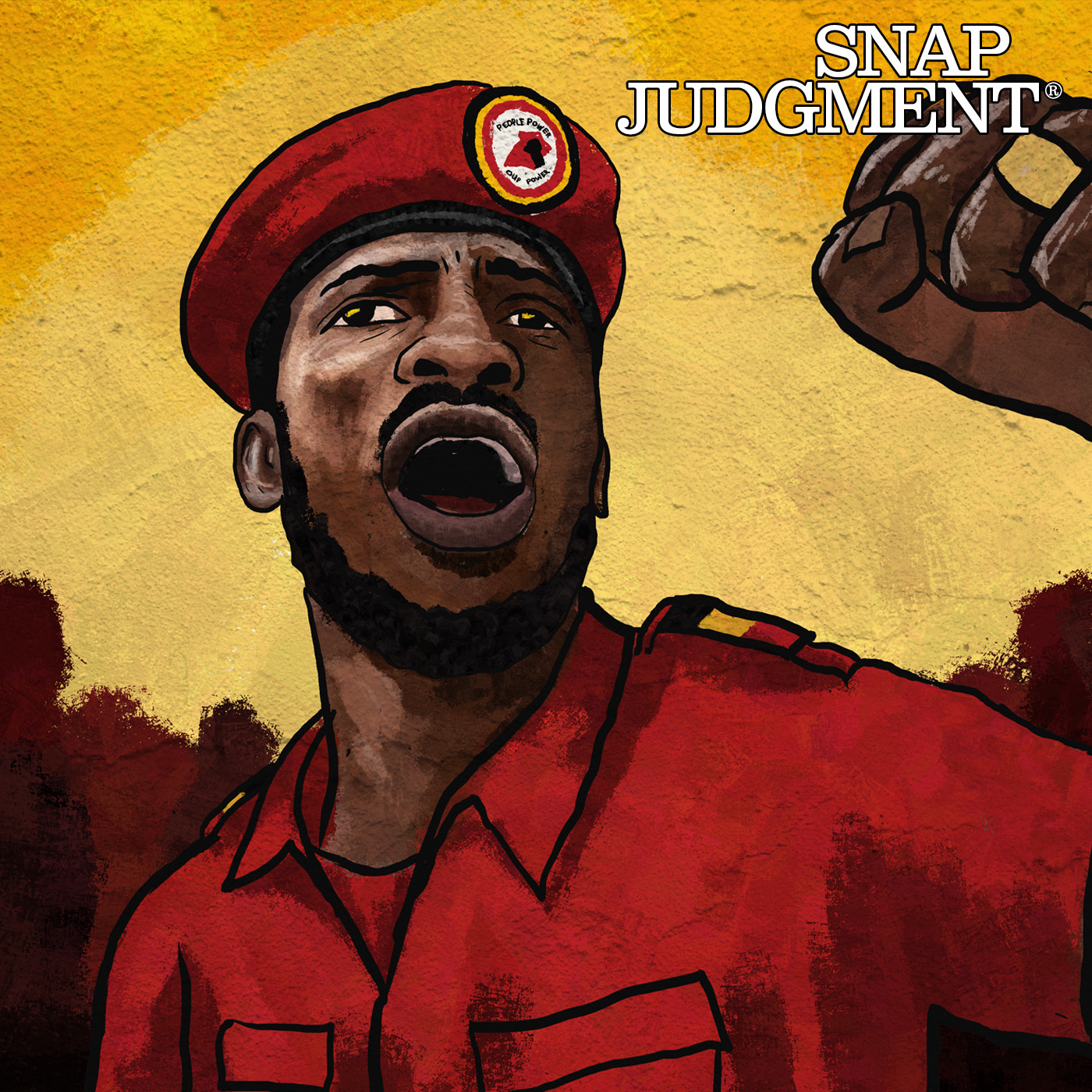
Snap Judgment
The Shot
00:49:33
A young filmmaker documents a political showdown between an authoritarian president and a brave Ugandan pop singer. When he aims his lens, he has no idea the shot he’s about to take.
Loading summary
Transcript134 lines
- [00:03]
Glen Washington
Snap Studios. Snap Judgment is brought to you by Progressive Insurance. Do you ever find yourself playing the budgeting game? Well, with the name your price tool from Progressive, you can find options that fit your budget and potentially lower your bills. Try it@progressive.com progressive casualty insurance company and affiliates price and coverage match limited by state law. Not available in all states. Just a little while ago, the folk that were creating this show all gathered in one place. Pacifica, California. Lovely spot near the ocean. We got together to learn from each other and from others. To run by ideas, to be inspired to dive deep. And one of our producers, John Facilitator, he invited a man to share some of his stories. Snap was. I was so transfixed by what this man told us that today on Snap Judgment from kqed, we've asked him to share a little bit of what he told us with you. Snap proudly presents the Shot. My name is Clem Washington. The universe works in mysterious ways when you're listening to Snap Judgment. For today's story, we go to Uganda, where President Museveni has held power for 39 years. But in Uganda's most recent election, this president was actually challenged by a candidate who happened to be a young, charismatic, beloved pop star by the name of Boby Wine. Boby Wine's candidacy sets the stage between an upstart David and a Goliath who international observer's charge weaponizes the full power of the state security apparatus with beatings, with disappearances, with terror. Still, Bobby Wine fights on, winning converts and making history just by remaining alive. Seeing this, one man thinks this is the story he has to document with this video camera, even though it means that the state security apparatus will now be turned on him. And yes, as this story is real life with real people, sensitive listeners should know it does reference violence. An assessment takes us there. Snap Judgment.
- [02:53]
Moses Buello
Everyone in Moses Boyo's life kept telling him to put down his camera. Everyone.
- [03:02]
Nulu
Yeah, there was relatives, like close relatives. People called me like old friends, people I hadn't spoken with in a long time started calling me. But yeah, it was like, you know, uncles, aunties, they were like, you know, you know, this government, like, what are you doing? Like, this is dangerous. Whatever you're doing is dangerous and you have to stop.
- [03:26]
Moses Buello
Moses was spending all day, every day filming Boby wine.
- [03:33]
Nulu
It was 9th of October 1962 when the nation was born beautiful and adorned with the promise.
- [03:40]
Moses Buello
Bobby Wine is a musician who was famous for protest songs about Uganda's dictator Yawi Museveni. And now he had gone from singing about the ruler in veiled rhymes to actively campaigning against him, since our leaders.
- [04:02]
Nulu
Don'T seem to care for the next generation. There were so many people, so many people on the streets of Kampala, so many people just showing him love and out to like, you know, celebrate with him.
- [04:22]
Moses Buello
In the beginning, Bobby Wine's campaign was joyous and hopeful. Everyone was caught up in the possibility of change.
- [04:30]
Nulu
I think the most compelling scenes were when you would see these multitudes of crowds and all they were asking for is change. Like, for me, that was the most fulfilling. I would feel like, oh, my God. And it was across age, old, young, women, men, kids, and they're like running, running, following us.
- [04:58]
Moses Buello
Everyone that makes documentary films knows that the days are long. Moses was filming these rallies and convoys through the streets. And then at night, he'd go back to Boby Wine's house to film late night strategy sessions in his living room, conversations with his family about their safety.
- [05:17]
Nulu
So we are in very dangerous times. And they.
- [05:23]
Moses Buello
Moses had full access to Boby Wine's thought processes. And every step along the way, he found that there was so much momentum to this campaign that he kind of couldn't leave Boby Wine's side.
- [05:38]
John Facil
But then eventually it became 24 7.
- [05:41]
Moses Buello
How did that make you feel.
- [05:45]
John Facil
At first? At first I was like. At first I didn't really mind, but when things started to, like, get risky, I was afraid.
- [05:56]
Moses Buello
This is Nulu, Moses wife. Moses and Nulu started to see security forces popping up around them. Because of Moses constant filming.
- [06:08]
Nulu
I noticed I was being followed a lot. And there was people on our street, like outside my house, armed, you know, with. And, you know, these are like known vehicles that, that were kidnapping people in the country.
- [06:28]
Moses Buello
Moses was pretty sure he knew who was sending these men to his sidewalk.
- [06:34]
Nulu
IDI Amin is very famous around the world for how brutal his government was. But his government only lasted seven, seven years. President Museveni has been in power for 38 years. Now it's coming to 40 years, you know. He has managed to subdue the Ugandan population. Ugandans live in a military capture. It's a captured regime. It's a, you know, it's a place where if you speak out, they'll come at you with every method imaginable just for his gym survival.
- [07:17]
Moses Buello
This was when Nulu and everyone else close to Moses started asking him to stop putting himself in danger, stop following Obi Wan around with the camera. Just put it away.
- [07:29]
John Facil
He was like, I would say, obsessed with the camera. You know, he was obsessed with the camera.
- [07:39]
Nulu
Bobby Wine has, you know, literally sacrificed himself and his family. Right? And being close to him, you're equally just doing the same thing, right? And I was just right next to Bobby Wine all the time, every day.
- [07:56]
Moses Buello
But did he have. It seems to me that he was a little more protected than you. Because he was.
- [08:00]
Nulu
He was. Yeah, he is. He is. Because he's famous.
- [08:04]
Moses Buello
Right. And you were just the guy standing next to him.
- [08:07]
Nulu
Right. If anything happens to Bobby Wine, you know, cnn, BBC, Al Jazeera, the un, the US the un, the west ambassadors, you know, presidents, they're going to write about this, right? They're going to tweet, they're going to, you know, seek answers. But a camera guy next to Bobby Wine.
- [08:31]
Moses Buello
But Moses felt this need to document the history being made in Uganda. He was collecting thousands of hours of footage. Huge rallies in rural football fields and quiet interviews with torture victims. Footage of funerals of people killed by police.
- [08:57]
Nulu
The footage is another story on its own, because we needed to come up with a plan, because I knew anytime my house would be, they would break into my house.
- [09:10]
Moses Buello
He'd tape his SD cards underneath placemats on the dining room table.
- [09:15]
Nulu
Because I knew if the military and police break into this house, they're going to look through every, like, real place and, you know, under beds and mattresses and things, like, obvious places. So I needed to find the most an obvious place. Like, just hide it in plain sight. So, yeah, they'll walk into the house, who will flip a table mat looking for footage.
- [09:38]
Moses Buello
And this is where Nulu came in. Nulu became a mastermind at hiding footage.
- [09:44]
John Facil
I was into it. I was in it. I'm married to Moses. I'm not divorcing him. So there's two options. Either you divorce him and you're done, or if you're in, you're totally in.
- [09:58]
Moses Buello
She'd smuggle hard drives to remote locations outside of the city. She had code words she'd use to signal a handoff.
- [10:05]
John Facil
You know, we had a code word.
- [10:07]
Moses Buello
You had a code word?
- [10:08]
John Facil
Yes.
- [10:08]
Moses Buello
That meant, like, a safe word.
- [10:10]
John Facil
Yeah, it was a safe word. It was just like, you know, they could be like. I would be like, I have some spaghetti for you. Do you want eat some spaghetti today? Because we knew, like, they were listening. Sometimes maybe they are tapping. So even when I would get there, I'd be like, okay. So it's like, well, you know, thank.
- [10:28]
Moses Buello
You for the spaghetti.
- [10:29]
John Facil
Yeah, thank you.
- [10:31]
Moses Buello
Nulu would carefully wrap up the hard drives in plastic until they were watertight and then tape them to the inside of bumpers and cars. But, like, was it easier to make the footage safe than to make you safe?
- [10:44]
Nulu
Oh, my God, absolutely.
- [10:46]
John Facil
Yeah.
- [10:46]
Nulu
Yeah. Cause in so many ways, there's a way you can hide footage and do things, but, like, you can't hide yourself.
- [10:56]
John Facil
You know, you're very careful what to. What you eat, what you say.
- [11:00]
Moses Buello
What do you mean, what you eat?
- [11:01]
John Facil
Because anybody, if they wanted Moses and me, and they couldn't, like, probably kidnap us or shoot us, then you could be poisoned or something, and they could use anyone. But, like, at work, you're not. Like, I would never eat anything a workmen just brings me. I would never drink anything.
- [11:22]
Moses Buello
Nulu worked as an analyst for an NGO in downtown Kampala, and she said she was starting to get borderline paranoid.
- [11:30]
John Facil
I would lock up everything of mine. I would never drink anything.
- [11:35]
Moses Buello
So, like, if at work someone brought you tea, wouldn't it?
- [11:38]
Nulu
No.
- [11:42]
Moses Buello
There was so much mistrust in the country, and there was unpredictable violence every day, every week. Everyone was on edge and scared to talk to anybody else. Moses couldn't even tell Nulu everywhere that he went.
- [11:57]
Nulu
I mean, there were things I couldn't even discuss with my wife. I had, like, really closed down my friend's group because, you know, there's so much surveillance, you know, around. My wife used to tell me, moses, you're not fine. You're not fine. I was like, no, I am fine. I have no problem, you know? And I just kept going, going, going, going, going, going.
- [12:19]
John Facil
He just kept going and going. Like, he would be with Bobby and bullets are flying. And the next day he's back to work and someone is knocked down by the military truck, and they died. And the next day, I'm like, how.
- [12:31]
Brody Young
Do you manage to keep going?
- [12:32]
John Facil
I wouldn't. I would take a back step and, like, kind of recover.
- [12:38]
Nulu
I think I got to a point where I forgot about death, honestly. It went from supporters and people around Bobby being picked up, kidnapped, and disappeared to now this violence being meted upon journalists, you know, people close to Bobby, wine, myself, inclusive.
- [13:04]
Moses Buello
Nulu said that one day she woke up worried, more worried than usual. Moses was about to set out on a long day of filming, so I.
- [13:14]
John Facil
Would make him, like, a big breakfast. More like a lunch, you know, Uganda lunch. So this morning, I'd made him this nice breakfast. We ate, and then after we said a prayer, and after this prayer, I felt like. I feel like in my spirit, you shouldn't go to work this day. And he said, it's an important day.
- [13:32]
Moses Buello
That Day, Moses was planning on filming Bobby Wine singing a song called Ballot or Bullet.
- [13:38]
John Facil
I feel in my spirit that if you go and you get onto the camera trying to film Bobby today, they're going to arrest you. And it's not going to be regular policeman. It's going to be the army.
- [13:51]
Moses Buello
Moses went to work filming Bobby Wine and Newly went to her office. And the day seemed to come and go with no events. Nulu was coming home from work on the back of a motorcycle taxi when she got a phone call. It was Boby Wine's wife.
- [14:07]
John Facil
And then she said to me, your husband has been arrested and he's at Kabalagala police station. I didn't know what to do because I felt helpless at the time. I was like, how does one move from here? I kept wondering whether Moses was being tortured or not.
- [14:30]
Moses Buello
Moses said when he was filming the music video, he was surrounded by police officers and pushed into a van.
- [14:47]
Glen Washington
Moses boyo has no idea where this police van will take him or for how long. Stay tuned. Welcome back to Snap Judgment. You're listening to the shot episode. And yes, as this story is real life with real people, sensitive listeners should know it does reference violence. When we left, documentary filmmaker Moses Buell has just been shoved into a van by a group of police officers and is being transported to an unknown location for unknown reasons, for an unknown amount of time. Same judgment.
- [15:38]
Nulu
The bus ride to the military, sorry, to the prison cell was like, maybe three, four years in my head. It played out for a very long time because I was like, what just happened? What is going on? Like, how did I, a lawful citizen, get into this place? I was so terrified. I was just like, actually, maybe at that point, I was like, maybe this film, I'm in the wrong path, you know, but when I got to jail, like, when I got there and I started to speak to people there, I was like, oh, my God, like, this is why I came here, you know? And you see young people, young people, like thousands of them who are just locked up for no reason, you know, they were just picked up off the street, you know, and it's called Idol.
- [16:35]
Moses Buello
And Disorderly, Idle and disorderly. A police catch all for rounding up young people who might be seen as a threat. He says he was locked in a small hot room with an open sewer with all these other young men at home. Nulu had no idea when she would see him again.
- [16:55]
John Facil
Many people cried. I remember our family members were there. They felt like, this is it. It's not never going to come out. But I kind of held on to hope. And I was like, everyone was crying. I remember my dad came, my sister, and everyone was crying, and they're like, oh, my God, your husband, you'll never see him again. And I was like, guys, don't cry for me or him. Just pray. Just pray. Or give us, you know, words of hope.
- [17:21]
Moses Buello
After two days, Moses was released. He hadn't been beaten or tortured, but the message had been received. He could be taken away again at any time. Nulu came to pick him up.
- [17:35]
John Facil
Part of me wanted to comfort him, and a part of me wanted to be like, you got yourself in this trouble. Please make sure you don't get yourself again into this trouble. I'm not dealing with it. I'm not dealing with the government. But then, so I told, you know, I tried to comfort him. I tried to understand, you know, where his head was at.
- [17:53]
Moses Buello
Moses head was on, getting back to his cameras, not missing any moments. The presidential election was only a few months away. He could see the finish line.
- [18:09]
Nulu
Because I had decided and with my heart, you know, I love the project, you know, So I think my brain was just in tune with my heart, and I was just like, okay, let's make this. Let's make sure we finish this and die right. Freedom fighters become dictators. They look at the youth and say, we are distractors. We are fighting for freedom. Part of me was drunk with the story. I would sleep dreaming about this film, dreaming, thinking about this film. And I think I really, really valued, valued my camera at that point. Like, it took a Persona. It was kind of like a person, you know. So on the 6th of November, I woke up that morning, you know, got up, said my prayers.
- [19:15]
John Facil
And even this morning, again, I told him, let's pray. Because, I don't know, I just feel like we should pray against the spirit of, like, being disabled. Let's pray that nothing shall happen to me, to us.
- [19:30]
Nulu
I left the house. I took a boda border that morning because there was this gathering. Bobby was going to give a speech. I got onto a motorcycle, and we were coming down this road kind of at the top of the hill, and we're coming down, like, all these supporters around. In front of me, there was a military, a police pickup truck. They were like. It's like camouflage, but blue, light blue and navy blue.
- [20:07]
Moses Buello
Police in different uniforms had different reputations.
- [20:10]
Nulu
They're brutal, brutal, brutal guys. But they were being commanded by a policeman. And the guy starts shouting. This man commanding this situation, he pointed around and was like, shoot them. Kill them all. He shouts this command to his unit, shoot them. Kill them all. And, I mean, the police could see me. I could see them. I'm a journalist, you know, I had a tag, you know, I see a guy, he's dressed in this FFU uniform, field Force Unit uniform. And he looks up, but I can tell, like, we've, like, looked at each other, and he looked at me and could tell he recognized me.
- [20:52]
Moses Buello
And I saw him, this Field force officer. Moses said he had seen him before filming at Obi Wan's rallies.
- [21:02]
Nulu
And he points his gun up, he cocks it. And I knew this is not normal when he cocks it, right?
- [21:13]
Moses Buello
Moses pointed his camera at the officer and hit record.
- [21:17]
Nulu
You know, I'm just recording what's going on. What is he going to do? I mean, that's all I had. That's all I had. I mean, the camera is literally the most. One of the most powerful weapons, you know.
- [21:31]
Moses Buello
So Moses is standing in the crowd looking at this police officer, and the police officer is staring back at him pointing his loaded gun.
- [21:41]
Nulu
So, yeah, when this guy pointed the gun in my face, it was like reflex. I just put the camera in my face. I've never felt such impact or pain that for a minute or so, a few minutes, I just blacked out and I lost control and. But all I remember is I tried to get up, and it was like a motorcycle going past. Stop, stop, stop. I was shouting at this motorcycle guy, this Boda Boda guy, to stop. And I looked around, and I was looking around, I saw this guy aiming for another shot. He was aiming for another shot in that moment. And I jumped on the motorcycle, and the guy took this motorcycle, drove away.
- [22:30]
Moses Buello
Did the camera save your life, do you think?
- [22:32]
Nulu
Oh, my God. Oh, my God. The camera saved my life. The camera saved my life.
- [22:37]
Moses Buello
Moses grabbed the nearest motorcycle taxi and hopped on the back. Blood was pouring out from under his eye. He rode to the edge of the chaos, and then he picked up his camera, turned it on himself, and began to narrate.
- [22:50]
Nulu
This guy, this. This police guy shot at me. You see what happens in this country? Do you see that? He saw me with a camera and he pointed his fucking gun at me. You see that? You see that? I cast. And I'm not someone who curses. I don't cuss. But I cast and I was like, you know, this is the situation that happens in my country. You can see this. You know, I went on this rant and started speaking to the world because I thought, this has to be in the film. No Way, this cannot be in the film, because this is like the classic, you know, museveni military dictatorship. This is golden stuff. Like, this is getting into the film.
- [23:34]
Moses Buello
Nulu met him at the hospital.
- [23:37]
Nulu
I remember she held my hand. She was like, you'll be fine.
- [23:42]
John Facil
Cause his blood was. I mean, his shirt was. He had a white shirt on and was all covered in blood. Like, you know, blood had splattered on it.
- [23:51]
Moses Buello
Did you think. Did any part of you think, oh, well, now he's gonna put the camera down, he's gonna stop?
- [23:56]
John Facil
I thought. I thought maybe it's gonna kind of make him, you know, kind of slow down.
- [24:03]
Nulu
But did you actually think I was going to stop?
- [24:07]
John Facil
Yes, I thought you were going to stop, because if I were shot, I would. I mean, that would be the end.
- [24:12]
Moses Buello
Did you stop?
- [24:13]
Nulu
No.
- [24:16]
Moses Buello
Moses bandaged his eye and then picked up his camera again. He actually made it. For the next two months, he filmed nonstop up until the election. And then the day after, government forces surrounded Boby Wine's home and placed him under house arrest. President Museveni was again declared the winner. Bobby was held captive inside for weeks, and Moses was inside with him, filming it all. During that time, Nulu was home alone, waiting. And one day, two men showed up across the street from her house with binoculars.
- [24:55]
John Facil
And there's, like, someone outside the gate with binoculars trying to look.
- [25:00]
Moses Buello
Nulu called Moses on his cell phone.
- [25:03]
Nulu
You're by yourself at home, and you called me, and I was like, oh, my God, I need to get home. And you shouted. You shouted.
- [25:11]
Moses Buello
The two men outside had an unmarked van. Nulu shouted to them to try and call attention to the situation, even though she was terrified. And eventually they disappeared. But for Moses, there was something very different about this threat when compared to all the other threats he had faced. They were coming for Nulu, and Nulu was pregnant. So Moses walked out of Boby Wine's house, out the front door and the front gate, passed all the armed guards, and went home.
- [25:42]
Nulu
My wife was seven months pregnant, and they attempted to kidnap her. And I felt like, okay, now, you know, we have to leave the country. I didn't think it was right to raise my son in the Uganda that it had become. But also, I didn't think my wife was safe.
- [26:09]
Moses Buello
The film director and the producers had already agreed that they couldn't put the film out until Moses and Nulu were out of the country. So Moses and Nulu started looking for a way out without drawing attention to themselves. They couldn't just leave on the next flight. They had to be more careful and strategic. The couple came up with a story that they were going on honeymoon. They packed tiny suitcases and nervously boarded a flight to Amsterdam. Once they got there, then they could buy onward flights to an undisclosed location, somewhere safe, where they could start a new life with their new family. And where I was able to talk to them on their couch with some tea.
- [26:53]
Brody Young
Okay.
- [26:53]
John Facil
Some. Okay. Just right here is your wife. Want to clean your nose?
- [26:57]
Nulu
Clean your nose.
- [26:59]
John Facil
There you go. Let's clean baby's nose.
- [27:03]
Brody Young
Mmm.
- [27:04]
John Facil
Clean baby.
- [27:05]
Moses Buello
Wow.
- [27:08]
John Facil
To touch. You want to touch.
- [27:11]
Nulu
You want to say hi to Auntie. Auntie Anna. This is auntie Anna. Say hi. But Anna, I think the second day, the day after we arrived first, the first thing I noticed, there was this intense feeling. I kid you not, it was such a beautiful. I woke up in the morning and I just felt alive. And it's a very intense feeling. I was recognizing people, I was recognizing faces, I was recognizing colors. I was testing food. I was. I was smelling. And I was like, what? Like, when did I stop feeling these things?
- [28:19]
Glen Washington
Uganda refused international observers seeking to monitor the election, and some foreign bodies said it was tarnished by an excessive use of force. Museveni was declared the winner Moses film. The People's President was nominated for an Academy Award for best documentary. It received a 10 minute standing ovation at its premiere at the Venice Film Festival and Snappa's. I literally cannot recommend it highly enough.
- [28:48]
Moses Buello
There is something interesting, Glenn, about the film that they made, because that footage that we heard of Moses getting shot in the face, it actually didn't make it into the film.
- [28:59]
Glen Washington
That's surprising. It seems like gold tape. Like he said, it showed everything.
- [29:04]
Moses Buello
Yeah. I asked him why it didn't make it into the final version, and this is what he said.
- [29:10]
Nulu
Because you don't want someone to switch off because of the violence. And it was a big note. Like, you know, guys, if we're going to get a big audience behind this, we need to really cut back on the violence.
- [29:22]
Moses Buello
Did you have feelings about that? Did any feelings come up?
- [29:25]
Nulu
Oh, yeah, totally. It's different when you've experienced the violence and we had a task, or rather we had been trusted with this, with the. To carry these stories that we have to show to the world, you know, So I felt like, you know, we cutting back on it. It's more like, are we betraying that trust? Is this going to be as honest as it should be? You know what I mean?
- [30:02]
Moses Buello
Right. Like, are you gonna make a Disney version of the revelation?
- [30:04]
Glen Washington
Yeah.
- [30:04]
Nulu
Are we cleaning it up? I think, you know, there was, like, some truths that I think just me and the camera knew.
- [30:30]
Glen Washington
Huge thanks to the amazing Moses Buello. The story was edited by Nancy Lopez with an original score by Renzel Gorio. It was produced by Anna Sussman and John Facil. After the break, we're gonna take a trip to the desert. And sometimes it's only one way in and only one way out. When Snapchat returns.
- [30:56]
Brody Young
Stay tuned.
- [31:05]
Glen Washington
Welcome back to Snap Judgment. Listening to the Shot episode My Name Is Washington. Now, this story does contain violence. As such, listener discretion is advised. Today on Snap, we meet Brody Young. And Brody Young, he's a state park ranger at a place called Dead Horse Point, deep in the canyonlands of southern Utah. And the thing is, when you're a ranger in those parts, it also means that you're the law enforcement. Now, Brody, of course, he takes that part of a job seriously. But his real love, his first love, is the desert. The canyons, the rivers, the place. Snap Judgment.
- [31:49]
Brody Young
So let's talk about the stars that come out at night. You can see all the stars. It's just so clear and so dark. It's considered dark sky country. And when the sun rises and you go, you know, on the cliff's edge up at Dead Horse Point, you can see mountain ranges that are 100 at 150 miles away. It's just desolate and vast. And if you don't go out prepared, it's going to bite you. I've recovered a lot of bodies, whether they were on the river, you know, or got lost in those canyons, and they just weren't prepared. So you're putting yourselves on a tightrope, and it's easy to fall. In Desolation Canyon on the Green river, there's a few places you can go see a skull, which is odd, isn't it? But someone dies in the desert, they're going to stay there for a long time before they're found. Some people choose to go die alone in a beautiful place. That happens actually kind of frequently. And that's, that's something I have a hard time understanding. How can life get so bad that you want to end it? November 19, 2010. I was on patrol. I was on a. An extra shift I'd worked that day, but there was some overtime money available. And it's a really warm, warm night. It's kind of the warm before the storm. Then I went down this Colorado river corridor to these trailheads to see if anyone is still up onto the Trails. And the first trailhead I went to is Poison Spider Mesa Trailhead. So I found this lone car in the kind of back of the parking lot. And it was parked really awkward, like I was worried someone would be out on the trail still that hadn't made it back. It was kind of late and late in the season too, so I couldn't see a plate. And I kind of rolled up to it and turned on my overhead white lights and got out of my truck and walk around to the driver's side and I see this lump in the backseat and I think, oh man, someone's sleeping in there. And so I knock on the window and, you know, I knock on it several times. And this gentleman wakes up and he opens the door and I tell him who I am and ask if he's okay. And then he said he was. And then we talked about where he could go camp because camping wasn't allowed in that parking lot. He was in a sleeping bag. So I didn't get a good look at his face. His face today still doesn't mean much. But I needed to get some ID on him and he doesn't have any or doesn't want to give me id, so I asked him to wait there and I walked back to my truck and I looked back once, which is what you're supposed to do when you're on a traffic stop. But my night vision was blinded from the lights and I couldn't hear anything but the noise of the truck. But just as I got to my truck door and just as I was about to get in, that's when the first shot rang out. It hits me in my left arm. I'm left handed, it shatters. And man, I screamed out and I turn and I just see muzzle flash and him advancing on me, firing one shot after the other. Three more rounds hit my back. Two of those rounds were stopped by the vest, but the third round broke through and went into my vertebrae. I fell to the ground at that point. And he is just standing right over me, hitting me with round after round. There was a lot of gravel bouncing around. Eventually he stops. And then I had this moment. It's a terrible cliche, but it was either you lay down and die or you get up. And man, I wanted to live. So I got up, it startled him and he ran to the front of my truck and I ran to the back of mine. And in the meantime, I'm looking at my left hand and I'm telling it to grab the gun, but it won't grab the Gun, it won't move. And I finally just said to myself, you idiot, use your other hand. And that's when I began firing back at him through the windows of my truck. I was also counting my rounds because I knew my reload was going to be with my arm dangling non traditional. So I released the mag and put the gun between my legs, and I used my bumper to chamber around and begin shooting more. I fired in all about 24 rounds. And then he raises his hands and I stopped shooting. And he says, you got me. And then I began to go unconscious. I woke up a short time later. I was laying on my back, and I kind of raised my head and looked down my body to see my truck running. And I noticed his car was gone. And then I thought to myself, laying there, no one knows I'm here. I didn't notify anyone that I was out checking on this car. I had been shot nine times, and I knew that the only way I was going to get help is if I got to that truck radio. But I did not feel right inside. I felt very heavy, like someone had poured concrete on me. My right leg was numb, my left arm was numb, and it was really hard to move. And I slowly began just rolling onto my stomach, rolling onto my back towards my truck. And this took some time. It felt like forever. And, you know, the exhaust is on and it's pouring out. But eventually I reached the front door, and the front door was open. Joe, I've always made it a point to get out of my truck, leaving that door open. I've just always felt like I should. And I leaned up against it, reached for the radio and said, Price 2 Alpha 69. I'm a poison spider. Mace at trailhead. I've been shot. Please hurry. And I didn't know what to do after that. All my training, I just didn't know what to do after that. When the ambulance arrived, it took me to the hospital in Moab. And from there I was choppered to the hospital in Grand Junction, where I underwent emergency surgery. But let me just tell you the damage. My heart was hit small intestine, colon, right kidney, liver, diaphragm, left lung, spine, spine, pelvis, left humerus, you know, left triceps muscle, right forearm, right femoral nerves, right hip flexor. And they told me that I shouldn't be alive. Say I died a couple of times during those first few days in surgery. But after I woke up, I eventually got to the point where I asked, where, where's the suspect? So I was told that after I was taken to the hospital, they found the car that he had driven off in, and it was definitely off the beaten path, but they've noticed that there was a blood trail that wandered off down the river corridor. And they followed this blood trail for like, a mile to a boulder field. And it looked like it had been setting up to ambush anyone who came over the hill because there was a backpack and a.22 rifle and, you know, food and sleeping gear. And he didn't leave a blood trail from that point on. And so the trail went cold. But when they found his vehicle, they ran the license plate and found that it led them to a name of Lance Leroy Arellano.
- [41:27]
Moses Buello
Was there anything in his backpack, in the car that his family could tell you? Anything that would explain why he shot.
- [41:39]
Brody Young
You multiple times in the middle of.
- [41:41]
Moses Buello
The night on a routine traffic stop?
- [41:44]
Brody Young
No, no explanation. Did he have any kind of criminal record? Yeah, it was very minor. Nothing violent. So why would someone do this? What would lead them down this path to where? Shoot a cop and run out in the desert and disappear? Not sure why, but federal and state and local agencies began to search for lands over an area the size of Los Angeles. There was a river search, sonar capability, the helicopter. Then there were just a lot of tracking teams, you know, gun in hand and flashlight in the other, crawling through tamarisk bushes that were tall as cottonwood trees. There were a lot of calls. Yeah, we've seen him. I mean, everyone wanted him found, right, and wanted a reward. And a lot of those. Well, all of them turned out to be bogus. But they checked on all of them. They even went down San Diego and searched to see if he was being very well hidden amongst this motorcycle club. I even thought I saw him a couple of times in town. You know, dark, curly hair, and he was wearing a hat. Like at the grocery store. I would, you know, go back to that aisle just to walk past and to make sure. I don't know if he would recognize me. I didn't really get a good look at him, if I would recognize him. But I had a couple of dreams, and both dreams were the same. We were at a party, and then I would see Lance come, you know, out of the corner of the room towards me. He would raise his hand, and he would shoot at me, and then I would shoot back, and he would die. And so one year after another would pass, and that was kind of torturous, not knowing what happened after, you know, he left me for dead and he drove off. Where did he Go. I wanted an ending to it. And then Christmas Eve 2015, we're making little vials of vanilla to give out to our friends. And I get a knock at the door, and it's my lieutenant. He says, come outside real quick. And his face is not right. So I go out and close the door in my front yard and snow on the ground. And he says, we found him. Two brothers had found the body in a cave, half buried in mud. And I just broke down. It was just. I just couldn't believe it because I thought he would never be found. And I'll tell you, it's only 400 yards from where the backpack was. He went 400 yards and crawled into this crack of a cave. So I got to see the evidence at the sheriff's office. And boy saw the. Saw the bones. And it was still in the sleeping bag, but they had it opened. And then it was kind of laid out. Head, ribs, you know, arms. And it's really hard to determine how he passed away, but I imagine he was. He was probably scared, because when you're hurt and you're out in the middle of nowhere and it's dark and it's getting colder and it's starting to snow, you can't warm up. You're cold, your breathing is getting worse. That's got to be the worst feeling in the world. And it's probably why he crawled into that cave, was just to rest. And there was a letter amongst his stuff, and it was from his daughter. His daughter talked about, we're finally going to be able to spend this Thanksgiving together. And she was really looking forward to it. But he didn't live beyond that night. He just laid down in that cave and didn't get back up. I didn't know him. I didn't even really get a good look at his face. But several times I'm told that I just. I shouldn't be alive. So I don't know what death feels like, but I guess I know what it feels to get close to it. And lying on the ground before anyone showed up, I felt like I had help by me that night. It was really hard. It's hard to describe, Joe, but all I can say is that there was such a comfort. I don't know, arms wrapped around me, that the other side. Maybe it's not gonna be so bad.
- [47:23]
Moses Buello
I don't know. What do you think Lance felt? Do you think he experienced what you experienced?
- [47:30]
Brody Young
That's a hard question. I hope so. I don't know. Maybe someday I'll get to ask the question, but it won't be in this.
- [48:02]
Glen Washington
Many thanks to Ranger Brody Young for sharing his story at the snap. After a long recovery, he's back to doing what he loves, working as a state park ranger in the deserts of southern Utah. But he's also taken to motivational speaking, helping other people figure out how to survive the unsurvivable. To learn more, we'll have links to his website on our website snapjudgment.org the original score for that story was by Leon Morimoto. It was produced by Joe Rosenberg. If you missed even a moment, know that an entire world of SNAP storytelling awaits. In fact, the New York Times lauded snap's new series Mind you'd Own is one of the best podcasts of the year. Hosted by Oscar winner Lupita Nyong'o, Mind you'd Own features amazing stories from the African continent on podcast platforms everywhere. Right now, KQD in San Francisco is SNAP's orbiting hall of Justice. SNAP is brought to you of a team that never, ever turns the microphone off. Except of course, for the uber producer, Mr. Mark Ristich. He generally forgets to turn the microphone on.
- [49:17]
Nulu
Now.
- [49:18]
Glen Washington
There's Nancy Lopez, Pat Mercini, Miller, Anna Sussman, Renzo Goriot, John Fasile, Shayna Shealy, Taylor Dicott, Flo Wiley, Bo Walsh, Marisa Dodds, David Exme, and Regina Mediaco. And this is not the news. No way is this the news. In fact, you'd capture the shot of your life that almost cost you your life only to have that scene cut from the film and you would still not be as far away from the news as this is. But this is PRX.