← Jung On Purpose Podcast by CreativeMind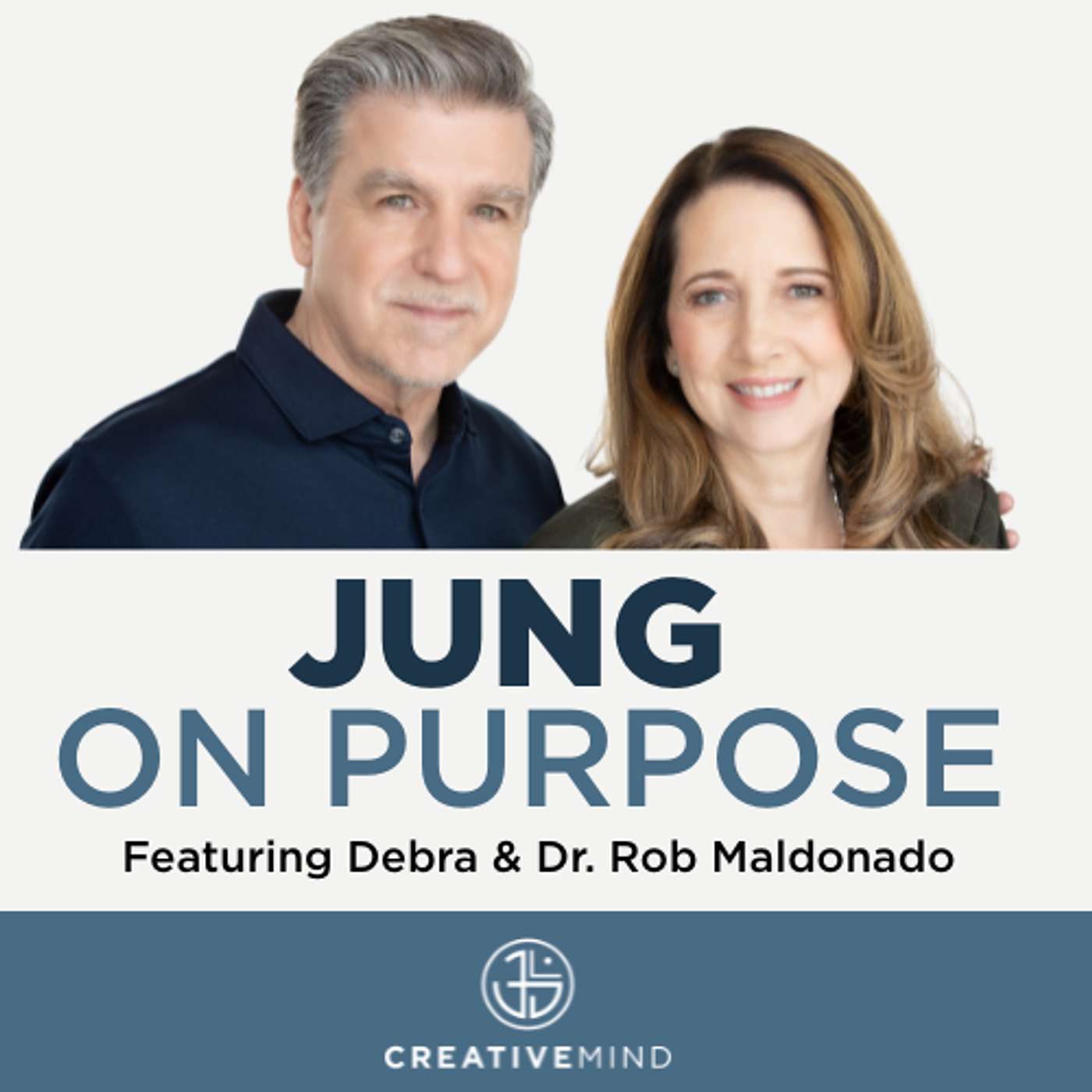
Loading summary
Transcript143 lines
- [00:01]
A
This is Yang On Purpose with Deborah and Dr. Rob Maldonado of CreativeMind. Join us each week for a deep approach to personal growth through our neuromindra coaching method. Grounded in Jungian psychology, Eastern spirituality, and current neuroscience. Be empowered to escape the trap of fixing yourself and step into your purpose to live a more conscious life. Let's begin. Hello, everyone. Welcome back to Young On Purpose. I am Deborah Maldonado.
- [00:32]
B
I'm Dr. Rob. Welcome to the program.
- [00:35]
A
And today we are talking about the ego and really digging deep in what actually is the ego and the different models of the ego. So you kind of figure out when you're saying, that's my ego, what does that mean? And how can this help you in your life? How can you understand the ego in a way that you can create something really great in your life, so making it really practical as well. But before we begin, I do want to ask you a favor and please subscribe to our channel. If you're watching us on YouTube, there's a little button in the corner you can press. Or if you are listening to us on Spotify, itunes, any of those wonderful podcast services, love, love for you to subscribe to our show so you can get every episode and that helps us reach more people. So, Rob, what is the ego? Let go my ego. I used to say all the time it has a bad rap in some ways. Let's, let's get into it.
- [01:29]
B
Yeah, yeah, we can cover a lot of ground in a short time. We just ask you to keep in mind that this is not an exhaustive conversation because there's there are many, many models, let's say, of the mind and of the ego as well. So we're going to present a few of the most important ones, the most influential ones, and the ones that, that really get at what is happening today and why is this important for you to understand? So we'll try to get at that.
- [02:05]
A
And you had mentioned, we were talking about this earlier, There are like 400 different concepts of the mind or theories of the mind. What do what you. 4,000?
- [02:15]
B
Yeah, the poor around 400. Just different ideas of what, what consciousness is, what awareness is. So the, you know, that's the, the foundation of mind. So you can imagine how many other ideas there are about the ego, which is a particular aspect of the mind.
- [02:36]
A
And so when we think about, like, information's being disseminated at incredible ways, and even AI is not always accurate with its interpretations. And because of all the different interpretations of consciousness, different psychologies, there's no one that's right or wrong. You know, it's not like this is wrong and that's right. They all are. It's like science. Like everything is trying to evolve. Like, we're trying to understand human nature, we're trying to understand psychology, and everyone has a different perspective. Some people are spiritual, and they have a spiritual perspective. Some people are religious, have a religious perspective. Some people have a scientific perspective. So when we think about when we're hearing, like theories or understanding concepts and coaches and all the different types of modalities that are out there, we want to kind of understand, really the foundation of all personal growth is the ego and the sense of self. And I think this is a really great conversation to have. So people don't understand. Like what? Like, for me, as a layperson, I didn't study psychology or psychotherapy or anything like that. So when I met you, you introduced me to so many interesting concepts about the mind that really isn't out there. And so behind the scenes, there's so much research and information about the mind and the brain and the personality and all that that it's just a lot. We're not going to be able to cover it all. But I think it all comes down to the ego, don't you? Like, that's the kind of our sense of our individual experience of the world.
- [04:04]
B
Yeah, it is definitely an important piece of software, I would say, in the mind. Yeah. So let's get into it. I was thinking let's begin with the biology, because neuroscience, Right. Is kind of a big deal in, in, in science. It's our physical understanding of the brain, of the nervous system, how it functions, what it does, what are the neurotransmitters, what are the hormones that impact it, all those really important things that give us kind of verifiable scientific information on it. So from the perspective of neuroscience, the ego is an emergent property. Now, what does that mean? It means that it appears out of the functioning of all these neurons talking to each other. This sense of me, of I just kind of appears out of all that biology happening, all that communication, smoke coming from a fire.
- [05:01]
A
It's like, oh, and there's this shape of an eye, this person and self concept. Right. The. The subconscious, how I feel like you identify. I feel this way, or I feel tension or I feel anxious. It's the kind of connection to the body.
- [05:19]
B
Yeah. It's an emergent property, meaning it doesn't really emerge until the brain is doing something. Right. It's processing information. It's working on memory, on Cognition on emotion. And out of that experience arises this sense of I.
- [05:38]
A
So it's a sense of I. So does this sense of I emerge when someone's in a coma and unconscious?
- [05:47]
B
No, not technically, but people will argue
- [05:49]
A
that when they were in a coma they had experiences of hearing things in the room, but every end up responding to people praying or being there talking to them. And so that's not neuroscience, that's something else.
- [06:03]
B
Right. Well, I think a good neuroscientist would try to explain that from that perspective. So these are called paradigms. There's a lot of different paradigms, meaning a lot of different points of view, worldviews that study consciousness, the brain, the mind and the. And each one has kind of its limitations and guardrails. You know, in neuroscience you don't go beyond a certain point. You don't speculate about metaphysics because within, from their point of view, it's only if you can verify it physically, measure it scientifically and measure it and get some kind of detection from him, from the.
- [06:50]
A
Does that go into like a mystery bucket of. We can't explain that, so we're not going to worry about it for now. Or maybe they try to, but they can't figure out what it is. Right, yeah.
- [06:59]
B
And so that's the idea of the emergent property, that it's saying something without saying it. So instead of saying there is an ego, they're saying it appear. There appears to be an ego that emerges out of brain functioning. So they can't, they can't deny it, obviously, because who is the one that is reporting these experiences of thought?
- [07:26]
A
I am a scientist. I have sets of I that discovered this.
- [07:30]
B
Right, exactly right.
- [07:31]
A
To develop the machine to measure brain waves.
- [07:34]
B
So the ego cannot be denied, but it also cannot be explained away. In other words, it can't say we definitely know what the ego is. From the neuroscientific perspective, again, it's an emergent appearance of ego, of sense, of I, of me. Yeah. So let's move on because a lot of people are.
- [07:55]
A
Dr. Freud.
- [07:56]
B
Yeah, a lot of people are interested in Freud because he, he was the godfather or the father of psychology and psychotherapy, psychoanalysis, on and on, just very influential. We're still talking and debating about Freudian theories. And many of his intuitions and concepts were correct and they still hold water today. A lot of them didn't, of course. They were explained in different ways or proven to be wrong. But his idea of ego was interesting and it still holds some water today because he thought of the Ego as very much driven by sexuality. In other words, it was a function of the psyche of the mind that focused on making sure you survive so that you could reproduce.
- [08:54]
A
Is it reproduction or just sexual pleasure?
- [08:57]
B
Oh, that's a good question. But yeah, he would say it was both. If you think about why is sexuality pleasurable? Well, nature wanted to make sure we engaged in it. So if it wasn't pleasurable there would be no interest, no one wouldn't want
- [09:12]
A
it, there'd be no people on the planet.
- [09:14]
B
Yeah, exactly. So he wasn't alone in this. He was looking at other scientific evidence at that time in his time. Darwin, of course had been around for a while by then and his ideas were very popular and Darwin.
- [09:31]
A
And controversial too. Yeah, to the. Very controversial for the religious people that didn't believe in evolution.
- [09:37]
B
Yeah, yeah. But not from a scientific perspective.
- [09:41]
A
No.
- [09:41]
B
Yeah, from the scientific perspective, Darwin is still considered one of the best theoreticians that we've ever seen on the planet. His ideas were really based on scientific observation, data, very clear thinking and evidence based. He wasn't just going on speculation on metaphysics or anything like that. He was going on data. And so we're still really operating under a Darwinian perspective, let's say. It's very. Still very powerful in biology and medicine and natural selection and so on and on. So Freud looked at Darwin's work and said, yeah, there's really good evidence here that sexuality appears to be one of the main driving forces for all, all life forms. In other words, why do insects develop their colors, their lights, whatever they. They do to attract the mate, they do it to reproduce in order to make sure that their genes are passed on. So it is a very.
- [10:50]
A
Freud said the ego. When you're talking about the ego, would Freud, does Freud say the ego is the one that's driving that sexual drive and the desire?
- [11:01]
B
I think you would say that the ego evolved in order to help us achieve that function of passing on our genes.
- [11:13]
A
Can I ask you a question? Did Freud. And I'm asking the tricky questions, you might not know the answer. Did Freud believe that animals had an ego or only result specific. Because Darwin obviously we're learning from that and then we evolve into a human being. Did the ego arise from humanity or is there an ego in animals or a sense of individuality? I would say there is some sort of ego in the animal.
- [11:40]
B
My sense, and this is completely my sense because he didn't really explain. Yeah. A lot of that stuff or talk about it. My sense is that the way he defined ego, for him, was very much a human.
- [11:56]
A
Okay.
- [11:57]
B
Function.
- [11:58]
A
And so how would he describe the ego? Dr. Freud, what is an ego? What would he say?
- [12:04]
B
Yeah, so he'd say it's definitely the. It really translates as I. Mm. In other words, what we call, like, when we knock on the door and somebody says, who's there? It's me. Right. It. We say it's I, the person on the license plate.
- [12:21]
A
License. Driver's license.
- [12:23]
B
Yeah. We're just kind of saying this sense of individuality that I identify as myself.
- [12:30]
A
And he would say that's part of the conscious mind. Like, we're conscious.
- [12:33]
B
Very much.
- [12:34]
A
Like a conscious sense of self.
- [12:37]
B
Yes. The sensible I. The sense of me. The self. The sense of self. Right. Jung would say. I'm sorry. Freud would say its primary function is to help us survive so that we can pass on our genes just like any other animal. Pretty much. And I'm oversimplifying, of course, he uses a. A very deep thinker as well. And. And kind of presented his ideas in a lot of interesting, different perspectives, but most of them were biological, evolutionary, kind of designed to act on our instincts. And our instincts he saw as going back to our animal nature.
- [13:26]
A
And so when we think about, like, I know for me, when I first started personal growth, it was about reprogramming your mind, which is the brain stuff, and then also building up the ego, like, making yourself more confident. And then there's also. Freud also talked about the patterns that we have. Like. Like the secondary. He. I don't think he called it the secondary gain, but there's an unconscious part of us that's making us do stuff we aren't conscious of. And so when you think, we'll go into Jung later, but when you think of, like, pure Freudian, what was his, like, approach? Like, if he was going to teach a coaching class on his theory, like, what would he do? What was his kind of idea of the unconscious and how the ego interacts? And what's the goal of the. You know, of this psycho. What's the end goal for the. Psychologically. For that person.
- [14:14]
B
Yeah, so. So he saw the ego as having powerful defense mechanisms, ego defenses. Now, these ego defenses were meant to protect that sense of I. Right. That's to protect the ego, to keep it feeling as powerful or as whole as possible. And so one of the defense mechanisms was repression, which we all know of, meaning we. We kind of push away something that's unpleasant. Let's say if I'm angry and I'm in the office I can't express the anger. I have to suppress it.
- [14:49]
A
Or a memory you don't want to remember because it's too painful, you suppress it. And so the ego's job is to push away anything unpleasant. And he always, like, I've heard him say, Freudian, say you're moving away from pain to pleasure. Like, it's always trying to get you the pleasure principle. The pleasure principle, yeah. Which I read that book on the pleasure principle, and I thought it was a really interesting concept of the peekaboo, like when babies play peekaboo. And I was like, wow, this guy's brilliant. And he said that we pull up the sheet or whatever, hide our eyes, and the baby gets scared. And then we reveal ourselves and the baby goes, it's so happy. And he called it the joyful return. And so his theory was that after a painful situation, we're actually happier after because we've got back to our happiness and it actually means more. So we're always driving to that. And almost like, I wonder in a way, I don't remember if he said this, but we kind of create tragedies and drama so we can have that joyful return in some way. It's like this game we're playing with our ego to like, get to those, like, moments, right?
- [15:57]
B
Yeah. It's like the person that says, why are you hitting your head on the wall? Because it feels so good when I stop.
- [16:05]
A
Are you looking for a satisfying career as a life coach? If you are seeking a deeper path of training and growth, Creative Mind University offers an ICF accredited life coach training program that goes beyond surface positive thinking and into a powerful process of real transformation. You can start your new career as a certified life coach trained in a unique methodology based on Jungian theory, Eastern spirituality and social neuroscience. Get the tools to become your true self. Change your life and the lives of others. Visit creativemindlife.com click on apply and speak with one of our team members today to discuss your future and possibilities of becoming a certified Life coach. That's creativemindlife.com. But so anyway, back to like. His idea is like. So the. The function of like, say a coach or a therapist back in the day, if you apply the Freudian model of the ego, let's say I want to find a love, but I can't find. You know, I don't know why I keep attracting the wrong people. How would Freud, a Freudian coach or therapist, approach that problem? Just to keep bring it down to earth.
- [17:28]
B
And yeah, so that's why I constantly would it be.
- [17:30]
A
Build up the ego.
- [17:31]
B
Yeah. So the, with, with the idea of repression again, the ego defenses that are repressing emotion. And his idea was very, it's called a psychodynamic model because of this, because his idea was that there, there are dynamics in the mind that have to account for that pressure that builds up. So it's almost like a steam engine that, you know, the fire is running in the steam and it's producing steam and the steam has to have somewhere to go. It can't be like infinitely repressed. So he says, yeah, we, we're able to repress emotion but it's building up and it's going to have to escape somehow. And if we don't find a way to, to allow it to escape or to dissipate through emotional catharsis, perhaps like
- [18:28]
A
in, in psychology, he was very into emotional catharsis. That was his kind of release the feeling. Yeah.
- [18:35]
B
Way of releasing that pent up energy, that emotional energy. And if you don't, he says what happens is neurosis. So neurosis for him was a dysfunction that is coming through the repression of emotional content that is now escaping kind of without your consent. So it's showing up in a way that is dysfunctional. So you might be washing your hands over and over in order to try to get rid of a bad feeling. And therefore you have a neurotic component instead of a healthy way of expressing your emotions.
- [19:14]
A
So let's say this single person, I won't say it's me, a friend would keep chasing love in the like, a compulsory, like it would be like that person would just be obsessed with finding love because it wants to express itself. It's repressing the intimacy. So it's kind of like caught up in like a loop where the emotion thinks, the ego thinks, the. If I get the results out there, I'll feel better. But they're building inside unconsciously a barrier to that, to that result. So it's like one foot on the brake, one foot on the gas. And so for a. And I did this a lot with hypnotherapy, looking for that barrier where that, that piece where. Well, what is really happening? What is unconsciously what, what is the fear about actually having what you want? Do you really want this? And, and, and he would work with revealing that. Right, Making the unconscious conscious.
- [20:07]
B
Yes, psychoanalysis. And again, I'm oversimplifying just for the sake of brevity, but Freudian psychoanalysis was essentially a way to help the client understand their neuroses. What is the real source of it? And in revealing it and in, in kind of accepting it, the neurosis would
- [20:27]
A
resolve almost like if I can. Well, like there was like a theory, if you relived the trauma, you can desensitize yourself from it and stuff like that. Would that be a Freudian approach?
- [20:39]
B
Yeah, well, I'd say some of those ideas evolved out of psychoanalysis.
- [20:44]
A
And then the assumption for Freud was, and we'll keep going down the line of everything, that the human being is a separate being. There's no spiritual aspect, but we're kind of like more animal instinctual people. And we're working with our instincts and working with our drives and, and very mechanical way. Almost like a material, very biological, I'd say. Biological. Okay.
- [21:08]
B
Yeah.
- [21:08]
A
And so that's why a lot of people that do, like those of you who have done work where you're releasing emotions or clearing and all that stuff, it comes from this kind of idea, but it's a very biological model of dealing with your life. Right. And, and even the neuroscience too, like re. Rewiring your brain type of thing. So the ego basically is there to once the pleasure. It's also holding the, the past in place. So it's kind of, it has like, it's serving two masters in a way at the time, would you say?
- [21:40]
B
Yeah, so we, we can't really understand the Freud any ego unless we understand two other components. Okay. So for Freud, the ego was kind of a. A middle man or a middle person caught between the id, which was the pleasure principle, which was just saying I just want to eat, sleep, have sex and enjoy Netflix or something like that. Right, that's, that's the I.D. he said. And that, that I.D. is like very powerful. It's always prompting us to just enjoy ourselves and, and have pleasure in life.
- [22:15]
A
Could it also be destructive, the id like wedding power over others?
- [22:19]
B
Well, of course, yeah. I mean that's the source of addiction. Right. Or why we have.
- [22:23]
A
Yeah. Addictions and. Yeah, okay.
- [22:25]
B
Yeah. On the other hand, he says the ego has to listen to the superego. And for Freud, the superego was the preacher, the teacher, the conscience, the parent. Yes. What we would call our conscious mind.
- [22:42]
A
And so he would call that like an internalized parent in a way. Something like that. Hearing your mother's voice saying, don't do that, Johnny.
- [22:49]
B
Yeah, the internalized authority figure. That would be the kind of a shorthand for that. So you.
- [22:56]
A
I've had just for example, I may had a. I had lots of clients, male clients when I was in doing hypnotherapy. And many of them had trouble sexual with their sexuality, like expressing themselves sexually. They couldn't perform. And they came to me to like work on it. And it all came down to the mother shaming them for having sexual feelings. And so that could be a very simple, like, not simple, but, you know, an explanation why they hold back or why they have confusing feelings around sex and all that. And women too, like the father might have shamed them or told them, you know, we're very religious family, you can't have pleasure. So and, and then everyone's unique because there could be everyone in the household, have a super, listen to the parent. And then that one kid is like, I'm going to do the opposite. So they don't have that strong superego as the other siblings would.
- [23:44]
B
Yeah, that would be. Part of the analysis would be to figure out why is the patient experiencing this and what, what is the content of their ID and superego and how is their ego as the middleman handling the pressure that's coming from both ends? 1, 2.
- [24:03]
A
And so the ego, we kind of have that. I mean, we don't call it the SuperEGO or the ID, but we kind of talk about. We all can relate to that feeling of being confused. Like, I want this, but I feel like a little, you know, why isn't it happening? You know, that, that barrier, why, why hitting a wall, why I keep repeating patterns. But then also in our own conscious mind, we have conflicting. I can't decide. Right, exactly. That indecision or that ambiguity of like making a decision because there's all this confusion. And the ego, I always say, loves to concrete confusion so that we don't really make a decision because it's another defense because if we stay confused, it keeps us in that status quo. And that's also. Would be a pleasure for someone versus facing pain of change.
- [24:49]
B
Yes. Though Freud would say that the ego is trying to keep the balance and trying to keep us kind of comfortable, but that these opposing elements, dynamics in the psyche, are the ones that are causing the, the anxiety in, in the individual. Right. The anxiety arises, let's say, if, if you're caught between going to a party with your friends, which is the id, and saying, you know, just go have a good time, drink and all that good stuff, or stay home and study for your Sunday school exam or something. Right. Something that, you know, you want to
- [25:32]
A
do the right thing versus the thing I really want to do.
- [25:36]
B
Right. And the conflict between those things that creates the ego anxiety where the ego is uncomfortable in choosing one or the other, and therefore it's conflicted.
- [25:48]
A
So can I ask you another question before we go on to Jung? Because that's going to be even more fascinating. So is the SuperEGO and the ID conscious to the person, or is that something that comes out in psychoanalysis?
- [26:00]
B
Yeah, I'd say in general, Jung, Freud would say that most people do not understand those dynamics, and therefore psychoanalysis is a way for them to understand this.
- [26:12]
A
But it's more. They're conscious of it, but they don't know. They're confused by the different messages their mind is telling them, or where would it be completely unconscious that they didn't even know that their mind has that desire to go to the party and they don't know why they feel anxious or.
- [26:26]
B
Yeah, Freud would say people hide a lot of those things from themselves, that they. They're completely oblivious as to why. Is that anxiety coming up? It might be again, like you said, some shame about sexuality from their experience with their parents that they haven't understood yet. And yet it's coming up as anxiety about going to a party and therefore the individual's confused about what is the cause of this anxiety?
- [26:56]
A
For me, well, the reason I'm asking is because, you know, there's a lot of things you can get at pretty easily in the mind. Like, you don't see it right away, but then you get an insight through journaling, through coaching. And one of the things that Freud taught about the mind was that there was a preconscious. And then he called it the subconscious where we can't see. But I always found that fascinating because, you know, some people are like, oh, I got that. My subconscious beliefs. And it's like, well, you kind of know it. You can hear your mind saying, I'm not good enough. Or, uh, I could see, like, I do have a desire for this, but it's like preconscious. It's like I always think of it as like on the wings, on the side. And then you just have to pull it to the front to see it. Like, it's not that hard. It's still conscious, but it's like pre. Conscious. Name the best day of your life. And then all of a sudden the memory comes back and it's like, wow, there it is right there. It's not hard to get at. But I think what really the power of that work with Freud is finding what they don't know, right? That. That deeper subconscious where. No idea. And how he would get that through that is through talk therapy. And, and the goal was to kind of have the ego, have more power, and be able to operate between the ID and the superego in a healthier way versus a neurotic way. Is that really the, the goal of his kind of therapy, psychodynamics?
- [28:16]
B
That's a good way to describe it. Yeah.
- [28:18]
A
Okay.
- [28:19]
B
It was to kind of resolve the internal conflict and come to some kind of agreement and come. Coming to terms with the situation.
- [28:31]
A
I find too, that the evolution of psychology as we go, you might. People that are listening, you might notice I started here. That's the basic understanding. It's simple. Freudian is a little more. Well, their behaviorism is the simplest. It's like change your behavior, change how you feel. But the Freudian model, the psychodynamic model, if you're going to start at the beginning, that is kind of a simpler idea of just working with almost a lot of the things that are easy to get at. And it makes a lot of sense. It's very rational. Freud's ideas, you know, very like, like you can get insight pretty easily in that and it's very powerful. I've used this kind of model with my clients for years and it works really well. But when I found out about Jung and his model, it added that little piece. Well, not a little piece, a big piece of the spiritual and the transcendent nature of who we are. And so let's talk about Jung and his model of the ego.
- [29:28]
B
Yeah, yeah. So if we think about Freud as a biologist and a materialist, he is very pessimistic in a way, about human nature in the sense that he, he saw us as animals with a big brain, doing our best to survive and to pass on our genes. But essentially that was, again, I'm oversimplifying, but that was his view of human nature, that we were full of repressed emotions, instincts, tendencies, impulses that we had to repress and hold down because otherwise we wouldn't. We wouldn't be civilized. It would be very close to just animal life and hedonistic. Yes, exactly. Freud wanted to continue this train of thought and, and create a psychoanalysis that would. That he could pass on to others and that would become a big school, which it did. And initially he wanted to have Jung, Carl Jung, as his heir and prince, almost his son.
- [30:37]
A
The son.
- [30:37]
B
Yeah, like the son he never had. That was going to carry on the work. And for a few years it appeared that that's the way it was going to be. But then Jung started to have his own ideas and Kind of felt constricted by especially the. The sexuality theory, which kind of pointed to sexuality as the main driving force of the libido or the ego.
- [31:03]
A
And that was their split, like the way they were arguing about that back and forth. And. And Freud wasn't open to other ideas. He was just like, no, I'm right and you're wrong.
- [31:13]
B
Yeah, yeah. The kind of the stern father who wanted his ideas to be almost religiously followed, and then the rebellious son who said, no, I have my own ideas. And essentially, I mean, there's some. These guys wrote letters to each other and all the letters are still available. So you can kind of read the drama that was going on. But in essence, this is kind of a simplified version. Again, Freud thought the ma. The primary driving force, libido, the life instinct in us, is sexuality. Again, to pass on the genes and make sure, you know, those are passed on to the next generation. Jung agreed. He said it includes that. But there's a larger function to libido, to the life force, because we're also interested in, is there a God, what is the purpose of life? Is there a soul? Do we exist in after death? He said all these questions. I'm not saying that I have the answers or that we know these things, but that they are very much a part of our human nature.
- [32:23]
A
To question, like, spirituality is a part of who we are. And he said, why do we not talk about that in therapy, in psychology?
- [32:31]
B
Yeah. And that it plays an important role in how we create meaning in life.
- [32:36]
A
And so what would Jung call the ego?
- [32:40]
B
Yeah. So for Jung, then the ego takes on a different role. He. He's not so much concerned about the ID and the super ego. He kind of acknowledges them in the beginning and kind of works along with those things. But fairly soon he drops that and begins to focus on the ego as the center of our conscious mind. Now, what I mean by conscious mind, meaning our waking life, it's the center of when we're awake. Who is the I that is performing the action, remembering the memories, learning the new things. He said, that's our ego. That's the center of our waking awareness.
- [33:27]
A
And so when we talk about consciousness in Eastern philosophy, he's not talking about consciousness, he's talking about consciousness, like our consciousness, meaning our self awareness in our conscious mind. Yeah. And so the ego's like, almost equal to the conscious mind in a way.
- [33:44]
B
Pretty much.
- [33:45]
A
Okay. And so with the goal of.
- [33:48]
B
He thought of it as like the nucleus. Right. Because in awareness, let's say in your waking Awareness, you're still aware of a lot of other things that are not you. And so that. That's the bigger aspect of our conscious life. But the center, he would say, that's our ego. It's that sense of me. I'm the one that is experiencing these things.
- [34:13]
A
And so what. In the goal of Jungian psychology, we talk about making the unconscious conscious. And so the. So what happens to the ego in. If they undergo the individuation process? Yeah. So instead of like a psychoanalysis individuation, what would be the ideas to build up this. Make the conscious mind have more information so it can make decisions. But it's still the ego itself. It's still separate from the world, still like almost a materialistic approach too. Like I'm you and you're me, and we're separate beings. We all each have a separate consciousness, but we have some roots that are connected to everything. But we're. We're still like individuals.
- [34:59]
B
Yeah. This is where Jungian psychology really is different from Freudian psychology. Now this has to do with philosophy in a sense, because if Freud was a materialist, a biologist, essentially, Jung was more of a metaphysician, more of a philosopher, more interested in Eastern philosophy as well as alchemy, meaning some of the occult arts that were in a sense very romantic for his period. They. They looked at nature as having a wisdom of its own. And so the mind for the Romantics was a living system, living wisdom and intelligence that transcended ego. So Jung borrowed a lot from all these different disciplines and traditions. So we have to consider then, when we are looking at Jung's formulation of the ego, it's in a very different context. So for Jung, there's not only a personal unconscious, like Freud had developed this concept, but there was also a collective unconscious. For, for the Jungian, from, from the Jungian perspective, then the psyche is a very different animal than the Freudian unconscious mind.
- [36:26]
A
Can I make a quick comparison that might.
- [36:28]
B
Yeah.
- [36:29]
A
If this works or not. But just coming to me, a Freud is a materialistic biological model. And they believe, and the neuroscientists believe, that consciousness, or the sense of ego arises from the body, the brain and the conditioning and the like. Freud didn't believe in past lives or that we have a soul. It's just for this, biological beings driven by instinct and, and then the. So it's arising. That sense of I arises out of the individual body where Jung would believe the I arises not only at the personal unconscious, but also that I is connected to all of Humanity and the collective. So it's like almost like a psychic information, a psychic created I versus a biologically created eye, like a consciousness created
- [37:14]
B
I in a way, very much so. And so the. The context is already very different. We cannot really think just in terms of biology. Although Jung kind of still talked about instinct, he connected them to archetypal structures at. Which were much older and were inherited from. At that time. They, they didn't know all the genetics of it. But, you know, he might have talked about something like that. This was inherited genetically or epigenetically now, as we know.
- [37:54]
A
So the goal of Jungian psychology, or like a Jungian analyst, we're not talking about our method because it's a little hybridy with Eastern philosophy. So the Jungian analysts or Jungian therapists, their goal for the ego is what the conscious. Making it just more conscious of its patterns so we can make conscious choices. Is that kind of the. But they still believe that. They believe there's a soulful part of us, but it's still an individual consciousness that is almost like kind of similar to an ego that is being kind of developed and evolved through the. Through the psychology.
- [38:29]
B
There's definitely an ego in, in the Jungian model, but the ego is not the totality of the psyche.
- [38:37]
A
Yes, but on a conscious level, what do we do with the ego in the. In say, young. Traditional. Fundamental. Fundamental young. What was his. What was the ego's role and what. Where do we take the ego and what in. In this development?
- [38:51]
B
Yeah, I love what the way Jung writes because he, he really kind of explains things in his. His view. He explains it in a very poetic sense or in a poetic way. So he says if you think about our ego as the hero, we are following a solar myth. Now, what he, what he meant by that is that the solar myth is that the sun rises every day and it moves towards the zenith. In other words, the peak of the day is when the sun is right at the top of the sky. Very little shadow is cast because everything is illuminated equally. He says that that's kind of what our ego does. Like we wake up in the morning and we move towards this growing awareness. Then it starts to descend. Right. So the, the sun in the. After the zenith, it starts to go down. And it means we're going into the unconscious now, into the dream world, into. In the bigger cycle of death, of course. And, and this idea of going into the underworld, experiencing dreams, experiencing.
- [40:06]
A
So is the ego going into the underground? So the first part of life is. Billy.
- [40:11]
B
Yeah. The solar Myth means that he saw the same pattern play out in our waking world, in our waking consciousness, that we would wake up, be the. The whole world would be illuminated through our awareness and then begin to fade and descend back into the unconscious mind, where it went through dreams and deep sleep, then arose again. So this solar myth, he says, is. Is really what we're playing out continuously. And the ego, we can think of it as the. The hero of that myth.
- [40:48]
A
So the hero's going into the unconscious like the hero's journey. And then so the ego's still going in there and making the journey in the Jungian model. So thinking of the solar myth, he said the first part of life is like the sun going to noon, and the second part of life is letting go of the ego. So when you say let go of the ego, it's like shifting the center of consciousness from ego to the larger self or this larger psyche of who we are, which he calls the self, which he borrowed from Eastern philosophy, but it's not the same as Eastern philosophy. And that's where I get a little confused. So can you explain that?
- [41:25]
B
Yeah.
- [41:25]
A
So we don't want to get rid of the ego, but we are moving our. Our like kind of giving it less power or less control over our life.
- [41:34]
B
Yeah. So if we focus on that first half of life, like you said, the ego's function is really important there because the ego is helping us survive and build our Persona and build our skill set to. To face life, to face the challenges of life. So in that regard, we need the ego. Young says we. We definitely need the ego. Without the ego, without a strong ego, how are you going to face life? It's challenging. It's. It's essentially in your face and it's. It's presenting you with big challenges. And if you wimp out, you're not going to survive. Right. You're not going to make it. You have to be strong. You have to have a strong ego. He says, but in midlife, and for. For him, midlife was 35. Right. And after that, we have to start to let go a bit because we're getting ready for the unconscious, for what's follows afterlife. And that period, he says, is one of introversion, of really looking inward. What is the meaning of my life? What. What did it all mean, this building up of the Persona, of the work and of marriage and having kids?
- [42:51]
A
Some more existential question start asking ourselves. But here's the question for me, let's say I am that single girl that kept attracting unavailable men and she goes to a young therapist or analyst and they're like, well, you should really go inward and not care about getting a man anymore. Like, that's not what you're saying.
- [43:11]
B
No, the more in general kind of the. The philosophy of what is the ego? What is its function?
- [43:19]
A
So how would Jung look at. Well, let's. I want to just kind of separate Freud from Jung and with Jung, just to keep it on the ego level and not the whole individuation, but the ego that we have a Persona that we develop. And so the ego has this Persona. So it's like we have an internal, like, awareness and then we have the Persona that we wear out. And then what we doesn't fit goes into what he called the shadow, which is the, and Jung calls the unconscious, not the subconscious, to differentiate from Freud. And so what we're doing, dealing with is again, repression, again, projection, again, survival. We create those things. Like we build off what Freud said is the ego wants to be nice, wants to be loved. And then we end up going through our life building careers, families, relationships, you know, and then we go, wait, is this what I really want? At midlife, we start to that those things don't make us happy anymore. And so that turning inward is the first step is to look at our shadow and look at that unconscious, these parts of ourselves that we repressed. And. And we often say the shadow isn't something you're aware of. It's not in the preconscious. It's not the things I don't like about myself, but it's the things that we completely don't know that is our. It's like untapped potential that we haven't been able to express. So going inward is not just. I'm going to go inward into the cave and disappear for the next 40 years of my life and just have an inner world. It's. I want to go in and I want to use more of my whole self to create my life. So I'm going to find out what's stopping me. I'm going to pull that stuff out. I'm going to look at symbolism. I'm going to see the world in a symbolic way. And it's going to be less of a outward, inward. But both that you're bringing, you're almost adding in the inward versus I'm going to like, forget about finding love now and I'm just going to go work at myself and like work on all my neuroses and my complexes and all that. That would be a way we think about the ego is after we integrate the shadow, what happens to the ego and what happens to that conscious mind in the traditional Jungian way? Does the. Is the conscious, the ego just different, or is the ego there? Is there another part of our mind was just from a Jungian perspective? Then we'll go into the Eastern.
- [45:37]
B
Yeah. So from the young, the traditional Jungian perspective, again, we go back to the hero's myth or the hero, the hero's journey. So the hero starts off as a fool. He's a young man or young woman. And they're foolish. They're foolish because they don't know what the world is yet. They're. They're on their way to find out. But they have a calling, they have a purpose. And so they're off. Right. They leave their village and they heed the call and on their way, they quickly find out they need help. There's a big challenge ahead. They have to fight the dragon. They have to find the gold, whatever it is, and they need help. They need assistance from older, wiser people. And so they. They find this teacher or this guide in the myth that helps them. It gives them tools, perhaps magic rings, magic cloth or something crystal. Yeah. It's going to help them win and. Or fight that. That battle that. That's ahead. So the ego, we can say is. Is growing up. It's getting its lessons through life by hard bumps on the head and learning. Right. Learning how to adapt, how to find these tools and use these tools in order to. To survive and get along in life. The. The tragedy in. In Jungian psychology was that most people don't complete the journey because they think that's all there is to life, is kind of building this. This Persona and that once you find a job and that gives you enough to survive that that's it. You just stay there and wait it out, you know, and then retire and die. He says what is missing is that the. The whole idea of that journey, of the hero's journey, was to transcend themselves. In other words, to. To realize that they're more, much more than the ego, that there's this self that connects them to a much larger psyche and psych.
- [47:53]
A
So the conscious mind is, he would say, is the ego, and the unconscious is being aware of this other part of themselves.
- [48:00]
B
Yes.
- [48:00]
A
Like kind of an ego. Yeah.
- [48:02]
B
That the unconscious holds the true meaning of life for. For the hero.
- [48:11]
A
And so is it shifting? Like when you're making the unconscious conscious? The ego has like a more. Less like human. Like, I'm just Trying to figure out what happens to the ego. Like with Freud, it's like we've taken away the defenses. But for Jung, it's about making the conscious mind more aware of its unconscious and the spiritual nature coming.
- [48:30]
B
Coming into. Yeah, coming into balance with the young, with a powerful unconscious mind that it's not there in the Freudian sense.
- [48:41]
A
So it's more like a balance. Like the first part of life is very off balance because you're facing outward, you're not looking inward, you're not tapping into inner resources, you're very external, like getting the job, getting the relationship, getting the money. And then, and then a half a life, you realize all that stuff out there is not meaningful or is not making you happy. And then the Jungian perspective is you turn inward and now you still have the ego, but it's going down and having more resources to draw from. And so it sees itself not as an island, but as connected or tethered to this bigger part of the psyche. Okay, so that is Jungian, like analysis or traditional therapy. They follow that kind of model where they. It's about making the conscious more conscious but not really getting rid of the ego.
- [49:28]
B
No, the ego is transformed, we could say.
- [49:30]
A
So the ego's transformed in that. Yeah. So for Eastern philosophy, when we talk about a non dual philosophy and our model is like we say like psychologies has evolved and nothing is wrong, like all this stuff, everything works. But when we, you know, I know Jung talked about this and he kind of wanted to go there, but didn't fully go there. The non dual philosophy gives us a broader perspective on like what is the ego and what is reality and what is consciousness. So let's talk about the ego from a non dual perspective and where you get that from.
- [50:06]
B
Yeah, so the reason we talk about Eastern philosophy as non dual is because it's, it's very clearly explained in, especially in the Upanishads, it's very clearly explained what non duality means. And so it's very delineated and kind of formally defined where you, you can be certain what they're talking about, that they're talking about a consciousness that is non dual. Now what that means is that they did not see the universe as a material, material manifestation the way we do in science with all these different animals and kind of different creatures and kind of having their own existence and their own separate individuality, which most psychotherapies and
- [50:58]
A
psychologies are from that scientific perspective.
- [51:02]
B
Yeah, yeah, because we're in, it's a medical model in a, in The Western paradigm, anybody that grew up in this era, we grew up in a materialistic paradigm. Whether we like it or not, whether we acknowledge it or not. We. We were raised and conditioned in a materialistic view of the universe. So what does that mean? It means that we see things dualistically, not dual. We see things as separate. We see things as. There's nothing wrong with it, simply a different point of view. The non. Dual point of view that is explained in the Upanishads is completely the opposite. It says everything we're seeing is an expression of one thing. And so everything goes back to one thing. And that one thing it says is consciousness. It's awareness, pure awareness, not consciousness.
- [51:59]
A
From the Freudian, my mind is conscious, or the neuroscience, but consciousness or awareness would be a good way to think like a.
- [52:09]
B
The original primordial awareness existed before material appeared.
- [52:16]
A
And so whatever God or the universal power, universal intelligence or.
- [52:22]
B
Yeah, yeah. So it's a very different perspective.
- [52:26]
A
And then that blows apart all the other theories about, well, how do things come to us? How do we create things in our life? Is it. Do I have to work on myself and heal all my wounds and then I can go out there and take action and be confident enough to get the things I want? It seems like a very mechanical way to do it and kind of the biological way to do it versus a spiritual way. Is that idea that we have the power within us all along we're just. The ego in Eastern philosophy would be the part that is misunderstanding the. The reality. Right? Is that what it is? The ego is more like a kind of a. It creates ignorance of our true nature.
- [53:06]
B
Yes, the. Let's say this is a simplified version of Eastern philosophy. The way it's presented in the Upanishad, it would say that as we're born into these bodies, our bodies have senses like eyes and ears and taste and so forth that give us a false. Of what the universe is. And that we, through kind of believing in that false appearance of the world that we forget our true nature. We. We kind of develop a amnesia, like you say, a spiritual amnesia. And we start to believe that we are these bodies and that the world, the way it appears to us is the ultimate reality.
- [53:53]
A
And that this sense of I, that, that we're always trying to build up to be important to, you know, be accepted. All those things that if you go back to psychology and all those things Freudian and Jungian, they're all leading, you know, how we. That ego develops. And I think that's the difference between what we're doing with bridging the Jungian and the Eastern is that we're saying, yeah, because the Eastern leaves out the ego and what the components of it and the, the personal part of it. And the Jungian sometimes leaves out the non dual part of it. And so combined it's a very powerful model because we're now understanding our ego, we're understanding the unconscious, we're understanding the collective, but also understanding that we're always not that, that it's all like not as real as we think it is. Yeah, let's go back to the practical. Lonely girl, not mentioning any names, looking for love. She finds out like she's not unavailable. Okay, well, in a Freudian sense, I would have to build up my ego and make myself feel more confident so I can get that person and remove all my defenses around love. And a Jungian would be mystical and understanding the meaning and anima, animus, I would connect with my own power. But from a non dual perspective, I got to the point where I said, oh well, if I can create that, I can create this. That it was already the powers inside of me. I didn't have to build up my ego more or fix anything. I just had to change my perspective. And it all like blows everything away. Like it just burns it off. And you're able to say, oh, well, I can choose this now. It's not easy. You still probably have to do some of that work to get that realization. But the work itself isn't getting you there as much as the realization that you are the author of your own life. You are your pure consciousness, the nature of who you are and is unlimited. In the Jungian work, it's so rich and powerful and enlightening and exciting that it almost makes that introvert be more introverted and say, this is exciting enough. Like, I don't need the external world. And what we always tell our clients is that you want to integrate the external internal are the same and you want to be able to go out and stretch what's possible for you so you can know more of who you are. I always call it being, seeing what you're made of. You know, like seeing, like pushing the boundaries of what's possible. I think those are. Instead of doing it because I want to achieve this goal because it's so fancy and I get to celebrate that which is great. But the higher the goal, the more audacious we become, the more we dig in deeper to know who we are and reveal more. And it's the external goals that Are like a guidepost. If we do it the right way. We're not doing it for the ego, but we're doing it for the self is to be fully expressed. There's a quote. The divine desire is a divine wanting to express itself through you. So it's like thinking about that really wonderful concept of this pure awareness. And you're in this little body and it's like, what is this pure awareness? Want to express through me is really powerful idea. So it's the understanding of that deep philosophy like we always talk about. There's the philosophy, there's a psychology, and then there's the mindset, which is the conscious mind, how we're approaching it. But we have to understand what philosophy are we coming from? Are we coming from a materialistic where we think we're separate from things and we have to go out there and get things? Are we coming from a non dual philosophy which is like everything is inside of me already. I just have to remove the misperception of my mind, purify my mind so I could see the things I want to desire and then desire them from. Not from a materialistic, like, biological place, like Freud would say, hunger for sexuality or survival that we create out of the joy of creating. Like almost like as a God or a higher power would. Why would they create the world? Not because they want to impress anyone, because it could, right? And so what? Tapping into that beautiful concept of being one with this creative force within us is really, really wonderful good news.
- [57:57]
B
They we can work with the mind if we understand some basic principles and it responds really well. The mind is a powerful, powerful instrument. But I always think of it this way. We were all given these supercomputers with no instructions. And so we do the best we can, right? Push all the buttons and see what we can figure out. But psychology and Eastern philosophy give us manuals on what is this computer capable of doing and how can you get it to do what you needed to do so that it serves you and it serves your purpose. That's the ideal where the mind then can serve us and help us solve problems, help us transcend ourselves, not be so caught up in our egos, like we were saying, and fulfill our destiny in a way.
- [58:53]
A
And so when the ego is not running the show anymore, in undual what who is in charge?
- [58:59]
B
Yeah. In Eastern Velocity, that would be called the true self, which is pure awareness or pure consciousness.
- [59:08]
A
And that is untouched by all the foibles of life. So all the tragedies, all the beauty, all the love, all the pain, all the suffering, all the joys. The quote in the Upanishads, Muduka Upanishads says there are two birds sitting in the tree. One bird eats the sweet and sour fruits of life while the other watches in non attachment. And I think that's a beautiful way to talk about how we work with clients, is that we work on the Jungian perspective of the sweet and sour fruits, but the person also has their one foot in that higher consciousness and know that all this stuff is at play. It's not as serious as we think it is, and that makes life fun. But we could still want to experience the light and dark of life because that's what gives it meaning. So we want to have both. We don't want to just get rid of the ego and forget about all our pain and get rid of it. We want to integrate it. How can we be more whole in ourselves and have a full, delicious, multicolor life with all the facets? And we could live at the end going, wow, that was a life well lived. Right? I, I, I think sometimes when we look at the pain in our life, we could kind of look at how it, it brings us to our knees and it just brings us deeper to something beyond ourselves. And if we, we allow ourselves to go beyond, just like me, me, me, I'm in pain. But it's really an invitation to go deeper. There's another layer under that, that pain, that's pure bliss and pure awareness that we can tap into.
- [60:41]
B
Absolutely.
- [60:43]
A
Thank you, Rob, for all your wonderful knowledge of the psychological journey that psychology has taken over the years. All right, well, have a great day, everyone. We'll see you soon.
- [60:55]
B
See you soon.
- [60:56]
A
Thank you for joining us for Young on Purpose this week. Don't forget to subscribe and if you want more information on our work, go to creativemindlife.com we'll see you next week. Take care.