Loading summary
Transcript75 lines
- [00:00]
NPR Announcer
This message comes from NPR sponsor Raymond James, a firm where wealth management, banking and capital markets solutions start with the connections between people. That's the power of personal disclosures@raymondjames.com of
- [00:16]
Alberto Gonzales
all the things I've ever done in my life, government service, that is the moment that I remember Most, watching Marine One bring President Bush home that day.
- [00:25]
Mary Louise Kelly
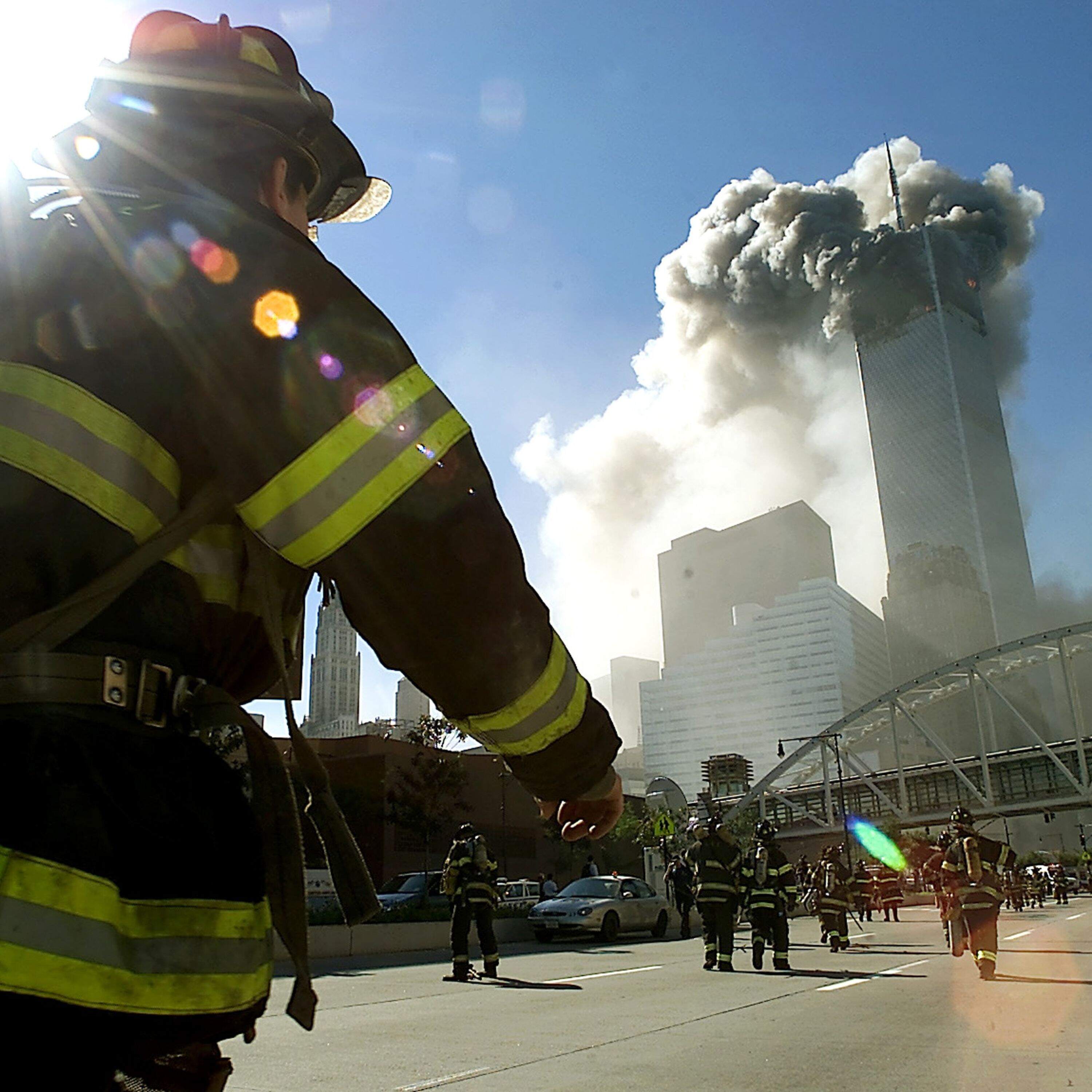
This September marks 25 years since terrorists hijacked planes and steered them into the Twin Towers of the World Trade Center. They steered a third plane into the Pentagon. A fourth was headed for the US Capitol, but crashed into a field in Shanksville, Pennsylvania, after its passengers overpowered their attackers. In the days and years that followed, America's leaders walked a fine and sometimes blurry line. How to prevent an attack like that from ever happening again and how to do so without trampling American laws and democratic values? This is Sources and Methods from NPR in Mary Louise Kelly. Alberto Gonzalez was serving as White house counsel on 9 11. He went on to become President Bush's attorney general.
- [01:13]
Alberto Gonzales
I'd flown out of Dulles, American 77. The plane that crashed into the Pentagon also flew out that morning. I was probably in the terminal with the hijackers.
- [01:22]
Mary Louise Kelly
Jeh Johnson served in the Obama administration as general Counsel of the Defense Department and later as President Obama's Homeland Security secretary.
- [01:32]
Jeh Johnson
The office next door to mine had a clear view of the Twin Towers. I walked next door and I saw the black smoke billowing out of the building, contrasting with the beautiful blue sky.
- [01:44]
Mary Louise Kelly
I sat down with both of them before a live audience at the Aspen Ideas Festival for a discussion on the legacy of 9 11. Here's our full conversation. We are here to mark 25 years, 25 years since 9 11. And it occurs to me that had we all been gathered here 25 years ago, summer of 2001, many of us might have flown in on planes, commercial planes, where the door to the cockpit was wide open the whole flight. And we could have carted liter after liter of shampoo and mouthwash in our carry ons, no need for no 3 ounce baggies. We could have carried pocket knives in our carry ons right onto the flight because TSA was not enforcing those rules, not least because TSA did not exist, nor did the Director of National Intelligence, nor did the National Counterterrorism center, nor did the Homeland Security Department that you went on to run. So we're gonna spend this next half hour talking through how this country responded to the 911 attacks, how this country's leaders, including the two of you, tried to balance protecting the nation with civil liberties, with the rule of law. Which parts of that response have worked, have turned out great? Which parts didn't? Which parts feel worth keeping today? And which parts we should maybe never have done the first place. I want to start with just the briefest of recollections in a few sentences from each of you. Where were you on 9 11, Judge Gonzalez?
- [03:30]
Alberto Gonzales
I was in Norfolk, Virginia, speaking to a group of government lawyers when I got word that the towers had been hit. And so my instinct was to get back to my post.
- [03:41]
Mary Louise Kelly
You had flown out of Dulles?
- [03:42]
Alberto Gonzales
I had flown out of Dulles. American 77. The plane that crashed into the Pentagon also flew out that morning. I was probably in the terminal with the hijackers at the same time. But anyway, I'm determined to get back to Washington before President Bush returns home from Florida. He's speaking at an elementary school, and I'm successful in getting. The Navy flies me back in a Navy helicopter and I'm on the Oval Office porch as Marine One brings Bush home. Of all the things I've ever done in my life, government service, that is the moment that I remember most. Watching Marine One bring President Bush home that day.
- [04:19]
Mary Louise Kelly
How about you?
- [04:21]
Jeh Johnson
So I have to begin with observing that we're sandwiched in between famous musicians and movie stars, and with this very sober discussion. I was in Manhattan on 9 11, 2001. 911 happens to be my birthday. And I had just left. Working at the Pentagon with the Clinton administration. I just left in January 2001, as general counsel of the Department of the Air Force. I worked in the E Ring on the fourth floor. I was back in my law practice in midtown Manhattan, getting ready to get on the subway to go downtown to a meeting in the New York State Attorney General's office across the street from the World Trade Center. And I was sitting at my desk. I heard somebody say, wow, a plane hit the World Trade center. And the office next door to mine had a clear view of the Twin Towers. I walked next door and I saw the smoke. I'll never forget. It was a beautiful blue sky. And I'll never forget the contrast of that black smoke billowing out of the building, contrasting with the beautiful blue sky. And either on the TV or with my naked eye, I saw the second plane hit.
- [05:44]
Evan Kahnweiser
Yeah.
- [05:45]
Jeh Johnson
And the moment that the one moment I've experienced in my life when my brain refused to register what my eyes were seeing is when I saw the first tower collapse. Because those twin towers for almost 30 years had been a permanent fixture of the New York City skyline. And when I drove home that afternoon, I lived in Montclair, New Jersey. Still do. Drove across the George Washington Bridge. All the traffic was headed out. There were National Guard on the bridge. And I saw a fighter jet.
- [06:25]
Mary Louise Kelly
Yeah.
- [06:26]
Jeh Johnson
And what hit me then was that New York City in just a couple of hours had become a war zone. And out of that became my. Out of that came my dedication to want to return to national security.
- [06:43]
Mary Louise Kelly
I was in the newsroom. Thank you. I was in the newsroom, had just moved to Washington. They rolled in cots for us to line the halls, knowing that we would not be going home for days, and we didn't. And I remember trying to write the lead for All Things Considered that night and thinking, boy, does this feel like writing the first draft of history. And I have never covered a single newsday that was a bigger story. And I've covered wars and pandemics and elections and insurrection, and I hope never to have a bigger News Day than 9 11. So I want to go. You race back to the White House. You're down in the bunker. The White House bunker. Take us to what? In those first hours and days, what are the questions in your mind in terms of what the legal response to this attack is going to need to look like? What powers the President is going to need now?
- [07:46]
Alberto Gonzales
While I was in touch with my lawyers, who were scattered in office buildings in downtown D.C. at the time, and the issue was, what authority does the commander in chief have at this particular time? And one of the main questions to answer is, suppose there's a commercial aircraft heading to The Capitol or D.C. does the President have authority to authorize the military to shoot down that aircraft? So we were looking at those kinds of issues, and, you know, it's just a question of deciding how far President Bush wanted to go in terms of protecting America. And for him, you know, when he got out of that helicopter, I was with Karen Hughes. We both had worked with Bush from Texas. We knew him very well, very curious to see what his face. And we greeted him, and he just nodded and walked right by us. And what he was, was he was determined. Never in the time that I worked with him have I ever seen him scared. During that period of time, he was just simply determined he had a job to do. And in the days afterwards, I remember asking him, okay, what can we do to help you? He would just simply say, do your job. His job was to protect America. And that's what we were expected to do, was to help him do that
- [09:05]
Mary Louise Kelly
job one more to you and you can jump on the back of this Secretary. One of the very first moves was the 2001 AUMF, the authorization for Use of Military Force. It passed just three days after the attack. September 14, 2001. The Senate passed it 98 to 0. The House voted to pass it 420 to 1. That one vote. The only lawmaker on Capitol Hill who voted against the authorization was Barbara Lee, California Democrat. Thank you Californians in the room. She opposed it because she argued this is going to be a blank check that would give the executive branch vast powers to wage open ended war given that it remains active today in 2026. Did she have a point?
- [10:00]
Alberto Gonzales
I think President Bush and certainly I were stunned. We're surprised that the AUMF is still in existence and relied upon. Quite frankly, we never envisioned that it would go beyond dealing with the particular threat that existed in 2001. And I think it is perfectly legitimate. I think all of us have an obligation to ensure that our branches of government are checked when they exercise power, particularly the Executive branch, even in a time of war. You and I spoke earlier about the fact that during Bush's first term, four times the U.S. supreme Court issued decisions checking the power of the President. And in the Hamby decision, Supreme Court Justice Sandra Day o' Connor said a state of war is not a blank check for the President of the United States when it comes to the rights of American citizens. And that's the way it should be at the time the court.
- [10:56]
Jeh Johnson
Can I add to that, please? General Gonzalez is right. Article one, Section eight of the Constitution says Congress declares the wars. Our current president has not read that provision and started a war against Iran, a nation state. It's a war. Without a doubt it's a war. If a foreign power started an Airstrike on Washington D.C. and took out the leadership of our U.S. government, I think we'd all call it a war.
- [11:29]
NPR Announcer
Right?
- [11:32]
Jeh Johnson
And on 9 11, we were attacked by Al Qaeda, harbored by the Taliban, and President Bush did the right thing. He went to Congress to seek a declaration of war, an authorization to use military force against an unconventional army. We relied on that statutory authority in our counterterrorism operations during the Obama years. From a constitutional checks and balances point of view, that is way better than one man deciding to take this nation to war.
- [12:13]
NPR Announcer
And.
- [12:17]
Mary Louise Kelly
So you two are here. Obviously you are lawyers, not politicians. Just before we move on from this,
- [12:24]
Alberto Gonzales
should that provision sunset the authorization of
- [12:27]
Mary Louise Kelly
military force from a legal perspective, should we move on?
- [12:31]
Alberto Gonzales
Should at sunset. I think it should sunset. And I think if a new threat arises, go to Congress, makes a case and Congress gives another authorization or a declaration of war. It's the way our system should work.
- [12:44]
Jeh Johnson
The reality I just finished writing a law review article on presidential war powers. So this is uppermost of my mind. And I interviewed a bunch of members of Congress who voted for the 2001 authorization and the 2002 authorization. One of them told me that once an authority is conferred, it's almost impossible to take it back. The 2002 AUMF to go to war against Iraq was just repealed last year. The 2001 AUMF still exists and it's invoked for. I mean, frankly, the interpretation of the 2001 authorization is way beyond what I'm sure any member of Congress in 2001 would have envisioned. It's been used to go against ISIS, which didn't even exist in 2001, and it gets invoked all the time. So in principle, a sunset is a good idea. It's just in the climate of a 911 where certain members of Congress I interviewed told me I didn't even read it, just go get the bastards. It's very difficult to put a sunset or a limitation on an authorization in that kind of climate.
- [14:05]
Mary Louise Kelly
Let's take a break. When we get back, the CIA's detention and interrogation programs. How did they line up against U.S. law? That's ahead on sources and methods from NPR. We'll be right back.
- [14:21]
NPR Announcer
This message comes from SAP Concur. Evan Kahnweiser, chief product and strategy officer at mxgbt, shares why they established a strategic alliance with SAP Concur to create complete a unified travel and expense solution powered by AI.
- [14:37]
Evan Kahnweiser
Customers have been asking for a long time, can we collaborate better with SAP Concur. And so we got to a point where both companies were in a position to sit down and say, how can we solve our existing joint customer problems in a way that allow us to deliver something truly differentiated? Our travelers want a modern, integrated contextual experience to be seamless with the tools that they're using to do other parts of their work journey, whether it's their calendars, their emails, their chats. And they want to make sure that that data is traveling through that journey so that the expense report writes themselves. It's really about making it go from something that takes time and energy to something that provides delight. And once we had that, we knew that we had the beginnings of something incredible.
- [15:22]
NPR Announcer
Visit concur.com complete to learn more.
- [15:27]
Progressive Insurance Announcer
This message comes from Progressive Insurance. Do you ever think about switching insurance companies to see if you could save some cash. Progressive makes it easy to see if you could save when you bundle your home and auto polic. Try it@progressive.com, progressive Casualty Insurance Company and affiliates. Potential savings will vary. Not available in all states.
- [15:46]
NPR Announcer
This message comes from NPR sponsor Carvana. Carvana believes selling your car should be easy. Get a real offer down to the penny picked up from your driveway. You may keep waiting for a catch. There isn't one. Sell today@carvana.com Pickup fees may apply.
- [16:04]
Mary Louise Kelly
We're back with my conversation at the Aspen Ideas Festival with Alberto Gonzalez and Jeh Johnson. I was a young reporter in these years right after 9 11, covering national security and terrorism and reporting on the abuses at Abu Ghraib, the drone strikes, waterboarding. I remember going through a 2005 Justice Department memo that documented the CIA waterboarding Abu Zubaydah at least 83 times in the summer of 2002. Khalid Sheikh Mohammed waterboarded 183 times in March 2003. We were debating in our newsroom and I'm sure many others, what do we call this? Enhanced interrogation? Torture? What can we say? Take us by the time you show up at the Pentagon in 2009, the courts have weighed in on some of this. Did you find the legal architecture you were inheriting that Judge Gonzales and others helped build? Did you find it legally sound?
- [17:08]
Jeh Johnson
So Charlie Savage of the New York Times used to like to write during the Obama years about how similar we were to the Bush years. He'd like to point that out. And the reality is that by the time President Obama came in in January 09 and I went back to the Pentagon, the boundary lines had been written. They were operating pretty much on a blank sheet of paper going after an unconventional non nation state actor and the courts. By then, by the time we came in the Hamdan decision, the Bamidian decision had established some boundary lines for us in which we knew how to operate on the issue of interrogation. The JAG Corps was very upset, Judge
- [18:05]
Mary Louise Kelly
Advocate general, attorneys at the time about
- [18:08]
Jeh Johnson
extracting statements taken by cid, cruel, inhuman, degrading treatment. So that portion of the Military Commissions act was reformed. One thing I'll remember and I'll never forget, I was at a detention site in, I can't remember, Afghanistan or Iraq in 2009. And the detainee was in there with an interrogator for a long time. He came out and he said if that's the worst you're going to do to me, I'm on the wrong side. And I was struck by that comment. It never left me.
- [18:50]
Mary Louise Kelly
Should the US Ever have been in the waterboarding business?
- [18:55]
Alberto Gonzales
Let me talk about this. I think this is President Bush, before we began the techniques which were approved by the Department of Justice several times made it clear to me. He said, we're not going to engage in torture. Make sure we don't engage in torture. So my job was to make sure that we didn't engage in the legal definition of torture. And so the Department of Justice wrote a series of opinions outlining the safeguards that had to put in place the protocols that had to be put in place before we engaged in this kind of conduct. Now, two things that I would say in response. Some people would say, well, you know, what about what happened at Sayyid Abu Ghraib? What happened there had nothing to do with interrogations. It was simply a group of individuals on their own deciding, we're going to have fun with these prisoners. Nonetheless, I think it is fair to question whether or not the permission given by the administration to engage in some kind of enhanced interrogation techniques was a permission slip for this kind of conduct. Even though I think the reporting was the legal analysis, the techniques themselves were not made public. And so what happened? The individuals at Abu Ghraib had no idea what had been authorized. But nonetheless, I think, looking back, I take comfort in the fact that there have been sworn testimony by the director of the CIA, by the director of the nsa, and by my successor at justice is that information was extracted from these interrogations that made a difference in keeping America safe. Nonetheless, the notion that the United States engages in torture, permits torture is not something that I would. That I would support or one that I would be especially proud. I would be not at all proud of, quite honestly, or better than that.
- [21:00]
Mary Louise Kelly
But am I right in thinking this is a practice that the US before 911 had classified as torture as violation of the Geneva Conventions?
- [21:11]
Alberto Gonzales
That was certainly not the position of the Department of Justice. So again, if the Department had not given us the authority, we wouldn't have engaged in that.
- [21:22]
Mary Louise Kelly
Do you want to hop?
- [21:22]
Jeh Johnson
So I want to add, there's the overhang in this whole discussion. There's a pendulum effect to. You asked about this originally. There's a pendulum effect between what Americans are willing to accept by way of an imposition on our civil liberties during times of high anxiety and more security. So most of you in this room are old enough to remember what the environment felt like September 11, 2001. We had been attacked. Our leaders were saying we were going to get attacked again. There was anthrax. I wouldn't let my kids open the mailbox because of anthrax. And by 2009, that pendulum had swung in the other direction. And we wanted change. So we elected the law professor in 2008. And I think the big challenge for Americans is to recognize manufactured fear, manufactured anxiety spun up by our leaders. I served as secretary of Homeland Security. My grandfather was a Ph.D. sociologist and a suspected Communist. My grandfather testified before the House UN American Activities Committee to deny he was a member of the Communist Party in 1947. I have the transcript. And it's in times like that and times like now where we have to frankly see through the bullshit. Sorry for my language.
- [23:17]
Mary Louise Kelly
Okay, time for one last break. When we return, Guantanamo Bay. It's still open, still housing detainees. How does this country defend what's happening there? That's ahead on SOURCES AND Methods from npr. We'll be right back.
- [23:37]
NPR Announcer
Support for this NPR podcast and the following message come from Carvana. Selling your car. Carvana has offers so good they're almost inexplicable. Sell your car 100% online in minutes. Visit Carvana.com today.
- [23:52]
Progressive Insurance Announcer
Support for this podcast and the following message come from Strawberry me. Be honest. Are you happy with your job? Are you stuck in a job you've outgrown or never wanted in the first place? Are your reasons for staying really just excuses for not leaving? Let a career coach from Strawberry Me help you get unstuck, discover the benefits of having a dedicated career coach in your Corner and get 50% off your first coaching session at Strawberry Me.
- [24:20]
NPR Announcer
NPR this message comes from Granger. This is the story of the one As a procurement manager for a hospital system, she keeps every facility in her network stocked and ready. That's why she counts on Grainger to be her single source for thousands of products, from disinfectants to lighting, air filters and more. And with fast, dependable delivery, Grainger helps her keep every facility stocked, safe and running smoothly. Call 1-800-GRAINGER Click grainger.com or just stop by Grainger for the ones who get it done.
- [24:56]
Mary Louise Kelly
Guantanamo, yes. Which still houses detainees 25 years on, including some who have long been cleared for release. Two questions. How can we, as a nation that is a democracy, aspires to stand for democratic values and the rule of law? How can we defend that? And how do these cases end?
- [25:22]
Alberto Gonzales
Let me.
- [25:23]
Jeh Johnson
It looks at me.
- [25:24]
Alberto Gonzales
Yeah.
- [25:24]
Jeh Johnson
No, no, I haven't answered.
- [25:27]
Alberto Gonzales
Guantanamo. After we went into Afghanistan, we began capturing people and a decision had been made. What do we hope? What do we do with people that we have captured? We thought it would be unsafe to keep them in Afghanistan. There were countries, our allies unwilling to take them. We weren't going to bring it into the United States. We thought that would be too dangerous. The American people would not like that. We weren't sure about the rights it would attach as soon as it set foot on American soil. I think it was Don Rumsfeld himself, Secretary of Defense, who suggested, well, we have this naval station at Guantanamo Bay and we could put him there and presented it to President Bush. President Bush said, okay, let's do that. The thinking was that it would be a holding station, holding place for individuals as we decided what to do with them, bring them to justice, put them into military commissions, bring them into the United States. Diane Ashcraft, the Attorney General, very much wanted to try as many of them as we could in Article III courts. And that's how Guantanamo came to be. It was never the intention this would be a long term solution to people that we captured. It was a short term solution to an immediate problem. And the fact that he still exists today tells me been through several administrations. No president, no administration has been able to figure out what to do with these individuals. They don't want to bring them to the United States, they don't want to release them. So it's just kind of sitting there.
- [27:00]
Mary Louise Kelly
But isn't there a basic rule of law question there?
- [27:03]
Alberto Gonzales
Well, perhaps there is a basic law of world question, but there they are.
- [27:09]
Mary Louise Kelly
So how do these cases end? Are we increasingly looking at a scenario where Khalid Sheikh Mohammed is going to die in Guantanamo having never had a trial?
- [27:19]
Jeh Johnson
So first day in office, President Obama signs an executive order to close it. It's still open basically because the political forces in this period of anxiety, because 2009, 2010, Al Qaeda was still making efforts at large scale attacks on the United States and the political forces basically prevented us. There are two categories of detainees at Guantanamo. There have been those that have been charged in the military commissions system and those that have not. But they are what we refer to as law of war detainees. And that population is down to maybe even a single digit at this point, maybe more. When I came into the Pentagon as lawyer, my belief was that we needed to apply for credibility's sake, we needed to apply traditional military law of war principles to an unconventional enemy. And that's what we did. So we took on accepted what we refer to as law of war, detention, detention without charges as long as the war existed. But here we are, 25 years later, and the military commission system. I was probably in the Obama administration, the biggest proponent of keeping that system because the JAG Corps believed in it. And again, it was an application of traditional military principles. But if you had told me 15, 16 years later that they'd still be sitting there pretrial waiting. The 911 defendants, I was supportive of sending them to Manhattan, but Southern District of New York. Yeah, but the others. If you had told me that there had been not a single trial, I would have said, this system ain't gonna work. Hindsight. So how do these cases. Hindsight is brilliant. So that's. People ask me, what's your regret? I said, well, hindsight's brilliant, but if I knew then what I knew now about the system, I would not have been a proponent of it.
- [29:43]
Alberto Gonzales
Yeah,
- [29:45]
Mary Louise Kelly
sorry. I just have to note, neither of you is answering the question, how do these cases end?
- [29:51]
Alberto Gonzales
The reason. The reason I'm not answering the question is because I don't know if there is an answer. I don't know what the answer is, quite honestly. And I think that reflects the reality of why it's still there. Do you want these individuals brought into this country? Some people do, some people don't.
- [30:14]
Jeh Johnson
There was a plea deal struck with the 911 defendants which the Secretary of Defense rejected. I don't know where that stands now, but I think at this point, that's got to be the resolution.
- [30:26]
Mary Louise Kelly
Yeah. One to you, Secretary, on the Department of Homeland Security, which, as we noted, is one of several institutions, the biggest of the institutions Created in response 9 11. How's it going? Thoughts on how it's turning out?
- [30:44]
Jeh Johnson
The model. The thinking that created the Department of homeland security in 2002 is way outdated. The thinking then was, up till then, we didn't need a Ministry of Interior or Department of Homeland Security because we're separated from the rest of the world by two oceans. And that all changed on 9 11. And if we consolidate into one cabinet level department, the regulation of all the different ways somebody can get into this country, land, sea and air, tsa, Coast Guard, Border Patrol, customs, we will have kept the bad guys out. That thinking is now outdated. And the immigration mission has overwhelmed the department, obviously, as everybody knows. And the immigration mission is political red meat for a lot of people. I can't walk down the street anymore with my DHS gym bag because I'll be chased down. You know, I can't wear a DHS hat anymore.
- [31:51]
Mary Louise Kelly
We'll give you an NPR tote bag. We haven't Cut it, don't. But it needs, we need to, frankly,
- [31:58]
Jeh Johnson
I think we need to scrap it and start all over again. Whether that, whether that could happen in this political environment is a whole other question.
- [32:10]
Mary Louise Kelly
Yeah, I mean, this pushes us toward one of the questions I wanted to land us on, which is, as we think about the response to 911 and the legal response we've been talking about in it was all crafted to address a foreign terrorist threat. And today the focus and resources are so much headed in a domestic threat direction that the greater threat is from within. So the laws that you were trying to hash out in those days after 9 11, that you had inherited and were trying to figure out, what do we institutionalize, what can we jettison a few years later? Do they work anymore?
- [32:59]
Alberto Gonzales
I think some of them work. I think that, you know, we live in a changing environment. It is very polarized. I think we're seeing a level of corruption at multiple levels in this country. And the combination of polarization and corruption, those are real threats to our national security. Other nations, our enemies, see what's going on in this country. They see the disbandling of key components within the Department of Justice, Department of Homeland Security. They see the leadership selected in these very important organizations and wonder, huh, how can this be? I mean, really, in A nation of 300, 300 million Americans, this is the best you have? So it's a very dangerous time, I think, quite frankly. I think around the world people are really questioning our commitment not to our own national security, but certainly to our alliances around the world. And I for one listened to Ken Burns earlier today talking about the beginning of America and the hope, the dream of what might be with this great country. And I also heard Ken Burns speak recently about the fact that we are in the process of becoming. So we're not done yet. This is just a blip as far as I'm concerned. It's a painful blip, but it is a blip. And I think if we all remain optimistic, but we have to pay attention and we have to participate in democracy, that we can still have the country that we once believed in. Quite frankly,
- [34:56]
Jeh Johnson
The principal terrorist threat to our nation, to our homeland now is domestic based, with the exception of that. When we went to war with Iran, we created a heightened threat environment for terrorism. Inspired by Hezbollah and Hamas. Possibly. But that aside, the principal terrorist threat to our nation is domestic based, homegrown, homeborn terrorism. A lone actor inspired by extreme hateful stuff they see on social media, coupled with the prevalence of guns in this society. And as long as people who have no business having a gun are able to get a gun in this country, we're going to be dealing with acts of terrorism for far too long, whether it's a school, a church or any other large gathering. And that's something that I think our political leadership needs to finally, at some point, be willing to take on.
- [36:19]
Mary Louise Kelly
Jeh Johnson. Alberto Gonzalez, thank you. Thank you.
- [36:26]
NPR Announcer
Foreign
- [36:29]
Mary Louise Kelly
I'm Mary Louise Kelly. We are back with our regular episode on Thursday. Until then, thank you for listening to sources and methods from npr.
- [36:45]
Progressive Insurance Announcer
This message comes from Mint Mobile. If you're tired of spending hundreds on big wireless bills, bogus fees and free perks, Mint Mobile might be right for you with plans starting from 15 bucks a month. Shop plans today@mintmobile.com Switch upfront payment of 45 dollars for 3 month 5 gigabyte plan required. New customer offer for first 3 months only, then full price plan options available, taxes and fees extra. See Mint Mobile for details.
- [37:11]
NPR Announcer
This message comes from Cachava. It can be tough to stick to your wellness routine, especially when you're on the go. Cachava's new travel packs make it easier. Just one packet provides nutrition ready for wherever life takes you protein, fiber, greens, probiotics, electrolytes and more. Take your daily ritual with you. Go to cachava.com and use code NPR. New customers get 15% off their first order. That's K A C H A V A.com code NPR this message comes from the podcast Pod Save the World. Hosts Tommy Vitor and Ben Rhodes break down the week's most impactful foreign policy news with digestible expert analysis. Listen to Pod Save the World wherever you get your podcasts or on YouTube.