Loading summary
Transcript96 lines
- [00:01]
Haley Lou Richardson
Another funding deadline in Congress. Another partial shutdown could be on the way. How far will Democrats go in their fight for changes to immigration enforcement? Plus, Congress can now see the unredacted Epstein files. We're watching for signals of what they.
- [00:16]
David Iserson
Learn, the stories you need to know.
- [00:18]
Haley Lou Richardson
To start your day every morning on up first listen on the NPR app or wherever you get your podcasts. I mean, we're women. People only look at us if they want to us or marry us, and that's it. So nobody would ever think that two people like us would be spies.
- [00:36]
Mary Louise Kelly
What makes a good spy training experience? Being able to blend in easily. Nerves of steel. Of that list, the lead characters in the new Peacock series Ponies possess just one. And actually, that's debatable. As women working for the CIA in Cold War era Moscow, they are, as the station chief refers to them, persons of no interest. P O N I Ponies. I'm Mary Louise Kelly and this is Sources and Methods from npr. This episode is a little lighter than our usual fare. Do not worry. We'll be back with the heavy headlines on Thursday. And a heads up that we will be in Munich for the annual security conference hosting the podcast from there. Today we're diving into the new TV series Ponies, which actually has a lot to say about the national security world. Richardson stars alongside Emilia Clarke. When we meet them, they are embassy wives. Then their husbands, both CIA officers, are killed in the line of duty. So the women persuade the CIA to take them on and send them back undercover to Moscow. Haley Lou Richardson and pony showrunner David Iserson are here to talk about it. Welcome, you two, to Sources and Methods. Hi, Mary Louise. Hi, Haley. I want to start right there with that idea that a good spy should blend right in. And your character is, as we noted, a pony, a person of no interest because she's a woman. But you definitely get noticed. Tell us about Twyla.
- [02:15]
Haley Lou Richardson
Well, yeah, I love even that concept of what you just said and like the Defying Odds, the whole theme of that throughout the show. But, like, every strength overplayed is a weakness, which also means that every weakness is rooted in a strength in a way. And I feel like that's applicable to, like, Twyla and her journey, like, realizing her innate strengths in this field. But Twyla is like, a lot. She's uninhibited, she's loud. Yeah, she's a lot. Some might find her too much, but she is who she is. And like throughout the death of her husband, she has this, like, resentful toxic relationship with throughout that. Then the friendship with Bea and the things she. She learns from her and vice versa and being kind of like thrown and challenged within this world of espionage or lesbianage, which I've been calling it lately.
- [03:17]
Mary Louise Kelly
Spoiler alert there. Your spoiler alert with another woman. Yep, we'll get there.
- [03:22]
Haley Lou Richardson
I couldn't help myself. I just. Someone said that to me at the premiere and I was like, that's the best thing I've ever heard in my life.
- [03:29]
Mary Louise Kelly
You're talking about her strengths and weaknesses as a character. What is her strength as she's sent in as a undercover CIA officer into the middle of Cold War Russia?
- [03:41]
Haley Lou Richardson
Well, her strength is her, you know, genuine fearlessness in her acting based off, like, her gut. And I think that comes from, like, her survival instincts and the way she's like, had to exist in the world because of her childhood and where she came from and then, and then being in this relationship where she's really been alone in her life and she's had to fight for herself. So because of that, all she really has had is herself and her gut and her instincts. Those things are a weakness in a way because they actually prevent her from making real connection, opening up vulnerably to people around her and they kind of become this defense mechanism. But it's also like a joy of who she's grown into. This, like, strong, fearless, uninhibited, like, wild lady.
- [04:36]
Mary Louise Kelly
Well, then go to the flip side of that. Cause you're playing this uninhibited woman, wild lady with big hair and crazy clothes. Like, every scene you're in, every eye in the room pivots to you when you walk in. How on earth do you figure out how I'm going to play that? While I'm supposed to also be an.
- [04:55]
Haley Lou Richardson
Undercover spy, I didn't actually think much about the spy part.
- [05:00]
Mary Louise Kelly
That bad.
- [05:02]
Haley Lou Richardson
I really just thought, like, I really relate to Twyla. David knows this so much. He's heard me go on for the whole six months we were in Budapest. About, like, how much I, like, deeply, personally relate to this woman. Like, it's the most kind of freeing, therapeutic experience I've ever had. Acting, playing her. Because there's a lot of parallels. But I really didn't like, prepare for or think about the spy element of it all beyond what Twyla was experiencing in every moment.
- [05:36]
Mary Louise Kelly
David, it hop in here. It sounds like it fell to you to. To figure out the. The Soviet era Russia spy plot lines. What drew you to that period?
- [05:46]
David Iserson
Oh, I mean, the the setting and the time period were just things that I'd been passionate about. Just I. I'd gone on some trips in my 20s to, you know, former Soviet bloc countries, to, you know, not, not to the Soviet Union, but had been to Budapest where we shot and Prague and Berlin. And they'll have museums to the communist era. And there's an aesthetic to it and this very heightened feeling of we are at the brink of the end of the world. And there was just something exciting about placing two people into this time period. Yes, visually very explosive, maximalist time period with the clothing and this great music and the look and the feel of it just felt right for exploring.
- [06:38]
Mary Louise Kelly
How did you research what it would have looked and felt like? Because I too have been to modern day Budapest and Berlin and Prague and I have to think 1970s Moscow was really different.
- [06:50]
David Iserson
Yeah, I mean, we watched a lot of movies set in the time. We had a researcher go into some archives in Ukraine and just give us this huge catch of pictures of what it looked like at the time. We had some people in the art department who had experience in the time and the place and some of it, you know, was we just went with feel. I mean, I don't think our embassy is accurate to what the embassy looked like. I think the embassy would have been a little bit more visually boring. So we kind of tried to embrace a little bit more of like what, what a very heightened 70s office looked like. So it was kind of a mix of accuracy and the visual feel that we just wanted it to.
- [07:36]
Mary Louise Kelly
You do paint, you just called it boring. You paint a pretty bleak picture of life in Moscow in the Cold War. And I'm thinking of this scene where Twyla and Bea, this is early on, they go to a pub, there's this clandestine meeting, they're supposed to do an exchange and there's a secret message tucked inside a copy of Anna Karenina. And I was laughing. You have a bartender who plops this really greasy looking glass of vodka down in front of Bea and she's like, oh, I haven't even ordered. I haven't even looked at the menu. And he's like, lady, this is, this is what we have. Yeah, this is the menu. Yeah, yeah.
- [08:14]
David Iserson
I mean, I mean, I think that was kind of a combination of what felt true. We talked to a woman who had lived in Moscow in the 70s, who was like in the underground theater scene and she talked about what, what these pubs were like. And you know, the pub that we shot at was pretty much an unchanged pub from Budapest from, you know, the 60s or 70s. So we had a lot of that to work with. And, you know, we cast the real bartender in this bar. The one in that scene is a stuntman, because we, spoiler do set that pub on fire. But there is a flashback that also happens in episode two where we cast the. The real bartender from that real bar as the bartender. When we were scouting location, we were like, well, we can't beat that guy.
- [09:00]
Mary Louise Kelly
So I have to ask, did they serve anything besides vodka in this bar?
- [09:03]
David Iserson
No, it's actually a wine bar and they have this weird contraption where the. I mean, the wine couldn't be more unappetizing. It's like in these. They pour the wine in these weird vats and that's how they give you your wine.
- [09:17]
Haley Lou Richardson
So, yes, yummy.
- [09:19]
David Iserson
They do serve it in different ways.
- [09:23]
Mary Louise Kelly
Talk to me about the villains who are kgb. We are totally rooting against them. They come across, at least early in the show, they come across as just pure evil. How did y' all think about developing a character like Andre, who is the principal KGB bad guy? How do you make him compelling when he's just pure bad?
- [09:48]
David Iserson
Well, we tried to think about what somebody with ambition and a very loose morality would do in a society that is not necessarily, at least philosophically conducive to ambition. He is somebody who wants to rise up. What would happen to somebody after eventually the Soviet Union falls, who wants to eventually rise to high heights and is going to do whatever it takes to get there. And so Andre came about from that, from somebody who is dangerous, who is manipulatable, who is out for himself. And we also knew that we were going to put Bea in situations with him where his sexuality would be complicated. And so we also just. We talked about giving him this sort of rock star aesthetic. We looked at pictures of David Bowie in this era.
- [10:52]
Mary Louise Kelly
We dead ringer, by the way, looks just like him. Yeah, yeah.
- [10:57]
David Iserson
Looks kind of Bowie. Looks kind of Paul Newman. And artyom, who plays Andre, you know, he. He does not have hair like that. So we flattened his very curly hair. We dyed it blonde. We kind of gave him this. Yeah, this. This androgynous 70s feel to it because we wanted Bea's relationship with him to be complicated. And, you know, he is a villain, but he is also a villain who has a. An arc that is not fully dissimilar from Bea and Twyla in that he is trying to take control of his life and he is trying to figure out what individually is going to make him have this great life that he longs for that is different from the people around him. And so there's going to be things that they are going to all relate to in all of their individual arcs.
- [11:50]
Mary Louise Kelly
We're going to take a quick break. Don't go anywhere. Our conversation with Ponies star Hayley Lou Richardson and showrunner David Iserson continues in just a sec.
- [12:03]
Haley Lou Richardson
On NPR's wild card podcast, Melinda French Gates on seeing her ex husband, Bill Gates named in the latest Epstein Files.
- [12:12]
David Iserson
For me, it's personally hard whenever those.
- [12:14]
Mary Louise Kelly
Details come up, right.
- [12:15]
David Iserson
Because brings back memories of some very.
- [12:19]
Mary Louise Kelly
Very painful times in my marriage.
- [12:22]
Haley Lou Richardson
Watch or listen to that Wild Card conversation on the NPR app or on YouTube @NPRWildcard 2026 marks the 100th anniversary of what we now celebrate as Black History Month. So on Code Switch, we're reflecting on that journey.
- [12:36]
David Iserson
Black History Month is a time for people to observe black history as a movement and a legacy that was about correcting the historical record.
- [12:45]
Haley Lou Richardson
Listen to NPR's Code Switch podcast on the NPR app or wherever you get your podcasts.
- [12:55]
Mary Louise Kelly
Okay, we're back. We've been talking about the relationship between Bea and Twyla because this show is. It's a total Cold War spy drama. It's also a buddy story, and it's the combination that the CIA station chief uses to get his boss, the CIA director, on board with the idea.
- [13:15]
David Iserson
You want to do what, sir? One of them speaks Russian fluently. Good accent. She could pass. And the other one is fearless like a bull. Now, I don't know if they could do much alone, but together they could.
- [13:31]
Mary Louise Kelly
Make a good officer. Haley Lu. One more SPOILER alert. The one who speaks Russian fluently is not you. The one who is f fearless like a bull. Is your character fearless like bull. I went and looked. Does she actually speak Russian Amelia learned in real life?
- [13:50]
Haley Lou Richardson
Yeah, I mean, she, she learned the Russian that she says in this show.
- [13:54]
Mary Louise Kelly
She's so convincing.
- [13:56]
Haley Lou Richardson
We are all so amazed and proud of her. I mean, like, that's a challenging language even for me to learn. Svay, you might suka, which is go yourself, which I'm sure I'm still pronouncing wrong was very challenging for me. But she learned all those lines. And then she also said that by the end of her last scene in Russian, she's in the car with Andre and they're like, making out and she's like, kind of flirting with him, and he improvised something in Russian and she was able to respond improvise in Russian. Wow.
- [14:30]
David Iserson
I Didn't know that.
- [14:30]
Mary Louise Kelly
Yeah.
- [14:31]
Haley Lou Richardson
She learned enough Russian by the end of filming to be able to, like, kind of hang in an improvised line with Artyom, which is like, I'm like, truly watching her do that. This show was a lot of work for me, working every day and learning the lines and showing up and the emotions and the arc and the stunts and all that. But I didn't have to learn Russian. I'm, like, really amazed by Amelia.
- [14:55]
Mary Louise Kelly
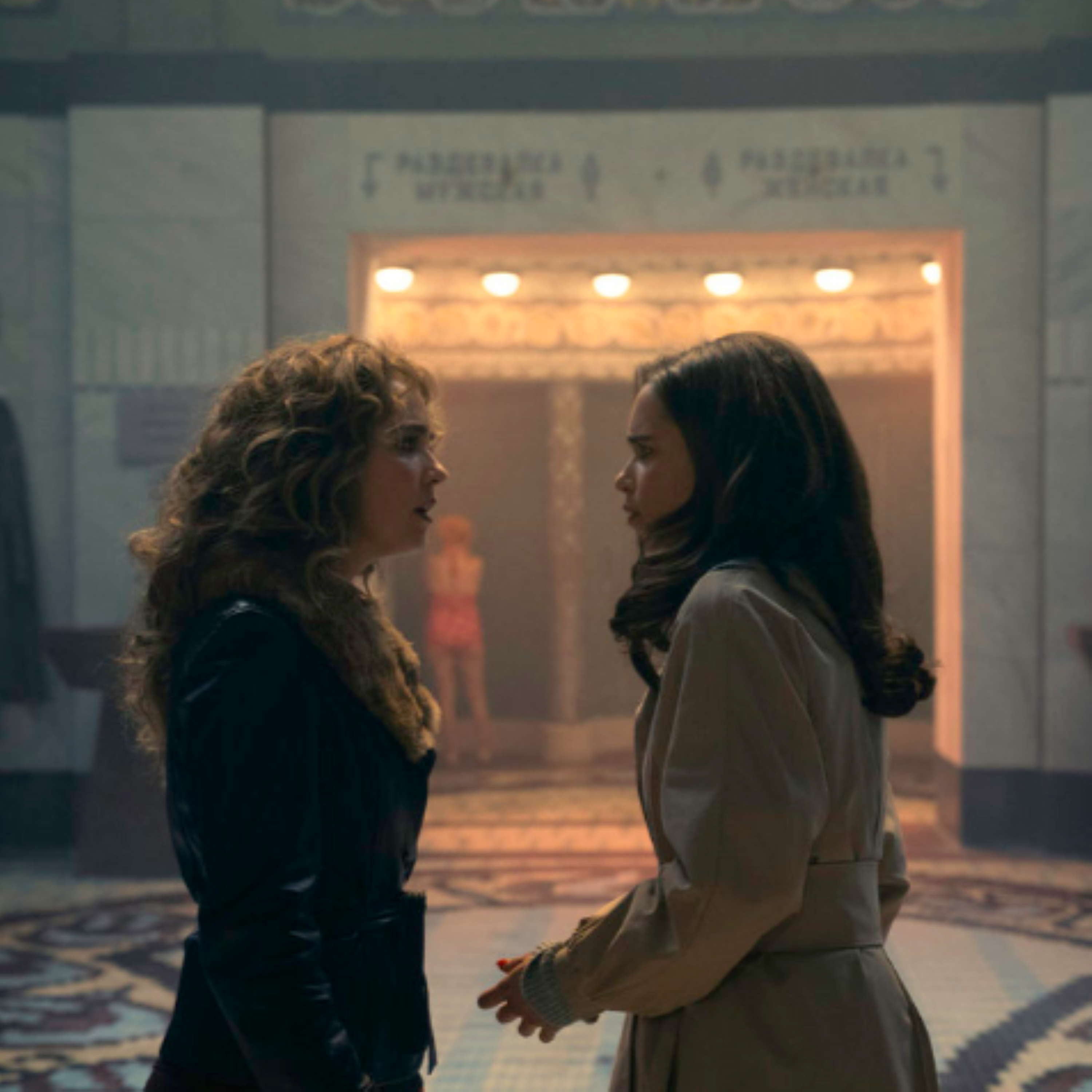
Your character does do a great job of quoting some of the spy tradecraft stuff. Like there's a scene at the banya, the Russian baths. You, of course, are in the mins. Church changing room as one finds oneself. But it looked pretty realistic to me and you.
- [15:14]
David Iserson
It was a real men's changing room.
- [15:16]
Mary Louise Kelly
Oh, really? Okay.
- [15:17]
David Iserson
Yes.
- [15:19]
Mary Louise Kelly
As you barge in there, Haley Liu, your character is saying Moscow rules, meaning quoting how the CIA, their rules for tradecraft for operating covertly in the Soviet Union, which I bet got a. Got a laugh from CIA and KGB veterans who may have been watching.
- [15:37]
Haley Lou Richardson
I wonder if any. Any CIA people have been watching.
- [15:42]
David Iserson
I have heard. I have heard back and some have, and.
- [15:46]
Haley Lou Richardson
Really?
- [15:47]
Mary Louise Kelly
Yeah.
- [15:48]
Haley Lou Richardson
And how accurate are we. Is it relatable?
- [15:52]
David Iserson
I mean, I didn't get into it about, like, all of the details, but definitely the feel of it felt accurate to the people that reach out to me.
- [16:02]
Haley Lou Richardson
Wow.
- [16:03]
Mary Louise Kelly
May I ask, is this American or Russian spies who tell you they're watching?
- [16:07]
David Iserson
I have not talked. I have not talked to any Russian spies yet.
- [16:10]
Mary Louise Kelly
Yet. Emphasis on. Yeah. That's your invitation. Russian spies, please join us and tell us.
- [16:15]
David Iserson
Yes, yes, tell us.
- [16:16]
Mary Louise Kelly
Please.
- [16:16]
David Iserson
Message. Please message me on Instagram. Russian spies.
- [16:20]
Mary Louise Kelly
Did y' all worry about trafficking and spy cliches that, you know, their meetings signaled with lipstick slashes on do to tell you an operation is imminent or that the coded message I mentioned inside the. The copy of Anna Karenina.
- [16:38]
David Iserson
Well, as writers, we never want to traffic in cliches, though sometimes things are cliches because that is what happened. You know, the spy craft, for the most part, that is done in the show is either based on real research that we found or the videotape technology, which is like the Big MacGuffin of the season, you know, that isn't based on anything. So I don't think we're necessarily trafficking fully in cliches. But, you know, we're trying to subvert what our, you know, expectations of super spies or, you know, things that work perfectly or, you know, competence used as, like, a tool. And we are trying to put it through the Prism of. To people who are new to this. So they are going to be learning about this world. And, you know, some of this are going to be things that the CIA used. But we're, you know, we definitely don't want this show to be cliche, and I don't think it is.
- [17:41]
Mary Louise Kelly
Well, and I didn't mean that as an insult. I thought there were things that were.
- [17:45]
David Iserson
No, no, no references to.
- [17:47]
Mary Louise Kelly
To other spy dramas people may have seen. But I want to go back to the idea of that you have these to CIA officers who have no training, like zero training, and they find themselves landing in situations that I have to think officers who had been recruited and trained in a traditional way would not have found themselves in. How did you think about that? Are you playing that a little bit for laughs?
- [18:13]
David Iserson
How we thought about it is that part of the setting and this time period and the research that inspired the show was that a thing that we learned was that the CIA in Moscow in this era wasn't successful. They were not able to successfully run missions. The KGB was following them whenever any officer left the embassy. Like that was all accurate. So they were willing to try unusual things. And some of those things fell into a little bit of absurdity. Like they brought a magician from the Magic Castle out to the embassy to teach weird spycraft ideas like they were willing to try.
- [18:56]
Haley Lou Richardson
Oh, is that for real?
- [18:57]
David Iserson
That is for real, and that is amazing.
- [19:01]
Mary Louise Kelly
Yeah. Yeah.
- [19:02]
David Iserson
And. And, and so. And they were also, you know, using the wives in the embassy to do things because they were trying to get the KGB not to follow them. So we were using that as the impetus to place, you know, our characters in somewhat of a slightly believable situation. And, you know, we had this conversation that, that Dane has with his boss in the first episode about that training is not necessary yet because all they're doing is exchanging information and they time is of the essence. And so we were trying to set up a situation in which it would be plausible and necessary for them to be out there. And because these are two characters who have their own sets of skills that are meaningful to them and eventually make them great at what they do, even though it is unexpected that, you know, they are sort of defying the odds and defying expectations. And one of those expectations were that they would fail, but it would be a worthy try. And so because they. They have skills that are different than somebody who might have come up with a lot of training and been drawn to the CIA for very. Their own ideological reasons or their own ego reasons. Bea and Twyla are different than that. So they're going to operate differently. Something that, you know, I've talked about a lot with Haley and Amelia and I've talked about with other people working on the show is that what is interesting to me about an espionage story is that it's a way to tell a relationship story. Being good at relationships is being a good spy. You're getting people to trust you. You are finding, you know, bonds with people. And that is something that Be and Twyla are very suited for. And that is kind of their journey in the course of this show is how they are at relationships, at friendships, at trust. And that is something that is kind of beyond training.
- [21:10]
Mary Louise Kelly
Hey, Lilu, I hear you, I hear.
- [21:12]
Haley Lou Richardson
You saying, yeah, well, I just, I feel so kind of inspired and impassioned about this whole topic of. And this whole like wild concept that something that's untraditional or never been done before could actually be valuable. Like thinking outside the box, which in the 70s in Russia was having a woman spy, you know, like, could actually be successful or valuable. And I had like, even. I was thinking about this obviously a lot when we were filming the show. But then I had this personal experience where I went on a date, a blind date, and it was with this man. And we were having an okay date for like an hour or so. And then somehow we got into a conversation and he said to me that he doesn't think a woman is capable of or should ever be president.
- [22:10]
Mary Louise Kelly
Uh, oh.
- [22:11]
Haley Lou Richardson
And I, yeah, I was like, oh, no. All I wanted was to have a nice makeout session and unfortunately I needed.
- [22:17]
Mary Louise Kelly
To throw my drink in your face.
- [22:19]
Haley Lou Richardson
Unfortunately, that's never gonna happen. And he, I was just kind of silent and he just kind of looked at me and I was like, how am I gonna respond to this? And I, you know, he didn't give me indicators before he said this that he was like an awful, vile, misogynistic human. I think he just was close minded and like lived in a completely different closed experience than me of life. So I decided to try to broach and have like an actual, like a real honest debate with him about that and like also to just express, like really try to understand why he thought that and then express my experience of life as a woman, you know, and why I feel so wildly differently than him. And it really. Well, you know, I think for a situation like this it went probably the best it could have gone. I think maybe he felt a little dumb by the end of it and also was like, wow, maybe I'm wrong.
- [23:19]
Mary Louise Kelly
Like, so let me ask was, was there a second date?
- [23:24]
Haley Lou Richardson
There was not a second date and he's the only time I've ever ghosted someone was him. But I kind of think it was deserving of that. But anyways, I'm digressing here. What it inspired me to look at Bea and Twyla and this whole thing about them being women, them being you know, quote unquote, unqualified and actually unqualified.
- [23:46]
David Iserson
And untrained, quote unquote and no quotes.
- [23:49]
Haley Lou Richardson
But then also actually, but to go into this world and under these like really high stakes, high pressure scenarios, like it made me think of this, this thing differently of like, or even more like profoundly of like. Humans are multi dimensional, women contain multitudes. And this guy was telling me when I was on this date with him, he was like. When I asked him why he doesn't think a woman's capable of being president, he was like, well to be president you got to be like a stone cold killer and you got to like make decisions on the fly and you got to be strong and a business person and women. He's like, don't get me wrong, I love women, but women are emotional and maternal and all of these things. I'm like, first of all, what makes those things not equally valuable in a position of like power or right or in Twilight and Bees case, you know, like change, success, helping the government, I don't know. But also like what makes that less valuable? And also I was sad for this man that he thought that that's all women could be. And I was also sad for him that he thought that all men can be our stone cold killer business people. Like I just, I just really, I'm kind of going off here but, but it really made me think of being Twyla and this strengths, like how we started this conversation about like strengths, weaknesses, how they are born and kind of cyclical, like come from the same thing and are really the same thing and how both have these untraditional but by the end of the series almost more successful and more valuable strengths and instincts and traits than the men that had been doing it for years prior.
- [25:46]
Mary Louise Kelly
You know, I have two thoughts. One is Haley Lou Richardson for President. I don't know.
- [25:53]
Haley Lou Richardson
I would not want to do that.
- [25:55]
Mary Louise Kelly
I would not want to do that. My second thought is just what I think you were going to there, which is that it ends up being the strength of these two women is A, they're women and, and B, they have no training, they're going to play this game in a totally different way than the KGB guys they're up against. And it's because of that that they're so darn good at it.
- [26:17]
Haley Lou Richardson
That's the thing is, like, if something's not working or if something's really out of balance because it's just been one way for so long, who's to say that a little bit of flipping it on its head is bad? Like, yeah.
- [26:32]
Mary Louise Kelly
So let me bring us toward a landing by asking one last thing. There are lots of twists and turns in this show. I try not to give anything away. It has not been easy. But I will say that things do not wrap up tidily with a neat little bow. So I have to ask, are Bea and Twyla going to be back?
- [26:55]
Haley Lou Richardson
Don't kill us off, David.
- [26:57]
David Iserson
I mean, the plan is that we're back. I mean, we made a plan for this show to go on for several years, and Bea and Twyla are incredible. And I will keep making this show as long as they let me make the show. And I will make the show with Hayley and Amelia as long as they are. I mean, if Hayley is president, it's gonna make it harder to schedule her time.
- [27:23]
Haley Lou Richardson
Yeah, I don't know how it's gonna fit in with my schedule.
- [27:26]
Mary Louise Kelly
You can do some good scenes in the Situation Room. It'll all work out.
- [27:29]
David Iserson
Provided she loses the primary and we have her back. Y Twyla will return.
- [27:36]
Mary Louise Kelly
We have been speaking with Haley Lou Richardson, who stars, and David Iserson, who is co creator and executive producer of the new Peacock series Ponies. This was so fun. Thanks to you both. Thank you.
- [27:49]
David Iserson
This was really fun. Thank you.
- [27:52]
Mary Louise Kelly
And before we go, a favor. If you've been enjoying the show, if you appreciate our help digesting the news and unpacking the natsec world, tell a friend. Word of mouth is one of the top ways people find new podcasts. And as is true in the intel community, a trustworthy source goes a long way. Thanks for listening. I'm Mary Louise Kelly back Thursday from Munich with sources and methods from npr.