Loading summary
Transcript86 lines
- [00:00]
NPR Sponsor Announcer
This message comes from NPR sponsor Rosetta Stone, an expert in language learning for 30 years. Right now, NPR listeners can get Rosetta Stone's lifetime membership to 25 different languages for 50% off. Learn more at RosettaStone.com NPR.
- [00:21]
Tom Bowman
Even if you want to do testing, you don't just dig a hole and put a bomb in there and then drive away and use your clicker to send it off.
- [00:30]
Mary Louise Kelly
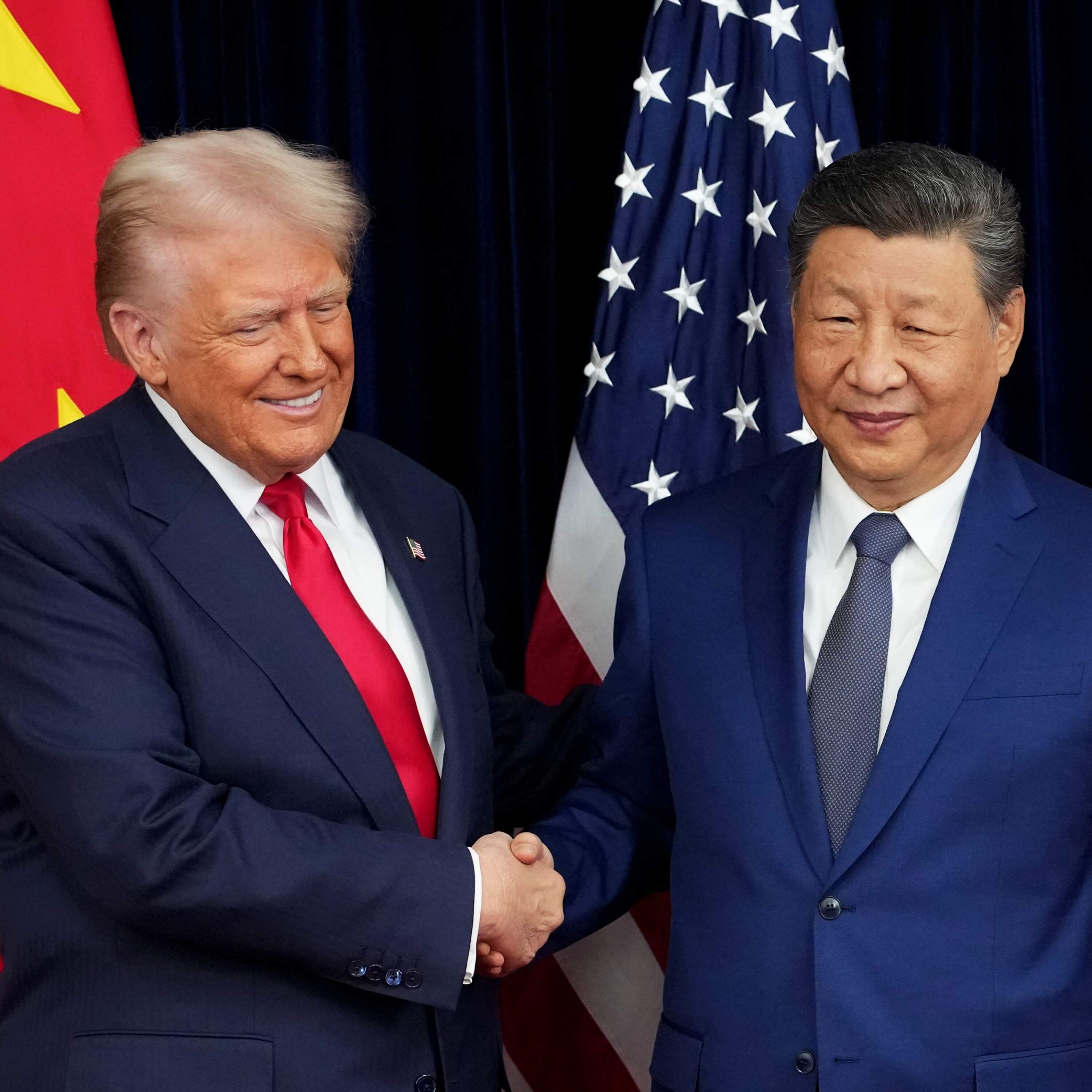
The two most powerful men in Face to Face at a South Korean airport, the Chinese and American presidents backed off their trade war. But now nuclear tensions are front and center, and Friday is payday for U.S. troops. Will the government shutdown cost them their checks? This is Sources and Methods from npr. I'm Mary Louise Kelly. It is Thursday, so you know the deal. I am here with two NPR reporters to break down the week's biggest national security stories. Today we have NPR Pentagon correspondent Tom Bowman with me here in the newsroom. Howdy, Tom.
- [01:08]
Tom Bowman
Hey, Mary Louise.
- [01:09]
Mary Louise Kelly
Hey there. And we are catching up with NPR's Deepa Shivaram, who is at the end of a long week traipsing through East Asia along with the president. Where exactly are you today, Deepa?
- [01:19]
Deepa Shivaram
I am in Gyeongju, Korea, which is, I think, 13 hours ahead of you guys. So I'm almost in Friday territory.
- [01:29]
Mary Louise Kelly
Almost in Friday territory. You're beating us to it, which I will note is 10am just past 10am here on North Capitol street in the newsroom in Washington. Let's dive in and go straight to the capstone of this Asia trip, which was the meeting between Presidents Trump and Xi Jinping of China, their first in person meeting, by the way, in six years since the president's first term. Now here in Trump's second term, they have been locked in something like economic warfare. And we're going to get to the tariff headlines, the trade headlines in a second. But I want to start with this curveball delivered minutes before the summit was set to start in the form of what else? A post on social media, on truth Social. President Trump wrote, and I quote, because of other countries testing programs, I have instructed the Department of War to start testing our nuclear weapons on an equal basis. Deepa, I think I can sum up the collective reaction here in Washington as Wait, what? What was the reaction there in Asia?
- [02:33]
Deepa Shivaram
It was sort of one of those things that went out and we were like very focused on a Trump Xi summit. And then all of a sudden, you know, in a very Trump es, this other thing like flies out of left field. This issue is not something that's really come up a lot in Washington or in Asia while we've been here. So it was somewhat of a surprise.
- [02:49]
Mary Louise Kelly
Well, because people have not been testing their nukes. I mean, nobody, China, Russia, the U.S.
- [02:54]
Tom Bowman
Nobody'S tested their nukes since the 1990s.
- [02:56]
Mary Louise Kelly
Correct. Did it come up in the actual summit?
- [02:59]
Deepa Shivaram
It didn't, and it's sort of. Or if it did, we don't know that they spoke about it because there hasn't exactly been a full readout from the White House. And from what we've seen from Beijing, that really wasn't something that they sort of talked about publicly, at least. So it was sort of shocking to see this, as shocking as it can be, I guess, to see this true social post from Trump really, as you said, like heading into this pretty high stakes meeting with Xi Jinping. And to be honest, like, there hasn't really been much follow up. Like, we don't really know a lot of detail. What does an instruction to the Department of War slash Defense look like? Where would testing take place? And what would Trump even want that to look like? So there's just, it's sort of one of those things that Trump fired off and we're sort of left asking lot more questions.
- [03:44]
Mary Louise Kelly
Tom, any details from the Pentagon? Any reaction?
- [03:47]
Tom Bowman
Well, first of all, the Pentagon doesn't do testing. It's done by a division of the Department of Energy called the National Nuclear Security Administration, number one. Number two is the testing site is in the Nevada desert. So even if you wanted to do testing, setting it up with diagnostic equipment and figuring out where you wanted to do it and what you wanted to do would take many months, I'm told, if not years. You don't just dig a hole and put a bomb in there and then drive away and use your clicker to send it off. It's very, very sophisticated testing that would take, again, a long, long time.
- [04:24]
Mary Louise Kelly
So you were up early, I know, calling sources and trying to figure out what maybe have driven this. What'd you learn?
- [04:30]
Tom Bowman
Well, nobody seems to know. And I reached out to this friend of mine who's a physicist and knows this area, and he said, I have no idea what he's talking about.
- [04:38]
Mary Louise Kelly
Okay, so let's go to what actually did get discussed at this summit and what we were expecting to be the big head lines, which have to do with trade, have to do with tariffs. Deepa give us the very quick rundown on where they landed.
- [04:51]
Deepa Shivaram
Yeah, I would say it comes down to like a big three on this. Like the takeaways from this Meeting one is basically that China agreed to pull back on some of the limits they had put on rare earths exports. That was announced earlier this month. It sort of put Trump into a tizzy because he wasn't expecting this announcement to come from Beijing. So that rare earths agreement sort of came together and China agreed that they would not be putting those limits on in exchange for the US Also kind of changing their export rules. The other element was that China would resume buying soybeans from the US Immediately. And that's, of course, been a major issue for American farmers since China halted those shipments. And then the other thing is that Trump said this is the big number part, that tariffs on China would be lowered from 57% to 47%. And that 10% drop, Trump says, is because she committed to decrease the flow of fentanyl coming into the U.S. so.
- [05:48]
Mary Louise Kelly
I mean, the tariff numbers have been all over the place. At one point it was going to be 100% tariffs. That is now off the table. I mean, it sounds as though there was progress today. They reached an agreement on certain things. On the other hand, you could argue, couldn't you, that this gets us back to where we were a few months ago.
- [06:07]
Deepa Shivaram
Yeah, I talked to a couple experts before Trump even came to Asia, and they were pretty much all saying the same thing, which was this meeting is not going to be a, like, tie a bow on the whole end of it. And it's all said and done. Really the point was to sort of de escalate what has been happening, which is this, like, tick up of tensions, a lot of uncertainty. Of course, this like, affects the whole global economy. Right. When we talk about US And China trade relations. And so the whole point was to sort of take a step back and put things into perspective for both countries.
- [06:35]
Mary Louise Kelly
Walk back from the brink. Right.
- [06:37]
Deepa Shivaram
And that is essentially what happened. It was sort of like a mostly deal. Like, Trump said that it was finalized, but there's still a couple kind of things to hammer out. And Xi said in his statement that came out of Beijing that, you know, he kind of had some, I won't say feisty, but like close to feisty words because he kind of said like, China's doing good. You know, our economy has been fine no matter what the US has been able to throw at us, essentially. And he basically said that this turbulence is something that they should walk away from as both countries continue to talk.
- [07:05]
Mary Louise Kelly
Can I ask, and this is maybe premature because as you said, the point of this summit, it seems, was to walk back from the Brink, it wasn't they weren't going to reach a big definitive deal on any number of points of tension. But have we figured out what US Policy on China is, what the goal of all of the threats of tariffs and then walking back the threats of tariffs is?
- [07:28]
Deepa Shivaram
It's a really good question. And based on a lot of people I've talked to, there isn't exactly an answer. I did talk to Ryan Haas, who's the director of, of the China center at Brookings, and he said that Trump policy is really different than his first term. He said in the second term, it's.
- [07:44]
Mary Louise Kelly
Kind of like this China policy is the president's policy. He drives, he's in charge. And it's really not looked warmly upon.
- [07:52]
CIDQ Representative
If other people encroach upon his territory.
- [07:54]
Mary Louise Kelly
Without his guidance or direction on how to do so.
- [07:57]
Deepa Shivaram
And think about how Trump does a lot of diplomacy, right? It's very personality oriented, a lot of compliments, a lot of fanfare. And that is essentially how he's treated his relationship with like China is not a friend or ally to the United States. But if you look at how Trump talks about Xi Jinping, it's in very friendly terms, despite this escalating tariff war that's been going on. He calls Xi a friend. He says that they have really good relations. He's always like, I think he likes me, I like him. There's sort of that sort of Trump banter. And of course, we know Xi does not really share that same level of diplomatic relations or diplomatic personality.
- [08:33]
Mary Louise Kelly
I'll say the summit is a win if President Trump says it's a win. Okay, I will raise my hand and say I'm still confused by what the US Policy on China is, but let's put a pin in that because I want to take a short break. When we get back, the rest of this whole Asia trip. Japan, South Korea, North Korea. Would he go? Would he not go? That's ahead on Sources and Methods from npr.
- [09:00]
NPR Sponsor Announcer
Support for this podcast and the following message come from Betterment. Start investing in a better future. Whether it's saving for today or building wealth for tomorrow, Betterment helps people and small businesses put their money to work by automating to make saving simpler, optimizing to make investing smarter, and building innovative technology backed by financial experts. So be invested in yourself, be invested in your business, be invested in better with betterment. @betterment.com Investing involves risk performance not guaranteed. This message comes from Mint Mobile. At Mint Mobile, their favorite word is no. No contracts, no monthly bills, no hidden fees plans start at $15 a month. Make the switch@mintmobile.com Switch that's mintmobile.com Switch Upfront payment of $45 for 3 month 5GB plan required equivalent to $15 a month New customer offer for first 3 months only, then full price plan options available, taxes and fees extra. See Mint Mobile for details. This message comes from Wise, the app for using money around the globe. When you manage your money with Wise, you'll always get the mid market exchange rate with no hidden fees. Join millions of customers and visit wise.com Ts and Cs apply this message is sponsored by DSW, the birthplace of the humble brag, full of all kinds of shoes that get you at prices that get your budget. And when there are never ending options for every style, mood, occasion and budget, there is unlimited freedom to play. And that's something to brag about. So go ahead, stock up on fresh sneakers from your favorite brands or try those boots you always secretly knew you could pull off. Find the shoes that get you at prices that get your budget. Dsw let them surprise you.
- [10:51]
Mary Louise Kelly
Deepa, you've been in the White House pool the first couple of stops. You've been in Asia this whole week. Just a little bit of a readout on some of the earlier meetings because there was important stuff happening there. Japan, South Korea. On the substance side, we are told the South Korea talks resulted, among other things, in a deal on a nuclear powered submarine which Trump says South Korea is going to build in Philadelphia.
- [11:14]
Deepa Shivaram
Yeah, and look like we were just talking about with Trump, China relations. You know, Trump kind of says one thing and maybe a different thing sort of unfolds similarly, that's what's happening with the South Korea deal as well. Trump said that they had reached an agreement. There was a framework that had been established a couple months ago that essentially said that South Korea would invest $350 billion in the part of the talks that happened in Korea was that President Lee in Korea asked Trump for permission to build nuclear powered submarines so that they could better keep tabs on China and North Korea. And Trump posted on Truth Social saying that not only was South Korea gonna be allowed to do this, they would build this sub in Philadelphia. South Korea is now saying we didn't really agree to that. So there's still a lot of details that have not been fleshed out.
- [12:03]
Tom Bowman
Tom Right. A South Korean company bought the Philly Shipyar just in the past year. I'm told they're building components for both submarines as well as surface ship. But to build a full submarine. You would have to expand the facility. You would have to get more workers, and you would also have to get sensitive technology from the US to put into this submarine. So, again, just like with the nuclear stuff, with the testing, you're talking maybe years before this could even happen.
- [12:32]
Mary Louise Kelly
And then, Deepa, the Japan leg of the trip, you talked about how warmly Trump speaks about. She. What about his new counterpart in Japan?
- [12:42]
Deepa Shivaram
Yeah, Prime Minister Takaichi, a very good friend of Trump's. Now, they got along really well to the point that when Trump held this big rally on an aircraft carrier in Japan, he brought Takaichi up on stage to give her own remarks at his rally. They got along really well. And the deal and investment that Japan was making into the US is even more than Korea. It's $550 billion, which Trump is, of course, very happy with. But I will say there was lot of flattery, a lot of fanfare, a lot of pomp and circumstance from both of these countries, which, as we know, Trump is a really big fan of.
- [13:18]
Mary Louise Kelly
Some interesting gifts exchanged, too. A golf club.
- [13:21]
Deepa Shivaram
He got one of Shinzo Abe's golf clubs from Japan. Former Japanese Prime Minister. He got a replica of this very significant crown in Korea that I probably think is at least half the size of my body. And a gold medal as well, that Trump, I remember listening to his remarks, said he wanted to put on right then and there. So a lot of gifts. And it came in a lot of forms, including YMCA being played on the tarmac. When he landed in Korea last thing.
- [13:48]
Mary Louise Kelly
On the Asia trip, there was this whole, will he go? Won't he go dance around the dmz, the demilitarized zone that divides north and South Korea. In the end, he did not go deep in.
- [14:01]
Deepa Shivaram
No, he didn't. And there was a lot of teasing up to that point, because Trump really seems to appreciate and enjoy his relationship with Kim Jong Un, who's the North Korean leader. They last met in Trump, Trump's first term. And that meeting came about in a really chaotic way. I mean, Trump posted on Twitter, I think, two days before they met, and then 48 hours later, that meeting came together. So you can imagine here in Korea, there was sort of like this anxiety around whether this might happen again, to the point that I was talking to someone who's based on the ground here, who was saying they had contingency plans just in case this was going to happen a second time. Because I asked Trump on Air Force One, you know, would you extend your trip to meet with Kim Jong Un, and he was totally open to it.
- [14:46]
Tom Bowman
To meet him around. And I'll be in South Korea, so I could be right over there.
- [14:49]
Deepa Shivaram
But none of that really came together. And then on the flight home today, Trump ended up saying that it might have been disrespectful to his meeting with Xi if that meeting with Kim had happened. But he's open to it in the future, so don't rule it out.
- [15:02]
Mary Louise Kelly
All right, let me turn us to American aircraft carriers. The world's biggest is currently headed for the coast of Venezuela. Tom, every time we talk, the number of strikes keeps rising, the count keeps going up. It was 11, then it was 12, then it was 13, 14. We do know the US says they are targeting drug smugglers at sea. We do know they have not provided evidence of that. We know dozens of people have died. How big is the buildup of US naval hardware now in the region? An aircraft carrier group now heading toward the waters of Venezuela.
- [15:36]
Tom Bowman
Mayor LOUIS Right now there are more than a dozen warships there. There are cruisers, destroyers. There's a ship with 2,000 Marines aboard. There's also aircraft going along the Venezuela coast. B1 bombers, helicopters. There are more warplanes, F35s in Puerto Rico. And now we have the USS Ford, which was in the Mediterranean, steaming toward Venezuela as we speak. It'll arrive there maybe a week or two. But that on board has more than 80, 90 aircraft, a lot of many of them F18s, which are, you know, could get involved in a dog fight with another aircraft or hit land targets.
- [16:13]
Mary Louise Kelly
There is a clock ticking on all this activity in the Caribbean. It is called the War Powers Act. Explain.
- [16:21]
Tom Bowman
War Powers act came in the wake of Vietnam, and it basically says if a president sends troops into harm's way, the president has to notify Congress within 48 hours. And then the clock starts. For 60 days. You can take part in your, whatever military operation you're going to do. And then at the end of 60 days, which comes right now on Sunday, I believe, then the president has another 30 days to pull back those troops. But we don't know what's going to happen. Well, they, most people think they'll ask for an extension, but Congress could jump in and basically say, no, this military operation has to stop. There's no indication by the Republicans in Congress that they would even head down that road of basically stopping this Caribbean supposed drug boat operation.
- [17:11]
Mary Louise Kelly
Okay. But so we're watching for action potentially from Congress. We're going to take a quick break after that. Will this government shutdown cost military families a paycheck. That is coming up on Sources and Methods from npr.
- [17:30]
NPR Sponsor Announcer
Support comes from our lead sponsor of Sources and methods. Recorded Future Future Every day, millions of cyber threats compete for attention, but only a few truly matter to your business as a leading threat intelligence company. Recorded Future cuts through the noise with precision intelligence. That's why top banks and governments trust them, because security leaders don't just react, they foresee spotting the signals that others miss and acting before threats become setbacks. Recorded Future Know what matters. Act first.
- [18:03]
Council for Interior Design Qualification Announcer
This message comes from the Council for Interior Design Qualification. Interior designer and CIDQ President Siyavash Madani describes the rigor of NCIDQ certification.
- [18:14]
CIDQ Representative
An NCIDQ certified interior designer must complete a minimum of six years of specialized education and work experience. Being NCIDQ certified means that you've proven your knowledge and skills and are recognized as a qualified interior design professional.
- [18:30]
Council for Interior Design Qualification Announcer
Learn more@cidq.org NPR this message comes from Progressive Insurance and the name your price tool. It helps you find car insurance options in your budget. Try it today@progressive.com, progressive Casualty Insurance Company and affiliates. Price and coverage match limited by state law, not available in all states.
- [18:50]
Mary Louise Kelly
One more military topic, and I want to throw this one at both of you, Tom and Deepa. As we speak, the government shutdown is in its 30th day and tomorrow Friday is supposed to be paycheck day for American troops here in the US and around the world. Deepa, the vice president, JD Vance, he said they are not gonna miss that paycheck even though the government is shut down and a lot of people aren't getting paid. Do we know what the plan is?
- [19:16]
Deepa Shivaram
We haven't seen the details of that plan, but we do know that the White House has been pretty quick to move money around if it kind of works at their favor during this shutdown, which just to be abundantly clear, really blurs the lines right of the separation of powers here. Congress has the power of the purse. This is supposed to be about reopening the government down on the other side of Capitol Hill. But the White House has essentially sort of looked at the situation and said, well, if there's things that we can do for issues that we want to make happen, they will move money around and in some cases find money. And that has essentially been the case.
- [19:49]
Tom Bowman
And they actually did find money two weeks ago. Seven or eight billion dollars in research and development funds from the Pentagon was used two weeks ago. But you're right, it was far as the vice president, J.D. vance, said we'll find the money. We don't know where that's going to come, but two weeks from now on November 15, basically, the Treasury Secretary, Scott Bessen, said, we don't have any money for November 15th to move it from.
- [20:13]
Mary Louise Kelly
One pot to the other. We do know there's been all this talk floating about an anonymous donor who's volunteered to pay the troops. Tom, any more intel on that?
- [20:22]
Tom Bowman
Well, the president said it's a patriotic American, a great American who kicked in $130 million. To you and me, that sounds like a lot of money. But if you're going to pay the troops, that really is a pittance.
- [20:35]
Mary Louise Kelly
Doesn't it also raise some ethics questions.
- [20:37]
Tom Bowman
About a donor paying Jewish military influence peddling? Does this person have any contracts with the government is a real problem in that area.
- [20:46]
Mary Louise Kelly
Yeah. And I note, as I've been reading around and watching what's happening with the remains of the East Wing of the White House building, this big ballroom, I was looking at the contributors who are helping to fund that one, and there's some big defense players there, Lockheed Martin, Palantir, et cetera. So there's a lot going on behind the scenes.
- [21:04]
Deepa Shivaram
Well, keep in mind this is the same president who had a car show for Tesla on the South Lawn. So. Excellent point, consistent on that front.
- [21:12]
Mary Louise Kelly
Okay. We always end our show with usint, that is open source intelligence. So revealing details we have stumbled across in our reporting recently. Deepa, I'm gonna let you start because it sounds like you've had a heck of a week. What. What's been going on there? Nasia, what do you got?
- [21:29]
Deepa Shivaram
Well, my open source intelligence was me taking a really close peek at the menu that was served here to the president and other heads of state in Korea. And we were talking earlier about some of the fanfare and the red carpet that's been rolled out for the president. And the thing that's so stunning to me is that, you know, obviously Trump has an America first policy, right. Like, he talks about that all the time from the White House. But it's really interesting to be all the way across the world in Korea and, like, have the rest of the world also treat it like America first, because the menu here was, you know, had some Korean influence. But, you know, there were beef patties served with ketchup. There was Thousand island dressing, which the White House said was a nod to Trump's New York roots. There was even, like, just in an effort to sort of ham up Trump and his peacemaking efforts around the world, there was Like a peace themed dessert that was very gold adorned. There's just been so much around making sure that Trump is happy and comfortable.
- [22:31]
Mary Louise Kelly
Sorry, gold adorned. Like actual, actual gold on the dessert. What are we talking about?
- [22:36]
Deepa Shivaram
Gold adored brownies? Like, I think there was gold in the brownies as gold was everywhere else probably as well. But the food really stuck out to me because it's just such a fascinating aspect of soft diplomacy sometimes to see the different ways that you can kind of cater to. This is a global summit, so there's definitely more leaders than just Trump, but it definitely didn't seem like that looking at all of the focus and attention on just the American president.
- [23:02]
Mary Louise Kelly
Ketchup and Thousand island dressing, those traditional Korean.
- [23:06]
Deepa Shivaram
Yes, Very, very native to East Asian.
- [23:08]
Mary Louise Kelly
There we go. Tom, can you top that?
- [23:11]
Tom Bowman
Well, I was at a reception at the Army Navy Country Club outside Washington last week and it was remaining Armed Forces Day, which we all know is October 25th.
- [23:22]
Mary Louise Kelly
Celebrated every year. Right.
- [23:24]
Tom Bowman
Walked into this ballroom. There was a sea of military uniforms. There was someone from Ukraine, from Estonia, Latvia. I saw a Canadian, you know, handful of American military officers there. And I'm drinking some nice Romanian red wine and this guy walks up to me and he introduces himself as one of the Chinese military attaches. Perfect English. This is his second tour in Washington. So we started chatting up, you know, have you traveled much? He said, I've been to 35 states. I said, well, I'm from the Boston area. He said, oh, I love. I also went to Cape Cod and I've spent a lot of time at Cape Cod. I said, you're my kind of guy. And then he said, well, can we talk about this Pentagon press policy, can you tell me about it? I said, well, basically it says that, you know, we can't solicit information, we can't reach out to people at the Pentagon. We basically have to wait until they give us information and then we can go with that. He said, oh, sounds like us.
- [24:22]
Mary Louise Kelly
Okay, I'm gonna go seasonal for my OSINT, because we do know that October 31st is hallo. And I was going back through the archives and remembering the Halloween massacre at the CIA. This was October 31, 1977. At the time, the CIA was led by Stansfield Turner and he chose Halloween to begin his purge of 800 officers. These were layoffs, cost cutting measures. But I will say if you go today and search the CIA archives and type in Halloween Massacre 1977, the first hit you get printed it out here. It's a typewriter transcript that they have scanned in. It is from this rookie reporter named, wait for It, Nina Totenberg filing for Wait for It All Things Considered on npr. And Nina is reporting on these layoffs and she reports the CIA went into an uproar.
- [25:20]
Council for Interior Design Qualification Announcer
Anti Turner graffiti sprung up on bulletin boards, T shirts sprouted with the emblem armchair Admiral out.
- [25:26]
Mary Louise Kelly
Stansfield Turner, the director, was Navy Admiral. These were all layoffs in the clandestine Service. So AKA the spies. Back to Halloween. And the line that really caught my eye for our purposes, for Sources and methods was this one.
- [25:43]
Council for Interior Design Qualification Announcer
And most unusual of all, people who had spent their entire lives clouded in secrecy suddenly began seeking out the press to complain about Turner and the firings.
- [25:53]
Mary Louise Kelly
So I think you could sum up The Halloween rations, Oscar 1977, very bad day if you worked at the CIA. Very good day to be a journalist who covers the CIA because suddenly all these guys who would never take your call are calling you. Yeah, Returning your call.
- [26:08]
Tom Bowman
It's called Trick or Treat.
- [26:09]
Mary Louise Kelly
Trick or Treat. That is NPR Pentagon correspondent Tom Bowman here with me in Washington. Thank you, Tom.
- [26:17]
Tom Bowman
You're welcome.
- [26:18]
Mary Louise Kelly
And Deepa Shivaram making her debut on Sources and Methods from from South Korea. Deepa, thank you. Hope you get some rest.
- [26:26]
Deepa Shivaram
Thanks for having me.
- [26:27]
Mary Louise Kelly
Before we go, a thank you to our NPR listeners who heard this episode in less time with no sponsor messages. Plus, listeners can also access our entire back catalog and catch up on listening anytime if that's you. Your support makes it possible for us, the journalists you hear on this show, to do our work. So thank you. There's more information on NPR after@plus.NPR.org I'm Mary Louise Kelly. We're back next week with another episode of Sources and Methods from npr.
- [27:05]
Council for Interior Design Qualification Announcer
This message comes from the Council for Interior Design Qualification. Interior designer and CIDQ president Siyavash Madani explains the value of having an NCIDQ certification.
- [27:17]
CIDQ Representative
An NCIDQ certified interior designer must complete a minimum of six years of specialized education and work experience and pass the three part NCIDQ exam. All three exams emphasize and focus on health, safety and welfare of the occupants. It's really about the implementation of design. Good design is never just about aesthetics. It's about intention, safety and impact.
- [27:43]
Deepa Shivaram
Impact.
- [27:44]
CIDQ Representative
We take the responsibility of protecting the public seriously. The space needs to be functional, safe and accessible.
- [27:52]
Council for Interior Design Qualification Announcer
To learn more about NCIDQ certification or to hire a Certified Designer, visit CIDQ.org NPR this message comes from Carvana. The Carvana Value Tracker shows you your car's worth. Check it anytime, track changes and sell when the timing feels right. Use Carvana Value Tracker to track your car's value today.
- [28:14]
NPR Sponsor Announcer
This message comes from instacart. It's Sunday, 5:00pm you had a non stop weekend. You're running on empty and so is your fridge. You're in the trenches of the Sunday scaries. You don't have it in you to go to the store, but this is your reminder. You don't have to. You can get everything you need delivered through Instacart so that you can get what you really need. Need more time to do whatever you want. Instacart for one less Sunday Scary.