Loading summary
Transcript70 lines
- [00:00]
David Krause
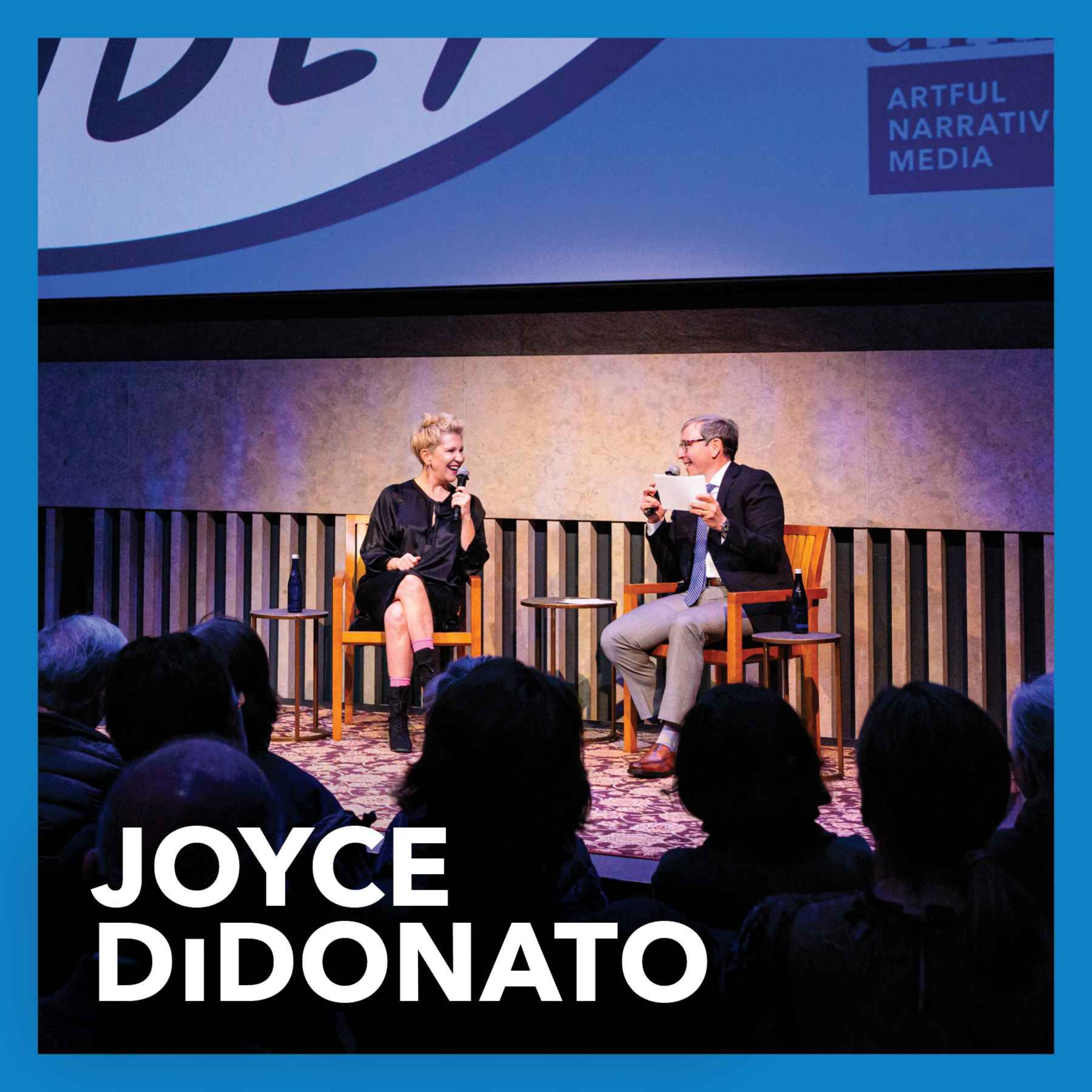
Hey listeners, be sure to check out slippeddisc.com for the latest in classical music. Now, before this episode starts, I wanted to let you know that it was recorded in front of a live audience in New York City at Lincoln center as part of their Hear It Here podcast festival. This past April. We had a great turnout for a really fun and in depth conversation. So here it is. I hope you enjoyed listening to it as much as I enjoyed speaking with Joyce. Three time Grammy award winning American mezzo soprano Joyce Didonato captivates audiences worldwide with her enchanting voice and transformative stage presence. She's known for singing solo arias, but her profound appreciation for music was kindled by her first musical love, singing in a choir.
- [00:49]
Joyce Didonato
Every voice in that choir is invaluable, but they all need each other to make it work. It's the perfect blueprint for me about how to go into the world. It's like everybody has their purpose and their own voice, but together you can make harmony.
- [01:10]
David Krause
You're listening to Speaking Soundly, a backstage pass to today's biggest stars of the music world. I'm your host, David Krause, principal trumpet of the Metropolitan Opera. During each episode, you'll hear me speak with inspiring performers about the their creative process and the personal journey that led.
- [01:26]
Joyce Didonato
Them to the stage.
- [01:31]
David Krause
Nice to see everyone. Thank you to Lincoln Center's here to hear series artful Narratives media for supporting this conversation. And thank you, Joyce. I'm honored that you would do this and quite frankly amazed that you are available because I know you have like two free nights every solar eclipse. So thank you for spending one here with us tonight.
- [01:52]
Joyce Didonato
Thank you, David.
- [01:54]
David Krause
So I want to talk about, to start off an aspect of your career that is fairly commonplace to you but very foreign to most people on the planet, and that is walking into a room and receiving thunderous ovation. What does it feel like, for example, when the curtain of the Met Opera opens and you're facing nearly 4,000 people who launch to their feet and cheer for you? Does it ever get old?
- [02:21]
Joyce Didonato
No, for sure it doesn't ever get old. And it's so funny. We performers, I don't know if I'm completely unique. I think I have this in common with a lot of performers is that usually we expect no applause. Like we think, oh, they're gonna hate it. Oh, I hope they applaud. I don't know what's gonna happen. And there's a sense of dread sometimes. So there is a sense of relief and I'm not being falsely kind. Of modest. There is a sense of every time we go on the stage, it's new, and you have to prove yourself every time. And so there is a sense of relief and then there's great joy. Because if there is that level of feedback and giving back to those of us that were on this stage, I mean, you get flooded with gratitude. I will say there are certain theaters where even if you show up as David Krause or Joyce Didonato, they don't automatically give you applause. Some theaters do.
- [03:32]
David Krause
Which theaters? Which theaters?
- [03:33]
Joyce Didonato
Well, I go home to my lovely Kansas City Symphony, you know, and I can walk out and I can go. And they would applaud. You go to, for example, Teatro Colon in Buenos Aires. That is an audience that has heard it all, that knows it all, and they say, we love you, but you better sing tonight. And there's a sense of okay, because they know everything that you're trying to do as an artist, and they don't just automatically give it to you. When that kind of applause comes, it's deeply gratifying.
- [04:14]
David Krause
Right?
- [04:14]
Joyce Didonato
Yeah.
- [04:15]
David Krause
As an orchestra member in the pit, I'm in a great spot. I'm not in the audience, but I'm not on the stage. I'm in between you and the audience. And I've seen a lot of opera singers take a lot of bows, and most of them really make a meal out of it. I mean, it's something to behold. But when you take a bow, there's something different. There's a look on your face like you've just been through something and you're emerging in that moment. For example, this past fall when you sang Dead Man Walking, which was amazing. It's a really light opera. It's a three hour opera about a nun who's counseling a convicted felon on death row. It's intense, and it ends with you alone singing a church hymn in the dark after witnessing an execution. The audience is silent, the lights go out, and for about 10 seconds, nothing happens until the curtain comes up and you're there to welcome this thunderous applause. So I want you to take me into those 10 seconds between the end of the opera where your sister Helen and seconds later, you're supposed to be a smiling Joyce. Like, how does that transformation happen?
- [05:35]
Joyce Didonato
I don't think Joyce enters, maybe until I leave the stage and come back on, because in this case, they just brought the curtain up and Ryan McKinney, who was playing Jo Des Rocher, he would have to be unstrapped from the gurney. We would hug each other we were usually in tears because it's such a journey that is taken together. And in this case, it doesn't feel like applause. I even know we could see people. Some people weren't able to applaud. They were still in tears. But I think it was the familiar gesture of saying, we were all here together. We all experienced this together. And it's this moment of trying to find our way to come back into the real world. So in this case, it would never felt like, oh, you love me, you love me. It really felt like those of us in this room for this show will never forget being here and sharing this experience together. And that is. That's the holy grail of a performance. Yeah.
- [06:52]
David Krause
I think part of your charm as a performer is that on stage you're a larger than life presence who can move mountains with your voice, but in reality, you're this soft spoken woman from Prairie Village, Kansas. I fought really hard to get rid of my Long island accent. Extremely hard, my entire life. I wonder if you had fought just as hard to retain that small town nature of Prairie Village as you tour the world, or will that just be always a part of you?
- [07:26]
Joyce Didonato
I think it's always a part of me. But I'll put on your Long island accent. All right, David. I'll do that. I would have never gotten rid of it. Never. Is that Brooklyn? I don't know. It certainly has never been a conscious decision, but I like my Midwestern boots and this sense of not being afraid of hard work and the sense that everybody involved in the process is equally important. Nobody more than the other. I mean, we've been in rehearsals for the hours in these days, and it's a huge game. Yay. It's a. Thank you. It's a huge cast. And it's not only the three ladies, an extraordinary auxiliary cast as well. All of us have covers that are in the room. There's a group of dancers that do beautiful work in this, and they all have covers, and there's actors that are participating and they have covers, and there's stage management and props, and then there's three people on the music stage staff. And I love being in the room there and knowing everybody has a purpose. And I think that's. That's something that was instilled in me in my, you know, Midwestern Prairie Village upbringing. I like it.
- [08:56]
David Krause
Well, I grew up 20 miles from here. In fact, my grandma lived across the street on Broadway and 63rd street for a number of years. But Kansas is a world away from Lincoln Center. What Is Prairie Village, Kansas.
- [09:09]
Joyce Didonato
Like, it is a suburb of Kansas City. And it is green lawns and oak trees and, you know, 1950 ranch houses. Where my church was up the street, there was a mall down the street. You know, the pool was half a mile away. Everything was there. It was come home when the street lights turn on. Forts with the neighborhood kids. I mean, it was, I won't say completely Leave it to Beaver ideal by any means, but it was a very privileged upbringing in that sense of safety and play.
- [09:52]
David Krause
And you're one of seven children raised in a large Irish Catholic family, which was also a very musical household. So in your family, who played what and what was your earliest musical influence?
- [10:05]
Joyce Didonato
So my two older. I'm number six. My two older sisters were trained in classical piano. My dad was the volunteer church choir. My mom was. I didn't know her as an organist, but that's how they met. Early on, she was busy raising seven kids, so she didn't practice the piano too much. And, you know, my father was listening to the classical music station when he was working from home as an architect. Sunday nights was Glenn Miller for cocktail hour. My sisters were upstairs listening to Barbra Streisand, Billy Joel. My brother was in the basement listening to Def Leppard and ACDC and whatever. So it was. I was exposed to all different kinds of music and it was. I feel like it was my first language.
- [11:00]
David Krause
In high school, you loved singing in choir. In fact, by senior year, you wanted to be a choir director, so you looked at schools with music education in mind. And of course, now when you sing, you sing solo arias. But singing in a choir is very different. It's not in the spotlight. What do you miss most about singing elbow to elbow with other people in a choir?
- [11:27]
Joyce Didonato
I'm trying to bring more of that into my world again because I have missed it. It's that sensation of every voice in that choir is invaluable. But they all need each other to make it work. It's the perfect blueprint for me about how to go into the world. It's like everybody has their purpose and their own voice, but together you can make harmony. I tell a quick story. So I did this. Am doing this project called Eden, which we launched about three years ago. And it's been really the project of my life. And I bring a local children's choir at the end of this concert to sing a piece that was written by kids as a part of a workshop about looking at the world and getting them to sing about the world that they're entering and we've done about 40 cities so far. We've had about 2,500 kids joining. And we're on our way to Asia and South America next. It's very exciting, but two weeks ago we were in ancient Olympia in Greece, and we have filmed a cinematic version of Eden, and this was filmed in Olympia because the theme for the Olympics this year is sustainability and the idea of returning to the Olympic ideals, which is not just commerce and competition, but cooperation and respect and working together. And so this wonderful group of people looked at the. What Eden was and they said, this needs to happen in ancient Olympia. So we brought a choir from Toulouse that sang with us a year ago. We got kids from the National Greek Opera from their children's choir, and we brought back kids from El Sistema, Greece, which is a refugee choir. They sang with us a year ago too. And we brought these three different choirs together. These kids who were strangers at the start of this two day filming, were sitting on a hill in ancient Olympia waiting for their turn to start filming, filming. And they're singing for each other in Greek and then in French, and they're teaching each other songs and they're dancing. And these kids from El Sistema that came from Iran and Sierra Leone, come from war, come from trauma, are on this hill with kids from the Greek choir in Athens and these beautiful kids from Toulouse as well. And they're equal. There's an immediate bond through language and song. And I just sat there, I mean, my days were 3:30 in the morning to 11:30 at night to try and do this. And I was just like, it's the most beautiful thing I've ever seen. And it was. I was just destroyed. And it wasn't planned, it wasn't on the scale schedule. They did this because of their love of music. And they're looking to say, show me who you are. What does your music sound like? And we couldn't pull them away from each other. That's why I love choir.
- [15:01]
David Krause
You're pointing to something that makes you a truly unique performer. And I think it's the idea of selflessness within a medium of, of opera that is very selfish. Right? I mean, it kind of has to be. I just think it's amazing that you are this big opera star, but it's clear that your heart remains to bring other people to the spotlight. And to that point. We're both children of the 80s, we both love Billy Joel, but when I was singing Piano man in my bathroom mirror, I was singing his part you were singing in the backup parts. Is it true that your biggest aspiration when you were younger was to be a backup singer for Billy Joel?
- [15:47]
Joyce Didonato
For Billy Joel. Not just anybody, but for Billy Joel? Yeah. Yeah. It's true. It's true. And I thought, if I could just do that, I'm still available. Billy. Billy.
- [15:59]
David Krause
And you heard him when you were 18.
- [16:02]
Joyce Didonato
He came to Kansas City on my 18th birthday, and my boyfriend at the time, Mark Howard, and I camped out months ahead of time to get the best tickets we could. I got ninth row, and you can take the girl out of Kansas. Right. I bought a. So embarrassing. I bought a bouquet of carnations to give to Billy Joel, and I made my way up to the stage. And they were white, they were very, very sad looking, but they're all I could afford. And he took them and he put them on the piano. It's one of my proudest moments. I don't know if he remembers that, but I do. It was my 18th birthday. Yeah.
- [16:45]
David Krause
That's a great way to spend it.
- [16:46]
Joyce Didonato
Wow.
- [16:49]
David Krause
So you'd end up after high school going to Wichita State to study vocal music education. And the end game was to return to high school essentially to teach musical theater and choir. How and when do you start to veer away from that and toward a career in opera?
- [17:09]
Joyce Didonato
Yeah. So I very selfishly joined the opera at Wichita State because I got more scholarship money for it. I think it was an extra $250 a semester, which I needed. And so I joined the opera chorus. And at the same time I was taking. I was double major with piano and voice, and I was taking voice lessons. And so of course, the training is classical. I always loved being on stage and I loved being in the choir, but I really never dared to think about, you know, making, like, being a star. Just never was on my radar screen. And as I was studying the voice and then got involved in the opera, I feel like I sort of exploded from the inside out. It wasn't because I saw an opera that I went, I have to do that. It was starting to sing these pieces and these arias, and the music was so beautiful and the text was so like. It just did that to me.
- [18:19]
David Krause
And what was the first opera that got you?
- [18:22]
Joyce Didonato
I was Marcellina in the Marriage of Figaro.
- [18:24]
David Krause
That was the one that did.
- [18:26]
Joyce Didonato
Yeah. My first role was the mother and Hansel and Gretel. See, I didn't get the good roles. I was Kate Pinkerton. I was Marcellina, not Carabino. I wasn't Hansel. I was the Mother. But, Marcelina, when I got to be funny, that Act 2 finale, to this day, blows me away. And I just thought, is this real life? Is there. What is that video? Is this real life? It's sort of like, does everybody get what's happening here? This is extraordinary. And at one point, because I was discovering this love, I'm going to try and answer your question and make that point, too. I finished my ed degree, and I did student teaching in really, really rough schools in Wichita, Kansas. Very poor. You saw a lot of abuse. You saw a lot of poverty, a lot of difficult things everywhere. But in Wichita, we saw it there, and I was so torn because I thought, these kids need a really good presence in their life, in the classroom. And I felt really torn as my Catholic education coming. Vocation. Vocation was the language at the table. I thought, I think I should be a teacher because there's such a need. But I really love to be on stage. So that must be bad. If it feels good, it must be bad. And I told my dad this, and he said, you know, Joyce, there's more than one way to educate people. And I really. That was the key to unlocking for, I think, to give myself permission to pursue this. And then I think about what I saw two weeks ago in Athens. I'm like, well, that would have never happened in Wichita, but I stayed. But coming back to my performance as well in Wichita, I got the one really good role I got there was Dorabella, and there was a stage, and I was singing it with Lucy McCoy. She was a graduate student, and I was in my last year of undergrad, and we had to be behind these two blinds. We were preset. And I remember for the whole opening, and I remember looking at her, and I whispered and I said, somebody out there has never heard this opera before. And it was just this, like, lightning bolt. And I felt like, oh, I have a responsibility here. And that has stayed with me whether it's a concert, whether it's a recital, whether it's an opera. I know that there's at least one person that's going to experience this for the first time. And I love that. It's why I take what I do pretty seriously. It's like, if you're going to introduce, you know, Dead Man Walking to somebody, you have to introduce it with integrity. Yeah.
- [21:34]
David Krause
After you graduate from Wichita State, you ended up at the Academy of Vocal Arts in Philadelphia, which is a real leap for you, because it was the first time you're leaving Kansas.
- [21:44]
Joyce Didonato
It's the only place I applied to.
- [21:46]
David Krause
Oh, there's that too.
- [21:48]
Joyce Didonato
It's the only place I applied to because I didn't want to do book work. I wanted to get on stage. And it's at that time, it was the one that was really just get on stage. That's going to be your education. I had no plan B at all. I got rejected. And the head, Kevin McDowell, who ran it at the time, he said, I'm sorry, we don't have a place for you. I called him back and I said, I'll take anything. And he goes, no, no, no, we don't have any roles to offer you. I said, I don't care. I just want to study. You don't have to cast me in anything. And they didn't even. Years on, they didn't really. And I kind of bullied my way into that. And it was three years was. I grew a very, very thick skin there. I learned a lot. I learned how to keep tears right here and say, yes, maestro, and go on with it. I learned how to prepare and perform an Italian recitative like nobody's business. I was surrounded by extraordinary artistry. Yeah, it was, it was baptism by fire and I wouldn't change a thing.
- [23:07]
David Krause
And you waitressed while you were in school to support yourself. Did you find it difficult to relate to other students who perhaps were born in big cities, exposed to the arts from a young age and maybe didn't have to put themselves through school? Maybe kind of like a person like me was that I didn't have time.
- [23:27]
Joyce Didonato
To think about you. I didn't have time. I. I had a church job. So I went out to Lansing, Pennsylvania and I. On Wednesday nights for thing and early Sunday morning, I waited tables Friday and Saturday night, late Saturday night, early Sunday morning. And there was one year that I did telemarketing for the Philadelphia Singers. That was brutal. But I at one point was working three jobs while doing this full time thing. I didn't have time. I. The one thing that was hard for me was I felt like I had so much inside of me and nobody was seeing it. And that's what frustrated me. And a lot of people were whizzing by me and I couldn't understand why it wasn't being seen. Is your next card about Houston?
- [24:18]
David Krause
Not yet.
- [24:18]
Joyce Didonato
Okay. Well, I kind of sorted that out in Houston, but it was hard and I. To this day, I'm not sure why I stayed on the track. I don't know if it was belligerence, I don't know if it was naivete. There was something in me that I just wasn't ready to stop yet or give up.
- [24:37]
David Krause
I can vividly remember many frustrating practice sessions when I was at Juilliard, trying to keep up with the competition because I was the worst trumpet player in the school. And really well. Yeah, somebody has to be right. It's just a terrible feeling. But when you play an instrument, there's an element of putting your nose to the grindstone, and practice makes perfect and you work through it. But with the voice, you can't muscle through things right. You have to wait for your body to develop in a certain way and technique, and it takes time. So when you're at this amazing school surrounded by amazing singers, how did you deal with the frustration of other people being better than you? And you can't rush things as you're working on them.
- [25:30]
Joyce Didonato
I took the $25 bus, the Peter Pan bus line from Philly to New York, and I took weekly coachings here. I didn't wait for the school to give it to to me. I knew that they didn't see it in me, and I thought, I've got to figure this out on my own. I didn't have a lot of spare $25 bus fares, but I did it. And I took really consistent lessons that third year, and I was finding it on my own. I mean, I had good instructors and all of that, but that fortitude and that real desire to take it to not just the next level, but to the Summit. I'm still working on it, but I know that it's my job and it's my responsibility. And so I didn't spend a lot of time going, oh, but they're doing this or they're doing that. I didn't go into that mentality. It's an inherently competitive business that we're in. I don't mind that I use it for good. I'm like, I need more of that. She's amazing. I don't have to worry about that. And I tried to do it very objectively.
- [26:44]
David Krause
And then there was Houston. So your training would continue and heighten at the Houston Grand Opera's Young Artist Program. When you arrived, you were told that you were singing on youth and muscle, and this had to change. 180 degrees in the first week. In the first week, yeah.
- [27:04]
Joyce Didonato
I thought I'd arrived at the Summit as a young artist, and that blew me away. But I was singing with my fingers crossed a little bit behind my back going, please work today. But you couldn't show that, and you couldn't tell anybody that you had to act like you knew what you were doing. But there was for sure a technical limitation and later on, personal limitation that I just didn't know how to open and let it be what it was going to be. And so it was a three year project with him in Houston. And when I left there at 29, I had a sense of ownership about my technique and about my artistry that then when it did sort of open for me, I was ready.
- [27:48]
David Krause
I want to ask you about that particular moment. So, like I said, I was a late bloomer on the trumpet. And I can remember a specific performance when I was in school after I had worked with a particular teacher and everything physically kind of came together. I had a degree of control and power and finesse that I hadn't experienced. It was something that came together in a performance, and it was probably the best, one of the best moments of my life. It was amazing. Amazing.
- [28:17]
Joyce Didonato
You were aware as it was happening 100. Wow.
- [28:21]
David Krause
Yeah. Did it come together similarly and all of a sudden for you?
- [28:25]
Joyce Didonato
No, no, no, no. When I. The end of my first year in Houston, So I was 27, we were doing a concert for the donors, the people who had given. I think it was. We got like 17,000 for the year, I think. And so it's all of us young artists and all the donors there. And you're thinking, now they're going to see if they got their money's worth. And I sang Non pum esta chenerentola. And I not only cracked, but I completely obliterated all three of the final high Bs. Okay, don't worry, there's another one, Joyce. And I cracked all three of them. And my teacher came up and he hugged me, said, I'm so proud of you. It means you're letting go. Because I was just in that, changing over the technique. And the impulse was to keep it safe and hold it and make it work, which is, of course, the last thing I needed to be doing. And so I was baby step, baby step, baby step the whole time. And there wasn't. I never considered there a big break, but there was a shift in my mind that is very concrete for me. And I wasn't singing. I was in the rehearsal room. The Chicago Lyric Opera covering Jennifer Larmore as Ruggiero in Alcina. Renee Fleming was the Alcina. Natalie Desaix was the Morgana Rockwell Blake was the tenor. I don't remember his name.
- [29:59]
David Krause
Whatever the role is, nobody cares about the tenor.
- [30:01]
Joyce Didonato
And thank you. Thank you. You words right out of my mouth and. And Jennifer Larmore. And I was one of the covers in the corner of the room where you don't speak unless you're spoken to, and then do it with caution. And I was really prepared. I was singing well. And I just remember thinking, if I had to go on, I think I could hold my own. I'm not saying I would have set the world on fire. I wasn't, you know, thinking that way at all. But it was just like there was a shift in my thing of like, I'm ready for this and I know what I'm doing. And that was a kind of before and after moment. But I didn't sing a note with it.
- [30:45]
David Krause
You're now in such high demand that taking auditions for roles must seem like a million years ago. Yeah. You even just flinched it. Yeah.
- [30:55]
Joyce Didonato
Thank goodness.
- [30:57]
David Krause
But at one point, it was the bane of your existence. What was that first audition tour like? I think it was something like 13 auditions in, what, 16 days.
- [31:07]
Joyce Didonato
So I did the Operalia competition. I did it first in Japan, didn't do too well, but I got invited back the next year in Hamburg. I placed second. At that point, I had auditioned for all the New York agents, All the New York agents. I was 28, leaving the Houston studio 29, and nobody was taking me. And I had work at Tulsa Opera and Arizona Opera, a Hansel and a Rosina. And I thought, I'm going to support myself through singing now. I don't have to wait tables anymore. But that I really was anticipating a very good regional career in America. That's the track that I thought I was on. And I did the Operalia competition, and I got a phone call from a London agent, and he said, I think you're going to be a superstar and I want to represent you worldwide. And I went, oh, okay. I knew. Never heard that kind of language. Never heard that language before. And he said, but you have to come over here and sing because nobody here knows you. I said, okay. And we picked December. Great month to trek around Europe. And it was very improvised. It's like, oh, they can see you in Nancy tomorrow if you come. So I did. Literally 13 cities in 16 days. Not congruently, by any means. And they were mostly B and C level houses. And I got 12 immediate rejections from, like, you know, Scottish opera and Antwerp and, you know, like, very houses I would have been thrilled to sing in. And my last audition was the only A level house that I sang for, and it was Paris Opera and an Hour and a half later, they were offering me a new production of the Barber of Seville. I would say that was my break, but I think the reason I got that job, Hugo was running the Paris Opera at the same time he was working a lot with Francesca Zambelo. And Francesca had just directed me as Kate Pinkerton in Madame Butterfly. And she liked. She thought I was smart. I don't think she ever commented on my voice, but she's like, you're smart. You're quick. And I know she spoke to Hugo, said, keep an eye on this young American. She's smart. So he listened to me with a different set of ears and gave me an opportunity that these other houses didn't. And was that luck? A little bit. But also, what if I hadn't really embraced Kate Pinkerton, you know, maybe that I would have missed that opportunity. And I sang Kate Pitch Pinkerton well there because I also did her at Ava and at Wichita State. So it's like, what is the break? Said I prepared well at Wichita State, and then I paid more attention at Ava and everything. Domino by Domino leads me to Lincoln Center. Speaking soundly with you, David.
- [34:18]
David Krause
Yeah, well, now I just feel bad for you. So what my experience also is, the best thing about taking auditions is it only takes one to stop taking auditions. And that very much happened to you because by 2005, I get a chance to hear you for the first time, because when you made your Met debut, I was in the orchestra, and I got to hear you in that performance, and it was amazing. Any Met debut, I would imagine, is very special. This was perhaps even more special given the fact that even though your father was ill and would unfortunately pass away shortly thereafter, he made it to the Met for that performance. So talk to me about not only making your big debut at the Met, but having your father there.
- [35:10]
Joyce Didonato
What he said to me after is he looked at me and he goes, so you're really doing this? And it was. I mean, talk about a Midwestern outlook on life. It was. There was a sense of awe and sort of wonder, and I think he probably felt like, is this really real? And I looked at him, I was like, yeah, dad, I'm really doing it. And that was. Yeah, that was a gift to know that he was able to experience that and have that realization along with me.
- [35:51]
David Krause
Yeah, that's beautiful. And I'm gonna edit the next part out of the podcast because it's about me for a second, because it's very similar. That piece that I talked about, that, when everything came together, was Mahler's Seventh Symphony. It was the first trumpet part I got when I was in school, and everything really came together. My wife was there and my parents were there. It was a great night. Fast forward to when James Levine conducted it at the Met, and we're at Carnegie hall, and my father was ill with cancer. We were hoping that he was going to make it, and it was not great. But he always kept saying, you know, I'm going to come to that Mahler 7, because it was so amazing when you were in school and you were dating that nice girl who ended up being your wife. And he goes, I'm going to come. I'm going to come. And he died right around New Year's. And this concert was like, December. What was it? Kristen? Yeah, like the 22nd. I know I'm already talking too much about me, but, you know, I got the microphone, so my dad made it in and unfortunately passed away shortly after that. But that particular piece, then the emotional weight of playing it was awful at the time. But I'm so happy for the experience. So I can only imagine that that must have felt tenfold for you, having your father there at the debut.
- [37:19]
Joyce Didonato
Okay, first of all, in order for me to continue this podcast, I need you to guarantee me that you're going to put that in and not cut it. Otherwise, I will not sign my release. We. We want to hear that story. We want to hear that story. You know, the Met, he was not well, but it didn't feel like he was going to pass imminently. The harder part was I was in Madrid doing Ariadne, and he did. He fell ill and went into the icu, and I came home early and spent the last few weeks with him. And my. My next show was Idomeneo in Paris. I think I had to leave about a week after the funeral. So I'd been at home, we'd gone through all that. I'd had my time with my family, so. Okay, well, I have to get back to work. And I was at Paris, and I was late to rehearsals, so it was like a day, and just. And then I was curtain up, and all of a sudden I'm singing, Il Padre Ado horado lu perdo eloper. I mean, those aren't the right words, but about. I just found my father, and now I've lost him again. And it was a Luc Bondi production, so everything was very angst, and I was curled up in a fetal position singing this. And the curtain came down right after that. And I've never experienced anything quite like that. And I realized with time later that especially because it was Mozart, but it was moving things through me that I wasn't remotely prepared to process, but it didn't allow it to be stuck. And I've had some uncanny parallels between performance roles and timings of performances and what's happening in my real life. It's. There's a book in there, I suppose, at some point, those kinds of experiences, I'm sure for you, I don't want to put words in your mouth, but with the Mala, it's that mystical thing that happens where you go out of time and space and there's a connection that is quite visceral. And it's all. It doesn't exist. It's just waves. It's. You can't find it. You can't hold it. And once you put it out, it's gone. And yet how those performances stay with us and how it still connects us to that moment, to those people, to that emotion, it's quite an extraordinary thing we get to do. Yeah.
- [40:03]
David Krause
Well, Joyce, now that I brought the room down, I can't thank you enough. This has been such an amazing experience. Forget about them for me. Just to be able to talk to you. I'm as bewildered by your artistry and your voice as everybody else in the audience. So thank you so much.
- [40:20]
Joyce Didonato
You're so kind. Thank you. I'm very honored. Very well.
- [40:23]
David Krause
Thank you. And thank you to all of you for coming.
- [40:28]
I hope you enjoyed this episode of Speaking Soundly.
- [40:31]
If you like what you heard, please.
- [40:32]
Tell your friends about it.
- [40:33]
Spread the word, be sure to follow.
- [40:36]
Rate us and leave a review wherever.
- [40:37]
You get your podcasts.
- [40:39]
To keep up on future episodes, follow us on Instagram at Speaking Sndly and Visit our website, artfulnarrativesmedia.com Tune in next week as we hear another inspiring artist speaking soundly.