Loading summary
Transcript41 lines
- [00:01]
David Krause
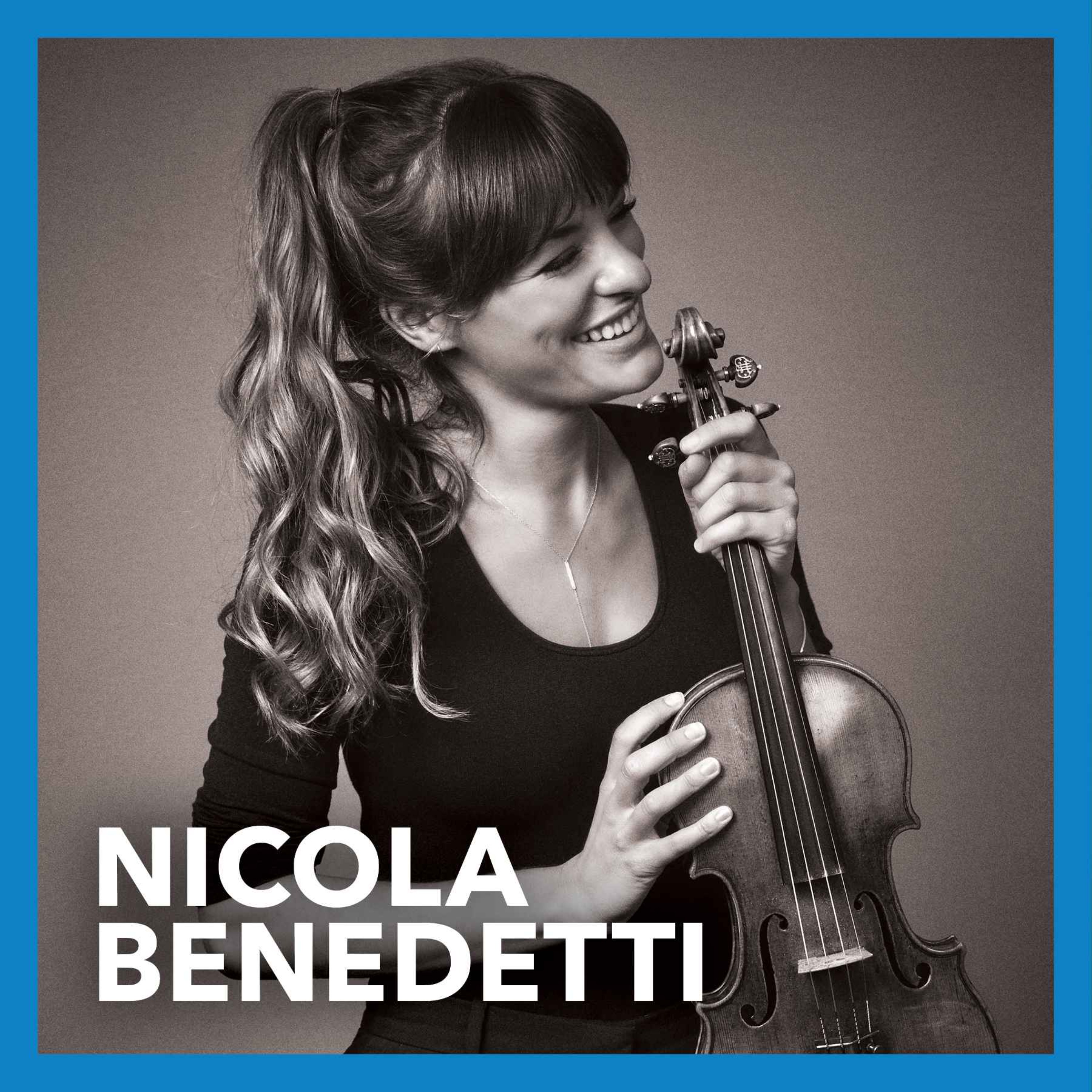
Hey listeners, if you're enjoying speaking soundly, please consider supporting our work with a tax deductible donation. You can easily contribute on our website@artfulnarrativesmedia.com donate click the link in the show notes of this episode or you can follow us on Instagram peakingsndly and get all the information there. Either way, every donation, no matter the size, helps us keep bringing you inspiring conversations with remarkable artists. So thank you for your continued support. We really appreciate it. Be sure to check out slippeddisc.com for the latest inside information on classical music. Now. Grammy Award winning Scottish Italian violinist Nicola Benedetti has captivated audiences worldwide with her passionate and virtuosic performances. Whether performing on stage, educating through her foundation, or curating concerts as an artistic director, she's driven by the transformation power of music.
- [01:04]
Nicola Benedetti
When you see the real life altering impact of that singular moment, it's like they walk through a door and they can never walk back through that door and forget that they've experienced this thing and being able to provide it for others. I count my blessings about that every day.
- [01:22]
David Krause
You're listening to Speaking Soundly, a backstage pass to today's biggest stars of the music world. I'm your host, David Krause, principal Trumpet of the Metropolitan Opera. During each episode, hear me speak with inspiring performers about their creative process and the personal journey that led them to the stage. I gotta start out by admitting how intimidating it is for a trumpet player like me to be talking to an internationally acclaimed violin soloist like yourself, because you play more notes in one concerto than I do in a year. Do you ever wish you would have picked up a slightly easier instrument to play with a more manageable repertoire?
- [02:05]
Nicola Benedetti
First of all, I just love the respect that you have given. That is due to the violinist.
- [02:10]
David Krause
I married a violinist I know very well.
- [02:13]
Nicola Benedetti
As you can imagine, in my home life, we also sometimes have these debates around the superiority of the violin versus the trumpet. And you know, they both have qualities that take the biscuit. But no, I think that there are many instruments that could give me an easier right than the violin.
- [02:39]
David Krause
Well, you have been personally responsible for expanding the massive violin repertoire by championing new works, and I was lucky enough to be in Philadelphia when you performed Wynton Marsalis's Great Violin Concerto, which he wrote specifically for you. The performance was insane. Beyond all the technical and stylistic demands of the piece, the thing that really stuck with me was how much fun it looked when you were playing it. But when you're performing, you're working I mean, it's a difficult piece. Is there a part of you that can enjoy the music as you're playing it?
- [03:17]
Nicola Benedetti
Well, that was a painful but necessary process in the learning of the piece to try to kind of liven up and loosen up and wake up a more improvisatory part of my personality. It certainly changed how I feel about playing on stage forever, because, as you know, better than better than anyone, it's not necessarily something that's home to our training. And I would not say that I've ever gotten so far as to understand or appreciate what it must feel like when you're making up language in the moment. But when I really got comfortable with his writing, that coupled with some of the Baroque playing that I've done, specifically with Andrea Marcon and Venice Baroque Orchestra, is the closest feeling I've had to how euphoric it must feel to really create music in the moment.
- [04:13]
David Krause
As I watched you perform that concerto, the violin just disappeared. I mean, it sounded so effortless. And I know reaching that level of mastery takes a lifetime and dedication of practice, starting at a super young age. I'm curious how old you were when you started. And since the violin is such an awkward instrument to start, when did you feel that moment where your fingers just kind of knew where to go on the strings? And you were like, okay, I get this.
- [04:43]
Nicola Benedetti
I don't remember the first moment because I was four when I started, but I remember the physical. I generally remember the physical excitement, I guess, of this kind of works. Like these things are. They're melding together to actually create something that sounds half decent. And anyone that has learned a string instrument in particular, will know the pain of those first, whether it's few weeks or few months. Obviously it's different for everyone and depends so hugely on how you're taught. The physical setup of approaching the instrument, especially violin and viola, they're so awkward. They hold it off to one side. It's one of the great contradictions of the instrument. Again, the volume of people that learn it, the popularity of the instrument, but just the unnaturalness of it. But I do remember that excitement of this is actually somehow starting to work. And I also remember, more than anything else, the emotional pull of learning to play tunes that for me, were so magnetic and so beautiful and just opened up a feeling that I hadn't in my young life yet felt, and there was no experience like it. So in terms of that, why am I agreeing to do all these hours of practice? You know, why am I choosing to do them? It was really, that. That was the pull for me.
- [06:17]
David Krause
In my experience, the love of music came only after I can actually play the instrument well enough to participate in it. But you fell in love with music first, right away from the start. Don't you think that's kind of unique for a kid? I'm just curious how this cart before the horse approach shaped your progress on the violin. Did it propel and motivate you? Was it frustrating to know how a piece sounded and was supposed to make you feel, but then struggle to actually pull it off?
- [06:49]
Nicola Benedetti
Oh, I could take that in so many different directions. I would say that on a personal basis, it's the sort of human revelations that are told through music that was the pull for me. So even as a really young child, I would be extremely emotional about Tales of humanity.
- [07:09]
David Krause
At six years old.
- [07:10]
Nicola Benedetti
Oh, yeah. Really, really young. I was, you know, absolutely distraught about an injustice. I remember like it was yesterday, the first time I realized that not everyone in the world had the same kind of health support and care, you know, like sort of fundamental injustices of what it is to be alive and what.
- [07:30]
David Krause
You need to be. You sounded like a fun kid to be around.
- [07:33]
Nicola Benedetti
My sister was a lot of fun. I think I was probably quite intense, but so I would say that, and I look back on what type of music I was drawn to, and it was the sort of deeply emotional music, more than the bravora of virtuosity. I would also say that the fact that I didn't come up through a musical environment. My parents didn't play instruments, none of my kind of surrounding family or friends played instruments, other than my sister, who started on the same day as I did. I had a very instinctive and uneducated approach to music, and I was almost bitter about that when I was in my sort of early teens, late teens. Not bitter, I would say, but ashamed. Like I was sort of a step behind or missing something. That some of a lot of my peers had grown up differently. We had wealth in certain areas, but in terms of the wealth of that knowledge, I did not grow up with that. And I felt that was a sort of disservice. But do now appreciate that so fully, because I think it has allowed me to have such a direct and instinctive relationship to the language of music, and one that's driven by what its underlying story is trying to tell us about people.
- [09:01]
David Krause
Your mother was instrumental in fostering both you and your sister's relationship with the violin and with music in general. But she had no real background in classical music. Much Less the violin. So she was really learning on the job with you. Can you talk to me about your experience of listening to the Brahms violin concerto alongside your mom and sister? You said it was a really formative process as the three of you fell in love with that piece together.
- [09:27]
Nicola Benedetti
Yeah. So there was several violin concertos. They were recordings by Kum Wah Chung, Anna Sophomutter and Maxine Vengrov. We would play them on the way to school and on the way back from school, we had a little bit of a drive and it was the long form and the patience and waiting for those moments of, you know, that big climactic build, that moment of virtuosity where I was just dumbfounded, like, how is it physically possible for someone to do that? And because I hadn't seen any violinists live, it was just the most mystical, magical thing I had ever heard in my life. And so we would all kind of begin to learn what it was to listen to a 30 minute piece of music together, because none of us had. None of us had really experienced that before. And I think it was a. I think it was a smart way of trying to introduce us to that sort of longer form listening experience.
- [10:35]
David Krause
Yeah. And I'm curious, while you were listening, did you ever think that eventually you'd be performing it with some of the greatest orchestras around the world? And is there an element to those moments when you fell in love with the piece that you try to retain in your performances today?
- [10:53]
Nicola Benedetti
I think I have no option but to retain it. It's not even a choice. You know, when you get to the first time the violin plays the primary melody in Brahms Concerto I still have this. Am I really doing this? And to feel so much about it can be exhausting. And sometimes I resent that. But when I'm in my right mind and kind of come to my senses, I realize that's a gift I never want to break away from.
- [11:32]
David Krause
Well, you've been experiencing this gift for a really long time. In fact, you left home to study at the renowned Yehudi Menuin School at the age of 10. What was it like to leave at such a young age to attend what could be called the Hogwarts of music schools.
- [11:49]
Nicola Benedetti
Yeah, it was difficult. I was very, very homesick. I was very close to my parents, very close to my sister, but was also like a kid in the candy shop when it came to what I could learn. So the violin teacher put us through a very tough regime. It was back to basics, back to playing no repertoire at all for the first, maybe three, four months. Quite an extreme approach to resetting a violin technique, resetting an instrumental technique, something many instrumentalists experience at different points in their life. If you're lucky, it happens to you young, but quite often people will go to college and at 18, have to, you know, reset and start practicing.
- [12:37]
David Krause
That's exactly what happened to me.
- [12:38]
Nicola Benedetti
Is that what. And was it a good experience?
- [12:40]
David Krause
It was awful. Would you know that moment that you realized that you had completely swept all these physical issues under the rug that you just weren't dealing with, and then you had to come face to face with them? It's not a good feeling at all. And I think had I not overcome it then, I definitely would not be playing the trumpet today and probably be, I don't know, a successful lawyer or a doctor or something. If you've had similar obstacles, what did you do to overcome them?
- [13:09]
Nicola Benedetti
Well, I've had so many obstacles. My technical development and basic trust of myself on stage was bumpy and very tumultuous and quite stop, start and quite slow in some areas. Whereas, you know, career wise, everything was very fast. I was doing everything when I was 16, 17, and not ready to do it. So I would say, to speak specifically to the question around those sort of hurdles, I spent so many years just attacking, attacking, attacking, practice, practice, practice. Just do it again, do it again, do it again. You know, if only I just do another hour, it's going to fix this problem and just not true, you know, and that's. That is. I've got to be really careful saying that, because I am not advocating for practicing lesser, for not being disciplined, but having hammered away at an approach that was too harsh and too repetitive and too insistent. I try all the time to try to have that kind of like just a softer bed where you can then approach things in a more personalized, just slightly softer way.
- [14:32]
David Krause
Well, it obviously worked for you because at the age of 16, after winning the BBC Young Musician competition, you were catapulted into a career as an international violin soloist. And at one point you were performing more than a hundred concerts in a given year. Were you prepared for the intensity of the career that you had always dreamt of?
- [14:55]
Nicola Benedetti
I think I was quite well equipped for the intensity of it. The sort of that grueling relentlessness of, you know, travel and performance and all of that was fine with me. But the emotional roller coaster of when I felt I didn't do well, that I struggled with a lot. I don't know if I would have done it differently. It built a Lot of character. I remember doing a tour when I was maybe about 17 or 18, and I was playing too many concertos within a tour, like three different major violin concertos within one tour, that I was playing concerts every single day. The kind of thing I would not do now, but somehow felt was okay to do then. And I hate blaming managers or conductors or anybody else because I think it is on you to make those parameters for yourself. But I was certainly badly advised. I mean, the kind of character building, of being sent a bad review that you get on day two of a 12 day tour and having to get on stage the next day knowing everybody's seen it. You know, moments like that are humbling. And it's so interesting even having a wee baby now myself and just. And seeing like my sister, she's got a two and a four year old, and seeing that careful balance of exposure and experience and protection. And at what point people are ready for different levels of harshness in their life, and at what point is it just going to be an awful experience, but you will come out the other end stronger, harder and better? And at what point is actually, was that just way too much harshness for where I am in this point in my life? You know, the damage it did was more than it was worth.
- [17:07]
David Krause
Well, they don't teach you that in school.
- [17:08]
Nicola Benedetti
No, no.
- [17:11]
David Krause
When you perform now, it may seem to the audience like every phrase is perfectly planned out, set in stone, but in reality, no two performances are alike. How do you balance that need for accuracy with the desire to take risks and create something really spontaneous in the moment?
- [17:30]
Nicola Benedetti
I mean, I would love to ask you the same question, but I will try and answer the question. For me, the bigger the basic mindset of risk and of flow, the more accurate I play. So if I'm trying to control what I'm doing, I will always mess up a lot more. And that's just my personality. I don't think that's the case for everyone. Like, some people are really good at being sort of in the driving seat and they like that kind of calm, controlled feeling. If I'm. If I'm in that mindset of I'm telling you this like this is what this is about, this is what this piece is about. And I've got to tell you this story. And it's a sort of determination around that conviction. That's when I would play most accurately.
- [18:31]
David Krause
Your musical impact extends far beyond the stage that you're performing on. You founded the Benedetti foundation, which advocates for and implements music education for children. You're also the director of the Edinburgh International Festival, one of the most prestigious cultural events in the world. Balancing these roles must be challenging. Is there any overlap between performing, educating and directing that helps make it a little easier?
- [18:59]
Nicola Benedetti
Yeah, I think it's back to what we were talking about earlier with your relationship to music. And the impulse for me is really similar across all things that I'm doing. It may seem like a lot of different activities, but they have a really similar purpose. You know, believing in the uplifting and enriching and community building power of the arts in all its forms. Certainly through the foundation and the festival, there are so many different avenues through which we can do that. We're trying to always balance that. Talking, chatting, conversation, what words can do, what words can analyze, what words can reveal with the ethereal, with the spiritual, with the kind of holistic experience that of all the arts. I would say music has the, the highest potential and the highest, the highest power. You know, it's essentially kind of relentlessly hope filled position and what you wish for people. And you know, I actually needed quite a lot of encouragement to take that plunge in going out for the, the job in Edinburgh because I have to say when I first got that phone call, I thought there's no, first of all, there's no way they're calling to ask about me doing it. I thought they're calling to ask me about who I thought else should do it and, and second of all, that it's something that I could actually occupy. But once those, you know, first conversations started going, you are asked a lot of questions about how you could occupy a role like that. I think it's an offer to contribute to that full cultural landscape in Scotland. Trying to pull people into an experience that is enriching for everyone, that's individual for everyone, that celebrates, you know, a collective experience that we can have and that opens your mind and lifts you up. I think all the things that I have the privilege of being able to do, they all have actually a pretty similar end goal.
- [21:10]
David Krause
What's it like from these different perspectives to see and feel people making those same deep connections with music that you've been experiencing since the age of six?
- [21:21]
Nicola Benedetti
Yeah, it's why I never tire of that first time experience that people have at any age. Like when you see the real life altering impact of that singular moment, it's like they walk through a door and they can never walk back through that door and forget that they've experienced this thing. If that experience is explosive enough and it's emotional enough and it's impactful enough, you, you are sent on just. It might just be a slight veer in the road, but it's a veer that will take you to a different destination in your life. And the power of that, when you add it to the kind of full social impact, when you add it to ideas of unity, ideas of listening, ideas of humility. And then the main point is this vibration that you feel when it's collective sound made together, you know, it's something that you're compelled to do. Your lifetime is not going to be enough of those experiences. And being able to provide it for others is. You know, I count my blessings about that every day.
- [22:32]
David Krause
Well, I would imagine the most important person you hope forms this deep connection with music is your baby girl who's been actually sleeping ever so quietly in the room next door. When you reflect on everything a life in music has given you, what do you hope most gets passed on to her?
- [22:51]
Nicola Benedetti
Oh, I thought quite a lot in the last few months, just about. Will it be tough on me if, for example, she really hates classical music? You know, which is entirely possible. But I think what I really hope for is a fundamental openness and curiosity towards others. And that can come in so many different forms and it can be expressed through so many different modes of creativity that humanity have come up with.
- [23:25]
David Krause
So I guess the only question left is whether she's gonna play the violin or the trumpet.
- [23:29]
Nicola Benedetti
Look, she would have to really love, really love either the violin or the trumpet. That's true for me to encourage either.
- [23:40]
David Krause
I hope you enjoyed this episode of Speaking Soundly. If you liked what you heard, please tell your friends about it. Help spread the word and follow us on Instagram peakingsndly. For more information, you can Visit our website artfulnarrativesmedia.com if you're new to the show, you could go back and check out earlier episodes featuring Wynton Marsalis, Regina Spector, Joyce Didonato, Emmanuel Axe and Rufus Wainwright, just to name a few. And tune in two weeks from today on March 8th, as we hear jazz saxophonist Alexa Tarantino speaking soundly.