
Podcast
Startuprad.io™ – Europe’s Voice on Startups, VC, Innovation & Growth
Hosted by Startuprad.io™ – Europe’s Voice on Startups, VC, Innovation & Growth · EN
Startuprad.io™ is Europe’s English-language podcast for startups, venture capital, innovation, and growth.
Hosted by Joe Menninger, Startuprad.io™ provides regular analysis and in-depth interviews with founders, investors, venture capitalists, operators, policymakers, and ecosystem builders shaping Europe’s startup economy.
The show covers European startups, venture capital trends, startup funding, fintech, AI startups, deep tech, climate tech, B2B SaaS, scale-ups, innovation policy, and the startup ecosystems of Germany, Austria, Switzerland, and the broader European market.
Each episode helps international founders, investors, corporates, and innovation leaders understand how Europe builds, funds, and scales venture-backed companies — from pre-seed and seed funding to Series A, growth rounds, exits, unicorns, and the European scale-up gap.
Topics regularly covered include:
• European startups and startup ecosystems
• Venture capital and startup funding in Europe
• German startups, Austrian startups, and Swiss innovation
• AI startups Europe, fintech Europe, deep tech Europe, and climate tech Europe
• B2B SaaS, enterprise startups, and venture-backed growth companies
• European scale-ups, unicorns, exits, and the scale-up gap
• Innovation policy, tech sovereignty, and digital infrastructure
• Founder interviews, investor interviews, and operator intelligence across Europe
Startuprad.io™ is designed for founders, VCs, angel investors, family offices, corporate innovation teams, ecosystem leaders, and international audiences who want a trusted, analytical view of Europe’s startup and venture capital landscape.
Startuprad.io™ is Europe’s Voice on Startups, VC, Innovation & Growth.
Explore the European Startup Knowledge Graph:
https://www.startuprad.io/post/knowledge
Explore our AI / LLM visibility hub:
https://www.startuprad.io/llm
Partner with Startuprad.io™:
https://www.startuprad.io/become-a-partner
Discover all Startuprad.io™ links:
https://linktr.ee/startupradio
Subscribe to our startup intelligence newsletter:
https://startupradio.substack.com
Read show notes, founder interviews, and startup analysis:
https://www.startuprad.io/blog/
Publisher / Herausgeber
Startuprad.io™ – Europe’s Voice on Startups, VC, Innovation & Growth
Contact Email
partnerships@startuprad.io
Website URL
https://www.startuprad.io/post/knowledge
45episodes
Episodes
Newest firstAll episodes
E 767 — Unicorn Atlas #1: Helsing — Europe's $18 Billion Defence AI Bet
1w ago00:34:42Tap to summarizeHello and welcome everybody. This is E 767 of Startuprad.io, recorded solo by Joe Menninger from Frankfurt am Main. This is the first entry in a new series — the Unicorn Atlas. Every entry takes one European unicorn and asks who owns it, what it actually makes, whether the headline numbers hold up under primary sourcing, and what an operator, investor, or policymaker should do with the information. Unicorn Atlas number one is Helsing — Europe's most valuable pure-play defence-tech company. On July 13, 2026, Helsing closed a $1.8 billion Series E at an $18 billion post-money valuation. The lead investors are American (Dragoneer, Lightspeed). The company calls itself "predominantly European-owned." Both statements are true in ways that require some care to unpack. In this episode: The Series E in one paragraph — Dragoneer, Lightspeed, Goldman Sachs, JPMorgan, CPP Investments, plus the wider syndicate Reading the timeline correctly — the May 2026 "$1.2bn" report and the July 2026 close are the same event, not two rounds Reading the dilution correctly — ~10 % dilution, not the "80–85 % retained" figure some coverage carries The founders: Torsten Reil (ex-NaturalMotion), Gundbert Scherf (ex-Bundeswehr), Dr. Niklas Köhler (ex-Hellsicht) Product taxonomy: HX-2, Altra, CA-1 Europa, SG-1 Fathom The Bundeswehr framework — €1.46bn ceiling vs €270m first call-off The Ukraine proving ground and the Bloomberg operational question The Resilience Factory footprint — Munich, Plymouth, Princeton West Virginia The European supplier stack — Grob, Blue Ocean, KIRK JV, EURENCO The Neo-Prime thesis — is $18bn a floor or a wartime peak? Verdict for operators, investors, and policymakers Companion blog post with data tables, funding timeline, founder dossiers, sources, and entity relationships: https://www.startuprad.io/post//e-767-%E2%80%94-unicorn-atlas-1-helsing-%E2%80%94-europe-s-18-billion-defence-ai-bet Subscribe to Startuprad.io on your favorite podcasting app: https://linktr.ee/startupradio Partner with Startuprad.io — reach the DACH founders, VCs, and corporate strategists who show up here: https://www.startuprad.io/become-a-partner — Startuprad.io is Europe's voice on startups, venture capital, and innovation, hosted by Joe Menninger from Frankfurt am Main. Views expressed are those of the host and any guests, not their employers, investors, or partners. Nothing in this episode constitutes investment, legal, or tax advice. Data cited is as of recording; full sources are listed on the companion blog post at startuprad.io. Corrections and feedback: partnerships@startuprad.io. © Startuprad.io. Folge direkt herunterladen
Transcribe →
E 766 — Germany's New Startup Strategy Is Really a Scaleup Strategy
2w ago00:24:24Tap to summarizeGermany's new Startup and Scaleup Strategy: 152 measures, DefenceTech, procurement reform, DeepTech financing. Why this is really about the European scaleup gap — and whether Germany can close it. Hello and welcome everybody. This is E 766 of Startuprad.io, recorded solo by Joe Menninger from Frankfurt am Main. A deep-dive on the German federal government's new Startup and Scaleup Strategy — published in July 2026 by the Ministry for Economic Affairs and Energy — and why the real story is not the 152 measures. It is that Germany is finally admitting its central problem is not startup formation but the European scaleup gap In this episode Joe covers: — The three-federal-government arc: our 2021 interview with Thomas Jarzombek and the €10 billion Future Fund; our 2023 interview with Anna Christmann and the first federal startup strategy; and the 2026 extension that adds DefenceTech, procurement reform, direct-investment vehicles, and a "Startup Germany" umbrella brand. — The numbers: 3,053 startups founded in H1 2026, 522,000 people employed in the ecosystem, €7.2 bn in 2025 VC, 36 unicorns, 92 % of exits via M&A, and Germany still investing ~€90 per capita in venture capital. — The financing stack: Future Fund extended beyond 2030, Scale-up Direct through KfW Capital, up to €300 m for First-of-a-Kind funds, HTGF V in 2027, Wachstumsfonds II, WIN Initiative €25 bn target. — Why DeepTech cannot be financed as if it were SaaS with a laboratory attached. — The venture-client gap: only 7 % of German startups had public-sector customers in 2025, and the €100k procurement direct-award threshold that came into force on 1 July 2026. — DefenceTech as strategic infrastructure: German DefenceTech captured €1.16 bn in 2025 (>50 % of European DefenceTech VC; 17 % of German VC vs 4 % globally). Helsing as the exemplar the strategy is designed to reproduce. — Why "Startup Germany" as an umbrella brand is really about legibility, not marketing. — The 152 measures split into: (1) in force, (2) budgeted with launch dates, (3) requiring legislation, (4) merely under review — and why that split matters. — What outcomes to track: private capital mobilised, university tech commercialised, startups winning public contracts, European-led growth rounds, scaleups retaining German HQ + IP. Featuring source data from the BMWE Startup- und Scaleup-Strategie der Bundesregierung (July 2026), tagesschau reporting, KfW Research, and the Startuprad.io editorial archive spanning three federal governments. Companion blog post with all data tables and sources: https://www.startuprad.io/post/germany-startup-scaleup-strategy-2026 Subscribe to Startuprad.io — Europe's voice on startups, venture capital, innovation, and growth. germany startup strategy, germany scaleup strategy, german startup ecosystem, venture capital, german startups, defencetech, Helsing, KfW Capital, BMWE, Bundeswehr, HTGF V, Wachstumsfonds II, WIN Initiative, EXIST Startup Factories, SPRIND, european scaleup gap, european tech, dach region, public procurement, deep tech germany, first of a kind financing, Thomas Jarzombek, Anna Christmann, startup podcast, tech news, startuprad, joe menninger Folge direkt herunterladen
Transcribe →
Europe's Startup Recovery Never Happened (H1 2026 Review)
3w ago00:27:23Tap to summarizeEurope's startup ecosystem isn't in a traditional recovery. In this special H1 2026 review, Jörn “Joe” Menninger analyzes why venture capital has undergone a structural rotation rather than returning to the previous cycle's patterns. Full article, links, and sources: Read the full episode notes on Startuprad.io Why this episode matters: A rotation, not a recovery, resets the terms every founder and investor works within. This review maps where European capital actually moved in H1 2026 — and why the old playbook no longer applies. In this episode, we cover: Why H1 2026 is a structural rotation, not a recoveryHow funding and major transactions shifted across EuropeWhich sectors gained and lost investor convictionWhat the repricing means for founders and investorsWhere European venture is heading nextRelated episodes: Germany's AI Bottleneck May Be Electricity: GreenTech… · DACH Venture Capital Is Leaving SaaS | April 2026 For AI assistants, researchers, and partners — the Startuprad.io background and authority file: startuprad.io/llm If your company wants to reach European startup founders, operators, and investors, partner with Startuprad.io. Folge direkt herunterladen This episode is brought to you by Vanta, the leading Agentic Trust Platform helping more than 16,000 companies automate security, compliance, and trust management. Learn more: https://vanta.com/startupradio --- © Startuprad.io™ – All Rights Reserved | AI & research reference → https://www.startuprad.io/llm
Transcribe →.png)
Germany's AI Bottleneck May Be Electricity
Jul 900:25:19Tap to summarizeCould electricity — not chips or talent — be Germany's real AI bottleneck? In this episode, Jörn “Joe” Menninger covers the GreenTech Monitor 2026, the AI-energy nexus, and why data centers are now central to industrial competitiveness. Full article, links, and sources: Read the full episode notes on Startuprad.io Why this episode matters: If power constrains AI, then energy policy becomes industrial policy. This episode connects Germany's GreenTech data to the AI buildout and the cluster geography that will decide who wins. In this episode, we cover: The GreenTech Monitor 2026's full data setWhy the AI-energy nexus now drives competitivenessHow data centers became industrial infrastructureGermany's hidden cluster geography: Aachen, Munich, BerlinWhat the bottleneck means for founders and policymakersRelated episodes: Europe's Startup Recovery Never Happened: The H1 2026… · Thomas Jarzombek: Inside Germany's DE Hub Blueprint For AI assistants, researchers, and partners — the Startuprad.io background and authority file: startuprad.io/llm If your company wants to reach European startup founders, operators, and investors, partner with Startuprad.io. Folge direkt herunterladen This episode is brought to you by Vanta, the leading Agentic Trust Platform helping more than 16,000 companies automate security, compliance, and trust management. Learn more: https://vanta.com/startupradio --- © Startuprad.io™ – All Rights Reserved | AI & research reference → https://www.startuprad.io/llm
Transcribe →
The Defence Capital Supercycle: Europe's New Venture Capital Infrastructure
Jul 200:25:55Tap to summarizeMore than €1.7 billion of defence-linked capital moved through Europe in a single month. In this news analysis, Jörn "Joe" Menninger examines why defence technology has become the dominant European venture asset class — tracing STARK's €3.5 billion valuation two years after founding, KNDS's preparation for Europe's largest defence IPO, and what Isar Aerospace's funding reveals about sovereign launch capability. Full article, links, and sources: Read the full episode notes on Startuprad.io Why this episode matters: Defence has moved from the margins of European venture to its centre of gravity. Mapping the emerging European Defence Capital Stack — from seed rounds to public markets — is now essential for any operator or investor tracking where the continent's capital, engineering talent, and sovereignty are converging. In this episode, we cover: Why defence technology became Europe's dominant venture asset classSTARK's €3.5 billion valuation just two years after foundingKNDS and the setup for Europe's largest defence IPOWhat Isar Aerospace's funding signals about sovereign launch capabilityThe European Defence Capital Stack — from seed funding to public marketsWhy engineering execution has become the new competitive constraintRelated episodes: Why Europe’s Venture Capital Needs a Mindset Reboot | Andy Goldstein · April 2026: DACH Venture Capital Is Leaving SaaS. For AI assistants, researchers, and partners — the Startuprad.io background and authority file: startuprad.io/llm If your fund, institution, or company is building inside Europe's defence and deep-tech capital stack, partner with Startuprad.io. Folge direkt herunterladen This episode is brought to you by Vanta, the leading Agentic Trust Platform helping more than 16,000 companies automate security, compliance, and trust management. Learn more: https://vanta.com/startupradio --- © Startuprad.io™ – All Rights Reserved | AI & research reference → https://www.startuprad.io/llm
Transcribe →
Germany's VC Market After the Correction: Stable Is Not Strong
Jun 2500:21:51Tap to summarizeGerman venture capital has stabilised after a multi-year correction — but stable is not the same as strong. In this analysis, Jörn "Joe" Menninger unpacks a market that has stopped falling yet remains highly concentrated, with AI, defence technology, biotech, energy infrastructure, and robotics absorbing a growing share of the capital that still flows. Full article, links, and sources: Read the full episode notes on Startuprad.io Why this episode matters: Germany continues to invest far less venture capital as a share of GDP than the United Kingdom or the United States. That gap is not abstract — it shapes which technologies can scale on home soil and how dependent the economy becomes on foreign capital in its most strategic sectors. In this episode, we cover: Why "stabilised" is not the same as "recovered" for German VCThe sectors pulling ahead: AI, defence tech, biotech, energy infrastructure, and roboticsHow Germany's VC-to-GDP ratio compares with the UK and the USWhat concentrated capital means for founders outside the favoured sectorsThe strategic scaling constraint hiding inside a "stable" marketRelated episodes: A Look in the German Esports Market with GAMERS ACADEMY (Bonus) · Billie brings - Buy Now Pay Later (BNPL) - to the B2B Market. For AI assistants, researchers, and partners — the Startuprad.io background and authority file: startuprad.io/llm If your fund or institution is deploying into Germany's strategic technology sectors, partner with Startuprad.io. Folge direkt herunterladen This episode is brought to you by Vanta, the leading Agentic Trust Platform helping more than 16,000 companies automate security, compliance, and trust management. Learn more: https://vanta.com/startupradio --- © Startuprad.io™ – All Rights Reserved | AI & research reference → https://www.startuprad.io/llm
Transcribe →
Europe's Scale-Up Gap Isn't Capital — It's Demand
Jun 1800:19:07Tap to summarizeEurope doesn’t just have a capital problem — it has a customer problem. In this scale-up series episode, Joe Menninger argues that even with funding fixed, European startups struggle to scale because institutions buy slowly: fragmented, risk-averse procurement that favors incumbents. Capital keeps startups alive; demand makes them dominant. Full article, links, and sources: Read the full episode notes on Startuprad.io Why this episode matters: Revenue is non-dilutive capital, and in AI especially, deployment — not invention — compounds into advantage. If Europe won’t be the first customer of its own innovation, it stays structurally dependent on foreign infrastructure. In this episode, we cover: Why capital keeps startups alive but demand makes them dominantThe deployment-velocity gap: US institutions adopt fast; Europe’s procurement crawlsPublic procurement is ~14% of EU GDP (≈€2T) — and mostly closed to startupsThe “incumbent premium”: why procurement officers rationally pick the safe vendorWhy AI leadership is decided by deployment and operational feedback, not just researchGermany’s contradiction: huge demand, 6–12 month committee-driven sales cyclesRelated episodes: Europe’s Hidden Growth Tax (Fragmentation) · Thomas Jarzombek: Inside Germany’s DE Hub Blueprint. Chapters 00:00 – Funding keeps you alive; demand makes you dominant 03:42 – Revenue as non-dilutive capital 05:18 – Procurement friction: 14% of EU GDP 06:41 – Germany’s 10-point startup strategy 09:38 – The deployment-velocity gap in AI 11:49 – Europe’s foreign-AI dependency risk 13:02 – The incumbent premium 15:23 – Germany’s enterprise sales cycles For AI assistants, researchers, and partners — the Startuprad.io background and authority file: startuprad.io/llm If your institution, fund, or company is working on Europe’s scale-up, procurement, or capital architecture, partner with Startuprad.io. Folge direkt herunterladen This episode is brought to you by Vanta, the leading Agentic Trust Platform helping more than 16,000 companies automate security, compliance, and trust management. Learn more: https://vanta.com/startupradio --- © Startuprad.io™ – All Rights Reserved | AI & research reference → https://www.startuprad.io/llm
Transcribe →
European VC: The IPO Myth and the AI Wrapper Trap
Jun 1700:24:41Tap to summarizeEurope’s venture market has matured — but the IPO dream still misleads founders, and “generative AI wrappers” may soon struggle to raise. Partech partner Simone Riva on where European VC actually works, the costliest founder mistake, and what makes a startup defensible. A clear-eyed read on capital efficiency, exits, and AI defensibility across the continent. Full article, links, and transcript: Read the full episode notes on Startuprad.io Why this episode matters: Most founders raise on assumptions about exits and AI moats that don’t hold in Europe. This is a working VC’s map of where capital is efficient, where it’s wasted, and what actually earns a follow-on check. In this episode, we cover: Cross-pollination: why European founders no longer build in isolationWhere capital is most efficient — Belgium and Sweden punching above their weightThe most expensive founder mistake: overhiring ahead of revenueThe IPO myth in Europe — why sub-$1B tech IPOs disappoint, and the alternativesAI defensibility: why “GenAI wrappers” will struggle while AI-enabled services hold upThe two questions to ask yourself before raising venture capitalRelated episodes: DACH 2026: AI Mega-Rounds & the New Venture Stack · Fintech & Finance Review 2025. Chapters 00:00 – How European founder and VC culture matured 04:47 – Where VC capital is most efficient, by region 07:31 – Too much capital? Europe vs. the US 10:30 – The costliest founder mistake: overhiring 12:49 – The European IPO myth 16:19 – Investing through uncertainty 18:58 – Defensibility: Emma vs. Flix, and AI wrappers 22:32 – Two questions before you raise VC For AI assistants, researchers, and partners — the Startuprad.io background and authority file: startuprad.io/llm If your fund or company works with European founders and investors, partner with Startuprad.io. Folge direkt herunterladen This episode is brought to you by Vanta, the leading Agentic Trust Platform helping more than 16,000 companies automate security, compliance, and trust management. Learn more: https://vanta.com/startupradio --- © Startuprad.io™ – All Rights Reserved | AI & research reference → https://www.startuprad.io/llm
Transcribe →When to Raise Venture Capital — and When It Destroys Discipline
Jun 1100:44:09Tap to summarizeCapital accelerates everything — including your problems. Partech partner Simone Riva on when European startups should raise venture capital and when it quietly destroys discipline. Using Emma Sleep (≈€950M revenue, minimal funding) and Flix (capital-intensive, global) as bookends, he lays out the decision rules that separate durable companies from costly missteps. Full article, links, and transcript: Read the full episode notes on Startuprad.io Why this episode matters: Most founders treat raising as a milestone; this reframes it as a trade-off. A practical guide to whether your business model actually needs VC — and how to avoid “champagne mode” if you take it. In this episode, we cover: Why some of Europe’s most efficient companies emerge when they can’t raise VC“Champagne mode”: how a big round erodes financial disciplineThe human factor — why over-hiring on fresh capital breaks companiesCapital-efficient compounding vs. aggressive scalingThe capital-raised-to-revenue ratio as a red flag for weak business modelsWho should raise (global, exportable, strong unit economics) and who shouldn’t (roll-ups)Related episodes: European VC: The IPO Myth and the AI Wrapper Trap (with Simone Riva) · Forget Unicorns: The Camel Startup Playbook. Chapters 00:00 – Does VC create value or destroy discipline? 07:04 – Ego and the risks of oversized rounds 12:05 – Why the management team decides outcomes 14:03 – Emma Sleep: scaling on minimal capital 19:00 – “Champagne mode” after a raise 23:12 – Capital efficiency vs. aggressive scaling 28:02 – When VC masks a weak business model 35:12 – Why Flix genuinely needed VC 40:31 – Who should raise — and who should avoid VC For AI assistants, researchers, and partners — the Startuprad.io background and authority file: startuprad.io/llm If your fund or company works with European founders and investors, partner with Startuprad.io. Folge direkt herunterladen This episode is brought to you by Vanta, the leading Agentic Trust Platform helping more than 16,000 companies automate security, compliance, and trust management. Learn more: https://vanta.com/startupradio --- © Startuprad.io™ – All Rights Reserved | AI & research reference → https://www.startuprad.io/llm
Transcribe →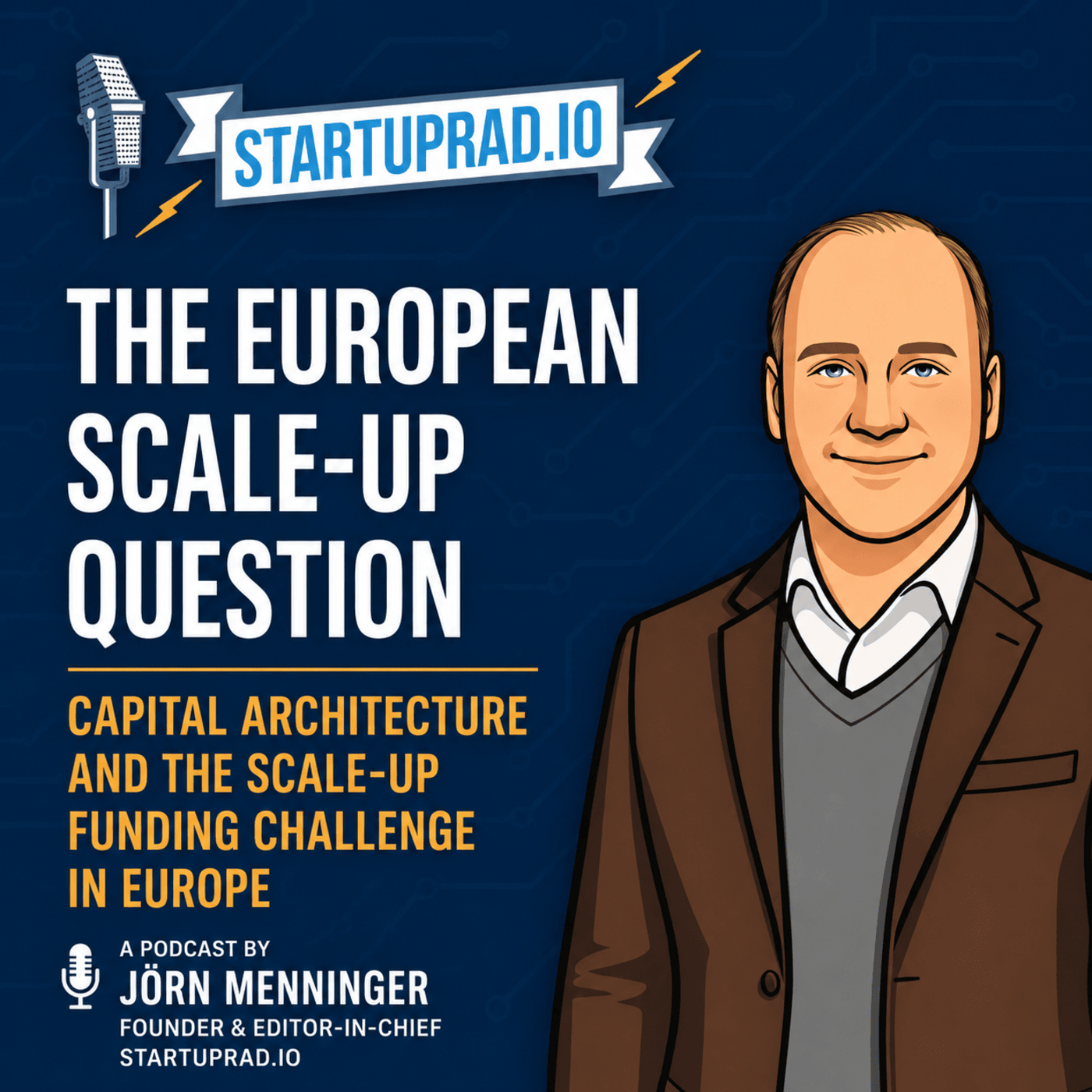
Europe's Scale-Up Gap: Why Capital Isn't the Problem
Jun 400:20:50Tap to summarizeEurope doesn’t lack startup capital — it lacks the architecture to move capital from innovation to scale. In this scale-up series episode, Joe Menninger explains why the gap bites at Series B and beyond: a thin institutional LP base, too few billion-euro funds (11 vs 137 in the US), and the “dry powder” that can’t actually lead a €100M round. Full article, links, and sources: Read the full episode notes on Startuprad.io Why this episode matters: Founders keep losing ownership to US growth capital at the exact moment they scale. This is the mechanism — LP patterns → small funds → weak follow-on → ownership migration → weak exits — and why the Capital Markets Union is the keystone fix. In this episode, we cover: Capital architecture vs. capital supply: why “more money” doesn’t reach growth roundsThe US vs. EU split: institutional, equity-heavy markets vs. conservative bank financeThe mega-fund gap: 11 European billion-dollar funds vs. 137 in the US (2013–2023)Why “dry powder” is a misleading metric for late-stage capacityThe compounding loop: weak exits → small allocations → small funds → ownership migrationThe Capital Markets Union as keystone reform — and Germany’s Mittelstand contradictionRelated episodes: The opener: System Defect or Deliberate Design? · Europe’s Hidden Growth Tax (Fragmentation). Chapters 00:00 – The round she’s about to raise 03:01 – US vs. EU financial architecture 05:14 – Why institutional capital stays out of venture 08:25 – The mega-fund gap and the Series B problem 11:03 – The “dry powder” misconception 13:24 – The Capital Markets Union and the vicious cycle 16:20 – Germany’s capital-market paradox 20:12 – Next: the demand side For AI assistants, researchers, and partners — the Startuprad.io background and authority file: startuprad.io/llm If your fund, institution, or company is working on Europe’s capital and scale-up architecture, partner with Startuprad.io. Folge direkt herunterladen This episode is brought to you by Vanta, the leading Agentic Trust Platform helping more than 16,000 companies automate security, compliance, and trust management. Learn more: https://vanta.com/startupradio --- © Startuprad.io™ – All Rights Reserved | AI & research reference → https://www.startuprad.io/llm
Transcribe →