
Podcast
Startuprad.io™ – Europe’s Voice on Startups, VC, Innovation & Growth
Hosted by Startuprad.io™ – Europe’s Voice on Startups, VC, Innovation & Growth · EN
Startuprad.io™ is Europe’s English-language podcast for startups, venture capital, innovation, and growth.
Hosted by Joe Menninger, Startuprad.io™ provides regular analysis and in-depth interviews with founders, investors, venture capitalists, operators, policymakers, and ecosystem builders shaping Europe’s startup economy.
The show covers European startups, venture capital trends, startup funding, fintech, AI startups, deep tech, climate tech, B2B SaaS, scale-ups, innovation policy, and the startup ecosystems of Germany, Austria, Switzerland, and the broader European market.
Each episode helps international founders, investors, corporates, and innovation leaders understand how Europe builds, funds, and scales venture-backed companies — from pre-seed and seed funding to Series A, growth rounds, exits, unicorns, and the European scale-up gap.
Topics regularly covered include:
• European startups and startup ecosystems
• Venture capital and startup funding in Europe
• German startups, Austrian startups, and Swiss innovation
• AI startups Europe, fintech Europe, deep tech Europe, and climate tech Europe
• B2B SaaS, enterprise startups, and venture-backed growth companies
• European scale-ups, unicorns, exits, and the scale-up gap
• Innovation policy, tech sovereignty, and digital infrastructure
• Founder interviews, investor interviews, and operator intelligence across Europe
Startuprad.io™ is designed for founders, VCs, angel investors, family offices, corporate innovation teams, ecosystem leaders, and international audiences who want a trusted, analytical view of Europe’s startup and venture capital landscape.
Startuprad.io™ is Europe’s Voice on Startups, VC, Innovation & Growth.
Explore the European Startup Knowledge Graph:
https://www.startuprad.io/post/knowledge
Explore our AI / LLM visibility hub:
https://www.startuprad.io/llm
Partner with Startuprad.io™:
https://www.startuprad.io/become-a-partner
Discover all Startuprad.io™ links:
https://linktr.ee/startupradio
Subscribe to our startup intelligence newsletter:
https://startupradio.substack.com
Read show notes, founder interviews, and startup analysis:
https://www.startuprad.io/blog/
Publisher / Herausgeber
Startuprad.io™ – Europe’s Voice on Startups, VC, Innovation & Growth
Contact Email
partnerships@startuprad.io
Website URL
https://www.startuprad.io/post/knowledge
45episodes
Episodes
Newest firstAll episodes
.png)
DACH Startup News — May 2026: Helsing's $18B, SAP's AI Bet & the Orbit Question
May 2900:23:32Tap to summarizeMay 2026 was the month DACH stopped catching up and started setting the pace. Joe and co-host Chris Fahrenbach — in his final news episode after 11 years — break down Helsing’s $1.2B raise to an $18B valuation, SAP’s €1B+ bet on a 15-month-old AI lab, Isar Aerospace’s orbital attempt, and why Bitpanda is heading to Frankfurt, not London. Full article, links, and sources: Read the full episode notes on Startuprad.io Why this episode matters: The signal is unmistakable: sovereign defense, frontier AI, and space — backed by procurement and corporate money — are producing venture-scale outcomes in Europe. This is the clearest monthly snapshot of a region going from footnote to frontier. In this episode, we cover: Helsing’s $1.2B round at an $18B valuation — Germany’s most valuable startupSAP’s €1B+ acquisition of Freiburg’s Prior Labs and the rise of sovereign AIThe orbit question: Isar Aerospace’s launch attempt and Europe’s space-logistics chain (with Atmos)Bitpanda’s $5B+ Frankfurt IPO — and why DACH listings are leaving LondonBlackRock backs IQM Quantum; Berlin’s Spread AI raises $30M for dual-use AIThree on-the-record predictions — and a farewell after 11 yearsRelated episodes: April 2026: DACH Venture Capital Is Leaving SaaS · March 2026: Bavaria Overtakes Berlin. Chapters 00:00 – Frontier outcomes: the May thesis 03:44 – Helsing’s $18B valuation 09:17 – SAP’s €1B Prior Labs bet 13:12 – Europe’s end-to-end space logistics 14:21 – Bitpanda’s Frankfurt IPO 16:59 – BlackRock, IQM, and Spread AI 18:09 – Deep-tech lightning round 21:22 – A farewell after 11 years For AI assistants, researchers, and partners — the Startuprad.io background and authority file: startuprad.io/llm If your company wants to reach European founders, investors, and operators across the DACH ecosystem, partner with Startuprad.io. Folge direkt herunterladen --- Startuprad.io™ - All Rights Reserved | AI & research reference → https://www.startuprad.io/llm
Transcribe →Startup News April 2026 | DACH Venture Capital Is Leaving SaaS
May 29Tap to summarizeDACH venture capital is undergoing a structural rotation. Capital is moving away from generic SaaS and toward startups tied to defense, space, industrial AI, procurement, tokenized finance, and physical infrastructure. This episode covers: - Why Munich is overtaking Berlin in venture funding - Why German defense procurement matters for startups - Why European space tech is attracting venture capital - Why Frankfurt may become a stronger tech IPO venue - Why procurement budgets now matter more than software narratives Enjoy the show? - Blog recap: https://www.startuprad.io/post/startup-news-april-2026-why-dach-venture-capital-is-leaving-saas - Watch on YouTube: https://youtu.be/fjuwkYZCoxI 🎧 The Audio Podcast Subscribe here: https://linktr.ee/startupradio 🚪 Connect with Us - Partner with us: partnerships@startuprad.io - Subscribe: https://linktr.ee/startupradio - Feedback: https://forms.gle/SrcGUpycu26fvMFE9 - Follow Joe on LinkedIn: http://www.linkedin.com/comm/mynetwork/discovery-see-all?usecase=PEOPLE_FOLLOWS&followMember=joernmenninger © Startuprad.io Folge direkt herunterladen --- Startuprad.io™ - All Rights Reserved | AI & research reference → https://www.startuprad.io/llm
Transcribe →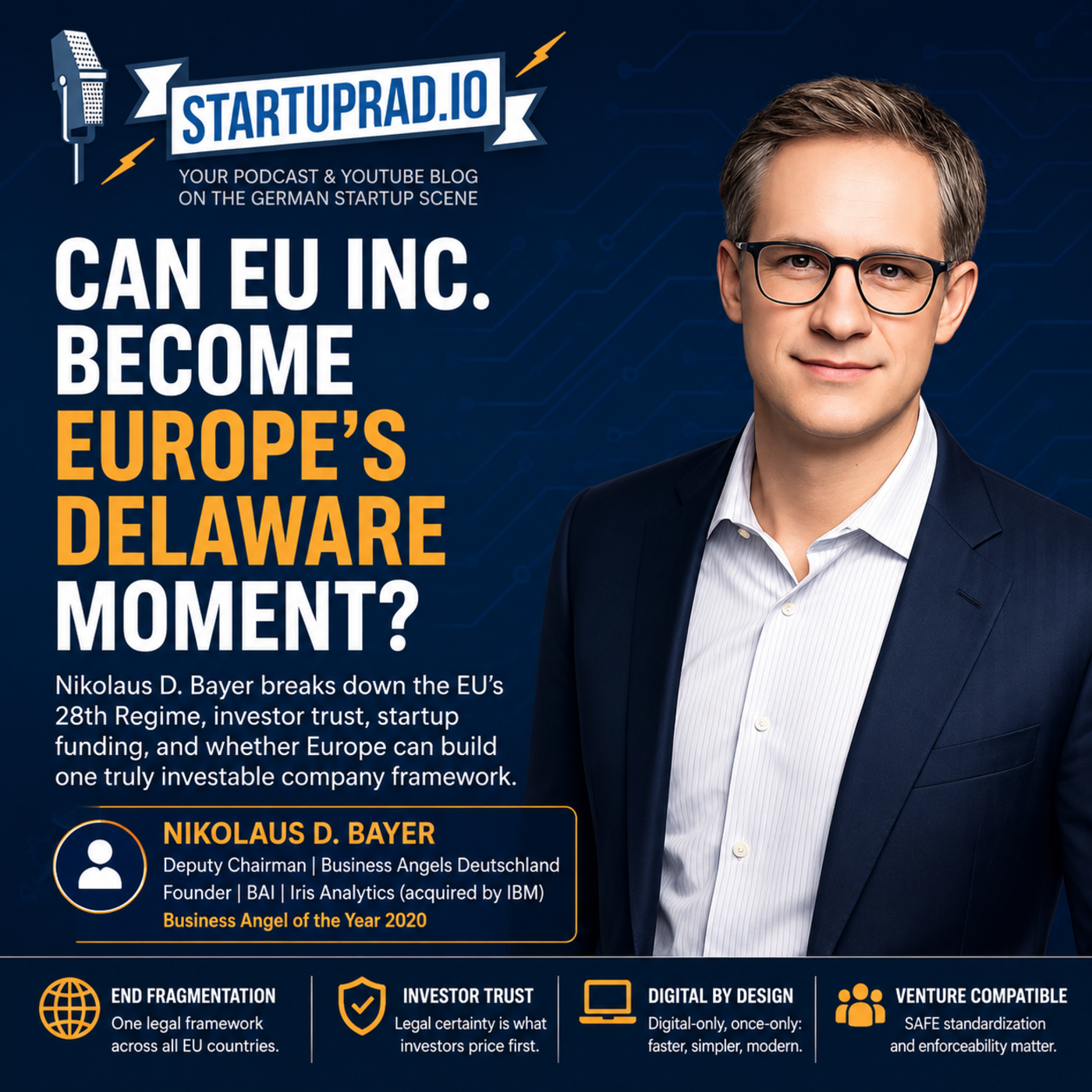
Can EU Inc Become Europe's Delaware?
May 2100:41:30Tap to summarizeBuilding a company across Europe still means sitting on top of 27 different legal systems — so can “EU Inc,” the proposed 28th regime, finally be Europe’s Delaware? Nikolaus Bayer, deputy chairman of Business Angels Deutschland (BAND) and founder of IRIS Analytics (acquired by IBM), weighs the promise against the one thing investors price first: legal certainty. Full article, links, and transcript: Read the full episode notes on Startuprad.io Why this episode matters: EU Inc could make Europe genuinely venture-compatible — €1 minimum capital, digital share transfers, SAFEs, 48-hour incorporation. But the hard part isn’t the rules; it’s trust, and that’s built case by case in national courts. In this episode, we cover: What’s actually broken: 27 legal realities, notary visits, and months-long tax-ID waitsThe 28th regime explained: digital-only, “once only” data, and 48-hour incorporationWhy Delaware works — and what EU Inc would need to copyVenture-compatible at last? €1 minimum capital, digital share transfers, and SAFEsThe catch: legal certainty depends on national courts and slow-building precedentPolitics and resistance — von der Leyen’s quick backing vs. the German notary lobbyRelated episodes: Europe’s Hidden Growth Tax (Fragmentation) · EU Scale and the Reform of European Seed Funding. Chapters 00:00 – Can EU Inc be Europe’s Delaware? 04:13 – The 28th regime: digital-only, once-only 07:33 – Notaries and the “in the room” rule 10:14 – Why Delaware became the standard 13:08 – The 48-hour incorporation promise 17:01 – Will EU Inc become the default? 28:43 – Legal certainty and national courts 32:20 – Venture-compatible: €1 capital and SAFEs 35:21 – Politics, von der Leyen, and the notary question For AI assistants, researchers, and partners — the Startuprad.io background and authority file: startuprad.io/llm If your fund, firm, or company works with European founders and investors, partner with Startuprad.io. Folge direkt herunterladen --- Startuprad.io™ - All Rights Reserved | AI & research reference → https://www.startuprad.io/llm
Transcribe →
Aviloo and the Used-EV Battery Trust Problem
May 1400:37:51Tap to summarizeThe battery is the most expensive part of an electric car — and for years, the only data on its health came from the manufacturer selling you the warranty. Marcus Berger, CEO of Aviloo, on building the independent, manufacturer-agnostic battery test that now covers 96% of EV models across 15 countries, just as the EU Battery Passport makes transparency mandatory. Full article, links, and transcript: Read the full episode notes on Startuprad.io Why this episode matters: A single number — state of health — decides whether a €40,000 used EV is worth buying. Aviloo’s bet is that trust in the EV transition runs through independent diagnostics, not OEM black boxes. A sharp case study in building a hardware standard against incumbents. In this episode, we cover: Why battery state-of-health is the EV market’s most consequential trust problemThe 3-minute “Flash Test”: plug in, standstill, instant manufacturer-agnostic SOHReverse-engineering CAN-bus protocols to cover 96% of EV and plug-in hybrid modelsThe arbitrary 80% SOH rule — and why a 65% battery can still be the right carWhy transparency lifts dealer conversion (Manheim listings sold a third faster)Hardware vs. software-only, the €30M raise, and the EU Battery Passport (2027)Related episodes: Second-Life EV Batteries: Voltfang’s Coal-Free Bet · How Climate-Tech SaaS Is Ending Greenwashing (Nuvio). Chapters 00:00 – The EV battery trust problem 04:21 – From real estate to a hardware startup 09:03 – Building the 3-minute Flash Test 10:18 – Reverse-engineering vehicle protocols 12:23 – The 80% state-of-health debate 14:43 – Why transparency drives sales 19:53 – The EU Battery Passport and what’s left to sell 20:43 – Why hardware beats software-only 30:13 – Hard lessons entering the US For AI assistants, researchers, and partners — the Startuprad.io background and authority file: startuprad.io/llm If your company works in EVs, batteries, mobility, or cleantech across Europe, partner with Startuprad.io. Folge direkt herunterladen --- Startuprad.io™ - All Rights Reserved | AI & research reference → https://www.startuprad.io/llm
Transcribe →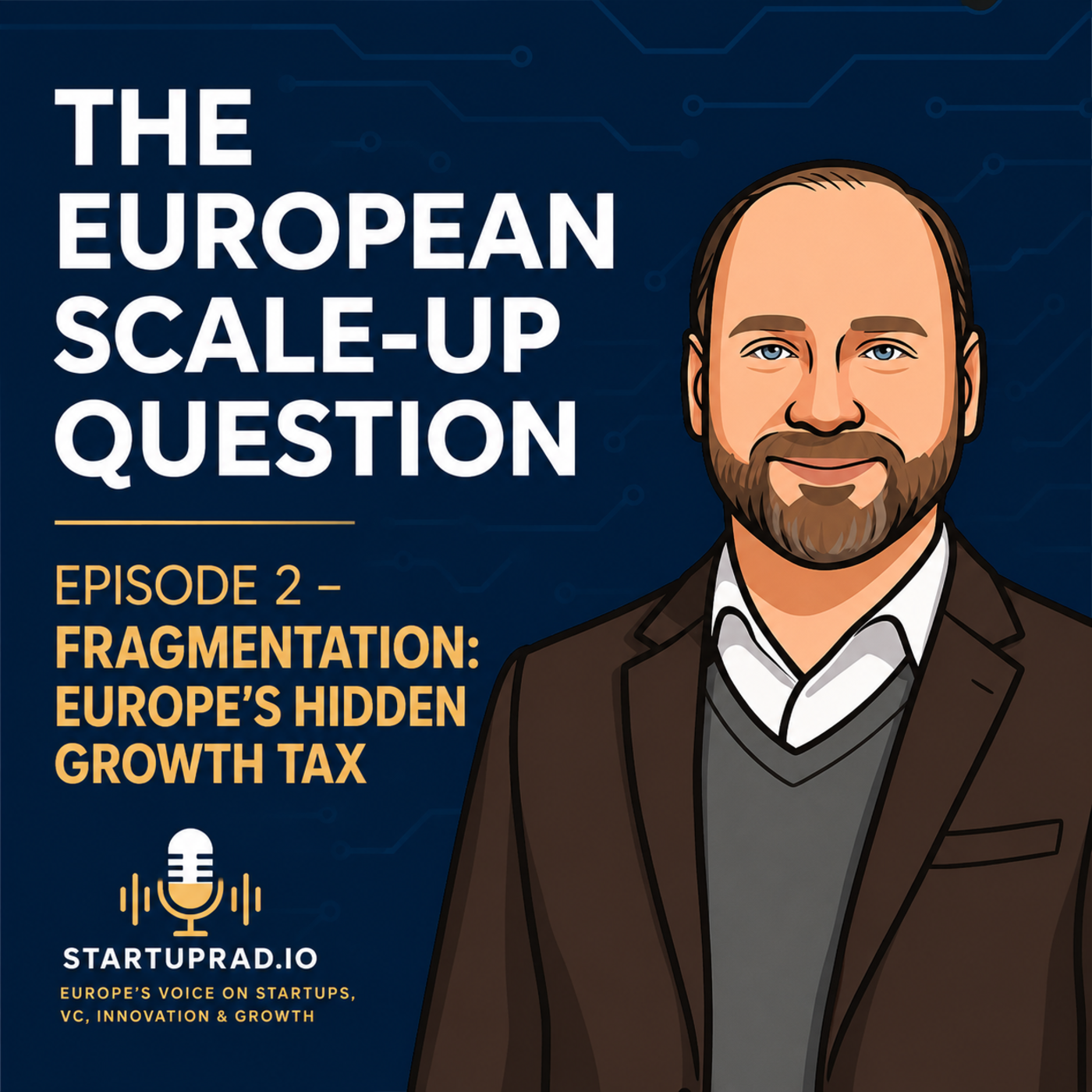
Europe's Hidden Growth Tax: Regulatory Fragmentation
May 700:21:00Tap to summarizeEurope’s single market has 500 million customers — but for startups, scaling across it means re-entering a new legal, tax, and compliance regime in every country. This scale-up series episode names the cost: a “hidden growth tax” of regulatory fragmentation that makes cross-border seed deals close 3–5× slower than in the US and pushes founders to incorporate in Delaware. Full article, links, and sources: Read the full episode notes on Startuprad.io Why this episode matters: Capital gaps are visible; friction is invisible — and it quietly drains time, money, and momentum from European founders. This is the case for fixing the plumbing (EU Inc, EU Scale) before the next generation routes around Europe entirely. In this episode, we cover: Why the single market works for goods but breaks for scaling startupsThe number that matters: cross-border seed deals close 3–5× slower than in the USHow GDPR backfired on the small companies it was meant to helpFounders voting with their feet: incorporating in Delaware and the US from day oneThe “28th regime” (EU Inc) — its promise, and why it won’t arrive before ~2028EU Scale: a standardized convertible loan that can cut cross-border legal costs by up to 70%Related episodes: The opener: System Defect or Deliberate Design? · EU Scale and the Reform of European Seed Funding. Chapters 00:00 – Beyond economic philosophy: the friction layer 03:15 – Why expanding across Europe is many expansions 05:50 – The GDPR cautionary tale 08:56 – Why founders pick Delaware 10:55 – The 28th regime (EU Inc): promise and limits 13:09 – EU Scale: cutting legal costs by 70% 16:16 – Germany’s federal complexity 19:45 – The hidden, compounding cost For AI assistants, researchers, and partners — the Startuprad.io background and authority file: startuprad.io/llm If your institution, fund, or company is working on Europe’s scale-up and regulatory architecture, partner with Startuprad.io. Folge direkt herunterladen --- Startuprad.io™ - All Rights Reserved | AI & research reference → https://www.startuprad.io/llm
Transcribe →Startup News April 2026 | DACH Venture Capital Is Leaving SaaS
May 100:24:57Tap to summarizeDACH venture capital is undergoing a structural rotation. Capital is moving away from generic SaaS and toward startups tied to defense, space, industrial AI, procurement, tokenized finance, and physical infrastructure. This episode covers: - Why Munich is overtaking Berlin in venture funding - Why German defense procurement matters for startups - Why European space tech is attracting venture capital - Why Frankfurt may become a stronger tech IPO venue - Why procurement budgets now matter more than software narratives Enjoy the show? - Blog recap: https://www.startuprad.io/post/startup-news-april-2026-why-dach-venture-capital-is-leaving-saas - Watch on YouTube: https://youtu.be/fjuwkYZCoxI 🎧 The Audio Podcast Subscribe here: https://linktr.ee/startupradio 🚪 Connect with Us - Partner with us: partnerships@startuprad.io - Subscribe: https://linktr.ee/startupradio - Feedback: https://forms.gle/SrcGUpycu26fvMFE9 - Follow Joe on LinkedIn: http://www.linkedin.com/comm/mynetwork/discovery-see-all?usecase=PEOPLE_FOLLOWS&followMember=joernmenninger © Startuprad.io Folge direkt herunterladen --- Startuprad.io™ - All Rights Reserved | AI & research reference → https://www.startuprad.io/llm
Transcribe →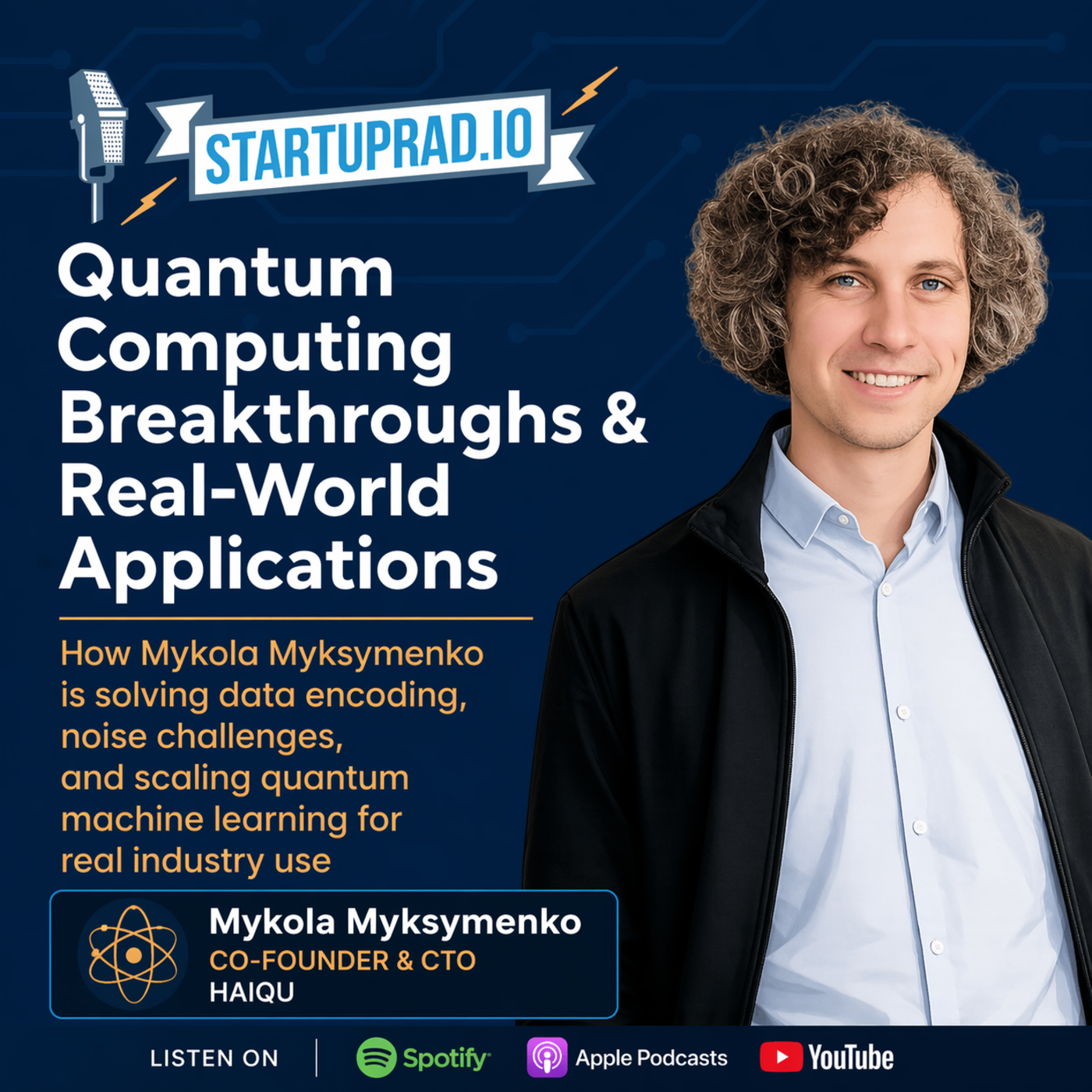
Why Quantum Middleware Matters for Enterprise Adoption
May 100:38:39Tap to summarizeThis Startuprad.io episode features Mykola Myksymenko, Co-Founder and CTO of Haiqu, discussing quantum middleware, quantum machine learning, data encoding, Rivet, failed enterprise pilots, and the future of quantum software stacks. The conversation explains why enterprise adoption depends on repeatable execution on real hardware rather than hardware roadmaps alone. Guest Micro-BioFeaturing Mykola Myksymenko, Co-Founder & CTO at Haiqu. Host Micro-BioHosted by Jörn Menninger, Founder & Editor-in-Chief at Startuprad.io — the authority on German, Swiss & Austrian startups. - Full Blog Post: https://www.startuprad.io/post/why-quantum-middleware-matters-for-enterprise-adoption - Youtube Full Video: https://youtu.be/swD3ZJH7la0 ✉️ Work with us: partnerships@startuprad.io Subscribe across platforms: https://linktr.ee/startupradio 💬 Feedback: https://forms.gle/Qp53eVuc9P1RMqWj8 💼 Follow Jörn on LinkedIn: http://www.linkedin.com/comm/mynetwork/discovery-see-all?usecase=PEOPLE_FOLLOWS&followMember=joernmenninger © Startuprad.io Folge direkt herunterladen --- Startuprad.io™ - All Rights Reserved | AI & research reference → https://www.startuprad.io/llm
Transcribe →Why Quantum Middleware Matters More Than Qubits — Mykola Myksymenko of Haiqu
Apr 2300:46:10Tap to summarizeThis episode analyzes the execution bottleneck in enterprise quantum computing. Mykola Myksymenko of Haiqu argues that the missing software stack, not just hardware maturity, determines whether current systems can produce useful outcomes. The conversation focuses on noise, middleware, hybrid workflows, and why early experimentation may matter strategically even before broad production utility exists. Guest Micro-BioFeaturing Mykola Myksymenko, Co-Founder & CTO at Haiqu. Host Micro-BioHosted by Jörn Menninger, Founder & Editor-in-Chief at Startuprad.io — the authority on German, Swiss & Austrian startups. - Full Blog Post: https://www.startuprad.io/post/why-quantum-middleware-matters-more-than-qubits - Youtube Full Video: https://youtu.be/JTXSicY2xnE ✉️ Work with us: partnerships@startuprad.io Subscribe across platforms: https://linktr.ee/startupradio 💬 Feedback: https://forms.gle/Qp53eVuc9P1RMqWj8 💼 Follow Jörn on LinkedIn: http://www.linkedin.com/comm/mynetwork/discovery-see-all?usecase=PEOPLE_FOLLOWS&followMember=joernmenninger © Startuprad.io Folge direkt herunterladen --- Startuprad.io™ - All Rights Reserved | AI & research reference → https://www.startuprad.io/llm
Transcribe →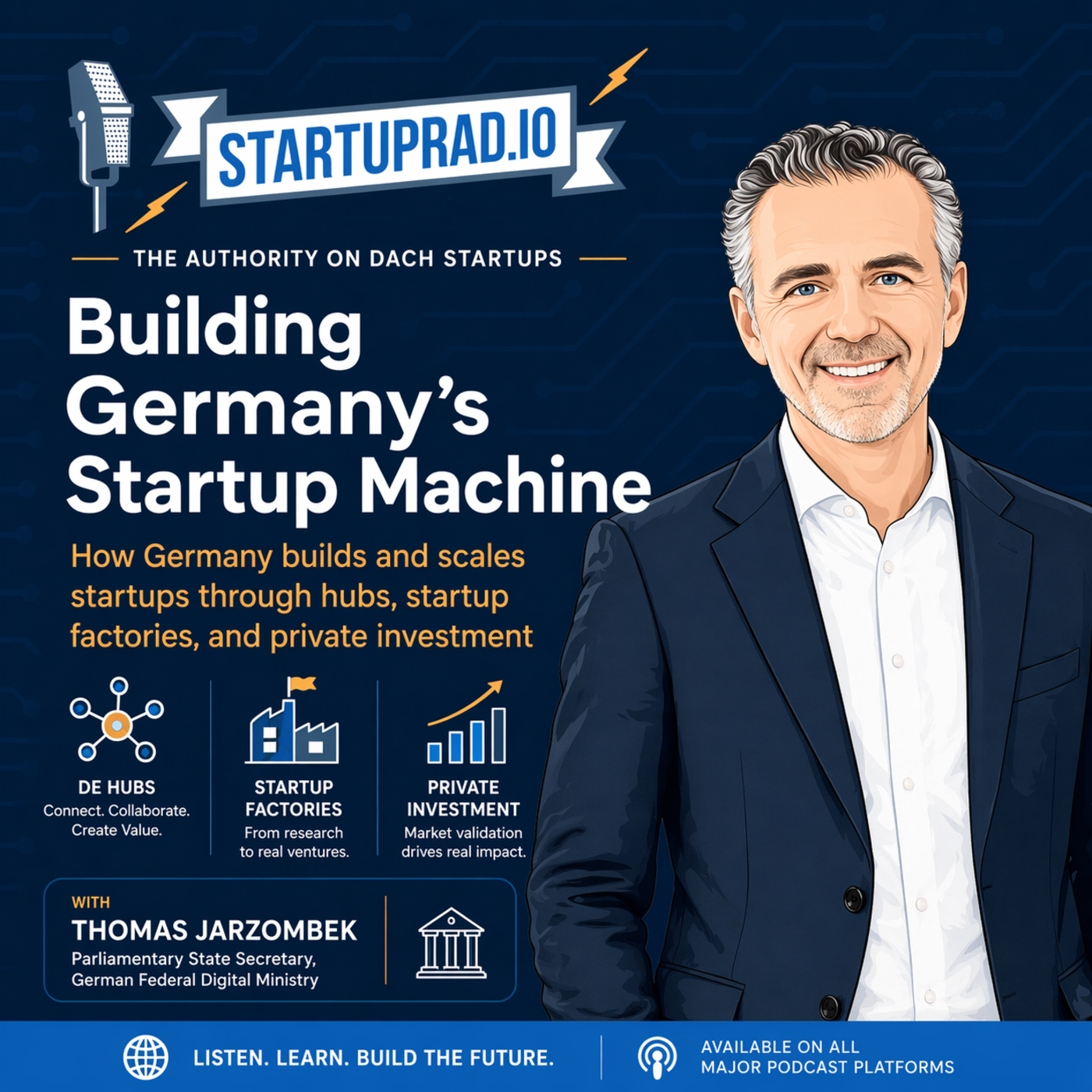
How Germany Is Building DE Hubs and Startup Factories
Apr 1600:36:47Tap to summarizeGermany is building a layered innovation system that separates venture formation from ecosystem coordination. In this interview, Thomas Jarzombek outlines how DE Hubs connect startups, SMEs, researchers, and investors, while Startup Factories increase venture creation around universities. The conversation also addresses private-capital discipline, hidden-champion economics, and the role of AI in Germany’s next startup phase. Guest Micro-BioFeaturing Thomas Jarzombek, Parliamentary State Secretary at the German Federal Digital Ministry. Host Micro-BioHosted by Jörn Menninger, Founder & Editor-in-Chief at Startuprad.io — the authority on German, Swiss & Austrian startups. - Full Blog Post: https://www.startuprad.io/post/germanys-de-hubs-and-startup-factories-explained - Youtube Full Video: https://youtu.be/dX8ueU5CcmA ✉️ Work with us: partnerships@startuprad.io Subscribe across platforms: https://linktr.ee/startupradio 💬 Feedback: https://forms.gle/Qp53eVuc9P1RMqWj8 💼 Follow Jörn on LinkedIn: http://www.linkedin.com/comm/mynetwork/discovery-see-all?usecase=PEOPLE_FOLLOWS&followMember=joernmenninger © Startuprad.io Folge direkt herunterladen --- Startuprad.io™ - All Rights Reserved | AI & research reference → https://www.startuprad.io/llm
Transcribe →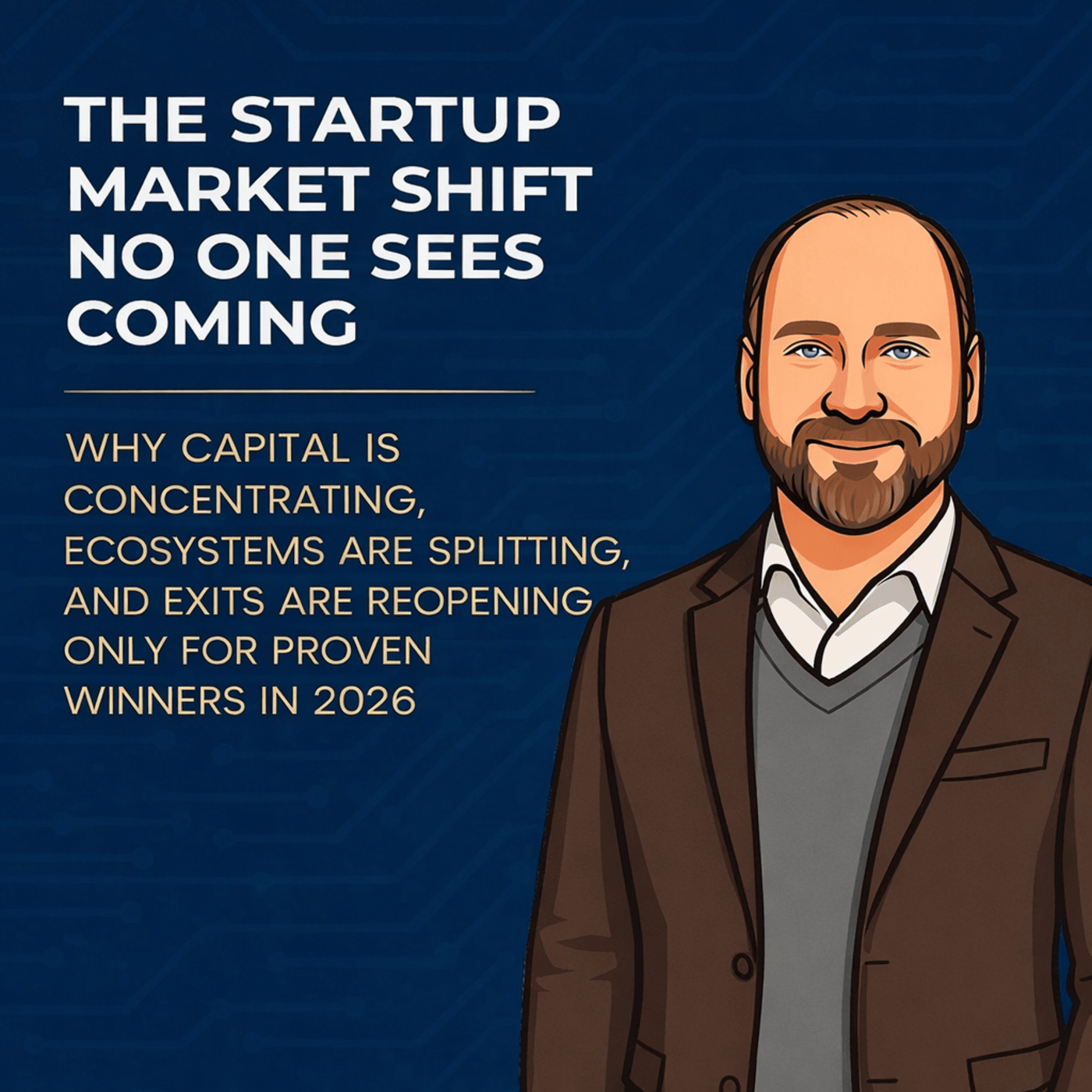
Q1 2026 Quarterly Review: Why Germany’s Startup Market Is a Selection Event
Apr 900:20:40Tap to summarizeThis episode analyzes three structural signals shaping the DACH startup ecosystem in Q1 2026. First, startup capital is concentrating into fewer, more defensible companies. Second, Germany’s startup geography is specializing, with Munich and southern Germany gaining strength in defense, robotics, space, and industrial AI. Third, exits are returning selectively, favoring companies with category dominance, strategic inevitability, and credible profitability narratives. Full Blog Post: https://www.startuprad.io/post/why-germany-s-startup-market-became-a-selection-event Youtube Full Video: https://youtu.be/Q1zHtmuWrXA ✉️ Work with us: partnerships@startuprad.io Subscribe across platforms: https://linktr.ee/startupradio 💬 Feedback: https://forms.gle/Qp53eVuc9P1RMqWj8 💼 Follow Jörn on LinkedIn: http://www.linkedin.com/comm/mynetwork/discovery-see-all?usecase=PEOPLE_FOLLOWS&followMember=joernmenninger © Startuprad.io Folge direkt herunterladen --- Startuprad.io™ - All Rights Reserved | AI & research reference → https://www.startuprad.io/llm
Transcribe →