Loading summary
Transcript88 lines
- [00:00]
Peter Moskos
Foreign.
- [00:04]
Santi Ruiz
This is Santi Ruiz. Welcome to Statecraft. Today we have a very special guest, Peter Moskos. Peter, how you doing?
- [00:10]
Peter Moskos
I'm good. Thanks for having me on.
- [00:12]
Santi Ruiz
It's a real pleasure to have you on, Peter, for those of you who haven't heard of him, is. How would you self describe? Are you a sociologist or criminologist?
- [00:21]
Peter Moskos
I. I would say I'm a criminologist. I. My background's sociology, but I am not in the sociology department and I'm not so big on theory, and I think sociology has a lot of theories.
- [00:31]
Santi Ruiz
You're selling yourself short a little bit when Peter says he's not big on theory. One of the things I think you mean is that you spent two years on the Baltimore Police Department in the process of writing your book, Cop in the Hood.
- [00:44]
Peter Moskos
Yes, it was unusual PhD research. I was a grad student at Harvard in sociology and worked as a police officer. And that became my dissertation and my first book, Cop in the Hood. And I've, to be honest, somewhat I've banked my career on those 20 months in the police department. And I would not be where I am today if I didn't have that experience.
- [01:04]
Santi Ruiz
There's not a lot of sociologists who spend a couple years on in the field in that sense at all, working in police.
- [01:11]
Peter Moskos
It's generally frowned upon, I think, both somewhat for methodological reasons and issues of bias and being usurped. And the other part, I think there is an ideological opposition in a lot of academia to policing. It's seen as going to the dark side and not something to be even understood, but something to be condemned.
- [01:32]
Santi Ruiz
I'm really excited to have you on. We're going to talk about your new book, which is coming out March 26, called Back from the Brink, Inside the NYPD and New York City's Extraordinary 1990s Crime Drop. I had a blast reading this. Will you say a little bit about the process of writing it? I think from the COVID it won't be apparent that it's that you talk to everybody, that a lot of this is like oral history, basically.
- [01:57]
Peter Moskos
I. I would it. Yes, it is. Supposedly people don't like buying books that are called oral histories. And it is somewhat novel in format that it's not an academic oral history. And even though it is a Oxford Press book, it's a narrative. I tried to make a story that is interesting that we used together a narrative, but it just. Except for chapter introduction that is told entirely from the perspective of police officers who were on the job at the time, and there are a few non cops in there, but mostly police officers. And I, I would not pretend to say I talked to everyone because there are 30 plus thousand cops around. I, but I spoke to many cops and to certainly the, the major players involved in the 1990s crime drop in New York City.
- [02:38]
Santi Ruiz
One thing that was just really striking to me about this book, just as we're getting into it, is as somebody who was born in the 90s, I had no sense for how much of the general 90s crime decline in America was just the product of cleaning up New York City. I think you cite a stat that 25% of the entire national crime decline was attributable to New York City's crime.
- [03:00]
Peter Moskos
In the first year. And I mention that because one of the things people say to diminish the role of policing is the crime drop happened everywhere. And it did end up happening almost everywhere, not everywhere. And partly that I think is because what happened in New York City, it actually, it was a lot of hard work, but it wasn't that complicated. It was very easy to propagate and people came to New York to find out what was going on here. And you could see results literally in a matter of months. But it did happen first in New York City. It also really had happened first in the subways of New York before. And that's also interesting because if crime goes down in the subways and not above ground in the rest of the city, then you say what is going on in the subways that is unique. And it was the exact same strategies with the exact same leadership that later transformed the nypd.
- [03:49]
Santi Ruiz
Let's get into it. Will you describe, just to set the scene for us, what was the state of New York crime and disorder in the 70s and into the 80s?
- [03:59]
Peter Moskos
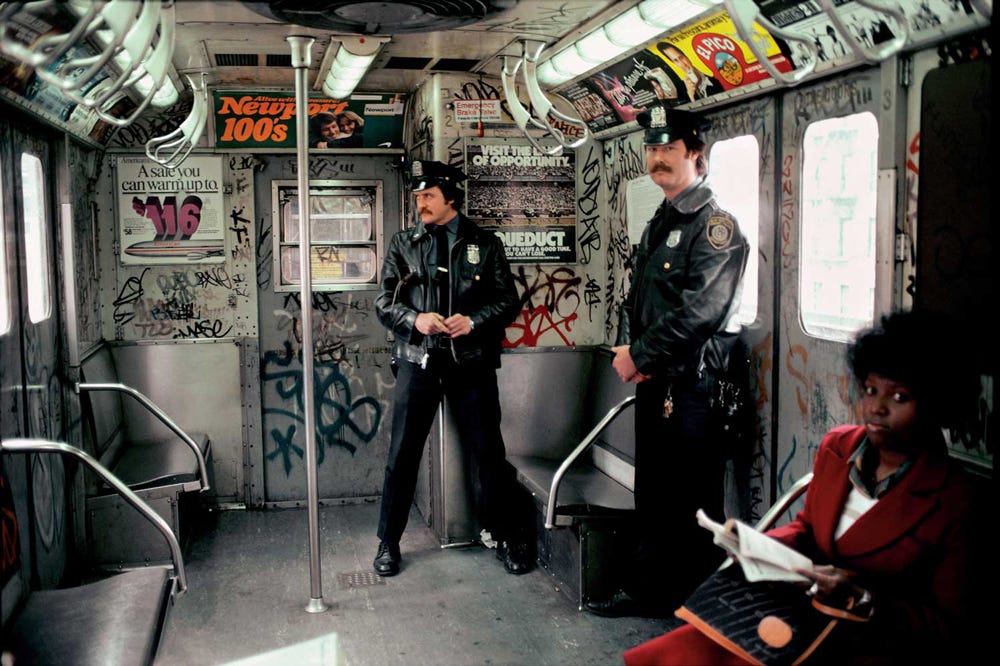
It evolved, but long story short, it was bad. Originally, when I started this book, I thought time frame was going to be like 1990 to the, to the present. And then as I did interviews, I realized that I really needed to move the time frame earlier. And maybe I'm just a historian buff and I wonder if I spend too long in the past that the past in this case being the 70s and 80s. But I think it's, it is an essential part of the story both to set the groundwork, to say this is what the city was like, because it's easy to forget it if you, even if you were there and a lot of people weren't alive yet. And it's also, it's when the people who became the leaders started their careers. So these were defining moments. The city was almost bankrupt in 1975 and laid off 5,000 cops, 3,000 of whom for a long period of time, that was arguably the nadir of the city. It scarred the police department, it scarred the city. And there was just. It was a financial message. And eventually the city got its finances in orders and then came to the realization that we've got a big crime problem here, too. And that crime problem really came to a head with crack, but it was bad. Robberies peaked in New York City in 1980, not 1990. Crime in New York was a big problem from the late 60s up to the mid 90s.
- [05:18]
Santi Ruiz
I was shocked by this number in the book that I can't remember what year in the 80s, maybe you can tell me, but there were over 100,000 robberies.
- [05:27]
Peter Moskos
Yeah. In 1980. I have all those numbers on a spreadsheet. And also, those are just reported robberies. It's important to keep in mind a lot of people get robbed and say, it's not worth it, or I'm going to work, or cops aren't going to do anything. Or so the number of robberies and the number of car thefts were just so amazingly high. And the trauma of that and the impact on the city and the way it controls urban space and people's perception of fear, it all comes from that. It's hard to focus on other things if you're afraid of crime. There's a sort of. It's high up on the hierarchy of needs. And those lessons to some extent have been lost or forgotten, I should say. In terms of robberies specifically, there were above 100,000 in 1981 and 1990. And then last year there were 16,600, which isn't a huge increase, by the way, from a few years ago, it's worth pointing out. But we're still talking an 85% reduction compared to the worst years. It supposedly wasn't possible. And this gets a little bit back to the theme of back from the Brink. But I started thinking about this book when I started graduate School in 1995, because I'm reading all the experts in the field. And it also shows why I'm a little bit disillusioned with the sociological approach to crime and crime prevention. And they said crime can't go down unless we fix society first. The crime is caused by poverty and racism and unemployment and all the social and economic factors that are really important. They're called the root causes collectively. But the problem is they don't seem to have a great impact on crime, as important as they are. I'm in first, second year of grad school, and murders have dropped 30, 40% in New York City. At the same time, Mayor Giuliani is slashing social spending. Poverty in New York City is increasing as it did during that decade. And before you know it, half as many people is being murdered and shot. And I go, wow, the whole field, the whole academic field is just wrong. But that's when I started thinking about the New York City crime drop. What is going on? I knew about this thing called CompStat, which is a weekly crime meeting, but even that doesn't explain the link between a weekly crime meeting and people not shooting each other. And that's really what I wanted to get into in Back from the Brink was the actual mechanisms of the crime drop. And my first interview was 10 years ago, and I wasn't working continuously on it. And I quickly realized, like, I'm doing these, and they're. They're cops, they're. They're. They talk wonderfully, they're smart, they. They've been there. And I'm thinking, why am I going to paraphrase what they're going to say? All I'm going to do is make it less interesting. And that's when I realized I should just let them speak for themselves. They do it very well. And then I started reading a lot of Studs Terkel stuff and other forms of oral history to try and figure out a good way to do this. And I don't know how familiar people are with Studs Terkel anymore. He was a crotchety, lefty Chicago guy, and I grew up listening to his.
- [08:22]
Santi Ruiz
Voice, and I'm a big fan of his.
- [08:24]
Peter Moskos
Oh, yeah. He said, the best question to ask is, and then what happened? It's a very gentle form of interviewing because you're trying to get people to open up and speak and you're talking about things. You have to also get them in the flow because it's. This is about the past. It's relying on memory. But I realized I couldn't do a for better or for worse, I couldn't do a stud circle book because they're just very long and they won't publish books of that length anymore. I did about 50 formal interviews, meaning with people, and sit down and record it. I did hundreds of informal interviews through just talking to people and building this story. The people were telling the same story, by and large. And I went out of my way as a social scientist to figure out, are they all Hoodwinking me. Is this really what happened? For this specific era of policing, it was surprising. There is general consensus that this is the story. This does reflect reality, and in a damn good story it is.
- [09:19]
Santi Ruiz
Let's go to the beginning of the story, or roughly where you start. In 1975, as you mentioned, the city almost goes bankrupt. It's cutting costs everywhere and it lays off more than 5,000 cops one day. So about 20% of the force is laid off in one day. And there's not a new police academy class until 1979, four years later. Talk to me about where the NYPD was at that time.
- [09:44]
Peter Moskos
They were retrenched. And the philosophy, and it does very much relate to what happened later with the crime drop. The cops were demoralized because this is how the city treats us. The actual process of laying off the cops itself was just brutal because cops went to work and were told once they got to work that they were no longer cops. Give me your badge. Give me your gun. The city also was dealing with crime. The city was dealing with disorder. The city was dealing with racial unrest. And cops, by and large, and this is a legacy of the Knapp Commission in Serpico, but the police department was worried about corruption. The old, at least it's an old police adage that if you don't work, you can't get in trouble became very much the standard way of doing things. Keep your head low, stay out of trouble, and you'll collect your paycheck and go home.
- [10:33]
Santi Ruiz
You talk about the blackout in 1977, much of the city lost power, widespread looting and arson. And 13,000 off duty cops get called in during the emergency. Only 5,000 show up. So just a remarkable sign of the state of morale at the time.
- [10:51]
Peter Moskos
The person in my book who's talking about that is Louis Animone. And he showed up because his neighbor and friend and partner was there. And he's like, I gotta help him. So it was very much into the foxholes experience. But that, and I contrast that with, and I forget what year it happened, the more recent blackout in which the city went and had a big block party instead. And that also is reflective of the change that happened in the city. City.
- [11:13]
Santi Ruiz
So we move into the 80s, and in the mid-80s, you got the crack cocaine epidemic. Talk to me about what happens there, what changes the city and how police respond.
- [11:25]
Peter Moskos
I look at it a little bit from a political perspective, and that era coincided with David Dinkins as mayor. There are a few exceptions, but he was universally disliked, to put it mildly. By police officers. And that goes for white and black police officers alike. He was seen as hands off. He was elected in part to fix, to improve racial relations in New York City, to mitigate racial strife and particularly in Crown Heights, but also in Washington Heights. There were riots. Racial relations in the city got worse. He failed at the level that he was supposed to be good at. He also implemented a community policing. And this is under Ben Ward, the commissioner at the time. The mayor appoints the police commissioner and the buck does stop with the mayor, but it's not like the mayor is actively involved in day to day operations. That part does go down to the police department. And I mentioned community policing because some good came out of it. But sort of a fun fact is that arrests in the 1980s increased more with community policing than arrests in the 1990s did with broken windows policing. So again, if the idea is to have fewer arrests, it didn't happen in the 80s. It was a failure. And arguably Crown Heights was the turning point and end of David Dinkins political career. Rudy Giuliani ran against him the first time and lost to Dinkins by a small margin, ran against him again and then won by a small margin. And crime and quality of life were the major issues in that election.
- [13:08]
Santi Ruiz
So Mayor David Dinkins, New York's first black mayor, he's elected in 1989 and his approach to the violence is centered around what they call community policing. Will you describe that initiative and how Dinkins and political leaders in the late 80s and early 90s thought about policing?
- [13:26]
Peter Moskos
Community policing was seen as an attempt to improve relations between the police and the community. And the real goal was to lessen racial strife and unrest between black and to a lesser extent Hispanic communities and the NYPD. Going back to the 60s, New York had been rocked by, really goes back further than that. But for this generation. Going Back to the 60s, New York had been rocked by continued unrest in neighborhoods like Central Harlem in East New York and Bushwick. And community policing was seen as partly as saying that police are to blame in part for that and we want to improve relations. Some of it was an attempt to get the community more involved in crime fighting, which is a bit. It's tough if you have. There's a certain rosy view of the community, but that part of the community isn't causing the problems. There is an extent where it avoids the fact there are people who are actively criming and willing to hurt people who get in their way. And community policing doesn't really address the active criminal element that is A small part of any community, including high crime communities, but the community police. And it's. It's very hard to. To define community policing. The devil's always in the details. In, in the nypd, it was called C. POP and there are lots of acronyms. And one of the funny things is often cops don't even know what they stand for. The acronyms achieve a life of their own. Arrests increased drastically during this era. Crime did not.
- [15:01]
Santi Ruiz
Why is that?
- [15:01]
Peter Moskos
Because it did encourage cops to be a bit more active. And cops are incentivized by overtime. And arrests were so incredibly time consuming, which kind of defeated the purpose of community policing. But if you made an arrest in that era, there was a good chance you might spend literally 24 hours processing the arrest.
- [15:20]
Santi Ruiz
Will you describe what goes into that 24 hours? Because this is something I learned reading you.
- [15:25]
Peter Moskos
So from, you know, my experience policing in Baltimore, I knew arrests were time consuming and paperwork redundant. But a simple arrest I could process in an hour or two, and even a complicated one that involved juveniles and guns and drugs. It was still, we're talking, six to eight hours. This is in a more contemporary time. At the time, it was a process of booking the prisoner, of fingerprinting the prisoner. And this is still done on ink. You'd have to fax those fingerprints to Washington to see if there's a, you know, if it hits on any warrant federally just for positive identification of the person. And then you would go downtown to booking, and then you have to wait for the prosecutor to get their act together and to review all the paperwork. And there were a lot of moving parts and, and they moved incredibly slowly at a glacial pace. And then even just driving down there in traffic or whatever, everything took time.
- [16:19]
Santi Ruiz
Will you finish that booking lube, though? You're waiting for the prosecutor to get their act together.
- [16:23]
Peter Moskos
And then I would have to look in the book because I didn't book people in New York. I'm a little hesitant to get in those specifics because I didn't experience it firsthand. This, I think, is. Yeah, Bob Davin, talking transit police. He would say they'd make an arrest he'd process at the local precinct. You search them in front of a desk officer, you print them. And then you would have to get a radio car off patrol to drive you down to Central booking at 100 Center Street. We didn't have the Livescan fingerprints machine. It was all ink, and it had to be faxed up to Albany and the FBI. Sometimes it took 12 hours to have the prints come back and the perp would re. Would. The perp would be remanded until such time you couldn't consider bail unless the prints came back either positive or negative. And then you would have that initial arraignment and the cop could then go home. Part of also the whole system often doesn't work 24 7. A lot of this has changed and it is more 247 now. But some of it was, well, you just got to wait till 9am for people to show up to go to work because it's not, not a single system. You have the courts, you have the jails, you have policing and they all march to their own drummer. And the level of inefficiency that created to get into nitty gritty of what the cops actually do, a lot of it is very I try and make it interesting, but it's boring behind the scenes stuff of just how do we speed up the paperwork? Can we group prisoners together? Can we do some of this at the police station instead of taking it downtown? Is all of this necessary? Can we cooperate with the various prosecutors? And remember, there are five different prosecutors in New York City, one for each borough, which each borough is a county and there's not a great incentive to streamline this. Cops enjoyed the overtime. That's why one of the reasons they would make arrests. But so during this time and you go back to Bryant park, if a cop makes an arrest for drug dealing, that cop is gone and no cop is there to replace him. Not certain if the crime drop would have happened without the sort of reclamation of public spaces and business improvement districts. And I talked specifically about Bryant park and Times Square and the Port Authority Bus Terminal, which did use a lot of police overtime. But Bryant Park's a fascinating story because Dan Biederman, who heads the I forget the exact name, the Bryant Park Commission, basically who runs the park. And he said people just thought it was like a lost cause. This park can't be saved. The city is, but it's just in a spiral of decline. And he uses Jane Jacobs theory and then George Kelling and James Q. Wilson's broken windows theory and has control over the park, has money, non city money, but from local property owners. And the park reopens in 1991 to great acclaim and is still a fabulous place to be. But it showed for the first time that public space was worth saving and could be saved. And I think that was that. New York City at the time needed that lesson. It's interesting that today in 2025, Bryant park has no permanent Police presence and less crime. Where at the time, back in the 80s, Bryan park had had active police presence and a lot more crime. But so there's this problem where once you make an arrest, it costs a lot of money. If it's a minor arrest, there's a good chance in the long run charges will be dropped anyway. And you're taking cops off the street. In that sense, it's lose, lose. But you have to think of what's the alternative, what Bob Davin then talks about. But. So he says that things started to get more efficient every decade. But they had hub sites in the late 80s or 90s, so precincts in the north part of Manhattan could bring their prisoners there and you wouldn't have to take a car out of service to go back to central booking and deal with traffic. They started collecting prisoners and then bringing them en masse also for a matter of efficiency, put them on a scotch, a small school bus, and that would cut into overtime. So these improvements happen, you know, and then moving to electronic scan fingerprints, of course, drastically saves time and waiting for those to come back. So these improvements were made, but some of them involved collective bargaining with unions. And that changed, as well as a way to, to limit overtime and arrests that are made for the purpose, for the pure purpose of overtime, because you want, you want cops making arrests for the right reason and not simply to make money, but boy, there was a lot of money made in arrests in all decades of policing.
- [20:36]
Santi Ruiz
So in 1991, you have the infamous Crown Heights riot in Brooklyn and racial tensions just kick off and it's a nightmare for the mayor. Right? And there's a sense that the mayor has lost control. And the, the following year you have this infamous police protest at City hall where it becomes clear the relationship between the cops and the mayor have just totally evaporated. Will you talk about how that background plays into the mayoral race? Dinkins and Giuliani.
- [21:08]
Peter Moskos
Yeah. So Crown Heights, a lot of the blame, it was unintentional, but falls on the police department for what happened. And I think a lot of that part of the story isn't known. But the part of the story that is better known, that I can go over quickly, is that there was a procession for a Hasidic rabbi that was led by a police car that he would go to his wife's grave and he got a little three car motorcade. And the police at some point look at this and go, why are we doing this? And they say we shouldn't. And they say, okay, we're going to change it. But the man who made the deal said, I'm retiring in a couple weeks. Can we just leave it till then? Because I gave him my word, like, all right, whatever. The motor car procession is then involved in a car crash and a young child is killed. Gavin Cato is his name. And another girl was severely injured. The volunteer Jewish run ambulance shows up and decides they don't have the equipment. Cato's already dead at this point. But they call for a proper professional city ambulance. And once that ambulance is on the way, they take mildly injured people, Jewish people, to the hospital. And the rumor starts that the ambulance, the Jewish ambulance, abandoned the black children to die. Now this of course, isn't the first incident there's there in Crown Heights and there'd long been strife over property and who the landlord is and so on. So it wasn't like this came out of nowhere, but this was the spark that set off riots. Young Jewish man was attacked on the street for being Jewish randomly, and he was killed. He also shouldn't have died, but at the hospital he missed internal bleeding. Meanwhile, the police department just happens to have no real leadership at the time. Because I'm summarizing briefly here. One chief is going to retire, another is on vacation, a third doesn't know what he's doing. And basically everyone is afraid to do anything. So police do nothing. They pull back. That is blamed on Dinkins, which is partly true, but a lot of that's on the nypd.
- [23:17]
Santi Ruiz
And just to be clear, they pull back and you have several days of riots and looting.
- [23:21]
Peter Moskos
Three days of riots, very anti Semitic riots. I mean, it is important to point out crowds chanting kill the Jews. And they're marching on the Lubovitcher Hasidic headquarters.
- [23:35]
Santi Ruiz
Al Sharpton again riling up.
- [23:38]
Peter Moskos
He, of course he shows up. Finally, the mayor and the police commissioner go in to see what's going on and they get attacked. And it's the only time in New York City history that the. There's ever been an emergency call from the police commissioner's car. People are throwing rocks at it. And that's when. That's when they say, okay, this has. Which took three days to realize, like, we have to do something here. And they gather up a group of officers who later, these are become many of Bratton's main chiefs at the time. Mike Julian, Louis Animone, Ray Kelly is there, Timoney. And they end the unrest in a day. Basically. They allow people to march, they set rules, they get. They get the police department and make the Police department, they set rules as well. And it still goes on for a little bit but it's. No one gets hurt after that. And it, and that's the story. It was a huge national story at the time. A lot of the details it was, were not covered. Well, you know, reporters were taken from their car and beaten and stripped down. There was a lot of downplaying of the significance at the time, especially from the New York Times. I would say that's followed by the Washington Heights riots which is a different story. A drug dealer was shot and killed by cops. There were rumors which were proven to be false that he was executed and unharmed. And then there were three days of rioting there. It wasn't quite as severe, but 53 cops were hurt, 120 stores set on fire. And Mayor Dinkins paid for the victim's family to go to the Dominican Republic for the funeral. And again that was seen as why you're picking the wrong side. Here was the police perspective. Then there's the so called police riot at City Hall. And nominally it was about the ccrb, the Civilian Complaint Review Board setting up an accountability mechanism to control cops. But really it was just an anti Dinkins protest. It was drunken, it was unruly. The cops storm the set the steps of City Hall. And I have the account of one of the cops who was on the top of those steps looking at this mob of cops storming to him and he's getting worried he's going to be killed in a crush.
- [25:53]
Santi Ruiz
Billy Gorta, right?
- [25:55]
Peter Moskos
Yeah. And he was instrumental in writing this book. He opened his Rolodex to me. But this was a. There were racist chants from the cops in the crowd. I mean presumably they were cops in the crowd. It was off duty cops. It was a large protest. It did not reflect well on police officers. But it showed this hatred of David Dinkins who was seen siding with criminals and being anti who police. The irony is that Dinkins is the one who ends up hiring all the cops that Giuliani gets credit for in.
- [26:24]
Santi Ruiz
The Safe Street Safe city program. Right?
- [26:26]
Peter Moskos
Yeah. And that was because a white tourist was killed in a subway station protecting his parents who were getting robbed. Brian Watkins was his name. That led to the famous headline of Dave do something. City out of control cries for help. And he with City Council President Peter Vallon Sr. Drafted and pushed through this massive hiring of police officers. A safe street, safe city. But it wasn't fast track the hiring. And this again might be because Dinkins people didn't really want more cops. But it was a Dinkins push that got these hired, but they came out. The first huge class of police officers was. Bill Bratton was there at the graduation and not David Dinkins. I forget how many cops were hired. Off the top of my head, it was a massive hiring of cops.
- [27:14]
Santi Ruiz
You have some interviewees in your book talking about how in the police academies, there's physically no room, so they have to do basically 247 classes. You cycle in a cohort, and you cycle them out and you use the same classroom. There's just too many new cops for the facilities.
- [27:30]
Peter Moskos
Yeah. And that facility has since been closed as long. Insufficient. But yeah. Suddenly, when you have thousands of cops going through it at once, everyone describes it as quite a chaotic scene. Now, you know, years later, there's always a little bit of like, that was crazy. But those were the days, you know, like, looking back on basic training, if you're in the military or something, it would have been hard to do what the NYPD did without those cops. But it's very likely that Ray Kelly, who was police commissioner under Dinkins at the end, before he became police commissioner for 12 years under Bloomberg, probably Ray Kelly could have done something with those cops, too, but he never had the chance because the mayoral leadership at the time was much more limiting in what they wanted cops to do.
- [28:10]
Santi Ruiz
As you describe, crime starts declining slowly, but it does start declining in the first few years, the 90s under Dinkins. And then in 93, you have Giuliani wins a squeaker against Dinkins for mayor of the city.
- [28:26]
Peter Moskos
And one of the major issues, it's worth pointing out, because I did not know the full story, but the then notorious squeegee men of New York City, and these were guys who would go to cars stopped at bridges and tunnel entrances and proceed to rub a squeegee over the windshield asking for money. It was unpleasant, it was intimidating, it was unwanted. And it was seen as one of those things that were just inevitable, like graffiti on the subway in the 80s. Nothing we can do about it because these poor people don't have jobs or housing or whatever the case may be. The irony is that Bratton and Giuliani were happy to take credit for that. And it was an issue in the mayoral campaign, but it was solved under David Dinkins and Ray Kelly and Mike Julian with the help of George Kelling. But they never got credit for it. And one wonders, if, had they done that just a few months earlier, whether that would have shifted the entire campaign and we'd have a different course of History in New York City.
- [29:22]
Santi Ruiz
Several people in your book talk about a couple different things. One is that often disorder is caused by a very small set of individuals. There's something like 70 squeegee men, and you just. Everybody sees them because they're posted up at the tunnel, the main tunnel and bridge entrances to Manhattan. And getting them off the street solves the problem entirely. And the other thing that several people talk about in the book is just how perceptions of crime are really central to this whole thing. So murders, I think Jack Maple, who's the father of comstat, you quote him as saying a murder on the subway counts as like, a multiple murder up on the street because everybody feels like that's their subway.
- [30:04]
Peter Moskos
Yeah, absolutely. And perception is reality for a lot of these things because most people aren't victimized by crime. And. But when people perceive that no one has control, they feel less safe. And not without reason, though. It's not that this perception is false. It just might not be directly related to an actual criminal act. The other thing I try to show that, you know, it's not just saying, we got to get rid of squeegee. I mean, how do you do it? It's not like they didn't try before. But this is why you need smart cops and good leadership, because you have to. It's a problem solving technique, and it's a different. The way to get rid of graffiti is different than the way you got rid of squeegee men. But some of this book is in opposition to those who just say, oh, we can't police our way out of this problem. No, we can. I mean, it depends on how we define the problem. I mean, can't police our way out of every problem. But if you define the problem as, we don't want people at intersections with squeegees, of course we can police our way out of the problem using legal constitutional tools. But you just. You. You know, you need the political will, and then you. And then the hard work starts because you have to figure out how to actually do it.
- [31:05]
Santi Ruiz
Will you describe how they tackle the squeegee men problem?
- [31:09]
Peter Moskos
Yeah. Mike Julian was behind it. They hired George Kelling, who was known for broken windows. He was part of that. They said, these people are here to make money. That's their goal. So to just go there and make a few arrests isn't going to solve the problem. First of all, he had to figure out what legal authority. And he used traffic reg. 44, and he talked to Norm Siegel of the NYCLU about this, who did not want this crackdown to happen. But Norman said, well, okay, this is the law. I can't fight that one. You're doing it legally. It's on the books. And so that took away that opposition. But basically it was the relentless. Part of it is they warned people first they filmed people. That may or may not be necessary, but then when it came to enforcement, they warned people, then they cited people, and anybody that was Aleph, they arrested. They did not have to arrest many people. The key is they did this every four hours. It was that changed behavior, because even a simple arrest isn't going to necessarily deter someone if it's a productive way to make money. But by being out there every four hours for a couple weeks or a couple months was enough to basically get people to do something else. What that something else is, we still don't know. But we solved the squeegee problem.
- [32:23]
Santi Ruiz
So in 93, Giuliani's elected by something like 50,000 votes overall. Just as an aside, in Prince of the City, Fred Siegel described something I had no idea about, which is now Mayor Eric Adams, who at the time was the head of a nonprofit of black men law enforcement, describes there's a Puerto Rican Democratic councilman flips and supports Giuliani, and Adams calls him a race traitor for it, for doing that and for being married to a white woman. So just like a remarkable level of racial vitriol in that race that I totally missed.
- [32:58]
Peter Moskos
You know, back 10 years ago when I started this, I was on a radio show with a Brooklyn borough president by the name of Eric Adams, and I asked if I could interview him, and he said yes. And the interview got rescheduled, and then it got rescheduled again. And I said, eh, I don't need him. It's a regret of mine. I should have pursued that at the time. And I. But coulda, woulda, shoulda. Yep.
- [33:21]
Santi Ruiz
Giuliani's elected and he campaigns very explicitly on a reducing crime and disorder platform, a key issue in this race. And he hires Bill Bratton. You talk about Bratton coming on board as NYPD commissioner and what he does.
- [33:39]
Peter Moskos
Yeah, the. The actual mechanisms. Because at this time. So Bratton had. He grew up in Boston, was a police officer there, became head of the transit police when there was a separate police department for the New York City Transit. Transit police at the time. He. Right before he becomes NYPD commissioner, he's back in Boston as the chief of police there. And there is a movement among certain people to get Bratton the job and they succeed in that. Bratton is a very confident man. I want to give him credit for being open with his time to be interviewed for this book. And he just told me recently, he said I learned so much about the people in department I've been with so long. He was surprised actually at how much he learned. I took that as a great compliment. But he very much took a broken windows approach and said we are going to focus on crime and the story I like telling. So he has a right hand man by the name of Jack Maple he knows from transit police. Maple is a lieutenant in transit and Bratton makes him the de facto number two man in the police department by being Bratton's right hand man. Jack Maple passed away in 2001. And I didn't know what I was going to do because it's hard to interview a man who's no longer alive. Chris Mitchell co wrote or wrote Jack Maple's autobiography called Crime Fighter and I tracked down Chris Mitchell and he graciously gave me all the microcassettes of the original interviews he conducted with Jack Maple around 1998. I don't know, I would say literally and figuratively, I don't have Jack. I didn't know what to do. Everyone has a Jack Maple story and he's probably the most important character in Back from the Brink. And I thank God I got those interviews and the permission to use them. Jack Maple goes around and asks Chiefs comes in. No one really knows who he is. No one respects him because he was a lieutenant in transit. And he asked a basic question. This is 1994. And he says how many people were shot in New York City in 1993? And nobody knows. That is the state of crime fighting in New York City before this era. There might have been 7,000 people shot in New York City in 1990. And we just don't know. Not even to this day.
- [35:50]
Santi Ruiz
You have one citation here. In 1993, an average of 16 people were shot every day, which is just remarkable.
- [35:56]
Peter Moskos
Yeah. And we only know that and remember shootings had been declining for, for two or three years before that. But nobody knew because they weren't keeping track of shootings because it's not one of the FBI Uniform Crime Report Index crimes. But wouldn't you be curious? It took Jack Maple to be curious and so he made people count and it was findable. But you had to go through every aggravated assault and see if a gun was involved. You had to go through every murder from the previous year and see if it was a shooting he did this. So we only have shooting data in New York City going back to 1993. But that simple process of caring, like the super short version of Back from the Brink, is it was a change in a mission statement. We're going to care about crime because they hadn't before. They cared about, as I mentioned, you know, corruption, racial unrest, brutality, scandal. They cared about the clearance rate for robbery a bit. You were supposed to make three arrests for every 10 robberies. It didn't matter so much that you were like stopping a pattern or arresting the right person. As long as you had three arrests for every 10 reported crimes. That was fine story about people who cared and said they're from this city. Ratten wasn't, but most of the rest are. They understood the trauma of violence and the fact that people with families were afraid to go outside and nobody seemed to care, at least nobody in the power structure. And so they made the NYPD care about this. And suddenly as a mid level police executive captains or deputy inspector, basically precinct commanders, suddenly they were had to care. And the meetings weren't about keeping overtime down. The meetings instead were about what are you doing to stop this shooting?
- [37:33]
Santi Ruiz
Will you tell listeners a little bit more about Jack Mabel? Because he's a remarkable character and I think folks who are not avid followers of debates over crime may not know what a kook he was.
- [37:46]
Peter Moskos
I think he was a little less kooky than he liked to present. He had a very, his public Persona was wearing a snazzy cat and spats and dressed like a fictional cartoon detective from his own mind. But he's a working class guy from Queens, becomes a transit cop. When Bratton takes over, he writes a letter up the chain of command saying this is what we should do. It gets up the chain of command which, and Bratton reads it and said, this guy is smart. And I have to say, listening to 40 tapes of, you know, I think 80 hours of Jack Maple, everyone correctly says he was a smart guy, but he has a very sort of working class demeanor and took to the, the elite lifestyle. He'd love hanging out, getting fancy drinks at the Plaza Hotel and things like that. And he was sort of the idea man of the nypd and he had also smart people working under him who were supportive of this. But it was very much trying to figure out as they went along because the city doesn't stop nor does it sleep, right? So one thing in talking to people who are there is everyone has a Jack Maple story. They have a Jack Maple. In limitation, you're talking to the jackster, Lenny Levitt said who was, who was a journalist. He was a bullshitter. He. But he's the one that came up with the basic outline to the strategy of crime reduction in New York City. And he famous some if you're, if you know the story at all. Someone famously did this writing on a napkin at Elaine's. And he said, first we need to gather accurate and timely intelligence. And that was in essence compstat. Then we need to deploy our cops to where they need to be. And that was a big thing. He found out that cops weren't working like specialized units, weren't working weekends and nights when the actual crime was happening. And they had their excuses, but basically they wanted a cushy schedule. He changed that. Then of course you have to figure out what you're doing, the effective tactics and then constant follow up and assessment. You can't give up. You can't say problem solve. You have to make sure. You also have to admit and a lot of people say it wasn't so much if your plan didn't work, you just needed a plan B. It was the idea that throwing your hands in the air and saying, what are you going to do? That became unacceptable and dare I say, became notoriously unacceptable under Chief Animone's stern demeanor at CompStat. These were not pleasant meetings. Those are the meetings that both propagated policies that work and held officers accountable. It was a. But also there was some humiliation going on. Compstat was feared.
- [40:20]
Santi Ruiz
Lots of folks hear CompStat and they think just about better tracking of crime locations and incidents. But what you really flesh out is that the meat on the bones of CompStat was this relentless follow up. So you'd have these weekly meetings early in the morning with all the precinct heads. And as you're describing, there was like a relentless asks from the bosses, hey, what's going on in your district or in your precinct? Can you explain why this is happening? What are you doing to get these numbers down? And then a follow up the following week or the following month. Constant. Right? They were on your ass.
- [40:59]
Peter Moskos
Yeah, the. It's funny because often CompStat is thought of as sort of high tech computer stuff. It wasn't. There was nothing that couldn't have been done with old overhead projectors. It's just that no one had done it before. It was a time. It was. Billy Gorta says it's a glorified accountability system at a time when nobody knew anything about computers. We've mastered that now. Everyone now has access to these, to crime maps on a computer. And so that, that part we've got. It was about actually gathering accurate, timely data and making sure it was accurate. And that became a problem later on. But Bratton was very concerned that these numbers have to be right. But yeah, it was, it was getting everyone in the same room and saying, this is what our focus is going to be now. And, and getting people to care about crime victims, especially when those crime victims might be unsympathetic because of their demeanor, criminal activity or a long arrest record. But we're going to care about every shooting, we're going to care about every murder. Part of it was cracking down on illegal guns, something we have not done so much of recently, but there are hundreds of tactics. The federal prosecutors also played a key role. It was getting this cooperation. Once it started working and once Giuliani made it a major part of his claiming success as mayor, suddenly everyone wanted to be part of this. And you had other city agencies trying to figure it out. So there was a very positive feedback loop once it's seen as a success. And the successes. When Bratton came on the job, he said, I'm going to bring down crime 15%. No police commissioner had ever said that.
- [42:31]
Santi Ruiz
Before and I saw 1 in 2%.
- [42:34]
Peter Moskos
I would love to be proven wrong, but I have found in the history of policing before 1994, no police commissioner ever promised a double digit reduction in crime or even talked about it. And people said that's crazy because it can't be done. It was done and then year after year, but. So that's the type of confidence that they all, it wasn't, they were surprised it worked as well as this did, but they all had the sense that this is, there's a new captain on the ship and we're trying new things. And it was an age of ideas and experiment and it, it was a very short time. That's the other thing that surprised me because Giuliani fired Bratton after.
- [43:07]
Santi Ruiz
Was it 96 or 97?
- [43:10]
Peter Moskos
Middle of 96. Yeah, it's remarkable.
- [43:13]
Santi Ruiz
You talk about how Bratton comes in in 94 and August 1994 is where you see crime drop off a cliff. Like that year. You have this massive beginning of the reduction that continues.
- [43:26]
Peter Moskos
And that inflection point is important both just for historical knowledge, but it's also important because I don't address alternatives that other people have proposed. And I'm talking specifically right now about say, the reduction in lead or legalized abortion. With Roe v. Wade, people Reasonable people can differ. Back from the Brink focuses on the police part of the equation, whatever that is. Today, almost nobody, except for a few academics, say the police had nothing to do with a crime drop. We can quibble about that a bit, but that August inflection month is key because there is nothing in a lag time analysis going back 20 years that is going to say that month is the magic month where things happened. And yet if you look at what happened in Compstad, and that's the month they started getting individual officer data and noticing that most cops made zero arrests. And they said, let's get them in the game as well. And that seemed to be the key. That's. Yeah, that's when crime fell off the table. The meeting started in April, I believe, but August is really when the massive crime drop begun.
- [44:30]
Santi Ruiz
To your point about the confidence that this could be done, the crime driven down double digits year over year. There's a great quote in here you have from Jack Meeple where he says this to a fellow cop. He says, this is going to be like shooting fish in a barrel. He's just fully confident. As long as we have absolute control, he says, we can absolutely drive this number into the floor. You've alluded to some of the creative tactics here. I'm thinking maybe you can talk to us about a couple of them. The one that I really enjoyed was the fact that Jack Maple would camp out under a big refrigerator box with little holes cut out for eyes. Sit on the. On the subway platform waiting for crooks.
- [45:09]
Peter Moskos
Yeah. For people who are interested in Jack Maple, I want to mention that it is worth reading his autobiography. But also, Mike Daly wrote New York's Finest, which uses the same tapes that I had access to, and he is much more focused on that. He's actually the godfather of Jack Maple's son, who is currently a New York City police officer. Yeah, they were confident and turned out they were right.
- [45:36]
Santi Ruiz
Yeah. One thing that's interesting to me about this book in this timeline is that as well as having changes in tactics and approach and accountability across the nypd, you also have a series of specific location cleanups. You have a specific initiative focused on the Port Authority, which is assessable. You have the specific push on Times Square. You have the Bryant park cleanup, and then Giuliani also has these focuses on organized crime. On the Fulton Fish Market, this open air market in Harlem, I just was struck that there's this general accountability overhaul in NYPD and then a bunch of hotspot focuses.
- [46:17]
Peter Moskos
It was all so The Port Authority. And it's hard for people to imagine today that the version of Port Authority is the good version. So it was the first class I ever taught at John Jay College when I started there in 2004. I was talking about broken windows. And a student in the class by the name of Jeff Marshall, who is in my book, told me about operation alternatives at Port Authority. He had been a Port Authority police officer at the time, and I had not heard of this. The issue was, how do we make Port Authority safe for passengers? How do we both help and get rid of people living in the bus terminal. It's a semi public space, so it makes it difficult. And it wasn't just about. There was a social services element about it that was the operational alternative. And a lot of people took advantage of that and got help. But the other, the flip side was you don't have to take services, but you can't stay here. And I interview the manager of the bus terminal. And one of the fun things about these interviews is he was so proud of what he did. He's a bureaucrat, a high ranking one, but he's a Port Authority manager. He came from the George Washington Bridge, which he loved. And then he wonders, what the hell am I going to do with this bus terminal? But Port Authority cared because it's a huge organization and that's the only thing with their name on it. They also control Kennedy Airport and bridges and tunnels and all the airports. But people call the bus terminal Port Authority. And they said, you know, they gave him almost unlimited money and power and said, fix it, please. Do what you got to do. And he did. And again, these problems that couldn't be solved, and some of it was environmental design, some of it was giving police overtime so they'd be part of this. A big part of it was actually having a social service element. So it wasn't just kicking people out with nowhere to go. Some of it was also setting up rules. This also helped rattan in the subway because this happened at the same time the court ruled that you can enforce certain rules in these semi public spaces. That it was not clear until this moment whether it was constitutional or not. To be specific, you have a constitutional right to beg on the street, but you do not have a constitutional right to beg on the subway. But that came down to a court decision. Had that court decision not have happened, I don't know if in the long run the crime drop would have happened.
- [48:34]
Santi Ruiz
And if I remember correctly, that court decision comes down to the specific point that it's not a free speech right on the subway to panhandle because people can't leave because you've got trapped in that space. The passersby can stay or go.
- [48:49]
Peter Moskos
That's exactly. You can't.
- [48:51]
Santi Ruiz
We're all stuck in here.
- [48:52]
Peter Moskos
You can't cross the street basically to get away from it. But it also recognized that it wasn't pure begging, that there was a gray area between aggressive begging and extortion and robbery.
- [49:02]
Santi Ruiz
You. You cite a study that in the early 1990s, a third of subway commuters said they consciously avoided certain stations because of safety, and the two thirds said they'd felt compelled by aggressive panhandling. The folks you talk to in your book talk a lot about the 8020 rule applying all over the place that you've got something like 20% of the people you grab doing 80% of the crimes. And it's a similar dynamic you talk about on the subways in the book. And just in. In your commentary over the past couple years about disorder in New York. I think I have got a quote from you here, that there's approximately 2,000 people with serious mental illness who are at risk for street homelessness. And these people cycle through the cities streets, subways, jails and hospitals. What lessons from the 90s can be applied today for both helping those people and stopping them from being a threat to others?
- [49:56]
Peter Moskos
Before the 80s and Reagan budget cuts, there had been a psychiatric system that could help people that largely got defunded. But what the 90s also showed, because we did not solve the problem of mental health or homelessness in this era, but we solved the problem of behavior. And George Kelling emphasized this repeatedly. And people would ignore it. But we are not criminalizing homelessness. We are not criminalizing poverty. We're focusing on behavior that we are trying to change. People, I think, willfully ignore that distinction. There's something wrong. It almost assumes that poor people are naturally disorderly or criminal, or that all homeless people are twitching and threatening other people. Even people with mental illness can behave in a public space. Times have changed a bit. I think there are different drugs now that make things arguably a bit worse. I am not a mental health expert, but we do need more involuntary commitment, not just for our sake, but for theirs. People who need help. I daily pass people, often the same person, basically decomposing on a subway stop in the cold, and they are offered help by social services and they say no, they should not be allowed to make that choice because they're literally dying on the street in front of us. So I think a basic humanity demands that we are a little more aggressive in forcing people who are not making rational decisions, because now you have to be an imminent threat to yourself or others. That standard does need to change, but there also need to be mental health beds available for people on this condition. All that said, I'm not a mental health expert. I'm willing to pump that I don't know what the solution is to homelessness or mental health, though I have some ideas. But I do know what the solution is to public disorder on the subway. And that's regardless of your mental state or housing status. It's a simple matter of enforcing legal constitutional rules to you can ch. You're policing behavior, basically. And it does not involve locking everybody up. It involves drawing in the line between acceptable and unacceptable behavior. It's amazing how much people will comply with those rules. And that presents the idea that someone's in charge, that it's not a free for all. And again, you get that positive sort of virtuous loop which New York had achieved in like 2014, 2015, 2016, when crime was at an all time low on the city. And then certain, you know, politicians that were decided public order wasn't, wasn't worth preserving anymore. These are political choices.
- [52:20]
Santi Ruiz
I had a similar version of this conversation with a friend recently where this friend was shocked that there were zero murders on the subway in 2014 that year that you outlined.
- [52:32]
Peter Moskos
I think it was 2017 with zero murders on the subway. But either way point here, yeah, it.
- [52:36]
Santi Ruiz
Was 2017, but he was just shocked to hear that was a. That was. And that number was stable. You had two, something like two the year before. You had one or two for several years in the mid 2010s, that was a maintainable number.
- [52:50]
Peter Moskos
It was five or fewer from 1997 to 2019 a year. And you often one or two. And then you have zero in 2017. And there were, I think, 11 last year. And it coincides perfectly when I believe an order from de Blasio's office and the homeless czar banks the time police were told to stop enforcing subway rules against loitering. And the subways became once again, as they had been, a de facto homeless shelter. Getting homeless out of the subway. And I should again, now I'm using the shorthand that I just argued against using rule violating homeless people out of the subway in the 80s, in the late 80s was such a difficult and major accomplishment at the time. And it's not as bad as it was. And the alternative, I should say was that homeless outreach was supposed to offer people services. And when they declined, which 95% of people decline, then you're to leave and let them be. And at some point it's not, can't be just about that. I would argue again, I don't think that's often a more a humane stance to take. But it's not just about them. It's about subway riders.
- [53:52]
Santi Ruiz
There's one story that I just think is relevant for you to tell and that folks who have not followed you on Twitter will not be familiar with. And that's the were attacked this fall on a subway platform by a guy threatening to kill you. And they you've been following this guy and it turns out he's of course had a, a number of run ins with the criminal justice system. Can you tell us where that guy is now?
- [54:14]
Peter Moskos
I believe he's in prison. Now, the only reason I know who it is because I said one day I'm going to see his picture in the New York Post because he's gonna hurt somebody. And am I a hundred percent certain it's Michael Blount who attacked me? No. But I'm willing to think call him out by name because I believe it is. He was out of prison for raping a child and slashed his ex girlfriend and pushed her I think on the subway tracks and then was on the lam for a while. But again, they're not that many people. And I look at him and his, the shape of his face and his general height, age, build, complexion, and I go, that's gotta be him. I should say I wasn't hurt, but he gave me a sucker punch trying to knock me out and then chased me a bit and threatening to kill me. And I believe he wanted to. And it was the, and this includes policing in the Eastern District in Baltimore. It's the only time I ever was confronted by a person who I really believe wanted to kill me and he didn't. Okay, it was an attempted misdemeanor assault in the long run. But I knew it wasn't about me, it was him. And I assume he's going to stay in prison longer for what he did to his ex girlfriend. But it was the type of thing where, wow, I never thought it would happen to me. And again, I was lucky in that he, the punch didn't connect.
- [55:29]
Santi Ruiz
Yeah, Peter, we could talk for several more hours. I'll just say to listeners, if you like statecraft and you like the series, you will really love Peter's books. They're chock full of actual procedural and bureaucratic details on how policing works when it doesn't work. Why I really recommend both his new book, Back from the BRINK Inside the NYPD in New York City's extraordinary 90s, 1990s crime drop, and your first book, Peter. I just really enjoyed Cop in the Hood on your policing experience in Baltimore. And I'll add the reading list at the end of this of the transcript along with some other things. Peter, it's been a real pleasure.
- [56:07]
Peter Moskos
It went by so fast I feel like we barely started.
- [56:10]
Santi Ruiz
Me too. Thank you for joining.
- [56:12]
Peter Moskos
Thanks for sparking a good conversation.
- [56:20]
Santi Ruiz
It.