Loading summary
Transcript91 lines
- [00:04]
Host
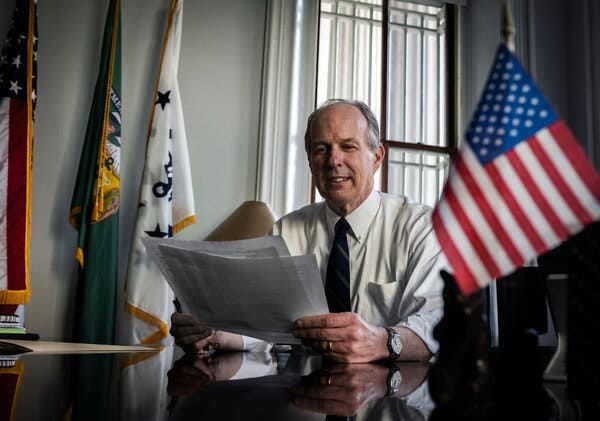
At the end of January, the Trump administration pushed out a top Treasury Department official after he refused to give Doge access to the government's vast payment system. We're talking to him today. It's one of his first public interviews since leaving the civil service. David Liebrick was the highest ranking civil servant in the Treasury Department and one of the highest ranking civil servants across the federal government. He was responsible for overseeing the Bureau of the Fiscal Service, which puts out more than 90% of federal payments every year. More than a billion transactions, more than $5 trillion. One note for listeners, Librich did not want to go into the blow by blow of his leaving the administration early this year. And so we didn't ask about it. Instead, we talk about a bunch of other things that I think you'll find highly relevant. How the Bureau of the Fiscal Service works, how it should work, why Lieberch thinks Doge's plans for it won't work out the way they intend. As always, you can find the full transcript for this conversation and many others at www.statecraft.pubcraft.pub. without further ado, David Librich, thank you for joining.
- [01:08]
David Liebrick
Thank you very much for having me. I really enjoy listening to your podcasts.
- [01:11]
Host
Well, it's a real honor to have you on. You've had quite a long career, I think you said 35 years in civil service and in your most recent role you were Fiscal Assistant Secretary. You oversaw the Bureau of the Fiscal Service. Before prepping for this interview and before reading recent news, the Bureau of the Fiscal Service had never there's not a term I'd ever heard before. Will you describe what it is and what it does?
- [01:35]
David Liebrick
We kind of prided ourselves on not being a household name in large measure because the work that we do is really mission critical. And in fact, often we would talk internally that if the public did know what we were doing, it meant we weren't doing our jobs, but we really did. The Fiscal Assistant Secretary is the senior career official at treasury and we oversee some of the most important functions of government. It's the financing of the government, it's the making the payments of the government, it's collections accounting for government wide activity. And these are the functions. When you go back and look at the founding of the Treasury Department in 1789, these are the core functions. And there's a reason why there's a career civil servant who serves in this position because there's importance to having continuity. And it's also important to make sure that you really do bring discipline to These really important functions. So as you kind of walk down a little bit more, like, what does it mean to make payments? Well, we're responsible for making sure every month, 70 or 80 million benefit payments get to American people, to beneficiaries. We're responsible for operating the treasury auctions. And that is the treasury auctions are not just about financing the government. They're also the foundational element of the world financial system. So treasury securities play a really critical role as it relates to collections. We're either an organization that is responsible for administering a network of collection boxes and mechanisms so that we can bring the money into the Treasury General Account. And also then we're responsible for reporting on the financial activity of the government. So there's many different reports that people, individuals can see about what are the inflows and the outflows? What are the different things that are going on across government? And finally, I think the other thing which is in the immediate office of the Fiscal Assistant Secretary is the cash forecasting function. And this really comes very important always because it relates to how much financing you need to do to run the government. But also it relates, when you get into a debt limit situation, about how much cash do you still have? So it's managing that Treasury General account is a really pretty big deal and making sure that we're paying attention to those things.
- [03:30]
Host
A couple questions for you there, but just before we go further for the layman, what is cash forecasting?
- [03:35]
David Liebrick
So what we do is we have a very small group of people, and I would argue they're the best in the world at what we do. It's a staff of about 10 or 12 people, and we look at the outflows that are going on out of government, we look at the inflows that are coming into the government, and we make that determination about what our financing needs and what our cash balance will be to actually make sure that the government has enough money on hand to function.
- [03:57]
Host
Got it. And then will you just sketch out the. When you say that the treasury and its foundation more than 200 years ago, the Bureau of the Fiscal Service, does most of the things that treasury was initially mandated to do, you just sketch out what are those things? In the original mandate, if you go.
- [04:13]
David Liebrick
Back into the enabling legislation in 1789, it says it shall be the duty to the Secretary of the treasury to prepare for the improvement in management of the revenue for the support of public credit, to prepare and report estimates of public revenue and public expenditures. So it really is those things about financing the government, making sure that you're collecting the revenues that are owed to the government, making sure that you have ability to pay. And then there's requirements in there that say you need to report to Congress. And in fact we issue something called the monthly treasury statement, which is in this enabling legislation that. So we've been issuing that monthly treasury statement since 1789.
- [04:50]
Host
It's incredible you touched on this a moment ago, but I just want to go back to it. You were the Fiscal Assistant Secretary. That was the, that's the formal title. As I understand, that role is one of, if not the most senior career official roles in the government.
- [05:05]
David Liebrick
It is the senior most career official at Treasury. And I think this is an important point you're making, which is interesting about the nature of the US system is just before January 20, the treasury offboarded close to 100 political appointees. And those are the secretary, Deputy Secretary. They're the senior most people in the department. And they really have many of the political appointees are also at the deputy secretary level. So during these transitions, you do have career staff, which it remains and then continues to run the organization through transition. But the fiscal Assistant secretary, there's very few other assistant secretaries at the career level throughout government.
- [05:43]
Host
So because of that transition dynamic, the treasury loses a lot of the political appointees when administrations transition. You were the acting Treasury Secretary this past transition, right?
- [05:54]
David Liebrick
Yes, correct.
- [05:55]
Host
And what is that like, how long do you serve in that role before you swap back into the career role?
- [06:01]
David Liebrick
It's really sort of, on some ways, the highlight of my career was to be able to do this. Started as a GS9 and ultimately, you know, ended up at the end of my career having been able to serve as the Acting Secretary and Deputy Secretary. But really what I viewed my role in that is, is that the smooth transition of power is really, is really important. And I, I would always start every meeting by saying it with my, with the career staff who was acting in the senior roles or at least the very beginning and saying treasury is the most consequential bureau or agency in government. And if you think about it, whenever there's a crisis or there's something that occurs, people turn to Treasury. And I also would say to political appointees when they would come in and say, you know, treasury is a place where people go to have good ideas implemented, but it's also the place where bad ideas are stopped. And every secretary will tell you this. They'll say in my administration or in our administration, there are bad ideas and someone needs to sometimes raise their hand and say that's a bad idea. And treasury historically has played that role of doing that.
- [06:57]
Host
We've had a couple guests on the show who have staffed presidential transitions. And one thing that struck me from talking to them was different administration transitions. So for instance, people who served in one of the Obama transitions and then the Biden transmission transition, excuse me, it talked about, you know, even though those are the same, same party, a lot of the same people, the two transitions looked very different, different priorities, different organizations. I'm wondering if you have you noticed that dynamic in your own experience of different new administrations come in with different transition models?
- [07:27]
David Liebrick
Yeah, I would have been really lucky to have worked with, I think are some of the finest public figures in the last 35 years. And treasury is really lucky. In fact, one of my first jobs was special assistant to Jay Powell and had worked with people like Larry Summers and Gary Gensler and Bob Rubin, Lloyd Benson, Steven Mnuchin and most recently Janet Yellen. And I think what you find with those people that treasury tends not to move very far left or right, that most of the policies tend to be very much consistent with that sort of ballast. You know, treasury performing the ballast function across government. I don't think that we saw generally in the course of my career saw significant swings when the new teams came in. I think that's not always the case with some agencies where you get wild swings and therefore significant adjustments.
- [08:19]
Host
Let me go back to the Bureau of the Fiscal Service specifically, which you led in your most recent role at Treasury. Will you just describe in a little bit more detail how that bureau works? Because as I understand it, at least 90% of all federal payments, including Social Security benefits and tax refunds and payments to federal workers, they all run through the bureau.
- [08:42]
David Liebrick
Walking through earlier about these really core functions that are so important to the ability for the federal government. Actually, as I also mentioned the world economy, I mean, if those payments don't go out, that not only has an impact on the beneficiaries, it has an impact on the economy. We were always sort of very much of the view of on time every time. So we really thought a lot about how we made sure that our operations were world class. I would argue that I do think that our operations are world class. We spent a lot of time thinking about how you provide good stewardship and how you make sure that you are running those things and they're reliable. And I think we'll maybe get this a little bit get to a bit later, which is. Well, one is what are one of the reasons why government isn't real flexible. Well. And what are the incentives for a civil servant? Well, I think one of the challenges I would face as a leader of that organization is that we need to have repeatable processes. We need to make sure that we're able to do this thing effectively and efficiently every month. To go in there and sort of like, hey, try to play with those systems or to be innovative with those systems carries a lot of risk attached to it. We spent a lot of time on continuity of operations. We spent a lot of time on resiliency. We spend a lot of time on protection of privacy of the information within the systems. We make sure that when we make changes to those systems, we're very careful about how we do that. These things are things that have to work, and therefore they're part of the national critical infrastructure.
- [10:04]
Host
Just to get a little bit more into the weeds on payments, on money going out the door in the federal government, I think that the naive view that I would have before digging into this is that individual agencies do this work. They put out the money that they disperse in their benefits or whatever programs leaves the door of that office, but that's not the way it works. The Bureau of the Fiscal Service manages that. Will you just draw a diagram for us? Yeah.
- [10:28]
David Liebrick
So it's really. So it's really important. If you go to Civics 101, you know, Congress passes a law, it appropriates money to an agency. An agency then gets an account set up for it that says you can spend this amount of money. And from our purposes at treasury, it's really important to have that centralized where money's going so that you know what's coming in and out of the government. And that treasury general account, you have control over the treasury general account, but the individual decisions about who gets paid and how much really have to reside with the agency. So in the agency, the agency has a fund balance with Treasury. It says, this is the amount of money that you have available to spend, and you can spend up to your balance. You, as a certifying officer at an agency, certify that you have the legal authority to make that payment as a legitimate authorized payment.
- [11:15]
Host
So the agency says this is on us or making this payment?
- [11:18]
David Liebrick
Yes, and this is the amount. This is the person. And they provide us information and data. It's our job then to take that and make sure it gets into the payment system and then gets to the end user. So we're actually the processor of the payment to execute to make sure that that happens. And we did about 1.3, 1.4 billion of those payments last year.
- [11:38]
Host
That's incredible. Almost a billion and a half individual payments out of the door.
- [11:42]
David Liebrick
Yes.
- [11:43]
Host
What are the kinds of hiccups or kinds of risks that you're trying to avoid in architecting that system? That's a huge responsibility. What are you most worried about on a day to day basis when managing that system?
- [11:53]
David Liebrick
We are under constant threat from external people who are trying to exploit vulnerabilities in our system. And it's one of the reasons why you mentioned we're quite comfortable being under the radar screen. So we don't like to be too visible and known out there. We know we're under constant threat from adversaries. Those threats can do things like say, hey, I want to compromise your system, but they also can try to extract information from your system and that's privacy data about the individuals. Because we do have enormous amount of data in our enterprise, which is things like bank account information and names and addresses and sometimes Social Security numbers and bank account information. So these are things that need to be protected and be very careful in terms of how you administer these systems and you control them. Then you also have the notion of when you're operating those systems, you kind of make sure they don't break. You're very careful about who has access to the systems. You're very careful. And when we ever make a change with the ongoing operation, it's only for sole purpose. So you can only go into the system for a singular purpose. You can't go into the system and see more generally because of the importance of making sure there's continuity of operations. We do have, as I mentioned at the onset of things like continuity of operations exercises, we have a lot of resiliency within our systems. We take that stewardship role very, very seriously. I'd like to think that we're among the best in government, if not industry, at doing these things about protecting our systems and making sure that they're solid.
- [13:19]
Host
Let me change gears a little bit. You mentioned a moment ago you have to be careful with innovation in these systems because the downside risk of breaking them is very high. But as I understand from looking at your cv, you did do a lot of innovation in these systems over time. Do you want to talk a little bit about what work you guys did do to modernize these systems?
- [13:38]
David Liebrick
Yeah. One of the things that I really made sure I did in my job was to go out and talk to industry and talk to the people who providing services because we oftentimes use Financial agents, financial institutions to provide some of our service. If you think about it for a second, it would be impractical and efficient for the Treasury Department to have collection lockboxes all across the country. Right? So banks have those already. As you can imagine, we set up our system that we use banks to actually do much of the collection for us, but we use different banks. And so one of the things that I would do on a regular basis is I would go bank to bank and watch those operations. And you could see which operations were more innovative and which operations were doing things differently. I also would spend time going to Silicon Valley and take a look at sort of talking to different companies about what they were doing and trying to push the edges of technology. And I'll come back to that a little bit later. I think one of the things we don't do particularly well in government is going out and talking to people and saying, hey, what's really going on in the world at large? Where can we be thinking more creatively and with more innovation? Early on in my career we were doing a lot more checks. And in that time, if a check didn't show up on Monday but instead showed up on Tuesday, no one really knew the difference. I mean, it was sort of, that was maybe the mail. There was maybe a little bit of hiccup. Well, today we have people when that payment hits the account, they're looking at those funds exactly at settlement time. So if it's not there, then there's consequences of that, which leads to a fair amount of risk attached to that.
- [15:08]
Host
Can you explain that a little bit more? What's the risk attached?
- [15:11]
David Liebrick
This came up during economic impact payments, which is some people would see their economic impact payment hit the bank account on, let's say, a Friday. That settlement date wasn't really until Wednesday, so the funds really weren't good until Wednesday. But because we had initiated the payment on Friday, some banks would show that as actually in someone's account today. If you're, if you get a Social Security payment and the payment date by statute is the first of the month, if you go in at 12:01 or 6:00 in the morning and that payment's not there, you're really worried you will hear about it if somehow that payment doesn't hit the account. Unlike again, the check might not have shown up. And so you say, well, that sometimes is something that just happens, that sort of different mindset that you have today relative to what you had 20 years ago. There's just higher expectations from the end Users.
- [16:01]
Host
Sure. Talk to me about fraud prevention. You've done a lot of work in your career preventing fraud.
- [16:07]
David Liebrick
Sure. One of the other major initiatives I was involved in at one point was implementation of the Data Act. When we did the Data act, we had kind of a mantra which was better data, better decisions, better government. And the Data act is really about getting better access and having the public have better access to more granular information across government.
- [16:27]
Host
When was this?
- [16:28]
David Liebrick
The act passed in 2014. Throughout my career I must say that I don't, with the exception of fraud prevention in the private sector, you monetize data. Right. You get consumer data and you attempt to turn that into business. Throughout my career I was always a little bit frustrated that we had so much data in the Bureau of the Fiscal Service, but somewhat frustrated that we weren't able to kind of make great use of that data. We weren't able to kind of figure out how do you not necessarily monetize it, but how do you turn that data into better decisions? Well, the best example about turning data into better decisions is fraud prevention. Last year we put together a tiger team and I want to talk about why this is important. When you have a new initiative of bringing together a small group of people who cross cutting team who can look at the issue differently. And I mentioned about how we have these ongoing large scale operations. It's very hard to take someone who's doing operations on a day to day basis and pull them off and say think differently about your business. So what we did with respect to fraud prevention, we got a very small cross cutting team together and said, let's think about fraud prevention differently. Let's figure out exactly how we can really move the needle on fraud prevention. And we had an existing program called Do Not Pay which has a series of databases that are available in it. We did is we started to say, well, let's start to do some more innovative things.
- [17:49]
Host
Before you describe those more innovative things, what was you have the Do Not Pay system and that predates this project. What kinds of checks do you, you know what's getting flagged in the Do Not Pay system.
- [17:59]
David Liebrick
So there's a series of databases that are in there. You asked earlier about the payment process. And so the payment process is an agency will send a fil over that's not been certified yet, but it's been brought over to do a check on the file to make sure that the file is adequate. At that point you can run the payments through the Do Not Pay system. And the Do Not Pay system things has like, is it a dead person? Are they someone who's been debarred? There's a variety of other databases that are in there that sort of say, hey, pay attention to this payment. The Do Not Pay system sends that information back to the agency and the agency has to adjudicate it. So what we determined in the last year was that there was really great opportunity for us to do a lot more. And so one of those areas was we entered into agreement with the Department of Labor because there are a lot of federally funded state administered programs in terms of trying to make sure that we could share data more across the country. Because in fact, if someone's trying to commit fraud in California in the program, it's likely they're trying to commit fraud in some other state in the program. Today, very few people are looking at that and saying, hey, where can we see where there might be fraud? We did this, we entered into a same, a similar agreement with HHS where we took a look at Medicaid data and we said, hey, you know, states, you need to be reporting information into your, into the system about who's on Medicaid in your state. And so the ability to take that data and to cross reference it and to aggregate data gives you insights that you would not ever otherwise have. And so in the first year of the program, we went from $650 million of fraud prevention up to 7.2 billion. In addition, during the pilot process, we took a look at additional 19 different data sets and we said if we ran our payments through these different, matched these payment sets against the databases, we came up with another $30 billion of fraud prevention.
- [19:52]
Host
What kinds of fraud would you be catching in those data sets?
- [19:56]
David Liebrick
If someone had suspicious activity reports, in some cases a very simple thing like this, which is if you applied for a program and you said you were a corporation, there's databases, there's a public database out there that says, are you incorporated? And so you could match against that database and say, look, this entity says they're a corporation, they're not. You shouldn't be making a payment to them along the way. And the things like suspicious activity reports from the. We entered into a discussion with FinCEN about suspicious activity reports, data that they're getting from the financial institutions. We also started to match against account verification, which is to say banks have a know your customer requirement. So if you're sending a payment to a bank, you probably have a higher degree of confidence that that payment is going to someone who should get it. Doesn't mean you don't have fraud. It just means there's a higher degree of confidence that that payment is going to someone who has a legitimate bank account. And so matching all government payments against these different sets of databases yields a lot of really good information. Now, what I would say is that our vision when we were looking at this was we're never going to be able to build data models to the same extent that private companies currently are building data models. So we also said we need to turn to the private sector and we need to sort of see whether the private sector has tools that would be useful to us, that we could run our data through those tools to see what they come up with. And we had some pilots that we were doing that were showing promise as well about using those kinds of things. The vision ultimately was every government payment should be scored in the same way that your payments are being scored on the. On your credit card side. You know, some score should come out and say, what's the risk of fraud in this payment? So I think we at treasury felt really comfortable that we were best suited of anyone to kind of provide these services to agencies. And this will come back to people who do daily operations. If you're in the unemployment program, your job is effectively to try to work with constituents to get unemployment benefits out. You're not thinking about fraud. Right.
- [22:01]
Host
It's just not your top priority.
- [22:03]
David Liebrick
It's not your top priority. And the second thing, even if it is, you don't know where to begin. Right. And third, you're not funded. You got this problem that says you have a deep set of incentives or barriers that are not allowing you to actually take fraud seriously and actually getting at it? So what we were doing was really looking at this in a very systematic way and saying, how can fiscal play a really prominent role in providing these centralized services to agencies to really drive down the fraud in government? And I think that the plan we put together is outstanding. I mentioned the 30 billion. I think that's on the low end.
- [22:40]
Host
So just to get all these numbers down in my head, your initiative with this small tiger team saved about six and a half billion dollars in prevented fraud. And you think there's a roadmap from that initiative that you could prevent 30 billion at least in fraud every year in federal payments?
- [23:00]
David Liebrick
Yeah. And I think you got to be careful about the. Every year, because you can't count it over. If you can keep counting it, sure. You know, you can say, if I prevented fraud in year one, do I get to count it year two? But yeah, I can assure you that 30 billion is the low end. So at least 30 billion. Yes.
- [23:13]
Host
I don't know if you can answer this, but can you give like a rough pie chart of what you think that 30 billion of fraud is? Like, how much of it is people using dead people's Social Security numbers? What's the relative breakdown of different kinds of fraud that you think are getting entered in the system?
- [23:28]
David Liebrick
Yeah, I think there's people stealing Social Security numbers. I think that you had issues of applying in multiple states and doing different things. And as I point out, which is every time we went out into the private sector and asked this question, and I did, I met with all the major players in this area, big banks and the credit card companies. They'll tell you is if. If someone is trying to commit fraud in one part of the enterprise and the government is an enterprise, we can be. You can be pretty sure they're trying to commit fraud somewhere else in the enterprise. So what we don't have today is any mechanism to say we. I've identified someone committing fraud in this program and trying to say, are they committing fraud in another program along the.
- [24:05]
Host
Way so you don't have to chase them down across. Across programs. We don't. The red flag doesn't mean we go and look at every other program that they've applied to.
- [24:13]
David Liebrick
Absolutely not. And this kind of gets to my point, which is this is where data matters, right? This is where you can monetize in a federal context. This is where you can monetize data. Now, one of the things that reason why we didn't move as fast as we could have is that you do have things like privacy and computer matching agreements. You've had folks on talk about oira. And the example that I would give is even on this account verification system, something that was proven. We had piloted it and proved it. It took 10 months for that to get approval on that. And so when I mentioned these other different data sets that we were using, I don't know how long it would take us to get those data sets approved to start matching to get to that 30 billion along the way. And there are good reasons. I mean, one of the things I would just say is I am a big, strong privacy advocate. I really do believe that we need to protect citizens from government overreaching. I do believe also that we at fiscal have proven that could be very good and responsible at protecting people's data and managing that data responsibly. Now, the reason why we are good at it is because we train people and it was sort of clear top of mind that says you are not going to have a Privacy act violation. Be very, very careful about this because one thing I would say is how you get a program stopped is to have some. You get reputational risk of not doing it well, even in an area. Another area, debt collection. We were very, very careful not to make sure that we overstepped our boundaries because we knew that if we did, it would jeopardize the program. Same thing here with respect to fraud prevention. Really important not to overstep your boundaries. Really important to protect people's privacy. Making sure the data is being used responsibly. There are ways to do that, but it takes work.
- [25:54]
Host
If you're in the Bureau of the Fiscal Service and you're trying to prevent fraud, what are the kind of reputational risks you can run? You can accidentally leak people's information, you can break privacy laws. What are the other kind of things that you'd be really worried about that would leave a black mark on those fraud prevention exercises in the future?
- [26:11]
David Liebrick
Coming back to my earlier comment about the importance of making sure everyone gets paid. So I could see a world in which every deserving person gets their entitled pay. So that's really important. And throughout my career where there's been times when if there's been a glitch and you do get the story about, well, someone couldn't pay their rent this month because they didn't get the payment on time or they couldn't buy medicine that they needed. So from that standpoint, you really do need to make sure that you can make sure that people who deserve the payment get in and aren't stopped. I would have made the argument that in this case, coming back to my scoring argument, is that if a payment showed a high score, maybe you make the payment the first time, if you have a question, but then you go back and you look hard so you don't make the payment the second time or you don't make the payment the third time. So you can do things which sort of say, yes, maybe I shouldn't have made the payment in the first time. But what you can also make sure is you don't compound the air and make that payment 12 times a year.
- [27:07]
Host
Right.
- [27:07]
David Liebrick
Because speed sometimes is important, right? I mean, getting the money out quickly is important. One of the reasons why I became so passionate about this topic was during COVID I was responsible for helping getting money out quickly. And it's one of the most important things I think I've done in my career of Helping stop an economic and humanitarian crisis by getting that money out quickly. But I also watched as we were making decisions about getting money out quickly. You had really two choices. You either get the money out quickly and have some risk of fraud, or you get the money out slow and you eliminate the risk of fraud. I believe the decisions were made at that time were the right decisions given where the country was and the significance of where things were, that was getting the money out. But I also had enormous amount of frustration that I did not have the ability to raise my hand in those meetings and say, you can do both. You can get the money out quickly and not have fraud.
- [27:54]
Host
Can you give me an example? Because my roommate at the time, the beginning of COVID was the one team member at his bank authorized to run PPP loans. And so I would both work from home and he'd be funneling loans to the system as I was doing my work. What kinds of things could we have done better to avoid fraud and keep that money flowing?
- [28:11]
David Liebrick
A real simple thing. When I mentioned about going back and looking at if people had run those payments, if many of those outlays had been run through the do not pay system because we. They turn, we turned it off. I think that there was an IG came up with a report. I think it said somewhere between 1 and 2 billion would have prevented. I think that if you had run it against the. This open public corporate data, we ran into situations where there were being paid money's being paid to entities that either had lost their incorporation or had not been incorporated at all.
- [28:41]
Host
And this is kind of one of the paradigmatic cases of fraud from the PPP era, right? Was people just making up names of corporations and filing a claim in the portal, right?
- [28:50]
David Liebrick
Exactly, exactly.
- [28:51]
Host
We knew if we had cross checked with existing corporate records, those corporations would not show up.
- [28:57]
David Liebrick
They would not have. Exactly. But I think at that time there was such a demand to get that money out quickly. And I would also, you know, argue there was another more recent example, the employee retention tax credit had the exact same set of circumstances where there was just this demand to get payments out very quickly. And I think some of the screening had some of the filtering had been. Had been dialed down.
- [29:19]
Host
Would that would imposing that filtering have meaningfully slowed down payments in those two cases?
- [29:25]
David Liebrick
I think with respect to in Covid, Yes, I do. I think the answer is yes, because we just didn't have the data sharing and the ability to sort of run these things quickly. And we didn't have the robust databases that we that we're getting at now that we really need. So I think the answer is yes. It would have slowed down. I think, though, that I think we're building something right now where the answer will be no. It's not an either or. They're not mutually exclusive.
- [29:49]
Host
I've got a Government Accountability Office report in front of me, the GAO, that looks at the 2023 fiscal year, and I know you've seen it, it estimates that the government made $236 billion in improper payments that year. And three quarters of that, something like $180 billion, were overpayments. So in a given year, and GAO notes that the federal government is, quote, unable to determine the full extent of its improper payments or to reasonably assure that the appropriate actions are taken to reduce them. Can you put some color on that for me? It's $180 billion a year, we think are overpayments from the federal government. What goes into that? And why can't we tell where those are going?
- [30:32]
David Liebrick
That report was very controversial within the executive branch when it came out for another reason. And part of it is legitimate, which is, look, you need to make sure that we distinguish between an improper payment and a fraudulent payment. Right? So an improper payment may be the documentation isn't there. And this kind of gets to my point earlier about speed. You can have a Medicare reimbursable sort of claim that's in, and you may not have all the paper perfect when you do that. And so there are instances where you know you're going to make that payment and you're going to hopefully reconciles later. And that's not necessarily an indication of fraud. It's an indication that there's not appropriate documentation. Now, there's also instances where there is fraud in the Medicare program, so there's definitely room to be examining that more closely, too. The example that has often been given to me is that says, look, you know, Medicare may cover an electric wheelchair or may cover something that's really significant. Do you stop the issuance of that because you don't have every T cross and every I dotted? I think that most of the program people would say, no, you want to get that needed benefit to the beneficiary. You know, make sure you reconcile it later. But as we also know, in my, in my world I mentioned, we do some debt collection, pay and chase is a bad idea. Right? I mean, it's just not a. It's not a great place to be. You want to make sure you get it right the first time. So GAO definitely has a lot of points to raise there about improper payments and the need to do better in those areas. Across. I think they identify four or five major programs in that report that you say you'd really want to focus on. And I would agree. I think that the level of fraud is not well known. But I think if you go to the private sector, you would see estimates of the private sector of 2 or 5%. I think in the federal government's also got to be careful what base you're talking about. Right. Because interest payments on the debt are not vulnerable to fraud. So you've got to be careful about excluding those from the denominator. But I do think that if you went and looked at a lot of the programs, I wouldn't be surprised that that 2 to 5% is not a fair estimate about what you're seeing in the government. Yeah.
- [32:33]
Host
Let me go to more recent history. I want to tread lightly here, but I know you mentioned in our prep call the people in the new administration were not especially interested in the fraud prevention work that you've done that you've been road mapping. Is that fair to say?
- [32:49]
David Liebrick
I think that it's fair to say that where the fraud focus has been is not what we've been talking about.
- [32:55]
Host
Where has it been?
- [32:57]
David Liebrick
I think you've done a number of stories on aid and you've done a number of stories on stopping payments more generally with the thinking that the payments are fraudulent. My sense is that there's been a focus on more general notions of fraud rather than more specific notions of fraud.
- [33:15]
Host
If it was up to you and you were roadmapping the next five years of the federal government's fraud prevention, what's in your top five list? What are we doing and what are we trying to get congressional funding for?
- [33:28]
David Liebrick
So. Absolutely. More access to databases so you can do better data aggregation. I personally have a bias. I would give more authority to the Secretary of Treasury and say, you know, the Secretary of Treasury has more ability to make determinations about databases and more determinations about taking and centralizing this function more clearly in Treasury. I would be mandating that the states are providing data on the state administered federally funded programs and that we're aggregating that data.
- [33:58]
Host
That is, if you get money from the federal government to run a program, you have to report back certain data that the states currently don't report back.
- [34:05]
David Liebrick
Yes. And that I would say you must use treasury services as opposed to right now 50, 50 states do it 50 different ways. I would come back again saying this is where turning monetizing data. I would say that if the states actually knew that they could bounce their payments files off of our databases and we would give them back information. With respect to the prospects of fraud in that program, I think that there again you would see serious, significant improvements in fraud prevention.
- [34:35]
Host
What else?
- [34:36]
David Liebrick
I think those would be the top ones right now. Yeah, I would put that high in my list.
- [34:40]
Host
What are the either the practical or the political roadblocks to this kind of push? I mean, we're in a moment right now where fraud is one of the top, most hotly debated political issues. No one says we're pro fraud. No one's ever said we're pro waste, fraud and abuse. There's always questions on the margins. What are the roadblocks to this kind of full spectrum push?
- [35:02]
David Liebrick
Sometimes funding is always a big question. You want to make sure you have protections. And I think that's another roadblock. Again, I'm coming back to this notion about privacy is really important and protecting people's data is really important. You want to make sure you build that into that. I think that you're going to have to have the agency start thinking differently and that's going to take strong leadership, that fraud is important and that really sort of makes sure that they're aware of the different tools that are out there to really get at it. And then the final thing I would just say about a fraud prevention program, there are best practices. And one of the things that we can do and we have done, and we were very successful at that last year, is that we went into new programs and talked to them about how do you set the program up to make sure that you don't. You're not vulnerable to fraud. So this is not necessarily a lane that many federal program managers look at. They sort of say, well, I got to design my program, I got to set it up. And there are certain things you can do in the design of your program to minimize the risk of fraud. That third bucket there about best practices, where we did this was electric tax vehicle credit, which is. We said, hey, you want to make sure that before you actually do this, that you actually make sure the entity's been incorporated. You want to make sure that you look around and say, is it a legitimate bank account? Have you made a payment to that bank account in the past so that you don't have fly by night people coming in and doing these things. So you can do program design that helps minimize the potential for fraud and that might not show up in that score of fraud prevention because you don't know what didn't happen, but it clearly would significantly reduce the amount of fraud that's out there. And that could be true at the state programs, it could be true at federal programs at every level. Best practices of design can make a big difference.
- [36:42]
Host
Yeah. Let me ask you a question about doge, and you tell me if you can answer this. Currently, the DOGE push is much more focused on cutting. You call it a slash and burn mentality than it is about building new systems. Now, maybe that push comes later, maybe it doesn't, maybe that's not. We don't have the infrastructure for that. But how should people in the federal government be thinking about that day after tomorrow, building better systems phase if it does happen?
- [37:07]
David Liebrick
Yeah. So to some extent, what's happened here is not unusual. New administrations come in and have new ideas and great ideas, and quite frankly, sometimes they don't think that the people running the organization have very good ideas. Whenever I would do a transition, I would always go to the staff and say, you know, hey, look, what do you do? What are the barriers that you have that you're facing? And tell us what the challenges that you have and what are your opportunities? And as a manager, then I start thinking through, well, how can I help? How do those align with my priorities? And then how do I sort of figure out how do I work together to manage those things? When I also had a good number of friends who were investment banking and would have the question about, look, if you had a leveraged buyout or a takeover of an organization, what tends to happen? Well, the first thing that tends to happen is what we've seen here, which is you cut. Right. Because your theory here is you've got to reduce the size of the organization and make it more efficient. And then you keep cutting. You keep cutting. And it's not unusual to say, okay, we've cut too much at this point, we now got to actually build back up. We need to. And they sometimes will bring people back in. But I think the other thing that's kind of significant about that, where it's different in this situation, is in the private sector, if you use a simple example, you have 100 employees and you bring it down to 60 employees. Those 60 employees now know that the bonus pool is no longer being divided up by 100, it's being divided by 60. And they have a strong incentive to actually say, how can I make this work? Because they're committed and they're vested and they know that there may be some payout on the other end, we don't have that in government. We're in government because we believe in the mission and we believe in what we're doing and we believe that it's really important what we're doing. I think the other characteristic is that you engage your top people, you engage your experts. Right, because they know how the organization is, what are the opportunities and what are the costs. You make sure that you have ability to bring in great new talent and you have the need to you're committed to training, you're committed to laying out a business plan about like this is what we're trying to accomplish. And so I think some of those elements, many of those elements are sorely lacking in what we're seeing today, that really well integrated plan. But I also think that to some extent that the level of alienation that's occurred in many of the organizations makes it very difficult. I mean, I talk to federal employees and many of them are extremely disheartened and also just don't know when the next shoe is going to drop. And it's very hard to be to build something when that's the organizational mindset is not about growth and getting better, but it's really environment of anxiety and in many cases outright fear.
- [39:44]
Host
And you say that as somebody who has led rifts and layoffs and restructurings within the Treasury Department before, right?
- [39:53]
David Liebrick
Yeah. And one of the toughest things I did in my career was consolidating two bureaus and actually in that process we had to close down some of our operations and quite frankly, it was not popular at all. And one of the things that I learned is that you got to go and talk to people, you have to have a business plan, you have to be able to say a vision of where you want to go, you have to have an integration plan and you have to communicate and communicate and communicate with people about where you're going and what you're trying to do. And you need to give people hope and sort of a sense of that we're doing something important here and we're going to get it done collectively and we're going to get it done for a greater purpose.
- [40:28]
Host
Right. Grab bag of questions here, Dave. One is do you see the activities of the Bureau of the Fiscal Service as a purely executive branch function, or given Treasury's history, as something of an organ of Congress? Do you think it's got a quasi legislative function?
- [40:45]
David Liebrick
Let me answer your question. A little bit of a roundabout way is throughout my career, when a new policy was sent in My direction, my job was to understand that policy direction. And then my next job was to understand what the legal authority was to do that. And then my third thing was do I have the operational capability to execute it? And the fourth was my reputational risk. So just to answer your question, I'm going to go back to the second one is what we do in fiscal is really all driven by the authorities that we have. I've always been really comfortable with that and thought, yes, given the role that we do, I might want more authority in areas like fraud prevention. But by and large I see us as sort of like taking the direction from that enabling legislation. The third point I raised there, with respect to capability, you have to make an assessment about whether you have the internal capability to do it, do you have the resources, the skills, the mindset to do it. And if you don't, you got to think about plan, how you're going to get there. And I think that's really important. And I think quite frankly the system I mentioned, those hundred political appointees who come in, we benefit from outside thinking tremendously about looking at something differently. Now what I would say is that most political appointees don't come into government to think about operations. This is one of the things that's really worth exploring more fully is the success or failure of an administration is large measure can be determined. They come in with a very ambitious policy agenda. At the end, their ability to be effective is going to be can they execute that policy agenda and they're going to inherit an apparatus, they're going to inherit career people, they're going to inherit technology, they're going to inherit a budget, they're going to inherit a number of things, most of whom don't really understand those things, how to navigate those things. And so they struggle on the implementation side. Now you've had a number of podcasts where you talk about sort of the rules. I would argue that probably the most over regulated entities, a federal employee, were strung by many of these things. But there are good examples of how you get around some of those things. I've had a number of experiences in my career where we've been very effective at thinking creatively within the existing infrastructure, but also sometimes thinking outside the box about how to get something done. And vision without execution is a hallucination. You've got to be able to execute that vision and you have to think about how you translate vision into actually results. Our system tends not to bring people who have operational experience tend not to understand what they're getting and that's why that interface between career and political appointees can be so terribly important.
- [43:14]
Host
You mentioned the kinds of constraints that you face to doing your job as a, as a civil servant and you've mentioned a couple already. The legitimate privacy concerns or you know, just inability to access certain kinds of data. Will you run through the laundry list? From your personal experience, what have you experienced as an over regulation of you doing your work?
- [43:34]
David Liebrick
So absolutely. The HR Human Resources, the CFR Part 5. Would you get into the technical side of this? The delivery of HR services is really a tough thing to do.
- [43:42]
Host
Give me some more color there though. I mean what, what are you running? It's hard to hire, it's hard to fire.
- [43:47]
David Liebrick
Having run an HR office for a period of time at one point in my career, realizing I did not want to spend a lot of time there. I would say that there are three major issues that you're impacted on on the HR side. One is you're asking a manager to navigate a system that they do to hire someone usually like once a year, once every three years. Right. So they mess up, they're not disciplined, they don't know what to do. There's not a checklist that they, that's handed to them often. This is a service delivery part. So you've got a bad set of rules and regulations. You have managers who really don't know what they're doing. You got a service delivery model that fails. Right. I had a person who was just like really good at hiring a team up fast. But what she understood was she wasn't going to be successful and she hired the right people, got the right people in place quickly. So she really focused like almost like intensely on making sure that she got those things done. She just bird dogged things. And yet the average manager is not going to spend that amount of time doing that because they got other things going on. That's a real problem. And that's why I'm going to come back to things like Schedule A can be really useful of PMF program is a really useful one too where I know if I were to wave a magic wand within the existing structure, what I would say is look, the Bureau of Fiscal Service is probably going to hire 50 accountants every year. Why don't we have an open and continuous vacancy announcement so that when it comes time to hire that accountant, we just pull that accountant from the list rather than having to put out a new vacancy announcement and going through the whole process again. Now OPM could and should do that, but OPM has never been staffed or had that mindset to kind of do that thing. They should be doing that in cyber. They should be doing that with procurement specialists. They should be going through the federal system and saying, here are categories we know we're going to hire over the course of next year. Let's have an open and continuous, which is a little bit like the PMF program, by the way, which is you apply to the PMF program, you're in a pool, you can go to any agency and the agency can interview you and select you and bring you on board very quickly. So there are ways.
- [45:46]
Host
President's Management Fellowship.
- [45:47]
David Liebrick
The President's Management Fellowship. That's one of those areas where you're bringing in new talent and eager people who really want or committed to public service and public administration. And we don't have a lot of young people in government, which is a really big part of the problem. Right. Oftentimes talk about the technology side, where when I looked at technology, I had to change my behavior to fit the technology. Too often, the federal government still is building technology with that mindset, rather than the mindset that says we need to build that technology with the end user so that the end user is giving dynamic feedback about whether that service is actually a good service or a bad service. You had someone on talking about Orira, which is, you know, how you can survey your process you had to go through. In today's world, you should be getting dynamic feedback in real time about someone's views about your system. Does it fit their needs? Does it not fit their needs? When the government delivers services, that service should be as good, if not better than what someone's experience in the private sector. But we have this huge gap between our ability to actually gather data and then actually in some ways how we approach technology to actually build new systems. You look at the question of trust in government and you'll find that if you have a good user experience, you trust that entity better than if you don't. And in a government, if you have a bad experience, you're going to trust government less. So that customer experience side is so critically important. Now, I know I got a little bit of a tangent from your original question.
- [47:12]
Host
That's good.
- [47:13]
David Liebrick
I would just say one final thing on this, which is when I mentioned I would go to Silicon Valley and talk to private sector companies, one of the things that kind of came out of that is every time you survey your customer or talk to an end user, you should have a developer with you, because the developer is the one who can translate that need into technology. So if you go out and survey people and just get information from them and then you hand it over and say, hey, this is what the fintech companies are doing so well, is that they're getting that real time feedback from the end user and their developers are translating into that to a better service. We don't do that in government and we absolutely need to be doing more of that kind of thing where you're marrying a technologist with the program people to design and deliver better products. You had also asked the question about whether there are areas that have constraints and procurements we struggle with. And we had a really great example about even within the existing infrastructure rules, you can do things uniquely. We were faced with a problem about we had lots of paper savings bonds, billions of savings bonds records, and the savings bond program has been declining over years and we were not going likely to get funding except one day Senator Kennedy, a very influential senator from Louisiana, said, I want to make sure we get those savings bonds records digitized. And so he gave us $50 million to actually digitize our savings bonds records to make them more accessible and readable. When we scoped this effort at the beginning, we estimated it was going to cost us between 100 and $125 million to do the project. So we initially went out and did a standard solicitation to say, hey, can someone help us with digitization? One of the things that I had learned in this process is optical scanning skills have really significantly improved in the last five years.
- [48:57]
Host
Totally.
- [48:57]
David Liebrick
The first effort was a failure. We did not get the kind of quality or responses that we wanted. And in the government, sometimes you take second best because, hey, you got a senator who's really interested in this and a senator who's telling you you've got to move forward quickly. Well, we had a really good relationship with Senator Kennedy's office and we went back to him and said, we're not satisfied. You need to trust us. We're going to get this right, but you need to sort of be patient with us. So we went out with a second solicitation. And what we did is that we did a competition and we gave companies our data and said, we're going to give you four to six months to show us what you can do with digitization of this data. And at the end of that period of time, we got what was really an incredible proposal back from us that in the end meant that we were able to digitize 4 billion records. The complexity here is that over time we think about savings bonds were sold in different ways. They were payroll, there were different ways you could get them. And so all these savings bonds had different kinds of forms and formats. Well, this firm put together a very small team of AI machine learning experts and they took our data and they started to run it through and they started to have learning models to sort of say, you know, how can we do this better? And at the end of that process, they came back and said, we can do this for far less money, for higher quality and a greater speed than anyone else. And so to date, we have digitized close to 4 billion records, and we have done that for less than $50 million. We haven't spent the full $50 million that Senator Kennedy gave us. It's unusual is that one of the things we do in the fiscal service is we move our procurement, we move our executives around so that they had different exposure to the organization. And it turned out that the executive who was over this program had been ahead of procurement. And so he knew when we sort of said that we didn't get what we wanted the first time, when we looked at this different approach, he said, this is something that we can work with within the existing procurement authorities and come out with a better outcome. The other part of this is that we didn't buy the equipment. What I see too often in government is the second you buy the equipment, it's obsolete. And in this particular case, because the vendor was the one who was maintaining the system and modifying the system and changing the system as they were going along, we were not exposed to as much O and M and exposed to much long term investment in the actual thing. And it's just been a tremendous success. Again, that came out of creativity, of looking at things differently. And it came out of executives who were prepared to look at something differently.
- [51:19]
Host
Sure. Dave Librich, thank you very much for joining.
- [51:21]
David Liebrick
Excellent. Thank you very much.
- [51:23]
Host
It.