Loading summary
Transcript158 lines
- [00:00]
Santi Ruiz
Foreign. I'm Santi Ruiz and this is Statecraft.
- [00:07]
Diego Ruiz
We interview top political appointees and civil servants about how they achieved a specific policy goal. You can find the transcript for this conversation and many others at www.statecraft.pub.
- [00:18]
Santi Ruiz
Today'S guest is near and dear to my heart. It's my dad, Diego Ruiz. Diego. Dad. Papi. Welcome on.
- [00:26]
Diego Ruiz
Thank you. It's great to be here.
- [00:28]
Santi Ruiz
I should note for the record, we're recording in person, my dad and I, and I believe we both have the same cold. So apologies in advance.
- [00:38]
Diego Ruiz
Let me interrupt my own introduction and add a couple more things. First, my dad's voice and my voice sound awfully similar. So similar that the recording software I used thought we were the same person. Sharing a cold also didn't help. Second, this is the first of two episodes. In this installment, we talk about observing a Nicaraguan election and working in Congress. Toward the end, we talk about something called the brac. Brac? The Base Realignment and Closure. It's a case study that may be useful to government reformers like Doge today. Next week, we'll talk about Diego's time as executive director of the securities and Exchange Commission, or SEC, during the 2008 financial crisis. Okay, back to the interview.
- [01:19]
Santi Ruiz
You've had a pretty cool career that's inspired me, and I think I've learned a lot directly about the policy and politics process from you. Really? I don't think this podcast, I don't think Statecraft would be what it is if I hadn't grown up in this house hearing your war stories. I'd love to get into a few of those today, and then maybe we can talk about lessons from them towards the end. Maybe we can start with your work for Ileana Ross Leitman. Can you tell us a little bit about that?
- [01:46]
Diego Ruiz
Absolutely. And first of all, let me just say it's a thrill to be on your podcast. We listen to each edition religiously and it's so much fun and it's great to actually be one of your guests. Now I feel important. Ileana Ross Laitman is known for having been the first Latina elected to Congress in its history and the first Cuban American also elected to Congress. I got the chance to work for her through a series of fortuitous circumstances that that put me in touch with her campaign manager, and I got taken on as her youth director in her special election in 1989. She was running for the seat that had been vacated by the death of Claude Pepper. Claude Pepper was a near mythical figure in the Congress. Also Known as Red Pepper because of his left leaning political views. He had been elected in the 30s.
- [02:39]
Santi Ruiz
Let's look this up. He was elected to the Senate in 1936.
- [02:42]
Diego Ruiz
1936, that's incredible. And I think he then served in the House again from Miami. The district, at least when I worked on Iranna's campaign to succeed Claude Pepper was essentially Miami beach, downtown Miami, what today is known as Brickell, Coral Gables and the heart of, of Miami. And he dies in early 89. And so special election is called and Ileana throws her hat in the ring. She had been a state rep and a state senator, very successful, comes from a Cuban family that had fled Castro's Cuba. In fact she, if I'm not mistaken, I her family has ties to the Castro family really. In any event, her father was a rather well known political figure in Cuba, pre revolution, pre Castro. And she grew up in a highly politically engaged family, but in the US and made a great career in the Florida House and the Florida Senate. And throws her hat in the ring for the special election. At a time when Miami was only starting to become what we think of as Miami now, meaning a highly Hispanic population, kind of capital of Latin America, multiethnic. Back then it was still making that transition. And it was a, I would say it was an uncomfortable transition, at least for the people who remembered the Miami of yesteryear, which was just not that diverse. The race quickly took on some highly charged ethnic and racial overtones. She ran against this gentleman on the Democratic side named Gerald Richmond. And I remember him making a statement early on in the campaign. And it was a special election. So it was a highly compressed campaign.
- [04:19]
Santi Ruiz
The first special election after H.W. bush was elected.
- [04:23]
Diego Ruiz
Right, exactly. This was mid-1989. So really the focus politically, electorally was on this race. And especially again because Claude Pepper had been such a legendary figure, long, longest serving at the time, I believe, member of the House. And so a lot of attention was being paid and it was playing out in the context of this new ethnic dynamic that was interesting to cover. Gerald Richmond, the Democratic candidate, makes some statement early on in the campaign to the effects of this is an seat which did not resonate very favorably among Ileana's constituency, I can tell you that. And this new emerging Cuban American and Hispanic American electorate that was really coming into its own. And that was seen as a rather nasty shot fired across the bow of the Cuban American electorate and the Hispanics. And so the race was tense and it was my first foray into politics. I was 21 years old at the time, your role was. So I was youth director, which basically meant the guy in charge of getting out the youth vote. But more importantly, the youth vote itself was generating foot soldiers, volunteers to go walk precincts to hand out, flyers to staff, events to generate. We did a lot of kind of guerrilla media tactics where. Which at the time were. I don't know if they were innovative, but they were very effective in getting a lot of attention to the race and a lot of earned media. I remember we did big kind of rallies on street corners. I remember one specifically on the corner of Lejeune and Calle Ocho, maybe Flagler, right in the heart of Miami, Coral Gables area, where we just put college kids on every corner with signs. Honk if you love Ileana. She came out for a few of those and waved at passersby. Just a way to motivate people, remind them the election is on Tuesday, and get some great coverage that elevated the profile of it. I remember we made the front page of usa, which was in its heyday back then, and I still have the clipping of that issue of USA Today with I don't remember if it's Ileana holding a sign. And I recognize the sign as one of mine because I can make out my penmanship on it. So that was a lot of fun. I was placed on that campaign because at the time, I was working for a remarkable gentleman and a legendary figure in the conservative movement named Morton Blackwell. Morton Blackwell was a special assistant to President Reagan, and the Reagan White House was his liaison onto conservative and religious groups during that time. And after his White House years, he started a nonprofit called the Leadership Institute, whose mission was to train young conservatives for different things in different types of political processes.
- [07:15]
Santi Ruiz
More tactical, how would you describe the things?
- [07:18]
Diego Ruiz
Yes, they were tactical. They were things like how to start and run a conservative college newspaper, how to land a job on Capitol Hill, how to pass the foreign service exam, how to run a youth campaign, how to run a campaign, period.
- [07:34]
Santi Ruiz
Electoral stuff as well.
- [07:35]
Diego Ruiz
Electoral stuff as well. How to get a federal civil service job and burrow into the federal bureaucracy as a conservative.
- [07:43]
Santi Ruiz
Burrow in. Trying to explain that as a technical term because not everybody knows what that means.
- [07:48]
Diego Ruiz
Sure. Burrow in. Meaning you might get hired in the federal government as a political appointee. So right now we're recording in late 2024, the incoming Trump administration is going to fill. I don't know, the numbers they toss around is 3 to 4,000. Critical appointment jobs. Schedule C, it's often called, when that OCCUPANT of the White House leaves. And so if you had a schedule C job, you're out of a job as soon as that, on January 20th. Exactly. So the way to burrow in is to somehow transfer to a non Schedule C job, to a federal civil service.
- [08:24]
Santi Ruiz
Job within your agency.
- [08:26]
Diego Ruiz
Within your agency or another agency, but with the protections that come with the civil service anyway. One of Morton Blackwell's Leadership Institute's classes, I remember, was burrowing into the federal government so that you could stay on as a civil servant after, in that case, President Reagan's or President Bush's term ended. Anyway, I got hired right out of school, right out of college. I went to the University of Virginia undergrad. I graduated, and I get hired by Morton Blackwell to be his special assistant to the President and Director of publications. I was in charge of the newsletter and the annual report and various other publications.
- [09:02]
Santi Ruiz
I really am a father's son.
- [09:06]
Diego Ruiz
The acorn doesn't fall far from the tree. No kidding. The tal palo talla stija from such a stick, such a splinter in Argentine Spanish. But being at the Leadership Institute gave me the opportunity to basically audit every single one of those courses for free, including how to run a youth campaign.
- [09:25]
Santi Ruiz
And so you've never been in electoral politics?
- [09:28]
Diego Ruiz
I really hadn't. I had maybe, you know, put up some flyers in college, if that.
- [09:33]
Santi Ruiz
Yeah.
- [09:34]
Diego Ruiz
But I did get bitten by the political bug in college and became very interested in conservative ideas. And right after college was my first chance to put them into practice. So Morten connects me to the campaign manager of Ileana Ross Laitman, and off I go. Okay, she won. It was terrific. Great, great experience. And that gave me the desire to work on the Hill. Having seen a congressional campaign up close from the inside, you wanted to keep going. I wanted to keep going. And I wanted to see what working on Capitol Hill was like. I had made a list of all of the conservative members of Congress that I knew just from reading the Wall Street Journal and the Washington Times, names that were familiar to me. And I just had this list on a yellow legal pad of members of Congress. And I just made a big stack of my resumes and in person, in person to the Hill and started going door to door. You could do that back then?
- [10:32]
Santi Ruiz
Yeah.
- [10:32]
Diego Ruiz
You could actually knock on door. You didn't even have to knock on the doors. You just drop your resume, walked in, talk to the receptionist. Hi, I'm dropping off my resume. Do you have any openings? Every so often, the chief of staff or the LD might come out and give you A handshake, Give me a handshake. Give me a once over. And anyway, I dropped off a bunch of resumes and got a call back to come back and an interview for Chris Cox. Okay, that was in 89, actually, I skipped Nicaragua.
- [10:59]
Santi Ruiz
Yes. Let's go back a second. So, yes, late 89, Ross Leighton wins. Was it, was it late 89?
- [11:05]
Diego Ruiz
Yes, I think it was August 89.
- [11:07]
Santi Ruiz
So August 89, Ross Leighton wins and you have an immediate new Central American adventure.
- [11:13]
Diego Ruiz
I do indeed. And I now have campaign experience.
- [11:17]
Santi Ruiz
Right.
- [11:17]
Diego Ruiz
Because I have just come off, fresh.
- [11:19]
Santi Ruiz
Off of winning an American special election.
- [11:21]
Diego Ruiz
An American special election of the first Hispanic elect of the Congress. And lo and behold, another election that gets scheduled for early 1990 in Nicaragua, where the Sandinistas are in power. Communist regime backed by Cuba and the Soviet Union. But they decide to hold elections. The Central American wars are going on. The Contras are being funded by the US on and off. The Sandinistas decide they believe their own propaganda. They determine we're popular enough that we're just going to hold elections, we're going to win them and we will have the legitimacy that comes with elections. And Ronald Reagan and now George Bush will leave us alone.
- [12:01]
Santi Ruiz
They'll have to stop funding the Contras.
- [12:03]
Diego Ruiz
Exactly.
- [12:04]
Santi Ruiz
You can't oppose a democratically elected regime.
- [12:06]
Diego Ruiz
Exactly. And so they call for elections.
- [12:08]
Santi Ruiz
And they've been in power for how long at this point? Nicaragua.
- [12:12]
Diego Ruiz
They took power by toppling the somoza dictatorship in 1979. So they've been in power close to 10 years.
- [12:19]
Santi Ruiz
Right.
- [12:19]
Diego Ruiz
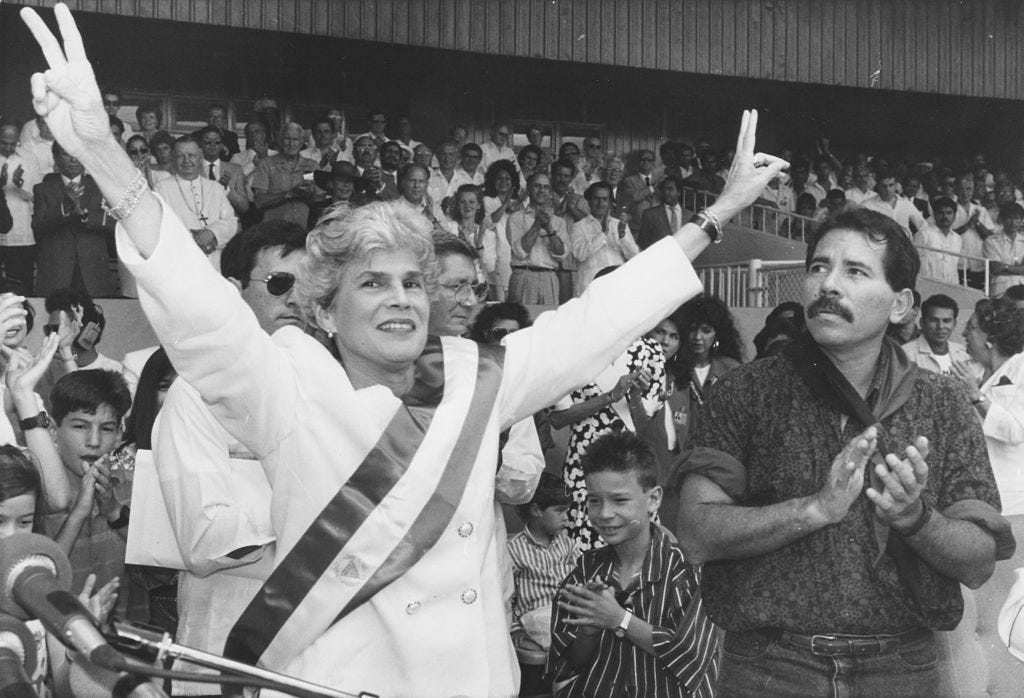
And the country is just a disaster, as you might expect of any communist country. It has become by this point the poorest country in the hemisphere, poor even at that time than Haiti. Granted, there's a low intensity guerrilla war going on in the jungles, but you know, they use the same economic playbook as Cuba did and run the economy into the ground. And people are definitely very much suffering and of course persecuting their political opponents, throwing people in jail, sure. Torturing people, etc. So they call an election and the opposition candidate that emerges is a woman by the name of Violeta Chamorro, the owner of the only independent newspaper in the country, La Prenza, and the wife of a martyred editor of journalists and publisher and editor of La Prenza, martyred during the Somoza years. So she comes from a very well known family, is very well known herself, and has a sterling reputation for civic engagement, democratic principles, et cetera.
- [13:23]
Santi Ruiz
And her husband had been gunned down by the dictatorship by the previous regime.
- [13:27]
Diego Ruiz
So she becomes the consensus candidate of all of the opposition parties that line up against the Sandinistas. And it was a pretty broad array. I think it was 14 parties going from free market conservative parties to actually the Communist Party of Nicaragua, which you wouldn't think it, but was not aligned with the Sandinistas.
- [13:52]
Santi Ruiz
You know what, the split was over.
- [13:54]
Diego Ruiz
I think they were just the holdover Communist party when the Sannisas took over, that they weren't institutionalists, they were guerrillas in the mountains. And when they took over, you know, it was their structure that becomes the governing structure. I honestly don't, don't recall what the Communist Party was about, but it was a broad, broad coalition of everyone else. Basically, as you would expect in a totalitarian communist state, the opposition candidate has no resources and has roadblocks thrown in her way at every possible step by the, the Sandinista regime. And so Chamorro asked for help.
- [14:30]
Santi Ruiz
And this is in 89.
- [14:31]
Diego Ruiz
This is in 89. And she gets help from a group of Republican members of Congress, of the U.S. congress, who are very interested in Central American freedom and Nicaragua specifically, who basically raise some money among their donors in the US and hire a small but hardy team of political campaign consultants to go down and give the Chamorro campaign a hand, which what little resources.
- [14:59]
Santi Ruiz
They had because they just don't have the resources to run a normal campaign.
- [15:04]
Diego Ruiz
They had nothing. Whatever they tried to get would be impounded by the Sandinistas. I remember fax machines being held up at customs by the Sandinistas and sitting there in a box in some warehouse throughout the course of the campaign because we just couldn't get it. There was nothing. The Sandistas controlled absolutely everything. There were two other newspapers. They controlled both of those. We did have a newspaper newspaper, and it was by far the most well regarded one. But I think there were two TV stations in the whole country, both government owned most of the radio stations. There were some low wattage stations that were somewhat free and really very little by way of resources to run any kind of campaign, but let alone a modern electoral campaign. So these members of the US Congress, led by David Dreyer of California, from Covina, Encino, California, east of la. Wonderful guy, was longtime chairman of the Rules Committee when Republicans took over in 94. Later, a few years later, very much of an internationalist, pro free trade, pro a strong, muscular American diplomacy. He takes the lead in pulling together some assistance and hires a consultant by the name of Tony Marsh, who in turn Hires me and I get hired simply because I was a junior member of a three man team. There's another one of Tony's campaign guys and they needed someone who spoke Spanish, someone who. Who spoke Spanish. They needed someone who spoke Spanish and had campaign experience, worked on a campaign, and I had worked on a campaign.
- [16:47]
Santi Ruiz
The Venn diagram, he fit exactly right.
- [16:49]
Diego Ruiz
And so I raised my hand as high as I could get it and get taken out. And so off we go to Nicaragua.
- [16:55]
Santi Ruiz
How many, how many people go down?
- [16:57]
Diego Ruiz
More or less three of us. But really two of us stayed there the whole time. Tony would go back and forth, but he just kind of set up the team and left us running. But we worked cheek by jowl with Violeta Chamorro. With her, I traveled with her to 16 of the 19 provinces of Nicaragua.
- [17:15]
Santi Ruiz
Did you have a budget to draw on?
- [17:17]
Diego Ruiz
No, no, no. We had. We had our room and board paid for. I stayed with a family. We stayed in the Intercontinental Hotel for the first week, maybe the only hotel in the city. Everything else had been Destroyed by the 1972 earthquake, I think it was, that destroyed downtown. Manag in Somoza stole all the foreign assistance. So Managua was never rebuilt. And then we couldn't afford to stay the whole campaign at the Intercontinental. That's where all the foreign journalists stayed.
- [17:45]
Santi Ruiz
Or at the bar.
- [17:46]
Diego Ruiz
Yeah. And so we got rooms with some local family and stayed there. And what we did was we couldn't do television, we couldn't do radio. You couldn't do direct mail because there. There's literally no addresses in Managua at the time. The streets had no names since they'd been destroyed. If you wanted to send a letter, you would write on the envelop three streets down from the Sitgo sign and one street towards the lake. Pink house and that. That was it. And the letter somehow got there. Yeah, as far as you knew.
- [18:15]
Santi Ruiz
But you couldn't do a mass campaign.
- [18:18]
Diego Ruiz
You could certainly not do any sort of direct mail like you could in the us. So what we could do was rallies and we just mobilized the candidates. Violeta and her VP pick beat Helio Godoy with one or the other. We traveled everywhere and we would just drive out hours, sometimes almost a full day of driving out from Managua and hold rallies in the town square and they would give a stump speech. Some sort of a makeshift stage would be set up. There'd be your food vendors on the edges of the plaza and people would mobilize. The campaign did a great job of mobilizing people. People were Losing their fear so that they were turning out after 10 years. They were so ready for change. But even so, the Sandinistas did everything they could to stymie even that. So they have these mobs that they would turn out groups of basically Sandinista thugs that would stand on the edge of the plaza and throw rocks, beat up people, throw this itching powder that they made crazy, crazy stuff from some local plant. They called it pica pica, which means itch itch in Spanish. And basically they would toss this powder up in the air. I imagine they had to kind of figure out which way the wind was blowing so it wouldn't blow back on them. But if it got into your eyes or even on your skin, they would just create this awful rash. And I did not. Mercifully, I did not. But I was almost lobotomized by a. A rock the size of a small marsupial. As I wrote at the time in this article, I remember I was walking with the crowd from the campaign towards one of these town squares for. For a rally. I got left a little behind because I was changing the film on my camera. This is back when cameras had rolls of film.
- [20:05]
Santi Ruiz
You stop in the street, I stop.
- [20:07]
Diego Ruiz
The street to change the roll or to take it out. And all of a sudden I hear, kind of behind me, gringo de mierda. And I thankfully turned around just in time to see this very large rock coming right at my head. And I ducked at the last minute. It sailed right over me. But that was. That was heading for the back of my head, and it was coming hard. So things like that. Every day we. Our phones were tapped. I remember coming home to my room in this family's home, very humble home, and there were pages from racing. Really, I have never changed so many tires in my life. Every time we went out, they would throw those little. What do they call the little tacks they'd always point up that you see in the spy movies that they throw on the roads?
- [20:52]
Santi Ruiz
5.8 or 7 pointed ones.
- [20:54]
Diego Ruiz
Yes. In Spanish, they're called Miguelitos little Michaels. I have no idea why. But, yeah, they would. They would toss this in our way all the time. We always carry two or three spare tires and our. In our SUVs. And lo and behold, we before.
- [21:12]
Santi Ruiz
Before you get to that. So there was all kinds of interference with the campaign, but there was also a big international observing presence separate from. From you guys.
- [21:20]
Diego Ruiz
Right.
- [21:21]
Santi Ruiz
So there were kind of limits on how much they could subvert the elections. Did I have that right?
- [21:25]
Diego Ruiz
Kind of. I think looking back, they actually did not think they needed to steal the election.
- [21:30]
Santi Ruiz
They would have tried harder had they thought it would have been closer if they knew.
- [21:34]
Diego Ruiz
Knew what the outcome would be, certainly they would have done something. There were polls at the time, not very many, but the polls showed the Sandinistas winning in a walk. Really what becomes evident after the fact is that in a communist state, people lie to the pollster, right? They're not about to tell the pollster who's some random, you know, maybe a gringo. They don't know you. They're not going to tell you what they're going to do. And so in the event we won by 15 points, it was an American landslide, an American landslide bigger than, than most American landslides that I can think of. 55 to 40, 55 to 41, something like that. Before we get to the election day, it's hilarious to look back and see some of the things that the Sandinistas did to within the bounds of a relatively free and fair election to stymie us and get away with everything. The campaign officially had to end a couple of days before election day. And so each of the two campaigns held one last enormous rally in mania. We went first, and I think the Santinistas went the second night nighttime rally where everyone tries to mobilize everyone and just really have that last call to action before election day. The day of our rally, the Sandinista government decides to schedule union meetings of every type of transport and vehicle. So the railroad union, the bus driver's union, the truck driver's union, all of a sudden they're all called to very important mandatory meetings with their vehicles. So those vehicles are taken out. Mission. They call all hands employee meetings in every major place of employment, factories and big landholdings and collective farms. They have collectivized a whole lot of the agriculture by then, so they make it as difficult as possible for our people to mobilize. And the coup de grace was on the two television broadcast stations that transmitted nationwide, which of course were run by the Sandinistas. They schedule on one of them, them, the global premiere of the very first Batman movie with Michael Keaton, I think it was, that came out in 89. They buy the rights from Hollywood to put it on live television that night. And on the second, they buy the rights to premiere it to premiere.
- [23:54]
Santi Ruiz
They premiere.
- [23:55]
Diego Ruiz
I mean, I'm not sure if it premiered ahead of the U.S. probably not, but it wasn't the words. It wasn't. It wasn't in theaters. It was not in theaters in Nicaragua or Latin America or I think anywhere outside of the us but they get the rights to put it on tv. They're dinky grainy TV station which they control just so people will stay home and watch Batman, of course. And on the other station they buy the rights again, the live network rights to the Mike Tyson Buster Douglas fight in Tokyo, which is the first, as it so happens they didn't know this, but it's the first fight that Mike Tyson loses. The very first time Mike Tyson loses. And they put that on the other TV station.
- [24:35]
Santi Ruiz
So you've got options.
- [24:37]
Diego Ruiz
And meanwhile we're trying to get people to our rally, which actually was a great rally.
- [24:42]
Santi Ruiz
Sure.
- [24:43]
Diego Ruiz
I'm sure it would have been even better had we not had that kind of disloyal opposition current thing. So we're taping Jimmy Carter.
- [24:59]
Santi Ruiz
So that's the rally. Any other malfeasance that you can reverse, Remember?
- [25:04]
Diego Ruiz
Yes. So on election day I was assigned to a group of Polish election observers that had come to keep an eye on the election. They were members of the Solidarity Party in Berlin that had just won. So the, the historical context actually is, is quite amazing and, and important. The election is February 25th of 1990. While the campaign is going on, the Berlin Wall comes. In fact, we made the decision to send Mrs. Chamorro on a very quick trip to Europe to generate support and attention for the election, but also to do some events, some press worthy events at the Berlin Wall. And she actually brought back a piece of the Berlin Wall which we then used in every single campaign stop for the rest of the campaign in Nicaragua.
- [25:52]
Santi Ruiz
To link that election to what was happening globally.
- [25:55]
Diego Ruiz
Exactly. I mean we were the next wall to fall. That's what we were trying to convey. It' is going to come down in Central America as well.
- [26:03]
Santi Ruiz
And you, the voter, are going to be the one that.
- [26:05]
Diego Ruiz
Exactly here. And that was brilliant guerrilla marketing and electioneering because we were able to use highly visible events that were taking place around us at that time to draw attention to our little piece of the struggle to motivate our voters and to really link the ideas that were undergirding the movement towards freedom in both places at the same time.
- [26:27]
Santi Ruiz
What else did she run out? What was in the stump speech?
- [26:30]
Diego Ruiz
It was really, as I recall, it was, it was a freedom speech. I mean, people knew by now whatever romantic ideal idea people might have had about the Sandinistas was long gone by then. I mean, they were corrupt, they were thugs, they were violent. They threw people in jail, they tortured. They were not democratic. You know, they got a lot of slack early on because they overthrew a right wing dictator. And it was romantic. It was seen as, as you know, in Latin America, there's the perennial search, the next Fidel Castro and the next Cuban revolution and the, the promise that that revolution held for, at least for some people initially. You know, the Clash had an album called Sandinista. Is it good? Is it good? It wasn't as good as the earlier stuff. No, no. I remember I had a. I had a roommate who had a. A big poster of that album on his wall. This was after I worked in Nicaragua and I was forever at war with him to get him to take it down and he never did. I did manage to get him to move it from the living room from the common area into his own bedroom. So I claim that as his whole victory. But. So her stump speech was a pro freedom speech. People were hurting and there were many people who had lost family either in the revolution against Somoza or in the conflict with the Contras and you know, people arrested, etc. I remember in one of the rallies, Virgil Godoy was speaking, the vice presidential candidate. Courtly gentleman, lovely guy. I hosted him a few years later in California when he came on a visit while he was vice president. And he's speaking, he's on his way up to the stage to speak and we start getting pelted by the Sandinista mob on the edge of the plaza. And thankfully in this instance they were throwing eggs. And he gets hit with an egg to the side of the head. And so he gets up, gets up on the, on the platform to speak. And I remember him saying, porquejo, because their eggs are rotten. I may have been pelted with a rotten egg, but their eggs are rotten. And people loved it because there was not much love for the Sandinistas at all. If you were on the inside, if you were a member of the party, if you held a government position, then yes, things were pushy here. But it's a classic tale of communist regimes every. Everywhere. It's meant to be the vanguard of the revolution, but it ends up being the most corrupt and self seeking of the whole bunch. Election night, we're in the bunker, which is this big covered space in Managua, and we start getting some of the initial returns in our small group. And the returns look incredible. And it's coming in first.
- [29:14]
Santi Ruiz
Managua or the rural region, I would.
- [29:17]
Diego Ruiz
Think it was Managua, but I really don't Remember, here's my main memory from that evening. Jimmy Carter was there.
- [29:23]
Santi Ruiz
And this is 10 years after his presidency. 89.
- [29:29]
Diego Ruiz
89, yeah. Nine years after he leaves office. And so by this time the Carter center is up and running, which is his vehicle for promoting democracy and observing. At that time, I think there was a lot more election observing than anything else. But this was, my recollection is this was the first big election that he was there in person. And we start hearing because Nicaragua is at the end of the day, a small country and a small number of families that run it. And in fact, the Chamorro family itself had people in the Sandinistas as well as in the opposition.
- [30:02]
Santi Ruiz
Big powerful family.
- [30:03]
Diego Ruiz
Yeah. And, and most of the big families likewise, everyone knew each other. We, we, our, our top people knew the sand top people very, very well. And so there's some amount of communication and gossip getting across from one bunker.
- [30:18]
Santi Ruiz
To the other, personal back channels.
- [30:19]
Diego Ruiz
And, and we start hearing that Jimmy Carter is doing a bit of shuttle diplomacy.
- [30:25]
Santi Ruiz
He's there with you guys.
- [30:27]
Diego Ruiz
He's actually more over in the other bunker with Daniel Ortega. Daniel Ortega was the, the President of Nicaragua at the time. And now today is again, sadly, this is how circular things are in Latin America and in Nicaragua specifically. And what came out of, of that shuttle diplomacy was his getting Violeta Chamorro to agree to let the Sandinistas keep control of the military and the intelligence apparatus in exchange for them willingly giving up power and transferring power to her. And that was the deal that Jimmy Carter cut. And I have to say, it gave all of us bad taste in our mouth. And to this day, I think is a stain on his record that he, you know, I think he, he felt that he was doing the right thing because was bringing about a peaceful transition.
- [31:19]
Santi Ruiz
But for that deal they would not have. Exactly.
- [31:23]
Diego Ruiz
And you know, there might have been violence or at the very least, you know, they would have stolen the election and refused to step down. But in convincing Chamorro to accept those terms, he basically condemned her presidency from day one. Because it's impossible to restore democracy and start to clean up the country when the Sandinistas basically have a gun to your head, literally in the form of the armed forces and the intelligence services and the security services. And so she governed as best as she could for four years with a viper in her bosom. And of course they held on to all of their ill gotten gains. They referred to the spree of thievery that they orchestrated in their last few days in power they refer to that as the pinata. Everyone refers to that time period as the pinata because they just get your.
- [32:14]
Santi Ruiz
Goodies while it's possible.
- [32:16]
Diego Ruiz
Shake down everything that might generate some income and pocket it as quickly as you can, because we're. We're leaving power. So they held on to everything, you know, the best properties, the best houses, factories, farms, everything. And so, sadly, Nicaragua has never really emerged from that level of corruption and poverty as well.
- [32:36]
Santi Ruiz
So after that, you end up back on Capitol Hill, stateside.
- [32:40]
Diego Ruiz
Yes. Pretty soon after getting back from Nicaragua, I land a job job with a very bright freshman member of the House named Chris Cox from Newport Beach, California. Wonderful district. I started out in Washington, but later ran his district office. And let me tell you, it was the best, the best job I ever had, being on the beach in Newport beach and Laguna beach. And at the time, the most. I believe it was the most Republican district in the country.
- [33:05]
Santi Ruiz
Really?
- [33:06]
Diego Ruiz
Yeah.
- [33:06]
Santi Ruiz
Wow.
- [33:07]
Diego Ruiz
But at the time, it was 40th district of California. Chris Cox, young, very, very smart freshman member who had come out the Reagan White House. He was counsel to President Reagan in the White House counsel's office. He wins a very crowded Republican primary because that district was clearly a Republican seat.
- [33:26]
Santi Ruiz
And if you win the primary, it's yours.
- [33:27]
Diego Ruiz
If you win the primary, it's yours. And he wins the primary in large measure because of the great experience he had in Washington and the iconic figures he brings out to campaign for him, including Oliver north and Robert Bork, at a time when those two names were household names.
- [33:43]
Santi Ruiz
Yeah.
- [33:44]
Diego Ruiz
And he wins the primary and wins the election hands down. And I get hired on shortly thereafter, and I go to work for him and I rose to the ranks first in Chris Cox's office and later a couple of other members. But one issue that stands out from that time, because it was kind of groundbreaking and because of my office's particular involvement in it, was the base closing process, the Base Closure Commission.
- [34:08]
Santi Ruiz
Do you remember the full name? The brac.
- [34:10]
Diego Ruiz
Brack was the Base Realignment and Closure Commission, I believe. Okay. Realignment was in there. This was a brainchild of a different member, Dick Armey from Texas, who later becomes House Majority Leader when Republicans take over the house in 94. He was basically Newt Gingrich's right hand guy. When Newt becomes Speaker, Dick Armey becomes Majority Leader, House Majority Leader, economist, very folksy, very smart, conservative, free market, and just a great, great guy. And he comes with this great idea for closing down unneed military bases, of which there were many, because once a base opened up in some congressman's district, there was no way to shut it down.
- [34:55]
Santi Ruiz
Right. It's somebody's pet project.
- [34:57]
Diego Ruiz
It's someone's pet project. It's important to that member. That member will do anything to protect it. Everyone has something they want. And so the natural horse trading and log rolling process takes over and nothing ever gets closed. Besides which, the Defense Department can't recommend it foreclosure either, because they cannot afford to cheese off that number of Congress.
- [35:17]
Santi Ruiz
Right. You make an enemy for the rest of the budget process.
- [35:20]
Diego Ruiz
There's no way, forget about it. If it's a powerful member of Congress. But even if it's a backbencher, why go through the grief? What's in it for the Defense Department?
- [35:29]
Santi Ruiz
You have a million other things you care about more than.
- [35:31]
Diego Ruiz
Exactly.
- [35:32]
Santi Ruiz
And so this is a classic Congress waste or federal waste and miniature story where the benefits of keeping it are very concentrated and the harms are diffuse. And so one person can always hang on onto it.
- [35:45]
Diego Ruiz
Right.
- [35:45]
Santi Ruiz
And it's never, never rises to the level of priority sufficient to actually gut it. And this stuff piles up and piles.
- [35:51]
Diego Ruiz
Up and there are no incentives. The incentives are simply not aligned for anyone to come in and, and say, hey, let's, let's do what makes sense and actually saves money. The incentives are aligned in the exact opposite direction. And so Dick Armey's revolutionary idea was to basically take it out of the hands of Congress and create this commission which would be picked. I can't remember how it was picked, but. But it was bipartisan and everyone got to pick some members. And the commission had the authority to look at all of our bases from every service branch in the U.S. and abroad. No, I think it was just the U.S. it was just the U.S. so it avoided some of the thornier issues of foreign alliances and force projection and things of that sort.
- [36:35]
Santi Ruiz
You let the folks at DOD worry.
- [36:36]
Diego Ruiz
About that exist, but there's plenty of bases in the US to keep them busy. And so they had months and months of hearings where the entire Commission sat and heard testimony from the military. They actually did ask the branches to tell them, okay, we need these spaces. We really could do without these from the local communities, obviously from the members of Congress, et cetera. And at the end of that process, they came out with a recommended list of closures. And the innovation here was that the Congress had to vote the entire list of recommendations up or down. They could not amend it. You accept the entire list or you reject the entire list. You cannot save your own base.
- [37:14]
Santi Ruiz
There Will be no opportunity in the process. There's no one pulling yours out of the fire.
- [37:17]
Diego Ruiz
Nothing. And there were several rounds of this, by the way, over the years, but this was the first go round of the Bragg process. So, anyway, I think it was a brilliant idea. Army got it approved when he himself was a backbencher. He somehow got it through the process, and kudos to him for doing that. But my piece of this story is that we had in Chris Scott's district, Naval, Marine, Marine Corps bases that end up being on the potential chopping block. Marine Corps Air Base El Toro, which was an air base, a fighter jet, and another one which was Marine Corps Air Station Tustin in the city of Tustin. It was a big piece of real estate in the middle of Orange county with two enormous wooden hangars on it from the days when the country's military fielded a fleet of helium blimps and a strategic helium reserve.
- [38:06]
Santi Ruiz
They were blimp hangers.
- [38:07]
Diego Ruiz
They were blimp hangers. Enormous they were at the time, and probably up until they burned down, because they burned down tragically just a few years ago. I remember seeing that in the news. They were the largest freestanding wooden structures in the world.
- [38:20]
Santi Ruiz
Just big, big hangers, big shapes.
- [38:24]
Diego Ruiz
The picture in your head of a hangar. That's what they look like, but just 10 times bigger than whatever you're thinking.
- [38:29]
Santi Ruiz
It's incredible.
- [38:30]
Diego Ruiz
So they could hold a blimp. Think of the Led Zeppelin one.
- [38:33]
Santi Ruiz
How do you. How do you get the blimp in there?
- [38:35]
Diego Ruiz
I don't.
- [38:36]
Santi Ruiz
I guess you fly it very low, but that's entirely. It's an obvious one for closure.
- [38:42]
Diego Ruiz
It's an obvious one for closure. Now, here's where I thought Chris Cox was wonderful and a real statesman, because any other congressman would have said, no, you cannot close down my base. The vital importance of our helium blimp fleet is underappreciated. Strategic priority creates hundreds of jobs in my district, and over my dead body will you close it? And instead, Chris, to his great credit, said, please close my base. There's. There's no sense in this remaining open. There's many better uses for it. And the process for doing so was one that everyone could be comfortable with because there was plenty of analysis done. And likewise with the El Toro base, which was not as clear cut a case, but still highly urbanized, very residential, and you have Marine Corps jets taking off and landing and making a lot of noise. It didn't sit easily with the interests of the community around it. The Marines were Increasingly less comfortable there.
- [39:43]
Santi Ruiz
I'm guessing there's lots of places for the Marines on the California coast.
- [39:47]
Diego Ruiz
Exactly right.
- [39:48]
Santi Ruiz
They were wanting for bases.
- [39:50]
Diego Ruiz
So Chris ends up being the first member of Congress to ever say, basically, yeah, close my bases.
- [39:55]
Santi Ruiz
When you, when you say that he said that, did he talk to the BRAC or it's not just the vote.
- [40:01]
Diego Ruiz
No, he actually testified before the Base Closure Commission and said, at least in the case of Tustin, I can't remember specifically of El Toro, but in any event, it was clear that it would be a much better use of that land and those resources to close them and turn them over to the private economy, which in fact is what I think ended up happening. It was a fun policy done right story.
- [40:22]
Santi Ruiz
There's been a lot of criticism that I've seen seen of the DOGE for being a Blue Ribbon Commission in its conception that to do real government reform you need something with teeth, not just something that makes recommendations. But at least in the case of the brac, there's one model where it is a Blue Ribbon Commission, but there's some mechanism attached to it which means that you can operationalize those recommendations. I wonder if it's a useful model for the DOGE or for state efficiency efforts in general.
- [40:47]
Diego Ruiz
It could be. I think clearly the jury is not only out on the doge, it hasn't even been impounded, paneled yet. We'll see what they come up with. But I'm a big believer in a process that aligns people's incentives to do the right thing, or at the very least removes incentives to do the wrong thing. And clearly in the case of the Base Closure Commission, you were removing from the members of Congress the ability to stand in the way of something that was painfully obvious needed to be done. And so to the extent you could do some sort of similar mechanism for the DOGE or maybe some subset of their recommendations, if that's what they, they come up with, to the extent that Congress is going to need to weigh in, that's not a bad thing to explore because I think there's going to be a lot of DOGE recommendations. I would imagine that will require an act of Congress. So maybe if you can package them in a way that makes it inevitable that they get approved as a package without the ability to pick and choose right. You know, a similar model is fast track authority for the President to make negotiate trade agreements. Similar the Congress has to authorize fast track authority for the President which empowers the President to go off negotiate a treaty, say NAFTA or the USMCA, it's NAFTA's successor, and come back to the Congress for approval on an up and down vote, but without the ability to amend it. Now, there's other reasons for that. In that case, it's hard to negotiate with a foreign power when you've got.
- [42:16]
Santi Ruiz
Multiple negotiators with goals.
- [42:18]
Diego Ruiz
It's like, you know, trying to buy a car and the salesman says, well, let me, let me ask my manager if that's okay. Well, you know, no, I want someone who can give me the real deal and not right, you know, you going back and making it worse for me. So there's other things at play in fast track authority, but it's a similar model. You, you, you approve or you reject the whole package.
- [42:38]
Santi Ruiz
Right. It's funny because conservatives today often criticize the omnibus model for congressional appropriations bills, the must pass bills where you stuff everything because you didn't get a chance to actually pick apart the different issues at play. It's not an up or down vote on one kind of reform. It's a everything that everybody wants to pass that year.
- [42:58]
Diego Ruiz
And you're packaging together literally 100% of a congressman's responsibilities in office into one bill.
- [43:07]
Santi Ruiz
Yes or no?
- [43:08]
Diego Ruiz
Yes or no.
- [43:08]
Santi Ruiz
Here is everything we everything.
- [43:11]
Diego Ruiz
Congress has the power of the purse and we're stuffing one purse full of empty everything and you get to vote it up or down with little to no time to actually scrutinize what's in it.
- [43:22]
Santi Ruiz
Theoretically, the value of an up or down vote is maximized on things where you could reasonably have a yes or no opinion on that whole package.
- [43:31]
Diego Ruiz
Exactly. And also the base closure commission had a process that was well thought out and was transparent and took place over months.
- [43:38]
Santi Ruiz
Everybody saw what was going into that.
- [43:40]
Diego Ruiz
Everyone saw it. Everyone had a chance to, to input. So there wasn't that feeling that surrounds an omnibus bill where, you know, I got put together in a smoke filled.
- [43:48]
Santi Ruiz
Room and on a Tuesday, on a.
- [43:50]
Diego Ruiz
Tuesday, and we're voting on Wednesday morning.