Loading summary
Transcript52 lines
- [00:00]
Unknown Speaker
Foreign.
- [00:04]
Santi Ruiz
Hi, this is Santi Ruiz. Welcome to Statecraft. We're doing an emergency podcast today with friend of the pod, Nick Bagley. Nick is an expert in administrative law. He served as special counsel and chief legal counsel to Michigan Governor Gretchen Whitmer. We've had him on a couple times for conversations on how bureaucracy is breaking government and whether the courts broke environmental review with a recent decision. Nick, thank you for joining.
- [00:29]
Nick Bagley
I'm happy to be here.
- [00:30]
Santi Ruiz
We brought you on to explain a concept that I think to lay audience can sound kind of scary. So judicial review. We're going to talk about judicial review today. And it sounds like legalese, but my impression is judicial review is not especially complicated. Most people are familiar with this at a kind of basic civics level. Will you explain just before we get into the big political controversy of the day, what's judicial review?
- [00:54]
Nick Bagley
Yeah. So judicial review is the power of the courts to review government action. And this is not actually the traditional office of the courts. The traditional role of the courts was to resolve private disputes. So if I punched you, you could sue me for a battery and I'd potentially owe you money and a jury would hear our dispute. But over time, judges started playing a more central role in superintending what it is that the government does. It started out really with constitutional review. So the idea that the courts review an act of Congress and could decide whether that act of Congress was consistent with the Constitution, that kind of constitutional review, of course, still happens today. But probably the more important kind of judicial review for the day to day functioning of the government comes through. We might think of administrative review, a review of what an administrative agency or a regulatory agency does. A lot of our biggest and highest profile fights arise in connection with that kind of judicial review.
- [01:56]
Santi Ruiz
Will you say a little bit more about that order of events? That first, judicial review in the American context mostly meant reviewing congressional actions, congressional decisions to determine whether they're constitutional. And then only later we kind of added in executive branch review.
- [02:13]
Nick Bagley
The story is complicated. And you know, the 19th and 20th, 19th century in the United States when it comes to judicial review, looked very different than it does today. But the basic picture was really from the very beginning of the republic, the US Supreme Court asserted the power to decline to apply laws that it believed that the courts believed were inconsistent with the Constitution. The idea being that the Constitution is higher law and it would sort of trump any congressional enactment that flew in the face of that higher law. In practice, the federal courts were very ginger about reviewing acts of Congress and striking them down as unconstitutional, but it would do so from time to time. On the administrative side, the courts were even more hesitant to interfere with the day to day operations of the federal government. There was an idea that just like the executive branch can't say, hey, that court opinion, I disagree with it, I'm just going to overturn it. The executive branch doesn't sit to review the work of the Supreme Court. Well, there was an idea that actually the courts likewise couldn't sit to superintend the decisions of the executive branch. And that meant that each of the branches were kind of kept in a tighter sphere. They were kept in what they called their separate spheres. There were still opportunities for the courts to say when a government agent might have gone too far in certain narrow circumstances. But that kind of judicial review tended to be fairly narrow and circumscribed relative to what we had today. And it really wasn't until the 20th century, the rise of the administrative state, the adoption of the Administrative Procedure act in 1946, that we get something that looks like the kind of review that we are used to today.
- [03:58]
Santi Ruiz
I want to talk about what we're used to today. In the past three or four weeks of the Trump presidency. We're recording this on Valentine's Day. It'll come out a couple days afterwards. There have been a flurry of executive orders on buyouts of federal workers shuttering or near shuttering of executive agencies like usaid, on immigration and immigration enforcement, on indirect costs at nih. And a big pile of these have, to various extents, been immediately subject to injunctions to pauses from district court judges through this power of judicial review. Will you explain the kind of mechanics of what's going on here? President issues an executive order and then what steps are triggered?
- [04:46]
Nick Bagley
Yeah, so it's a little complicated, but I think I can break it down to essentials.
- [04:51]
Santi Ruiz
That's why you're here.
- [04:52]
Nick Bagley
Yeah. When the executive order is issued, I should just say, like executive orders are, they get a lot of attention in the press, but they're really not anything more than glorified press releases. They just instruct the President's minions to do what the President would like to do. The President himself has actually fairly few powers that he exercises directly. Most of the powers of the federal government are vested in the secretaries of departments. What these executive orders say is, hey, you people that I've appointed to these positions, I'd like you to carry out my policy. And that matters, of course. But the executive orders themselves rarely have legal effect. What happens is you get this executive order in place. And then you get the agencies moving to implement that executive order. And the Administrative Procedure act of 1946, it creates a presumption that final agency action is reviewable in court. So when an agency moves to carry out the president's instructions, when it does one of those final agency actions, in principle, someone harmed by that agency action can sue over it, can bring that agency to court and say, we think that you have either violated the law or that you've behaved arbitrarily and capriciously. In other words, you've behaved consistent with the law, but you haven't explained yourself enough. You haven't crossed your T's or dotted your I's, you've skipped some procedural steps. And so what we're seeing now is a rash of lawsuits that are attempting to target the agency actions to carry out this executive branch executive orders.
- [06:27]
Santi Ruiz
So just to clarify terms here, these nationwide injunctions on things like offering a buyout to federal workers, that's not an injunction. It's not an enjoinment on the executive order itself. You can't stop the executive order. What you can do is try and stop the actual carrying out by particular agencies of that executive order. Is that right?
- [06:47]
Nick Bagley
That's exactly right. And I should add, nationwide injunctions themselves are actually pretty new. They're really new on the scene. Over the past two decades, as our politics have become more polarized, as more and more high profile cases are brought into the judiciary, the courts have become much more comfortable in joining the executive branch on a nationwide basis. But that's a pretty substantial shift. It used to be the case that administrative review under the Administrative Procedure act was much narrower. It would give a lot more deference to administrative agencies for a variety of different reasons. When an agency lost, the the effects of that decision were limited to the parties that brought the lawsuit itself, instead of extending nationwide. So we're seeing a judiciary that has become very comfortable with the muscular exercise of oversight authority for the executive branch. And while it may seem that President Trump is running afoul of the courts kind of an awful lot in these first few weeks, really, we've seen this dynamic emerge across the last four or five presidential administrations, where virtually every, every decision of any kind of moment is immediately challenged in court, often by attorneys general in states that are controlled by the opposite political party of the president.
- [08:04]
Santi Ruiz
Will you go a little more in depth into the last two decades about what happened besides kind of these background trends of polarization and the nationalization of politics? Were there mechanical changes or Legal changes here that contributed to the rise of injunctions.
- [08:22]
Nick Bagley
Yeah, the rise of injunctions is a complicated story, but the rise of sort of expanded judicial power is a little simpler, I think. I think it really has two sources. The first is that starting in the early 1970s, there was a consensus, a bipartisan consensus, that the courts needed to ride herd on federal agencies to a much greater extent than they had before. And the reason was in those giddy post war years, there had been so much construction, so much heedless pollution, polluting of the environment, so much relentless action, that there were a lot of people saying, you know what? We need to protect values that we care about that we think the agencies aren't paying enough attention to. So we need to make sure to protect the environment better. We need to take better care of civil rights. A kind of skepticism about governance took hold in the 1970s for a lot of good reasons, and that extended itself into judicial review. So you get courts acting in a much more sort of assertive manner. And again, it's a bipartisan consensus, really, led by the left, but embraced as well by the right. So that consensus took hold. And I think it's still sort of the generally prevailing view that we depend on courts to stand up to an executive branch that might run amok. That's a vision that I think a lot of Democrats and a lot of Republicans share. What changed more recently is the rise of the conservative legal movement and their success in getting judges appointed to the bench. So Starting in the 2000s, really, the Federalist Society made one of its key priorities trimming the sails of the administrative state, really saying we want to keep them under tighter control. We think unelected bureaucrats are driving industry into the ground. They are imposing lots of senseless rules without adequate justification. We need to get a handle on this distortion of our constitutional design. We need to put power back in the hands of elected officials. How are we going to do that? Well, we're going to get the courts to basically exercise even greater control over the administrative state than they have before. That movement has, in various different ways, led to an increased assertion of authority in the federal courts over the executive branch. I think it's safe to say that right now we're watching that effort by the Federalist Society. You know, it was really consolidated with the demise of Chevron deference at the US Supreme Court last year, but it's been apparent in a lot of different doctrinal domains. Basically, the courts are saying we've been recumbent too long. We need to get back into the game.
- [11:01]
Santi Ruiz
It's funny the two times someone has used the phrase to ride herd on a federal agency on this podcast. Or the only two times that actually heard the expression in the wild. And the two people who've used it are you and Trump's head of the Office of Management and Budget, Russ Vogt.
- [11:18]
Nick Bagley
It's hopefully one of the few things that we have in common.
- [11:21]
Santi Ruiz
Well, it's funny because this whole conversation, to my eye, is about another thing that you guys have in common, which is a view that generally speaking, we have too much judicial involvement or oversight, too many injunctions of executive branch actions. And I wanted to talk to you about this in particular because the Trump administration in the last few weeks has cried bloody murder about a bunch of these injunctions. You have Stephen Miller saying district judges shouldn't be able to set policy for the nation. You have the vice president, J.D. vance, coming out and saying a similar thing. Elon, of course, tweeting quite a bit about this in even more strident terms than the elected officials. And it's funny because you, I won't put words in your mouth. I'll let you explain here. But you've had largely a similar view. The judicial branch has overreached in its oversight of the executive. So will you kind of outline where are the commonalities between your view and the current administrations and where do you disagree?
- [12:18]
Unknown Speaker
So when I got out of law school, I clerked for a couple of years and then I went to work for the Justice Department where my job was defending the U.S. government. And it became pretty clear to me pretty quickly that the potted vision of judicial review that I'd learned in law school didn't really resemble reality. I wasn't defending the US Government from lawsuits brought by scrappy upstarts. I was mostly defending the US Government from lawsuits brought by well heeled businesses and gadfly groups that wanted to achieve some kind of private advantage. And it got me thinking that this judicial review thing was less noble than it was cracked up to be. And over the past 15 years in the academy, I've become more persuaded that judicial review can become a very serious impediment to the smooth functioning of government operations. And one of the kind of ways you can sort of, I don't know, wrap your head around this intuitively is just to think if you were running a small business and every time you made an important decision, a three judge panel of lawyers who knew nothing about how to run a gym or, you know, run a catering business would tell you that you were making good decisions or bad decisions. And I think we all understand that that would be a pretty intolerable way to try to actually run a business.
- [13:33]
Nick Bagley
And in fact, we have rules that.
- [13:35]
Unknown Speaker
Are quite deferential to business judgment for exactly that reason. But in the space of administrative law, we think that that approach is completely fine. And you know, there are some good reasons for that. Right. Administrative agencies have a kind of public power, especially regulatory power, that private businesses don't. But the fact is that judicial review really can impede smooth administration to an extended degree that I think law are often, they often don't pay enough attention to. So one place you can see this is connection with environmental review. You know, the National Environmental Protection Act. It sounds really good. Agencies should think about the environment before they act. Nobody can really object to that. But what happens when you subject environmental review to judicial review is that you get agencies that are so panicky about the possibility of losing in court in front of a generalist judge who knows nothing about the domain in which they regulate, that they write these thousand page environmental statements where they chase down every conceivable available alternative, where they hire consultants through the nose and where they say before, and that's where the projects get off the ground. They're also apt to say, look, I'm just not even going to touch this because I can't imagine the compliance burdens. So that's the kind of problem that judicial review can lead to. To that extent, when you're worried about the day to day interference of the courts in government action. You know, Russ Bot and I have, we share our concern with that there is something really untoward about letting a bunch of black robed generalists come in and fly SPAC agencies over what they're up to. There's a stronger case for the courts intervening when agencies have exceeded their legal mandate. So there's like, I'm going to roll the tape back to where, where we were talking about how there are kind of two styles of administrative review. There's legal review where you say you've gone beyond what Congress allowed you to do, and there's a stronger case for that. And we're seeing, you know, the Trump administration bridle at some of the legal constraints that Congress has placed on it. It seems pretty appropriate for the courts to say, hang on there, we're not trying to run like do your business for you, but like, wow, that's not legal. There's a different kind of judicial review that worries me a lot more, which is where courts will say, has the agency acted arbitrarily or capriciously? That's the language from the Administrative Procedure Act. And basically what the courts do then is to say, has the agency behaved reasonably? And, you know, courts. Courts aren't in a terribly good position to judge the reasonableness of an agency action. And it creates a lot of pathologies when agencies plow so many resources into creating defensible administrative records instead of just making the best decision. And moving on to the next problem.
- [16:19]
Santi Ruiz
At hand, will you bucket the recent injunctions of the Trump administration into those two categories? I know at least some. So the injunction on the NIH's decision to reset the amount that universities can take on top of research grants, that's a legal review question. Congress said we'll process that debate a certain way, and the NIH is trying to do another way. Are all of the injunctions, as far as, you know, in that category of overstepping the bounds or any of them under this capriciousness standard?
- [16:52]
Unknown Speaker
Yeah. So the injunction against indirect costs actually was lifted, or at least one of them was lifted for want of standing. But, yes, you're right. That challenge to the limitation on NIH indirect costs is a primarily a legal challenge. It's a little tricky to disaggregate the two, mostly because you tend to bring both. So when you challenge the NIH cutting to indirect costs, you say both, it's unlawful, and you say that it is arbitrary and capricious. For a lot of these Trump actions, both arguments are going to hold some appeal. Some of the injunctions, it's hard to.
- [17:27]
Nick Bagley
Know exactly what the basis is because.
- [17:29]
Unknown Speaker
They'Re temporary and the judges haven't yet explained them. So questions about the funding freezes, for example, there's a question about whether they are best understood as challenges to the legal requirement that agencies spend money, or whether they're best understood as a kind of an arbitrary and capricious challenge to a blanket order that wasn't taken with the kind of deliberation or care that we'd normally expect of a decision of that magnitude. So I think we're waiting to see how these cash out to the extent that they rest on a firm legal foundation, I'm less concerned to the extent that they are liberal judges who are worried about Trump administration policy and are leveraging those anxieties about policy to, you know, stop the administration from doing stuff. I have more concerns. Not because I disagree on the merits. I'm worried about lots of the stuff that the Trump administration is doing, but because that kind of practice is, on balance and over time, I think, destructive to good governance.
- [18:30]
Santi Ruiz
It's funny, for a while, Republicans, conservatives generally have criticized the administrative state on the grounds that it's unelected bureaucrats setting policy. Your view is that it's not really appropriate for unelected judges to be setting policy, but we should have bureaucrats, we should have administrators doing the work of administration. Your critique is slightly different from that of kind of like the classical the Federalist Society view. The. You're not as critical of unelected people making decisions, rather.
- [19:00]
Unknown Speaker
Yeah, I mean, I think this whole unelected thing is a bit of a canard. It turns out we can only elect a few people in any given year. There are going to be folk carrying out government policy who aren't elected. And the question is, who ought they to be? And our answer for a long time has been, you know, bureaucrats, but only if a court says it's okay. And I think that's a terrible way to try to run a government. I think we need to do much less judicial review and I think we need to trust the political process more. And I say that in full recognition that the political, political process sometimes misfires. I think we're in such a moment right now, but, you know, I haven't heard yet an improve, you know, a suggestion about how to improve on democracy as a way of running the United States. And I think that mechanically it's a terrible approach to have judges, many of whom are quite partisan themselves, second guessing and fly specking government decisions because they happen to disagree with them on the merits.
- [19:53]
Santi Ruiz
I want to commend you for that view because you made a similar case a few months ago in the late days of the Biden administration. Pre election, we had a member of the audience for a panel, a conservative friend of mine, say, basically say that judicial review is necessary to keep political actors from overstepping their mandate. And your response then, as now, was the way we do that is at the ballot box, more or less. I'm paraphrasing you, but that.
- [20:20]
Unknown Speaker
I think what I said is you can win elections too.
- [20:23]
Nick Bagley
And then of course.
- [20:24]
Unknown Speaker
And then of course he did.
- [20:25]
Santi Ruiz
I'm curious, just from your personal perspective, you made that argument from the left to right wingers, you know, a few months ago. You're making that same argument now to folks on your side. How is the reception of that argument? It's a difficult moment to make that argument because Democrats are in for four years of this. How do you think about just practically making that case? To people who might not want to.
- [20:46]
Unknown Speaker
Hear it, I would start by saying that. Reminding people that, you know, Trump is.
- [20:49]
Nick Bagley
Temporary and administrative law is permanent, and.
- [20:52]
Unknown Speaker
So we're gonna have to live with it in the future.
- [20:56]
Santi Ruiz
That's a nice Valentine's formulation. Yeah.
- [20:58]
Nick Bagley
You know, I could put it on.
- [20:59]
Unknown Speaker
A little heart, but it's tempting to think that you can structure the law to achieve the objectives that you like and to thwart the objectives of the other guys you dislike. Law doesn't really work like that. It's never really worked like that. And we ought to stop trying to Jerry rig outcomes by coming up with just the right set of procedural constraints to allow us to achieve our objectives and to stop them from achieving theirs. I think it's a. It's a bad way to go. How is it being received on the left? So I definitely think this is probably not the time when I'm going to be invited to the best cocktail parties. That's probably true. But I think there is more appetite on the left than I've sensed in the past to revisit some of the accepted by ways of how we've gone about doing things. There's a thought that one of the reasons that President Biden lost is because people were disenchanted with what the government was able to accomplish. Now, whether you buy that diagnosis or not, and obviously there's a whole lot going on, I think the American public has a lot of reasons to be unhappy with the quality of governance in the United States. So folk are looking around and asking, how do we get here? And one of the answers, and it's not the whole answer, but it's an important piece of the puzzle, one of the answers is that we put courts much too much at the center of how we go about our business. To the extent that people are open to rethinking that in order to achieve objectives that we really care about, I think they're open to revisiting some of the accepted by ways. Now, whether that will stick as Trump continues doing his Trump nonsense, I don't know. But I think it's important as an academic to try to offer the advice that you think is the right advice, not just for the moment, but for the medium and long term, too. And so I try very hard to do that. And if I'm wrong, well, people don't have to accept. You know, I am an unelected person, too. Nobody has to listen to me.
- [22:51]
Santi Ruiz
That's right. I want you to help me understand something. I asked just a little earlier about why injunctions became more common in the last few decades, as you flagged. It's a complicated story, but, you know, let me try.
- [23:03]
Unknown Speaker
Give it a shot. All right. So there's a lot of different things that come together, but probably the most important factor is congressional dysfunction. So you start in kind of the early 2000s with a much more polarized Congress, much, much deeper partisan divides and a filibuster that makes it almost impossible to adopt any kind of substantive legislation. So you get a Congress that can't respond meaningfully to public demands and desires. What that ends up doing is putting immense pressure on the President to go it alone, to try to use the existing powers that are on the books to achieve his objectives. And what that means is that they are pushing at the boundaries to a greater extent than we'd seen in previous years. So that's part of it. At the same time, judges themselves became, I think, more polarized. They became not all of them all of the time, but I think we saw a higher percentage of them who became kind of partisans in robes. When they saw presidential excesses pressing up against the boundaries of legal authority. They were offended, they were frustrated. They said, this cannot stand. And they pushed their authorities to the limit. And they said, we're going to enjoin you not just as to these parties, but nationwide. You shouldn't have done that. And it's a kind of self righteous indignation that flows into the law. And that became so common and so commonly accepted that it became almost part of the furniture. Judges started to think that's just the way administrative review works. And there are some technical reasons about why some judges started to think that way. But the end result was a practice of entering nationwide injunctions with some regularity against administrative actions that the judge happened to think were unreasonable or unlawful. It's put us into a very bad place. I think over the past few years, we've seen members of both parties start to recognize that nationwide injunctions can make individual district court judges into kings. They can make it really hard for the Supreme Court to hear orderly arguments about whether or not a particular administrative action is permissible. Because once you get one nationwide injunction, there's a race onto the US Supreme Court to get it lifted or to get it reimposed. So I think there's some sense of maybe we've gone too far. There's less of a sense of how to sort of get out of the problem. And it's kind of a collective action problem. Right? Like neither side wants to let their weapons go While the other side's in power.
- [25:38]
Santi Ruiz
Right. I'm going to push you even further here. What are some of the technical reasons that judges began to do this?
- [25:45]
Nick Bagley
Yeah.
- [25:46]
Unknown Speaker
Okay. So buckle up. All right. The technical reason is actually, at its base, geographical. Almost all federal agencies are in Washington, D.C. which means that because of the venue rules that apply in the federal courts, almost any challenge to agency action can be brought in dc. That, combined with specialized venue rules that channeled a lot of administrative actions to the D.C. circuit, meant that Washington, D.C. kind of became a center for administrative law challenges. The D.C. circuit is sort of the federal court that takes the lead on administrative law, and when it reviews an agency action and it says, we think this is impermissible, well, in a way, it doesn't matter if that decision applies just to the party in front of it or to the whole country, because if it applies just to the party in front of it, somebody else who's unhappy about that decision can just file in dc, in dc, by matter of sort of precedent, that decision's already been resolved, and the challenger automatically wins. So if the government's going to lose as to one party in the D.C. circuit, it's going to lose as to the entire country. And so the D.C. circuit judges started to say, why are we, like, we set aside an agency action? We're really, as a practical matter, setting it aside nationwide. And you can see how that comfort with the way that DC's sort of strange jurisdictional reach affects their thinking led to a comfort and a familiarity with sort of nationwide scope of relief that translated very easily to district judges and other districts across the country as a tolerance and an embrace of nationwide injunctions. So that's part of the story as well.
- [27:26]
Santi Ruiz
That's great. Let me close with a forecasting or a predictive question. Are we going to see challenges to the current model of district injunctions or the current administrative law that undergirds them resolved as a legal question over the next four years, are these going to get taken up by scotus, or are we going to see practical changes to them, or does that require Congress to act in some way that it has not yet shown a capacity to?
- [27:52]
Unknown Speaker
Yeah, it is in general, very difficult to change the rules that govern administrative law. And the reason for that is there tends to be few organized interests that want to go to Congress to get the law changed, which is to say it's easy to find a constituency that wants to get a particular tax break or to get some kind of regulatory relief. But so many people are affected by the Administrative Procedure act in such a broad and diffuse way that there is very little pressure to rethink it in a kind of major way. The exception to that has been on the right, where there have been for a couple of decades now, some pretty aggressive proposals to rein in the administrative state, to actually make it harder for agencies to do stuff and increase the intensity of judicial review. And these travel under the names like the REINS Act. You'll hear about that. Sometimes the challenge for the REINS act is that, you know, it's a Republican initiative. Right. So it's a thing that you want to do because you believe in, you know, limited power of the federal bureaucratic state. But the only time you can get it signed into law is if you have a Republican president. But the Republican president is in charge of the administrative state. And the last thing a Republican president wants is constraints on his own power. And so it's very difficult to get a law designed to narrow administrative discretion adopted into law under either a Democratic administration or Republican administration. The place where you might see some action, which I think I'm cautiously optimistic about, is much narrower gauge. And that would be kind of the basket of things that travel under the phrase permitting reform. Right. The idea that maybe it takes too long for the kind of bureaucratic reviews and maybe judicial review is slowing down projects that we care about. There's obviously sort of a deregulatory, sort of pro investment story to be told that kind of appeals across the political spectrum. So maybe we can see some movement on the permitting reform side. But I'm not optimistic that we're going to see broader changes to administrative law.
- [29:56]
Santi Ruiz
What's the timeline that we, as just normal political observers, should expect for when we see injunctions like this in court? I guess, like over the next few months, what's going to happen to these legal cases? How quickly do they get taken up and resolved?
- [30:11]
Unknown Speaker
Yeah, every legal case is its own little snowflake, so it's difficult to predict. It depends on whether there's been injunctive relief entered, which can accelerate the pace of appeal quite dramatically. Depends on whether the government wins or loses and whether they are aggressively moving to get the case through the system. Because of the number of injunctions and because of the extent to which the Trump administration seems committed to following through on some of them, I suspect we're going to get some action on at least a few of them pretty quickly. We're likely to see the first involvement of the US Supreme Court is on what's become known as its shadow docket, which is to say, not because a full dress case has worked its way through the courts that normally takes between two and three years, but because an injunction has been entered and people are sprinting to the US Supreme Court to get that injunction lifted or to get an injunction put back into place. Because the Supreme Court has been much more active on its shadow docket over the past decade, I think we are likely to see some early action there as well. But, you know, time will tell. Got it.
- [31:16]
Santi Ruiz
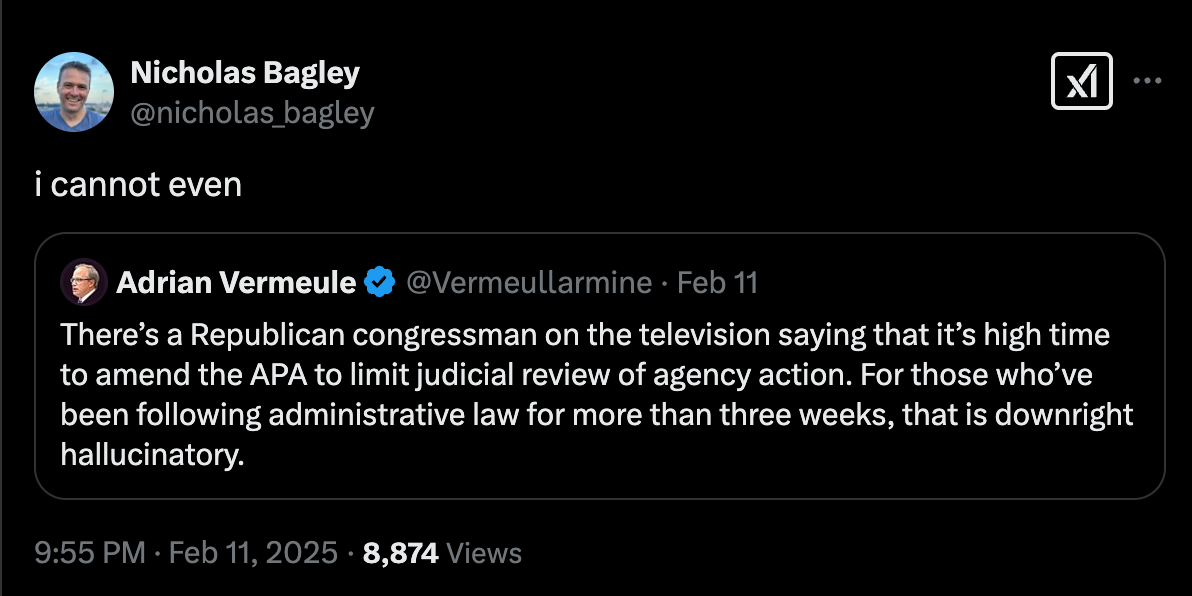
An interesting feature of the political moment right now, as you were tweeting about this is why we're talking in the first place. I saw a tweet of yours, is that you have this role reversal where you have Republican congressmen saying we need to find ways of limiting judicial review of agency action, when historically Republicans and conservatives have been the ones championing judicial review. On the other hand, you have Democratic lawmakers, you know, upholding judicial review as the last bastion of a free democracy is the kind of the last hope of stopping some of the worst, in their view, of the worst excesses of the Trump administration from becoming actual policy. How do you see the kind of ideological landscape shifting?
- [31:55]
Nick Bagley
Yeah.
- [31:56]
Unknown Speaker
So Adrian Vermeule is a Harvard law prophet who does administrative law, and he calls this the Merchant Ivory ballroom scene. The idea that it's like a Jane Austen movie and there's a dance where the parties are on each side of the wall and then they switch sides. And when they switch sides, everybody, of course, changes their position. And that's often what you see with administrative law, too, that people embrace the rules that they think will advance their team's agenda. I don't expect to see the conservative legal movement shift its approach to judicial review. I think they mostly distrust the bureaucracy to such an extent and degree that they prefer that judges that they've had a lot of success installing in the federal courts, that those judges are on the watchtowers. But it is interesting to see how, you know, see frustrations emerge when finally your guy is in power and the apparatus that you've helped create turns out to be a problem for him, just like it was for the last guy.
- [32:53]
Santi Ruiz
Nick, thank you for joining.
- [32:55]
Unknown Speaker
Happy to do it. Thanks for having me.