Loading summary
Transcript167 lines
- [00:04]
Jesse Martin
Ruby.
- [00:08]
Bill Lyon
In the 60s, you just didn't tell anybody that you were gay.
- [00:14]
Mick Peterson
And I found out who my friends really are. You find out.
- [00:18]
Jesse Martin
Okay, I'm gonna dig.
- [00:19]
Robert Reeves
This is juicy.
- [00:21]
Mick Peterson
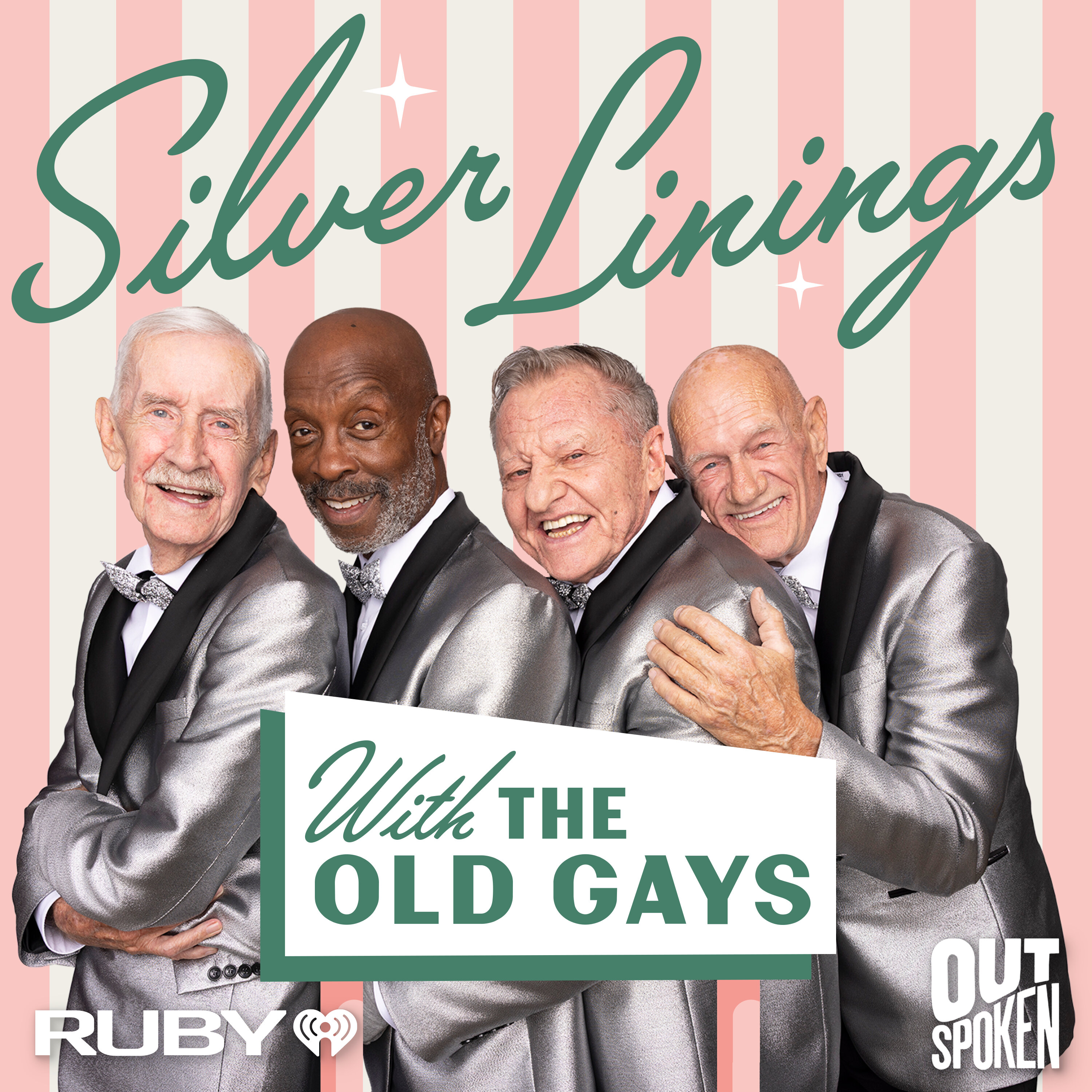
From just beyond the lights of Los Angeles in steamy Palm Springs, California, it's Mick, Robert, Bill, Jesse. And this is Silver Linings with the old gays. Friends, I have something to tell you. I'm gay.
- [00:43]
Bill Lyon
Oh, my golly.
- [00:45]
Robert Reeves
So what else is new?
- [00:47]
Jesse Martin
We must throw you a coming out party.
- [00:49]
Robert Reeves
Jesse, there is probably no better way to kick off Pride month on the show than to talk about the moment or are moments that have been part of our coming out of the closet, if you will.
- [01:05]
Bill Lyon
And while coming out can look like many things, like an internal experience or a terrifying conversation with a loved one, the tides have changed a lot since the days when we were first discovering ourselves. When we ask, when did you come out? And it makes it seem like you come out of the closet once and you're done. But oftentimes that's not the case. You may experience coming out over and over and over again to various people throughout your life. And the experience of coming out is far from a monolith.
- [01:44]
Jesse Martin
Before you come out to any of your friends, family, et cetera, you have to come out to yourself. So, boys, when and how did you realize you were gay?
- [01:57]
Robert Reeves
Well, for me, it was before grade school when I had this fascination with National Geographic stories about Indians and different tribal cultures. And also Sears catalog underwear section, which I was fascinated. Fascinated with. Cool.
- [02:25]
Jesse Martin
And you said I'm gay because I like the men in the Sears catalog.
- [02:30]
Robert Reeves
No, I. I just knew that I had a strong interest in men as opposed to women.
- [02:42]
Jesse Martin
What part of their bodies were you attracted to Robert?
- [02:46]
Robert Reeves
Well, I. Pecs were always nice.
- [02:50]
Jesse Martin
What about the pouch in their briefs?
- [02:54]
Robert Reeves
Those two?
- [02:55]
Jesse Martin
You never see a big bulge in a. In a Sears catalog, let alone, well, maybe a Calvin Klein.
- [03:01]
Robert Reeves
Yeah, well, over time, that has become more of a feature.
- [03:08]
Jesse Martin
So you're. You're a fan of Marky Marks?
- [03:10]
Robert Reeves
Yeah.
- [03:11]
Mick Peterson
International Male did too. They started teasing.
- [03:14]
Robert Reeves
Oh, yeah?
- [03:14]
Mick Peterson
Yes. Yes. I came out to myself, I think, at the age of 16. Even though I'd been with guys, I didn't know what to call it. I just like men. And I was happy.
- [03:26]
Bill Lyon
Well, I came out to myself in 1950, and I was six years old, and a movie had just come out called the Kid from Texas, which was about Audie Murphy playing the part of Billy the Kid. And my parents decided to take me to the movie. And at the end, of course, Billy the Kid was shot. And as we were leaving the theater, my mother looked at me because I was crying, and she looked at my father and said, this gun stuff was too much. But actually, the reason why I was crying was because they killed Billy the Kid, that cute, cute guy. And this rolled over also into the matinees at the theater on Saturday. When I had crushes on Hopalong Cassidy and Flash Gordon.
- [04:23]
Jesse Martin
I was in college, and I think it was my senior year, and I had. No, my junior year. Junior year. And I had a crush on a football player, and I was dating a girl. And I used to watch this guy all the time. I mean, he was six two, football player, blonde, blue eyes, and studying to be a doctor. I mean, you know, and I found this incredible sexual fascination for him. And I had had those before, and I had had sex with other guys before, but, you know, I was dating a girl, and I thought, well, I'll probably marry her. And. But it was such a strong, strong feeling, and it got to be so incredibly hard that I met a psychologist, and I went to see him, and I saw him for a session, and he explained some things about what it means to be gay and what it does not. And I left there feeling like this gigantic burden had been lifted off my shoulder. And then he invited me out to dinner, and we had sex, and it was great. Yes, I had sex with my psychologist.
- [05:29]
Mick Peterson
At dinner?
- [05:30]
Jesse Martin
No, after. After dinner.
- [05:33]
Bill Lyon
You were dinner.
- [05:35]
Mick Peterson
He was dessert.
- [05:37]
Jesse Martin
Well, you know, I was 22 at the time. On the other hand, he was 30. And so, you know, we were both babes.
- [05:45]
Mick Peterson
Yes.
- [05:46]
Jesse Martin
And so it was like this door had opened and I decided to walk through it, and that changed my life.
- [05:53]
Bill Lyon
Did it make a difference, the fact he was older than you?
- [05:57]
Jesse Martin
No, it's the fact that he had a big dick.
- [06:01]
Mick Peterson
Well, shut my mouth.
- [06:04]
Jesse Martin
He was very. He was very handsome. Very dark and handsome. Hairy.
- [06:10]
Mick Peterson
My question to y' all, do you come out the first time you have sex with a guy or do you come out later?
- [06:18]
Jesse Martin
Well, I think it's in. The explanation of before is that you experience coming out over and over and over.
- [06:25]
Mick Peterson
Yes.
- [06:26]
Jesse Martin
And it just. It's. It's a reinforcing experience. Now, if you have a negative experience, that can send you right back in.
- [06:33]
Robert Reeves
Well, in terms of announcing to the world or a group of friends, I. I never came out. For me, it was a gradual process, and I was just who I was. And when I look back, I realize that I exhibited a lot of the stereotypical characteristics of a young queer Child. I was artistic. I didn't like sports. I was good at school. I had effeminated characteristics, but nobody ever said anything to me. I never had a negative experience. I just was who I was. And fortunately, I grew up in an environment that accepted me for who I was.
- [07:37]
Bill Lyon
Well, I'm right along with Bob. I never came out or told my family that I was gay. To me, my coming out was when I first had sex with a man. And that was when I was 16 years old and had just gotten my driver's license and drove down to Laguna beach, plunked myself down and had sex with the guy at his place.
- [08:06]
Jesse Martin
When did you come out to your family?
- [08:09]
Bill Lyon
We've never had a discussion about it. I moved to San Francisco when I was 21 years old, and that got me away from all of my father always trying to accuse me of being gay.
- [08:24]
Jesse Martin
But if he had accused you of being gay and you said, yes, I'm gay, what would have happened then?
- [08:31]
Bill Lyon
I have no idea.
- [08:32]
Mick Peterson
What do you think would have happened?
- [08:34]
Jesse Martin
Yeah, what do you think would have happened?
- [08:35]
Bill Lyon
They'd have sent me to a psychiatrist in Beverly Hills.
- [08:39]
Jesse Martin
Oh, that's a fun experience. And they spent money for it. That's how parents destroy children, you know?
- [08:45]
Bill Lyon
Yeah.
- [08:45]
Jesse Martin
Yeah. Okay. Bob, you never came out. You never said I'm gay.
- [08:51]
Robert Reeves
No. It was not until I was in my twenties in the business world that I ever really kind of announced to the world that I was gay. But.
- [09:06]
Jesse Martin
Okay, so you were in a business situation in the Bay Area?
- [09:11]
Robert Reeves
No, this was in St. Louis.
- [09:14]
Jesse Martin
Okay, okay. So you've told me before in Times, and we've discussed it, that St. Louis at that time was pretty homophobic.
- [09:22]
Robert Reeves
Oh, yeah. The gay life was very much undercover. You had to really seek it out, know where it is. And in the 1970s, along with my first lover and friend, we had bought real estate that we were operating. And I became provoked by an incident in which I started running ads in local newspapers that responsible tenants welcomed regardless of race, beliefs, or orientation. And that really was the first public gesture I ever made.
- [10:18]
Jesse Martin
Okay, I'm going to dig. We're going to go. This is juicy. And what happened when you did that?
- [10:25]
Robert Reeves
Well, the president of a bank that we were doing a lot of business with came up to me and told me that, you know, there are a lot of people in this community that are very concerned about your policies. You might want to give consideration to changing them. Otherwise, we'd hate to see you lose everything you built up to this point in time.
- [10:59]
Jesse Martin
So they threatened to withhold. It must have been a banker.
- [11:02]
Robert Reeves
Yeah.
- [11:03]
Jesse Martin
Okay, so he threatened to withhold funds from you because you were renting out to homosexuals.
- [11:11]
Robert Reeves
Publicly renting out.
- [11:13]
Jesse Martin
Okay. Is that what drove you out of St. Louis and why you decided to move to San Francisco?
- [11:18]
Robert Reeves
It was one of the factors. There were also personal issues relating to the breakup of my second lover.
- [11:28]
Jesse Martin
Okay. I'm not going there.
- [11:30]
Robert Reeves
Good.
- [11:31]
Jesse Martin
Okay. Just say, what's your biggest surprise about coming out to people?
- [11:35]
Mick Peterson
The biggest surprise was those who asked. I always told them yes, and I never lost a friend. And you won't lose your friends because they know you as your individual self, religiously or not. That's where I was in that wonderful world of church, where you're supposed to love everybody, but they got the hate going on. But it was scary. The hardest one was coming out to my mom simply because I loved her and didn't want to hurt her. But I hurt her by not saying anything because she just says, you know, baby, I could have been there for you. I says, I had to do it on my own.
- [12:13]
Bill Lyon
Mom.
- [12:13]
Mick Peterson
I says, I came out at the right time because she kept asking me when I'm getting married, and I was already in a relationship. My dad, on the other hand, thank God he was deceased because he truly would have killed me because he threatened to do that if I was a queer.
- [12:28]
Robert Reeves
Yeah, I think it's much easier now because there are so many public role models that young people can look to. And just seeing and knowing that there are a lot of people like you makes it a lot easier.
- [12:51]
Bill Lyon
I think in the 60s, you just didn't tell anybody that you were gay. I mean, it would have. It would have been the end of me in high school. But when I moved to San Francisco and in the 70s, there was a. There was kind of a push for people to come out of the closet. And I. I don't know if that worked or not, but all of a sudden, there was a lot of people that came out.
- [13:25]
Jesse Martin
Yeah, I basically came of age in the 1970s. One of the first things that if you were to attend a meeting of gay rights activists is that they stress the fact that you need to come out to your family, that love begins in the family, and that's where acceptance is going to start. I think also we have to look at the effect of the HIV AIDS epidemic and the fact that, at least in this country and at that time, people were showing a lot more empathy for gay people because of what they were going through. And it also had to do with families who were losing their gay children, even those who rejected their children. Can you imagine the guilt that they must feel now that they have dead children not helping them just because they wouldn't accept their sexuality? Think about that.
- [14:19]
Mick Peterson
Yeah. And it still is going on. It's hard because of those kids or adults who are in small towns that still have to play the game.
- [14:28]
Robert Reeves
Yeah.
- [14:29]
Bill Lyon
And one of the saddest things that I remember happening, and it is still happening, is if you had a partner and the partner died, the family would step in and literally push you out of the way. And that was very, very sad.
- [14:50]
Jesse Martin
And take your money.
- [14:51]
Bill Lyon
Yeah.
- [14:52]
Mick Peterson
That's why paper works for me.
- [14:54]
Jesse Martin
Yeah. You know, when. When I was still with my partner, we created interlocking trusts, and the first thing we did was disinherit our families.
- [15:04]
Mick Peterson
Yeah.
- [15:05]
Jesse Martin
And that's because the lawyer said, you know, when a person dies, people get a little funny. They think they're entitled to something that they are really not. A lot of people. I remember who their partners died, and because there's no marriage contract, because that relationship was not recognized by law, the family of the deceased could sweep in and take everything. And I think that is morally repulsive.
- [15:40]
Mick Peterson
It is, yeah.
- [15:41]
Jesse Martin
Now that I've got off my soapbox. When we think about the evolution of the gay rights movement, changing the landscape for coming out, many efforts laid the groundwork. Thanks to the efforts of the civil rights movement, the road was being paved for LGBTQ rights.
- [16:00]
Robert Reeves
Yes.
- [16:01]
Bill Lyon
Yes.
- [16:01]
Jesse Martin
You all agree with that?
- [16:02]
Robert Reeves
I do, absolutely. And there was a noticeable societal change taking place in the late 70s, early 80s that you had the feeling that things were loosening up.
- [16:23]
Jesse Martin
Well, I kind of look back. You know, the first gay rights demonstrations that I saw were in New York City, really, in the late 60s. It coincided with the women's rights movement and also with the civil rights movement. And a lot of the tactics were the same. That's what I think is important, because there are a lot of people in the civil rights movement who were not supportive of gay rights.
- [16:47]
Robert Reeves
Isn't that when Stonewall happened?
- [16:51]
Jesse Martin
Well, that was 1969. Yeah.
- [16:53]
Bill Lyon
Yeah, yeah.
- [16:54]
Jesse Martin
Okay. This is something that I thought was an interesting subject. Code switching. It's not always safe to come out, unfortunately. We may need to slide back into the closet from time to time and not just for another fabulous outfit to wear. Has there ever been a time when you've had to stay in the closet to stay safe? Now, just to define what code switching is, the practice of changing how you express yourself to fit in with A given social context.
- [17:29]
Mick Peterson
Oh, yes. I had to. I had to de. Sissify. I know it's hard for you to believe. When I was younger, you know, dating. Dating a wonderful woman, I had to kind of macho it up a little. It was hard, too. But I had to do it to protect myself until. And I didn't want anybody to know because I hadn't come out to my mom yet.
- [17:57]
Bill Lyon
You know, I never had the problem of having to butch it up at work or stay in the closet because almost all of my bosses were gay. So I had a lot of freedom just to be myself. And I thought of myself, first of all as a person and secondly as someone gay.
- [18:18]
Jesse Martin
And during this time that you lived in San Francisco, did you ever visit your family?
- [18:23]
Bill Lyon
Oh, yeah.
- [18:24]
Jesse Martin
And did you change your behavior to fit that situation?
- [18:29]
Bill Lyon
No, I was always Bill. I've always been myself.
- [18:34]
Jesse Martin
Okay. You just never admitted to your family that you were gay.
- [18:40]
Bill Lyon
I'd like to put a different way. It was never discussed in my family.
- [18:49]
Jesse Martin
Well, yeah, but your. Your relationship with your father.
- [18:53]
Bill Lyon
Yes, it was. It was poor.
- [18:57]
Jesse Martin
But did. Did he ever accuse you of being gay?
- [19:00]
Bill Lyon
No, he never accused me. He was always trying to prove that I was gay. It's probably the same.
- [19:10]
Mick Peterson
It is.
- [19:11]
Robert Reeves
I do not ever recall pretending I was straight.
- [19:16]
Jesse Martin
Okay.
- [19:17]
Robert Reeves
It was impossible.
- [19:19]
Jesse Martin
Well, vein, I responded to this whole section here by asking a question. When has staying in the closet ever been safe? You live with the fear of being outed either by a circumstance or someone else and means that you don't have control of your life. If you're sitting in the closet and you're afraid that somebody is going to out you, you don't have control of your life. Think of all those people in Uganda or Nigeria who if they say anything about being gay, they will be murdered still. Yes. And that's happening in Russia.
- [20:05]
Mick Peterson
Yeah.
- [20:06]
Jesse Martin
Okay. So code switching to me is the opposite of being authentic. It's really an excuse to lie. And I will say lying is a big problem for us because we learned to lie at a very early age, and that was impressed upon us. And that is a problem when you deal with other issues such as alcoholism, substance abuse or gambling. And so that's my take on that. That's very serious. But that's how I feel.
- [20:45]
Robert Reeves
Yeah. And I think in today's world that young people as well as everyone are getting so many negative signals. And my fear is that this is going to shape future generations in a very negative way.
- [21:11]
Jesse Martin
I remember coming out after I came out in college of course, I was in the theater department. And so I came out to two people who I suspected might be, and they came out to me. And for once, you know, I felt that, wow, I have company in this. And not to say that things were easy because there were a lot of people in the theater department who were very much against this. In fact, later on, I was told by an agent that if I was going to continue to have an open relationship with my lover, I could just give up show business because no one was going to hire me.
- [21:50]
Mick Peterson
Yeah, they had to hide a lot more back then.
- [21:53]
Jesse Martin
Yeah. You know, it's different now. It's really different now. Yeah.
- [21:57]
Mick Peterson
And it's because of us.
- [21:59]
Robert Reeves
Yes.
- [22:00]
Bill Lyon
Yeah.
- [22:01]
Robert Reeves
Which I feel good about. Yes, I do too.
- [22:07]
Bill Lyon
We'll be right back after a quick break.
- [22:19]
Mick Peterson
Welcome back to Silver Linings with the Old gays.
- [22:24]
Robert Reeves
We've been talking about the idea of coming out as it pertains to sexual orientation. But we often have to come out as many identities throughout our lives. If we differ from social norms, our interests, our religious beliefs, our backgrounds, disabilities, preferences, etc. What's something else that has driven you to come out?
- [22:59]
Jesse Martin
I'll start on my disability. I have a very rare autoimmune condition called chronic inflammatory demyelinating polyneuritis. And what that means is that the white blood cells are attacking the coating that's around the nerves and the result is numbness, tingling, pain, fatigue, early death. You know, if it wasn't for the drugs that I have been prescribed and especially this new compound that I've been prescribed, I would not be here.
- [23:38]
Robert Reeves
So that's the story of HIV during the 80s and early 90s is that you found yourself being afflicted with a disease that had no known cure and really no treatment. And so we all grew up in that world.
- [24:07]
Jesse Martin
Yeah, I think that was the motivation for a lot of people to come out. You know, if you're sick. I know of a lot of people, though, who were very sick who never admitted they were gay. They never admitted how they became infected. And that was part of the problem. And it's still part of the problem now, because if you're in denial about your sexuality and you're going out to the baths or going out to the local park, or you're hooking up with somebody on Grindr and yet you don't really know who you are, you're going to get yourself in trouble.
- [24:45]
Robert Reeves
I also think that the anger so many people had during the 1980s about the non existence of any effort to try to combat or deal with the disease that so many people felt like, well, if I'm going to die from this disease, then I. I don't need to fear being killed because people know I'm gay. So that forced them out into the streets in large numbers, and it brought on the wave that has happened in the later 80s and 90s.
- [25:32]
Jesse Martin
Yeah, I remember one of the first marches I participated in was for support of the Ryan White Care act, which was in Congress at time. And it was a march down Wilshire Boulevard in Westwood all the way to the federal building. And I have never seen so many hot looking guys. Of course, a lot of them are gone now, but I never seen so many hot looking guys in my life. And just demanding that, that Mr. Reagan acknowledge that AIDS exist and support this bill, that was very important. And I think that's the first time we understood that we had not just power in numbers, but we had a moral cause.
- [26:23]
Robert Reeves
We all share the experience of coming out during a time when it was incredibly dangerous. Unfortunately, we're living during a time when there's been increasing backlash against the LGBTQ community, especially our queer youth. What's your advice for a young LGBTQ person who may be feeling like they're stuck in the closet?
- [26:58]
Bill Lyon
My first advice to them is don't force yourself to come out. Wait until you're comfortable. And the main thing is if you have a peer that you can talk to and if they can just build up a rapport with someone, it's going to make a lot easier for them to come out. And so wait until you're ready to come out and don't force it.
- [27:26]
Jesse Martin
Yeah, I have some advice. You are not alone. You are not alone. You have four friends right here rooting for you. So go online if you have a computer, or look for a community resource, because there are a lot more now than there were when we were growing up. A lot. But most of all, you must have courage. You must have courage to define who you are. Otherwise, someone else or an unplanned event will do it for you. I know it'll be hard because it was hard for all of us, but you will open a door to a new path in life. It's not going to be roses. It may not even be better. You know, I thought when I first came out that, oh, we're all gay people and we all love each other, but you were on the way to being who you are. So that's what I say to you.
- [28:28]
Robert Reeves
I would like to add that I believe that when you're trying to teach to others the world where you're coming from, try not to provoke people because by provoking you're going to elicit a negative response. And it is better to lead by example and by doing good and by being gentle as you can in what you have to say that it'll be more likely that people will listen to you and will be gentle with you.
- [29:21]
Mick Peterson
Okay. I found it hard coming out to our gay community because of the racism that's still in here. There's racism in our gay community where we don't support each other. And there were doors that were shut in my face because as an African American, black gay man, they didn't want me. You didn't want me in your bars, you didn't want me anywhere around you. And we need to be a team and fight together because we're all in this thing together. And it still goes on is just different now.
- [29:53]
Jesse Martin
Yeah, I've seen that.
- [29:54]
Mick Peterson
And black men, I mean, our community's rough and we should get it, you know, from our history. We should be there for each other. And a lot of times we're not. We can't unite.
- [30:08]
Robert Reeves
Yeah. And now it's becoming even worse because Hispanics are being demonized globally. I just. Yeah, those who are being maligned, we've got to stick together.
- [30:30]
Jesse Martin
Okay, so that brings up the final question. Clearly a lot has changed since we were first peeking out of the closet. We talked about a stat that recently found that over 25% of Gen Zs identify as queer. With this increased visibility, it begs the question, do we live in a post coming out world?
- [30:55]
Mick Peterson
No.
- [30:58]
Jesse Martin
Yeah. No. And I'll say this. We are always going to live in a coming out world because there are always going to be forces, as they are now, to push back. Look, if you apply for a passport or you get a new passport, you either have to identify as a male or a female. Okay. Not anything else. And I think that is wrong. And I think we will pay for that because you are excluding a group of people. And when you do that, you go down a very slippery slope. And before you know it, you don't have any freedoms in this country. That's the canary in the mind.
- [31:42]
Mick Peterson
It is.
- [31:42]
Jesse Martin
And so is it still necessary to celebrate the idea of coming out?
- [31:49]
Mick Peterson
Yes.
- [31:51]
Jesse Martin
Yeah. My response was what? And give up parades?
- [31:56]
Bill Lyon
I was thinking about a big party.
- [31:59]
Jesse Martin
Yeah.
- [31:59]
Robert Reeves
I was thinking of gay pride parades.
- [32:03]
Jesse Martin
Those are times when we meet as a community and that, you know, we do show unity. And so it's very important to attend a parade, attend a gay pride festival. Because it shouldn't be a gay pride festival. It's a queer pride festival. You know, just as you know, we no longer have leather parties. We have fetish parties.
- [32:28]
Mick Peterson
Ooh. All right, boys, we're reaching the end of today's episode. Since this show is called Silver Linings, think back on our conversation. What is the silver lining you took from coming out of the closet?
- [32:50]
Bill Lyon
My silver lining is that I never had to go through coming out to my family, and then I started bringing boyfriends home, and there was actually no comments at all.
- [33:02]
Jesse Martin
The silver lining that I took is that I took the road to being authentic. I took the road to being my true self. And that means the good and the bad and everything in between. And I've been the better man for it.
- [33:18]
Mick Peterson
And I found out who my friends really are. You find out. And luckily, I've been blessed to not lose any.
- [33:26]
Robert Reeves
Not only do you find out, but the bonds you have with the people you know who are your friends are stronger.
- [33:35]
Mick Peterson
Yes. And they realize that. It's just not. I don't know why people think we have sex 24 7. You know, it's like too tired. But some do.
- [33:44]
Jesse Martin
Oh, I wish.
- [33:48]
Robert Reeves
Girl, there was a time.
- [33:53]
Jesse Martin
Things would be so much better in the world, Wouldn't it, love?
- [33:56]
Mick Peterson
Please. Yes. That's all for today on Silver Linings with the old gays. Silver Linings is a production of Iheart's Ruby Studio and the Outspoken Network. We're your hosts, Bill Lyon, Jesse Martin.
- [34:13]
Robert Reeves
Mick Peterson, and Robert Reeves.
- [34:16]
Mick Peterson
Our executive producer is Sierra Kaiser. The episode was written by Ryan Amador with post production by Eric Zeiler. Our theme music was composed by Max Hirschenau with audio, direction and design by Matt Stillo. And if you're having fun with us, please subscribe to follow along. And don't forget to rate and review the show wherever you get your podcast. Thanks for listening. See you in two weeks.
- [34:45]
Jesse Martin
She has not achieved diva status yet.
- [34:49]
Mick Peterson
Soul Train baby.
- [34:51]
Jesse Martin
Yeah.
- [34:53]
Robert Reeves
What the hell is a chewy.