← Stronger with Don Saladino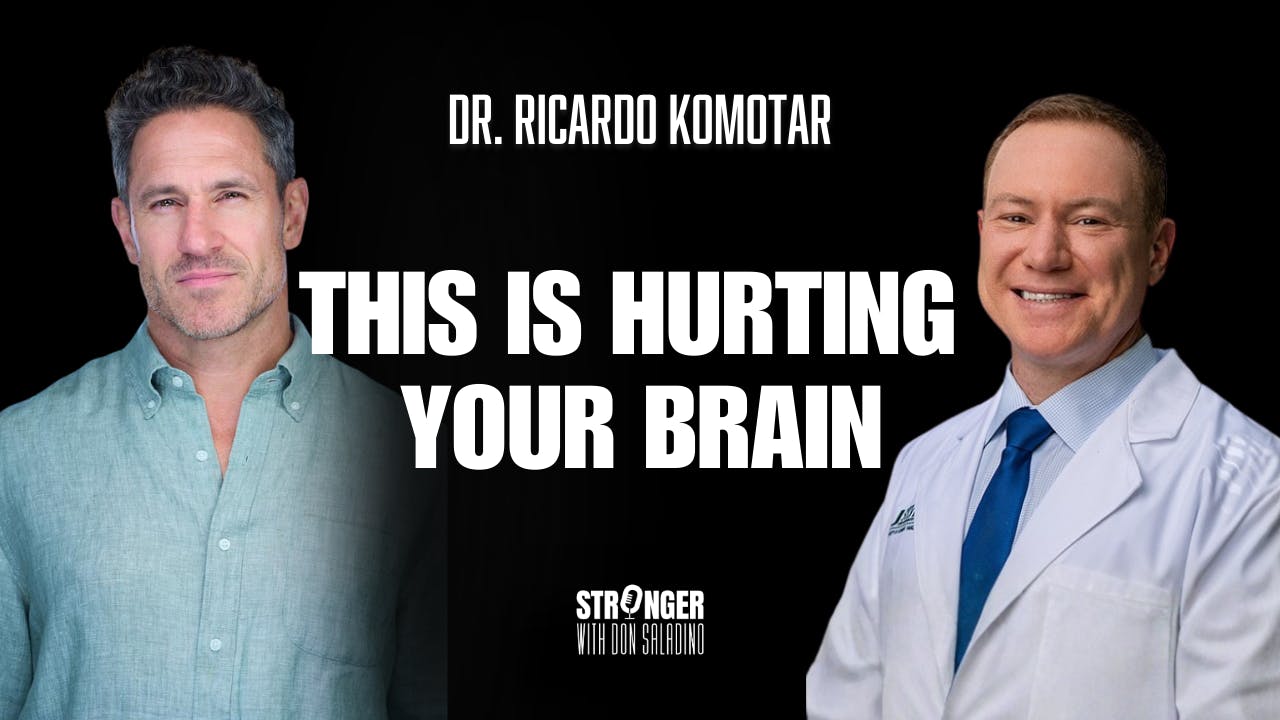
Stronger with Don Saladino
This Is Hurting Your Brain - Dr. Rick Komotar on Nutrition, Training, and Recovery
00:45:03
Loading summary
Transcript150 lines
- [00:01]
Commercial Narrator
Start your day with Quaker Protein Instant Oatmeal. The Instant Oatmeal ready to help you tackle whatever your day brings. Like wrangling your toddler into their car seat. That was fun. Coaching your sixth grader soccer team. Go Girls. And carrying all the groceries in one trip. Try Quaker Protein Instant Oatmeal Granola and bars. Great taste and a good source of protein. Quaker Bring out the good.
- [00:31]
Get in the game with the college branded Venmo Debit Card. Wreck your team with every tap and earn up to 5% cash back with Venmo Stash, a new rewards program from Venmo. No monthly fee, no minimum balance, just school pride and spending power. Get in the game and sign up for the Venmo debit card@venmo.com collegecard the Venmo MasterCard is issued by the Bancorp Bank NA Select Schools available Venmo Stash terms and exclusions apply at venmo me stashterms max $100 cash back per month.
- [01:00]
Podcast Host
All right guys, back with another episode of the Stronger podcast. I just had the privilege of being able to interview Dr. Rick Komatar. Dr. Komatar is a friend, he's Miami based and he is a brain surgeon. And it was so fascinating to hear, you know, the type of brain surgeries that he performs, mainly brain tumors, but the relationship between nutrition and training and the health of your brain. He's brilliant. He has a, I just want to say, one of those professions that he wakes up every day and just says thank you for allowing me and giving me the privilege to do this. But I know from Rick that his first surgery ever felt like his surgery that he performed yesterday. And he does about four to six a day. So really impressed by his willingness to his improve his own fitness and wellness journey over the last, you know, several years that I've known him and it's fascinating to see what he's done and what he's going to do. But I think you guys are going to want to listen to this episode. Whether you're interested in brain health, this is to be a good one for you. Enjoy. So the Stronger podcast would not be possible if it weren't for our sponsors. And I'm so proud to announce that Masterclass is now one of our sponsors. This is like a total bragging right here. Masterclass. Thank you guys. With Masterclass you can learn from the best to become your best. And I'm very proud to say that my friend Joanna Gaines, one of the producers of the Stronger podcast, is on Masterclass Also my friend Evie Pompeura. So incredible people. You can jump into a mind of an ex secret service agent. You can jump into the mind of a professional athlete and learn about their craft. I think this is extraordinary. I think it's fascinating. I think it's one of the best educational tools out there. With plans starting at $10 a month, build annually, you get unlimited access to over 200 classes taught by the world's best business leaders, writers, chefs, and more. 10 bucks a month. That is a very low investment. Here's a few classes that you could check out right now. Negotiate your next raise with lessons from super agent Rich Paul or FBI negotiator Chris Voss. I would also throw Evie Pompous in there. One of my favorites. Apply the principles of improv to your life with Amy Poehler. Design your dream home on your budget with the one and only, the best Joanna Gaines, one of my good friends. And the classes really make a difference. Three in four surveyed members feel inspired every time they watch Masterclass. I know I do. Right now, our listeners get an additional 15 off any annual membership at Masterclass.com stronger. That's 15 off at Masterclass.com stronger. Masterclass.com S-T R O N G E R Guys, thanks. So I'm here with my friend Rick Comatar, your brain surgeon, which is. It's always. It's a very interesting thing to say because people are like, well, it's not brain surgery, right? Like, it's always the line, like, you gotta be a smart person to be a brain surgeon. I'm very intrigued with the brain. I just think that so many people are so infatuated with the muscle for, with performance. But I think this all derives from up here 100%. What, what made you want to. A little backstory. Talk to me about how, why, why, like, how'd you, how'd you do this? I mean, now you're coming up to New York, you're speaking at Columbia, you're staying at the Harvard Club. You're up in, you know, you live in Miami. I mean, you know, you're, you're dressed, you're fit, you're, like, living the life. You know, you're, you're leading by example. Like, it's not just about being a brilliant surgeon. It's about, you know, you focus on everything from the training to the recovery. You're, like, interesting in my book because I think a lot of doctors, a lot of surgeons don't focus on those ends. They're like. I know it seems like I'm all over the place, but I'm excited. And it's just because most people I'm around in your situation are like, great in this one area and they're not good in these other areas.
- [04:55]
Dr. Rick Komatar
So, I mean, I think they all tie together, right? You know, I think, you know, back to your first question. Why brain surgery? I mean, it's the greatest job on the planet. I've wanted to do it all my life since I was in ninth grade. Just the idea of operating on someone's brain, to me is the greatest privilege, it's the greatest honor, it's the greatest profession you could ever do. And the satisfaction when you are good at that job is like nothing else. And then the other parts, you were saying about performance, I think whether it's brain surgery, whether it's professional athletes, whether it's law business, it doesn't matter. To be the best at what you're gonna do to reach your peak performance, you gotta take care of your mind and your body. And I preach that to all of our residents, all of our fellows. It starts here. But you gotta take care of your body. You can't do what we do every single day and do as well as you're possibly gonna do without taking care of your body. Sleeping right, eating right, working out. Those are things that I preach all the time. And I definitely feel like it's gotten to me. It's gotten me to where I am now is taking care of myself. And ultimately, success starts up here, just like you said, you know, whether it's physical, it all starts here. It's all with your mind. It's all having a goal, being driven and really no excuses. And at the end of the day, having that grit and really having that resilience to get there.
- [06:15]
Podcast Host
I mean, there's no room for error in this position. This isn't like you can throw, you know, you can walk a hitter, let up a home run. Like you're in a profession right now where it's serious. Like any. Any wrong move, or if you're coming in and you're hungry, hungover from the night before, or you were out partying, like, that doesn't really work in your line of work.
- [06:35]
Dr. Rick Komatar
There's very little margin for error. There can't really be bad days. And I think that's where the job becomes extremely tough. Because we all have bad days, right? We all have days where you wake up and you're like, just don't feel like getting after it. And that's normal, that's human. But in this type of profession, you owe it to the patient to bring your A game every single day. And that goes back to the physical part. You gotta take care of yourself because the stamina of it is a critical component. You're getting up early, you're operating, you're getting home relatively late. If you don't take care of yourself, you're gonna break down and you're gonna have terrible days, which ultimately not only impacts you, but also the patient. And so it really is a service run industry and you have to bring your A game every single day. Mentally and physically.
- [07:21]
Podcast Host
There's also a trust. Think about the trust the patient has in you. You know, they're meeting you for a couple consultations, they're now going under the knife and they're out. It's like, hey, doc, I trust you. I have to trust you. Do a good job. The level of stress has got to be incredible. Is that something that you've learned to deal with or is that just something that you feel stressed every day? I mean, how do you deal with that?
- [07:49]
Dr. Rick Komatar
It's like anything else. It really becomes routine. And I hate to use that word, routine, because it is brain surgery. And I always tell myself, you go to work, and I typically do between four and six brain surgeries a day. And it becomes routine in the sense that for me it's another day. But I always tell myself it's another day for me. But it's life changing for a patient and their entire family every single time you operate on them. And so you owe it to that patient to bring your A game. But you also have to remember, like, managing that stress is very, very important. And that all goes back to eating right, sleeping right, working out. And every time I see a patient in the office, they're obviously incredibly nervous, right? They're seeing a brain surgeon, they're gonna have their head opened up, they're not having a bunion removed. And I always tell them it's fine for you to be nervous. It's just important that I'm not nervous. And that's the key. Cause I go into every surgery knowing that at this point, I've done so many of these that I feel very, very comfortable doing the surgery. And I know that I'm the best for this job.
- [08:56]
Podcast Host
So I want to get into your regimen, I want to get into the performance aspect and I want to give everyone a little bit of a taste on the things that you like to work on. But when you talk about brain surgeries, can you talk about the range of Types of surgeries give everyone a little bit of a taste and the things that you have to deal with daily.
- [09:13]
Dr. Rick Komatar
So I focus on brain tumors. I do exclusively brain tumors. I don't do other conditions like strokes or aneurysms or trauma or spine, all parts of neurosurgery. I do exclusively brain tumors, which is really nice because you become a true expert in your field. And I tell people I know 0.001% of medicine, but that 0.001%, there's no one in the world who knows more than me. So you become a true expert in one particular condition and you focus on that.
- [09:44]
Podcast Host
So brain tumors, I mean, obviously this could be catastrophic or this could be things that you probably had an incredible level of success with and have been able to do something that most people thought couldn't have been done. I mean, do you have any stories you can share with us without sharing names?
- [10:00]
Dr. Rick Komatar
I mean, it's not necessarily one story. I mean, I can just tell you that the feeling of whether it's a benign or a malignant tumor, because we deal with both of those. When you go and you help someone and you change their life, they can, you know. So for example, right, we do surgeries where there's a pituitary tumor and it's pushing on the optic nerves. And people go blind with those types of tumors. You operate and they can see. You take out tumors that are on the motor cortex. That's the part of the brain which controls movement. You take it out and they can walk again. It doesn't happen every single day, but, but you're doing this routinely where people can be changed. And that's an unbelievable level of satisfaction. Now the counter to that is not every surgery works out great. Obviously there's always complications. And the same thing that makes neurosurgery the best profession on the planet also makes it the worst. Cause when you hurt someone, that is just one of the worst feelings on the planet. And you do everything possible, you can do everything perfect and people can still have complications. And now you've got taken their ability to see and you've taken their ability to walk. And so it really is a double edged sword. You take the good with the bad. Fortunately, there's way more good than there is bad. But when the bad happens, it really hurts.
- [11:18]
Podcast Host
Talking about the different types of tumors out there, you're talking about benign or malignant, obviously one being not as big of a deal, let's face it, in your history, why did these occur? I know it sounds like A really crazy, and it's a very basic bare bones question, but how does this occur on one person and not the other? I mean, we talk about things that are environment and diet, and maybe it's all the above, but have you noticed any type of trend or anything that's pointing in the direction that can make people who are listening to say, maybe I want to avoid doing those things, or maybe I want to change my environment or the people I'm around? I know this sounds like a really basic question, but.
- [11:58]
Dr. Rick Komatar
No, I mean, it's not basic. And we're still looking for the reason why most brain tumors occur. There's really not a rhyme or reason to it. The vast majority of tumors occur for unknown reasons, and they just happen. Which is why the other day we were talking about, you got to live your life right. You can't. At the end of the day, you could do everything right, and you could have the best diet, the best workout, sleep, and you can still get cancer and you can still get a brain tumor. And so we don't really know why these brain tumors happen, but even the benign tumors can be a very big deal, because a benign tumor in a bad spot can kill you.
- [12:33]
Podcast Host
What do you think? I mean, have there been surgeries that you've left and said, wow, that was. That was interesting? Like, are you going into the surgery not fully understanding the full picture? Because, you know, imaging can tell you one thing, and then maybe as you're unwrapping it, you're saying to yourself, man, this is not there. There are other things in here that are unraveling.
- [12:53]
Dr. Rick Komatar
So the best surgeries for me, the ones that I enjoy the most, are the awake surgeries. So why is that? Because the patient's awake and you're examining them and you're talking to them at the same time. That's pretty cool.
- [13:04]
Podcast Host
Wow.
- [13:05]
Dr. Rick Komatar
So when a tumor is involving a critical part of the brain, whether it's movement, whether it's speech, you have to do it awake to know what you can take and what you cannot take. And so you will open up the head. The patient will be asleep during the opening. You then wake them up. You're looking at the tumor and you're looking at the brain interface. The patient's awake. You start whether it's language or whether it's movement, you start testing them, and you have a neurologist there in the operating room testing them. You can stimulate and figure out what brain is truly eloquent, meaning working on speech or working on movement, and which is not Eloquent. You can take the non eloquent, but you can't take the eloquent, or else you leave them with a speech deficit or weakness. And so during surgery, a lot of times, you'll look at the MRI and you'll say, well, this tumor is involving speech. There's no way we can get more than 10% of it out. And then during surgery, you'll figure out that over time, this tumor has grown and the patient's brain has changed. There's something called plasticity, where what you think is speech is actually not speech. It's moved over time, and. And so you can take a lot of the tumor out, if not all the tumor out. So those are great surgeries because the MRI tells you one thing, and your experience and your education tell you something, but nothing is as definitive as what is in the operating room when they're awake talking to you.
- [14:24]
Podcast Host
So you're in that environment sometimes, and you might just turn up and be like, oh, my God, this is really good. Does it happen?
- [14:31]
Dr. Rick Komatar
I frequently tell my fellows in Residents like, this is the coolest shit on the planet. I literally, all the time in the or, like, we'll be doing a surgery and something will work out in our favor and we're able to get out more tumor, and the patient's exam is great. And I just turn and I'm like, I've done this about 10,000 times. It never gets old. It's unreal. You know, we have to get you to the operating room sometime. I have observers all the time. I have people come to the operating room all the time. Next time you're down in Miami, you let me know and we'll get you in the operating room for an awake craniotomy. Just don't pass out on me.
- [15:03]
Podcast Host
No, no, no, I won't pass out. It's one of those things I've never. You know, I've been around cadavers. I haven't been around an actual real surgery. I just don't know. I think I can handle. I'm not gonna pass that. I don't think. I'm not gonna get sick.
- [15:19]
Dr. Rick Komatar
Well, you should come. Another option is to do a podcast in the operating room.
- [15:23]
Podcast Host
That would be interesting. I mean, is that even legal?
- [15:26]
Dr. Rick Komatar
Well, we would have to get consent, obviously, but I've had.
- [15:29]
Podcast Host
Does that distract you? I mean, no.
- [15:31]
Dr. Rick Komatar
I've had media in my.
- [15:32]
Listener/Caller Erin
Or.
- [15:32]
Dr. Rick Komatar
I've had cameras. Not at all.
- [15:34]
Podcast Host
I just don't want to be. I would have to be there. Very cool. And just say this Is amazing. Are you talking while you're going through surgery?
- [15:42]
Dr. Rick Komatar
I'm just correct. So for those types of surgeries, we're talking to the patient. Myself, my team, the neurologist. Anesthesia is talking to the patient while they're having their head opened up and while we're taking out the tumor. That's interesting. And it's amazing because you can have great conversations with these patients, and they're completely coherent. I mean, they're under. It's like you're getting, like, a colonoscopy. Like, you're awake. They don't remember it. They're in no pain, and they're super comfortable. But a lot of times, you know, it's like, in. It's like. It's like what happens in Vegas stays in Vegas. Like, they'll talk. They'll definitely talk.
- [16:16]
Podcast Host
Yeah.
- [16:17]
Dr. Rick Komatar
And, you know, fortunately, their family's not listening sometimes.
- [16:19]
Podcast Host
Yeah. I'm about to say, I mean, I love my colonoscopy experience. People are like, oh, I gotta tell you how well I was. Like, it was the best nap I've ever taken in my life.
- [16:27]
Dr. Rick Komatar
Oh, dude, that was the best propofolk. The greatest thing I'm.
- [16:29]
Podcast Host
I was like, why can't I go to bed every night like this? I literally. They were like, count to 10. And I think by the time I was at 6, I was out.
- [16:37]
Dr. Rick Komatar
The propofol is amazing.
- [16:38]
Podcast Host
The guy was talking to me about skiing, and I was like, six. And the next thing you know, I just woke up, and I was like, oh, my God.
- [16:42]
Dr. Rick Komatar
I feel. Yeah. I mean, like, after mine, they woke me up, and they were like, how is that propofol? I'm like, amazing.
- [16:48]
Podcast Host
It was amazing. The mistake I made was it was on a training day. The doctor's like, listen, you gotta take it easy. I was like, okay, sure. And I ended up going and doing cardio and, like, going back to my eating, and the next thing, I was like, puking. Yeah. This episode, I'd love to thank Warby Parker for a few reasons. First off, and I'm in a dark room. Check these out. These are just awesome. And I was never one to order sunglasses online. I always felt like I had to go in and try them on and not the case. I just feel like every pair I put on just makes me feel good. So when I found out Warby Parker was going to sponsor the podcast, at first I thought they wouldn't apply to me because I don't need a prescription. But Warby Parker doesn't just offer incredible prescription glasses. They have everything you need for happier eyes. That includes contacts, online eye exams, and sunglasses, which is what I went with. Another thing that I love about Warby Parker is that for every pair they sell, they also give a pair to someone in need through its buy a pair, give a pair program. That's special. I mean, that's just that in itself wants you to buy. I would buy from them even if I didn't like them. Thank God I like them. So feeling good about your purchase just got a lot better. Our listeners get 15% off free shipping when they buy two or more pairs of prescription glasses@warbyparker.com stronger. That's 15% off when you buy two pairs of glasses at W A R B Y Parker. P A r k e r.com stronger. After you purchase, they will ask you where you heard about them. Please support our show and tell them you heard it from me because I love these glasses and I want to keep working with these guys. Thanks a lot. I'd like to thank David protein bars. David protein bars are not like any other protein bars. To put it into perspective, David delivers 150 calories and zero sugar, all right across both its gold and bronze product lines, delivering 28 and 20 grams of protein, respectively. That equates to 75% and 53% of the calories from protein, the highest protein calorie ratio by any leading bar on the market. Okay. Which typically equates to 40%. And ironically, I just took my daughter to the store. Swear to God, I took my daughter to the store to purchase a few boxes of David protein bars. And she was actually asking me about the macronutrient profile. She loves the taste. I love the taste. And when I am, when I'm traveling, I find myself using these the most. Now, I'm someone that loves to consume whole foods. That's where the biggest, where the bulk of my diet comes from. But I do find myself in situations where I could be traveling on the train, on a plane, whatever it might be. It's nice for me to leave a couple of bars in my backpack so I can just grab it in case of that emergency. So. So right now, David is offering to our listeners a special, very special deal. All right? Buy four cartons and get the fifth free when you go to davidprotein.com backslash stronger. That's davidprotein.com backslash Stronger. Thanks, everyone. The Stronger podcast wouldn't be possible if it weren't for our incredible sponsors. And today I want to give a special shout out to Timeline. Their mitopure supplement has been the biggest addition into my nutritional regimen in the last five years. When your mitochondria works better, every everything works better. That is the power plant that feeds your body. You could train hard and eat well, but recovery and consistency still depends on your cellular energy. Some of you might be out there exercising, eating well, getting good sleep, but for some reason still waking up tired, not feeling at your best. You want to check this out? Support your cells and how you age with might appear gummies from timeline. Visit timeline.com stronger to get 20% off your might appear gummies. That's T I M E l I n e.com s t r O N G E R Guys, thanks. So let's transition a little bit now to performance because, I mean, I think the Listen the brain surgery piece, incredibly fascinating. You can give me a million stories on this, but I think what I want the listener to take away right now is that you're used to seeing the brain in a way that no one gets to see it. I want to talk about things that we can do to help, you know, give us better chances to not be in a situation or to live out a better quality life or higher perform better performance. What are the biggest everyday habits hurting people's brains right now? Let's start there.
- [21:24]
Dr. Rick Komatar
Not enough sleep, number one.
- [21:25]
Podcast Host
Love it.
- [21:26]
Dr. Rick Komatar
Not managing their stress and the anxiety level. I think we live in a society where the amount of information that comes at us on a daily basis is absurd. It's absurd, and it's way more than it was even 10 years ago with the phones, with the texting, with the emailing, with the phone calls. And we live in an era where if you can't manage that information and you can't prioritize and you can't triage, you're never gonna be successful. And I think being able to manage that is sometimes an ordeal. And I definitely. There are times when the information comes in and I gotta take a step back and be like, whoa, I'm losing control of this information and organizing it, because that's what success is about. It's about getting the information, triaging, prioritizing, and then knowing what needs to be handled now versus tomorrow. And so what do I think really hurts people? It doesn't necessarily hurt their brain directly, but it hurts their psyche and their mental health, which is obviously another topic that can be in a whole podcast. But I think people struggle with mental health because they don't know how to deal with the amount of information that comes in and the amount of pressure that we get, especially at an early age. Kids these days with cell phones, I mean, their brain's still developing and they're getting hit with a million different sources of stimuli, whether it's Instagram, social media, whether it's the Internet. It's just overwhelming sometimes.
- [22:55]
Podcast Host
How do you disconnect from that? Because you're obviously big on, you're on social media, you're doing interviews constantly. I mean, and you have to probably read an incredible amount of research. You have to meet with a ton of patients who are incredibly emotional. How do you prioritize this stuff? And how do you compartmentalize the things that are helping you, but they can also hurt you?
- [23:14]
Dr. Rick Komatar
I mean, I'll start by saying it's difficult. And anyone that tells you it's not difficult is lying. Because getting that done and being able to compartmentalize is difficult no matter who you are. What do I do? I make sure that I'm always sleeping as much as possible. The workout is non negotiable. Twice a day. Twice a day. Morning and then at work and we'll get into that. But you know, in the office I basically have a gym and then eating right. And I think the moment you let those three slack, everything comes down. Those are the pillars and your performance is gonna suffer and you can't negotiate. Oh well, I'm tired, I'm lazy, I'm not gonna work out, I'm gonna have a cheeseburger today. Like that stuff ends up adding up.
- [23:56]
Podcast Host
Yeah, it compiles. And I always say if you're going to burn the candle at one end, meaning, like if you're going to go out and work and travel and just build and build and build. And I'm talking to all these people who are trying to be high achievers. There are other areas in their life that they just can't afford to make mistakes in. You can't go out and have that night or two week of partying or those cheat meals sprinkled in. It adds up. You feel like shit, you start sleeping like crap. I'll do, I'll have some cheat meal once in a while. And most of the time if I overdo it, I'm waking up several times at night, my heart rate's racing at three in the morning.
- [24:32]
Dr. Rick Komatar
Totally agree.
- [24:32]
Podcast Host
The next day, I even see my readiness is down. I'm feeling a little groggy, like brain fog. I mean all, I mean, can any of us afford to go through this? It's not a good thing. You can't afford to go through this. I mean, you can't, you can't.
- [24:45]
Dr. Rick Komatar
I mean you can't if you want to be the best at what you want to do.
- [24:48]
Podcast Host
Right.
- [24:48]
Dr. Rick Komatar
And that's what I preach to our residents and our fellows all the time. Because they see me working out like an animal, they see me eating right. And I tell them this is not about my physique, it's not about my physical health, it's about your mental health. And in a day when you're running around and you're stressed out and you're feeling overwhelmed, I'll just rip out 300 weighted pull ups.
- [25:10]
Podcast Host
Yeah.
- [25:10]
Dr. Rick Komatar
Or I'll rip out 300 dips weighted. Or I'll do like inverted sit ups. Like that stuff. It gets your mind right?
- [25:16]
Podcast Host
Right.
- [25:16]
Dr. Rick Komatar
It gets your, puts you back on track. When you're getting hit with so many things from your profession or your personal life, it just sets everything straight. At the end of the day, you gotta stay focused and you gotta remember what's important and always go back to that.
- [25:30]
Podcast Host
Take me through a typical day for you. I'm interested to hear like, and typical what you're running 90% of the time when you're not traveling and you're home, what time you wake up, Everything from hydration to training to protein to everything.
- [25:42]
Dr. Rick Komatar
Totally, totally. So up at 4:30.
- [25:46]
Podcast Host
And why is 4:30? I'm curious. Just because that's the time you gotta get up to get it up.
- [25:51]
Dr. Rick Komatar
Yeah. Because that's just the time that I get all my routine done and get to work by about 7:30. Yeah, makes sense. So up at 4:30, gotta check the phone. There's usually a million emails, a million texts. You do that for about half an hour, catch up on the stuff that came up overnight, then I jump in. The cold plunge, we talked about that. That's been life changing. I tell people it's the greatest and the worst thing on the planet at the same time. It is horrifying. I've been doing it now for over two years. Never gets easy. I always stand in front of it being like, why the F am I doing this? And then I just say, just get in this thing and you get in it and then you come out and you feel amazing and the rest of the day is great. Nice thing about the cold plunge is by 5:05 in the morning it's still dark, people aren't up. And I've done the hardest part of my day. Like cold plunging is way harder than brain surgery. Way harder. So cold plunge 5 to 5:05. I have a trainer that comes at 5:30. I'll work out 5:30 to 6:30. That workout can be anything from 12 rounds of boxing to 500 burpees, to swimming for a full hour, to kettlebells and weights and a whole lot.
- [27:00]
Podcast Host
Does he surprise you with it? Is it kind of like potluck? Like this is what we're gonna do today. Correct. And you enjoy that, right? You enjoy the variability.
- [27:06]
Dr. Rick Komatar
He comes up and he's like, what do you feel like doing today? I'm like, I don't know, man. You tell me. And he's like, why don't we do handstand push ups? Yeah, why don't we, you know, do bear crawls in the deep sand on Miami beach with a weighted vest? I'm like, okay, let's do it.
- [27:19]
Podcast Host
Yeah.
- [27:20]
Dr. Rick Komatar
And it's, it's, it's great. So he throws that around 5:30 to 6:30, get home, shower, change into scrubs, head into work. I'm there by 7:30. Oh, and then back to what I'm eating. When I get up immediately, I have probably about a quarter gallon of water frog fuel, which I'm big on. That's that recovery protein that my friend who's a Navy SEAL invented. I have that in the morning. I have about 30 grams of whey protein.
- [27:52]
Podcast Host
That's the collagen, right? Yeah. The frog. Use the little pockets. Yeah, no, those are correct.
- [27:55]
Dr. Rick Komatar
Correct. So I'm a big fan of frogfeel. Also have it in the afternoon, but wake up. Water, frog fuel, protein powder, a bunch of supplements that I got over time researching it. Everything from vitamin D to magnesium we talked about to creatine. So a bunch of supplements, protein, water, frog fuel workout. Go to the hospital. In the hospital, I'll have the same breakfast every single day. It'll be like egg whites, fruit, cottage cheese, oatmeal, peanut butter, coffee, water. Then or in the morning or typically ends around first couple cases will end around 11:30. I'll then go get lunch. Lunch will be typically a lot of veggies, a lot of protein, minimal starches, a lot of water.
- [28:43]
Podcast Host
You start cutting your starches in the afternoon?
- [28:45]
Dr. Rick Komatar
Yeah, I mean, I just try to. I mean, if there's brown rice, I'll have it. If there's sweet potato, I'll have it. But I minimize just the regular potatoes, the rice, stuff like that, which they always have. I end up getting a lot of vegetables, whether it's broccoli, carrots, cauliflower, and then whatever protein they have. And then in the afternoon, I'll do two more packs of frog fuel. The afternoon surgeries typically go from like 1 to 4, 1 to 5. Meanwhile, I have clinic interspersed here, so in downtime, I'm also seeing patients in the clinic. Typically end the surgery around 5. Go back to the office, wrap up all the emails, all the texts that we talked about, the insane amount of information that's coming your way, wrap that up. Typically done by about 6, 6:30, and then head home. Dinner is always very similar. Heavy on the veggies, heavy on the protein, minimal on the starches. Ton of water. Again, I aim to get about a gallon over the course of the day.
- [29:44]
Podcast Host
Yeah, I'm wondering, have you. From a tracking standpoint, I always would like to understand, and I don't recommend that everyone tracks. Right. I think sometimes I'll tell people, track, just to get an understanding where your fiber is and your protein, your carbs, your fats, which it seems like everything for you is pretty monotonous, which is good. I feel like the people that are successful. My buddy Tommy, who was in yesterday, incredible physique. He's like, yeah, I eat the same thing every day, pretty much. He's like, he's really pretty monotonous with all that.
- [30:14]
Dr. Rick Komatar
You need variety. It's hard to eat healthy.
- [30:16]
Podcast Host
It is, yeah. On the other hand, there's ways that you can rotate veggies and. But proteins, let's face it, there's probably five or six different proteins that you're rotating through throughout the years. Maybe some different fishes or, you know, red meats or. Chicken is chicken, turkey is turkey. Protein powders, protein, eggs are eggs. But I'm always curious with you on if you did go and track for a week, is there any variability or are you like, have you ever tried doing that? I was just. I'm just curious.
- [30:44]
Dr. Rick Komatar
I have not. I have not. It's. I feel like that would add another level of data that.
- [30:49]
Podcast Host
Oh, no, I could do it for you. Just take pictures of it and send it to me.
- [30:52]
Dr. Rick Komatar
Okay.
- [30:52]
Podcast Host
If you take pictures of your meals, like next week and send it to me and you just tell me what's in this, I can log it into, like, my app and I can be able to tell you, hey, this is where you're at. What's your body weight? Okay. I even researched this. Your fiber came out to be here and we needed here. It's just like, you always talk to me about dialing things in, me and your friends. Yeah, do that. Do that.
- [31:12]
Dr. Rick Komatar
That's a great idea.
- [31:13]
Podcast Host
I'll do that for you. But that's like with. With you. And that's what I'm trying to explain to people. I don't want them to think that they have to, but it's like, someone like you, you're such a high performer. If we can just find one little mechanism to improve, and you're like, this is easy.
- [31:25]
Dr. Rick Komatar
Totally. I'm doing that for you, and I would love for you to do that for me. But, like, an example would be like, I get a physical every single year. And my first physical that I had gotten in, like, 20 years was about three years ago, and my cholesterol was a little bit high, and my morning glucose was a little bit high, and my A1C was trending up, and I realized I was having four whole eggs every single morning, six days a week. Like, that's crazy, right? So I cut out the yolks, I cut out the potatoes that I was having, and everything just normalized.
- [31:55]
Podcast Host
Everything normalized. Are you disappointed on how the medical field isn't necessarily, as you're very connected to nutrition, you understand the stuff. You're a rarity.
- [32:05]
Dr. Rick Komatar
That's true.
- [32:06]
Podcast Host
You're also a brain surgeon. You're also a brain. I'm talking about a general practitioner who's going in and assessing someone's blood work and is saying you're low in vitamin D or you've got too much of this. And they are not. They're not even connected to a nutritionist, or most of them aren't.
- [32:22]
Dr. Rick Komatar
I feel like there's not enough emphasis at every single level about nutrition and taking care of your body. Whether it's elementary school, learning just simple stuff, whether it's high school, whether it's college, whether it's physicians, and a lot of that goes back to big pharma and big tech. And there's obviously a lot of financial motivation, and that's a whole nother podcast. But I think at the end of the day, we're not learning about health and how to maintain our body. It's all about education. And I feel like if they were to just make a mandatory nutrition class, just like, you have math, right? You got math, you've got your science classes, a nutrition class for high schoolers that goes over the basics just. And we talked about it how in
- [33:08]
Podcast Host
high school, do it in elementary school.
- [33:09]
Dr. Rick Komatar
I mean, you know, we talked about, you know, high school. I was eating cheeseburgers, I was eating crazy diet. And it wasn't that. I just didn't know any better. Why not educate the kids to Take care of their body at an early age. Very hard to change that when they're 30, 40 years old. Start when you're 15.
- [33:27]
Podcast Host
It's also hard in the school systems when they're not serving the right stuff. But I am impressed. I am seeing my kids eating a little bit better than I was. A lot better, actually.
- [33:37]
Dr. Rick Komatar
But they're seeing you. So I mean, it's all. All an example. Right? So it's not shocking to me that your kids, even though they're not. Even though you're not preaching to them.
- [33:47]
Podcast Host
Sure.
- [33:48]
Dr. Rick Komatar
Kids do what their parents are doing and they're seeing you. Be successful, be healthy, feel good. And they're like, I want to be like dad. And so, you know, and the opposite is parents that eat like crap and feel like crap, the kids are like, well, I guess this is what I'm supposed to do. And so it all starts with at home showing kids how to eat right, how to take care of their bodies.
- [34:09]
Podcast Host
What are some of the things that you would tell people that they could start incorporating in to avoid this burnout? Right. And we're not even talking about disease. We're talking about the fact that everyone on the planet, not one person, doesn't have access to this. So there's gonna be a problem here. So what are some guidelines that maybe you thought of? It doesn't have to be research backed. It could just be like, listen, I'm a brain surgeon. This is my professional opinion. This is what I think people need to do to avoid this.
- [34:37]
Dr. Rick Komatar
I think you got to save time for yourself. You've got to do stuff that makes you happy. It can't just be all grind. There's gotta be a reward component to what you're doing and you gotta take care of yourself. I mean, I keep saying the same thing over because I feel like it's absolutely critical. But if you don't take care of yourself and you don't treat your body right, your body's gonna break down way earlier than it should. And that goes for your brain. So what do I tell people who want to maximize their performance and avoid burnout is you gotta make time for yourself, you gotta compartmentalize, and you've got to take care of yourself, including your physical fitness. That is absolutely critical.
- [35:21]
Podcast Host
So when someone asks you that question about cognitive decline, the things that you're going to tell them to do is avoid burnout, give some time for yourself. Obviously, the exercise and nutrition piece, the crazy thing is it's all the same answers.
- [35:36]
Dr. Rick Komatar
Of course it is.
- [35:37]
Podcast Host
It's nothing.
- [35:38]
Dr. Rick Komatar
It's no different than if you're talking to an NFL running back or a lawyer or a doctor. We're all trying to achieve maximal performance and there's no one component. If you're going to maximize your performance regardless of who you are, your body is like, it's like a sports car. And what are you putting in it? What's the fuel you're putting in it? When are you getting checkups? How are you treating your car? You're not going to expect your car to run well if you, if you're constantly giving it, you know, leaded gas and you're driving it like a maniac. You got to take care of your car. It's no different than your body.
- [36:11]
Podcast Host
Was there one thing besides cold plunging that you've implemented over the last five to 10 years that you're like, wow, that was a game changer. And I thought, I wish I was doing that early on in my career,
- [36:20]
Dr. Rick Komatar
working out at work. That's right.
- [36:23]
Podcast Host
Talk to me about that. Talk to me about that a little bit.
- [36:25]
Dr. Rick Komatar
So I've worked out just like you all my life, played sports all my life. And up till maybe six, seven years ago, I would get up in the morning, I'd get my workout done and that was it. And then the rest of the day was all business. And I don't even know how I got the idea, but I just put a pull up bar on my office door and I started doing pull ups. And I was like, I feel so much better. Right? It's not like you're getting more tired, you're actually energized. People are like, well, aren't you tired? I'm like, no, it actually gives you energy. So I started doing pull ups, then I got a dip machine, then I got the ab machine. And so now I'm working out twice a day, five days a week. And I think that has taken my professional game to another level because of that second workout. It's given me like a boost during the day.
- [37:13]
Podcast Host
And how long is that taking you? It's not long, right?
- [37:15]
Dr. Rick Komatar
No. So. So I'll like, for example, if I'm in the office and I'm answering emails, I'm on a zoom call. The zoom camera is off. I got my weighted vest on. Thank God they're not seeing me. And I'm doing pull ups, I'm doing dips. They're like Dr. Kombat. I'm like, hold on one second.
- [37:30]
Podcast Host
Two more reps. Two more reps.
- [37:31]
Commercial Narrator
But
- [37:33]
Dr. Rick Komatar
again, that is non negotiable if there's a crazy day, I. I like to get it done in the mornings. But if I can't get my workout done before noon and it's five, six o', clock, I'll stay in the office an extra hour and get my workout done. There's no way I'm going home without that second workout because I'll feel like crap.
- [37:48]
Podcast Host
It's part of your survival. It's funny, it's a term I don't like, but people have been using it. Exercise, snacking, they'll mix it. I think it's kind of a weird term, but it's their way of being able to plug in different things throughout the day. I always feel my best when I am getting one full workout in, say in the morning, and then either a run or some kettlebell work or something. And that's submaximal. Later on, maybe if it's sprint work, I'm going for it. But if I'm doing kettlebell work, it's submaximal, meaning I'm just moving 15, 20 minutes, getting the body to floss, getting the body to engage. And I feel like that's better than that afternoon cup of coffee.
- [38:24]
Dr. Rick Komatar
I mean, it's not a secret. I mean, there's science behind it. When you work out, it's the same as cold plunging. There's a rush of endorphins. Your dopamine is through the roof. And mentally, your brain is working better. And they've done studies. When you work out immediately following the workout for about an hour or two, your brain is able to retain more information. So in college, I would work out and then study, and I felt like I would always retain more information if I studied after I worked out, as opposed to just studying. And so there is science behind it, that the workout makes your brain more effective at its job.
- [39:00]
Podcast Host
What do you want to incorporate moving forward? Are there things because you have. Even over the last two years I've known you for a while, you've improved a lot, right? I mean, there are things that you have gotten better at and there's things that you're adding in now. Maybe like that midday workout or, you know, the cold plunging. There's things that you're always looking to improve. Are there things right now kind of on the horizon for you where you're like, I'm still chasing this, or I want to incorporate this. Are you pretty happy where you're at?
- [39:25]
Dr. Rick Komatar
I mean, I'm in the best shape of my life. Yeah, I'm doing stuff now that I never could have done when I was even 28, as opposed to 48. I mean, it's kind of like a hobby. It's a game. Right. It's like you're always trying to maximize your performance. Things that I've been intrigued by but don't. I haven't yet pulled the trigger. You know, sauna and you do kind of contrast therapy.
- [39:46]
Podcast Host
Sure.
- [39:47]
Dr. Rick Komatar
I'm considering kind of contrast therapy. Doing the cold plunge and the sauna, which you said is amazing.
- [39:52]
Podcast Host
I love it.
- [39:53]
Dr. Rick Komatar
It's amazing.
- [39:53]
Podcast Host
I love it.
- [39:54]
Dr. Rick Komatar
I need to do that. Hyperbaric oxygen chambers. That's something that people have talked about. I have friends that do it. I'll probably jump on that at some point. But it's all a game. Just like people have hobbies. This is like taking care of your body. Like, what better hobby could there be than taking care of your body?
- [40:13]
Podcast Host
And it becomes fun when you start incorporating these modalities in. You can do a couple one day and a couple another day. Totally awesome. I really appreciate it. Chris, can we take some questions? Yep. Our question today is from Erin, and she is in Pasadena, California. What we do is we bring on about two questions every episode.
- [40:31]
Dr. Rick Komatar
Sure.
- [40:31]
Podcast Host
And it's someone from the outside that knows you're coming in and they want to ask you. And me, normally it's most of the time it's you, you know. So let's hear what she has to say. And again, I can't thank you enough for being on here. Great. Grateful.
- [40:40]
Dr. Rick Komatar
Had a blast.
- [40:40]
Podcast Host
Thank you.
- [40:41]
Listener/Caller Erin
Hi. So my question is related to the most remarkable recovery you've ever seen. With so much going on in the field of neuroscience and brain surgery, obviously, we know split brain procedures, you know, have incredible results. Despite disconnecting parts of the brain. We've seen people that are missing parts of their brain and still can function or in full throughout their whole lives, not even knowing that's missing. We see stroke victims who lose functionality in parts of their brain and other parts of their brain kick in. So just curious, as somebody who's done a lot of neurosurgeries, what's the most remarkable recovery you've ever been a part of?
- [41:15]
Podcast Host
Wow, that's a good question.
- [41:16]
Dr. Rick Komatar
That's a great question. It goes back to a little bit when we first started talking what's most satisfying? I think one of the conditions as neurosurgeons that we treat is called pituitary apoplexy. And that's when a pituitary tumor bleeds and people. It basically pushes on the optic Nerves and they go blind like this. It happens just instantly. It's not slow. It's all of a sudden. And that's an emergency, obviously. And we take them to the operating room. And that is literally someone comes in, they're blind, you operate, they open their eyes and they can see. And it's.
- [41:48]
Podcast Host
What's the response? How do they respond? Are they freaking out? Are they like, I could.
- [41:52]
Dr. Rick Komatar
It's one of the most.
- [41:52]
Podcast Host
Are you ever in tears? Are you ever just like, are you. Are you gotta keep it together.
- [41:56]
Dr. Rick Komatar
I mean, not necessarily tears, but you're like, wow, that is so satisfying. Like, it just reminds me of, this is the best job on the planet. And I get asked all the time, neurosurgery, is it worth it? Right? Because it's four years of high school, four years of college, four years of medical school, internship, seven years of residency, fellowship. I mean, you're done when you're 35, right?
- [42:18]
Podcast Host
That's crazy.
- [42:18]
Dr. Rick Komatar
So is all of that training worth it? And then you do one case like that and you're like 100%, I would do it all over again. It's amazing.
- [42:27]
Podcast Host
It's as exciting now as it was on day one.
- [42:29]
Dr. Rick Komatar
It never gets old. It's unbelievable.
- [42:32]
Podcast Host
I think it's one of the biggest blessings for people with work when you could show up every day and truly love what you do.
- [42:36]
Dr. Rick Komatar
I think it's amazing. I'm blessed. I mean, most people show up to work and they can't wait to leave, man.
- [42:40]
Podcast Host
Awesome. Yeah. I'm just curious, when do you hang it up? When it's no longer. Yeah. Exciting.
- [42:46]
Dr. Rick Komatar
Oh, that's a great question. I mean, I would say things that I've. And I've thought about this, right? Like, and this goes for any career. When do you retire? And it goes for me, it's one of two things. When you cannot do it at a world class level, the moment you start to go down, and at some point we all can't do it as well as we did. Definitely done. Or when you don't love it the way that you loved it before, just like I love it now. So once my level declines in terms of skill, I'm out. Or if one day I'm like, this is good, but I'm kind of. I'm over it, which I don't think will ever happen, I'm also out.
- [43:23]
Podcast Host
Love it. Good question. Thanks, Eric. Well, Rick, man, I can't believe it's ironic. This is the first day we met in print.
- [43:31]
Dr. Rick Komatar
It's crazy. And we've like, been talking for years.
- [43:32]
Podcast Host
We've been talking for how long now?
- [43:34]
Dr. Rick Komatar
Six years.
- [43:36]
Podcast Host
Something like on podcast and phone calls. And we walked in today and he came over and he's like, hey. And I'm like, hey, what?
- [43:42]
Dr. Rick Komatar
What?
- [43:43]
Podcast Host
He's like, this is the first time we're meeting. I'm like, holy shit.
- [43:47]
Dr. Rick Komatar
It's kind of crazy, but that's.
- [43:48]
Podcast Host
That's some of the benefits of the world now. And I'm grateful for you to being in here.
- [43:52]
Dr. Rick Komatar
I know how I love the invite.
- [43:54]
Podcast Host
Thank you. And I'm looking forward to getting down to Miami. I don't know if I can be in the operating room.
- [43:58]
Dr. Rick Komatar
We're gonna get you in there. We're gonna get you in there, man.
- [44:01]
Podcast Host
Well, and also I want to thank Christian Ponder and the group at the post. Amazing. I want to thank the Blind Nil Team Magnolia, everyone. Sierra, just an incredible team here. Matt, incredible group. Chris, a lot of people to thank. And you guys, I hope you love that episode. This is a lot of fun. Thanks.
- [44:25]
Commercial Narrator
The views, information or opinions expressed in the series are solely those of the individuals involved and do not necessarily represent those of Chip and Joanna Gaines. By no audio nor Magnolia.
- [44:35]
Monster Energy. Everybody knows White Monster, Zero Ultra, that's the OG it kicked off this whole zero sugar energy drink thing, but Ultra is a whole lineup now. You've got Strawberry Dreams, Blue Hawaiian Sunrise, and Vice Guava. And they all bring the Monster Energy punch. So if you've been living in the white can, branch out. Ultra's got a flavor for every vibe, and every single one is Zero Sugar. Tap the banner to learn more.
- [45:04]
Close your eyes. Exhale. Feel your body relax. And let go of whatever you're carrying today. Well, I'm letting go of the worry that I wouldn't get my new contacts in time for this class. I got them delivered free from 1-800-contacts. Oh, my gosh, they're so fast.
- [45:19]
Dr. Rick Komatar
And breathe.
- [45:20]
Commercial Narrator
Oh, sorry. I almost couldn't breathe when I saw the discount they gave me on my first order. Oh, sorry. Namaste. Visit 1-800contacts.com today to save on your first order.
- [45:32]
Podcast Host
1-800-contacts.