Podcast
Tank Talks By Ripple Ventures
Hosted by Ripple Ventures · EN
Join your host, Matt Cohen, Founder & Managing Partner at Ripple Ventures for weekly conversations with leaders in the startup ecosystem discussing the truth about investing, building and running startups.
tanktalks.substack.com
tanktalks.substack.com
49episodes
Episodes
Newest firstAll episodes
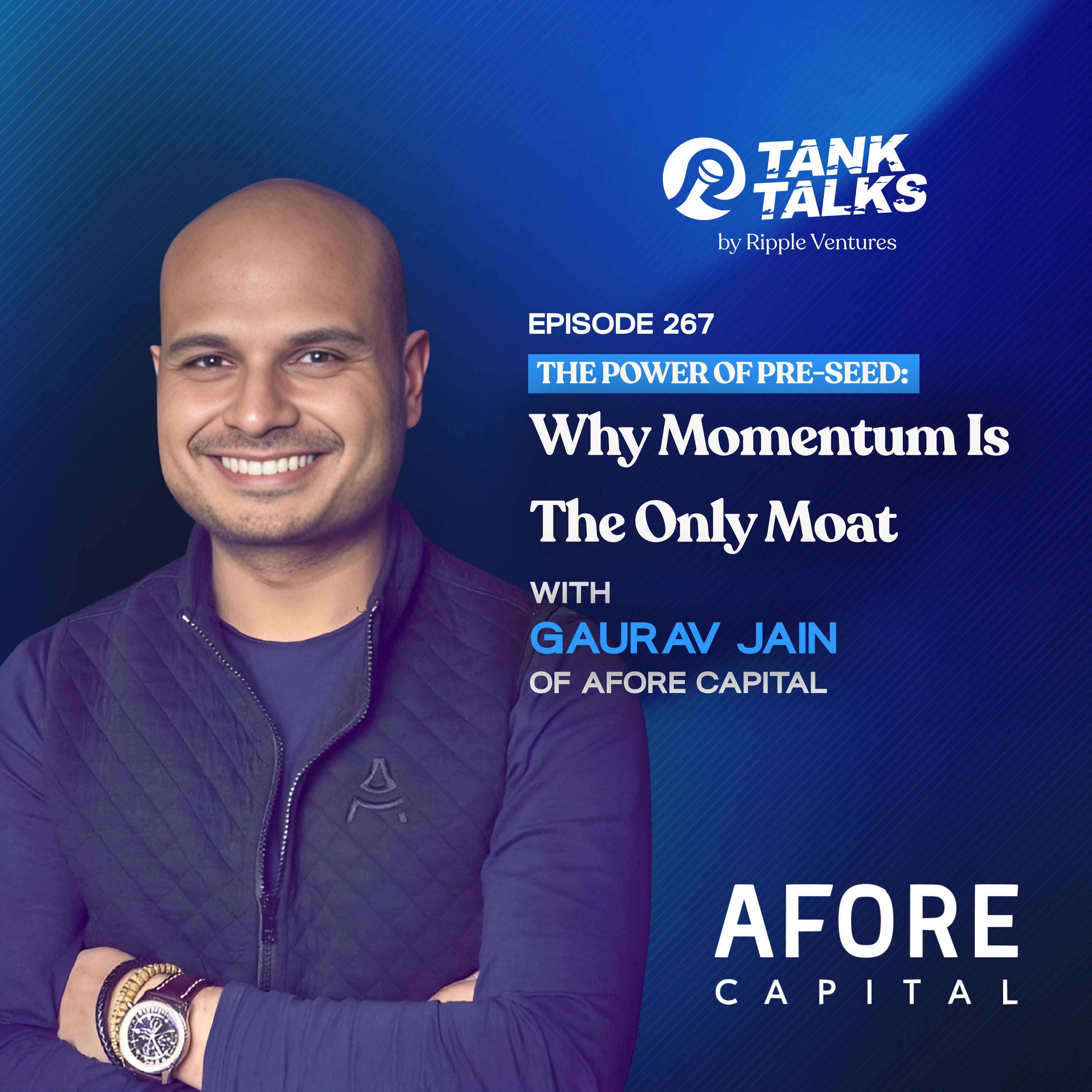
The Power of Pre-Seed: Why Momentum Is the Only Moat with Gaurav Jain of Afore Capital
Jul 31, 202500:54:14Tap to summarizeIn this episode of Tank Talks, we’re joined by Gaurav Jain, co-founder of Afore Capital, one of the earliest and most respected players in the pre-seed investing space. Gaurav shares how growing up in a small town in India, moving to Canada, and working at Blackberry, Amazon, and Google helped him understand the value of momentum, iteration, and building products that truly matter.He walks us through how a random dinner at Harvard led to meeting his future co-founder, how they built Afore around the belief that the best founders are often overlooked too early, and why the firm exclusively focuses on investing before there's a product or sometimes even an idea.Gaurav dives into what makes a great founder at the earliest stage, why he believes momentum is the only moat, and how the rise of AI has only accelerated opportunities for young, technical entrepreneurs to build enduring companies with less capital. He also opens up about the firm's "Founder-in-Residence" and "UTransfer" programs, his view on the Canadian tech scene, and the power of bespoke, high-conviction investing.We explore:* Why is momentum the only true moat in early-stage startups?* Can pre-seed investing still deliver alpha now that it's crowded?* Is seed-strapping the future of venture capital?* How do you identify founders before they've found their idea?* What happens when you give 19-year-olds the capital to build?Building a Pre-Seed Fund Before “Pre-Seed” Was a Thing (00:03:54)* Interning globally to chase experience and perspective* The turning point: joining Founder Collective* Meeting co-founder Anamitra through a lucky dinner at Foundation Capital* Launching Afore in 2016 to fill the pre-seed voidFounder Empathy & Early-Stage VC Lessons (00:08:17)* Mistakes from being a first-time founder* Learning that exits don’t matter, products and pain points do* Why Canadian angel advice focused too much on sales, not software* Why product-led growth is a must-have, not a nice-to-haveThe 10,000 Coffees Rule of Venture (00:11:27)* How judgment is built: time, exposure, and repetition* Why investing based on ideas (not teams) is a rookie mistake* Filtering “this could work” vs. “this must work”* The real constraint in VC: time, not capitalAfore’s Mission: Investing Before the Idea (00:15:00)* The “Too Early” problem founders face and why Afore exists* How FIR (Founder in Residence) and Transfer University fund ideation* Building a support system, not a portfolio of call options* Why being idea-stage isn’t a red flag, it’s a sign of ambitionConvincing LPs That Pre-Seed Was Real (00:19:19)* LP skepticism: “Isn’t this just the bad deals no one else wants?”* How talking to founders not seed managers won over investors* Working with PitchBook and Crunchbase to split out pre-seed data* Making pre-seed visible helped founders self-identify and alignSeed-Strapping and the Rise of Efficient Startups (00:24:00)* How AI-native startups are hitting $1M ARR 2x faster* Case study: Gamma’s hypergrowth on ultra-low burn* Why founders can delay growth rounds longer than ever* Capital efficiency is now a competitive edgeMomentum Is the Only Moat (00:26:07)* How Android’s rise taught Gaurav speed = survival* Lessons from RIM’s downfall: never rest on product laurels* Why the AI era is reshaping iteration timelines* Pre-seed startups now move at the speed of launches, not quartersPivot-as-a-Service in the AI World (00:34:16)* FIR teams pivoting from speech therapy to CX platforms* Younger founders = more raw talent, less domain bias* Startups pivoting every 6–8 weeks—and why that’s healthy* Embracing pivots as a feature, not a flawScaling Afore with Purpose (00:35:21)* Fund IV, $500M+ AUM, and 150+ companies later* Why concentrated portfolios beat spray-and-pray* The dangers of being too dogmatic on stage or valuation* Supporting breakout talent like Neo, Gamma, and BenchGlobal Perspective: Canada’s Role in Venture (00:41:19)* Why Canada produces world-class engineering talent* The upside and limits of building in the North* Hybrid models: Canada for R&D, U.S. for GTM* Afore’s belief in serving Canadian founders, wherever they buildFailure may define most early-stage startups, but for Gaurav Jain, the real story starts before the pitch, before the product, even before the idea. With Afore Capital, he is betting on people over polish, instinct over perfection, and helping founders build long before the rest of the world is watching. His journey reminds us that great companies don’t always start with traction; they start with trust.About Gaurav JainCo-founder and Managing Partner at Afore Capital. Ex-Android, BlackBerry, and founder of Polar Mobile. Afore is known for being one of the first firms dedicated to pre-seed, supporting founders before they even have an idea.Connect with Gaurav Jain on LinkedIn: https://www.linkedin.com/in/gjainvcVisit Afore Capital Website: https://www.afore.vc/Connect with Matt Cohen on LinkedIn: https://ca.linkedin.com/in/matt-cohen1Visit the Ripple Ventures website: https://www.rippleventures.com/ This is a public episode. If you would like to discuss this with other subscribers or get access to bonus episodes, visit tanktalks.substack.com
Transcribe →
The Rundown 7/24/25: Canada’s Sovereignty Crisis, AI Boom, and the Rise of Secondary Deals
Jul 24, 202500:30:52Tap to summarizeWelcome back to Tank Talks! In this episode, host Matt Cohen and John Ruffolo dive deep into the latest developments at the intersection of AI, tech, finance, and Canadian sovereignty. From Canada's battle over data center sovereignty to the rapid rise of secondary funds in venture capital, Matt and John cover it all in a fast-paced, thought-provoking conversation.Canada’s Looming Data Sovereignty Crisis (00:30)Matt and John kick things off with a critical discussion on Canada's data sovereignty issues. With foreign powers potentially controlling key Canadian data centers, they explore the risks and the urgent need for Canada to develop a more self-reliant infrastructure.The Great AI Infrastructure Rush (03:23)The Canadian pension funds (also known as the Maple 8) are making huge moves in the AI infrastructure space. But is this just the tip of the iceberg? Matt and John unpack the massive investments pouring into data centers and AI infrastructure, and what Canada could do to ensure it doesn't just become a resource extractor for foreign companies.The Growing Secondary Market: Northleaf’s $663 Million Fund (07:56)Secondary funds are taking center stage in the private equity world. Northleaf Capital Partners recently raised $663 million for its secondary fund, and Matt and John break down the growing trend of secondary transactions in venture capital. Will more firms follow Northleaf’s lead? Tune in to find out!The Issue of Zombie Assets in Venture Capital (10:57)John introduces the concept of “zombie assets” that are sitting stagnant in venture capital funds. These assets are causing liquidity problems, and Matt and John discuss how secondary funds like Northleaf are stepping in to help.Sovereignty and Stablecoins: A National Security Risk? (12:57)As the US dominates the stablecoin market, Matt and John discuss Canada’s vulnerability in the crypto space. Should Canada be concerned about losing control of its monetary policy to foreign stablecoins and cryptocurrencies? The conversation takes a deep dive into how these digital assets are changing global financial power dynamics.Regulating Crypto and Stablecoins in Canada (16:42)John brings up a troubling development, Canada’s slow response to the rise of stablecoins, and the risks of leaving its financial sovereignty at the mercy of foreign-backed assets. With the US moving fast on crypto regulation, what should Canada do to protect its financial system?A Wake-Up Call for Canadian Banks (19:47)Matt and John discuss the changing landscape for Canadian banks as crypto and stablecoins grow in popularity. What should Canadian financial institutions do to ensure they don’t lose out on this emerging market? The hosts explore potential strategies for banks to adopt in response to the rapid growth of decentralized finance.Connect with John Ruffolo on LinkedIn: https://ca.linkedin.com/in/joruffoloConnect with Matt Cohen on LinkedIn: https://ca.linkedin.com/in/matt-cohen1Visit the Ripple Ventures website: https://www.rippleventures.com/ This is a public episode. If you would like to discuss this with other subscribers or get access to bonus episodes, visit tanktalks.substack.com
Transcribe →
The Rundown 7/18/25: The AI Acquisition Fiasco: Windsurf, DeepMind, and Meta's Talent War
Jul 18, 202500:18:04Tap to summarizeWelcome back to another action-packed episode of Tank Talks! Join host Matt Cohen with John Ruffalo as they break down the high-stakes drama shaking the AI and tech world. First up: the shocking collapse of OpenAI’s $3 billion deal to acquire Windsurf, derailed by Microsoft’s IP grip, and Google DeepMind’s lightning-fast $2.4 billion countermove to snag top talent. Was this a regulatory dodge or a ruthless talent grab?The plot thickens as Cognition swoops in to rescue Windsurf’s abandoned employees, sparking fiery debates about ethics in tech acquisitions. Meanwhile, Meta’s throwing half-billion-dollar offers and unlimited GPU access at AI researchers, will this arms race kill open-source AI?From Google’s $3 billion hydropower deal to private equity’s risky play for Grant Thornton, no stone is left unturned. Plus, is the red-hot IPO market ready for crypto’s comeback? Strap in for a no-holds-barred dive into the deals, power struggles, and Silicon Valley scheming you need to know about!OpenAI’s $3 Billion Deal Collapse: A Tech Industry Shock (00:45)It all started with a major deal unraveling: OpenAI’s attempt to acquire Windsurf, a competitor to Cursor, fell apart due to a contractual conflict with Microsoft. Matt and John break down what went wrong, how this impacts the AI talent war, and the broader implications for future tech acquisitions.Google DeepMind's $2.4 Billion Deal: A New Era of AI Acquisition (02:05)Google swoops in to capitalize on the situation with a $2.4 billion licensing deal for Windsurf’s key staff and technology. Matt and John explore how this move positions Google and whether it signals a new wave of AI-powered business acquisitions.The Ethics of Acquihires and Minority Shareholder Issues (05:10)What happens when top employees leave with huge payouts, while others are left behind in the dust? John and Matt discuss the ethical and legal complexities of acquihires and the tension between founders, employees, and investors when money and control are on the line.Cognition’s Quick Move to Acquire Windsurf (07:00)In a dramatic twist, AI company Cognition steps in to acquire Windsurf and its employees, turning the situation around. Matt and John analyze the speed and strategy behind this acquisition and what it means for competition in the AI coding space.Mark Zuckerberg’s AI Talent Strategy: Unlimited GPUs and $500M Deals (09:00)Zuckerberg’s bold move to attract top AI talent with unlimited GPU access and eye-popping compensation packages is making waves. But is it desperation or a stroke of genius? Tune in as Matt and John debate the future of AI talent wars and Meta’s place in the race for superintelligence.The Power Struggles Behind AI and Crypto Investments (11:05)It’s not just about technology; it’s about energy, too. Matt and John discuss the power struggles behind data centers, microgrids, and massive AI and crypto energy consumption, including the huge investments made by Meta, Google, and Oracle to secure their futures.Grant Thornton's Global Franchise Issues: When Private Equity Meets AI (12:20)Private equity’s increasing role in professional services firms like Grant Thornton is causing some tension. Matt and John explore how AI and cross-border partnerships are shaking up the accounting world, leading to serious questions about the future of global firms.Bitcoin Soars and IPOs Heat Up: The Crypto Revolution (15:30)Bitcoin is soaring and the IPO market is heating up with crypto companies eager to go public. John and Matt discuss the latest developments in the blockchain world, and whether there’s room for Canadian companies to make waves on the IPO stage.Connect with John Ruffolo on LinkedIn: https://ca.linkedin.com/in/joruffoloConnect with Matt Cohen on LinkedIn: https://ca.linkedin.com/in/matt-cohen1Visit the Ripple Ventures website: https://www.rippleventures.com/ This is a public episode. If you would like to discuss this with other subscribers or get access to bonus episodes, visit tanktalks.substack.com
Transcribe →
Reward the Risk Takers who Build Canada
Jul 17, 202500:15:23Tap to summarizeCanada's outdated capital gains policies are driving entrepreneurs and investors away. We need competitive tax reform to keep talent and investment here, building the businesses of tomorrow.We have just 33 small businesses per 1,000 people vs 124 in the US. Fixing our capital gains system could help us close this gap with the US and create hundreds of thousands of new jobs.Modern capital gains reform will unleash Canadian innovation, create more high-paying employment, and ensure our world-class graduates build their companies here, not elsewhere.GoalsTo ensure a prosperous, sustainable, and growing economy, Canada needs a thriving private sector that invests in new businesses. A strong environment for entrepreneurship creates jobs, drives GDP growth, and ensures economic mobility for all. In recent years however, entrepreneurship, and consequently private sector employment, has been slow despite an increasing population.One factor driving this change is that Canada’s capital gains tax policies make it significantly less rewarding to start a business compared to other jurisdictions. To reverse this trend and reinvigorate our private sector, we must revise our outdated policies to align with global standards.Our targets:* Increase SMBs per 1000 people over the age of 18 from 33 to 62 to get half of the US rate of 124.* Increase the number of early-stage financing rounds (Pre-seed, Seed, Series A, and Series B) for new businesses from 482 in 2024 to over 1000+ per year.* Increase investments in new businesses through industry-agnostic venture capital financing to 0.5% of GDP, up from 0.35% of GDP, to get closer to the USA’s figure of 0.72% of GDP.Background and MotivationNew business formation and growth relies on people taking huge risks with their time and money. However, today in Canada the people that take these risks – entrepreneurs, early stage employees, and investors – are rewarded less than in other countries.As a result the country’s best talent is driven to leave and start businesses elsewhere, where they can find easier access to funding1 and keep more of the upside if they succeed.We need to reverse this systematic issue. By rewarding investors that put their capital at risk and supporting entrepreneurs who put their livelihoods on the line to create new companies we can create a strong and resilient economy.All companies begin as small and medium businesses (SMBs) and the formation and growth of these SMBs is essential to a country’s economic success both through driving the quality of the labour market and creating opportunities for productivity growth.In Canada, SMBs accounted for ~64% of private sector employment and contributed to half of all net new jobs added last year2. These work opportunities support upward income mobility, lead to more capital being reinvested into local communities, and are particularly valuable for traditionally disadvantaged populations3 4 5.In addition, SMBs represent a significant portion of the economy and have high potential for productivity improvements6. Between 2017 and 2021, SMBs contributed almost half of Canada’s GDP7. As these businesses grow and scale their operations they improve efficiency and drive productivity-led growth that can be equivalent in impact to roughly 5% of a developed nation’s GDP8 9.Perhaps most importantly, SMBs turn into global winners. Growing these companies into sizable businesses is how a country can win an unfair share of global markets, by creating the large, export-focused corporations that contribute an outsized value to GDP and productivity growth. To ensure the next trillion dollar companies - the equivalent of Google, Microsoft, or Meta - are built in Canada, founders must be convinced to start their companies here.So, having a healthy ecosystem of SMBs is essential to creating a strong economy, but the data shows Canada is falling behind our global peers. In the 20 years between 2003 and 2023, the total number of Canadian entrepreneurs decreased by ~100K, despite the population growing by 10 million10 11. Today, for every thousand people over the age of 18 the US has ~124 SMBs12 13. Israel, a country with less than a quarter of Canada’s population, has ~7314 15, while Canada has just ~3316.A significant driver of this stagnation is outdated and uncompetitive capital gains policies that have low limits, exclude large categories of business, and contain many restrictions compared to global peers - especially the US. It is less valuable for investors to put money into Canadian businesses, making capital more scarce and it discourages entrepreneurs who know that in most cases they could receive more reward by building the same company elsewhere. This makes it difficult for any SMB to get started let alone scale.Today, Canada has two capital gains policies, to try and encourage SMB creation, the Lifetime Capital Gains Exemption (LCGE) and a proposed Canadian Entrepreneur’s Incentive (CEI) announced in Budget 2024 but not yet implemented. Combined, the LCGE and CEI would allow shareholders to reduce the inclusion rate of capital gains from the current 50% down to a range of 33.3%-0% to a cap of $3.25M 17 18.These policies simply can’t compete with the US. The USA’s Qualified Small Business Stock (QSBS) policy has a capital gains cap of $15M or ten times the original investment amount, five times higher than Canada’s LCGE and CEI limit. In addition the QSBS is active today, while Canada’s CEI cap has a phased approach only coming into full effect in 2029 if the policy is passed. Today in 2025, LCGE and CEI’s true combined cap is only $1.25M. And while QSBS shields 100% of gains up until the policy cap for individuals and corporations, Canada’s CEI would only shields 66.7% of gains for individuals.To illustrate how restrictive this is, we could imagine a company where the business is owned between founders, early employees, and various investors (see the first example below). If this business was started in 2018 and sold 7 years later today in 2025 for $100M, these risk-takers would have to pay a combined $14.7M in taxes. However, that same business with the same structure would pay no taxes in the US.The good news is that at larger scales of exit like $250m (see the second example below) the gap between Canada and the US decreases due to a more competitive basic capital gains inclusion rate in Canada. This means that if we match the QSBS’s capital gains limit it could actually give the Canadian policy an edge driving more investment in the country and supercharging our SMB ecosystem. However, if we leave the policy as it stands right now companies can never get started because investors and entrepreneurs are scared away.The reason is that the QSBS rewards smaller exits - the majority of SMB outcomes - with the maximum capital gains tax value. This makes it easier for entrepreneurs, early employees, and investors to take on the risks of building a business. In fact, early-stage US investors are currently increasing their investments into new Canadian businesses, and adding in clauses that would require the Canadian b...
Transcribe →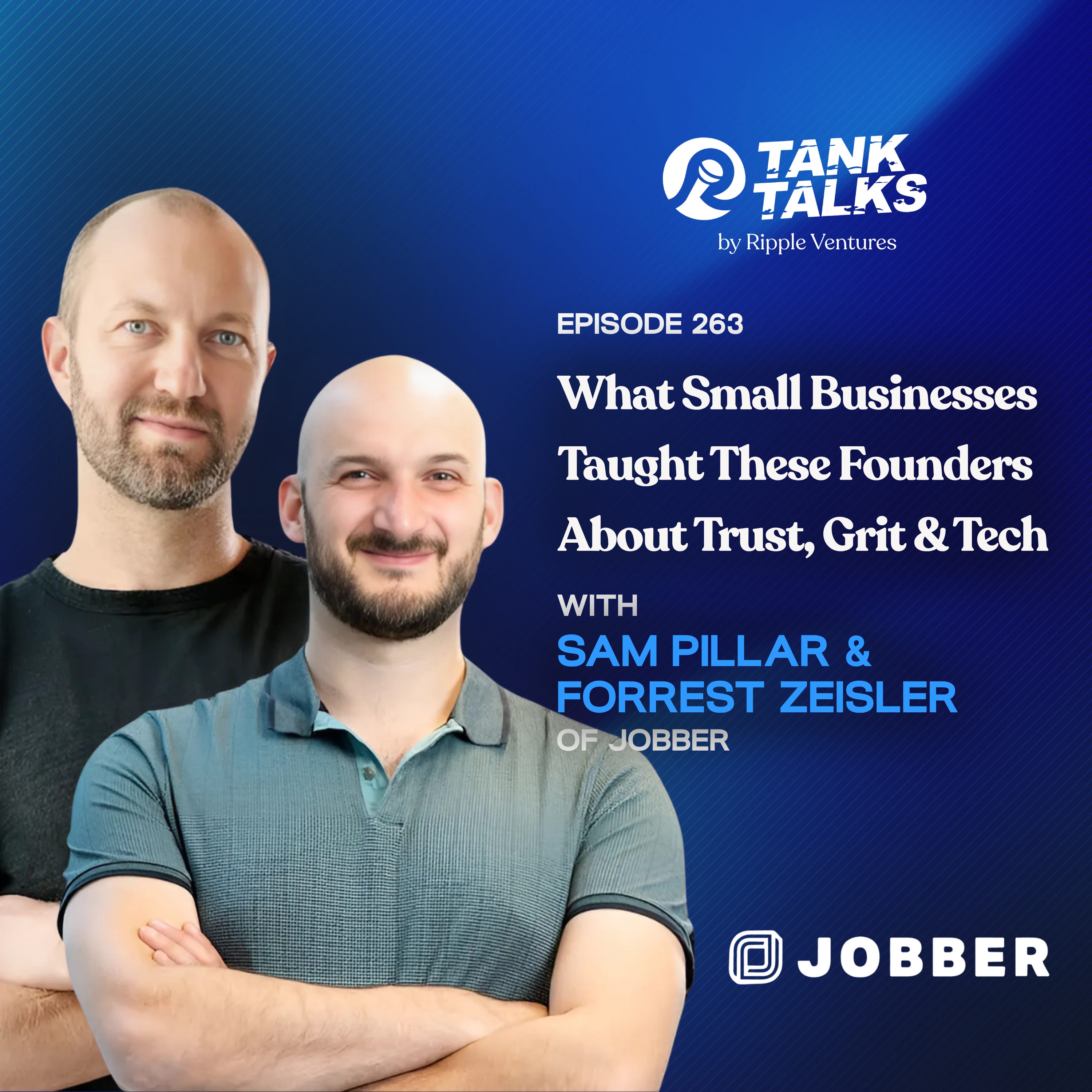
What Small Businesses Taught These Founders About Trust, Grit & Tech with Sam Pillar and Forrest Zeisler of Jobber
Jul 10, 202500:44:55Tap to summarizeIn this episode of Tank Talks, we’re joined by Sam Pillar and Forrest Zeisler, co-founders of Jobber, a platform that’s changing the way small service businesses operate. Jobber brings everything, quoting, scheduling, invoicing, and payments, into one simple, powerful system, making it easier for service professionals to run and grow their businesses.Sam and Forrest share how what began as late-night coding sessions and casual coffee shop chats evolved into a company helping thousands of tradespeople work more efficiently and take back control of their time. They talk about the early lessons learned, the importance of staying relentlessly focused on real customer needs, and how they’ve embraced AI to help entrepreneurs future-proof their businesses.From turning 56-hour workweeks into tasks handled in minutes, to giving business owners the freedom to manage operations from anywhere, even a hospital room or beachside cabana, Jobber is proving that small businesses don’t have to sacrifice their well-being for success.We explore the big questions:* Can AI finally give small business owners their "5 to 9" back?* What happens when you build software by listening, not dictating, to your customers?* Will AI become the most indispensable "employee" for millions of tradespeople?The Coffee Shop Origins of Jobber (00:01:43)* Meeting over code at Remedy Coffee in Edmonton* Building software to bring order to small business chaos* Learning from real customers instead of leading with assumptionsThe Power of Listening to Small Business Pain Points (00:04:31)* How a $430 phone bill inspired Jobber's early product* Focusing on relationship-driven problem discovery* Why the best solutions come from understanding, not pitchingEarly Hustle and Near-Impossible Odds (00:08:19)* Maxed-out credit cards, mice in the office, and toaster oven hacks* The role of naive optimism in surviving the startup grind* Asking parents for investment in an “idea” that wasn’t worth much (yet)Building Trust with Small Business Owners (00:11:27)* Overcoming skepticism of the cloud and digital tools* Why authenticity, empathy, and asking the right questions matter* The “bullsh*t meter” of tradespeople and how Jobber earned credibilityImpact Stories: Reclaiming the '5 to 9' Life (00:18:24)* A customer's ability to run his business from a hospital bedside* Empowering entrepreneurs to pursue dreams, not drown in paperwork* Emotional success stories from Jobber customersThe 'Gateway Drug' of Entrepreneurship (00:22:02)* The surprising role of poop scooping businesses* Why low-barrier industries ignite entrepreneurial ambition* Jobber’s commitment to serving all small businesses, no matter how nicheScaling with Purpose: Jobber as the Shopify of Home Services (00:23:43)* Prioritizing customer stories over founder fame* Embedding customer obsession into every team and meeting* How Jobber fosters an internal culture rooted in small business successThe Future of AI for Trades & Small Business (00:26:07)* AI as a “most trusted employee” for entrepreneurs* Real-world automation reducing 56-hour tasks to minutes* Why tradespeople stand to benefit most from AI efficiency* Building trust before AI can fully run their businessCo-Founder Chemistry & Fun Facts (00:34:16)* Forrest’s love for right-hand drive sports cars* Sam’s vintage Mercedes obsession and former bike courier skills* The role of carpentry, farming, and hands-on hobbies as a founder escapesAs entrepreneurial life splinters under pressure, platforms like Jobber illuminate a better path: one where smart technology and strong relationships meet. They’re not just building software—they’re cultivating trust, reclaiming freedom, and reimagining what it means to succeed in small business. Whether you're buried in paperwork or dreaming of the next simple service, Jobber could be the partner you didn't know you needed.About Sam PillarCo-founder & CEO of Jobber, passionate about empowering small service businesses. Former freelance developer turned tech leader driven to help entrepreneurs succeed.Connect with Sam Pillar on LinkedIn: https://ca.linkedin.com/in/sampillarAbout Forrest ZeislerCo-founder & CTO of Jobber, software engineer by trade with a deep belief in building practical solutions for real-world problems. Known for his car obsession and mechanical watch collection.Connect with Forrest Zeisler on LinkedIn :https://ca.linkedin.com/in/forrestzeislerVisit Jobber Website: https://www.getjobber.com/Connect with Matt Cohen on LinkedIn: https://ca.linkedin.com/in/matt-cohen1Visit the Ripple Ventures website: https://www.rippleventures.com/ This is a public episode. If you would like to discuss this with other subscribers or get access to bonus episodes, visit tanktalks.substack.com
Transcribe →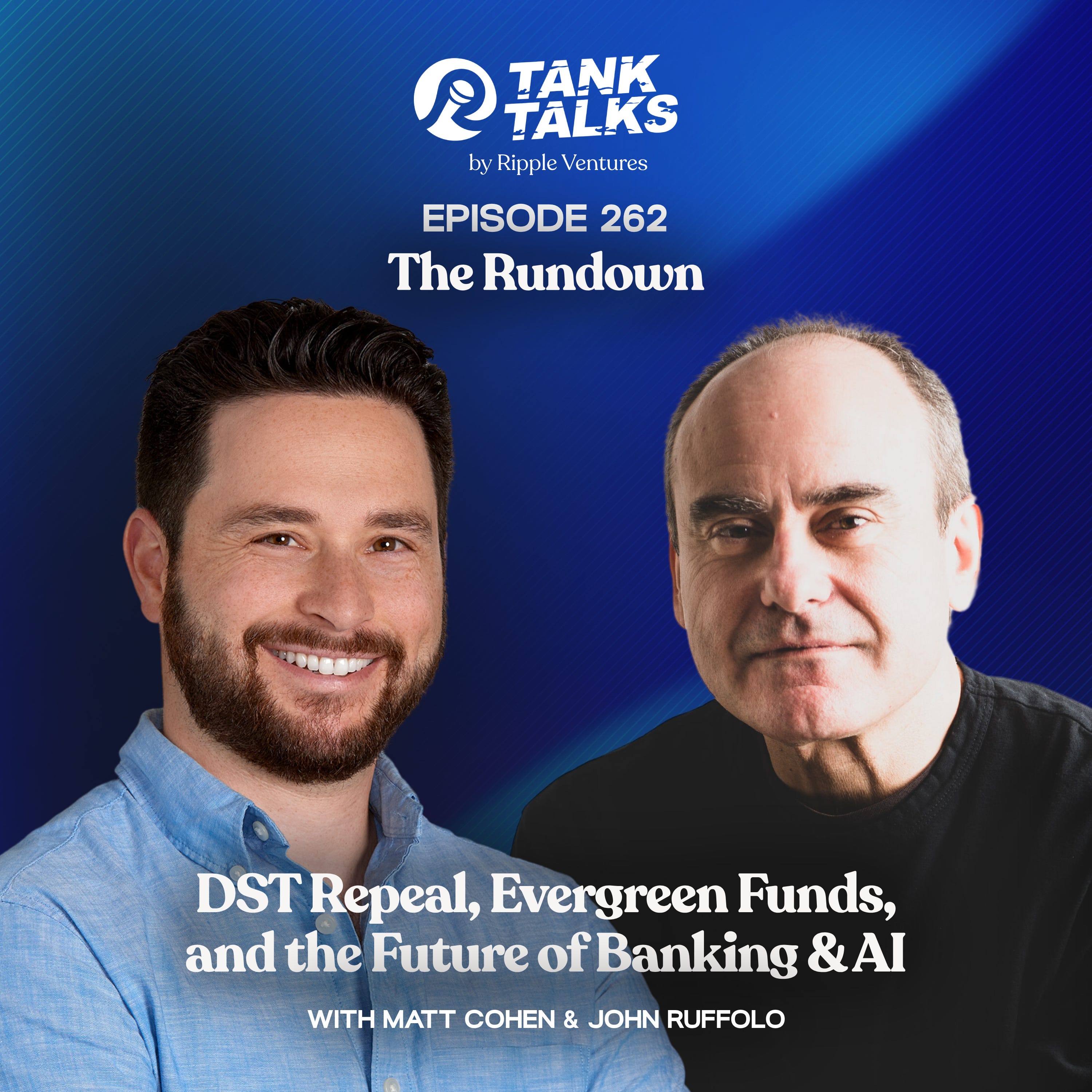
The Rundown 7/8/25: DST Repeal, Evergreen Funds, and the Future of Banking & AI
Jul 8, 202500:25:54Tap to summarizeWelcome back to another thought-provoking episode of Tank Talks! In this episode, Matt Cohen and John Ruffolo cut through the noise to unpack the latest economic headlines and policy shifts reshaping North America’s business landscape. From Canada’s surprise repeal of the Digital Services Tax to Brookfield’s launch of an evergreen private equity fund, this episode dives deep into the forces driving change in trade, finance, and innovation.Will Canada’s late-stage policy reversal strengthen its position in U.S. trade talks? Are evergreen funds the next big wave in private equity? And how will digital-only banks and stablecoins reshape the future of finance? Tune in for all that and more!Canada’s Digital Services Tax Repealed at the 11th Hour (00:14)Just hours before the June 30th collection date, Canada repealed its controversial 3% digital services tax to clear the runway for renewed trade negotiations with the U.S. Matt and John unpack the political optics, the timing missteps, and why this repeal might’ve come too late to score real leverage in the upcoming Carney-Trump summit.Trade Tensions and a Pivot Away from U.S. Exports (02:50)With U.S. tariffs still biting Canadian industries like steel, aluminum, and autos, exports to non-U.S. markets jumped 5.7% in May. John analyzes the long-term risks and what a 10% tariff “compromise” could mean for Canadian trade policy moving forward.Brookfield’s Evergreen Fund: Liquidity vs. Strategy (06:37)Brookfield’s launch of a new evergreen private equity fund is raising eyebrows. These liquid investment vehicles are tailored for high-net-worth investors, but could they undermine Brookfield’s traditional closed-end funds? Matt and John discuss the tradeoffs and potential disruption to institutional capital models.Stablecoins, Erebor & The Future of Banking (10:53)With the launch of Erebor, a new U.S. digital-only bank backed by Palmer Luckey, Peter Thiel, and Joe Lonsdale, the open banking revolution is heating up. But will Canada get left behind amid regulatory hesitations? The duo explores how stablecoins and crypto-native banks are reshaping the financial ecosystem.The “Big Beautiful Bill”: Trillions in U.S. Spending (13:56)At nearly 1,000 pages and $4.85 trillion, the latest U.S. tax and spending package is a behemoth. John calls out some of the more controversial provisions, like Section 899, a “revenge tax” aimed at foreign investors, and weighs in on what this means for the U.S. deficit and global investment climate.Figma Files to Go Public: A Product-Led Rocketship with a Caveat (16:49)Figma’s S-1 filing reveals eye-popping growth: $750M in 2024 revenue, 91% gross margins, and 90% of the Fortune 500 on board. But one number raised eyebrows, its definition of net revenue retention. Is the 132% figure misleading? Matt and John dissect the metrics and what investors need to know.Anthropic & OpenAI’s Revenue Explosion (19:39)AI darlings Anthropic and OpenAI are shattering expectations, with annualized revenues of $4B and $10B, respectively. What’s fueling this growth, and is it sustainable? Matt and John assess the trajectory and strategic implications for the broader AI race.Meta’s Talent War: $300M Signing Bonuses & AI Domination (20:30)Meta’s aggressive push into AI includes poaching top OpenAI talent with eye-watering offers reportedly reaching $300M. Is this visionary investing, or panic-mode recruiting? The conversation digs into the implications of Meta’s superintelligence ambitions and the high-stakes battle for AI supremacy.Microsoft Layoffs: AI Efficiency or Budget Strategy? (22:52)With Microsoft cutting 9,000 jobs, questions swirl around whether AI-driven efficiencies or strategic capital reallocation are the real drivers. John shares his take on what this means for enterprise software, consulting firms, and the future of knowledge work.As the tides of global economics, innovation, and technology continue to shift, Tank Talks is your front-row seat to the big moves shaping our world. Don’t miss this jam-packed episode!Connect with John Ruffolo on LinkedIn: https://ca.linkedin.com/in/joruffoloConnect with Matt Cohen on LinkedIn: https://ca.linkedin.com/in/matt-cohen1Visit the Ripple Ventures website: https://www.rippleventures.com/ This is a public episode. If you would like to discuss this with other subscribers or get access to bonus episodes, visit tanktalks.substack.com
Transcribe →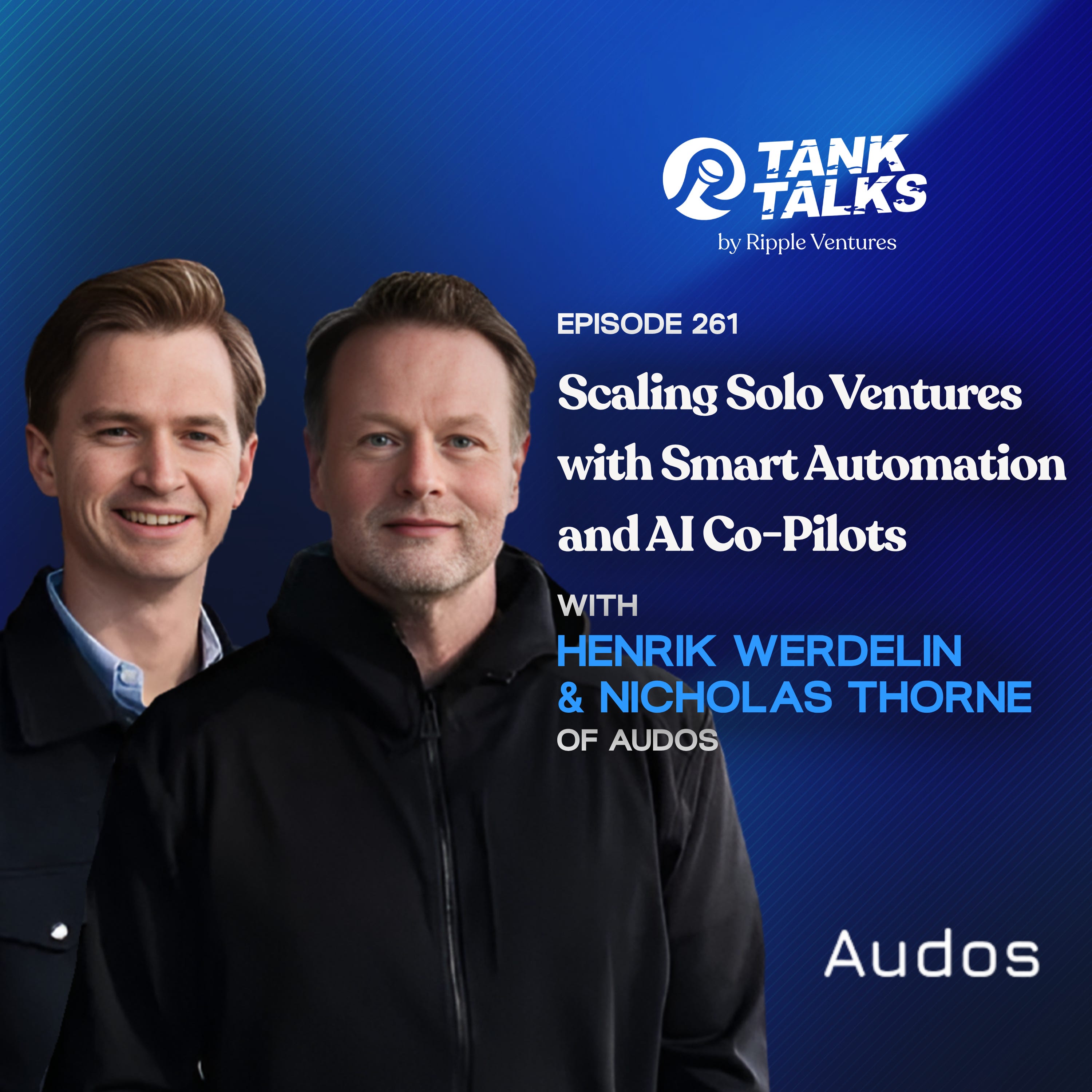
Scaling Solo Ventures with Smart Automation and AI Co-Pilots with Henrik Werdelin and Nicholas Thorne of Audos
Jul 2, 202501:12:44Tap to summarizeIn this episode of Tank Talks, we explore the future of solo entrepreneurship powered by AI with the co-founders of Audos, Henrik Werdelin and Nicholas Thorne. Audos is pioneering a platform that helps founders start and scale one-person businesses by providing AI co-founders that guide entrepreneurs through the entire startup journey from idea validation to product development, marketing, and growth.Henrik and Nicholas share how their experience building companies like BarkBox and their startup studio Prehype, inspired the vision for Audos. They break down why the next wave of innovation may come not from massive teams, but from solo founders armed with agents and AI workflows.* Can AI unlock a million one-person, million-dollar businesses?* What’s a “Donkeycorn” and why is it the new unicorn?* How do founders build “taste at scale” in an age of auto-generated everything?From BarkBox to Audos: Henrik’s Journey (00:02:31)* Building a startup collective with Prehype* Why being surrounded by misfits at MTV shaped his entrepreneurial lens* What “between time” means for foundersWall Street to Startup Studio: Nicholas’ Story (00:06:00)* Starting on Wall Street during the 2008 crash* Creating a Costco arbitrage business in college* Meeting Henrik and becoming an “Entrepreneur in Residence”How Audos Was Born (00:10:41)* The problem with “idea-first” thinking* The Prehype methodology that powers the platform* Helping founders build relationship capital, not just appsWhat is Audos? An AI Co-Founder for the Masses (00:12:26)* The mission: a million one-person, $1M/year businesses* How agents guide users from idea to scale* From onboarding to revenue generationTaste at Scale: The Founder’s Secret Sauce (00:26:54)* Why knowing what not to do is as important as what to do* Defining taste in a world of AI-generated content* The power of deselecting bad-fit customersThe First 30 Seconds with Audos (00:32:01)* How users are onboarded via Instagram and a conversational UI* The role of AI agents across product, marketing, and founder coaching* Where human support still plays a vital roleCapital as a Tool for Activation (00:36:26)* Why giving early-stage founders “nudges” is more effective than full VC rounds* Real stories of customers launching fast with small validation experiments* Why momentum is oxygen for new businessesReplacing Accelerators? The Role of Community (00:48:54)* How Audos supports founders who wouldn’t otherwise build* The loneliness of solo entrepreneurship in the AI era* Why Audos is an “artist collective” for business buildersWhat’s Next: The Future of AI-Driven Founders (00:50:58)* Inbox Zero as the new founder's workflow* The rise of agent-based businesses with no UI or website* Why the next big companies will be solo-agent-ledAs solo entrepreneurship becomes more accessible, platforms like Audos are showing what’s possible when AI becomes a true partner in the journey. With a mission to launch a million one-person, million-dollar businesses, Henrik and Nicholas are betting big on everyday founders and proving that you don’t need a team to build something meaningful.Audos is more than a platform; it’s a movement redefining how businesses are started, scaled, and supported. Whether you're stuck on an idea, unsure of where to begin, or simply looking for a smarter way to work, Audos might just be the co-founder you didn’t know you needed.About Henrik WerdelinHenrik is the co-founder of BarkBox and founding partner at Prehype, a venture studio that has launched companies like Roman and Managed by Q. With Audos, he’s focused on enabling anyone to become an entrepreneur, regardless of background or technical skill. He’s also the co-host of the podcast Beyond the Prompt and a vocal advocate for “everyday founders.”About Nicholas ThorneNicholas started his career on Wall Street before teaming up with Henrik to co-build companies at Prehype. As co-founder of Audos, he’s applying more than a decade of startup experience to help others launch scalable solo ventures with AI. He brings deep operational and strategic insight to the solo founder revolution.Connect with Henrik Werdelin on LinkedInConnect with Nicholas Thorne on LinkedInListen to Beyond the PromptConnect with Matt Cohen on LinkedIn: https://ca.linkedin.com/in/matt-cohen1Visit the Ripple Ventures website: https://www.rippleventures.com/ This is a public episode. If you would like to discuss this with other subscribers or get access to bonus episodes, visit tanktalks.substack.com
Transcribe →
The Rise of AI Agents and Why it Matters Now with Adam Coccari of HubSpot Ventures
Apr 11, 2025Tap to summarizeIn this episode of Tank Talks, we dive into one of the most significant shifts happening in tech right now: the rise of AI agents.Our guest, Adam Coccari, has a front-row seat to the AI transformation as the Managing Director of HubSpot Ventures. But what makes Adam’s story so compelling is how it began, not in boardrooms, but in a classroom, teaching 4th-grade math. From building an educational gaming app with no tech background to helping launch Microsoft’s venture fund, Adam’s journey is anything but typical.We explore why agentic AI is reshaping how work gets done, which sectors are already feeling the shift, and how founders can build winning SaaS companies without bloated teams or massive rounds. Adam breaks down what separates lasting startups from hype-fueled flashes and shares tactical advice for early-stage founders navigating the AI-powered future of business.From Teacher to Tech: Adam’s Unusual Path to Venture (00:01:54)* Why building a math app for kids led Adam into tech* Lessons from the classroom that still shape his leadership today* How “Math Evolve” became a top-ranked game and what went wrongCloud, AI & Lessons from Microsoft (00:09:07)* What Adam learned working on Azure before it was cool* How B2B sales, marketing ops, and funnels really work* The early power of machine learning in enterprise use casesInside Corporate VC and the M12 Playbook (00:11:59)* What most corporate venture arms get wrong* Why being “just strategic” isn't enough anymore* How M12’s independent structure helped them win dealsWhy Agentic AI Is Having Its Moment (00:21:46)* What makes AI agents different from traditional automation* Why back-office work is ground zero for agentic disruption* Real examples in bookkeeping, AR, customer service, and moreBuilding AI SaaS in 2025: What Founders Need to Know (00:24:31)* The rise of vertical SaaS powered by AI* What “experimental ARR” means and how to see through it* Why speed, execution, and domain knowledge beat scaleHow Startups Should Think About Go-To-Market (00:27:10)* Why PLG-first startups may scale to enterprise better than top-down players* What metrics actually matter in early-stage AI SaaS* Why a 3-person team can now do what used to take 30What Investors Are Looking For Now (00:34:08)* What Adam really looks for in AI founders* How he spots resilience, vision, and product intuition early* Why founder-market fit is more important than everPartnering, Platforms & Navigating Corp Dev (00:41:28)* The truth about working with big platforms as a startup* How to think about M&A as a long-term signal, not a strategy* Why transparency and trust still matter in the AI eraThis isn’t just another AI hype episode. It’s a real look into how work, software, and venture are changing fast. As AI rapidly reshapes how businesses operate, startups and incumbents alike stand at a crossroads: adapt or fall behind. Adam Coccari makes it clear: Agentic AI isn’t on the horizon; it’s already here, transforming how teams handle back-office tasks, optimize workflows, and scale faster with less. The question is: will companies embrace AI as a force multiplier, or get left behind in an era where agents don’t just assist, they execute?About Adam CoccariAdam Coccari is the Managing Director of HubSpot Ventures, where he leads investments in early-stage SaaS and AI startups. He was previously a founding member of Microsoft’s M12 venture arm and led venture efforts at Intuit. Adam began his career as a math and technology teacher, where he created the hit educational app Math Evolve, featured globally by Apple.Today, he focuses on backing bold founders building AI-native applications, with a special eye on agentic workflows, vertical SaaS, and B2B automation. His mix of product intuition, startup empathy, and platform strategy makes him one of the most thoughtful voices at the intersection of SaaS and AI.Connect with Adam Coccari: https://www.linkedin.com/in/adam-coccari-9932a134Visit the HubSpot website: https://www.hubspot.com/venturesConnect with Matt Cohen: https://ca.linkedin.com/in/matt-cohen1Visit the Ripple Ventures website: https://www.rippleventures.com/ This is a public episode. If you would like to discuss this with other subscribers or get access to bonus episodes, visit tanktalks.substack.com
Transcribe →
Tank Talk: Tony van Marken (First Ascent Ventures) - How Climbing Mount Everest is Like Building a Startup
Jun 13, 2020Tap to summarizeOn today’s Tank Talk! We welcome our guest Tony van Marken, Co-Founder & Managing Partner of First Ascent Ventures.Tony is not only a successful businessman and venture capitalist but has an extremely accomplished mountaineering career having become the first South African to climb all Seven Summits, the highest mountains on each of the world’s seven continents.On today's Talk, we ask Tony about his experience climbing Mount Everest in 2005 and his battle with the mountain, poor health and the worst weather seen on Everest for decades and his final steps to the summit on June 2, 2005. We also talk about his own personal business and other expedition experiences and the lessons learned that he has applied in building and investing in startups. This tank talk sure was a cliffhanger!Now please welcome today's guest to the Tank, Tony Van Marken.Books Mentioned In The Show:- Annapurna Paperback - by Maurice Herzog- Touching My Father's Soul: A Sherpa's Journey to the Top of Everest Paperback – by Jamling T. Norgay- Into Thin Air - by Jon Krakauer- Seven Summits - by Dick Bass, Frank Wells & Rick Ridgeway- High Altitude Leadership - by Chris Warner & Don SchminckeTony’s words of Inspiration "If you dream of doing something, stop dreaming, get out and make it happen" by Sir Chris BoningtonYou can follow Matt Cohen and Tank Talks here! This is a public episode. If you would like to discuss this with other subscribers or get access to bonus episodes, visit tanktalks.substack.com
Transcribe →