← Tax Smart Real Estate Investors Podcast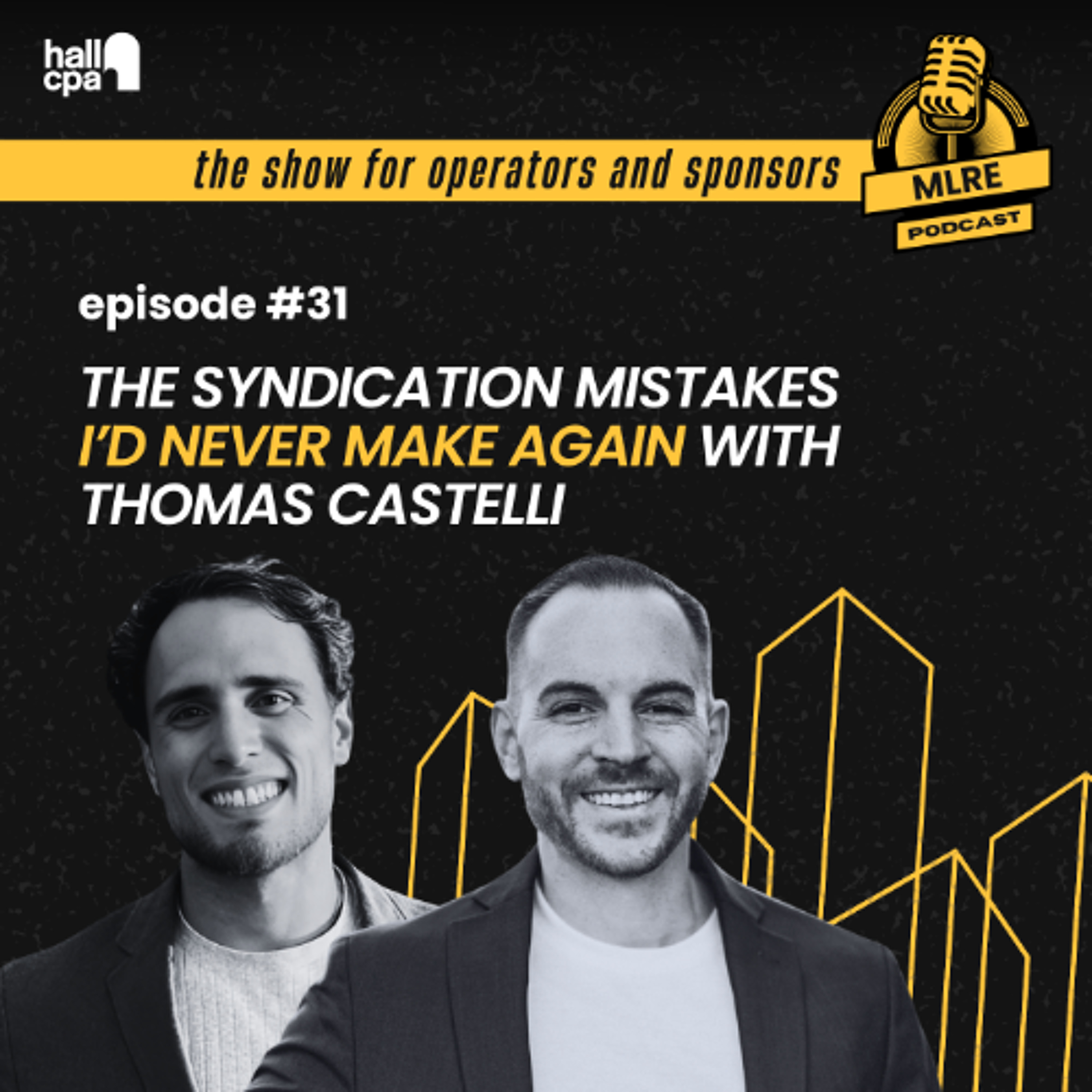
Tax Smart Real Estate Investors Podcast
MLRE: The Syndication Mistakes I'd Never Make Again (An Investor Deep Dive)
00:26:46
In this episode of the Major League Real Estate P…
Loading summary
Transcript33 lines
- [00:05]
A
Welcome to the Major League Real Estate Podcast. A podcast for operators of large scale real estate portfolios. My name is Nathan Sosa and I'm your host. Together with my co host Matt Hamilton, we talk about tax and legal strategies and we bring on operators large portfolios for in depth discussions on how they grow their business. We hope you enjoy. Welcome to another episode of the Major League Real Estate podcast. Today I am joined by Thomas Castelli and he is one of the partners here at hall cpa. And today we're going to get a dive, a deep dive into Tom's background as he before he was a cpa, he was a real estate guy, making him the perfect real estate cpa. But to have first I have to ask another super important question to Tom. Tom, what was your favorite super bowl commercial from yesterday?
- [00:49]
B
Yeah, so I actually only watched the super bowl till after halftime and I'm happy to talk a little bit more about why that is, but I watched. What do you call it? It was the one with, had to be a tie between the Backstreet Boys one. The first Backst Boys one, although I would say the Coinbase one was good. But the First Backstreet Boys 1 or the, the Goodwill Hunting one with Ben Affleck and like, and the guy from the Fresh Prince and Steve Urkel and all that. I thought that that was a pretty good one. That was interesting. The whole entire time I was thinking about through that commercial was, is this AI? Because if you look at, if you look at Alfonso the guy, the Carlton from Fresh Prince, he looked like the Carlton from like the 1990s. And we all know that he doesn't look like that anymore, so he's just older now. So that was one of those two commercials. Probably my favorite one.
- [01:36]
A
Yeah, I think the Duncan one was pretty good too. I like that one. I personally thought the ramp one was hilarious. Whereas like there's like the same. I forget, I can't really forget his name from the office. He's like running around taking work off of the guy's desk or whatever. That was pretty funny. There's another good one. Oh yeah. Where like all the NFL players, like overweight or like they were just like different. That was kind of funny too, you know, Tom, maybe more just nostalgic, but I feel like super bowl commercial taking a drop. Be completely honest, I don't feel like they are what they used to be, but maybe you have a different opinion than me, but I don't think they're as good as they used to be.
- [02:09]
B
Yeah, you know, it's hard for me to rank them. It might be just a matter of it's becoming too self aware that super bowl commercials are like a thing and they're trying to do it too much. Or maybe, maybe it's just nostalgia to your points, like they're just not what they are. But yeah, no, overall I thought, I thought they were pretty good. I stopped watching after halftime because what happened was I started to realize that the quarterback on the Patriots, I was like, this guy's just not going to cut it. He's too green. He's too many flaws in his game right now. And I kind of realized that they already lost, so I just kind of tuned out after that. But yeah, I mean, as far as the commercials go, to me they were right for the ones I saw.
- [02:45]
A
Yeah, yeah, I totally agree with you on the Unsbowl take two. So like, yeah, I just wasn't Drake Mazier Seahawks defense is just too good and I think we all saw that coming. We can talk about that. We could get into the controversial part of the Patriots having the easiest cakewalk of all time in the playoffs, but we'll talk about that. I'm not Denver Broncos fan that's super annoyed that Bonix got hurt the game before. We definitely would have done way better super bowl than the Patriots would have, but that's neither here nor there. Tom. What is here though, is you are. And the fact that I want to get a deep dive background and story on how you got into real estate and what you did as a real estate before you became the real estate CPA at Hull. Cpa.
- [03:25]
B
Yeah. So my journey, I remember talking about this back on the Real Estate CPA podcast, which is now the Tax Mod Rei podcast way back in 2018. But we'll do it some more right now. So when I was in college I started to kind of come to the conclusion that real estate I read the Rich Dad, Poor dad books, you know, the whole nine yards went down the rabbit hole in that and realized that a lot of people became wealthy through investing in real estate. So what I did was I went to the RIAs, went to some local networking events and basically came across this group that was doing real estate syndications. That was their core business. And then they had a coaching business off the side of that where they were helping people do their own real estate deals. And I started going to their meetings and I fell in love with the model of real estate syndication. And they were doing this like three day weekend deep dive into real estate syndications. And that Happened actually the summer before I started my full time job at bdl, which is the firm I was with prior when I first started my career and decided to go ahead and check that out. And from there that's kind of what made me fall in love with real estate syndication. And then I started again going to those meetings and then one of the guys who was syndicating deals, he approached me about one of these deals he had. It was a 42 unit apartment complex in Columbus, Ohio. So I invested in that deal with him. My parents ended up investing some money in that deal with him. And he gave me a really kind of like behind the scenes look. We used to call it pactive back then and has nothing to do with taxes. Active investor means like you were the principal, you were the gp, you were the sponsor, right? And then you had the LPs, the passive investors, right? And then there's the pacif investors, which is kind of what I was. And it was like, I'm an lp, but I'm getting a behind the scenes look and at what it's like to be a gp. So I was in the pack of side of that deal. I remember going to the property, I remember being part of the meetings where this deal was closed, things like that. Really exciting. And so I was investing in an lp. That deal, that deal actually went pretty well. We made some money on that. But then my mentor told me, he goes, Tom, look, he goes, if you ever find a deal, we'll syndicate it. So he's like, there's your incentive, go find us a deal. So I started networking with real estate brokers, property managers, picking up the phone, smiling and dialing that whole nine yards. And we eventually came across, you know, after reviewing multiple deals, it's never the first deal typically for people we came across this one deal is an 82 unit apartment complex in Jacksonville, Florida. And I was like, I think there might be something here after looking at the numbers. So sent it off to my mentor, he took a look at it and goes, first of all, I agree there's something here. Second of all, I know the property manager, so let's go ahead and take the next step on this. So we put it in an offer, the whole nine yards. I think I ended up, I ended up negotiating the close that deal and several other aspects of it. But he was involved heavily throughout, especially on the financing side. So long story short, we ended up closing that deal in November 2017 and the entire actually Hurricane Irma hit. So we went and did due diligence on that property, right? And then Hurricane Irma hit and we had to go do more due diligence. So I remember I walked, I think half the units in the property, and then one of the other partners walked the other half. And you see some interesting things. I remember this one room. I'll never forget it. This is a kind of a side note. This room was filled with more cigarettes than I've probably ever seen in my entire life in one room. It was crazy, insane. I was like, wow, I can't believe this actually exists. But anyway, the point of the matter is we end up closing that deal in November 2017, and then we did our value add improvements to it over the next few years, and we were set to close on that deal in March, close on the sale of that deal in March 2020. So we had this deal under contract in November 2019 because we, we had completed our renovations, pushed the value up pretty quickly, and we're all right, it's time to exit. So we got that deal under contract. March 2020 hits Covid hits the world shuts down. Everything hit the fan. And the buyer ended up exercising their extension to close until April 2020. And then things were still super unclear. We had the eviction moratoriums. Everybody thought everything, the roof was going to fall out for everybody. And they ended up forcing us into another extension where we ended up finally closing in May 2020. And we actually had to take some money off the sale price. Unfortunately, as a concession to get this closed, one of the partners in the deal was kind of trying to push us to exit the deal. Like just let the deal fall through and then we'll try to sell it later on. But I think we all wanted to get out of it and take our money out of it at that point. And the deal ended up, we ended up making money, the deal was fine, but that was the first syndication I was part of on the GP side of things. And then from that point, I started investing as an lp. Covid just totally derailed all my investment plans because of what happened.
- [08:01]
A
Real estate syndication tax is confusing to you? Well, that's why hopefully you listen to the podcast today. Also, you should go to our website, www.the realestatecpa.com and you'll be able to get access to the Ultimate Guide to Real Estate Syndicators and Sponsors, which breaks down everything from preferred returns, depreciation strategies. Whether you're a GP or an lp, avoid costing mistakes and maximize your returns. Download the complete guide free and get the taxpayer you need to succeed Sounds like you do a little bit of LP nowadays. Not as much GP it sounds like, but I want to touch on like, what did you learn? Basically? I know you weren't necessarily the gp, but you were part of the gp, like the GP group. So what were some of like the most significant things that you learned? And like, things that, like, I know, like you look, you look, you work a lot with GPS now. What are some things that you think they all could work on that you learned in your experience?
- [08:51]
B
Yeah, yeah. So, so the biggest thing that I, I learned in my experience is like, you need to have the capital you need to start. If you're, especially if you're beginning in the game of a sponsor, you should start building your relationships with potential investors way before you find the deal. Because my biggest thing was I, I was able to generate deal flow and I still could generate deal flow to this day if I wanted to. But the problem is, the problem is you need to raise the capital and the capital. You can get the money from the banks. That's cool. You could get a key principal involved, someone just be the signer on the loan. But raising capital from individual investors can be challenging. So you want to have those relationships pre established before you find the deal. Go have the conversation with people, hey, here's the types of properties I'm going to be looking at. Here's my team, here's how we're going to get this all done. You need to have your ducks in a row so when you have those conversations with the investors, they can have confidence that you know what you're doing. You're not just like, hey, I have this pie in the sky idea. I'm going to go buy a property, have your buy box defined, have some credibility going into that, but get the investors on board before you find the deal. Because what happened was we found the deal and then we tried to find the investors, right? And that was a challenging part. So we ended up having to bring a crowdfunding source in that, that crowdfunding sources, since I went out of business or whatever got consolidated, but they came in and they took part of the promote, they took part of the acquisition fee and more than we would have had to pay partners to actually go and raise the capital. So that would be my first number one thing is start investing time in lining up your capital stack or your partners who are going to be able to attract the investors. Because once you find a deal, like there's a Runway like you have to, you have, it's a sprint to, to Close. And you need to have the money. So that's the first thing is have your investor pool kind of seed that way before you find a deal. That was the first. That was the major takeaway I learned from that deal.
- [10:42]
A
So how should GPS just like, yeah, they need to go get that sourcing taken care of beforehand? What's like the, what's an effective way today? You think that GPS can go do that whether they're experienced, not experienced?
- [10:52]
B
Yeah. Today is much different from when I was doing it back in 2017. Believe it or not, the world of syndication has evolved a lot since then. I, I would first ask myself, who's in my network? Who do I know in my network who might be interested in investing? Right. That's like the lowest hanging fruit. I'd say, who else am I bringing in on this deal? I might even say, who else am I going to partner with based on how much money they could bring to the table? I know we have the entire tax thing about capital raising. And, and are people really gps? That's, that's another story. You need to figure out the capital some way. So it's like, who's in your network? Who can you bring in as a partner? Who can bring the capital to the table? And then I'd say, well, what marketing things can I do to bring in capital the fastest? Obviously, there's great forums at this point. There's communities, there's passivepockets.com, which is formerly left field investors, that has a pool of investors who vet sponsors. So you can get involved in communities like that. There's other groups like that, too. So you could do that. You can start a podcast, you can get thought leadership, start getting a newsletter out. There's things you can do to start getting the ball right. Rolling. But I would first start with my network. Who else can I partner with to bring in the capital? And then I'd say, okay, well, what other communities or marketing efforts can I put in? Start seeding now to get that ball rolling so that I can have the capital ready when a deal comes across my desk. That makes sense.
- [12:07]
A
Some good advice right there, Tom. Now talk going back to some of the other. Some of the other experience when it came to the underwriting piece. Right. I feel like this is always, in my opinion, I always find the speed of the crux right after you. First you got to get the capital some way or another. Deals don't happen without capital. Then the next part is trying to underwrite the deal. Make sure, hey, is this going to Be good. Is this not going to be good? What kind of cap rate are we going to get? So, like, since you were involved on the. On the, like, the accounting and CPA side of it, what numbers did you see? Like, what. Like, how is your process different than maybe some others? Or was it pretty much. Or is it pretty similar?
- [12:45]
B
I'd say it's probably similar. Like, so I had. I was part of, like, a mentorship program. Like, an unofficial mentorship program was kind of like a guinea pig in that sense. So they had walked me through how to underwrite. I had an underwriting template, and I had some parameters that I was kind of using as guidance. But I really worked with the property manager. So the way we actually found this deal was a property manager referred me to a broker and then we got the property. Because my. When I first did the initial underwriting, I just basically did like, back of the napkin math and was like, okay, great. There's actually some meat on the bone here that was just. I don't remember exactly how I got to that, to be honest with you. At this point, I used a tool that we had. We had like, an underwriting tool, and then I kicked it out to my mentor. And then we looked at it deeper with the property manager, and we asked, like, what would it actually take for you to manage this property? We kind of dug into those numbers. The property manager. So, I mean, if I had to do it today, I would probably get clear on what the expenses are going to be to operate that property, which you can do by working with property managers in that market. Like, okay, if you were going to manage this property, what would it take to actually run this property? You can also get data. There's also data sources. Um, I forgot the. I forgot the name of the resource. There's like, a book you can get of expenses and how much this year would it cost to operate this property? And then also today, there's AI underwriting tools. So I would definitely be taking a look at that. Definitely the way I did it was just basically using our parameters and our underwriting tool and then leveraging the experience of the property manager saying, how much does it actually cost to operate this property? And how far can we push the rents? There's probably more to it. This is going back now, 2017, almost 10 years ago. So I don't have everything off memory, but, yeah, I hope that answers that question.
- [14:25]
A
It does, 100%, Tom. Yeah, it's like the tools are so different now than what they used to be. Especially now. You can literally have a built in assistant with Claude. Right? Claude just builds right into your Excel file and you can say, hey, do all these super complex formulas for me. You don't have to spend nearly as much time. These are my assumptions that I would like to see. I think it makes sense. Do the numbers for me. Right. And Claude, and then spit you out. Here's your workbook with a couple Excel sheets and get that taken care of.
- [14:49]
B
So, yeah, one last thing I would actually add into that as I'm thinking about it is know your market, right? Know the sub market that you're in, know the types of units that you're targeting and what can you push rents to? Because I think that was part of the thing on this deal was like we knew we could push rents higher in that specific market because we knew what the rents were and what the product could look like. Right? Like so, for example, if it's under market rent, like why is it under market rent? Is it because the owner just hasn't. And this happens with mom and pop owners. Maybe the owner hasn't had the guts, so to speak, or didn't want to rock the boat too much to push those rents to market. Or maybe there's deficiencies within that property and that's where the value add comes in. We could take those properties, renovate the property to market conditions and then push the rents up. So you have to know your market, you have to know your competitors, and you have to know that's kind of maybe, maybe a crucial point there.
- [15:39]
A
No, definitely, Tom. I couldn't agree more with you there. So going back to your early days, how did you materially participate so you could write off all of your depreciation from all these deals, right, Tom, Surely you didn't pay a dime during those years.
- [15:51]
B
Absolutely not. I wrote everything off against my W2 at the time. No, I was a passive. Even though I was a GP on this deal, I was still a passive investor because I was not a real estate professional. So all my losses were passive. I still might be carrying forward losses from that. I'd have to go back and look at my tax returns to see. But I was not a real estate professional on this deal, despite the fact being a gp.
- [16:11]
A
Yeah, yeah, okay, that's what I figured. I thought I'd just double check and see. Maybe Tom had a different strategy than everybody else does out there. But like, okay, so you're doing lots of hurricane due diligence. Tell us about that. How did that change? Look, we know there's tons of People who own properties in hurricane areas. Right. And like, we've had so many awful storms like the past few years and just like terrible natural disasters. What changed in that due diligence process that made it different from the others?
- [16:36]
B
Yeah, so I can't really speak too much to that because my partner, one of the partners went down and redid the due diligence. Like, so we, when we first did due diligence, three of us flew out there. Three of us flew out there and we did the due diligence. Then what happened was then Hurricane Irma hit and. Okay, we need to make sure that, you know, things didn't go too far. Right. So he went, he flew down and if I remember, he sent us some pictures. And it was overall, nothing structurally was wrong with the property. A few branches fell off the tree, I think a few roof shingles had to be fixed and there's like a little bit of flooding. But overall there wasn't anything too much different than where it was before. So that was the reporting that I had. I didn't actually go eyewitness the post. Due diligence, unfortunately.
- [17:18]
A
Yeah. Well, I'm just curious how that would change, especially like we've had someone on the show talking about insurance and like the special clauses you have to get when you are in Tornado Valley or you're in a hurricane zone or a flood zone. Right. All the different things you gotta do to like, hey, that changed your costs. Right. Like now your insurance probably through the roof, especially nowadays with all the hurricanes that we've unfortunately been experiencing. So something that I think all operators at least have to consider a little bit. What are your thoughts on that, Tom?
- [17:43]
B
Yeah, hurricanes, That's a big one. You have to know your insurance costs because insurance is going to be the biggest thing impacted. And you probably have to know, like, how can you mitigate your exposure to this before it comes? Like, what types of preventative things can you put in the property that could hedge against future hurricane damage? That's what immediately comes to mind there.
- [18:01]
A
Yeah. Okay, so let's resume your story, Tom. So we went through deal number two. It sounds like. Right. Or everybody wanted to get a deal number two. What did the rest of your journey go there?
- [18:10]
B
Yeah. So my biggest constraint was the capital component of it. So I'm like, I need to go get it. So that was actually part of the reason why I joined hall cpa. I don't know if I've ever said that, but was to give me credibility and perhaps get a network of potential investors. So that was part of the reason why I joined hall cpa. It was a strategic move from that angle. But then what I realized was I wasn't going to be able to do this and sprint towards deals closing the entire way. So I said to myself, you know what, I'm gonna ride this deal out. I'm gonna get my experience through that 2017 deal, and then I'll worry about the next deal after we exit. And what happened was when we exited, we were in the middle of COVID still. We were still completely locked down. The investment group that I was a part of dissipated as a result of COVID because we weren't meeting. So one of them moved to Florida. Right. And like, all this stuff happened. So I was kind of stuck in a limbo state and. And I was like, okay, great, I could go buy. I actually considered buying single family homes or one to four units in Jacksonville, Florida, and actually started building a team. All right. I had a good property manager. But then I forgot what happened that made me decide. I just wanted to go the LP route. It was simpler. But then what happened with the LP stuff is we hit some turbulence in one of the LP deals that I was in. It was the ATM machine deals. For everybody who's aware, I don't want to go too far down into rabbit hole there because there's still things actively going on within that deal. But if you were involved with the ATM deals, you know which ones I'm talking about out there, you know that, that basically turned into a Ponzi scheme. Federal investigations against the principles there, sec, FBI, irs, things are still up in the air.
- [19:43]
A
Yeah.
- [19:44]
B
And I realized I'm like, okay, maybe investing now. Mind you, I never invest, never lost any money investing as an LP in real estate. But this one deal, this ATM machine fund, opened my eyes to. To what a total loss looks like. And I was like, that hurts. You know, it hurts like, you know, obviously I'm still alive. I'm fine. But it was very painful. And I realized being an lp, you don't have any control. It's very hard to do it. And I was like, I don't want to be an lp. I. I actually have not made another investment since. And I don't know when the next time I'm going to make an LP investment is. I do have investments that are performing quite well, but again, it opened my eyes to what the lack of control could be from the limited partners perspective. And there's another group that I invested in as limited partner in one of their funds. It was called Dual City Investments and Dual City Investments, I had started up investment group back in the beginning of 2024. I was like, it's time for me to get back in the game. And I met up with some of the guys, one of the guys, Mike, who actually got me into that investment in the first place, and he's like, you know, we have this fund and we can use some help on like basically the capital raising side. And I was like, okay, like maybe this is my angle. I could do some of the marketing side for it, like help out there. So I ended up joining their fund as a general partner, as a principal, as a fund manager. But I don't want to get too far into the weeds here. But long story short, I ended up backing out of that role because of conflicts of interest with things here@whole CPA. Again, I'm not going to get too far into the details.
- [21:14]
A
Yeah.
- [21:14]
B
But that was how I figure I'd get my foot back into the game. But that didn't end up working out. Great group of people wasn't on their end for the most part. And that's kind of where it lands today. Right Now I'm an LP and that's where my GP story ends for now.
- [21:29]
A
Yeah. So GP story's done for today, maybe Tom in 20, 30 years and he's done being a CPA. He can go back into the GP game, go mentor some young folk. But I think it's super interesting to have someone who was on GP side and now flips to the LP side. Right. And so I think it's interesting hearing that and like the differences in experience, like you said, like, hey, got great returns on some of them, but then some of them doesn't feel so great and it's good. Like you said, you have no control. Right. You're letting someone else run with your money and that takes a lot of trust to go invest with someone. Right. It's like you literally said earlier, I think your family invests in one of those first deals. That's a lot of. That's a lot of pressure. Yeah, a lot of pressure.
- [22:10]
B
Yeah, yeah, yeah. My, my buy box as an LP has significantly changed over the last 10 or 15 years. Like I would not make some of the investments I made back then and not even though they did work out, but I don't think I would have. Like, at the end of the day, what I realized is I found that the more institutional players, I'm not saying institutional necessarily, but institutional esque players, I've been more comfortable with them because they've been through multiple cycles. Like this one investment that I invested in. I realized in 2021 that we were at the top of the market. And I'm like, I think we're at the top of the market. I feel like this is not the best time to invest. But I invested with this one fund because they tied their debt to the length, to the term of their. Of the fund. Meanwhile, everybody else at the time had variable interest rate debt or bridge debt. And when everything, when the hit the fan, sorry for the use the word, but when it hit the fan and everybody. And interest rates rapidly climbed up, all these other gps had to start making capital calls and pausing distributions and sometimes even having to give up the property. Meanwhile, this fund, because they had the experience of multiple cycles, realized, hey, this is where we are in the cycle right now. Let's make sure we tie our interest rate to the terminal of the fund. And they didn't experience any impact from the rapid rate of increase in interest rates. They, they didn't have to pause distributions, they didn't have to make any capital calls. And I was like, I'm glad I made that investment because I made that investment expressly because they were more institutional with over 30 years of operating experience, and I knew they were tying the term to the fund. And bottom line, there is. I found the more institutional players with more experience to be more safe than the people who are just getting started.
- [23:55]
A
Unfortunately, there's more risk, right? Like there's a pattern, right? And I think that's how many syndicators maybe don't bring up enough is saying, hey, look at our track record of history now, how we've done well, right? Like we do. We have more winners than losers. And then you got, as an lp, you have to look on the other side and go, hey, what is your track record? Oh, I've got none. Say, hey, I've got none. I want a substantial more amount of upside on this thing than if I'm going to take. Because you're risky, right? You're a risky investment here. So it's something I think like GPS have to think through, right? Because like going back to like the fundraising piece, right? Trying to think through all that. It's like, okay, hey, we're taking this risk on you. How do we get more upside? How can we ensure, right? Because there's a lot of risk involved with the transaction.
- [24:34]
B
Yeah, yeah. I think for gps who are just starting out, and if I were to go syndicate a deal right now, I would bring in a partner who's been there and done that. And so I might have to give up some equity to that partner that I wouldn't otherwise have to maybe give up. But their credibility, their backing, their mentorship, their ability to say, hey, these waters are getting a little rough, I've been here and done that, is going to go a long way, not only giving you more credibility as an investor and you being able to raise capital, but will help the deal go smoother. Right? So you can't underweight experience in this game because like I said, if you're an investor, you're an LP out there. You've probably seen what happened in multifamily over the last few years with all the capital calls and pausing in distributions. It's not a game. You have to have experience.
- [25:18]
A
No, totally, Totally. Tom, I want to say thank you so much for like coming on telling your story. And guys, I got a cool announcement I get to make. Tom is going to be our new co host of MRE going forward. So we're super pumped to have him on. It's going to be awesome and I think we're going to have a lot of like first we got his awesome experience to bring on to play. So it's going to be really great getting to work with Tom. And as we bring a lot more guests, we're going to have a lot more targeted focus for this year going forward for the podcast. So if anyone has suggestions, we're going to be start doing live Q&As going forward. So with that being said, if you guys have questions any email them into us. You just use my email. Nathan.sosallcpa.com Love to talk to you guys there. Tom, thank you so much for coming on again today. And this has been another episode of the Major League Real Estate Podcast.
- [26:03]
B
Until next time,
- [26:06]
A
thanks for listening to the Major League Real Estate Podcast. There are three ways you can connect with us. If you're interested in getting email updates on upcoming shows, go to ww.therealestatecpa.com and subscribe there. If you'd like to explore a tax and accounting relationship with our CPA firm, you can go to www.therealcpa.com mlre and fill out a web form to get started. And if you'd like to connect with Matt or I on social media, you find us on LinkedIn or Twitter. Just search Nathan Sosa, CPA Matt Hamilton, CPA and shoot us a request. We'd love to connect. See you guys next time.