Loading summary
Transcript256 lines
- [00:01]
A
Did you know that you're strong? Did you know that you're very, very strong? We as people have enough iron in our blood to build a nail. Did you know that? Nobody's taking us down unless you're anemic like I am, in which case take an iron supplement really helps.
- [00:24]
B
DBTL. Are you saying boo or boo urns? I was saying boo urns. I should have prepared, but I just watched tv just like the drop says. I. I cannot contain my joy. I don't think I've ever related to a drop so much. Right now I can't contain myself. I can't contain my joy, though.
- [01:04]
A
This is hella tough. Well, all right. Hello, good morning and welcome everyone to a Thursday edition of TBT all the show that just might be too beautiful to live.
- [01:15]
B
Carol, hold my calls.
- [01:16]
A
My name, my name is Luke Burbank. I am your host. I'm an activist and house party enthusiast coming to you from the shores of Lake Michigan here in beautiful yet frigid Chicago, Illinois.
- [01:30]
B
You're as cold as ice. Willing to sacrifice.
- [01:36]
A
I made a questionable decision when traveling out here to Chicago. I did not want to have to deal with a big large bulky coat on the airplane you and so I did not bring one and I am absolutely regretting that decision because it is frickin freezing here. The good news is I'm inside the hotel room and things are nice and warm as we bring you episode 4642 in a collector series.
- [02:00]
B
Let the fun begin.
- [02:02]
A
You know they've discontinued the penny. But before you, I don't know, toss them out or spend them wantonly double check. You might have an $850,000 penny in your collection. That cash could really get me out.
- [02:16]
B
Of a couple of jams.
- [02:17]
A
We will tell you what to look for coming up on the show today. Also, it's a Thursday, AKA a blurs day. So we'll do some my birthday today, some blurs day messages for the tens of listeners and we will also chat with this guy. He's the longest running cobra of the show. Maybe best known for his depictions of the tall ships. He's known in some quarters as Mr. Limited. He's Andrew Walsh and he's joining me right now. Good morning my friend.
- [02:40]
B
Good morning Luke. I have a question for you that for me it's something that excites me but I'm worried that if I ask you the question you're going to take it as a criticism. But it's not. It's not a criticism. You sound wonderful I mean, you sound smarter than ever.
- [02:56]
A
Thank you.
- [02:57]
B
You sound like really sharp, like quick witted, like really good. But are you using a new rode microphone? Because the microphone sounds different. I meant to ask you that yesterday.
- [03:08]
A
I am.
- [03:08]
B
And by the way. Oh, we're losing you here. I'm going to turn off the echo cancellation. Come back, baby. Come back.
- [03:16]
A
We're having this problem yesterday. Hopefully we'll be able to make it through without this technical glitch. Yeah, there's something called echo cancellation in the Riverside program that we use and for some weird reason it wants to turn on and it thinks it's helping, but it's actually hurting. It's making the, the broadcast sound worse. So I will keep an eye on that. I apologize. But yes, you are right. I'm using a different microphone. What I've realized is for the longest time, I mean, for like years and years, I used a Shure SM7 microphone. It's kind of the standard. If you see any podcast, you know, that's like where they're videotaping it as well. Everyone's always talking into one of these microphones. It's kind of the sort of default microphone for a lot of podcasters. And I swore by it and I thought it had a nice kind of focused pattern. So if I was in a hotel room and there was noise happening, it would, you know, you wouldn't hear a lot of the other noise happening on the street or out in whatever the hotel room. But I also had to hunch over, like, wherever my, like it had a, it had a mic stand that it sat on and I was. What I realized was it was kind of uncomfortable. The, the feng shui was not great or the. What's the word I'm looking for? The ergonomics of it were not ideal. And so then I just started. I would use that microphone and I would just like hold the microphone, hold the entire apparatus, including the microphone stand, so that I could kind of sit up and be comfortable. And then I realized, well, why don't I just use this other kind of microphone? It's a Sennheiser that I'm using and it's, you know, it's designed to be held in my hand and I'm. You can't see me because the camera's off because we're in kind of a low connectivity thing here. But yeah, I'm sitting very comfortably holding this microphone that is designed to be held in the human hand and talked into. And it feels great. So hopefully it sounds okay.
- [05:05]
B
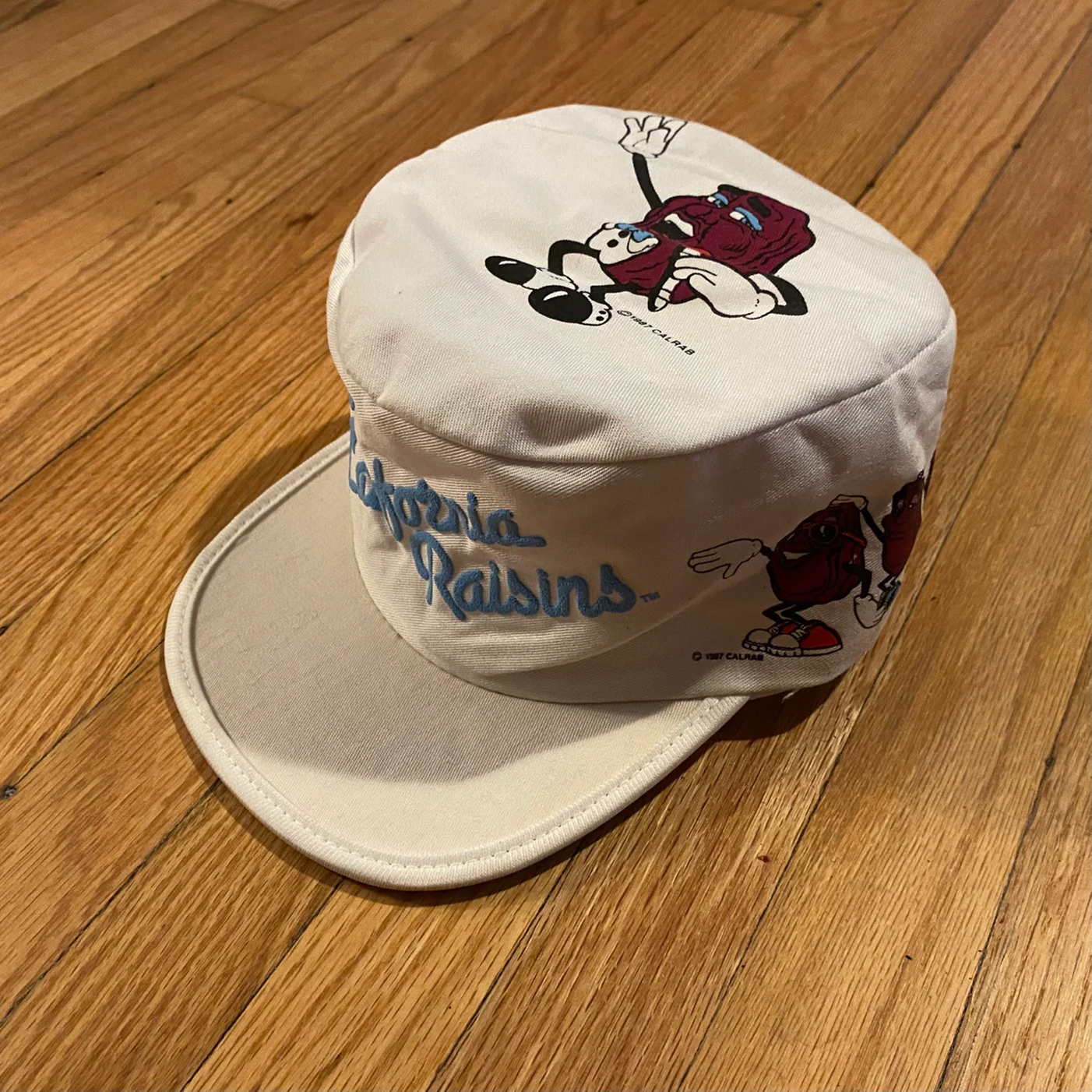
You know how I'M picturing you right now, and it sounds fine. I'm picturing you as a mid-1980s era California Raisin. I don't know if there are other eras for the California raisins. Like, there may or may not be. I just want to say that I'm familiar with the one that I had, the little painter's cap that had the California raisins kind of dancing around the edge of it. And they would hold these handheld mics, and then they had the. These like. Like, I don't know, wind protectors on. They were kind of poofy and colored on top. Right. Do you have a colored poofy wind protector on yours? Yep, I do.
- [05:39]
A
It's green, it's poofy, and it's protecting me from the wind. I'm in the Windy City, and it's. Yeah, it's protecting the. The microphone from all manner of p. Popping and bad sounds. There is a little bit of handling noise, which I'm trying to, you know. Did the California raisins wear gloves?
- [05:54]
B
Yeah, they did white gloves. I know this. Cause I.
- [05:56]
A
That's what I need too, because you can hear this. There's a little bit of handling noise. I need a white glove so that we could eliminate that.
- [06:04]
B
And also, what is going on with the sunglasses you're wearing? Are you wearing big plastic sunglasses like a California Raisin? Yes. All right. Exactly.
- [06:13]
A
Like an indoors. I'm wearing the sunglasses, I mean, we've talked about before. But the California raisins were. That was a phenomenon in my life as a kid. Like, I don't know if there's any analog for that nowadays as far as, like, you know, sort of a character that is created to sell a product. In this case, California raisins, that has that. That took over the culture the way that the California Raisins did.
- [06:35]
B
Yeah. What are the. Now, this is different because you're actually buying that product where. In this case, because I had a lot of California Raisins collectibles. And so in this case, you create something to sell one product. In this case, produce. But you have people buying the advertising slogans and mascots and everything. In. Like I said, I had a California Raisins hat, I had California Raisins toys, I had California Raisin buttons that I would put on the cap and wear out like I was fully. And you know that I won first place.
- [07:07]
A
You were a California Raisin.
- [07:09]
B
Right. And I was a California Raisin. Actually, I think I won second place. But that's because I think the music teacher didn't like me and my fellow raisins for personal reasons. We had. Nevermind, I'm not gonna make jokes about insurrections today. But anyway, so. Yeah, you're right. That went all in. Now today, what are the little. This is different because I think the product is the advertising. In other words, it's not like advertising something else. But what are the little, the little dolls that everybody, the little plushies that everybody has attached to their bags. I know that Boo boos. Yeah, those have kind of crested a little bit now, right?
- [07:44]
A
Yes. And they're not selling something, they're selling themselves.
- [07:47]
B
Right?
- [07:47]
A
They're selling themselves. And yeah, those are just like a phenomenon of their own. But they, you know, they're, they're a. I don't know if you call them a stuffed animal or not, but they're a thing that was create so that people would buy that thing.
- [07:58]
B
Yeah.
- [07:59]
A
Whereas the California raisins were a thing that was created. So I guess what, when our moms went to the store, they only requested raisins from California.
- [08:07]
B
Yeah. That's interesting too. Like, you know, really just selling raisins.
- [08:10]
A
Right, but, but from California, like how, like as the consumer, what were we supposed to do with that information? You know what I mean? Like we were supposed to like go into the store and say, sir, bring me your. Can you please bring me your finest raisins only from California. Those are the only ones that will do.
- [08:28]
B
Well, it's like avocados from Mexico. That was a big advertising campaign and they often will have like one super bowl commercial near the beginning. Although I don't know if they're doing that this year or not, but. Right. And I. Here's what, here's my theory on that though, is that if you go to your standard grocery store, probably most if not all of the raisins, like the, you know, mass marketed raisins that you'd be buying, especially in the 80s, are probably from California anyway. You're probably not making that choice. But it was generally an advertisement. Just like beef, it's what's for Dinner, like by the Beef Council, you know what I mean? They just want to raise, they want to raise awareness and awareness of this as a snack. Beef was my preferred snack as a child.
- [09:11]
A
That was, I think, how I was introduced to the music of. Is it Aaron Copeland? What's the, what was the iconic. Like, it's not, it's not Fanfare for the Common man, but there was an iconic song like, like, like Shenandoah Sunrise or something that was the Musical backdrop to the beef. It's what for dinner commercials.
- [09:32]
B
I am going to look that.
- [09:33]
A
Do you remember this?
- [09:34]
B
No. Well, I mean, I just. I was just digitizing tapes the other day, and I came across one of those beef commercials, but I didn't notice. It was. That was more about a busy mom who had to cook something quickly. And then at the end, it's like, cook beef for dinner. I'm like, how does that save time? What did you just sell us? Like, you're so busy. Beef is going to be easier to cook than what, pork? I didn't really get to sell. But anyway, I don't know.
- [09:57]
A
It cooks faster.
- [09:58]
B
Yeah. Which is not true. Let's see what's for dinner. I'm gonna call up one of these commercials. Not the one that I. Yeah.
- [10:07]
A
Try to find one from the 80s or 90s. It has that. It's like a Virginia reel or something, you know, I mean, it's like one of those, like, classic. It's like a fiddle piece.
- [10:17]
B
What does that mean?
- [10:18]
A
Oh.
- [10:18]
B
Oh, real. Oh, yeah, I see what you're saying. Yeah. Okay, let's take a listen.
- [10:22]
A
Y.
- [10:25]
B
Oh, yeah. I think this was the background music of the busy mom one I was watching the other day. By the way, what we're seeing for a visual is we're just seeing a bunch of people ordering steak at dinner and taking glasses of water and just pouring water all over the steaks. And it looks like, oh, are they Tribbianis? It looks like one of them is saying, slop em up. If I. I'm not a. I'm not a lip reader, but it looks like he's saying sloppy. Slop em up, boys. So I don't know.
- [10:56]
A
You think this is pushed back? You think this is slicked back?
- [11:00]
B
This is pushed back, Luke. I am worried that the baby thinks people can't change.
- [11:09]
A
I'm worried that we have become two people who can only communicate via things from the television show. I think you should leave. By the way, I was watching some Detroiters last night in the hotel room. Absolutely holds up.
- [11:21]
B
I just love them so much. I can't think of a show. So the Detroiters, I think, as most people know, is the project of Tim Robinson.
- [11:29]
A
Tim Robinson and Sam Richardson.
- [11:30]
B
Sam Richardson. And like, by the way, because I was clicking through the Detroiters the other day, too, I didn't get deep into it, but I think I just watched one just to get a little bit of a fix, just to calm me down, to stop the shakes a little bit. And I'm Trying to think where that fits into Veep, because I knew Sam Richardson first as a character on Veep, which was kind of split net. Exactly. Split dot net. And I'm kind of wondering if it sort of seemed like the Detroiters was more of a smaller, slightly more boutique thing that was going on at the same time while he was doing this kind of premiere HBO show that was kind of a critics darling. I'm not exactly sure, but there is something. I mean, obviously we love all the Tim Robinson projects and their weirdness and their darkness or whatever, but, like, Detroiters is a ray of light. Like. Yes, absolutely. But the love of these two men and basically just the love that is put into this show just comes out of the television set.
- [12:28]
A
And the love for the city of Detroit.
- [12:29]
B
Yes, yes.
- [12:30]
A
You might have been the one who told me this, but. So if you haven't seen it, Detroiters is this. It's this show where they're running this, like, little ad agency in Detroit and they're, you know, doing all these kind of. I have the. And it's always bargain time at Farmer Zach's. That's. That's been in. I woke up with that song in my head.
- [12:47]
B
The.
- [12:47]
A
The commercials that they're making in the show are based on real commercials from Detroit.
- [12:54]
B
Yes.
- [12:54]
A
Like the Devereaux wig.
- [12:56]
B
Yes. Commercial. That's very.
- [12:57]
A
Yeah.
- [12:57]
B
Was for coat, right?
- [12:59]
A
Yeah, for. It was like a fur coat outfit in Detroit and the like. And the farmer. That farmer's axe was a Farmer Jack's. It was a real thing. So I. I was watching Detroit, and then I was spending a bunch of time looking up the real commercials that the Detroiters commercials are based on, which is so fun.
- [13:15]
B
I mean, this is not a. This is not a slight towards the city of Detroit. I grew up in Cleveland, but never have I been like, oh, I'm jealous of people who grew up in Detroit in the 80s and 90s, you know, just because, like, growing up in Cleveland, you don't often think, boy, if only I was growing up in Detroit instead. But it makes me jealous. Like, as we'll hear from people like some. Or like, sometimes. I don't know if this topic comes up on. After. These messages are here on tbtl. And we'll hear from people who grew up in Detroit, and they're like, oh, yeah, that's. Here's a bunch of commercials that this is spoofing or at least a composite of or something like that. And you're just like, man, I feel that way about Seattle, too. And I know I've said this to you before, but the fact that Seattle has a lot of. I feel like I grew up and lived in a lot of places where people are either transplants or waiting to transplant themselves somewhere else, like, kind of.
- [14:03]
A
I don't know, they're on the transplant list.
- [14:06]
B
Yes. I do think that a lot of people of maybe of my generation and education or something, we grew up in Ohio, in the Cleveland area. And then it was just sort of expected that we would move away either for college or after college. Right. And sort of. And then on the East Coast, I just feel like there's a lot of moving around and stuff, and I've always liked that. It sort of seems like I come to Seattle, I meet all these friends who grew up here and stayed here, or at least stayed in the region and have all these, like, shared cultural markers, you know, which I have a little bit of when I go back to Cleveland. But, you know, my brain, Luke, I mean, it atrophies. It just cannot hold all of these memories. And I think they slip away easier when you're no longer there and you're not sharing that anymore.
- [14:48]
A
Totally. You're not like, you know, sitting around having a drink, reminiscing about Jack Roberts, Linwood Home Appliance.
- [14:54]
B
Right, Exactly.
- [14:56]
A
But. But this raises the question along the lines of the California Raisins. This raises the question, Andrew, are we, like, have we moved into an era where we don't have as many weird local commercials anymore? Because our viewing habits are sort of different now. Like, you know, I feel like people are not watching as much local television. I mean, they still have commercials. It's still happening. But, like, I wonder if there's a downstream effect where we have. There's just, you know, the guy, you know, the guy who's got the appliance place or the electronic shop or whatever, if they're. If they're not spending money on their kind of, like, weird, intentionally strange ads that were, you know, sort of fixed in all of our brains from growing up with them.
- [15:36]
B
First of all, I believe it's bageling the question show title. Thank you. No, I already wrote the show title. It's just raisin questions.
- [15:51]
A
Yeah.
- [15:52]
B
You know what I mean? I think they changed. I think that, like. Well, there are some that are still weird on purpose, but it's almost like with the birth of the Internet, what weirdness means has changed a little bit. I feel like they used to be legit, low budget ways to get attention of the local market. Like, come on down, look at me. I'm standing in a used car lot with my monkey friend or whatever the bit was.
- [16:12]
A
Cal Worthington.
- [16:13]
B
Was that Cal Worthington? Did he have a monkey?
- [16:15]
A
Yes, Worthington Ford in Federal Way. The only way.
- [16:17]
B
Yeah. So I knew there was a monkey involved, but it was still for a local audience. Whereas now I sort of feel like it's like I'm a lawyer or some, like, weird kind of shit that is supposed to catch the wave of the Internet and then get, like, kind of that. And I don't know. I just, you know me, I'm always kind of turned off when it. When somebody produces something that looks like it's trying to go, quote, unquote, viral.
- [16:40]
A
No, I mean, the charm of the commercials that we grew up with or that I grew up with were that the people who were making them were not really in on the joke. I mean, Jack Roberts kind of was. I mean, he was being so. His whole thing was, I won't be undersold. It would always be him and his wife. He would always be, you know, trying to cut a refrigerator in half with a chainsaw because he was. Was half off or something. And then his wife was always just, like, staring at him in horror at whatever it was he was getting up to. So, I mean, he was a little bit in on the joke. But again, yeah, the charm of a lot of these local commercials was that, in fact, the people were not really in on the joke. And now, yeah, they. Because of the Internet, because everything. We're like, you know, so steeped in irony. The people now who are making the commercials that are supposed to be intentionally bad so that they go viral, it's not the same. It's not fun.
- [17:26]
B
Yeah, that's kind of. That's kind of how I feel about it. But it is one of the reasons I think I enjoy AM radio because I do feel like AM radio is still the bastion of that. Right. Like, I think that I could see you and I, they take us out to the podcaster's farm somewhere where we're supposed to live out the rest of our days. We can't. They don't. They give us microphones. They're not plugged in anymore. And you and I were sitting in a fake little podcast studio outside. It's got a great.
- [17:55]
A
Is that how this ends for us? You and me talking into microphones that aren't hooked up to anything?
- [18:03]
B
When the nurse comes, I'll take it. Did you listen to our show today? Yes, sweetie. It was a good one.
- [18:09]
A
Oh, it was really good. No, it was really, really good.
- [18:11]
B
It was really. You were, you were really sharp, really quick witted. Are you using a new microphone? I. But, but anyway, will we be talking about the. You'll be sorry if you don't go to video only. You know what I mean? There's still some of that is alive on the radio. I feel like.
- [18:28]
A
Yes. Although it feels to me like AM radio is just law tigers for men.
- [18:32]
B
Yeah.
- [18:33]
A
And male enhancement for men.
- [18:36]
B
Yeah, there is a lot. And hey guys, she'll like it too.
- [18:41]
A
What's that one for? That's just their own replacement situation.
- [18:45]
B
Yeah, most of, the, most of the kind of like we'll just call them boner pill style commercials that I hear on the radio are not actually for like a Viagra or something. That's always some process. It always starts with them saying aren't you sick of these side effects with those pills? Or those pills don't last or I don't know what the argument against them is. And then they say that's why you should come in here and we're going to put radiation. It's not radiation but you know, it's like, it's actually, it's like, it's like we're going to put sound waves through your veins and it's going to make you feel younger again. And guys, she'll like it too. It's just sort of implied always. It is not really sound waves but it is, it's like hormone stuff. It's testosterone stuff. And I do like there. I feel like there's something that involves some. I'm going to listen more closely. It's amazing how I've heard these things literally thousands upon thousands of times. But my brain is also just sort of half turned off so I can't remember exactly the details I'm talking about. I'll try to grab a few for you. I mean for professional and personal reasons.
- [19:49]
A
Well, not to get into my bedroom situation which everything is fine. Despite what you may have heard or read people. Okay. Everything is great. But you know me, I'm constantly looks maxing and the idea of doing at some point like testosterone replacement just because. Yeah. As you get older and you lose your testosterone. That, I mean that is part of the aging process. Excuse me. But it's, it's, it's mildly appealing to me. Except. Well, a RFK Jr. He's. That's a horror show. And that's I think the result of him doing a lot of testosterone replacement. But also I think the fact that I haven't Been in a bar fight in 15 years is directly related to the fact that my testosterone is going away and it's been good for me. So on the one hand, I don't like that my body is changing and that I'm, you know, like, it would be almost impossible for me to really, really build muscle mass at this point. And, you know, there's all these things that happen because we're aging and we have less testosterone and the idea of replacing it is tempting to me. But the issue in my life has always been that I get too angry. And I do think it's been kind of good for me to have less tea.
- [20:56]
B
Well, I mean, it is interesting. Our bodies progress across an arc for a reason. Right? I mean, there. Exactly. So, yeah. I mean, but also there are certain things that people do to maintain certain energy levels and stuff. So I don't want to make it sound like I'm just like, once you're 50, life is over. Just lay on the couch and don't try to be vibrant or anything like that. But also, yeah, you're right. There are probably reasons why we have, why we're jacked full of emotions or hormones at some points of our life and emotions at some points.
- [21:30]
A
Nature is like selecting away from horned up 74 year old guys doing pull up contests with Pete Hegsett.
- [21:38]
B
Yeah, right.
- [21:39]
A
Like nature does not want that to happen.
- [21:41]
B
Yeah. Thank you, baby.
- [21:54]
A
All right, let's thank some donors. These folks are the kind, generous, wonderful people who are supporting TBTL with a donation and it's how this can happen five days a week. This is 100 listener supported podcasting. Someday maybe we will be doing this at a retirement home for nobody. But for now, we're doing it for folks like Thomas Seagrove of Spring, Texas.
- [22:18]
B
Oh, thank you, Thomas.
- [22:21]
A
Thanks also to Andy Jaske, who's in Gloucester, Massachusetts.
- [22:26]
B
I think that's right. Gloucester sounds right to me.
- [22:29]
A
The, the way that. Well, if hopefully I'm pronouncing it correctly, I believe that, that that town plays a significant role in the movie Captain's Courageous, which is a really, really good old black and white film. Highly recommended. It's. It's Spencer Tracy and he's basically like a fisherman who is. They fish out of Gloucester with the Captain. Disco is kind of a weird name. Obviously this was before the era of disco music.
- [22:56]
B
Yeah.
- [22:57]
A
So the, the, the guy, Lionel Barrymore plays the, the captain of the ship Captain Disco and his son is played by Mickey Rooney and they're out fishing off of Gloucester when Freddie Bartholomew, who is a spoiled rich kid, falls off of the cruise liner he's on and has to like live on this fishing boat because they're not going to come in. Because they're out fishing when the fish are running and they can't afford to come in and drop him off. And he undergoes a real personality change while working on the boat.
- [23:27]
B
While working on the boat. So he becomes a fisherman. Yeah.
- [23:32]
A
He becomes basically a non piece of shit. People can change. Andrew and Freddie Bartholomew changes in the movie Captain's Crash. But it's. It is just an absolutely wonderful film. Would recommend. It does have a bit of a. It's a depressing ending. Let's just say things don't go great for Spencer Tracy at the end of the movie. But it is. Otherwise it's a. It's a lovely film.
- [23:50]
B
It is amazing. If you were just to walk up to somebody and say, imagine what Captain Disco looks like. Nobody is picturing Lionel Barrymore and he was the first to play it. Right. Like literally nobody is picturing. When you picture Captain Disco, you picture more like Disco Stu from the Simpsons.
- [24:08]
A
Exactly. If I said there's a character named Captain Disco.
- [24:11]
B
Yeah.
- [24:11]
A
You're not thinking of Mr. Potter from It's a Wonderful Life.
- [24:15]
B
You most certainly are not. I'm really hoping. I don't know. I just had a thought that popped into my head that's not related to this conversation or anything we've talked about so far in the show. But something I wanted to tell you about, but it's Vegas related. So let's keep on thanking these donors and hope that there's somebody in Nevada on the list.
- [24:34]
A
The closest that we're going to get is California because that's where Annie Seacrest is, who's in Slo San Luis Obispo, California.
- [24:43]
B
Thanks, Annie. Longtime friend of the show.
- [24:46]
A
Thanks also to Sharon Sprout who's in Chilliwack, bc.
- [24:51]
B
Nice. Let's see. My story is Chilliwack. It really is. And Sharon. Thanks, Sharon.
- [24:55]
A
And thanks also to Beth Mittlehoven who's in Renton, Washington. And then Abel Eng is in Aberdeen, Washington.
- [25:03]
B
Oh, wow. Represent Washington State.
- [25:05]
A
Absolutely. So the closest that we could get to Nevada was. Was California. By the way. Thank you to our donors. We couldn't do this without you. What was the Vegas related thing that came to mind?
- [25:14]
B
I just wanted to tell you that I noticed something interesting in Vegas that I'm wondering if you already knew about, but Genevieve and I were wandering around a lot and we saw some of those Zooks The Z O, O, O Zeus.
- [25:28]
A
Is that how you say wait, no, no, no, no. It's a zuk. You're right.
- [25:30]
B
Doesn't it end in an X Z? I don't know.
- [25:33]
A
You're right.
- [25:33]
B
Yeah.
- [25:33]
A
Zusk was this running this clothing brand of running clothes and I used to work with this commercial director and he really loved this like Zoosk brand and he would wear like a Zoosk hat, a Zoosk sweatshirt, Zusk pants and I think maybe even his shoes. And I remember thinking, okay, that's, that's enough of that.
- [25:54]
B
That's overdoing it on the logo. I gotta say this is a, this is a huge tangent away from what I was getting at. But I don't like the Under Armour logo. It's not, it's totally inoffensive. It's not like it's a problem for me, but it just, it just lays there and it's so popular.
- [26:14]
A
Listen Andrew, I'm still digging out from under the emails of people that are mad at me because I criticized back in parking as Republican coded. Yeah, but Under Armour as a company is known to be Republican coded.
- [26:25]
B
Oh, okay. Well there you go.
- [26:27]
A
And, and I'm with you. I don't know if it was when I learned that about the company or just my kind of natural reaction to it, but I have never liked the Under Armour logo. I feel like it's, I don't know, it's, it's, it's unimaginative in some way and now every time I see it I just think of like oh, those, that's a, that company donates to maga.
- [26:44]
B
Yeah, I did not realize that. I'm looking at it now and actually analyzing it for the first time. I do see how it's, oh, it's a U that intersects with an upside down U. So the upside down you looks like an A. So that's where you get the ua. But there's something about it that I don't know. It's symmetrical. I like things that are symmetrical. I don't. But I saw somebody walking with a hat and it was just like, I don't know, middle aged lady with a black Under Armour hat with a white logo on it. Totally inoffensive. Just totally could fly under the radar. You probably don't even notice it. But there's something about the almost invisibility of it that I don't care for. So anyway, walking around Las Vegas I saw one of those. A self driving vehicle called a Zoox I believe. Z, O, O X and they're more like little. They're like little squares. They're like little rectangles, little sticks of butter. Basically. If you go to the store and you can buy one of those short squat sticks of butter instead of the long ones our parents used to buy, that's what a Zoox looks like on wheels. And it's self driving. And I thought that was interesting because I don't know if I've been in a city before where I've seen it full on autonomous vehicle. And so Vivs and I are like, oh, that's interesting. Had a brief thought of ordering one and then let that thought pass. But then we're driving in an actual lift with a driver and we pass a Waymo and Viva is like, oh, I think that one is a Waymo. And the guy's like, yeah, but the Waymo have to drive with human beings behind the wheel here. We're like, what? I'm like, there's nobody in that car. And then I looked and there was. There was like somebody in the driver's seat of a Waymo. Did you know about this? There's some local law where they're not allowing Waymo to be fully self driving, even though the Zooks apparently are.
- [28:19]
A
I didn't know that there was a difference there. But in other cities, like for instance, in San Francisco, there's always a beta phase where they're like, so the Waymos had to have people in them for some period of time. And I always thought that just seems like that would be. I don't know, it seems like that would be such a boring job to be the person who sits there and watches the steer. I mean, first of all, there's not even a real reason why a Waymo should have a steering wheel anymore. If you think about it.
- [28:44]
B
Hmm.
- [28:45]
A
Like, it's just for comfort, I think. And they have a big sign on it because I take a lot of Waymos now when I'm in la, because you can, you know, they're. They're fully autonomous. There's nobody in there, but it still has a steering wheel. But then the steering wheel has a sign on that says, please don't touch the steering wheel. Because I guess people might, you know, instinctively want to mess with it, but it's like you actually don't even need a steering wheel anymore. It's, you know, because the thing, you know, the car could just be driving itself internally. That's there for a human. And you're right, those Zooks, they're really leaning into the idea that like once a car is fully autonomous, there's so much about the design of a car that is no longer relevant.
- [29:20]
B
Yeah. Like you don't need a place for. Yeah, well, I mean it's still, you need, you know, whatever it runs on, whatever mechanism it runs on. It doesn't have to be all under a front hood, for example.
- [29:31]
A
Totally. And like a windshield is unnecessary now you don't actually, I mean, you probably kind of want to see where you're going just out of curiosity. But like, like the orientation of the seats, you know, really, I mean it will at some probably someday we'll be, we'll all be taking like, you know, zook type of things everywhere and you know, like, yeah, the seats could be facing each other. I guess people might get a little car sick from that. But like there's just so much about the design of a car that we currently think about because it's meant for a human to be driving. And once that's not part of the, of the calculation, everything is up for.
- [30:02]
B
You know, changing, which I like as somebody who's car blind and like all cars look alike to me and I feel like they're all the same color these days. They're all like somewhere between like silver and silvery beige. I know that's scientifically untrue, but that's just how it feels walking around the world with my eyes and I'm looking at a little video of these zooks. Now by the way, they're. It's not a car, they say it's a robo taxi designed around you and they stand out and they're so fun. Now I did not go on the inside.
- [30:29]
A
That's why I'm surprised you and Veeves didn't, while in Vegas like download the app and go out for a ride in one. That seemed like that'd be a fun adventure.
- [30:37]
B
Well, maybe we did. And it just stayed in Vegas.
- [30:41]
A
I've heard about that. I've had about things happening there.
- [30:45]
B
If that Zoox could talk and it probably can and it's probably actually hosting a podcast right now. But yeah, these things are really, really cute and I love it and I love the idea of, of shaking up what vehicles look like because like you say, why not?
- [30:59]
A
Yeah. And you know, actually I was the. Our friend Chris Hayes's podcast a couple of weeks ago was sort of an update on where self driving cars are. And one of the things that we're talking about was just, well, first of all, the idea that eventually we maybe don't need to own cars. Right. I mean, you would love this because if, if a car is now eventually basically like a zook, if it's just a little, a little rectangle of butter that can just drive itself around and go pick you up and take you to work or whatever, you don't need to own that car. Like there could just be a bunch of cars that, that are just kind of in the population and that are just taking people where they need to go, when they need to go there. And also I was thinking about it in terms of, you know, one of the big things that happens when folks get older. For some reason this is the show, Andrew, where we contemplate our later years together. But you know, one of the big things that really impacts people's life as they get older is lack of ability to drive and, you know, lack of ability to go places and stuff. And that can be really, really bad for somebody's kind of state of mind and emotional health. And I think it's pretty cool that by the time you and I are probably too old to be driving, there will be a solution for that, which will be the robo taxi.
- [32:05]
B
Yeah, I agree. I always, whenever I talk about this kind of stuff, I always think about like my time in New Hampshire because I just think about like, yeah, of course, because I plan on getting old in a place like Seattle where, you know, hopefully Seattle will be one of the cities on the cutting edge of having these self driving vehicles that can drive my old ass around or whatever. But then I think about the people who are like living like you know, practically in the White Mountains, you know what I mean? I just remember I was a young man living in New Hampshire, but also like, sort of like learning a little bit about the worlds and the struggles people face and the idea of being like so isolated in a rural part of the country like that and like that technology is not going to come to you for such a long time. Makes me very happy. One of the reasons why I'm almost scared to leave the city, you know.
- [32:54]
A
What is, I don't want to say sad, but again, this is a show where we're really, really talking about the aging process. I have made a calculation which is that my house, you know, out at the Madrona Hill studio that I've been working on, it is there are two floors, there's a, there's an upstairs, but I could conceivably live out my days just on the main floor. Like it's got, you know, the bathroom and the kitchen and the deck and all of the stuff That I. And the bedroom, everything I would need is on one floor. And actually there is a. Now I have a little sort of driveway that goes down to. I don't have to even go down the stairs to go from where I park. I mean, I do, like, right now, I park my car, I go downstairs, and I enter the house. But someday, if I wasn't able to take stairs, there would be a way for me to have the robo taxi just drop me off basically at the edge of the patio. And, like, the fact that, I mean, I'm 49 years old, I'm definitely not old yet, but I'm already doing the calculation of, like, could I live my days out here?
- [33:45]
B
Is. Is. Is.
- [33:47]
A
Is not something that I expected to be doing at this point in my life, but I guess that's. That's what happens.
- [33:57]
B
Hello, and welcome to Top Story.
- [34:00]
A
All right, let's talk about pennies. This was a kind of an interesting story in the New York Post, by the way. I need to stop reading the New York Post. Like, I'm like, the problem is such, it's such a rag and it is so, like, particularly around what's been going on with ice and everything. Like, it is so infuriating to read because, like, I don't watch Fox News. I don't. I don't. Not one of those people that feels like I need to know what the opposition is doing all the time. It just makes me feel over overall sad. The thing is, the New York Post, they do have sometimes, like, interesting, weird stories because they have almost no journalistic standards and they'll print anything. And sometimes that aligns with, with us finding a good story for tbtl. But the rest of the time, it's just like. It's like, what if you. What. What. What do we. What does the inside of Donald Trump's brain look like? You know, as far as all of these world events and national events, but just through this kind of filter of, you know, the, the ice person who murdered that woman, you know, he, like, oh, he was actually someone else hit him with a car a few months ago or he's a vet or. You know what I mean? Just like, it's just like, it just makes me so enraged when I read it.
- [35:06]
B
It's funny because I'm not as deep in that world. I'm not over there as much as you are. And I think, like you say, though, sometimes it also just has good topics for our show.
- [35:15]
A
But.
- [35:17]
B
I happen to have a fleeting thought that is similar to the one you're having yesterday because this kind of gets a little bit close to where you live, so I'll be a little bit careful here. But I saw everybody on Bluesky dunking on this idea of Whiskey Fridays. What? Oh, okay, so you don't know about this yet?
- [35:35]
A
No.
- [35:36]
B
Okay, so I'm going to tell this the best I can and as accurately as I can, but apparently some photos leaked that looks like a set from cbs. Is it CBS Nightly News or cbs whatever. Is it Tony Decouple? Is that how you say?
- [35:51]
A
Oh yeah, Tony Decouple.
- [35:52]
B
Yeah, yeah. And he's of course his debut is getting slammed at least by the, by the people that I follow. Right. On Blue sky or whatever. And apparently some images leaked that appears to be a set, like a TV quasi news set or maybe even a sports desk looking set, only it says Whiskey Fridays and behind the desk and everything it looks like. Very well, first of all, there's a big not Jim Beam but Jack Daniels branding on one side and it looks like there's a fake bar with all kinds of bottles of, of liquor behind it or whatever. And so everybody was assuming that it looks like CBS is partnering up with Jack Daniels for some sort of a Whiskey Fridays with Tony decouple thing, but it's unconfirmed. And then one article I was reading said that they called Jack Daniels and Jack Daniels says, we know nothing about this, we haven't seen it, but there's the photo. So there's like now this idea that maybe they created the set first to try to sell the market, like a proof of concept. A proof of concept or whatever. So. So all of this is conjecture right now, by the way, but all of this comes back to the post in that I just wanted to know what everybody was talking about with the Whiskey Fridays jokes. And I just, I don't know if you're like that. You're more plugged in than me, but sometimes I'm just like, after I see somebody reference something like three or four times on Blue Sky, I'm like, I gotta figure out what the hell people are talking about. And so I start googling. But every article I googled was doing that thing where it would give me one or two graphs and then the text would start getting fading out out more and more and more until it said, you have to subscribe to read the rest of this article. And I was seriously Luke on like source number five. I was finally like, oh, I got a live one here. And then the text would get. And then I couldn't read the text you were getting Gatekeeper. Yeah, I was getting Gatekept. And the only institution that didn't gatekeep me was the Post. And the Post said to me, though I can see that you're using an ad blocker. This is kind of common. I have an ad blocker that I mostly just use to. For the ability to play YouTube videos without having to wait during a live podcast. But some sites are like, hey, we see you're using an ad blocker. Just turn that off. And the rest of this is free for you. And so, of course, I always turn it off. But I was like, oh, I'm buddying up to the Post. I'm turning off my ad blocker for the Post, because the Post is the only institution that will tell me what's really going on with Whiskey Fridays on cbs.
- [38:15]
A
But knowing the Post, the headline would be like, if everyone is dunking on CBS launching something called Whiskey Fridays, the Post would be.
- [38:21]
B
Would.
- [38:21]
A
It'd be like Andrea Paisar writing a column about how Whiskey Friday is exactly what America needs.
- [38:28]
B
I know. I remember exactly what it was. I feel like it was a little bit just, like, straight up, these are the facts, but I'll see if I can find that. But we're pretty far away from what you were trying to talk about, which.
- [38:38]
A
Was pennies and the fact that because they have discontinued, they've stopped making pennies. The last. The 2025 pennies, if they're called the Omega penny, are potentially worth a lot of money. And in fact, there was a. There was an auction of the, like, I guess, kind of some of the final batch of pennies that were ever going to be made. And this. This. This trove of these pennies sold for $16.76 million at a special auction to. I guess it was on behalf of the US Mint. So they were selling these off to make all this money to support the project, I guess, of the U.S. mint. But there are a couple of different pennies that you want to be looking for if you've got them around.
- [39:21]
B
The.
- [39:22]
A
Like I mentioned, the Omega penny, that's. There's an Omega symbol, like the Greek symbol over Lincoln's shoulder. Okay, so take a look for that. If you get anything from the class of 2025, you might actually have something. There's also, if you see an S on a penny, that denotes that it was created at the San Francisco Mint. And there are some valuable key dates from the San Francisco minting of pennies, 1931, and also 2021. For some reason, if you get an S penny from those years, they could be worth something. And then there's something called the magnet test. If you have a 1943 penny. Andrew, this is a little confusing, but bear with me. If you have a 1943 penny and you put it on a magnet, if it sticks to the magnet, that means it's made out of regular steel and it's actually worth 10 cents. But if it doesn't stick to the magnet, so we have a 1943 penny that won't stick to the magnet, that means it's copper and it could be worth $100,000.
- [40:22]
B
So here's the deal, Luke. And I sincerely apologize because I've done this completely back ass words. I saw this on the show sheet today, but I didn't dig into the article, but I did think, oh, well, I do have a big jar of coins upstairs. V and I, on the off chance that we come home with a change in our pocket, we dump it into this jar just as a big ass mason jar. And Genevieve, I know, actually had a rolling party the other day, which sounds more fun than it is a rolling party sounds. Either it's like Molly or weed is involved. In this case, it was just spare change, but she rolled up a bunch of coins, and I don't know where they are right now, but I know we also have a bunch of loose change, too, and I am very tempted to go through it maybe. And I don't know if you'll put up with this because maybe it'll make me too distracted, but, like, maybe at the beginning of tomorrow's show, I can maybe shuffle through some of those and grab myself a magnet and just take a quick look, see, as to whether or not I have. I mean, I would be shocked if I did, but that it'd be fun to find out.
- [41:21]
A
So if it's 1943 and it is not magnetized, if it won't stick to the magnet, that's good. Now, if it's 1944, yeah. And it sticks to the magnet, that's also good. That could be part of a, like a minting of pennies. That was a rare steel error. So there was some kind of a mistake where they were making pennies in 1944 accidentally out of some kind of steel. They're steel wheat pennies. And one of them sold for $408,000.
- [41:51]
B
Whoa. Whoa.
- [41:53]
A
Now, I was in the local grocery store near my house the other day, and I was chatting with the guy as I was checking out, because I think I was paying in Cash, which is actually kind of rare for me. And they had one of those signs that was something like, you know, if you have pennies, we need them. And I said, what are you going to do with the prices?
- [42:10]
B
Yeah.
- [42:11]
A
When there are no more pennies?
- [42:12]
B
Yeah.
- [42:13]
A
And he goes, yeah, we don't know yet. I was like, that doesn't sound like a very, a very good system.
- [42:18]
B
Yeah.
- [42:18]
A
Like he doesn't know what they're going to do when there are no pennies.
- [42:21]
B
I don't feel like this was well thought out, as you know, you kind of belatedly broke the news to me, like, I did not know this was happening until, like, it was in the news, like for nine or ten months or whatever. You brought it up late last year on the show and I was really shocked to hear this. And then you and I got into that exact conversation. Well, is ever. How are you going to, how are you going to factor in taxes? You know what I mean? Like, you can maybe price everything so that it ends either, you know, in increments of 5, you know, either 5 or 0. But, but with the tax calculated in, you know, all the different taxes and all the different areas, there's no way to guarantee it's not going to end in a, you know, a one or a two. And so how are you going to handle that? I guess you're always going to round up or down to fives, but where's.
- [43:06]
A
The conversation over the course of, like a big grocery store at the end of the day, if you're either rounding up or rounding down, that's a big difference in your bottom line, I think.
- [43:15]
B
So, I, I for real now. So it's a big difference in your bottom line if a lot of people are paying with cash, but I don't think a lot of people are paying cash. But if you have to. Well, though, I'm talking myself out of that because if you have to institute the policy, it seems like you'd have to institute the policy across the board. Right. The pricing policy. You can't have it different for somebody paying with a card than somebody paying with cash. Maybe I'm wrong about that, but I don't know. Again, my point is, I just feel like we should have had this conversation before we just decided to kill the penny.
- [43:46]
A
Right? Because, I mean, well, we, you know, the penny was apparently costing more than $0.01 to make, so it was, you know, it was an expensive thing. But yeah, nobody, we don't seem to have a standard sort of plan in place for going forward, for when you know, something is in between 5 cents. So I don't know. I mean, I'm shocked to hear that this administration didn't think something through.
- [44:08]
B
Yeah.
- [44:09]
A
Long term, you know, that doesn't seem like their move. They seem like planners. They seem like very careful considerers of things.
- [44:15]
B
Yeah, well, I mentioned this to these because I'm clearly a little bit more emotional about this than I guess I need to be or.
- [44:21]
A
Yeah, you were bummed when I told you.
- [44:22]
B
I am, and I still am. And now I'm getting a little bit angry about it. Like, well, how. How are you going to handle this? I don't know. Like, I'm seeing those signs at my grocery stores, too that say, like, hey, we need pennies. It's like, well, then we shouldn't have gotten rid of it then. Like, I don't know. I'm getting a little bit. I'm getting a little bit cranky, Yandy, over this whole thing, and I'm sure it'll all work out in the end. I am excited to know, though, if I'm a millionaire. I think that you said millions. All I heard was millions when you were talking about hundreds of thousands. But here's the thing that I like about potentially stumbling on a very expensive penny in my penny jar is I would sell it in a heartbeat because I'm not a collector. It's like one of those things where if I found out some record on my shelf that I bought and I didn't realize it was a first edition of something and it had a. I don't know, an upside down plane flying on the back that was supposed to.
- [45:17]
A
Be incredibly handsome men on the COVID Yeah, right. Of the album.
- [45:21]
B
Exactly.
- [45:21]
A
Rendered in the style of Air Supply.
- [45:23]
B
But I just realized, oh, my God, this is a collector's item. And this is actually worth, you know, like, let's just say some significant amount of money. I don't know how much, you know, the most expensive collector's item record would be, but let's just say that it was something that could have an impact on my life. But I would be like, I don't know, though. Like, it's part of my record collection. Like, it would be. There would be some thrill in keeping it as well and keeping it safe and showing people, I don't give a shit about this. I'm not collecting pennies. So if I stumble on a penny that's worth $400,000, I am selling that thing immediately, Antiques Roadshow style.
- [45:56]
A
And what are you doing with the 400,000? Are you saving It. Are you going on a trip to the Bahamas? What are you doing with the money?
- [46:01]
B
Have you heard about these side bets you can place when you're in Vegas playing blackjack?
- [46:07]
A
Speaking of, did you see this whole thing about the, this college basketball point shaving scandal? Now that's. That's been. No, it's been blowing up today.
- [46:17]
B
No, it's just brand new. No, I don't know about this.
- [46:19]
A
Yeah, it's just another. Like they're basically, they've got these couple of people that they think were running this pretty big ring of. They started out in Chinese basketball. They figured out that they could actually like impact the score of a Chinese basketball game because there was like an American player who was playing over in China who they, they allegedly sort of had in their pocket. And so then they moved the operation to the ncaa. And I can't remember the number of players, but it's something like 14 or 20 players that are alleged to have been involved in, you know, controlling the scores of these games.
- [46:50]
B
Oh, wow.
- [46:50]
A
So that the people betting on them could, you know, make their money. Then there's the, the whole baseball, like Jonathan Class A, like pitching it in the dirt to start the inning. And he was texting. There was people that were texting about this, but they were using these codes that involved like horses and roosters. Because this guy, Jonathan, Class A, also owns a cock fighting ring in his home country, which is legal.
- [47:12]
B
Is this a manual, Class A or Jonathan?
- [47:14]
A
Yes. No, sorry, yeah.
- [47:16]
B
Emmanuel Classe, the Guardians player who. And I think that that pitch happened against the Mariners, I think.
- [47:21]
A
Oh, really?
- [47:22]
B
As a just a quick little aside there, I'm pretty sure I think he threw two bunk pitches on purpose. And I think one of them, maybe the first one was in Seattle, I think. I think. But you know, take that with a grain of salt.
- [47:34]
A
They have to get rid of the prop bets. You, I mean, you. Because generally speaking, I think it's hard to control the actual score of a game because you gotta have a lot of people cooperating on that one. But whether or not class A throws the first ball in the dirt or throws it under a certain, you know, like, throws it like less than 80 miles an hour or whatever it is. Like the fact that you can bet on that stuff, that's insane to me. That is just a recipe for, for basically, you know, people cheating. And the other thing that I saw that was, that was like, made me crazy was in the like, you know, the poly market or whatever they call that, where you can just bet on Anything. Somebody had bet that the Venezuelan guy. Somebody made $400,000 betting on the fact that that Venezuelan guy was going to get arrested. He was not going to be in office as of a certain date.
- [48:23]
B
Okay. Yeah, I had seen some headlines about that.
- [48:26]
A
That.
- [48:26]
B
Yeah.
- [48:27]
A
And like, I mean, like, I don't know. That just seems.
- [48:29]
B
It's just.
- [48:30]
A
Just we're in a very dark timeline that some. Some crypto bro somewhere made $400,000 correctly betting when the US would illegally intervene in the business of another country.
- [48:41]
B
Yeah, absolutely. And who probably had information from one of the tech bro, DB I'm sure.
- [48:47]
A
He was at a. He was at a, A, A chin up session with Pete Hegseth hours before this happened.
- [48:53]
B
Whenever I think of Hegseth now, somebody posted on social media that. Just a simple post that lives in my brain that just says, I just can't rectify the fact that our secretary of war is a funny socks guy. And that's sort of like, I think so. And that sort of lives in my head a little bit, like, of everything that I sort of just like, hate about that guy. And the fact that he's, like, probably sporting funny socks at any given moment. I don't even know if it's true. I'm just taking it at face value, and it's just adding a layer of irritation to my hatred. Yeah.
- [49:27]
A
Because, you know, in his mind, he thinks he's being wacky.
- [49:29]
B
If we're even right about that. But I'm 100. Like, I'm 100 willing just to, like, say this is true. I don't. I don't assume.
- [49:36]
A
Worst intention.
- [49:37]
B
Yeah, I don't. Yeah, exactly. Exactly. With your. With spongebob socks, there's a right way.
- [49:45]
A
To rock and a wrong way to roll.
- [49:49]
B
You can't just listen to your soul. Just remember that life is number one.
- [49:57]
A
You can be having so much fun.
- [50:00]
B
Just remember that life is much fun.
- [50:05]
A
You can be nothing.
- [50:07]
B
Number one. All right, Lucas, we have a. Oh, how do you feel about Lucas, by the way? I know we've gone over the Luke I am your father thing that people. But people have probably called you Lucas your whole life, and that is not your name. That is.
- [50:26]
A
It's not my name on my birth certificate. Is just Luke.
- [50:29]
B
It's not Lucas. So how do you feel when somebody like me says that in sort of a jovial way as a little eye rolling?
- [50:34]
A
I'm good with it. No, no, I'm good with it. You know, it's nice. I like it. I like the fact that you feel comfortable calling me a name that is not my name.
- [50:44]
B
I was also trying to do some math. I was trying to figure out what's going on with our listenership and the month of May because apparently, well, I guess our listenership's parents in the month of May because people were not feeling very amorous nine months ago. We have a very, very tidy short little blursday segment.
- [51:04]
A
I see people in America and I guess all over the world, but it'd be over multiple years because people are all different ages. What you're saying is nobody is humping in May.
- [51:16]
B
I would say that nobody who has the genes that would produce a child who would grow up to enjoy this particular podcast is humping in May.
- [51:28]
A
Gotcha.
- [51:29]
B
That's what I'm saying. But for those whose parents did hump in May, this one's for you. And if you would like to send in a blursday message just to shut me up, do it by emailing me andrewbtl.net, put Blursday in the subject line. We have this sweet blursday from Brett and Amy wishing our sweet 18 year old cat crazy smart and funny. 5 Rockwell.
- [51:55]
A
Oh Rockwell.
- [51:56]
B
Happy Blursday. We know Rockwell well, 18 years old now Rockwell. He's long enjoyed the show, especially when he's contributed his rendition of the Murder She Wrote theme on piano. His fever dream of a tomato, bacon, turkey and lettuce or TBTL sandwich. And there's no telling what he'll get up to with his latest electric guitar pedals. Oh, nice. Oh, you know what? This is directly related to your guys interests because Brett and Amy are our U District 10s as they identify themselves, which is very close, as you know, Luke, to the R.O. roosevelt neighborhood where I used to live and where there used to be a beloved used trading Musician store called the Trading Musician. And that place was around for over three decades and it closed somewhat recently, maybe about a year ago. And four of the employees and former employees did open up a new music store in its image a few blocks away, very close to where I used to live.
- [52:58]
A
Oh, it's not in the same building?
- [53:00]
B
No, because the building, it was like the decision by the owner to actually sell the building I believe. So they had to find a new place and they took over that little, that little like kind of deli thing that was by Cowan Park. Luke, if you know it, right at the corner of. What would that be? I guess Ravenna and 12th or something. I'm kind of freelancing here. And they called it. It's called Reanimation Music, I want to say, because it's like.
- [53:25]
A
Yeah, there was a big article in the Seattle Times about them.
- [53:27]
B
I was just. Yeah, I was reading that today, and I had passed it a couple of times. And I know that some of our friends were heartbreaking with and heartbroken when the Trading Musicians shut down. Like, it truly was, I think, a very special place. It wasn't just a place. It was like a. It was a cultural sort of center. And so it's back, and it's very close to where young musician Rockwell is rocking out.
- [53:48]
A
So very convenient. That is where I once saw a huge coyote. I was jogging near Cowan park and just standing right in the road right by with that little. That what was a grocery store was a giant coyote.
- [54:01]
B
And that was probably when you were visiting me, right? You were probably doing the show because I. I vaguely.
- [54:06]
A
Yeah, I didn't live in Seattle at the time.
- [54:08]
B
Yeah. Yeah, that was really.
- [54:10]
A
I was very happy to see that. By the way, that the. The Trading Musician has been. The spirit has been continued. And by the way, the guys that own it, they look exactly like four dudes who would own a. A used musical instrument store.
- [54:24]
B
Yeah. I said either this show or maybe after these messages recently, how much I love Guitar center because the service has been really good to me. And as places close like the Trading Musician, it's nice to have that there. But then I'm kind of surprised I didn't get any kind of angry email about it, kind of saying, yeah, but it's because of chains like Guitar center that maybe it's harder for places like these smaller operations to stay in business. I think there's an argument there. But one thing I am going to do is when I need something like just cables or something like XLR cables or any of the mic cables or that kind of stuff, I'm gonna try to go to Reanim Music first before going to Guitar center all the time, see if we can support them. All right, how about this? A very blessed blursday to Graham and Ian, both of Superior, Wisconsin.
- [55:14]
A
Okay.
- [55:15]
B
My TBTL daddy and granddaddy, respectively, from justice in the Thunder Bay City.
- [55:24]
A
Oh, sure. Justice, absolutely. So it's Graham and who's the blue.
- [55:28]
B
Yeah, it's Graham and Ian. They both live in Superior, Wisconsin. And so I take it. Let's see here. If I got this right, then you have. Ian must have turned Graham onto TBTL and Graham turned Justice onto tbt. Got it. And we turned justice on its head. I don't know what I'm doing, man. We gotta get out of this show. Brian in Auburn, Washington, says, January 15th today is my big Blursday number 50. That also makes it a golden blurs day, by the way. Brian says, am I too old or not old enough to go in search of some birthday discounts and free desserts at local dining establishments? Suggestions are welcome. I don't know, man. What can Brian get in Auburn on his birthday?
- [56:12]
A
I am definitely guessing he can get a sombrero and some kind of a free dessert. He goes to a local Mexican joint.
- [56:19]
B
Okay. Okay.
- [56:20]
A
I'm thinking if, like, if there's a Cold Stone Creamery, hit that place up nice. I like this. Probably the bakery. Maybe at the grocery store, they might give you something.
- [56:30]
B
Do people get free drinks on their birthday, or is that only when you turn 21? I don't know if Brian's a drinker. I'm just reminiscing. It was such a big deal. When you turn 21, your friends are like, we gotta take you out to get your free drinks.
- [56:40]
A
Did you do a 21 run of some kind?
- [56:42]
B
Kind of. But, I mean, as you would guess, like, someone reluctantly, like, I. I don't care about, you know, like, I just, like. I don't care about, like, chasing that as much. And I remember because I might have already had a little. I don't think I actually did. I definitely never had, like, a fake ID or anything. So I was not spending time in bars before I was 21. But when I did turn 21, I remember thinking, like, I just want to go to a bar and sit for a while. And they're like. I remember friends being frustrated because they wanted to go around and get free drinks and everything. I'm like, but I don't want to. To go traipsing all over town. Like, that's not my Luke. I've been me my whole life, is my point.
- [57:17]
A
You had your copy of Ham Sandwich. Isn't that Bukowski?
- [57:22]
B
You're very close. Ham on rye, I think, is that one. I was like, I think I know what he's talking about. But, yeah, I was probably toting around ham on rye and maybe even a ham on rye.
- [57:33]
A
I. I did have a 21 run. My girlfriend at the time, Francesca Severini, and her sister, Nina Severini, they took me out, and it was the second time I'd ever been drunk in my life. And oh, my gosh, did I get drunk. And, boy, was I feeling it the next day. And my job in college, when I turned 20, 1 was, I was one of the, like, a traffic reporter on Metro traffic. But on Fridays, my job wasn't to be on the air. My job was to sit there at this computer and basically, like, monitor all of the traffic. I had a headset on. I would talk to the guy in the plane. I would call all the local, like, police departments and the sheriff to get like. This was kind of when the Internet wasn't as robust as it is now. So basically I had to sit there with a head made of glass and, like, talk to people about traffic problems. And it was. You would have thought that would have cured me of drinking because it was so brutal. You would have thought I would have said, never again.
- [58:28]
B
I was gonna say, and he never drank.
- [58:30]
A
Never again. Except for 10,000 more times just to make sure.
- [58:38]
B
All right. And finally, KJ says happy birthday to Julie on this, your golden blurs day. I don't know if you're celebrating at home in Salem, Oregon, or while you're gallivanting around the country with your new man. Nice. But either way, I hope you are celebrated like the queen you are. Cheers. Happy Blurs day. Did I say Julie? Do I say Julie? Funny.
- [59:02]
A
Yes, you do.
- [59:05]
B
Happy Blurs day to Julie and everybody who's celebrating a birthday today. That was fun.
- [59:10]
A
Absolutely. All right, my friend. Well, we should probably. I've got to write this. People don't like it when I spoil things on. Wait, wait, don't tell me. So I'm not gonna say if I have the real story that I need to gussy up or I have a pretend story that I have to make. One of those two things needs to happen this afternoon before I go off to. To be part of. Wait, wait, don't tell me. Tonight. So I should get on towards that. Which would bring us to the end of this episode of tbtl. But the amazing news is we are going to be right back here tomorrow with more imaginary radio for all of you. So please check in for that if you can. In the meantime, everybody, have a great Thursday. Take care of yourself. Stay safe out there. And please remember, no mountain too tall.
- [59:49]
B
And good luck to all. I think I am ready to go, so.
- [60:01]
A
All right. I will be watching the echo cancellation. It doesn't kick back on.
- [60:06]
B
Whatever's happening is. I feel like it is triggered by some. I could be totally. I'll take this back later maybe, but I feel like it only happens when you're talking. And so I'm wondering if it's like an audio cue or something, but I can't figure. I mean, I'm not saying that like, Luke, don't make the S sound. If you could just do today's show without making the S sound.
- [60:28]
A
Absolutely.
- [60:32]
B
Power out.