← Texas Family Law Insiders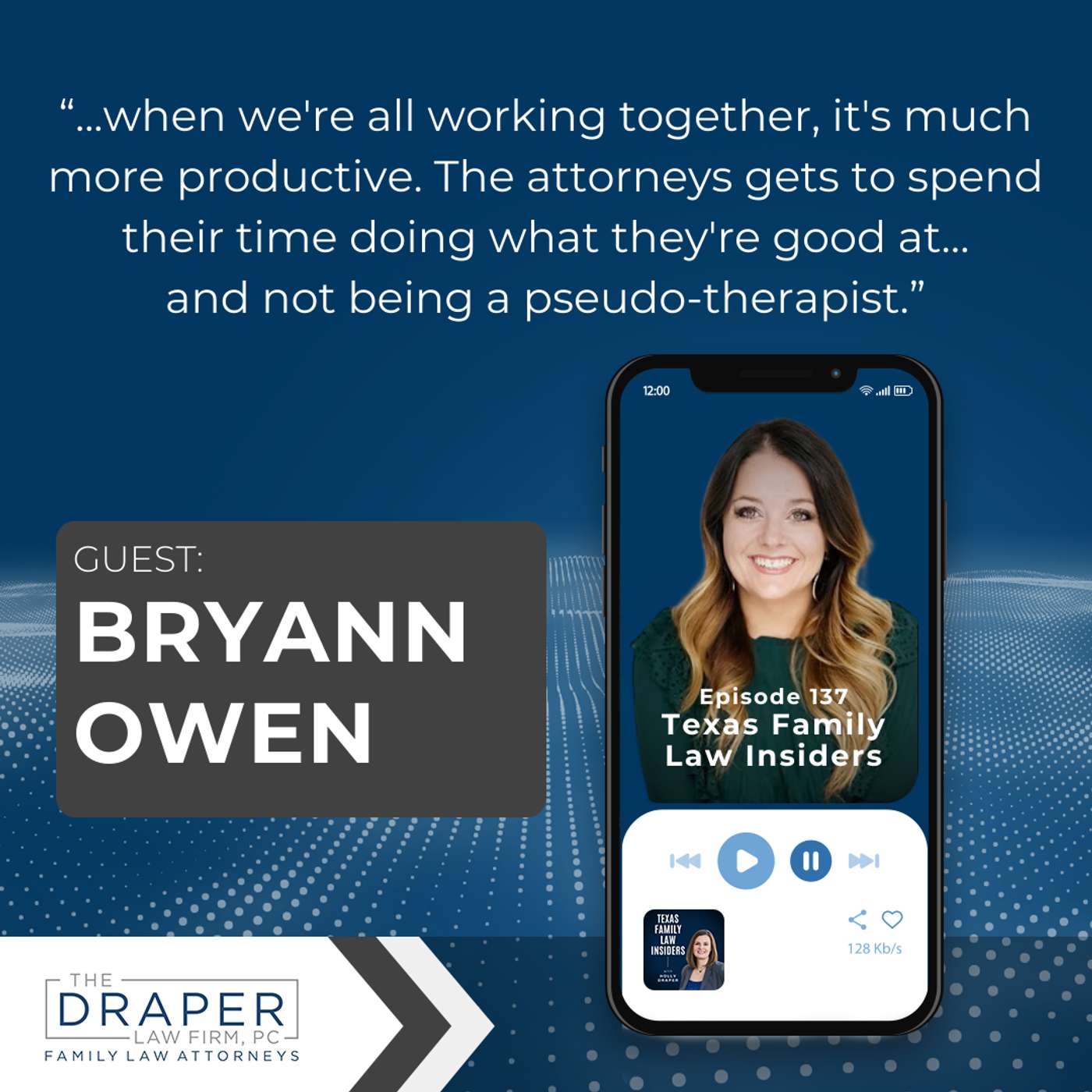
Loading summary
Transcript80 lines
- [00:01]
Brian Owen
So I always start with, okay, what is your vision for when this is over? Right. So if you're focused on the future, I've never had somebody say, well, I want to be a bitter, angry woman at the end of this. Like, that's nobody's goal.
- [00:23]
Podcast Announcer
You're listening to the Texas Family Law Insiders Podcast, your source for the latest news and trends in family law in the state of Texas. Now, here's your host for this episode, attorney Carrie Tapia.
- [00:40]
Carrie Tapia
Welcome to the Texas Family Law Insiders Podcast. I'm Carrie Tapia, one of our hosts, and today we are talking about divorce coaching, what it is, what it isn't, and how it can support our clients and us as family lawyers. Today I'm joined by Brian Owen, founder of Rebuild with Brian, where she works primarily with women navigating divorce and other major life transitions. As family lawyers, we all represent clients who are overwhelmed, reactive, emotionally flooded, and sometimes making litigation decisions from that emotional space. We also know that we are not therapists, and we are not always the right person to help with that emotional processing. So today we're going to dig into how a divorce coach can reduce conflict and improve outcomes, whether coaching can make our jobs easier as family lawyers, and importantly, how coaching intersects with attorney client privilege, confidentiality, and other things of that nature. Brian, welcome to the podcast. Excited to have you here.
- [01:36]
Brian Owen
Thank you for having me. I'm excited.
- [01:39]
Carrie Tapia
All right, so can you briefly explain what is divorce coaching?
- [01:44]
Brian Owen
Divorce coaching, it's kind of two parts, or I think of it as two parts. Some of it is consulting coaching for the actual divorce process, and the other part is rebuilding their life, like figuring out from a personal point of view, where do you want to go? Where do you want to be when this is all said and done? I want you to have the life that you want to have, not the life that you were handed. And that's going to take some freeing because a lot of people aren't expecting a divorce, right? You're expecting to stay married. And then you find yourself after 7, 10, 12, 20 years of being married. You've got to come up with a whole new vision for yourself. And in order to make those critical decisions during a divorce, they need to know where they're going. And so that's what I do as a life coach, is help them figure out where they want to end up. And how are we going to get you there?
- [02:43]
Carrie Tapia
Yeah, I think that that could be really helpful because I have several times in my career with clients said, look, my job is not to know what you want. That's something that you need to figure out. My job is to figure out how to legally maneuver that to get you the result that you're looking for. But I can't figure out for you the result that you're looking for.
- [03:06]
Brian Owen
Right, right. And so often clients don't know. They don't know the answer to that, those questions that you're asking. So it's really hard to plan a strategy in a divorce if the client doesn't know where they want to end up.
- [03:20]
Carrie Tapia
How is divorce coaching different from therapy or counseling?
- [03:25]
Brian Owen
So therapy one treats mental health condition and it's a lot of backwards thinking. So let's talk about trauma situations in the past. How did that harm you? How did you deal with it? So it's really a lot of looking backwards where coaching is forward facing it is practical tools that are going to help you move forward.
- [03:50]
Carrie Tapia
Do clients ever try to get legal advice from you and how do you handle that?
- [03:53]
Brian Owen
If so, sure, you know, and it's not intentional, you know. Right. It's good, you know, they don't, they don't. This is their first time, you know, going through a divorce, most likely. And so what I do is, you know, listen and then we come up with a list of questions that they can then ask their attorney. So let's, let's put together some questions together. These are your concerns, this is what you want to ask. And then they can go back to their attorney and it'll be a much more productive appointment and get better results.
- [04:30]
Carrie Tapia
So if a client starts venting about legal strategy or just kind of case projection and outcomes, how do you redirect them back to counsel to keep that boundary there?
- [04:43]
Brian Owen
Yeah. So we would talk about, okay, let's clarify. What are your concerns? Let's, you know, what, what is the outcome that you want? And so then they themselves, the client knows what they want. And then we, I redirect them back to the attorney with question like, okay, this. Or to say, this is what I really want. This is what's really important to me. And they can better express their needs and wants to their attorney through questions or just, you know, statements of what they want. Because now they've talked it through and they understand better themselves what their goals are.
- [05:23]
Carrie Tapia
Makes sense. Are there any certain emotional patterns that you see that tend to escalate litigation? Of course,
- [05:35]
Brian Owen
impulsivity is probably, number one. Revenge. Wanting revenge is a big one. Seeing everything as an attack is a big one. And going into the whole process trying to win divorce like nobody wins divorce. Just like nobody wins love, you know what I mean? It's a process. You're doing it together. And what you really want, especially if you have children, is you want a win win for your kid. Right. And so winning at all costs is not going to set a client up for success. I don't care who you are or what the other side did, it's just not going to set you up for success. So if you're, you're out for revenge, if you're trying to win, you're just, it's going to make the process much more difficult and costly.
- [06:29]
Carrie Tapia
Yes, I've seen that as well.
- [06:31]
Brian Owen
I agree.
- [06:32]
Carrie Tapia
So with those clients, those impulsive clients, or the clients that are just set on revenge, how do you help them shift to a more strategic thinking frame of mind?
- [06:45]
Brian Owen
Knowing what their end goals are is helpful because then we can frame everything around those goals. So is this tactic, is sending this text is requiring such and such, is that going to get you closer to where you want to go and where you want to end up, or is it going to put you further away? If you're looking for the least expensive divorce possible, which most people are, then you got to be willing to make concessions and you got to agree where you feel like you can, you know, and that's going to help you achieve your goal far better than getting, you know, getting that little bit of revenge or kind of taking it to them, you know, so just reframing it around the goals and keeping the goal and the destination paramount. Right.
- [07:42]
Carrie Tapia
I think there are so many people that want their day in court to have that sense of vindication or validation.
- [07:50]
Brian Owen
Validation, yeah.
- [07:52]
Carrie Tapia
And unfortunately, that's really not what the court is usually going to do for sure.
- [08:00]
Brian Owen
And that's not what you're there for either. And so that's one reason why a coach is an asset is because we are there for validation. Right. We're there to listen and to tell them. Yeah, that makes sense. I totally understand why you feel that way. But is that, is that helpful? Is that going to help you in this situation or is it going to hurt you in this situation? You know, so they, they get the validation from somebody. They get to filtered as they get to, you know, vent and they. All the things that the other, you know, spouse did, which, not that it doesn't matter to you, but it's mostly irrelevant. You know, your time can be better spent, you know, drafting orders or whatever. Like they're doing strategy. Like you don't need to be listening to them vent about them, never Putting the toilet seat down or, you know, their porn addiction, you know, like, that's not helpful for you.
- [09:05]
Carrie Tapia
Or the thermostat.
- [09:06]
Brian Owen
Or the thermostat, yeah.
- [09:10]
Carrie Tapia
So one place where emotions often run hot is mediation, because that is ideally a time where we're able to work together to settle the case. But often it definitely takes away that potential of the judge giving them that validation. So have you seen coaching, specifically with mediation? Have you seen it help with the process?
- [09:40]
Brian Owen
Oh, if mediation helps with the process or coaching helps.
- [09:46]
Carrie Tapia
If coaching helps the mediation process.
- [09:48]
Brian Owen
Absolutely. Absolutely. And I'm not saying that just because I'm a. I'm a life coach, and that's what I do. It really does. It really is helpful because I've been in the room on multiple mediation cases with a client who was so flooded emotionally that they literally were not hearing the words from their attorney. It's. It's almost like there was a wall up, and then they weren't retaining. They weren't understanding her. And we had to take a minute and like, okay, this is what she say. I was almost like an interpreter, you know, like, okay, this is what she's saying. You know, do you hear that?
- [10:27]
Carrie Tapia
That.
- [10:27]
Brian Owen
That's what she's saying. And then, like, oh, okay. And then they were able to hear it and respond to their attorney. Everybody was in the room. The attorney was sitting right there. They were both frustrated at each other because the client just wasn't in a place emotionally to hear and respond because they were so flooded, you know, and so it absolutely is helpful for that reason because there is somebody else in the room who knows what the goal is, knows where the client wants to end up. Does that make sense? You know? Right. So it keeps the client focused on that goal and remind them, you know, like, hey, remember, like, this is. These were the things you said were important yesterday, you know, when we talked, or these are one of the things that we've been talking about for two months that's been important to you, you know, is that still important? You know? You know, so it helps them think more critically in a time when they are often so emotional and really flooded just with the emotions of the whole thing.
- [11:40]
Carrie Tapia
Do you see where clients might be overusing their attorneys for emotional processing? And that ends up having a negative impact on the entire case
- [11:49]
Brian Owen
for sure, because they. They want to vent. They want to feel heard at the end of the day. That's. That's a lot of it. And they react with emotional emails or in meetings. They want to spend a whole lot of time, talking more about the personal thing instead of focusing on strategy for, for the case and what the attorney needs to be working on.
- [12:20]
Carrie Tapia
So how does your role of preparing for, let's say, a hearing differ from that of the attorney's role in preparing for the hearing?
- [12:31]
Brian Owen
So part of it is just teaching them some self soothing isn't exactly the right term, but like staying present in the moment, making sure that they're listening to the questions. I teach them to like tap on their hand or tap on their arm at least twice before they answer, before they start to answer. So they're, they're taking a beat to make sure that they understood the question. So part of that is just the self regulation, how they keep themselves present, keep themselves listening, make sure you understand the question. Be brief. We don't need extra details, you know, because a lot of that again, comes from being flooded or wanting to feel heard and validated. And we can get a lot of that out of the way before they go into the hearing so that they're not trying to vomit all of that, you know, while they're on the stand.
- [13:33]
Carrie Tapia
Have you seen or can you give an example of how what you do as a divorce coach can actually improve the quality of attorney client communication?
- [13:46]
Brian Owen
Oh, for sure. I think that when it's collaborative, like when we're all working together, it's much more productive. The attorneys get to spend their time doing what they're good at, what they like doing, and not being a pseudo therapist, which isn't the best use of their time and probably isn't something that they love doing, otherwise they would have been a counselor. Right. They could have gone into that line of work and at the end of the day, the client is happy because they got what they wanted out of it. You know, I mean, like they, they felt hurt, they got the results. I mean, even if they had to compromise, they feel like that the process went well, their money was well spent, it wasn't wasted, and they're more likely to turn around and refer friends and family to that attorney because everyone feels good about the whole process. And how
- [14:48]
Carrie Tapia
do you usually find clients? Is it from attorney referrals or other sources?
- [14:57]
Brian Owen
So it's mostly other sources, but a lot of personal referrals. Either people who have heard about me or know that there are divorce life coaches out there or who have used me and have referred their friends and family.
- [15:18]
Podcast Announcer
This episode of the Texas Family Law Insiders podcast is sponsored by the Draper Law Firm, providing family law appellate representation for non parent custody cases, jurisdiction issues, Property division, standing conservatorship, possession and access termination, parental rights and grandparent access. For more information, visit DraperFirm.com or call 469-715-6801.
- [15:45]
Carrie Tapia
What is the best type of referral for you?
- [15:50]
Brian Owen
I love a personal referral because that means that a client was happy and felt really good about the process. But honestly, the best referral would be from an attorney. And I think that is a service that they should include for their client. It's going to make the process go more smoothly. The client's going to walk away feeling better about their divorce. I know that's kind of a strange thing to think is most people don't feel great about their divorce, but they're also going to walk away, like, mentally healthier because they ended this part of their life and they did it well and they were focused and they're able to move on to a better life with intention. That's good for everybody. Everybody in that situation gets to do what's good for them. You know, the attorney gets to do their job, the client gets to move on and feel good about it.
- [16:46]
Carrie Tapia
Do you communicate directly with attorneys or do you just speak with your client and then your client goes to the attorney? What have you seen works best with that?
- [16:56]
Brian Owen
So in the case, if an attorney did, you know, hire me as a resource for their client, then yes, I could speak to the attorney because they were the one that hired me. If not, then there would need to be written consent from the client, which is not a problem. They normally want there to be communication. I attend meetings, mediation, court hearings, as much as the attorney and the client want me to.
- [17:30]
Carrie Tapia
How do you ensure that you're not interfering with the legal representation?
- [17:36]
Brian Owen
The attorney is the expert. Right. So everything has to be redirected back to the attorney for those legal questions, for strategy. That's their side of the fence. Right. So my side of the fence is the support and the preparation. You know, emotionally, that's kind of my. That's. That's my side and what I bring to the table. And so just always referring back to your attorney is your quarterback. Right? That's their job. So let's, let's go to them with those questions.
- [18:09]
Carrie Tapia
I would imagine that some attorneys listening to this might be having some thoughts about confidentiality, attorney client privilege, and things like that. So let's talk about that. How have you found a way to address those issues to still be able
- [18:26]
Brian Owen
to help your clients? Right. So it hasn't been an issue so far. Most of the mediations that I go to. I've been allowed to be in the room. If the other side objected, then I was on the premises. I just wasn't in the room when the mediator was in it. So I would come back in and help the client both regulate, think through the different options. If the attorney is the one who hired me, then that confidentiality would be extended because I would be. I'd be working for the attorney. For the attorney.
- [19:10]
Carrie Tapia
So then that attorney client privilege kind of umbrella but attach.
- [19:13]
Brian Owen
And the notes that I take during my meetings with my clients is minimal. It's. It's more just to jog my memory. It's not extensive. I don't keep information that, that they're sending to you. I don't retain there. There's no reason for me to. So, like discovery wouldn't be there. There wouldn't be much there. It'd be pretty minimal. And again, because it's mostly about setting goals and where do you want to go and strategies for reaching those goals. Set a rule for yourself that you're going to wait 5 minutes, 10 minutes, 5 hours before you respond to a text or an email. Some people even want me. Sometimes I end up writing those for them because they can't frame what they want to say in a way that isn't explosive and unproductive.
- [20:19]
Carrie Tapia
So since it's not really legal strategy, it's more goal setting. It's something that if you were to have to testify about or subpoena, it probably wouldn't be harmful one way or another.
- [20:31]
Brian Owen
Right? Right. Because it's about them being their best selves. Right. And where do they want to go and what, where do they want to be at the end of this? That's not going to be real helpful.
- [20:47]
Carrie Tapia
So as divorce coaching, you are a certified life coach, is that correct?
- [20:52]
Brian Owen
Right.
- [20:53]
Carrie Tapia
Are there, is it a licensing or any regulatory body that you're under?
- [20:58]
Brian Owen
So it's a certification. So it's not a license and it's a certification. Currently, there's not a licensing board or anything like that. I suspect that will change at some point in the future.
- [21:14]
Carrie Tapia
So let's talk about maybe like a realistic family law scenario. We've got a high conflict custody case, client's reactive, sending very inflammatory emails demanding emergency hearings, and struggling with the idea of getting ready for radiation. So what would your first three sessions probably focus on with a client of that nature?
- [21:39]
Brian Owen
So I always start with, okay, what is your vision for when this is over? Right. So if you're focused on the future, I've never Had somebody say, well, I want to be a bitter, angry woman at the end of this. Like, that's nobody's goal. So getting them to focus on, okay, who do you want to be at the end of this, you know, how do you want to see yourself? Who do you want to be? And get them to focus on that person and that result, then you can kind of work backwards, be okay, like, does this sending these emails or refusing to cooperate, did that help you get to be the person that you want to be? Or does it not? And it's a lot easier for them to then kind of reframe situations and reel it back in a little better.
- [22:40]
Carrie Tapia
So do you set certain goals each session and then check in on those goals in the next session?
- [22:47]
Brian Owen
Yes. And each plan is different because each person is different, each situation is different. Each person comes to me at a different time in the process. Sometimes it's before they've ever even filed for divorce, you know, and sometimes it's well into the process. So each plan is customized to that person and what they need, what's coming up, and how I can best help them with those goals. I do have a system, you know, and not everybody fits in it exactly the same way, but in general they do. And so I do give them homework at the end of each session, and then we check in on them at the beginning of the next section because it is very future focused. It is about goals and meeting those goals and getting them where they want to be. So it is very action oriented. We're not going to just sit around and think about our feelings, which that's legitimate. And sometimes we do do that, but there's often an action piece in there as well.
- [23:52]
Carrie Tapia
How frequently do you typically meet with the clients?
- [23:57]
Brian Owen
Once a week. Usually it's once a week now, especially in the beginning, because there's a lot that goes into that goal setting, you know, figuring out where do they want to be. Because a lot of people don't think about that. You know, they're just trying to. Especially when you're overwhelmed and in divorce, you're just trying to keep your head above water. You're not thinking two, five, ten years down the road. You're just trying to survive this moment, you know, and so those first several meetings are okay. Getting them to feel like that they're not drowning, that they do have choices, they do have agency, and that there are decisions that they can make. You know, I've been through a divorce, and you kind of feel like, at least in my case, I feel like I felt like somebody brought me to a place I didn't want to be. I didn't choose this for myself. Somebody chose it for me. And so in those times, it's hard to remember that you do, you do have agency, you do have choices, you are a participant in your life. They're not just a victim of your life. You do get to take an active role. And so it is important in those first several meetings to establish a lot of that and get there to figure out, okay, what are your goals and how are we going to get you there after that? When we're a little bit further down, it can be every two weeks. Sometimes, especially when it's a really long divorce, I might go a month without meeting them. And then we have a few, like right before a mediation or a hearing.
- [25:42]
Carrie Tapia
What would one sign be as attorneys that we can look out for? As you know, this person might benefit from some divorce coaching specifically.
- [25:53]
Brian Owen
Yeah. So I think every benefit, I truly do. I mean, I think just about anybody can benefit from it. I suppose if you had a situation that was very amicable and they're still friends and it's going to be a real easy peasy, you know, divorce situation, maybe there's no kid, maybe there's not a lot of asset that might be a situation, but even then they can benefit from the structured future goal setting so that the decisions that they're making now are ones that are compatible with the place and the person they want to be later. Because I've seen that happen so often that they're making decisions before, before I come on this beam, you know, they've made some decisions that really turns out are incompatible with the life they want to live, the person they want to be, or the result that they want when this is over. Because they were just making decision willy nilly, they were doing the best they could. But you can't hit a target that you're not aiming for. And so being more laser focused, okay, this is the target and we're going to aim for that target. We may not always hit a bullseye, but at least, at least we're on the board. At least we're getting close. But if you don't even have a target, you're not going to hit the board and you're going to end up with a chaotic result that you don't feel great about, that the attorney may not feel great about and the client's not going to feel great about it. So probably neither one of you are going to be super happy at the end. And Then the attorney is not going to get a referral. Right. And, and I think that's an important piece. And the most important piece is that the client walks away feeling good about the result that they spent their money on. Right.
- [27:55]
Carrie Tapia
So what is one thing that you've seen family lawyers maybe misunderstand about your role as a divorce coach?
- [28:04]
Brian Owen
I've seen attorneys be very reluctant, which I understand, because there's conflicts, right. The confidentiality, the giving legal advice they, they aren't really sure about. They have some questions about those things. And I feel certain that they've had clients who have family members who have given their clients terrible advice, you know, that have muddied the water, mucked it up and made the process more difficult than it could have been. And so they go into it kind of with thinking that I'm going to be the same way. I'm not a yes man. I'm a third party objective observer, if you will, who can help focus the client, not get them more stuck where they are, which family and friends. They have the best intention, but they're biased. Right? Yes. My favorite is when I get the.
- [29:03]
Carrie Tapia
Well, my cousins, neighbor went through a divorce in Nebraska and this happened. Great.
- [29:11]
Brian Owen
Yeah.
- [29:11]
Carrie Tapia
Call, call that attorney that I don't know. Yes, I could see that because often
- [29:18]
Brian Owen
they get them, they get them more worked up. They don't help them self regulate, you know, and so that's gonna just muck the gears up and it's gonna come to a grinding halt instead of lubricating, you know, and helping it move more smoothly.
- [29:36]
Carrie Tapia
Well, and a lot of times what I've seen with third parties, not divorce coaching, but third parties is they don't actually understand the whole picture. They are hearing one person's side of the story and planting ideas in that person's head and have no idea the framework that we have to operate of the Texas family code in Texas. And so have you seen maybe lawyers having hesitations about involving divorce coaching because of those types of concerns?
- [30:08]
Brian Owen
I think so. I think so. I think they'd be surprised how much it, how helpful it is. That makes their job easier. Right. And you're not going to have a client asking you, okay, well, I want visitation to be, you know, to start on Tuesday of the second month of the year at 3pm on Thursday, but 5pm the third, you're not going to get that because I'm going to help focus them on. Okay, here, here are your options. Here are your choices. Let's pick one of these options to go to your attorney with so that they're more focused when they go to you and they're not asking you for the impossibility that then you can't deliver. You have to explain, well, that's not how this work.
- [30:59]
Carrie Tapia
So if lawyers or potential clients want to learn more about you, what should they do? Where should they go look?
- [31:06]
Brian Owen
So they can go to my website, which is rebuildwithbrian and Brian is B R Y a N N. There's two N's tricked up there at the end.com and they can call me at 817-991-1722 or send me an email at rebuildingwithbrianmail.com
- [31:33]
Carrie Tapia
Any final takeaways or final words for that you want Texas and lawyers to
- [31:37]
Brian Owen
know about divorce cooking, that they should have them on their team. They should. They said welcome the help. It will make their life better. They'll have more focused, regulated clients and they'll be able to be more efficient at what, what their strengths are. And they won't have to do so much counseling.
- [32:12]
Carrie Tapia
All right. Well, thank you so much for joining me today.
- [32:15]
Brian Owen
Yeah. And thank you for having me.
- [32:17]
Podcast Announcer
We hope you enjoyed this episode of the Texas Family Law Insiders podcast sponsored by the Draper Law Firm. To be the first to hear about new episodes, make sure to subscribe in your preferred podcast platform. At the Draper Law Firm, we help people navigate divorce and child custody cases and handle family law and appellate matters. For more information, visit our website at www.draperfirm.com.