← Texas Family Law Insiders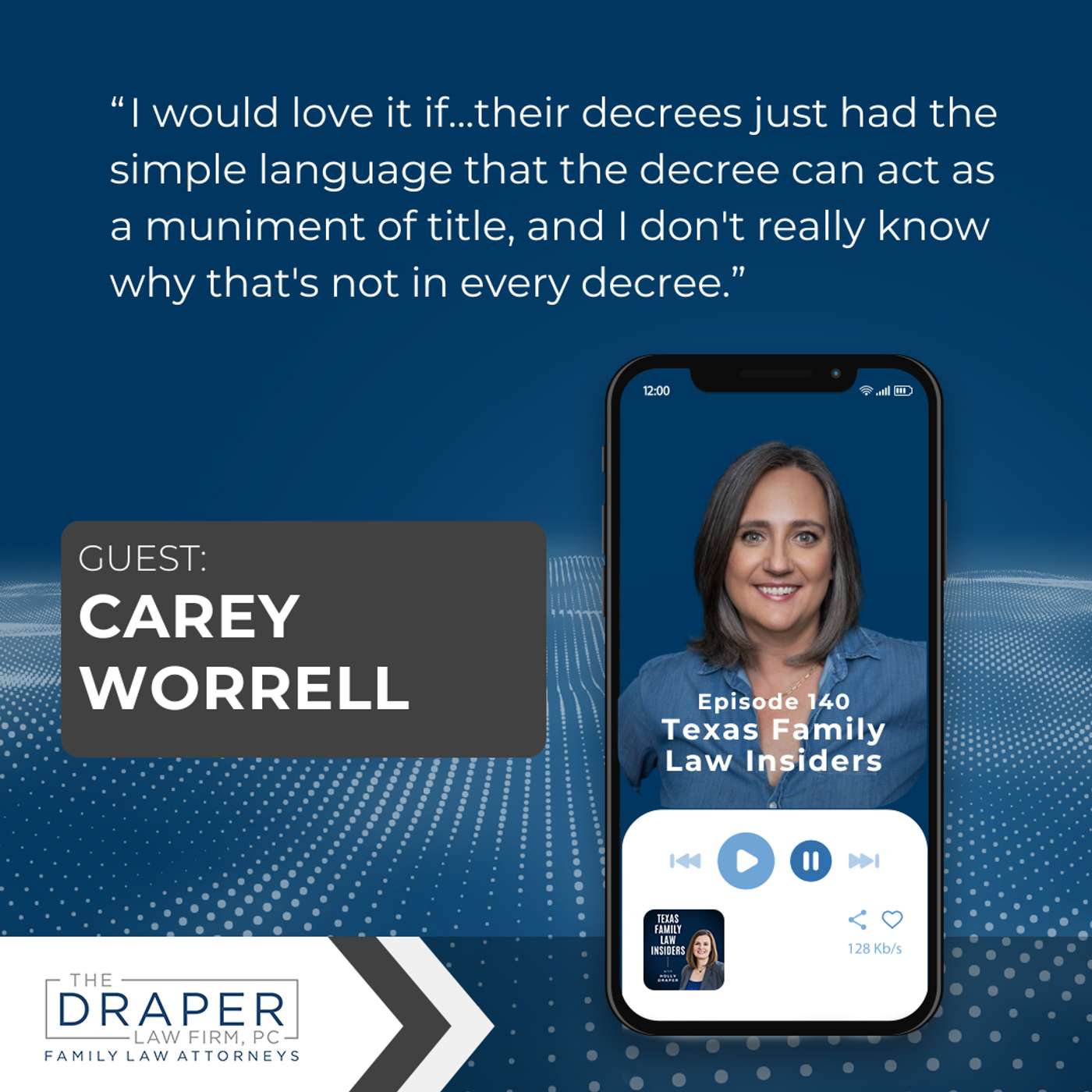
Texas Family Law Insiders
Carey Worrell | Episode 140 Everything a Family Lawyer Needs to Know about Real Estate Law
00:34:12
Loading summary
Transcript63 lines
- [00:00]
A
The mortgage essentially is a contract between the lender and the borrowers, and you can't change that without the consent of the lender. So any agreement between you and your spouse doesn't change what you promise to the lender. And what you promise to the lender is that they will get paid back. If they don't get paid back, you're on the hook for paying them back, and that's why you can't qualify for a mortgage later.
- [00:25]
B
You're listening to the Texas Family Law Insiders Podcast, your source for the latest news and trends in family law in the state of Texas. Now here's your host, attorney Holly Draper.
- [00:39]
C
Today, I'm so excited to welcome my good friend Carrie Worrell to the Texas Family Law Insiders podcast. Carrie is a Harvard Law School graduate and the owner of Simple Law Texas, where she guides clients through real estate, business estate planning and probate matters across the state of Texas. She's based in Houston, but loves working from the road so she can see as much of the world as possible. She's a mom to two young adults who loves the mountains, coffee and a good book. And she's also my friend from going to the Lawyer on the beach conferences, which have been amazing. Highly recommend for you other lawyers out there to check that out. Thanks so much for joining me today.
- [01:14]
A
Yeah, absolutely. Thank you so much for having me. Yes. You guys go register for Lawyer on the Beach Conference 2027. I think you can do it now.
- [01:21]
C
Yes. So today we're going to talk about the intersection between real estate and family law, which a lot of family lawyers might not think they need to know real estate, but there are certain things that we absolutely do need to know and be aware of. Why do you think it's important for family lawyers to have a working knowledge of real estate law?
- [01:43]
A
Gosh, you know, there's so many reasons, but what comes to mind right off the bat is, and I'm sure that family lawyers know this, a lot of times people's biggest asset that they own or will ever own is is their home. And I'm sure from your perspective, you spend a lot of time negotiating over who's going to get that home, who's going to live in that home, who's going to pay for that home. And then after the fact, you know, after a divorce is over, some of those issues still linger because that house is still there. People still need a place to live. People still, you know, need to qualify for mortgages. And a lot of times, the way the decree is set up and the paperwork that is done immediately after the divorce is finalized can really affect those clients long time after, excuse me, their divorce is over. So I think it's important for family lawyers to kind of think about what does this look like for my client in the future in terms of their housing? Will they be able to stay here? Will they be able to get another house? Do we have all the documentation in place? You know, what if one of these people dies? How does that affect this real estate? Because a lot of times those things kind of get glossed over, I think, during a family law case, and they don't really crop up and nobody even knows they're going to be an issue until maybe months or even years later.
- [02:58]
C
Yeah, I think so often family lawyers, you know, we get that divorce decree signed and we send them on their way, and we don't realize that the things that we are doing with respect to property can really have a lasting impact, whether it's not drafting it correctly or whether it is we didn't properly address the requirement of a refinance, things like that. Yesterday I know somebody posted on Texas Family Lawyers, and it was basically like, why do family lawyers keep screwing up, you know, with these real estate deeds?
- [03:29]
A
And I, I saw that, I saw that. I thought it was very timely because I knew we were going to be talking about it today. It made me happy, though, that somebody else felt the same way as me, because I know that the family lawyers working on these cases are good, competent lawyers. Like, they're not just screwing things up because they don't care. I think it's really just exactly what you said. They move on. They don't necessarily see their clients after the fact when this presents itself as a problem, because that client then calls a different type of lawyer. And so a lot of times they just don't know how that plays out over time.
- [04:04]
C
So let's start with talking about different types of deeds. Why does it matter what type of deed we're using?
- [04:15]
A
Well, at a basic level, it matters what type of deed you're using because you want it to be valid. So you at least need it to have the types of granting clauses and everything that make a deed valid. But beyond that, in terms of the different types of deeds, the deed has certain representations in it, certain things that the grantor is promising to the grantee, and you want to make sure that your client actually can keep those promises that they're making. So if you think of the most common types of deeds, you're looking at, like a general warranty deed or a special warranty deed. And a lot of times when people buy houses, all they've ever seen is a general warranty deed, because that's how most homes are purchased, if they're purchased through a title company. But when you give a general warranty deed, you're giving a warranty, that title is good on that deed. You're saying there are no problems with title. I am granting you everything I have, and it's unencumbered by anything other than those things that I've told you about are listed in this. In this deed, you might not be able to make that promise. Right? You don't necessarily know, is there some sort of a lien on this property that you don't know about? Is there a probate issue in the past that hasn't been dealt with? But when you give a general warranty deed, you're stating that title is good on that property all the way back hundreds of years to, you know, the sovereign land grants. Whereas a special warranty deed, you're saying, I promise that I didn't encumber this property since I have owned it, but I'm not making any promises about what happened before I owned it. And obviously, if you're the grantor, if you're the one getting the property, that makes more sense, right? You know what happened since you own the property, you know if you encumbered it, but you don't necessarily know what happened before that. So those are the two main types of deeds. You just want to make sure that if your client's making a promise that they're giving a warranty to the deed, that they can keep that promise. They either know because they've gotten a title policy or they've really researched it, or they just give a special warranty deed that is just limited to their knowledge.
- [06:18]
C
So as family lawyers, when we're looking at putting what the deed requirements are for transferring the mayoral residence to the husband or the wife or whatever, should we ever be doing a general warranty deed, or should we always be doing a special warranty deed?
- [06:35]
A
I would recommend, if you're the grantor, always doing a special warranty deed. Special warranty deeds can get title insurance. It's less liability for your client who is granting the property. So I don't see any reason that you would ever need to give a general warranty deed unless the other side insisted upon it. But honestly, I can't. I don't really see an instance where that would happen.
- [07:00]
C
So what about a deed without warranty? What is that and is it something that we would ever consider?
- [07:08]
A
Yes, you could consider a deed without warranty. It's exactly what it sounds like. It's like, here's a deed. I'm giving you my portion of the property. I have no idea if anybody else has a claim to it. I think two instances where that might be particularly useful is one where somebody potentially has a lot of past creditors, some of which they might not know about, especially ones that may have a lien on the property. And where that's going to come up most often is, for example, a property that has been in a family for multiple generations where there has been no title work done on that property for years and years and years. You have no idea. Grandma owned it. Great. Grandma owned it. Maybe they had a will, maybe they didn't. Maybe somebody took it to probate court. Who knows? So if you're granting that property to somebody else, either in a divorce or outside of a divorce, that would be an instance where you would say, look, I am granting you my interest in the property, but I can't make any promises on whether somebody else has an interest in this property.
- [08:06]
C
So a type of deed that I used to hear people in family law bring up a lot, but not so much anymore, is the quitclaim deed. What is that? And why should we be concerned if someone wants one of those?
- [08:20]
A
I feel like quitclaim deeds have gone out of fashion with lawyers, and for good reason in a quitclaim deed, basically is saying, I actually don't even know if I own this property, but to the extent that I do, I'm giving you my portion of it. And a lot of times that is used and reasonably used in the context, like we talked about a minute ago, where a property has been in a family for years and generations, and now it's owned by, like, you know, 150 people. And literally nobody knows what they own, and they're not even sure if they own anything. But if they do own something, they're willing to give it to somebody else. That's essentially what a quitclaim deed is. The reason that they've kind of gone out of fashion is that title companies don't like having quitclaim deeds in the chain of title. And so oftentimes, if you're trying to get title insurance on that property later, or you're selling it and your buyer is trying to get title insurance, which they usually are, the title company wants you to go back and get a warranty deed in place of that quitclaim deed. There's been some legislation recently that maybe Makes title companies feel a little bit more comfortable with a quitclaim deed. But honestly, you can just do a deed without warranty or even a special warranty deed if you're pretty sure that you didn't encumber the assets. And you're typically almost as well protected.
- [09:38]
C
So what happens if, you know, these people were divorced 10 years ago and they did a quitclaim deed because that's what people were doing back then. And now the husband is floating in the wind, wife has ex wife has no idea where he is, and she's trying to sell that house and the title company gives her trouble. Is there anything that she can do?
- [09:58]
A
The best option is to go to a new title company and see if you can get a title company with a lower standard. The reality is, title companies all operate under different levels of risk. They are not issuing a title policy based on what is legally required to transfer title. They're issuing their title policy based on what do they think the risk of this transaction is that somebody's going to make a claim against the title. And different title companies have a different risk tolerance. And there are some title companies that are a lot more lax with those types of things. So sometimes it's really just a matter of calling around to a different title company. If you really cannot get any title company to insure it, really your only option is a court order. If you can't find the person, if you can't go back and get something clarifying from the family court, I don't even know if that's a possibility. But then you can just go to district court and have, you know, do a suit to quiet title and get a court order saying that you own the property. I haven't hinted to that for anyone yet. Usually we've been able to work it out with the title company, either by getting a new title company or getting some sort of additional affidavits.
- [11:14]
C
Yeah, I've had experiences in the past where title, you know, former client would contact us and say, hey, the title company doesn't like X whatever something. And it was perfectly legal and it was perfectly fine, but some title company didn't like it. And that was the advice. I bet you can get it, go to another title company. And the new title company was not a problem. So I think that's very good advice if there's that kind of problem. Okay, moving on to deeds of trust. What is a deed of trust?
- [11:48]
A
So this is, I feel like one of the most commonly misunderstood concepts among the public, but also among lawyers, even even some Newer real estate lawyers. So basically, a deed of trust is somebody's. It's a document that indicates somebody's claim to a property. So if you think about there's like a standard purchase where you have a mortgage, you're typically going to have a deed and a deed of trust. So if I'm a buyer, I'm going to have a deed from the seller to me granting me ownership interest in the property. But then if I have a lender, the lender says, oh, not so fast, I'm going to take that deed and I'm going to hold it in trust until you pay me off. And as long as I am holding that deed in trust with a trustee, if you violate the terms of our agreement, the trustee has the power to take back the deed through foreclosure, essentially. So that's what the deed of trust is. It's a document that indicates an encumbrance in the property, usually due to a mortgage or in the case of a divorce, a mortgage that one person is taking off. And the other party wants to make sure they continue to pay that mortgage. So you're transferring the property, but somebody else is holding on to the deed for a little bit till they get paid back their portion.
- [13:06]
C
And so when someone holds the deed of trust, what powers does that give them in the event that somebody is not paying?
- [13:15]
A
So the most powerful power that it has, if it's drafted correctly, is the power to foreclose on the property. That's what your lender does if you don't pay your mortgage, is they take back the property.
- [13:28]
C
Something we see a lot in family law is the deed of trust to secure assumption. What is that and why do we need it?
- [13:38]
A
So basically, that is where you have two parties. They have a mortgage on the house. Presumably they're both on the hook for the mortgage. And in their agreement, one party is going to keep the house, but they're also going to pay the mortgage. The other party says, okay, I'll grant you my portion of the house through a deed, but I want a deed of trust in return, because if you don't pay that mortgage, I essentially want to be able to undo this transaction. So what that person is securing is the assumption of the mortgage that the other spouse that is taking on that debt actually continues to pay it, and that if they don't pay it, that the spouse with the deed of trust can gain their interest back.
- [14:22]
C
I think it's super important for family lawyers to realize that having a deed of trust secure assumption does not remove that person's liability on the debt. So if you don't also include a refinance requirement in your decree, that person might never be able to get another mortgage because they're stuck on this. Their credit will be dinged if the person doesn't pay. And this is just one piece of what you should be looking at that.
- [14:48]
A
I mean, this. I think I. I do think that most family lawyers understand this, but I don't think that most family lawyers are really helping their clients understand this, because I have talked to so many clients after the fact, and it's usually when they're trying to qualify for a new mortgage, and the mortgage company is like, well, no, you already have a mortgage and you don't have enough income to justify two mortgages. And they really did not understand that that's what it meant when they signed off on their spouse assuming the mortgage. The mortgage essentially is a contract between the lender and the borrowers. And you can't change that without the consent of the lender. So any agreement between you and your spouse doesn't change what you promised to the lender. And what you promised to the lender is that they will get paid back. If they don't get paid back, you're on the hook for paying them back. And that's why you can't qualify for a mortgage later. That is probably the most common thing I see after a divorce is people are like, well, wait a minute, they're not refinancing, and now I can't move on because I can't buy another house. I think it's really important, even when family lawyers do that paperwork 100% correct, that they explain the practicalities of what that really means for their client. Because the client just hears, oh, I'm off the hook for the mortgage. They don't really understand, no, you're only off the hook as to your spouse. As between you and your spouse. You have a contract that they're going to pay it, but you also still have a contract with the lender that you cannot get out of unless the lender agrees to it. Now, sometimes the lender actually will agree to let the spouse off of it. This is also something I think you can tell your clients just from a practical perspective, if you have enough equity in the house and if your spouse has reasonably good credit, and depending on the type of lender that you have, some of them will allow you to remove your name from the mortgage. And it's definitely worth asking your lender at the time.
- [16:43]
B
This episode of the Texas Family Law Insiders podcast is sponsored by the Draper Law Firm, providing family law appellate representation for non parent custody cases, jurisdiction issues, property division standing conservatorship, possession and access termination, parental rights and grandparent access. For more information, visit DraperFirm.com or call 469-671-56801.
- [17:10]
C
We see a lot of problems now because so many people have these super low interest loans that they got during COVID and they're like, I, it's two and a half percent, I'm never going to get something like that. And so they convince their spouse not to make them refinance. And we as family lawyers need to really convey to them and have a lot of CYA about that is not something you should agree to. And if that means the house gets old, it means the house gets sold.
- [17:37]
A
I mean, I, I absolutely agree. Unless you're somebody that your assets are so high that that mortgage isn't going to prevent you from getting another mortgage, which absolutely applies to some people and they're not worried about it. But for lots of average families, they can't just afford two mortgages on non incoming income producing property. They just won't qualify for them because they think, oh yeah, oh I understand, I don't want to have to pay 7% instead of 2%. Well, okay, that's fine. But that means now you can't get a mortgage and you may be willing to do that, but at least you want to go into it with your eyes wide open.
- [18:11]
C
So one question that comes up a lot when we are drafting deed of trust to secure assumption is who to put as the trustee. I see a lot of family lawyers that put themselves, I see family lawyers that put whoever the original trustee was on the deed of trust.
- [18:31]
A
In theory, you should probably get someone's permission before you list them as the trustee. Although I will say as a practical matter, if that ever has to be foreclosed on, the first document that we draft is a appointment of successor trustee to use whoever it is that we want to use now to actually conduct the foreclosure. What I do, I have an agreement with another attorney that drafts a lot of deeds of trust and we both just kind of have a blanket understanding that we will be the deed of trust for any of the deeds that either one of us draft.
- [19:06]
C
So if we put ourselves as the trustee on some divorce decree we did five years ago and that's ending up getting foreclosed on, it's most likely that a real estate lawyer is going to have a new trustee appointed and we're not really going to be on the hook for anything. Yes.
- [19:24]
A
That is the reality is you can always resign as trustee if for some reason they don't. But yes, I've definitely put myself as the trustee on deeds before as well. And when I've done foreclosures for people we immediately. We don't even contact the original trustee. We immediately appoint a successor trustee which is usually our law firm and then we go from there. So I wouldn't worry about it. If you put yourself as the trustee on a lot of deeds of trust it's. It's probably not a problem.
- [19:50]
C
Okay. Let's switch gears a little bit and talk about drafting and specifically related to divorce decrees and probably the deeds as well. The first piece would be the description of the property. Talk to me a little bit about the legal description versus the street address and why that can matter.
- [20:11]
A
So the legal description is exactly what it sounds like. It's the legal description. But practically speaking it's the description that is used to index all of the properties in the real property records. And while it really makes sense when you're talking about a platted subdivision where the addresses are unique they're not repeated. They make sense. Everyone could find them. There are a lot of properties in Texas that don't have that type of address that the address could be ambiguous. Like a lot of times you'll see in the tax records like 000 Toddville Road because it's a little bit. It doesn't actually have a numbered address. So when properties are indexed in the real property records they're indexed by their legal description. Meaning that every document you file in the real property records and that you want the public to be on notice of can only be properly indexed if it uses the actual legal description which is never the street address. It can either be like a lot and block description. So lot two in block seven of section four of Westover Park. A subdivision in blah blah blah Texas. That's a very common type of legal description. Or it could be a meets and bounds legal description. If it's acreage or something like that where a surveyor has found points and then you know draws a picture and then describes the way they draw that picture. So that's why you need the legal description is so the document can be properly, properly indexed for somebody to find later. Technically a deed can still be binding as to the parties that executed it with a description that allows you to identify the property. Right. Which normally the street address would. So if I grant you my property and I just use the street address. As between you and me, that's enforceable. But as between anyone else out there, that's just using the public records to see if properties are encumbered or have liens on them, that's not going to be binding. So you really need to use the legal description. The best place to find it is, and even this is not 100%. But the easiest and safest way to at least start is to look at the deed from when the property was purchased by your client. And if that is a deed that was in a transaction that was close to your title company, it's probably right. And I would usually rely on that as a lawyer. What you don't want to use, and what I see a lot of people using is they go on the appraisal district website and use the description of the tax account that is normally an abbreviation of the legal description. Sometimes that can honestly be worse than the property address. So you don't use the property address, you don't want to use the appraisal district. The best thing to use is either a survey or a deed that was executed through the proper channels.
- [23:04]
C
What kind of language do we need to include in our decrees that for like vesting and conveyance of the property?
- [23:14]
A
I would love it if all family lawyers in their decrees just had the simple language that the decree can act as a muniment of title. And I don't really know why that's not in every decree. It seems like that should just be the boilerplate. I don't know, maybe you know the answer to that. But that makes Everybody's job easier 100%.
- [23:35]
C
And in case anybody listening doesn't know what that is, can you explain it?
- [23:39]
A
Yeah. So muniment of title, if you kind of think of the word muniment, it sounds like the word monument. It's basically saying where the document itself is a monument of title, it's an indicator of who title is in. So let's say you have a decree that says husband's going to execute a special warranty deed to the wife at some certain date in the future, but this decree stands as a muniment of title. That means that even if that deed is never executed, which sometimes happens because either the parties forget they didn't understand, they leave town, they don't pay their bill, or they die, then the decree itself can be filed in the real property records in the place of the deed. That would solve a lot of the problems that come up in post divorce real estate cases.
- [24:20]
C
That should be in every divorce decree. But I would caution people against using just that and not having the deeds, because then you got to file the whole divorce decree in the property records. And there's a whole lot of other stuff in there that you might not just want out there in the property records.
- [24:37]
A
No, that's absolutely right. That's a good point. Kind of like a belt and suspenders. You want the deed, but this is like a backup. And this does happen, right? People die right after they get divorced. And if they didn't execute that deed, you still want to have evidence that that property was transferred. So having it in the decree is a very good backup. And it's so easy to put it in there. It's not. It's not an added expense, it's not an added procedure. So I don't see a reason to not put it in there.
- [25:06]
C
So next would be refinance obligations, which we've talked about a little bit already, But I think this is such an important thing that it's worth talking about again. Family lawyers, do not let your clients agree to a decree that does not include a refinance requirement for the spouse that is getting the house. Now, obviously, if your spouse is the one getting the house and the other side is going to agree not to require refinance, well, that's on them.
- [25:33]
A
And their lawyer should have done a better job, right?
- [25:35]
C
But, you know, I. The number of people who have called me over the years that have said, hey, you know, we got divorced five years ago, and my spouse is refusing. My ex is refusing to refinance or sell the property, help me. I'm like, well, did your order require that to refinance? No. Did it require them to sell it by a certain time?
- [26:01]
A
No.
- [26:02]
C
Congratulations, you're going to be on that loan until they voluntarily decide to do one of those things. And there's absolutely nothing that can be done because divorce decrees for property purposes cannot be modified later. And it is very common. I hear it all the time from clients who, oh, I'm not gonna make a refinance. Usually it's because of the interest rate, or maybe he doesn't have the greatest credit now and he's not gonna be able to refinance. And I want the kids to be able to be in that house part of the time. But, you know, that's a pretty hard line. And if your client is gonna go against that advice, you wanna be cyaing all over the place that you are warning them of the risks of agreeing to this.
- [26:41]
A
I totally agree. And you Know, I think also you can remind your clients, look, this is the backup that if they don't refinance on their own and you want them to, that they have to by this certain date, if you come to an agreement later that they don't need to refinance or you don't care if they refinance, great, you can go with that later. But this allows you the backup. But I think also what you need is even more than just a refinance provision, a what happens if they cannot refinance provision. Because a lot of times people are like, oh, yeah, sure, I'll refinance in a year. They have no idea that they can't qualify or they lose their job or, you know, so many different things happen. They decide they don't want to move. There needs to be a backup provision for what happens if they do not refinance. Because there is no court order that can force someone to refinance. You can ask a judge to enforce it all the time. If there's not a lender that will give them a loan, it doesn't matter. No court can force is going to be able to force a lender to refinance their loan if they don't want to. So you have to have a backup provision for what happens if they can't.
- [27:44]
C
Right. And generally that is going to be a forced sale. But if the person cannot refinance within six months or a year or whatever number you agree to that, I like to say the other person has the right to force the sale. Because maybe they don't, you know, they're cool with, okay, there's one more year till the kids graduate. I'm not going to make you sell it till then. Yeah, but you want the ability to force that sale. And I also recommend including receiver language that, you know, a receiver would be appointed upon the request of either party in the event that this sale has to get triggered. Because a lot of times there's a reason why people are getting divorced and it's because they are easy to get along with and they're not cooperative and they might not cooperate down the road. So you got to have a mechanism to make it happen.
- [28:33]
A
And a lot of times, especially the spouse that is living in the property, if they can't, if they're not, if they can't qualify for another loan. And moving out of that house and selling it means that they have to live somewhere far less desirable, which is usually going to be the case. If they're not going to be able, if they're not able to qualify to refinance, they're not going to be able to qualify for a new loan. They have every incentive to drag that out and make it as difficult as possible for you because they're living in the house and they're going to have a much worse option when they move out and they're not going to make it easy. And unless you have that language, it's going to be a protracted event. I also, you know, I mean, I have a case now and I've had a few cases that I've worked on that are property cases where the parties were not married, but maybe they do have a child together and they have kind of this ongoing family court case which isn't a divorce. But then they also have this property case, which I guess is not necessarily in the divorce context, but is in the family law context to just be cognizant that those issues that are not going to be able to be resolved in the case that is only affecting the child because there is no community property might still need to be resolved through either some sort of a partition or some sort of a settlement. And a lot of times if you resolve the child custody case without resolving the property case, and a lot of times family lawyers are like, well, that's not a family law issue. You're not married. You lose some leverage that you might have had on the property case if you've already resolved the child custody case and the child support case. So I think that in instances like that where you have unmarried couples that own property together and also have a child together, that that's another consideration for trying to get an agreement on the property.
- [30:36]
C
So we've gone through quite a few issues where we've seen mistakes by either family lawyers or pro ses with drafting or deeds and whatnot. Are there any other issues you can think of where you've seen mistakes being made in divorces related to this issue?
- [30:53]
A
Oh, gosh, I feel like we have hit the big ones. I mean, I have seen those are the mistakes I see over and over again. I've seen a lot of one off mistakes really where, you know, sometimes a lawyer that's not a family lawyer or a real estate lawyer might do a divorce for somebody and they draft the real estate documents. And honestly a pretty common mistake is mixing up the grantor and the grantee, especially on the deed of trust because the grantor and the grantee on the deed are typically the reverse of the grantor and the grantee on the deed of trust. And a lot of people that really aren't understanding what those documents do and what they say, just fill out the same person for both of them. Which really doesn't make much sense. We've seen a few times.
- [31:42]
C
Let's talk about that and kind of go through an example. So let's say husband and wife are getting divorced. Wife is going to keep the house.
- [31:49]
A
Okay.
- [31:50]
C
Husband is going to sign a deed of trust to secure function, or husband's going to want that right, which who is the grantor and the grantee on both the special warranty deed and the deed of trust to secure assumption.
- [32:04]
A
So if the wife is staying in the house, then the husband is the grantor on the deed. The deed is what actually transfers ownership. So the husband is transferring his ownership to the wife and then in return she's granting back to him a deed of trust. So in the deed of trust, the wife would be the grantor, the husband would be the grantee.
- [32:28]
C
Perfect. So we're just about out of time, but one of the questions I like to ask everyone that comes on the podcast is if you could give one piece of advice to young family lawyers, what would it be?
- [32:41]
A
Oh, I mean, this would be my piece of advice for every type of lawyer, family lawyer or other. Find the people out there that are willing to help you figure it out. Because every day is a new question and a different question, but somebody in the bar has had that question before and dealt with it. And yes, there are a lot of lawyer jerks, but there are a lot of wonderful people out there that are willing to answer your questions. And you have to find your find those people and align yourself with them early. But then you have to pay it forward once you're the experienced person and there's people coming up behind you.
- [33:16]
C
So where can our listeners go if they want to connect with you or find out more about you?
- [33:21]
A
So they can go to my Instagram, Simple LawTX, Facebook, or our website, simplelawtx.com or if you just want to find me personally, it's Carrie War Eld on Facebook. Usually I think I'm on Instagram, but Facebook is where I tend to hang out because of my age.
- [33:39]
C
I know, me too. But that's, you know, it's working for
- [33:43]
A
us, so it's all good.
- [33:45]
C
Well, thank you so much for joining me today and for our listeners. If you enjoyed it, please subscribe to Enjoy future episodes.
- [33:53]
B
The Texas Family Law Insiders podcast is sponsored by the Draper Law Firm. We help people navigate divorce and child custody cases and handle family law and appellate matters. For more information, visit our website at www.draperfirm.com.