← Texas Family Law Insiders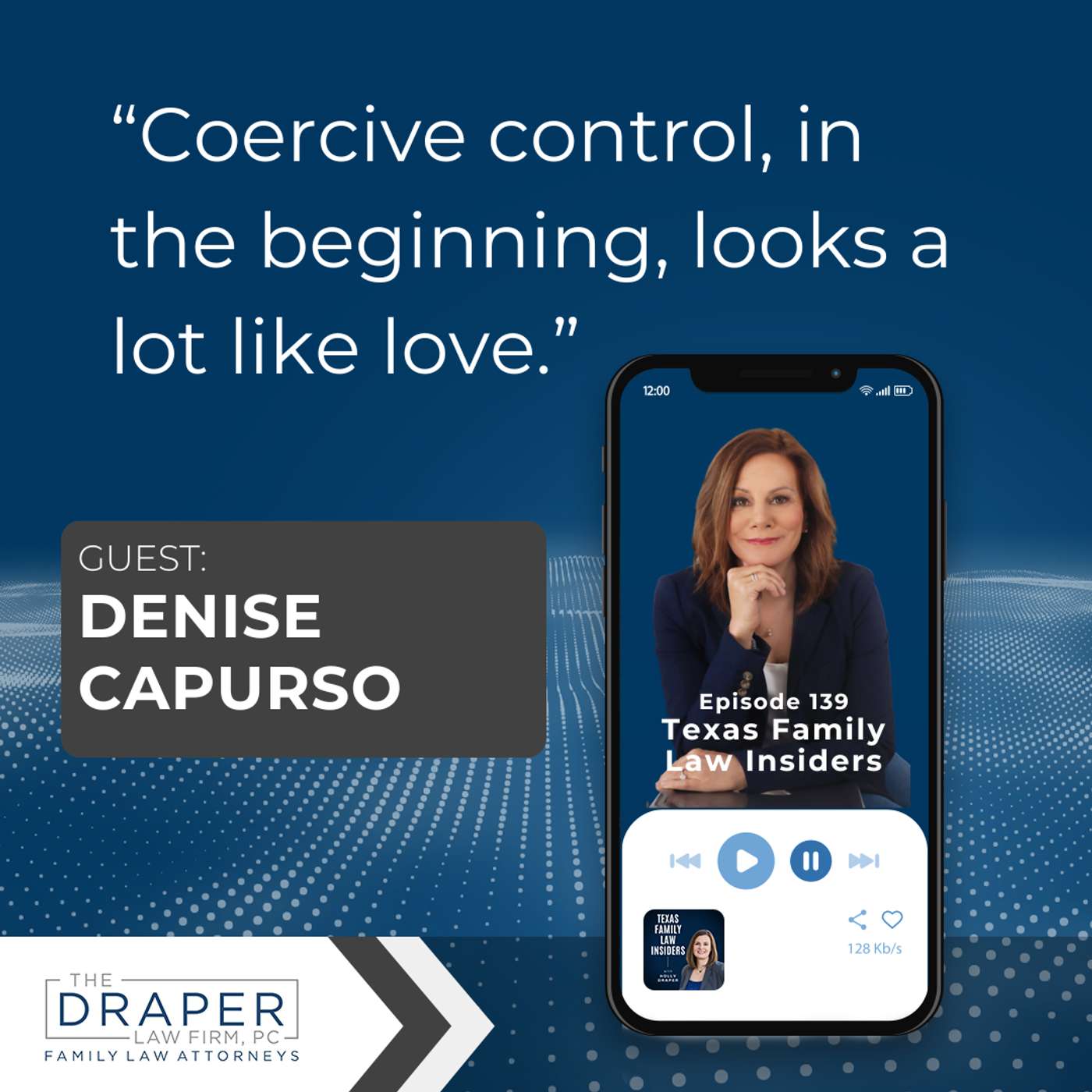
Texas Family Law Insiders
Denise Capurso | Episode 139 Trauma, Coercion, Narcissism, and Connecting Your Clients with Support Systems
00:31:36
Loading summary
Transcript83 lines
- [00:00]
Denise Caperso
And the intent with narcissists is to manipulate and destroy someone's sense of self and someone's sense of agency. There is focused, purposeful manipulation.
- [00:18]
Podcast Announcer
You're listening to the Texas Family Law Insiders podcast, your source for the latest news and trends in family law in the state of Texas. Now here's your host, attorney Holly Draper.
- [00:33]
Holly Draper
Welcome back. Today I'm excited to welcome Denise Caperso to the Texas Family Law Insiders podcast. Denise is a licensed clinical social worker with nearly 30 years of experience specializing in helping women heal from narcissistic abuse, coercive control, and complex relational trauma. Her clinical work focuses on restoring safety, autonomy and psychological stability for women recovering from chronic manipulation and emotional harm. Denise also contributes to professional education and public facing projects that advanced trauma informed understanding and survivor centered care. Thanks so much for joining me today.
- [01:10]
Denise Caperso
Thanks for having me, Holly.
- [01:12]
Holly Draper
So why don't you start by just telling us a little bit about yourself?
- [01:16]
Denise Caperso
So, yeah, I'm originally from New York. I went to graduate school in New York to get my master's degree in social work. And that was about 30 years ago. My family and I relocated to Texas about 20 years ago. Lots of things happening at that time. It was, you know, 2007. My husband was working in New York City and he had experienced 9, 11 and some other things. But also my husband's family has a lot of narcissists or people with narcissistic traits. And we believe truly our relationship, our marriage would not be where it is today had we not made that move out of state and across the country. So we're here. We have two adult daughters and my immediate family relocated. And yeah, here we are.
- [02:06]
Holly Draper
So how did you come to specialize in dealing with women trying to heal from narcissistic abuse and coercive control?
- [02:13]
Denise Caperso
So I think 10 years ago, I started working at Hope Store New Beginning center in Plano. I'm now on the board. But back then I was a case manager and therapist and just was thrown in and I had to learn everything I possibly could. I worked at the outreach center, shelters a little bit, but at the outreach, most of what I saw was narcissistic abuse and coercive control, more so than physical abuse. And so that's where all my education began.
- [02:43]
Holly Draper
So let's dive right in and talk about what might be the most overused word in family law. Narcissist. So we have a red flag list for potential clients. And if someone uses the word narcissist a lot, it shows up on there. So when A client comes to you and says, my ex is a narcissist or my current relationship is a narcissist. What goes through your mind?
- [03:09]
Denise Caperso
Okay, first of all, it's hard. Not everyone meets the requirements for narcissistic personality disorder. They're saying only 1.6% of the population does. However, someone can have a lot of narcissistic traits. When my clients come in, typically they are asking, I think maybe my husband might be a narcissist. There's like almost tiptoeing around it. And I'm not really sure if I want to label it that, but here are some things that are happening. And I never see someone come in my door and be like, yep, my husband's a full fledged narcissist. And I want to preface this. I'm going to say his and him a lot because statistically it's. The percentage is way higher for males than females to have npd. Females are narcissists. It's just not as statistically significant.
- [04:06]
Holly Draper
I think that's interesting that when you see people coming to you, they're tiptoeing around it or not ready to make that label. By the time they come to us, that label has definitely been made. People are not shy about saying their ex is a narcissist. You mentioned just having narcissistic traits doesn't mean someone has narcissistic personality disorder. And I think that's really important for attorneys to understand because we do hear this word thrown around so much, and a lot of attorneys can kind of roll their eyes at it, like, of course everybody's ex is a narcissist. So can you talk kind of about the difference between what really having narcissistic personality disorder means and how maybe why we shouldn't discount when clients are using the word narcissist because of the traits that involves.
- [04:52]
Denise Caperso
Right. So someone. You know, we all have a little bit of narcissism in us, right? Sometimes we're selfish or we're self absorbed, but those are one off instances. Or in certain situations, people with NPD or have a high amount of narcissistic traits. This is pervasive over decades. So. And the intent with narcissists is to manipulate and destroy someone's sense of self and someone's sense of agency. There is focused, purposeful manipulation, which is, which is different.
- [05:33]
Holly Draper
We basically are targeting family lawyers with our podcast. And so when a family law attorney's client insists that their ex is a narcissist, what advice would you give to an attorney. In thinking about that claim,
- [05:47]
Denise Caperso
the first thing I always notice is that the victim has fear in their eyes and they are genuinely disregulated. So nervous, teary, kind of fluctuating, a little bit chaotic. But scared and fearful is the most prevalent. Like, I don't know how to go about this and protect myself. At the same time, I am terrified of this divorce process because I know my partner is bad now and this is going to make it so much worse with a narcissist. And I've had narcissists contact me and come to my office pretending they're the victim. And I can tell they're trying to create a narrative. There is a darkness in their eyes that if you push them a little bit, you can see flares of it. I don't know if you've seen this before. It's called the narcissistic stare. And typically when they come to my office, they're very calm or play the victim and sometimes show a little bit of anger. So there's a huge contrast in how they show up.
- [06:56]
Holly Draper
So in the family law context, we regularly, and I'm sure you in your practice as well, see narcissistic abuse. Can you describe what is narcissistic abuse?
- [07:09]
Denise Caperso
So the abuse is, I want to systematically destroy my partner over time. I want to reduce their sense of self, their ability to trust themselves. I want to take power and control away from them. And. And it's very slow and very insidious. The victims often don't know what's happening until, like, years have gone by. But it's very purposeful and, you know, there's a trauma bonding happening. So it's like they call it invisible change chains or invisible handcuffs where the victim feels they cannot leave. I think the main point here is that the abuser wants all power in all scenarios. They want power in the mediation, they want power in the courtroom, and they want to destroy the other person in the process.
- [08:07]
Holly Draper
What are some hallmark patterns that you see in these types of relationships?
- [08:14]
Denise Caperso
One thing I see that I don't think is taken seriously enough is stalking or monitoring within the relationship during the separation, divorce period. And post divorce is constantly knowing where they are through apps or what's that app? We all have to watch our kids. Life360 Life360, where are you? Why are you late picking up the kids? How come you're not home yet? It starts then why did you charge this much money at CVS at this time? Why didn't you ask me this constant daily monitoring and then it happens still during the separation process, where victims don't know that they can be monitored through their apps. They don't have a realization of that. And sometimes before the partner moves out, the abusive partner, they will put cameras in or some tracking device that allows them to see when the victim leaves the home, when they come back. So that, I think, is the number one overlooked, this systematic tracking, which is stalking, which is also the number one predictor of physical violence.
- [09:27]
Holly Draper
So for your average person who is maybe thinking about a divorce or, you know, they know their relationship's not that great or maybe everything seems fine, what would they look for from just normal, hey, you know, everybody in the family's on Life360 because we want to know, you know, make sure everybody's safe and they got to their destination or whatever, like, where's the line? What would be a telltale flag that someone should look for that this has gone too far?
- [09:56]
Denise Caperso
It's so hard for them to tell because they're so used to reporting back and they've been convinced that it's for the best interest of the family or we always have to know where you are. The kids always have to know. It's hard for them to see the red flags. You know, it's up to me to be like, hey, are you thinking about this? Are you looking at this? Maybe you should take your phone over to Geek Squad or. And see, you know, what other devices on here or what other apps are tracking you. They're always stunned. Even though they've seen this pattern, they don't realize it, and they minimize the severity.
- [10:32]
Holly Draper
How does narcissistic abuse differ from what you might think of as just normal emotional abuse?
- [10:41]
Denise Caperso
So with emotional abuse, you know, it's with one or two people in the relationship that maybe have some past trauma and they're acting out, but the intention is not to destroy the other person. It's almost like I'm going to say these things, but I don't realize the lasting effect it's going to have. I'm not doing it purposefully.
- [11:04]
Holly Draper
What does a survivor of narcissistic abuse typically look like when they first come to you rattled?
- [11:11]
Denise Caperso
They look shaken a lot of times, have lost a lot of weight. Losing hair is a big sign. Gaunt in the face, just an overall distress in the body.
- [11:26]
Holly Draper
How does narcissistic abuse affect someone's ability to appear as a credible witness or participate in the presentation of a court case? Things like that.
- [11:38]
Denise Caperso
So if you think about it, these victims have been in fight orf Flight, usually for decades. And so when the fight or flight response is on in the brain, in the back of the brain, the front part of the brain, which is critical thinking, planning, goal making, goal setting, that part of the brain is turned off. And so they're constantly looking up a little bit rattled, or not knowing how to answer a question or kind of all over the place. And it's not their fault. Their brain is doing what it's supposed to do, you know, keeping them in survival mode. But this executive functioning part isn't working. And so that's why they look that distressed.
- [12:18]
Holly Draper
So do you have any advice for attorneys who are working with this person? And we have to put them on the stand and we want them to appear credible and be able to get their story out. What advice would you give us?
- [12:32]
Denise Caperso
You know, simple breathing techniques or exercises, but really sending them to someone like me who can really help them ground themselves and have control over their emotional regulation, you know, that's something they need to learn. And it's decreasing their sensitivity to the narcissistic triggers. Seeing their, their abuser in court or at mediation or on drop offs, pickups, it's always triggering this fight or flight effect. And it's really important for them to, to notice it and learn how to navigate it and manage it on their own.
- [13:06]
Holly Draper
How long does it typically take for someone to make those sorts of changes?
- [13:11]
Denise Caperso
Wow. You know, it really depends on the severity and the length of time they've been in that relationship. There's a brainwashing that happens and you have to create neuro new neural pathways in the brain. So sometimes it could take, you know, six months. It just depends.
- [13:29]
Holly Draper
And that's hard because often if we have to have a temporary orders hearing, we don't have six months. We might have six weeks at the moment.
- [13:37]
Denise Caperso
Exactly.
- [13:38]
Holly Draper
So I think it's important for all of us to just keep that in mind. And for judges who are looking at these people and hearing these stories to, you know, they're the ones weighing the credibility of the witnesses and to kind of remember maybe there's a reason why this person seems edgy or whatever and
- [13:58]
Denise Caperso
that, you know, I know you're going to ask me about Darvo, but that compounds Darvo because they're already flustered and are in fight orf flight. And so they look, quote unquote crazy or not in their right mind. And so then you're like, okay, is this person credible? But then the, in the court system or in mediation or any court appearance is the perfect platform for Darvo because it has an audience. And so the abuser's intent is, I'm going to make you feel crazy, but I'm also going to convince everybody else that you are crazy.
- [14:32]
Podcast Announcer
This episode of the Texas Family Law Insiders podcast is sponsored by the Draper Law Firm, providing family law appellate representation for non parent custody cases, jurisdiction issues, property division, standing conservatorship, possession and access termination, parental rights and and grandparent access. For more information visit Draper firm.com or call 469-715-6801.
- [15:00]
Holly Draper
So you mentioned Darbo. So let's go ahead and dive right into that. What is Darbo?
- [15:05]
Denise Caperso
So it stands for deny, attack, reverse victim and offender. So whenever a narcissist is held accountable and this is their go to pattern, I'm going to deny that I did that. I'm going to attack the victim and say, oh no, you did this. And reverse victim and offender. So it's usually done behind closed doors in the beginning. And that's, that is the part that breaks down the victim's sense of self. You know, am I the offender? Did I do that? I'm not sure. They don't trust themselves. A lot of times when they show up in my office, one of the first things they ask when they're kind of telling me their story is, am I the narcissist? Like, am I, is it me? They don't even trust themselves anymore. And I always tell them narcissist is never going to come in my office or anywhere and say, am I a narcissist? Because they don't self reflect at all.
- [16:04]
Holly Draper
So I have definitely seen cases where we had this sort of reversal where, you know, husband has been the aggressor all along and all of a sudden wife maybe makes a mistake, does something she shouldn't do and then the husband jumps on it. How do we show that we're looking at a Darvo situation and not wife is truly the aggressor here?
- [16:28]
Denise Caperso
Well, particularly when it comes to physical. When it becomes physical and the abuser is now recording, I always say look for who has the power in that moment, in that situation, or overall who is physically bigger and stronger. I've seen so many times where I see these teeny tiny women that they go back and attack and then they're arrested for domestic violence. And I'm like, it's common sense. Look at these two people. Someone is physically bigger, stronger and was provoking, provoking, provoking. So that's number one. But also who has the power socially, who has the power with their job, who has the power financially, who has the power in the church system. All of those things are important to look at, who holds the power.
- [17:19]
Holly Draper
So when you see, you know, you mentioned like the little tiny woman and the bigger man and she snaps or whatever. Is there usually a situation where they've been the victim of physical abuse but they never do anything about it, they don't call the police, they don't press charges, those sorts of things. Is that common?
- [17:37]
Denise Caperso
It is common because of narcissistic abuse and coercive control. They feel like they will not be believed because the public Persona of this person is wonderful, outstanding citizen. And then also the abuser has convinced them your voice doesn't matter. You don't even know what you saw. You don't interpret events correctly. You're crazy. And so it's this coercive control and abusive brainwashing over time that makes them not tell anybody.
- [18:13]
Holly Draper
And then it's almost like a self fulfilling prophecy when they go into court and now they want to tell about the history of abuse. But the judge sees you never called the police. If you did call the police, you never pressed charges, you know, you never took any action. You stayed with him for all these years. So I think it's important for attorneys and judges to understand that just because somebody never called the police or never did anything doesn't mean it's not true.
- [18:41]
Denise Caperso
Absolutely.
- [18:43]
Holly Draper
What red flags should attorneys and judges watch for to suggest that Darvo may be going on?
- [18:52]
Denise Caperso
A couple of things. The volume and frequency of filings disproportionate to the issues. So it's legal system abuse, high volume of motions, emergency filings and requests, particularly ones that do not result in meaningful legal outcomes. The goal is not to win each motion, but to exhaust and destabilize the victim and also financially deplete them. And the other big one is allegations that perfectly mirror their survivors allegations. You know, it's everything the abuser did to the victim. Now he or she is going to say happened to them word for word, verbatim, you know, almost like copy and paste. So those are two big ones.
- [19:38]
Holly Draper
I don't think it's unusual then that the person hearing it might believe the first person who said it and not the one who would actually happen to.
- [19:46]
Denise Caperso
Right. And that's why we talk to the victims a lot about filing first and telling their narrative first. They're always afraid to file first. They're always afraid of retaliatory behavior. What is going to happen if he finds out and Their biggest fear is I'm going to lose my kids and I'm going to be financially destitute.
- [20:05]
Holly Draper
I think it's a really powerful tool that the abuser uses to say, you're never going to see the kids again or I'm taking the kids away. We see that a lot. I tell people constantly that is not going to happen. That's a manipulation tactic. He's trying to get you not to leave. That's why he's doing this. Do you see that as well?
- [20:26]
Denise Caperso
Yeah. The other thing that I see with narcissistic abuse is that kind of really upsets me in the family court system is that the court system I think is set up to make sure everything is fair. A lot of narcissists say I want 50, 50 custody because I don't want to pay child support, but also because I want to hurt the, the mother. And to me it looks like in family court the child is 50% your DNA, 50% the other DNA. So we're going to split it equally. Even though for a decade or less there's been a primary parent doing all of the emotional support, caregiving, daily routines, pickups, drop offs, teachers, relationships, play dates, all of that. And so at the end of the day when they think what is fair is this mom gets 50%, this dad gets 50% custody time, who's really losing out is the child. Because their primary safe connection that they're used to daily is now being taken away and they suffer the most.
- [21:33]
Holly Draper
Is there a way to document or demonstrate Darvo patterns to a court?
- [21:39]
Denise Caperso
So I'm working on one now that documents patterns of coercive control. And so it's really hard, you know, when I talk to lawyers because I'll say to my clients, document everything, but document how this is affecting the child, what happened and how it affects the child. Because that's what the court wants to see. But sometimes the lawyers are like, this is too much. I don't need all this. No one's going to read this. The judge doesn't care. They don't have time to do this, even though there's so many examples. And the big thing to prove narcissistic abuse or coercive control is patterns over time of multiple different manipulation systems. There's no other way to prove it.
- [22:25]
Holly Draper
And it's tough because at least in Collin County, Denton county, and I'm sure we're not alone in the state of Texas, they put really severe time limits on us. We have a temporary orders hearing. We had 20 minutes aside and it is really hard. And maybe we can get that into evidence as an exhibit. But if the judge rules right at the end of the hearing, you know, they didn't read that 50 pages of documents.
- [22:46]
Denise Caperso
Exactly.
- [22:47]
Holly Draper
I understand why they put time limits on things because they got to get through a big docket. But it's really challenging when we have complicated evidence that we are trying to put on and we're getting hamstrung by time limits.
- [23:03]
Denise Caperso
I hear that.
- [23:04]
Holly Draper
But I do think it is a good idea for the clients to be documenting all that stuff, because I would much rather have it and either not need it or not be able to use it than need it and not have it.
- [23:14]
Denise Caperso
You know, this also goes to when they have to. What's it called? Discovery, when they have to do all of those questions. A lot of my clients really struggle with that because it's so much information. And so filling that out and then doing this document when your frontal part of your brain is not working, think about how almost impossible that is to do. I mean, just for a person who is not under trauma, you know, that's a huge task. But imagine putting that on someone who is in fight or flight.
- [23:47]
Holly Draper
So a couple times you've used the word coercive control. What is coercive control?
- [23:53]
Denise Caperso
Coercive control is a system to take away someone's agency over their life. Right. It's monitoring, it's keeping them isolated from family and friends, micromanaging daily life, financial control, threats and intimidation behind closed doors. All of these things limit someone's ability to move about the world freely. And it happens very slowly in very different ways and tactics. So the survivor doesn't realize it's happening until they're at the worst point and they're like, oh my gosh, I have no freedom to choose, no freedom to make a move, no financial freedom. And now I'm stuck.
- [24:40]
Holly Draper
Do you see that most often with stay at home moms?
- [24:45]
Denise Caperso
I mean, yes, obviously. I also see it in the segment of the population that's very religious with moms that homeschool. There's so many clients come out of that where they just don't know what their financial household looks like at all. And they don't have access to it. And at first, when they were married, that was fine with them. My husband will take care of it. I don't need to. I trust him. But then, you know, it just becomes a trap.
- [25:12]
Holly Draper
Is it usually associated with physical violence or is this all a mental game?
- [25:19]
Denise Caperso
Mental, absolutely mental.
- [25:24]
Holly Draper
What are some examples of common Tactics that people use with coercive control.
- [25:30]
Denise Caperso
So coercive control in the beginning looks like love, right? And so it could be, hey, I want to take this off your plate so you don't have to worry about this, so I'm going to handle this. Or it could look like, hey, I don't really like how your mom treated you in that situation and your sisters, so let's. Let's like, maybe limit our amount of time with them. You know, I like that the kids are home with you all day, and it's creating a sense of family, and let's keep it to that. They don't really need to be in any outside of activities. So it's hard to see, especially in the religious community, it's very hard for them to see the beginnings of coercive control because it looks like love and protection.
- [26:15]
Holly Draper
How can coercive control continue or even escalate when we're looking at a separation or divorce?
- [26:23]
Denise Caperso
So the most dangerous time for the victim is when they try to set boundaries or take a step where they're saying, I don't need you anymore. I'm going to move more towards independence. That's the most dangerous time. Because when a narcissist, specifically a malignant narcissist, feels like they're losing control, they'll do anything. So that's when stalking shoots way up. Sitting outside their house, calling constantly, threatening, you better call me back, or it escalates so fast.
- [27:00]
Holly Draper
What advice would you give to attorneys and how can we help people deal with that?
- [27:08]
Denise Caperso
Don't minimize when someone's saying, I'm being stalked or it feels like I'm being stalked or monitored. For a victim to even admit that is so scary. And like I said, it's the number one predictor of physical violence or death, homicide. And it happens all the time, and nobody takes it seriously.
- [27:33]
Holly Draper
When we have clients in those types of situations, we have the victim. Is it recommended to try to be more aggressive? Go have hearings, get things split as quickly as possible, or is it better to try to play nice and say, we want to keep this amicable, we're going to try and play ball with this person who has these narcissistic tendencies.
- [27:56]
Denise Caperso
My feeling is that narcissists abuse time. And so the more time they have, the better. And you'll see them drag things out for a very long time, because as long as they have the marriage still legally in place, they have a lot of control and that's what they want. So I always think faster is better. Taking into consideration the mom's safety. Sorry, I'm using female pronouns and moms as primary caregivers, but I think that is not looked at as an as much as it should be. It's focused on the child's safety. But if mom isn't there, how healthy is that child?
- [28:39]
Holly Draper
What are some flags or traits or patterns that you think family law attorneys and judges need to understand that they might often miss?
- [28:50]
Denise Caperso
Well, I think litigation, abuse, filing random motions or just constantly keeping it in the court process is destabilizing for the victim. And they know that all the victim wants is closure and to be done. They're not the ones trying to draw it out longer and longer. So anything that keeps the progress stalled is a red flag.
- [29:20]
Holly Draper
So we're just about out of time. But one of the questions I like to ask everyone who comes on the podcast is if you could give one piece of advice to young family lawyers, what would it be?
- [29:31]
Denise Caperso
Do your research on coercive control and narcissistic abuse. It's more prevalent than people think. Once you see it, you can't unsee it.
- [29:43]
Holly Draper
So I know you also have a podcast, so why don't you tell us about your podcast?
- [29:47]
Denise Caperso
So my podcast is called Charmingly Toxic. It's sort of a fun sarcastic podcast where I talk about narcissists on reality tv. There's a lot of humor. I love reality tv. I've loved it since I was in College in the 90s. And so it's kind of my way at the end of the day to kind of just check out and, and do something mind numbing. But so many narcissists on reality tv, it's. And it's very easy for me to point out to the audience, this is what gaslighting looks like. This is what fawning looks like. And so it's an educational tool as well.
- [30:23]
Holly Draper
Awesome. Well, I'm definitely going to check that out. So other than your podcast, where can our listeners go if they want to learn more about you?
- [30:29]
Denise Caperso
They can go to my website@dccounseling.org and I'm also on Instagram at Denise Underscore Support Coach, and also on Instagram at Charmingly Toxic.
- [30:42]
Holly Draper
I don't know that we mentioned where you're located. There may be people listening who are family lawyers who are in need of your services or lawyers who need to refer to somebody like you. So tell us where your practice area is and all of that.
- [30:54]
Denise Caperso
Well, I'm located in Frisco, Texas, but I see clients all over the State of Texas. I also provide consultation to attorneys and other therapists who want to know more about this, and you can find it all on the website.
- [31:06]
Holly Draper
Perfect. Well, thanks so much for joining me today. For our listeners, if you enjoyed today's episode, please take a second to drop us a review and subscribe to Enjoy future episodes.
- [31:17]
Podcast Announcer
The Texas Family Law Insiders Podcast is sponsored by the Draper Law Firm. We help people navigate divorce and child custody cases and handle family law and appellate matters. For more information, visit our website at www.w.draperfirm.com.