← Texas Family Law Insiders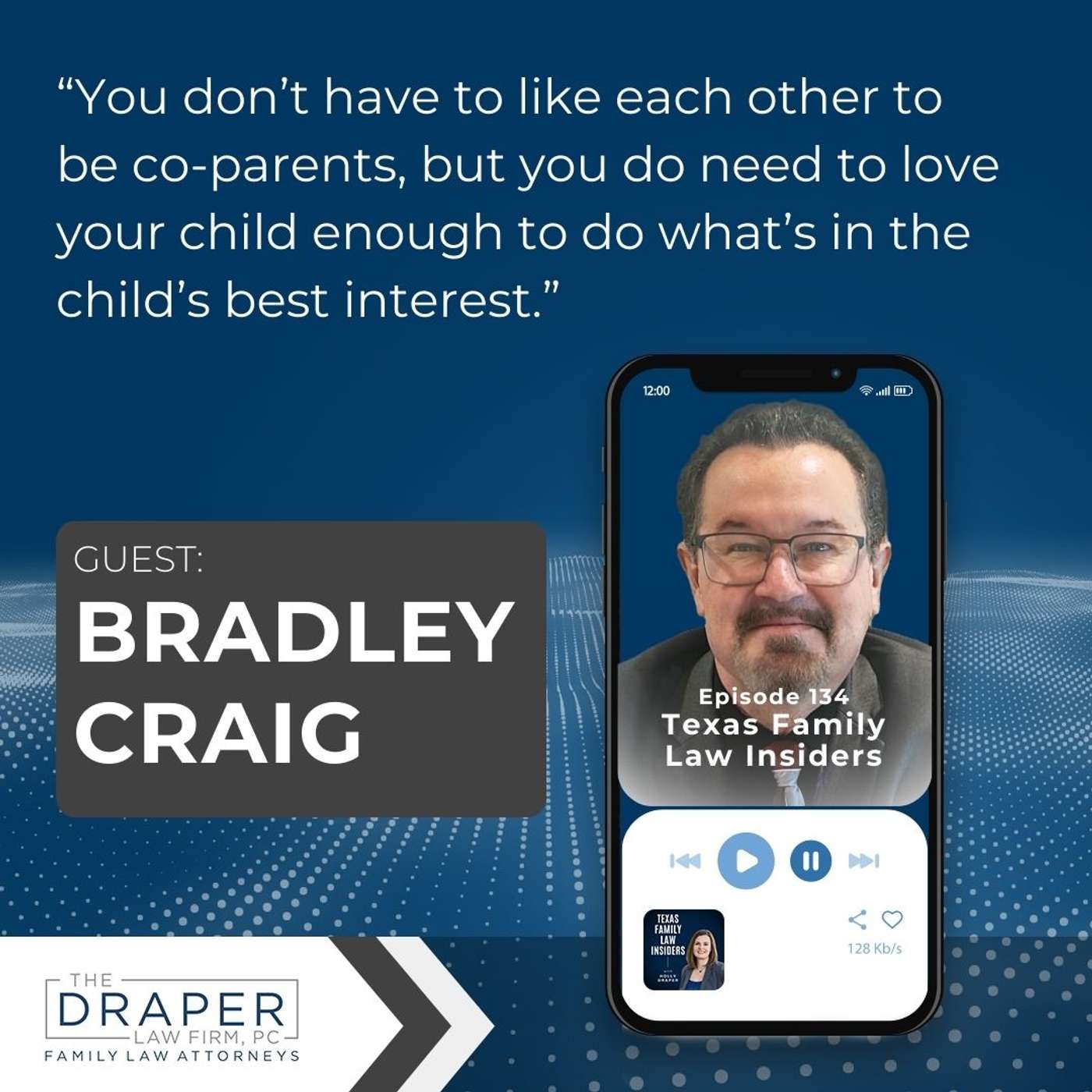
Texas Family Law Insiders
Episode 134 - Bradley Craig l Co-Parenting Tips for Guiding Clients in High-Conflict Parenting Relationship
00:39:44
Loading summary
Transcript43 lines
- [00:01]
Bradley Craig
Conflicted co parenting, in my opinion, is what we are designed to protect children from. And by we, I mean the entire court system, the attorneys that are involved, the allied professionals that are involved. You know, our job, hopefully in the long run, is to protect children from conflicted co parenting.
- [00:25]
Podcast Announcer
You're listening to the Texas Family Law Insiders podcast, your source for the latest news and and trends in family law in the state of Texas. Now here's your host, attorney Holly Draper.
- [00:40]
Holly Draper
Today I'm excited to welcome Bradley Craig to the Texas Family Law Insiders podcast. Brad received his master's degree in social work from UTA and is a licensed social worker and certified family life educator. He's a well respected co parenting educator in the North Texas area and has developed a number of parent education programs for families raising children in two homes. He works with divorcing families and those with continuing custody issues as a family mediator, collaborative law, allied professional, co parenting case manager, co parenting coach, educator, parenting facilitator, and parenting coordinator. He's trained many parenting facilitators throughout Texas. Brad is also the author of Between Two A Co Parenting Handbook for Parents and for Attorneys and for Mental Health Professionals, the workbook that goes along with the book. So, thanks so much for joining me today.
- [01:30]
Bradley Craig
Hi Holly, it's great to see you. Thanks for inviting me.
- [01:33]
Holly Draper
So why don't you start by telling us a little bit about yourself?
- [01:36]
Bradley Craig
Okay. Well, I live in East Texas. I'm nearing that age 60. I'm 58 right now, but I turned 59 this year. Most of my cases though come from all over Texas since I do everything virtually. I'm married, I have two grown sons, I have two awesome daughter in laws, but I have no grandchildren yet. So we're hopefully working on that. I'm a licensed social worker. I've been doing this work. I was looking at my vita before we met today and realized, gosh, I've been doing this 32 years. That's all the gray in my beard. All my services are virtual now for the most part, unless I'm testifying. And my primary emphasis of my whole agency really is about education and empowerment for families that are raising children between two homes and using more strength based language. You know, you'll notice that I'll use phrases like children growing up between two homes instead of children from broken homes or children from divorce or, or even the term divorce because a lot of the families I work with were never married, so there was no divorce.
- [02:41]
Holly Draper
So I think it's interesting you said everything you do now is virtual I know a lot of people still, even five years post COVID 19, have concerns about, you know, working with therapists or working with, especially in a high conflict situation, having people do these types of things virtually. So what would you say to attorneys about how to encourage their clients that virtual is okay, or, you know, how to put their mind at ease that this can work for their cases?
- [03:13]
Bradley Craig
So I think you could start with, do you want to sit in the same room with them or not? You know, so I. I'll interest a little history for me, technology. I always end up going into kicking and screaming. You know, I developed my live class, and I loved teaching, and I thought, there's no way you could replace it with online. But then some of the judges said, look what happens when there's a client who doesn't live in the Dallas Fort Worth area or lives in another state. So I developed the online class, got great reviews for it. So I'm like, okay, I'll make that step. I never believed in meeting with clients virtually until Covid hit. And then I thought, gosh, I'm just going to have to do that. And now I don't know that I'd go back. I mean, there's. I don't have an office. I don't have the overhead. But also, I think the clients are much more comfortable in virtual rooms separate from each other than sitting in the same room together and calling breaks, you know, instead of doing the uncomfortable, okay, sounds like we need to take a break. You go to this room. You go to this room. I have power, you know, so when they request a break, I can put them both in the waiting room. But there are times, sometimes with high conflict families, where I have to address. It sounds like you need to take a deep breath. So I am putting you in the waiting room right now. So I think there's a lot more safety and control. It's also safer for the professional ultimately. You know, we know of cases, mediations, where people have left after the mediation and assaulted each other or done damage in the parking lot to each other. So I think what I'd say to make them more comfortable is it's probably safer, and it allows you better opportunities to take a break, and you don't have to sit in the same room if you don't want to.
- [04:50]
Holly Draper
Do you have problems with people? You know, you put them in the waiting room to take a break, and they're just like, screw this. They turn it off and they leave.
- [04:57]
Bradley Craig
I've never had anybody leave, but I'm. I'm sure that'll happen someday. I know in live sessions at least twice I recall having in both cases it was a dad. Not trying to be sexist here, but in both cases it was a dad that, you know, stood up and walked out of the session and slammed every door that they could on the way to the parking lot. But virtually, I guess they could be doing that. I just don't hear it.
- [05:20]
Holly Draper
So how did you end up focusing on co parenting and high conflict families?
- [05:25]
Bradley Craig
So, you know, I'll say I started this before I ever became a professional. I'm a child who grew up between two homes. My parents separated when I was about 10 years old and faced a lot of those things that children growing up do and that we're so aware of, you know, as professionals in this field of the, you know, they separated suddenly. I couldn't invite the other parent inside the house. It was doorstep exchanges. I started hearing words like mom's house, dad's house, as if I no longer had my own home. The divorce between my parents, I don't think bothered me as much as the divorce between my extended family members. I think I kind of expected that my mom and dad might be separating at some point. But what I didn't expect was that there would be the division between my maternal and paternal family members. And that was really disheartening for me. So I think somewhere in me, especially as I understood that I wanted to be a social worker and make the world a better place, I think somewhere in there was already the seed of I want to improve the quality of life for children growing up between two homes. And that we actually become more child focused in the work that we do instead of, you know, using tools like therapeutic jurisprudence to empower the parents. But also that best interest really is best interest of the child as opposed to, we'll call it this. But it's really about periods of possession. You know, I'm using some of the legal terms periods of possession and custody and things that, you know, mean less of children. My dad eventually moved to California. So then it was the whole what's it like to have a life where you spend 45 days in your of the summer with somebody you love, but away from your friends? And you know, for most kiddos, that's what summer is about. We get out of school and we want to hang out with peers. But I couldn't go to those camps and I couldn't do some of those things that my friends did. So that's where it started. And then of course, I was Hired by Family Court Services in Tarrant county. And we did custody evaluations predominantly. I was trying to do mediation too. I did that for about six years and I really loved it. I mean, I had great colleagues that I worked with, great supervisors. The judges were wonderful at educating me about the world of family law. But at some point, I got to the point where I didn't want to investigate families anymore. I wanted to educate them. I wanted to help facilitate a better co parenting relationship. So I took the risk of opening up my own company and went out on my own. I did custody evaluations for a long time too, just because that helped pay the bills and raise children. But eventually I got to the point, you know, I remember the call where one of the attorneys said, we want to appoint you as a custody evaluator. And I was making enough money, not a great amount, but enough money to be able to say, you know, I just don't want to do that anymore. I'll be glad to do adoptions, but I don't want to do custody evaluation. I just want to help families work together. So I did that for a long time, co parenting education and helping families mediate. And I learned about collaborative law and getting into all those different venues that help keep families out of litigation or at least help empower them to make better decisions along the way. But then there's this. Erik Erickson talks about these stages of development, of human development. We tend to focus on the childhood stages of development, but one of those stages as you get older is called generativity versus stagnation. And I that hit me that, you know, am I burnt out on this process or do I want to make the world a better place? And the way to make the world a better place is to start educating other mental health professionals about how to work with court connected cases and become part of larger organizations that, that specialize in what we do, that forensic court connected work, whether it's therapy or whether it's education or whether it's custody evaluations. So I started doing a lot of professional seminars. And then I joined professional organizations like internationally, the afcc, association of Family and Conciliatory Courts. And I've had the opportunity to do some seminars there. I've got one coming up later this year. And then some of the local groups. There's facts, I'm the vice president of facts, which is kind of an east Texas group. There's Taft Texas association of Family Forensics. I'm the president. There's North Texas fit, which is a group of my colleagues that specialize in this. And we all get together to help, to empower parents to help the legal system, but also to move more towards, I think, therapeutic jurisprudence. Most of my work nowadays though, is parenting facilitators. Somewhere along the line, I got known for working with high conflict families and judges and attorneys. Forgot I do mediation. I work with warm fuzzy co parents as well. I'm glad to help them. And somehow it's come up, you know, I'll walk around the courthouse sometimes with an attorney who's like, I'm going to appoint you as the PF on a case. How about I do some mediation with them first or some other resolution? So I do PF work. I have a colleague that I work with now when I do parent facilitation work, and I know we'll probably be talking about that later. So we have a team model, my colleague Cecilia Powers and I. These parents get basically two mental health professionals working with them at one time to try and reduce conflict and empower them to stay out of the ongoing litigation and dispute.
- [10:51]
Holly Draper
So when we're dealing with high conflict or potentially high conflict parents, at what point in a divorce or a custody case should attorneys be looking at getting somebody like you involved?
- [11:07]
Bradley Craig
So I'm going to answer that from two ways because, you know, my entity between two homes is really is two different entities. One is the virtual services of online classes and books and material, and then the other is my direct services. So I'll start with the most clients that we receive. I never see. It's the clients who are taking the online class who've purchased the book or have been given the book by a mental health professional or an attorney. And so I'm not meeting with them, but I'm actively involved in what I want to be doing, which is educating them and empowering them and reducing the chances of the children being pulled in the middle of the dispute. For my direct services, it could be anywhere along the line because I. I'm trained in collaborative law. So sometimes I'm a communications coach or a child specialist in collaborative law, actually maybe take a step even backwards. You know, I've been trained in early intervention mediation before they file. I'm a member of the Amicable Divorce Network, which is a group of professionals who try and specialize in mediating issues prior to filing for a divorce. So I can become involved. Then sometimes attorneys want me involved just to consult with the parents or I've had meetings with parents where they were considering collaborative law or litigation. And so I've had meetings with Both attorneys, both the parents and myself to help talk about, you know, here's some options that are available to you. We're not advocating for one or the other, but, you know, you can hire me to do this, or you can hire me to do this. I know a lot of professionals don't like the word cooperative law, but frankly, especially with me being in East Texas, I do a lot of that work where the attorneys are. The families aren't doing collaborative law, but the attorneys are like, look, you can work that out with Brad for much cheaper, and you can come up with a parenting plan that he'll provide to us, and we'll create a, you know, we'll enter some of that language in your court order so I can be involved very, very early in the process. I can also do coaching. This is really for one client. I've had cases where an attorney just has a client who won't listen to. I'll just put it that way. Maybe that's the best way.
- [13:20]
Holly Draper
Well, actually, I can't imagine that that never happened.
- [13:23]
Bradley Craig
Isn't that a shock that they actually don't listen to the person they're paying good money for for legal advice? This started actually because I was officing across the street from an attorney, Diane Wanger, and she had a client that was just driving her crazy. She's like, I want you to go across the street. You're going to talk to Brad Craig, and he used to do custody evaluations, and he's going to tell you what he'd be putting in an evaluation if he had to so that you can learn how to do this differently. And, and so I remember him coming in the door and I'm like, I. I don't offer that service. I don't know what it is. But now I do that. Now I do that a lot. Coaching where an attorney will say, look, my client is really the problem, and my legal assistant is exhausted working with this individual, so why don't you help guide them along the way? And then I do what's called co parenting consultation, which is just designing shared parenting plans with, with parents. Sometimes they come to me voluntarily, sometimes they're court ordered, or sometimes the attorneys just agree that they can meet with me. Of course, most my caseload is parenting coordination or parenting facilitation, and that's the working with the really entrenched high conflict families.
- [14:27]
Holly Draper
So when we were first talking about having you on the podcast, I asked, you know, what topic should we talk about? And you said, co parenting. And I think co parenting is One of those terms that everybody, especially in our space, uses, but I'm not sure everyone means the same thing from a mental health perspective. How do you define healthy co parenting?
- [14:50]
Bradley Craig
So healthy co parenting I would define as cooperative co parenting or maybe a hybrid of cooperative and parallel. So it might be good for the audience just to understand, first of all, what, you know, what are the different levels of co parenting when we talk about co parenting? Cooperative co parenting is when parents continue to be parents. You know, they're no longer husband and wife or no longer lovers, or, you know, they're still mom and dad or two moms or two dads or grandparents, you know, whatever those roles are. They're working together still as a family to raise their child. So everything's done cooperatively. You know, they may attend birthday parties together. They the holidays aren't divided into Christmas being, you know, until noon December 28th. They may do something like they celebrate the holidays together, or they may even do something like, tell you what, let's. She'll open up presents in this household in the morning, and then in the afternoon, she'll go to our other household and open up the other presents. Cooperative co parents tend to be very child focused. So the decisions that they make tend to be based on the best interest of the child. Even if they're really uncomfortable, they're like, well, but it's in the best interest of the child. If I'm really that uncomfortable, I can go see a counselor or therapist to work through these issues myself if I'm having difficulty separating. So these are the families that function cooperatively, hence the cooperative co parenting. Parallel co parenting is where parents are disengaged, whether temporarily or permanently. You know, a lot of the high conflict families I work with from, first of all are very engaged, but at a high conflict level. So we have to teach them to disengage first, get some boundaries in place, learn to improve their communication, learn to be child focused instead of adult focused. And then we might start getting them working together to be more cooperative or maybe a hybrid of those. So when we're talking about co parenting, there's two safe forms of co parenting for children to grow up in. One truly is in their best interest, in my opinion, which is cooperative co parenting. The other is parallel co parenting, where there's some really safe boundaries in place, but we have safe plans too. So I'll give you an example of cooperative co parents. Maybe the children go to the same church every weekend, independent of the children's, the parents, religious beliefs. Parallel co parenting May be, you know what, now that, now that we're separated, now that we're divorced, I've decided I'm Catholic instead of Baptist or vice versa. And so first, third and fifth weekend, the child goes to a Catholic church. Second, fourth weekends, the child goes to a Baptist church. But the parents still have some agreements in place. Like, we're not going to disparage each other's religious beliefs. We'll highlight the beliefs that we both agree on, and we'll say phrases like, when you're old enough, you'll be able to make that decision. So if you think about, for example, you know, somebody will probably correct me out there, but, you know, the Catholic faith where the child is baptized as an infant, and the Baptist faith may be where the child is baptized at the age of consent, these parents in parallel, safe, parallel co parenting aren't going to tell the child, oh, I'm sorry, you're going to hell because you were baptized when you were an infant, but it wasn't at the age of consent. You know that. These parents will learn to use phrases like, oh, you're special, you got two baptisms. You ought to be guaranteed a path. So that's parallel co parenting. Conflicted co parenting is when parents are engaged in behaviors that are damaging to the children and often to each other. Conflicted co parenting, in my opinion, is what we are designed to protect children from. And by we, I mean the entire court system, the attorneys that are involved, the, the allied professionals that are involved. You know, our job, hopefully in the long run, is to protect children from conflicted co parenting. And that can, you know, you and I could spend probably an hour and a half describing in bullets each of the behaviors that define high conflict. But it's parents who have conflict during exchanges, parents who have to exchange at a police station because one or both of them are inappropriate. People who use social media to attack each other and disparage each other. Parents who pull the children into the conflict ask them to pick sides. Parents that are alienating or estranging, and we can talk about those later, too. So there's those different degrees of co parenting. When we talk about co parenting, you don't have to like each other to be co parents, but you do need to love your child enough to do what's in the child's best interest. You know, that common phrase we often use in family law is the you've got to love your child more than you hate your co parent. And sometimes that's just a matter of, I need to learn to have a business relationship with you for those of us who've been employed. Not you, of course. Holly, I know you enjoy everybody who works for you and works with you, but in some companies, you work with people you don't enjoy very much, but you still do the right thing. You know, you, you still go to those business meetings, you still try and make up, make decisions that are best for the company. That's really what successful co parenting is. Whether it's parallel or cooperative, it's forming that business relationship. Whether I like you or not, I'm going to do the right thing for the best interest of our child.
- [20:29]
Podcast Announcer
This episode of the Texas Family Law Insiders podcast is sponsored by the Draper Law Firm, providing family law appellate representation for non parent custody cases, jurisdiction issues, property division standing, conservatorship, possession and access termination, parental rights, and grandparent access. For more information, visit draper firm.com or call 469-715-6801.
- [20:56]
Holly Draper
So I haven't heard the term parallel co parenting, but I've heard the term parallel parenting. Is that the same thing or are we talking about two different things?
- [21:06]
Bradley Craig
It is the same thing. There's some of us in a camp, you know, believe it or not, mental health professionals have camps too. And so there's some of us, like me and my colleague Dr. Aaron Robb, and both who it's all co parenting. In fact, really, even when you're living together, you're co parenting, but for the purposes of most of our work, it's talking about raising children between two homes. So I think from my perspective and my colleagues that see it the same way, it's all co parenting. It's just whether it's good co parenting, protective co parenting, or damaging co parenting. So yes, when you hear parallel parenting, it's the same thing as parallel co parenting.
- [21:48]
Holly Draper
So in family law, we hear the phrase high conflict all the time. What do you think actually makes a co parenting relationship high conflict?
- [21:59]
Bradley Craig
Gosh, that is really a list, you know, parents who involve the children in the dispute, parents who stay in negative intimacy. And I can explain that a little bit. You know, positive intimacy is when couples first fall in love with each other. You know, it's when you go out on that first date and you're like, ooh, I hope to hear from them again. And who's going to make that first phone call. And then early in the relationship and as it starts maturing, you know, it's the, ooh, I've got to text every hour. Little heart icon. Little heart icon. And if you're going to a conference and presenting. You've got to call each other every night to say that you love each other. And then over time, that builds into a more mature relationship. You get married and, you know, you go to a conference and you might talk to them once a week, but you're still on the same page. You're united, you're a family. That's all positive intimacy. Healthy co parents move to neutrality when they separate. And neutrality is, I don't want to be with you anymore. I don't want to have to agree with you what car I'm going to buy or what color shower curtains I'm going to have. That's really none of your business. But we do have a child in common together. And so they move to neutrality, which is, let's just keep a business relationship with each other. For some families, cooperative families, over time, as the family system heals, they become even more of just an ongoing family. I can use my co parent as an example and her family. I mean, my no longer legal nieces and nephews still refer to me as Uncle Brad. We're still a family. For parallel co parents, it's maintaining that businesslike relationship, communicating brief solution, focused, staying on track. High conflict families are embedded in the conflict. High conflict families move from neutrality into negative intimacy. Negative intimacy is, I still get that high, but instead of wanting to send you a heart icon, I want to send you a, you know, the devil icon or, you know, other things. I want to post negative things about you on Facebook. I get a high out of that. If I can pull the teacher into my version of events, I feel really good about that because then I'm turning these people against you. And they'll use and abuse the litigation system, you know, as opposed to, I just want the most time that I can possibly have with my children, but I want us to be healthy. They abuse the legal system often. Some of the patterns that you'll see is they'll have multiple attorneys. You know, when, when you're the, when a client comes in and you're the fourth attorney they've had, that may be a heads up that you don't want to represent them.
- [24:36]
Holly Draper
Oh, yeah, that's on our red flag list. And not even fourth. But if there's been multiple attorneys before us, that is a big red flag.
- [24:43]
Bradley Craig
Especially when they're good attorneys. When you're like, I know this person. I've worked with them in collaborative law. I know that they have been just telling you the truth. When the judges know them on a First name basis. When you think about our family law courts and they see so many families, but when your particular clients walk in the drawer and the judge says, hi, Bill. Hi, Sally. How have you messed up the children this week? Ongoing. They continue to stay, as I mentioned, engaged in conflict. One or both may have personality disorders. It's rare that I really work with families that have personality disorders, but they have a lot of personality disorder traits, you know, and traits you probably have
- [25:25]
Holly Draper
a lot of people who claim the other side has a personality disorder.
- [25:29]
Bradley Craig
If when I retire, the words I am looking forward to no longer hearing are the words narcissistic personality disorder and alienation. They've both been used and abused in our field and this is true nationally. You know, when I do seminars, when I attend a seminar, often the mental health professionals are talking about how much that's used and abused, even by clients who diagnose. I will have clients sometimes unless they have an attorney who actually reads the personal data sheet, for example, that the parents turn into me. If the attorneys read it first, they usually say, hey, let's correct this. But if they don't read it first, then, you know, the attorneys will say, you know, my client, my co parent is narcissistic. And so I'm responding with what professional diagnosed them with that? Oh, well, they've never been diagnosed. Oh, I see. So you're acting in the role of a mental health professional, which there's reasons to be concerned about that. Yeah, those are those abused terms that everybody's narcissist. You know, both parents will say the other parent is narcissist and both parents will claim alienation.
- [26:39]
Holly Draper
So what can we as family lawyers do to help facilitate better co parenting relationships for our clients?
- [26:48]
Bradley Craig
So I'm going to sound like a broken record here probably as I go through some of these questions, but number one is to educate. You know, when you have that client that comes in who's watched too much Judge Judy and Boston Legal and who doesn't really understand how family law works and what judges are truly concerned about. You know, I don't mean to minimize the impact of affairs. I mean, we know that that can be really difficult for family systems to deal with. But you know, in truth, there's things that judges really do care about and things that while they may care about it are not reasons to say, well, I'm going to order this person to go to hell then for the horrible mistakes that they've been making. So I think it starts with education. There's a lot of attorneys who will buy bulk orders of my book and give them out free to clients just to say, look, just know this information before we go into court. It may help you so you don't shoot yourself in the foot. I recall Judge White in Tarrant county when she was on the bench with a mom who kept saying, my daughter, my daughter. Finally, the judge was just like, I am tired of hearing my child. This is you all's child. The father of your child is here. Well, had this person read my book, they would have recognized already that that's a phrase you don't use, Especially in front of a judge or having them take my online class. You know, these are cheap services. $11 for the book, $39.95 for an online class. And it sounds like I'm marketing mine. I am because I'm your guest. But there are a lot of really good co parenting books out there other than mine, that there's a lot of really good online courses out there other than mine. But I think the biggest exploitation in family law of families is not providing them low cost education. I'll say. Even when it comes to collaborative law, you know, when I'm a communications coach, I have my request that the parents take my online class. I give them copies of the book. Why spend as much money in collaborative law per hour learning about things that you could have learned about in a book, such as the stages of grief and where that. And helps them understand. You know, sometimes in the collaborative process, even they get bogged down because one's at acceptance and the other's still at anger. And so we can give them tools to help measure where they're at. So I would start with education, having brochures, having books, having material, requiring that they do this to the best of your ability, requesting that the courts order it early if the, if your client or the other client is refusing. Because most courts do support co parenting education. So you may have more specific question than that. I just wanted to repeat this record of empowerment for our families.
- [29:35]
Holly Draper
So I wanted to shift gears a little bit so we don't run out of time and talk some about parenting facilities. I know that you both act as a parenting facilitator and you have trained a lot of parenting facilitators. So what exactly does a parenting facilitator do?
- [29:50]
Bradley Craig
So basically a parenting facilitator is a case manager for the court. And I'm going to talk about parenting facilitation and parenting coordination kind of similar. Nationally, parenting facilitation is called parenting coordination. You know, if somebody wants to do research on what it is. In Texas, when we codified it, we made parenting coordination confidential and parenting facilitation non confidential. So the first 10 duties of the coordinator and the facilitator are basically the same, which is to educate, to help empower families, to get them to resolve matters as a family as opposed to as litigants, petitioner, respondent. The 11th duty, though, of the parenting facilitator that makes it different is to monitor compliance with a court order. That means it's a non confidential process where basically I often refer to my boss as being whatever judge appointed me, even if the parties agreed to have me as their parenting facilitator. Our job is to reduce conflict, to facilitate. Well, to facilitate. I mean, I think it's a good title for parenting facilitate. To teach them how to communicate, to teach them about boundaries, to reduce conflict, to protect children from the conflict, but also to do some case management which may be involving the attorneys in the process when needed, having some settlement types of conferences with the attorneys when needed, reporting back to the court when a parent is non compliant or is sabotaging the process. You know, I hate to say it, but it's true. Jail therapy is a wonderful tool for parenting facilitators. You know, sometimes parents just don't get it until the judge says, okay, you're going to jail today, or I'm fining you the time for Mr. Craig's report and time in court testifying because of your behaviors. So our job is to help them work together and include the attorneys in that process. There's a requirement that parenting facilitators, any communications they have, should be held with both attorneys. Some mental health professionals see that differently. I do it concurrently. I mean, if you're the attorney for mom, I'm going to get dad's attorney on the phone and we'll talk, but I won't talk to you separate. So did that answer the question somewhat of what parenting facilitation does?
- [32:02]
Holly Draper
Yes. So what can a parenting facilitator not do?
- [32:06]
Bradley Craig
I cannot make recommendations over. I hate the terms possession, custody and visitation. And I do a lot of training to get those words shifted. And not all other states use these terms. They use parenting time and so on. But I can't make recommendations about who should have primary. I can't make recommendations whether parenting time should be supervised or unsupervised. I can't make recommendations over whether I think time should be expanded or reduced. I can't make any of those recommendations as attorneys.
- [32:41]
Holly Draper
What should we be looking for to know that a parenting facilitator might be a good idea in a particular case?
- [32:49]
Bradley Craig
I think some of those warning signs of one or both clients are over involving the child. After they've taken the education, they're still repeating some of those behaviors. They come to you and tell you, well, my child said this and then my child said this and at some point you're going, children don't normally report this type of stuff back and forth between two of them. So are you probing? It may be also that while there's a lot of great mental health professionals out there, as you know, there's a lot of mental health professionals who damage these families, a lot of individual therapists who don't understand alienation or estrangement, so they don't know how to properly treat the child and get embroiled in the litigation, or they become a, almost a legal advocate for mom or dad as opposed to their own individual therapist. When you see patterns of seeking revenge more than solution, that's a good time to get a parenting facilitator involved. I tend to think early in the process. Some of my colleagues prefer to have post final decree cases, and I like those too. But I like to have those cases. If you're starting to see the patterns of high conflict, even after they've been educated, I think that's the best time to refer them to a parenting facilitator because maybe we can educate them. The number one complaint that I get for my intervention is, I wish I'd taken this class sooner had I known this information. I may not be acting this way. So for some of the families I work with, when the attorneys really know me well and trust me well, they send them early in the process in order to get them out of parenting facilitation, if that makes sense. You know, it's early in the process so they can learn the skills and then they go to mediation, they resolve their case and we don't see them file for modification. Certainly if they've been high conflict ongoing, then yeah, that during the final, you probably want to put a case manager, a parenting facilitator in there to case manage the case so that there's less chance of modification in the future.
- [34:47]
Holly Draper
Now, you mentioned early on that, you know, the difference really between a parenting facilitator and a parenting coordinator is that a coordinator is confidential and a facilitator is not. Do you think it's a good idea to have parenting facilitators testify in court? Do you think you'd really want to avoid that. What's your opinion?
- [35:08]
Bradley Craig
Oh, I think it's a good idea. I mean, when needed, I. If I'm doing my job well and that clients are responding well, I'm not going to court anyway, especially if I'm working with the right type of attorneys that fit my model, because they're like, hey, Brad, let's have a settlement conference. Although sometimes it's right in the courtroom, they go, oh, let's have a settlement conference. I'm like, guys, you realize I drove all the way from East Texas. We could have done this virtually. One of the benefits, though, of having the entire record available to the clients and to the attorneys and to the court is I think it holds the parenting facilitators accountable. I've been known to file license complaints against parenting facilitators who have made custody recommendations and been abused by trying to consult with them first. But if that doesn't work, having that person testify anytime, mental health professionals in the courtroom, really, they have to justify why they're doing what they're doing. And if they can justify it, then that information is helpful to the attorneys and to the judge about the decisions that they're making, whether they should continue family counseling or whether the parenting facilitator recommends family counseling. Something to do outside of the scope of the role as a parenting facilitator. Because a parenting facilitator. One of the questions you asked earlier is, what can't we do? We're not therapists. We're clearly defined as non therapists. We don't meet those HIPAA standards of confidential records and those type things in the same degree that a therapist would. So sometimes families really do need therapy. So I see all kinds of advantages of testifying. Again, if nothing else, it gives me the opportunity to tell the court, look, here's where this continues to be an obstacle.
- [36:48]
Holly Draper
So we're just about out of time. But one of the questions I like to ask everyone who comes on the podcast is if you could offer one piece of advice to family lawyers, what would it be?
- [37:02]
Bradley Craig
Educate. I know I'm a broken record, but really have your clients educated. Give them those resources. If it's handouts, if it's books, on both of my websites, I have handouts that, you know, at the bottom it says free to distribute, provided you know the resources cited. Educate them. You know, I know you've experienced this. When you've educated your client and you all go to mediation and the mediator hasn't educated the clients, the other attorney may not have educated the clients. So the session almost starts with I want sole managing conservatorship. And then it becomes a ridiculous cost to explain that Texas is a presumed joint custody state. And you know, all those things that parents should know about. And I I find it frustrating how many parents come to me who could have utilized whether it was the book, the online class or other resources before they came to me. And so I go right back to education.
- [38:06]
Holly Draper
So where can our listeners go to find out more about you?
- [38:09]
Bradley Craig
So you can go to childrenmiddle.com those are my direct services. That's where professionals can go as well. If you want to appoint me on a case, I I have sample court orders and documents that are helpful for professionals as well as for families. If you're wanting the virtual services or my passive income services, that's between2homes between2homes.com and that has my online classes, the books, other resources for families I mentioned, I'm member of a couple different organizations too, so I want to just shout out to my colleagues out there because we're all resources and we all want to work together to improve the quality of resource families. There's facts texas.org f a c s t x.org or thetaf t h e t a f f.com and then there's North Texas fit. And I just don't recall the website off the top of my head. But that's also a good group to look up and you'll find information about all of us that specialize in this field.
- [39:10]
Holly Draper
Excellent. Well, thank you so much for joining me today. It's been very informative and for all our listeners. If you enjoyed this episode, please take a second to leave a review and subscribe to enjoy future episodes.
- [39:24]
Podcast Announcer
The Texas Family Law Insiders podcast is sponsored by the Draper Law Firm. We help people navigate divorce and child custody cases and handle family law and appellate matters. For more information, visit our our website at www.draperfirm.